
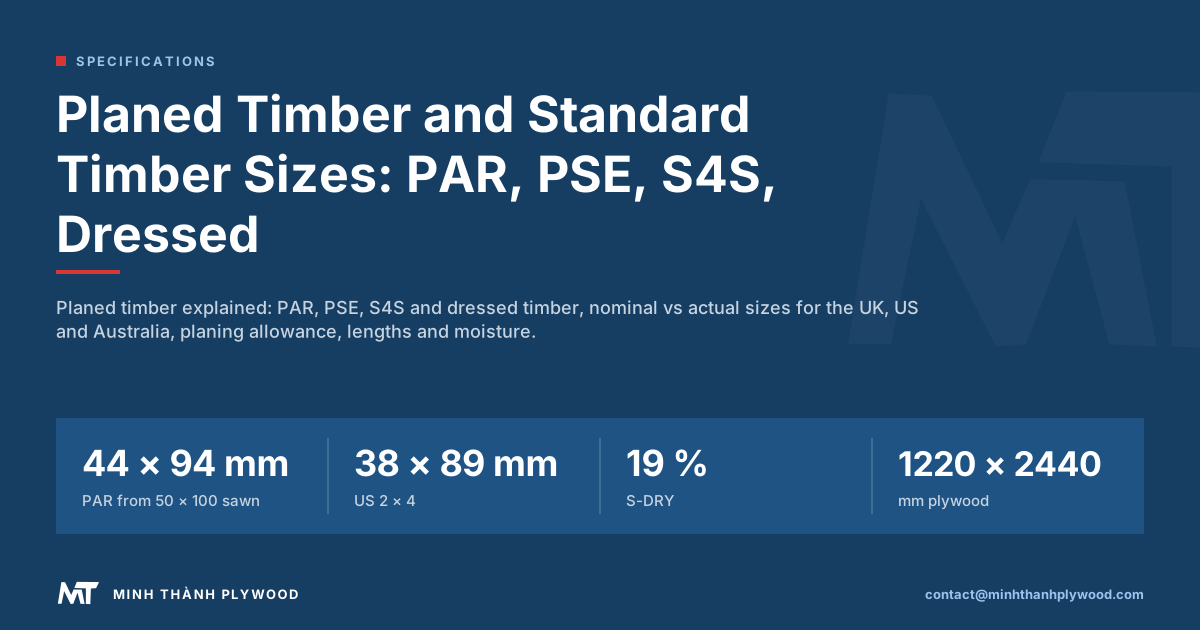
Planed timber is sawn timber that has been run through a planer so its faces and edges are smooth, straight and an exact size. Planing removes a few millimetres from every side, so a sawn 50 × 100 mm piece becomes about 44 × 94 mm. In the UK it is called PAR (planed all round), in Australia dressed timber and in the US S4S lumber. This guide gives the size tables for each market. Minh Thanh Plywood makes plywood and LVL in Vietnam.
What is planed timber?
Planed timber is sawn timber that has been machined smooth and straight on its faces and edges, to an exact finished size. The planer removes the rough saw surface and small bends, so the pieces fit together without gaps and are ready to paint, stain or oil.
- Sawn timber: rough faces, slight variation in size, used for hidden structure and packaging.
- Planed timber: smooth faces, an even size along its length, used for joinery, furniture, cladding and visible work.
- Regularised timber: structural timber planed or sawn on its edges only, to an even depth for floors and roofs.
Planed timber goes by different names in each market: PAR in the UK, dressed timber in Australia, S4S lumber in the US. Our plywood products and LVL are the sheet and engineered alternatives for many of the same parts.
Sawn vs planed timber: what changes
Planing changes the surface, the size and the price of timber. The table compares the two forms on one point per row.
| Point | Sawn timber | Planed timber |
|---|---|---|
| Surface | Rough, saw marks | Smooth, ready to finish |
| Size | Nominal size, slightly over | Finished size, about 5–6 mm smaller |
| Size accuracy | Varies along the length | Even along the length |
| Edges | Square, rough | Square (PSE) or rounded (eased) |
| Typical use | Studs, joists, battens, crates | Joinery, furniture, trims, cladding |
| Price per m³ | Lower | Higher: machining and waste |
The size loss is the point buyers miss most: a piece ordered as “50 × 100 planed” is a 50 × 100 sawn piece before planing, not after.
What does PAR timber mean on a quote?
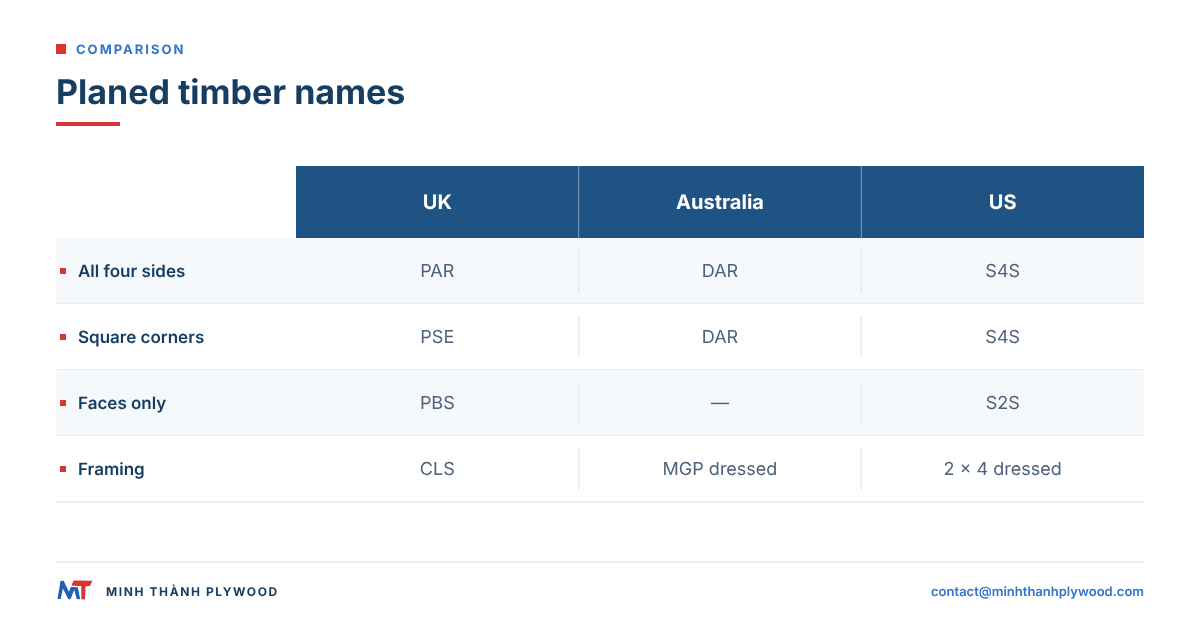
PAR means planed all round: every face and edge has been through the planer. PSE, S4S, DAR and dressed timber also describe planed timber; the differences are the market and which sides are planed. The decoder below covers the abbreviations on timber quotes.
| Abbreviation | Meaning | Market |
|---|---|---|
| PAR | Planed all round, four sides | UK, Ireland |
| PSE | Planed square edge, four sides, square corners | UK |
| PBS | Planed both sides, edges sawn | UK |
| DAR | Dressed all round | Australia, New Zealand |
| Dressed timber | Planed timber | Australia, New Zealand, South Africa |
| S4S | Surfaced four sides | US, Canada, Asia |
| S2S | Surfaced two sides (faces) | US, Canada |
| S1S2E | Surfaced one side, two edges | US, Canada |
| S-DRY (SD) | Surfaced after drying to 19 % or less | US, Canada |
| S-GRN | Surfaced green, before drying | US, Canada |
| CLS | Canadian Lumber Standard: planed, rounded edges | UK framing |
Standard timber sizes in the UK
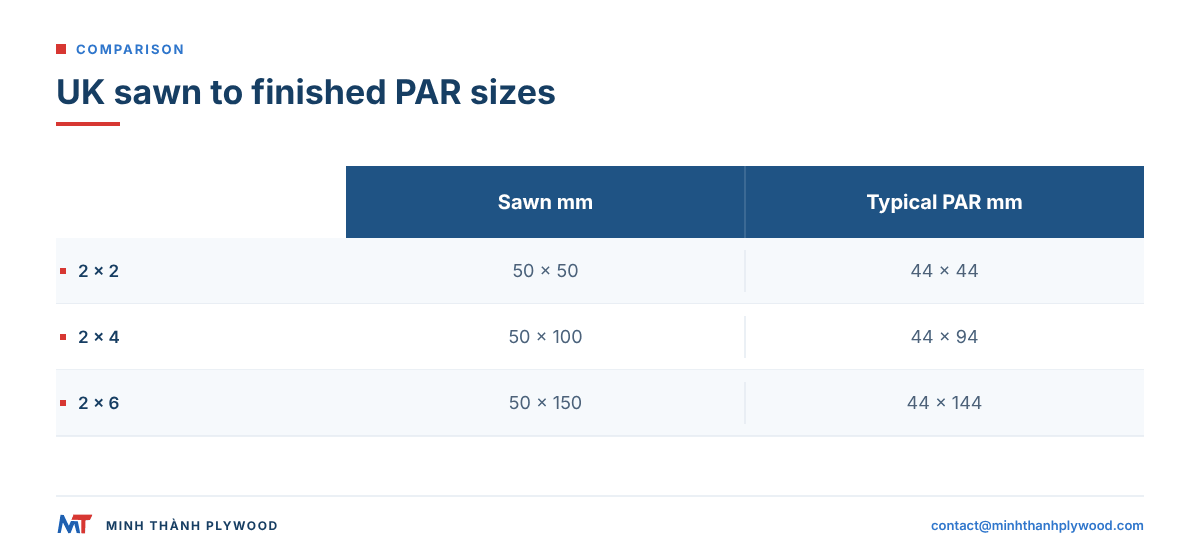
Standard timber sizes in the UK follow sawn sizes in millimetres, with planed sizes about 5–6 mm smaller. The table shows common sawn softwood sections and their typical planed (PAR) finished sizes from merchants.
| Sawn size (mm) | Old imperial name | Typical PAR finished size (mm) |
|---|---|---|
| 22 × 50 | 1 × 2 in | about 18 × 44 |
| 25 × 50 | 1 × 2 in | about 21 × 44 |
| 25 × 75 | 1 × 3 in | about 21 × 69 |
| 25 × 100 | 1 × 4 in | about 21 × 94 |
| 25 × 150 | 1 × 6 in | about 21 × 144 |
| 38 × 50 | 1.5 × 2 in | about 34 × 44 |
| 50 × 50 | 2 × 2 in | about 44 × 44 |
| 50 × 100 | 2 × 4 in | about 44 × 94 |
| 50 × 150 | 2 × 6 in | about 44 × 144 |
UK structural softwood is also sold regularised, for example 47 × 100, 47 × 150 and 47 × 200 mm in strength classes C16 and C24, and as CLS framing at 38 × 63, 38 × 89 and 38 × 140 mm. Lengths start at 1.8 m and rise in 300 mm steps.
What does PAR timber cost per metre in the UK?
UK merchants price PAR (planed all round) redwood by the metre, and the sections they stock are listed by nominal size. These are Selco Builders Warehouse prices, ex VAT, read in October 2026 (Selco planed timber); other merchants differ by region and trade card.
| PAR redwood section (nominal) | Price per m, ex VAT |
|---|---|
| 25 × 16 mm | £0.82 |
| 38 × 16 mm | £1.15 |
| 50 × 16 mm | £1.45 |
| 25 × 25 mm | £1.35 |
| 38 × 25 mm | £1.90 |
| 75 × 25 mm | £2.80 |
| 100 × 25 mm | £3.23 |
| 125 × 25 mm | £3.35 |
| 150 × 25 mm | £3.90 |
| 175 × 25 mm | £6.16 |
| 200 × 25 mm | £6.88 |
| 225 × 25 mm | £7.97 |
| 100 × 100 mm | £20.82 |
The 16 mm sections are used for beading and stops, and the 25 mm boards from 75 to 225 mm wide are the shelf and joinery stock. 100 × 100 mm is the post size.
Redwood vs whitewood PAR. Redwood is Scots pine, with a warmer colour and more resin. Whitewood is spruce or fir, paler and cheaper, and is sold by merchants as a pack of ten lengths (PTL), for example whitewood 50 × 22 mm from £2.13 ex VAT. Both are softwoods planed to the same nominal-minus-allowance rule.
Wide boards against plywood, per m². A 200 × 25 mm redwood board at £6.88 per m covers 0.2 m of width, so one square metre of face costs about £34.40; a 225 × 25 mm board gives £7.97 / 0.225 = about £35.40 per m².
An 18 mm furniture plywood sheet at our raw FOB example of US$350/m³ is 0.018 m³ per m², about US$6.30 per m² before freight, duty and VAT. The two prices are in different currencies and at different points in the chain, and the sheet is one flat part where the boards must be edge-glued, which is why shelves and carcasses move to plywood.
Standard lumber sizes in the US: nominal vs actual
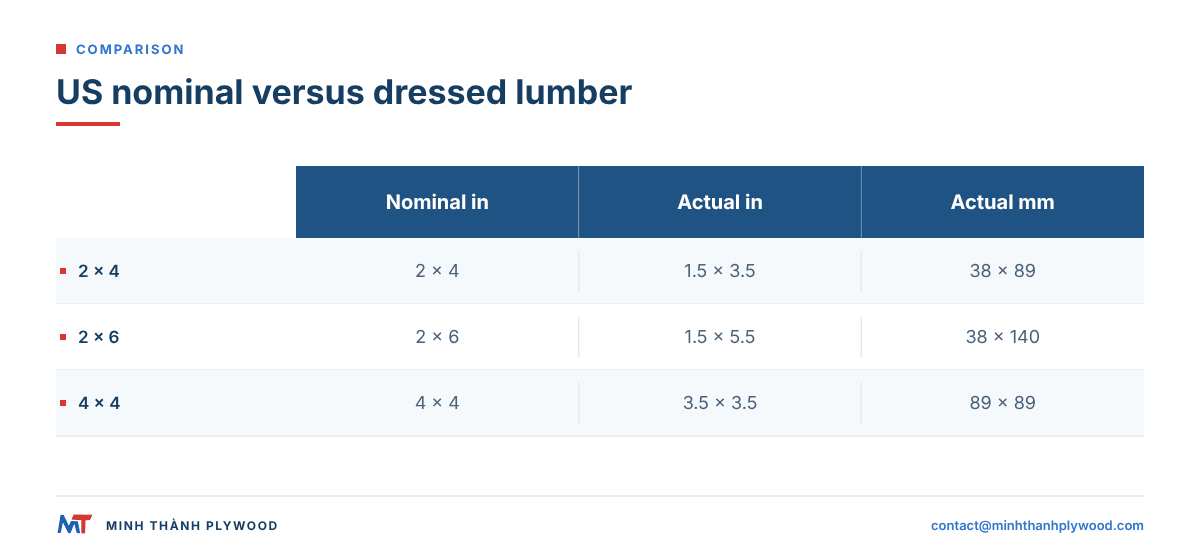
US lumber is named by its nominal size in inches, but a dry, dressed piece is smaller: a 2 × 4 is 1.5 × 3.5 inches. The sizes are set by the American Softwood Lumber Standard, PS 20. They apply to lumber dried to 19 % moisture content or less.
| Nominal (in) | Actual dry dressed (in) | Actual (mm) |
|---|---|---|
| 1 × 4 | 0.75 × 3.5 | 19 × 89 |
| 1 × 6 | 0.75 × 5.5 | 19 × 140 |
| 2 × 4 | 1.5 × 3.5 | 38 × 89 |
| 2 × 6 | 1.5 × 5.5 | 38 × 140 |
| 2 × 8 | 1.5 × 7.25 | 38 × 184 |
| 2 × 10 | 1.5 × 9.25 | 38 × 235 |
| 2 × 12 | 1.5 × 11.25 | 38 × 286 |
| 4 × 4 | 3.5 × 3.5 | 89 × 89 |
US lengths run in 2-foot steps, typically 8 to 16 feet for framing. A “planed 2 × 4” ordered in Europe usually means this US-style section, or the local 44 × 94 mm PAR piece. The millimetre column converts at exactly 25.4 mm to the inch, the definition NIST publishes.
Dressed timber sizes in Australia and New Zealand
Australian and New Zealand framing is sold by its dressed size in millimetres, so the name is the real size: a 90 × 45 is 90 × 45 mm. Machine-graded pine (MGP10, MGP12) and hardwood come in a fixed set of dressed sections.
| Dressed size (mm) | Common use |
|---|---|
| 70 × 35 | Internal wall studs |
| 90 × 35 | Wall studs and plates |
| 90 × 45 | Load-bearing wall framing |
| 140 × 45 | Floor joists, rafters |
| 190 × 45 | Floor joists, beams |
| 240 × 45 | Long-span joists |
| 290 × 45 | Long-span beams |
Dressed hardwood for decking and joinery uses finished sizes such as 86 × 19 or 140 × 19 mm. DAR on a quote means dressed all round.
Planing allowance: how much does planing remove?
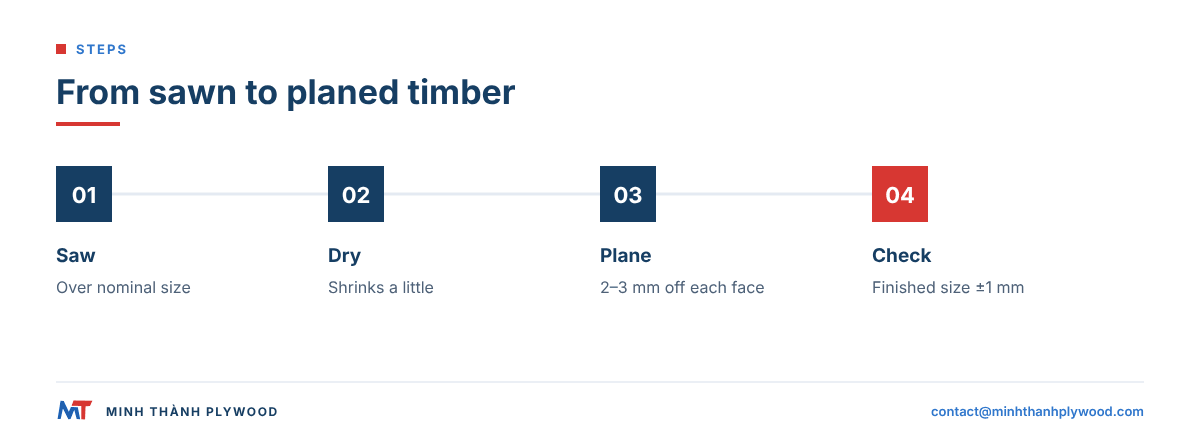
Planing usually removes about 2–3 mm from each face, so a planed piece is about 5–6 mm smaller in each dimension than its sawn size. Larger sections lose a little more, because they need a deeper cut to clean up bow and twist.
- Saw the log into sections slightly larger than the nominal size.
- Dry the timber, which shrinks it by a few per cent across the grain.
- Plane the faces and edges to clean, straight surfaces.
- Check the finished size against the order, usually within about ±1 mm.
When a drawing gives a finished size, order the planed size from the merchant’s list, not the sawn size. When a drawing gives a nominal size, ask the supplier for the finished size before cutting joints.
Standard lengths and widths
Timber lengths are sold in fixed steps, and widths in a fixed series, so a cutting plan should fit the stock lengths. Short lengths and odd widths cost more per metre.
- UK and Europe: lengths from 1.8 m in 300 mm steps; widths in 25 mm steps from 75 mm.
- US: lengths in 2-foot steps; widths in nominal inches (4, 6, 8, 10, 12).
- Australia and New Zealand: lengths in 300 mm steps; widths in the dressed series above.
- Long lengths: over about 6 m, many species become scarce; finger-jointed or engineered members are the usual answer.
Plan cuts so offcuts are useful: a 1.8 m length gives three 600 mm pieces, a 2.4 m length four.
Moisture content of planed timber
Planed timber should be dried before planing, so it keeps its finished size; the moisture content is part of the size. Wet timber planed to size will shrink later and may cup or split. The US Forest Products Laboratory’s Wood Handbook covers wood moisture and drying in detail.
- Kiln dried (KD) structural timber: 19 % or less in the US (S-DRY under PS 20); the EU and UK use a similar dry limit for graded framing.
- Joinery and furniture timber: usually dried further, to about 8–12 %, close to the indoor air it will live in.
- Green timber: planed wet (S-GRN), sized larger to allow for shrinkage.
For plywood, the same range applies: our veneers and finished panels are dried to 8–12 % moisture content at dispatch.
Timber grades and finish for planed timber
Planed timber is graded for appearance as well as strength, because its faces will be seen. The grade sets how many knots, splits and wane are allowed on the visible faces.
| Grade idea | What it allows | Typical use |
|---|---|---|
| Clear or joinery grade | Few or no knots | Mouldings, furniture, doors |
| Unsorted or merchant grade | Sound knots, minor marks | General joinery, shelving |
| Structural grade (C16, C24, MGP) | Defects by strength rules | Framing, beams |
| Utility or packing grade | Large knots, wane | Crates, pallets, battens |
Treated planed timber, pressure-treated after planing, is used outdoors; cut ends need a brushed-on preservative after cutting.
Treated planed timber
Treated planed timber is planed timber impregnated with a preservative for outdoor or damp use, and it is planed before treatment so the protection reaches the finished surface. Planing after treatment would cut off the treated outer layer.
- Use class: Europe uses EN 335 use classes 1 to 5; Australia uses H1 to H6; the US uses AWPA use categories.
- Above ground outdoors: decking, fencing rails, pergolas: use class 3 or H3.
- Ground contact: posts and sleepers: use class 4 or H4 and above.
- Cut ends: treat every fresh cut with an end-grain preservative.
For damp parts that do not need solid timber, film-faced or exterior plywood with a phenolic (WBP) bond is an alternative; our plywood thickness guide helps size it.
Plywood sizes compared with timber sizes
Plywood is sold by sheet size and thickness instead of section and length, and its sizes have the same nominal-versus-actual gap in some markets. A US “4 × 8” sheet is 1219 × 2438 mm, close to the metric 1220 × 2440 mm, and a US 3/4-inch panel is often 23/32 inch, about 18.3 mm.
| Point | Planed timber | Plywood |
|---|---|---|
| Sold by | Section × length | Sheet size × thickness |
| Common sizes | 44 × 94 mm PAR; 38 × 89 mm US 2 × 4 | 1220 × 2440 and 1250 × 2500 mm |
| Wide parts | Edge-glued boards | One sheet |
| Size accuracy | About ±1 mm after planing | ±0.2–0.3 mm thickness, sanded furniture panels |
| Movement across width | Swells and shrinks | Very small: cross-laminated veneers |
Our sheets come in 1220 × 2440 and 1250 × 2500 mm, plus custom sizes such as 1220 × 2500 and 1220 × 2280 mm, in thicknesses from 3 to 40 mm; cut-to-size plywood is cut into 4, 6 or 8 pieces from one panel.
When LVL or plywood replaces planed timber
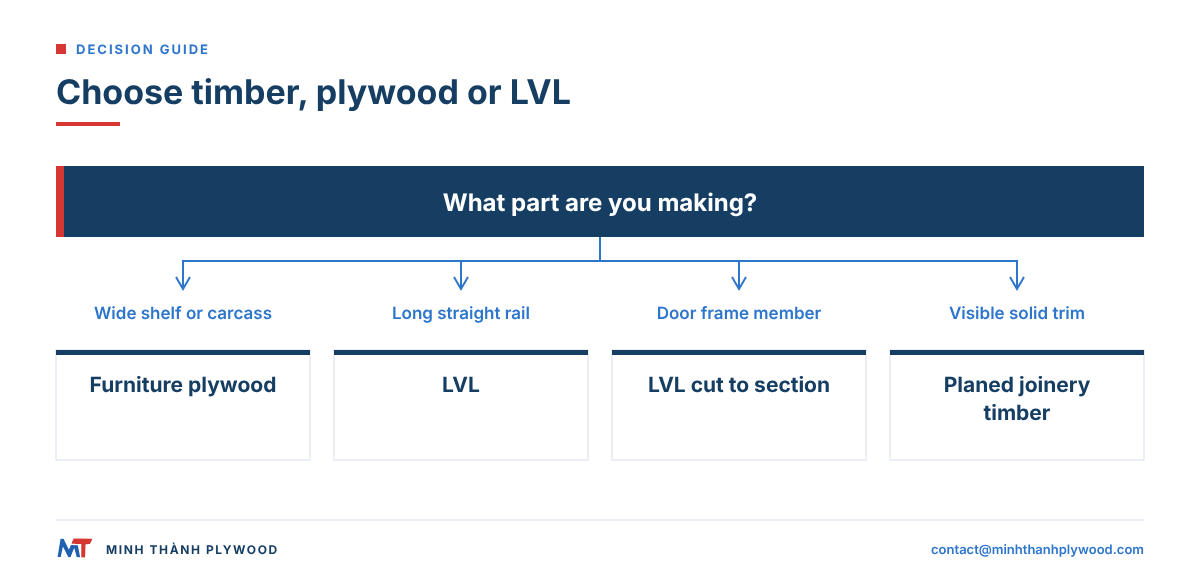
Use plywood for wide, flat parts and LVL for long, straight members when planed timber would warp, split or need edge-gluing. Both are made from veneers, so they are straighter and more stable than one sawn piece.
| Part | Planed timber | Better engineered option |
|---|---|---|
| Shelves and carcasses | Edge-glued boards | Furniture plywood |
| Tabletops | Glued-up planks | Plywood with a hard face |
| Door stiles and frames | Clear joinery grade | LVL cut to section |
| Packaging runners | Sawn or planed battens | LVL or packing plywood |
| Long straight rails | Finger-jointed timber | LVL |
Our LVL laminated veneer lumber is made in billets of 1220 × 2440 or 1250 × 2500 mm from Acacia or Eucalyptus plantation veneers, then cut to the member sizes on the buyer’s drawing.
What this means for your order
When a part can be made from plywood or LVL instead of planed timber, send the finished sizes, not nominal ones. For a panel or LVL order from our mill, the lines are:
- Application: shelves, carcasses, tops, frames, door members or packaging.
- Product: furniture plywood, packing plywood or LVL.
- Face and core (plywood): for example birch D+/D on Eucalyptus; Styrax for lighter panels.
- Section or size: finished thickness, width and length, with grain direction for LVL.
- Glue and emission: UF glue at E0 emission for interiors; MR or phenolic (WBP) for damp areas.
- Packing and quantity: from one 40HC, mixed specifications by agreement.
Production takes 15–45 days after the deposit, and free samples are available. Related reading: types of wood, spruce wood and larch wood.
Buyer questions, answered
What does PAR timber mean?
PAR means planed all round: the timber has been planed on all four sides, so it is smooth and an even size. It is the UK name for what Australians call dressed timber and Americans call S4S lumber.
What is the difference between sawn and planed timber?
Sawn timber comes straight from the saw, rough and slightly over its nominal size; planed timber is machined smooth, which removes about 3 mm per side and leaves an exact finished size. Sawn suits hidden structure; planed suits joinery, furniture and visible work.
What are the standard timber sizes in the UK?
UK sawn softwood is sold in thicknesses such as 22, 25, 38, 47, 63 and 75 mm and widths of 75, 100, 125, 150, 175, 200 and 225 mm, in lengths from 1.8 m rising in 300 mm steps. Planed sizes are about 5–6 mm smaller.
What size is a planed 2x4?
In the US, a dry dressed 2 × 4 measures 1.5 × 3.5 inches, or about 38 × 89 mm. In the UK, a planed 2 × 4 from a 50 × 100 mm sawn piece is about 44 × 94 mm.
What is S4S lumber?
S4S lumber is surfaced four sides: planed on both faces and both edges to a uniform size. S2S means only the two faces are planed, and S1S2E means one face and two edges.
What does PSE mean in timber?
PSE means planed square edge: timber planed on all sides with sharp, square corners rather than rounded ones. It is common for UK softwood boards and battens.
What is dressed timber?
Dressed timber is the Australian and New Zealand name for planed timber. DAR means dressed all round, the same as PAR in the UK and S4S in the US.
What is SD timber?
On many timber quotes, SD or S-DRY means surfaced dry: the timber was planed after drying to 19 % moisture or less. S-GRN means it was planed green, at a higher moisture, and will shrink further.
Is planed timber more expensive than sawn?
Yes, per cubic metre, because planing costs machine time and wastes wood. It often saves labour on site, since the pieces are straight, even and ready to finish.
Can plywood replace planed timber?
For wide flat parts such as shelves, panels and tops, yes: plywood is stable, flat and comes in sheets of 1220 × 2440 mm. For long narrow members, LVL cut to the section is the engineered alternative.