
You can varnish plywood like solid wood, and the best clear finish depends on the use: water-based polyurethane for most furniture, oil-based varnish where warmth and toughness matter, hardwax oil for a natural look, spar varnish outdoors. Wax alone is a polish, not protection. Minh Thanh Plywood makes sanded, UV-ready furniture panels in Vietnam; this guide compares every clear finish on them.
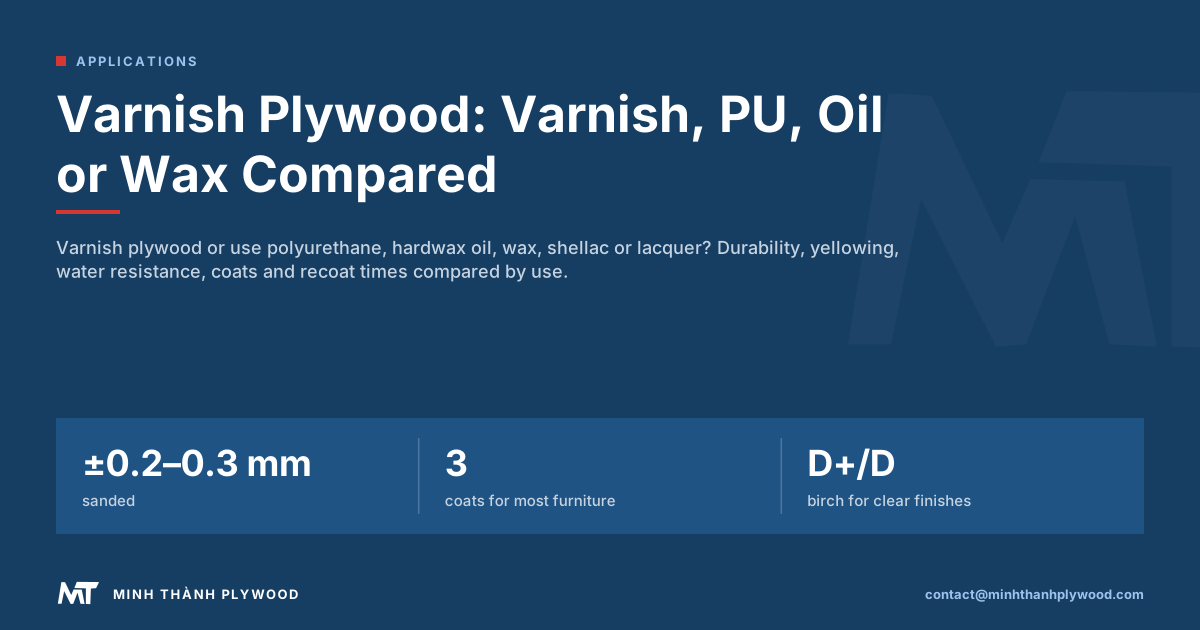
What varnish to use on plywood?
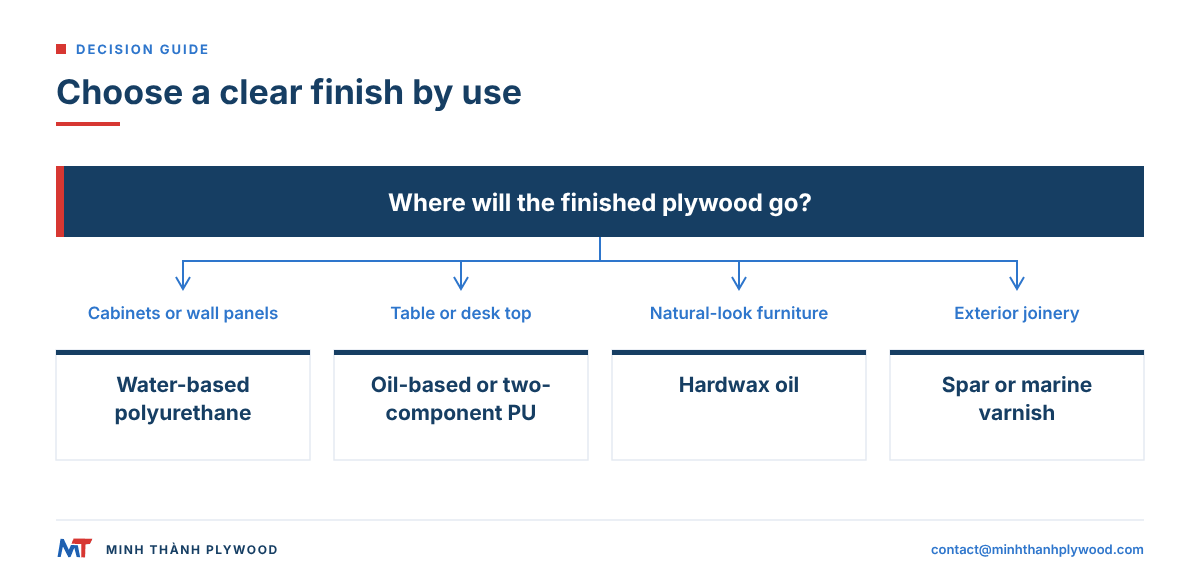
Polyurethane varnish is the most protective clear finish for plywood furniture, hardwax oil the most natural-looking and easiest to repair, and wax the least protective. Water-based polyurethane suits most indoor furniture and spar varnish suits outdoor joinery. The table compares the finishes metric by metric.
| Metric | Water-based PU | Oil-based PU or varnish | Spar or marine varnish | Hardwax oil | Wax | Shellac | Nitro or acid-catalysed lacquer |
|---|---|---|---|---|---|---|---|
| Type | Film | Film | Flexible film | Penetrating, thin film | Surface polish | Film | Film |
| Scratch and wear resistance | High | Very high | Medium | Medium | Low | Low | Medium to high |
| Water resistance | Good | Very good | Very good | Good | Poor | Poor | Good |
| Heat and solvent resistance | Medium | High | Medium | Medium | Poor | Poor | Medium to high |
| Yellowing | Little | Amber, deepens with age | Amber | Slight warm tone | None | Amber to orange | Slight to medium |
| Typical coats | 3 | 2–3 | 4–6 outdoors | 2 | 1–2 | 3+ | 3+ |
| Usual recoat | A few hours | Overnight | Overnight | Overnight | Hour | Under an hour | Under an hour |
| Repair | Sand and recoat | Sand and recoat | Sand and recoat | Spot repair | Re-wax | Easy, dissolves | Blends in |
| Smell and clean-up | Low, water | Strong, solvent | Strong, solvent | Medium | Low | Alcohol | Strong, spray only |
“Coats” and “recoat” are the usual order of magnitude; the maker’s label sets the exact numbers for each product. Spray lacquers belong on a finishing line with extraction, not on site.
Verdict by use
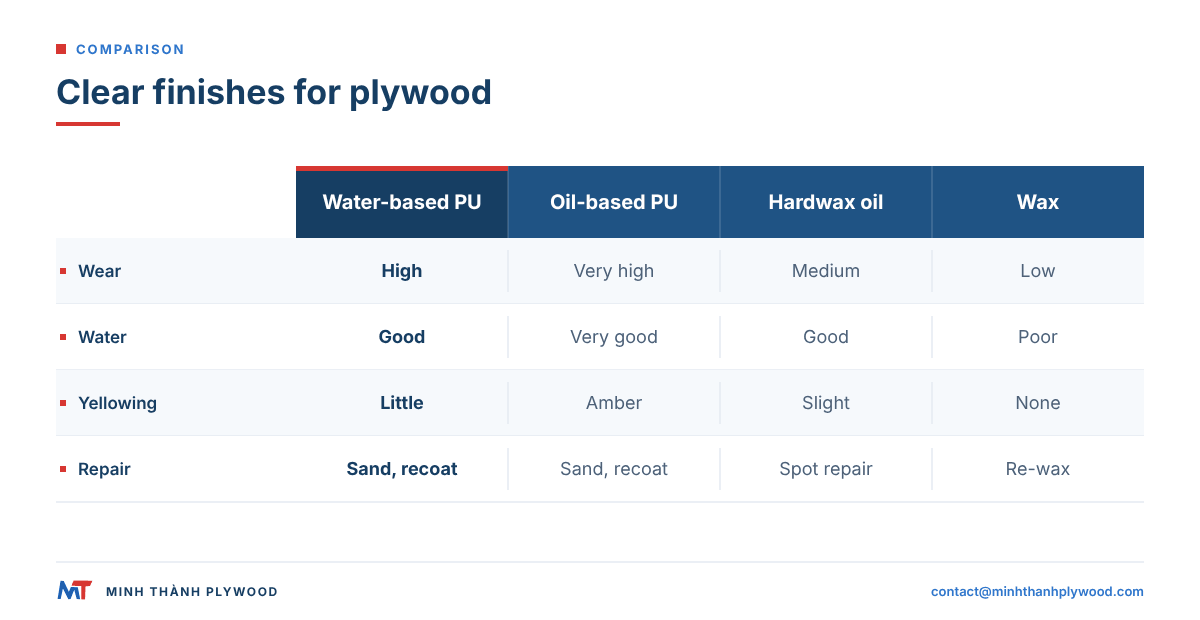
Pick the clear finish for plywood by where the panel goes and how it is used. One finish per use is the simplest rule.
| Use | Best clear finish | Why |
|---|---|---|
| Cabinets, wardrobes, shelving | Water-based polyurethane | Clear, hard, fast to recoat |
| Table and desk tops | Oil-based polyurethane or two-component PU | Highest wear and heat resistance |
| Wall panels and ceilings | Water-based PU, matt | Low sheen, little colour change |
| Children’s furniture and toys | Water-based PU or hardwax oil | Low smell; check the maker’s toy-safety rating |
| Natural-look furniture | Hardwax oil | Matt, easy spot repair |
| Exterior doors and outdoor furniture | Spar or marine varnish | Flexible, UV absorbers |
| Factory production runs | UV-cured or two-component lacquer | Cures in seconds on a line |
Can you varnish plywood?
Yes: varnished plywood is common in furniture, shop fitting, boats and interior walls. Plywood faces are real wood veneer, so they take varnish the same way solid wood does, with two differences: the face is thin, and the edges are end grain.
- Thin face: sand lightly; never sand through to the layer beneath.
- End-grain edges: seal them first, or band them, because they drink varnish.
- Large flat faces: show every brush mark and dust nib, so thin coats and clean air matter.
- Both faces: varnish the back too on loose parts, so the panel stays flat.
A good sanded face makes varnishing plywood quicker. Our furniture panels have sanded and polished faces, held to a thickness tolerance of ±0.2–0.3 mm, so the first coat goes on an even surface.
Thickness matters for a desk top as much as the finish. Owners in a Screwfix community thread judged 18 mm birch plywood enough for a 75 × 55 cm desk, and chose 24 mm for extra stiffness; wider spans between supports are better with 24 mm or a stiffening rail.
Varnish vs polyurethane on plywood
Polyurethane on plywood is a kind of varnish: a varnish whose resin is polyurethane. It is harder and more scratch-resistant than traditional alkyd varnish indoors, while spar and marine varnishes stay more flexible outdoors.
| Water-based polyurethane | Oil-based polyurethane | Traditional or spar varnish | |
|---|---|---|---|
| Look | Clear, close to raw wood | Warm amber | Warm amber, deep |
| Hardness | High | Very high | Medium, flexible |
| Indoors | First choice for light faces | Tops and high wear | Less common |
| Outdoors | Only exterior-rated products | Cracks in sun | First choice |
| Recoat | A few hours | Overnight | Overnight |
On pale faces such as birch and poplar, water-based polyurethane keeps the colour. Oil-based polyurethane gives a warmer, honey tone that many buyers like on pine.
Wood stain and varnish: stain vs varnish
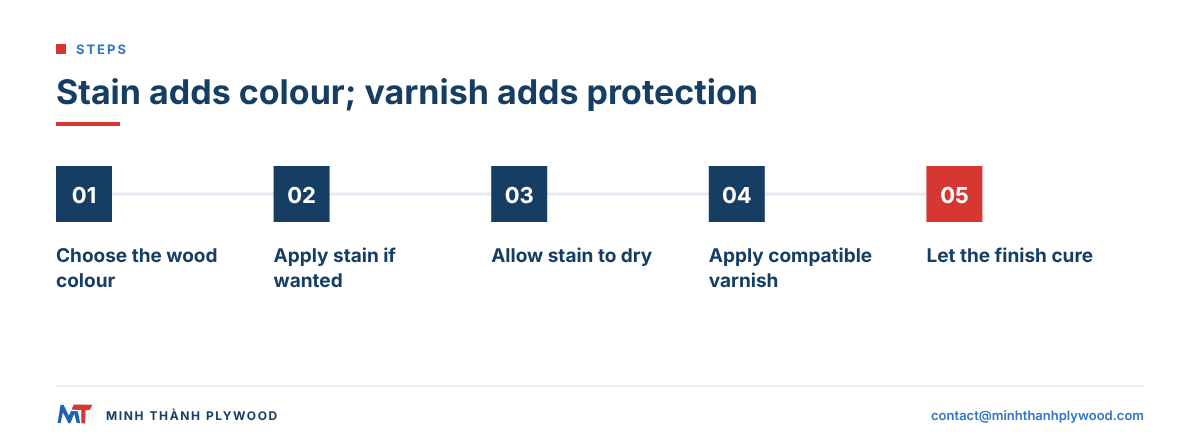
Wood stain changes the colour of the wood; varnish protects it. Stain soaks into the fibres and leaves almost no film, so a stained panel still needs a clear coat on top.
- Stain only: colour, little protection; fine on decorative surfaces that are rarely touched.
- Varnish only: protection, natural colour with a slight warming.
- Stain and varnish: colour plus protection; the usual furniture system.
- Tinted varnish: colour and film in one product; quick, but colour builds unevenly with each coat.
The order is always stain first, let it dry fully, then varnish. Wood stain v varnish is not a choice between the two on furniture: you choose whether you also want colour. Our guide on how to stain plywood covers blotch control on plywood faces.
Is wax enough to protect plywood?
No: wood wax on its own is a polish, not a protective finish. It gives a soft sheen and short-term water repellency, but it wears off, marks with heat and lets spills soak in if they stand.
- Wax over oil: a good combination for a natural look on low-wear pieces.
- Wax over varnish: adds sheen and slip; renew it now and then.
- Wax alone: decorative panels, picture frames, rarely touched surfaces.
- Avoid wax before varnish: varnish does not stick to a waxed surface.
If a waxed plywood panel later needs varnish, remove the wax completely with a solvent and sand back to clean wood first.
Hardwax oil and penetrating oils
Hardwax oil soaks into the face and cures to a thin, matt, water-resistant surface that is easy to repair in spots. It suits natural-look furniture and wall panels where a plastic-looking film is not wanted.
- Two thin coats are the usual system; wipe off the excess after each.
- Spot repairs: sand the damaged area and re-oil it; no visible edge.
- Lower wear resistance than polyurethane on tops that see cups, keys and cleaning sprays.
- Danish and tung oils give a similar look with less protection; they need more coats and more upkeep.
Oil darkens the wood more than water-based varnish does. Try it on an offcut of the same face before you oil a whole run of panels.
Shellac and lacquer
Shellac is a fast-drying, easily repaired finish with a warm tone, best as a sealer coat or on decorative pieces. Lacquer is the spray finish of furniture factories: nitrocellulose for quick, repairable coats, acid-catalysed and two-component lacquers for harder films.
- Shellac as a sealer: seals resinous faces such as pine and blocks bleed before other finishes, once the maker confirms the topcoat is compatible.
- Shellac as a finish: low heat and water resistance; marks under hot cups and alcohol.
- Nitrocellulose lacquer: sprays, dries fast, blends repairs; yellows a little with age.
- Two-component and UV-cured lacquers: hard and chemical-resistant; used on finishing lines.
Varnishing plywood step by step
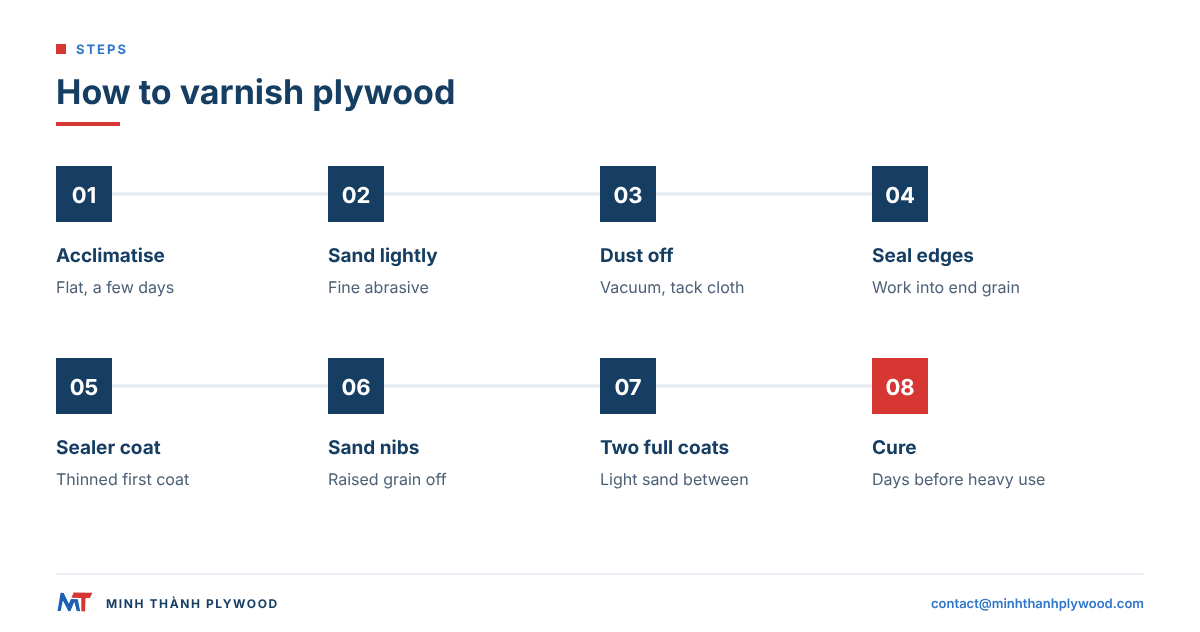
Varnishing plywood comes down to clean preparation and thin coats. These ten steps suit any brush-on varnish or polyurethane.
- Acclimatise the panel flat in the room for a few days.
- Sand lightly along the grain: 120 then 180 grit on the face, which is all a factory-sanded panel needs. Do not go coarser, because the face veneer is thin.
- Remove all dust with a vacuum and a tack cloth.
- Seal the edges with a first coat worked into the end grain, or fit edge banding.
- Apply a thinned sealer coat to the face, following the label’s thinning advice.
- Sand the raised grain lightly once dry, and dust off.
- Apply the first full coat thin, with the grain, from a wet edge.
- Sand lightly between coats with 240 to 320 grit to remove nibs. Most water-based varnishes are ready to recoat in a few hours, oil-based ones overnight; hardwax oil such as Osmo Polyx-Oil asks for 8 to 10 hours before a thin second coat and covers up to 24 m² per litre per coat, so one litre finishes about 12 m² in two coats.
- Apply the second and third coats, edges and back included.
- Let it cure before heavy use or stacking; full hardness takes days to weeks.
Work in clean, still air at room temperature. Dust in the air ends up in the film.
Which face grade shows a clear finish best
A clear finish shows everything, so buy the best face on the side people see. Uniform colour, tight grain and few repairs matter far more than under paint.
| Face | Look under clear finish | Grade for clear finish |
|---|---|---|
| Birch | Pale, fine, even; ambers under oil-based finishes | D+/D (about B/BB on the European scale) |
| Poplar | Pale, plain, very even | A/A or A/B |
| Pine | Strong grain and knots, warm tone | A/A or A/B |
| Engineered veneer (EV) | Uniform repeat pattern, any species look | Standard EV face |
| Eucalyptus | Fine, pinkish brown | A/A for two visible faces, A/B for one |
| Okoume | Pinkish, soft figure | By approved sample |
Order the visible face in the higher grade and the back in the lower one when only one side shows. Our birch plywood page explains the D+, D and E ladder, and our veneer grading page shows how faces are sorted.
Factory UV-lacquered vs site-finished panels
Factory UV lacquer cures in seconds under UV lamps and gives a hard, even film across thousands of panels; site finishing gives more choice of finish and repairs, but takes days and depends on conditions. Most furniture makers finish in their own factory.
- UV-cured lacquer on a line: very fast, hard, consistent; needs a smooth, flat, sanded face.
- Spray lacquer in a booth: flexible on colours and sheens; slower.
- Site-applied varnish or oil: best for one-off joinery and repairs.
Both faces of our furniture panels are UV-ready, made to the standard customers need to apply their own UV coating. We supply them raw, sanded and polished; the buyer’s line applies and cures the lacquer.
Epoxy and resin for clear plywood
Epoxy is the most waterproof clear coat for plywood, used on boats, bar tops and tables where the surface sits in water or takes hard use. Brush on a thin penetrating coat first, then flood coats, and finish with a UV-stable varnish if the piece is in daylight, because epoxy yellows and chalks under sunlight.
- Best for: marine joinery, bar and table tops, and edges that must be fully waterproof.
- Watch for: slow cure, a thick glassy look that hides the veneer feel, and sunlight yellowing.
- Screw holes and cuts: fill or dip them in epoxy or sealer before fitting, as water enters there first.
Which finishes UK buyers use
UK buyers usually mean one of four products: a water-based interior varnish or polyurethane for furniture, a hardwax oil (an Osmo-type oil) for desks and worktops, a yacht or exterior varnish for outdoor joinery, or two-pack epoxy for water contact. Pick by use and use the table above for the trade-offs.
Varnished plywood outdoors
Outdoors, varnished plywood needs a spar or marine varnish with UV absorbers, at least four coats on every face and edge, and a panel with an exterior glue line. Renew the varnish before it cracks.
- Glue line first: exterior or marine plywood with phenolic (WBP) glue; interior UF-bonded plywood fails outdoors under any coating. The European standard BS EN 636:2012+A1:2015 covers plywood for dry, humid or exterior conditions, and BS EN 314-2 defines the bonding-quality requirements.
- Spar or marine varnish: flexible, with UV absorbers; not interior polyurethane.
- Seal edges and fixings with extra coats.
- Inspect each season: sand and recoat dull areas before the film breaks.
How long does a sealed plywood finish last? Indoors, finished plywood lasts decades. Outdoors, unsealed plywood may last only a few years, while plywood that is sealed and maintained can last 10 to 20 years or more, according to Toolstation’s guide to sealing plywood. Primer alone wears down and needs redoing every 1 to 2 years, which is why a flexible exterior varnish or paint, kept up, beats it.
The US Forest Products Laboratory’s Wood Handbook (FPL-GTR-282, 2021) notes that clear film finishes outdoors need the most frequent renewal of all wood finishes. Our guide to whether plywood is waterproof explains what each glue class survives.
Yellowing and colour change under clear finishes
Every clear finish changes the colour of plywood a little; oil-based finishes change it most. Pale faces such as birch, poplar and maple-look EV show the change most clearly.
- Water-based polyurethane: closest to raw wood; slight cool tone on some products.
- Oil-based polyurethane and varnish: warm amber at once, deepening over years.
- Shellac: amber to orange depending on grade.
- Light exposure: the wood itself darkens or fades in sun under any finish.
Finish a sample of the exact face with the exact product and keep it as the colour reference. Two batches of the same finish on two different faces never look the same.
Common varnish faults on plywood and fixes
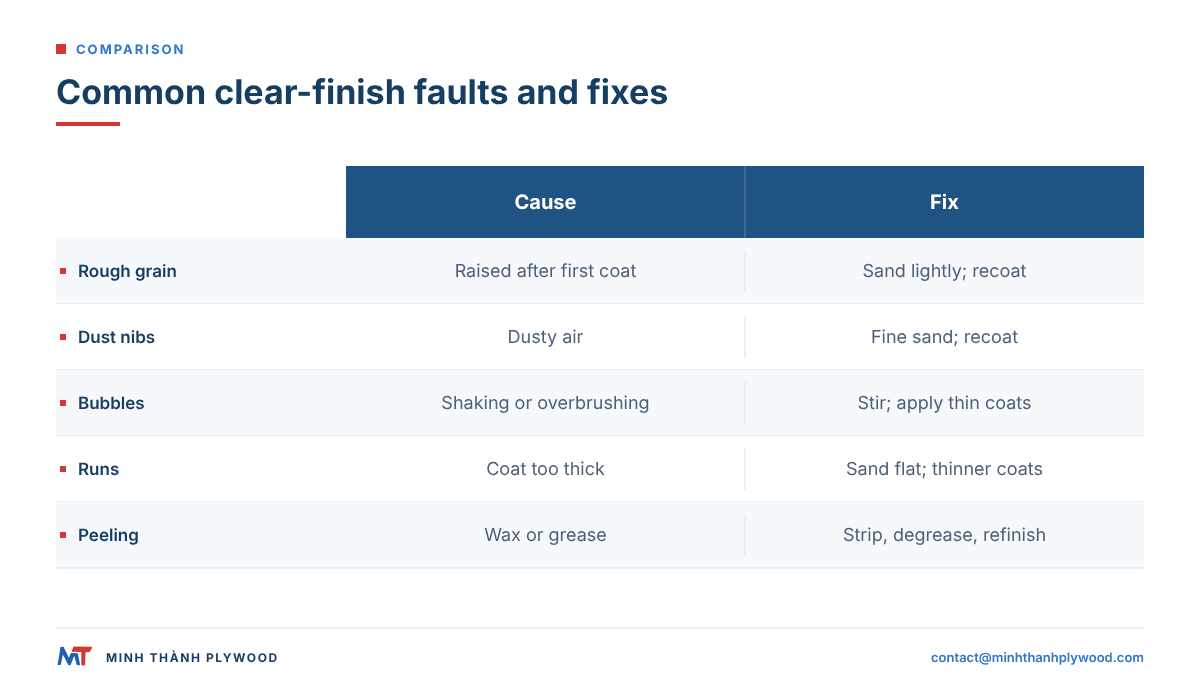
Most varnish faults on plywood come from dust, thick coats or a skipped sanding step. The fix is nearly always to sand back the faulty coat and apply a thin one.
| Fault | Cause | Fix |
|---|---|---|
| Rough, furry surface | Raised grain after first coat | Sand lightly, recoat |
| Dust nibs | Dusty air, no tack cloth | Sand with fine abrasive, recoat |
| Bubbles | Shaking the can, overbrushing | Stir, thin coats, tip off gently |
| Runs and sags | Coat too thick, vertical panel | Sand flat, thinner coats, finish flat |
| Blotchy sheen | Edges and faces absorbing unevenly | Sealer coat first, more coats on edges |
| Sanded-through face | Coarse grit or tilted sander | Cannot be fixed with finish; replace or paint |
| Peeling | Wax or grease on the surface | Strip, degrease, sand, refinish |
What this means for your order
For clear-finished furniture, order the face that will look right under the finish and let your own line or finisher apply it. Send these lines with your request:
- Application: cabinets, tops, wall panels, shop fittings or exterior joinery.
- Face and grade: birch D+/D, poplar A/B, pine A/B, EV or eucalyptus A/B, matched to an approved sample.
- Surface: sanded, polished and UV-ready for factory lacquering.
- Core and glue: white Styrax or Eucalyptus core; UF glue at E0 emission for interiors, phenolic (WBP) to your specification for outdoor use.
- Size and thickness: 1220 × 2440 mm or 1250 × 2500 mm, 3–40 mm.
- Quantity: from one 40HC, mixed specifications by agreement.
Ask for free samples to run your finish on, and see our furniture plywood from Vietnam range. The pillar guide on how to finish plywood covers paint, stain and clear finishes together, and our guide on how to paint plywood covers opaque finishes.
Buyer questions, answered
Can you varnish plywood?
Yes. Sand the face lightly, remove the dust, seal it with a thinned first coat, then build two or three thin coats of varnish, sanding lightly between them. Seal the edges and the back as well.
What is the best varnish for plywood?
For indoor furniture, a water-based polyurethane varnish: clear, hard and quick to recoat. For a warmer tone and a tougher film, an oil-based polyurethane. Outdoors, a spar or marine varnish that stays flexible.
Is polyurethane better than varnish on plywood?
Polyurethane is a type of varnish. Polyurethane varnishes are harder and more scratch-resistant indoors; traditional oil-based and spar varnishes are more flexible and handle sun and movement outdoors better.
What is the difference between wood stain and varnish?
Stain colours the wood and gives little protection; varnish forms a clear protective film and changes the colour only slightly. On plywood you stain first, if you want colour, and varnish over it.
Is wax enough to protect plywood?
No. Wax gives a soft sheen and a little water repellency for a few hours of contact, but it wears off and does not stop scratches or spills soaking in. Use it as a polish over oil or varnish.
How many coats of varnish does plywood need?
Usually three: a thinned sealer coat and two full coats. Table tops and shelves that see heavy use get a fourth coat; vertical panels and cabinet sides are fine with two to three.
Does varnish make plywood waterproof?
No. A varnish film keeps liquid water off the wood while it is whole, but the panel's water resistance depends on its glue line. Interior UF-bonded plywood stays an interior panel under any varnish.
Does clear varnish yellow on birch plywood?
Oil-based varnishes and polyurethanes give pale birch a warm amber tone that deepens with age. Water-based polyurethane stays much closer to the raw colour, which is why it is the usual choice on birch and poplar.
What is UV-ready plywood?
UV-ready plywood has faces sanded and prepared to the standard a factory line needs to apply its own UV-cured lacquer. It is supplied raw; the buyer's line applies and cures the coating.
Can you varnish over stained plywood?
Yes, once the stain is fully dry. Check that the stain and varnish are compatible, usually by using the same maker's system, and test on an offcut first.