
A wood veneer panel is a board with a thin face of real wood pressed onto each side of a stable core, usually plywood, MDF or particleboard. The core sets screw holding, flatness and weight; the veneer sets the look. Minh Thanh Plywood presses veneer on hardwood-core plywood for furniture buyers and explains how to choose and specify each part.
What is a veneered wood panel?
A wood veneer panel is a flat board, usually plywood, MDF or particleboard, with a thin face of real wood pressed onto each side. The core gives strength, flatness and screw holding; the veneer gives the look of oak, walnut, birch or any chosen species at a fraction of the cost of solid wood.
Furniture, kitchens, wardrobes, shopfitting and wall panelling all rely on veneer panels. They give a real wood surface across wide parts that stay flat, which solid wood boards of the same width cannot do without movement.
The same panel has three buying decisions: the core, the face veneer and the back veneer. Each changes how the panel behaves in your plant and in use. This guide takes them in the order a buyer decides: core first, then face, then pressing, edges, grades, price and the order line. For veneer as a material, start with the wood veneer sheets guide.
Three terms mean the same product in most catalogues: wood veneer panel, veneered panel and decorative veneered board. Timber veneer panels and hardwood veneer panels are the same idea, named after the face rather than the core. What differs between suppliers is the core under the face and how the two are pressed together, and that is where this guide spends most of its time.
A veneer panel is not the same as a laminate or melamine panel. Those carry a printed decor paper under resin, not wood. The veneer vs laminate comparison explains how to tell them apart on a finished cabinet.
What is veneer plywood?
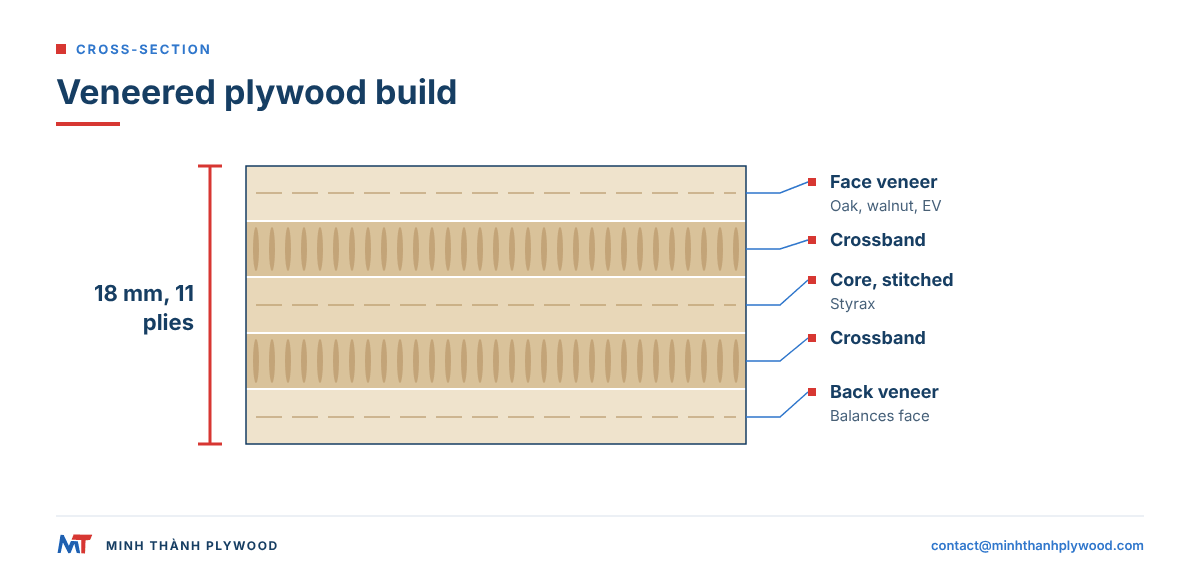
Veneer plywood is plywood with decorative wood veneer on its outer faces. Under the face sit core veneers, peeled from logs and laid with their grain crossed layer by layer, then glued and pressed into one sheet.
“Veneer” and “plywood” are often confused because plywood is itself made of veneers. The difference is purpose:
- Core veneers are thicker, usually 1.4–2.0 mm, peeled from plantation logs, and laid to give strength and stability.
- Face veneers are thinner, 0.2–0.5 mm, chosen for appearance, and pressed on the outside.
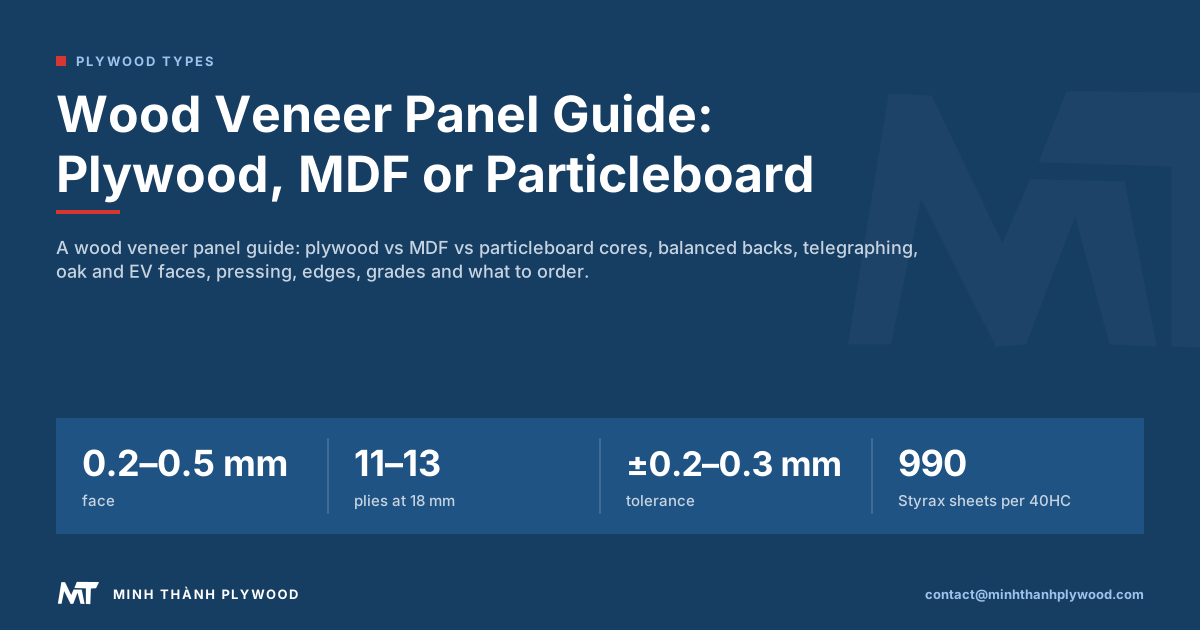
An 18 mm furniture panel usually has 11–13 plies, 11 being the most common. Only the two outer plies are face veneers; the rest is core. So when a buyer asks for “oak veneer plywood”, the oak is a fraction of a millimetre on each face, and the strength comes from the core underneath.
The veneer thickness guide gives face and core thicknesses by panel type.
Plywood vs MDF vs particleboard: which core for a veneered panel?
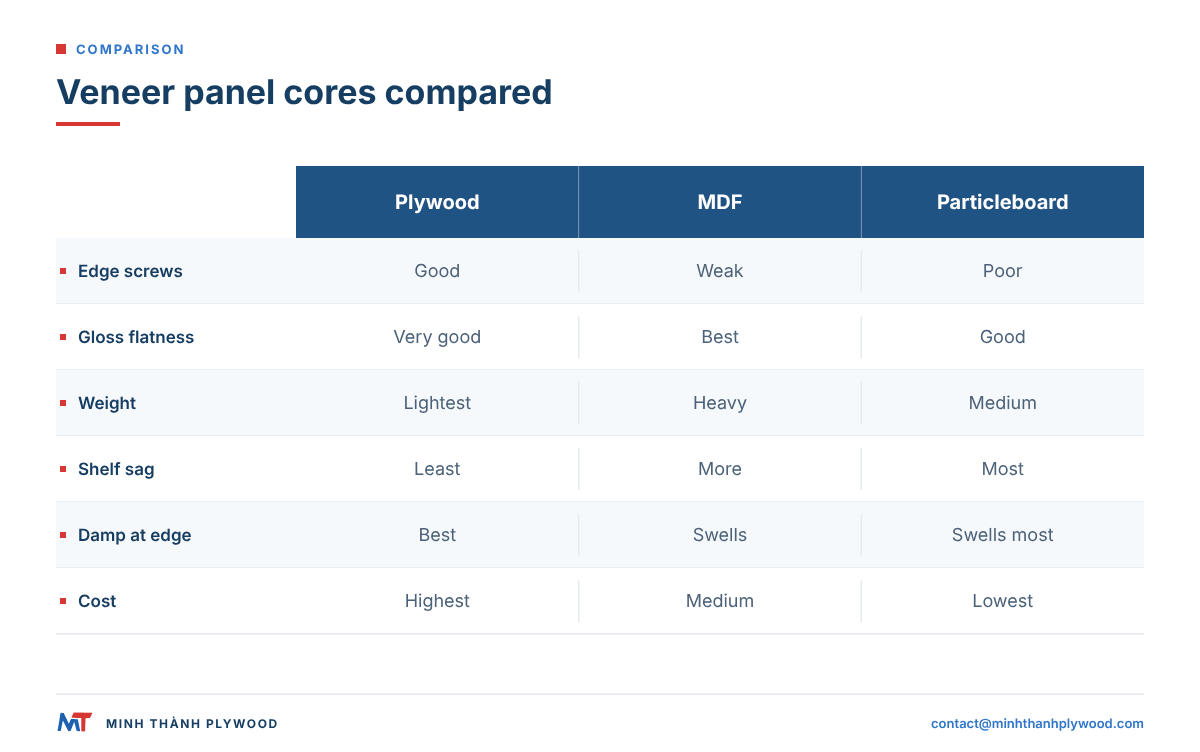
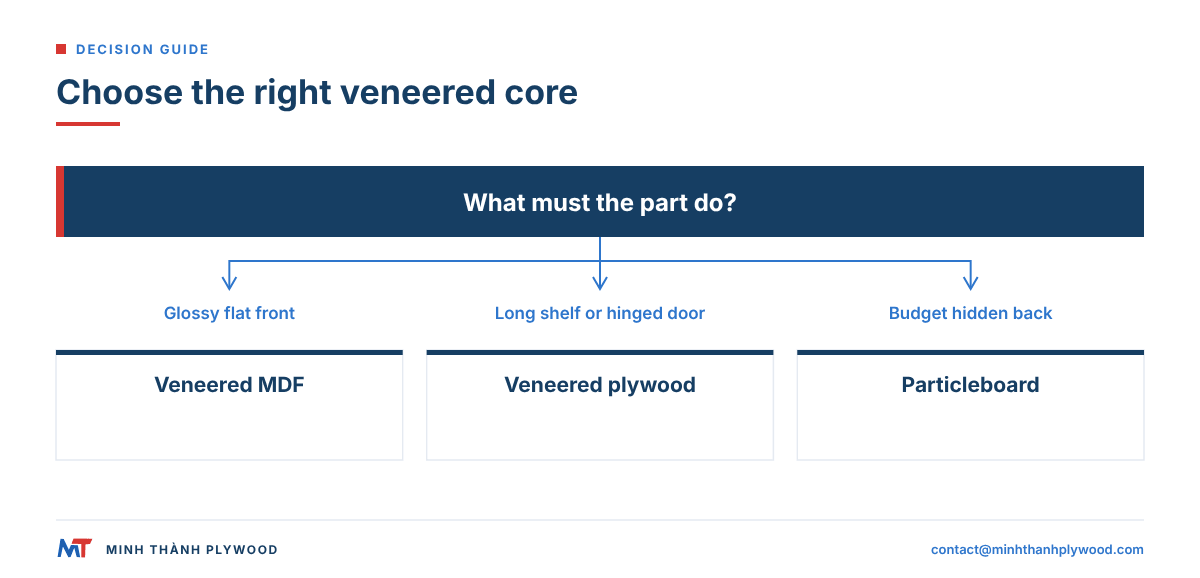
Plywood is the strongest and lightest veneer core, MDF the flattest, particleboard the cheapest. Choose by what the part must do: carry screws and load, show a perfect gloss, or simply fill space at the lowest cost.
| Property | Plywood core | MDF core | Particleboard (chipboard) core |
|---|---|---|---|
| What the core is | Crossed veneer layers | Fine wood fibres pressed with resin | Wood chips pressed with resin |
| Screw holding in the face | Very good | Good | Fair |
| Screw holding in the edge | Good | Weak, splits | Poor |
| Flatness for gloss finishes | Very good when calibrated | Best | Good |
| Weight | Lightest: Styrax core about 500 kg/m³ | Heavy | Medium to heavy |
| Stiffness and sag on a shelf | Best | Sags more | Sags most |
| Edge after cutting | Layers visible | Smooth fibre edge | Rough chip edge |
| Damp and edge swelling | Best | Swells if wet | Swells most |
| Machining (routing, profiling) | Good | Excellent | Poor on edges |
| Relative cost | Highest | Medium | Lowest |
| Typical parts | Doors, carcasses, shelves, drawer boxes | Painted or high-gloss fronts, flat panels | Carcass sides in budget furniture, backs |
The table shows why furniture plants often mix cores. A wardrobe can have plywood doors and shelves, MDF fronts for a painted series and particleboard backs. Each part gets the cheapest core that does its job.
Which core for which part, in a typical furniture plant:
- Doors on concealed hinges: plywood, for screw holding at the hinge cup and a lighter door.
- Shelves over long spans or carrying books and plates: plywood, for stiffness.
- Drawer boxes: plywood, for screws and joints near the edge.
- Painted or high-gloss flat fronts: MDF, for the smoothest finish.
- Wall panelling fixed from behind: MDF or plywood, depending on weight and damp.
- Hidden carcass backs: particleboard or thin plywood, for cost.
Particleboard deserves a fair word. It is stable, flat and cheap, and it carries veneer well on parts that never take a screw in the edge. Its limits are edge strength and water: chips at a cut edge break out, and water at the edge swells the board permanently. Under veneer it suits budget carcass sides and backs, not doors or shelves.
MDF has one more advantage worth naming: machinability. A router cuts clean grooves and profiles in MDF with no tear-out, so moulded doors and grooved wall panels are usually MDF under the veneer.
Veneered MDF vs veneered plywood
Veneered plywood beats veneered MDF on strength, weight, screw holding and damp; veneered MDF beats plywood on surface flatness and price. For cabinet doors with hinges and for shelves, choose plywood. For flat, glossy panels that carry no load, MDF is enough.
Three practical differences decide most orders:
- Hinges and fixings. Concealed hinges screw into the door face and carcass edge. Plywood holds them under repeated opening; MDF edges crack and screws pull out over time.
- Weight per container and per part. A Styrax-core plywood panel is markedly lighter than MDF of the same thickness. That means lighter doors on hinges, cheaper handling and more square metres under a container’s payload.
- Flatness under gloss. MDF has no grain or layers, so a high-gloss lacquer shows no texture. Plywood reaches the same result when the core is calibrated before the faces go on.
The third point is where plywood quality differs most between mills. A plywood core pressed once, faces included, can show core joints through the face. A core pressed, calibrated and then faced in a second pressing, as Minh Thanh does as standard, removes that gap.
The full substrate comparison is in plywood vs MDF.
Hardwood veneer MDF and veneer over MDF: when MDF is the right core
Hardwood veneer MDF is the right board for flat, finished panels that need a flawless surface and carry no screws in their edges. Veneer over MDF gives the smoothest base for thin, figured faces and for piano-gloss lacquer.
Good uses of hardwood veneer MDF:
- Wall panelling and ceiling panels fixed from behind.
- Flat doors with face-fixed hinges and no edge screws.
- Reception desks and shopfitting fronts with high-gloss finishes.
- Panels routed with decorative grooves, where MDF machines cleanly.
Uses where veneer over MDF disappoints:
- Shelves over long spans, which sag under load.
- Kitchen carcasses near sinks, where water at the edge swells the fibres.
- Parts that are shipped, handled and fixed many times, where edges chip.
- Panels where weight matters, such as tall wardrobe doors on hinges.
Many buyers order both: veneered MDF for wall panelling and veneered plywood for the furniture in the same project. Keep the face species and batch the same on both, so the colour matches.
A combined order is common in shopfitting. The wall panels behind a counter are veneered MDF, fixed from behind on battens, while the counter carcass, shelves and doors are veneered plywood that carries screws, hinges and load. Both use the same oak face from one batch, so the room reads as one material.
If you buy the MDF locally and the plywood from Vietnam, send the plywood mill a sample of the MDF face. The approved sample keeps the plywood face close in colour and cut, and the finishing line then evens out what is left.
Balanced construction: why every veneered panel needs a back
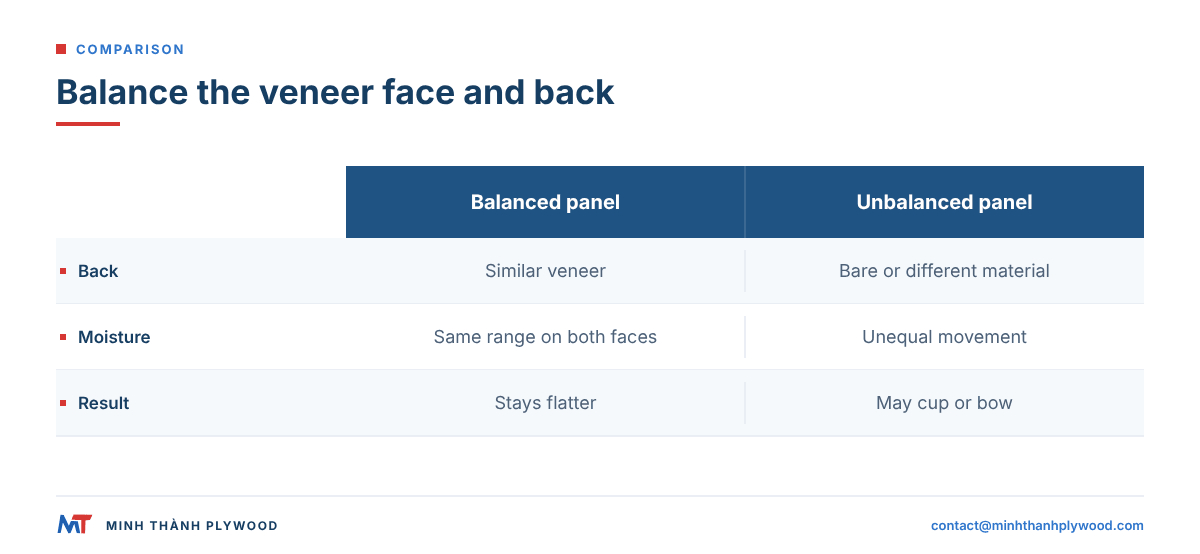
A veneered panel needs a veneer on both faces, of similar species, thickness and moisture, so the forces on each side cancel out and the panel stays flat. A face with no balancing back pulls the panel into a cup.
Wood veneer shrinks and swells across its grain as humidity changes. When the face moves, it pulls on the core. If the back carries a veneer that moves the same way, the pulls balance. If the back is bare, or carries a very different material, the panel bows towards the stronger side.
Practical rules for the back:
- Same or similar species and thickness as the face, or a backing veneer of known equal behaviour.
- Same moisture content at pressing: Minh Thanh dries veneers and finished panels to 8–12 %.
- Same grain direction as the face, along the panel length.
- Lower grade is fine for backs that are hidden, as long as the thickness balances.
That is why panels are quoted as face/back pairs. A walnut face with a lower-grade walnut back is balanced; a walnut face with no back is not. Plywood helps here: its crossed core layers resist cupping better than MDF or particleboard, but it still needs a back.
Moisture at pressing matters as much as species. A face pressed wetter than the back shrinks more as it dries and pulls the panel into a cup over the following weeks, often after the panels have shipped. That is why veneers and finished panels are dried to the same range before and after pressing, and why panels are stored flat and covered at both ends of the trip.
Balance also applies to finishing. A panel lacquered on the face and left bare on the back takes up moisture through the back and can bow. Seal both faces with a similar build, even if the hidden face gets a cheaper coat.
Telegraphing: why core flaws show through veneer
Telegraphing is when the shape of the core shows through a thin veneer face as dents, ridges or lines, most visibly under gloss lacquer. It comes from the core, not the face, so it is prevented in the core.
Common causes on veneered plywood:
- Gaps and overlaps in core layers. A gap leaves a dip; an overlap leaves a ridge under the face.
- Uneven core thickness. A core not calibrated before facing presses unevenly.
- Sanding marks on the core that the thin face follows.
- Glue lines and spots that harden under the face.
Prevention is a matter of build. Minh Thanh’s furniture cores are stitched horizontally and vertically, so core veneers do not drift apart in the press. The core board is pressed and calibrated before face and back go on in a second pressing, so the face sits on a flat, even surface. Sanded furniture panels hold ±0.2–0.3 mm thickness tolerance, down to ±0.2 mm.
When you test a veneered sample, look at it at a low angle under a strong light after finishing. Telegraphing that is hidden on bare wood shows clearly under a high-gloss coat.
Species for a wood veneer panel: oak, walnut, ash, birch and EV compared
The face species sets colour, grain, price and how the panel takes finish. Oak and EV are the most ordered faces on furniture panels; walnut and figured species are the premium end; birch, poplar and okoume are the plain, cost-effective faces.
| Face | Look | Takes stain and lacquer | Relative price | Typical use |
|---|---|---|---|---|
| Oak (crown, quarter, rift) | Open grain, warm to pale | Very well, many stains | Medium to high | Doors, wall panels, office furniture |
| Walnut | Dark, figured | Oil and clear lacquer | High | Premium furniture, feature walls |
| Ash | Pale, strong grain | Very well, often stained | Medium | Contemporary furniture |
| Birch | Pale, fine, even | Very well, paint and clear | Medium | Kitchen carcasses, children’s furniture |
| Poplar | Pale, plain | Paint, stain | Low to medium | Painted parts, interior fit-out |
| Okoume | Pinkish, plain | Paint, stain | Low to medium | Interior panels, furniture backs |
| EV (engineered veneer) | Any designed grain and colour | Very well | Low to medium | Hotel and office runs, flat-pack |
Minh Thanh produces 10+ face veneers. The most produced are EV, Poplar, Birch, Okoume and Pine; Bintangor, Eucalyptus, Gurjan, Sapele and other decorative faces such as oak and walnut are pressed on request. The walnut veneer comparison covers walnut in depth.
A few notes per face that buyers ask about most:
- Oak is the standard decorative face in Europe; it takes stains, oils and lacquers well and hides small marks in its open grain.
- Walnut is the premium dark face; American black walnut gives even colour across large runs, European walnut more figure.
- Ash looks close to oak with a paler colour and bolder grain, and is often stained black or grey.
- Birch gives a fine, even, pale face that paints and lacquers cleanly; birch faces on a Vietnamese core are birch-faced plywood, not full birch.
- Poplar is the plain, cost-effective face for painted furniture and interior fit-out.
- Okoume gives a pinkish, plain face that sands smoothly and suits painted and stained interior panels.
- Gurjan gives the red-brown face Indian and South Asian buyers know; it is the usual pick for that market.
- Sapele gives a striped, reddish mahogany-type look for doors and joinery.
- EV copies any of these in a designed, repeatable colour at a lower price.
For the Indian market, gurjan and EV faces are the familiar choices; for Europe, oak, birch and EV lead; for the Middle East, bintangor, okoume and EV.
Oak veneer panel: crown, quarter and rift cut for interiors
An oak veneer panel is the most specified decorative panel in European furniture and interiors. The cut decides its look: crown cut shows cathedral arches, quarter cut shows straight stripes with ray fleck, and rift cut shows straight grain with little fleck.
| Oak cut | Grain | Interior style | Price |
|---|---|---|---|
| Crown cut | Arches in the centre, straight at the sides | Classic, country, warm | Base |
| Quarter cut | Straight stripes with silver ray fleck | Traditional joinery, offices | Higher |
| Rift cut | Straight, even, little fleck | Modern, minimalist | Highest |
European oak and American white oak are the two main sources. European oak is usually warmer and more varied; American white oak is paler and more even. Both stain well, which is why one oak panel can serve light Scandinavian and dark smoked interiors.
The oak veneer guide lists cuts and grades in full.
Veneered oak panels: matching, layout and colour control
Veneered oak panels look best when the leaves are matched on purpose and kept in sequence from panel to panel. Matching is the layout of leaves across the face; it changes the look as much as the cut does.
- Book match: every second leaf turned over, so the grain mirrors at each joint. Classic for crown-cut oak doors.
- Slip match: leaves laid side by side the same way up, giving an even repeat and even colour. Best for long runs of quarter- and rift-cut oak.
- Random or plank match: leaves of mixed width and pattern, giving a board-like look for wall panelling.
- Sequence match: consecutive panels cut from the same flitch in order, so the grain flows across a wall of doors.
Colour control matters more than the match on a large order. Oak from different logs varies; mixing batches on adjacent doors shows. Order a project’s panels from one face batch, keep the approved sample on file, and number panels in sequence where the grain should flow.
For wall panelling, plan the layout before ordering. Mark on the drawing which panels sit side by side, which way the grain runs, and where doors cut through the wall. A panel schedule numbered in sequence lets the mill pack panels in installation order, so the fitter opens the packs and works along the wall without sorting.
Veneered oak panels also change colour with light. Oak ambers under most lacquers and in daylight over the first months. Install panels for one wall at the same time, so they age together.
Wood veneer wall panels: slatted, acoustic and tongue-and-groove
A wood veneer wall panel is a thin or slatted veneered board fixed to a wall, and it is the second thing UK buyers mean by “wood veneer panel”, after the flat board that joiners buy. Minh Thanh supplies the veneered plywood and EV base board that panel makers cut, groove and slat; the finished wall system is sold by brands such as Panels by Sofia, and the UK stockists below sell the base boards.
| Format | Size and thickness | Core | How it is fixed |
|---|---|---|---|
| Flat veneered board | 2440 or 3050 × 1220 mm, 4 to 31 mm (Latham Timber’s stock range); 1250 × 2500 mm from Minh Thanh | Plywood, MDF or EV plywood | Screwed to battens, glued to a flat wall |
| Veneer sheet | 0.6 mm sheets (HM Wood Shop: oak, beech, walnut, cherry, mahogany, maple) | Applied to your own substrate | Contact or PVA glue, pressed |
| Thin design panel | 3 mm and 6 mm, plain, grooved or wave (HM Wood Shop, reconstructed oak) | MDF or fibre base | Adhesive or fixings to a flat wall |
| Slatted acoustic panel | Veneered MDF slats on a felt backing | MDF | Adhesive, screws or battens |
| Tongue-and-groove wall panel | Veneered MDF with an interlocking edge | MDF | Concealed fixing to battens |
Core choice follows the fixing. A flat plywood board holds screws and carries a shelf, so it suits joinery and feature walls. MDF takes a clean routed groove with no tear-out, so slatted and grooved panels are MDF under the veneer. Whatever the format, the panel needs the balanced back described above, or a wall panel cups away from the fixings in heated rooms. For feature walls, order the panels as a numbered set so the grain runs across the wall.
EV plywood from Vietnam: engineered veneer and what to check
EV plywood is plywood faced with engineered veneer: plantation wood peeled, dyed, glued into a block and re-sliced to give a designed grain such as oak, walnut or teak in a repeatable colour. It is one of Vietnam’s main furniture plywood exports and one of the faces Minh Thanh produces most.
Why buyers choose EV:
- Consistent colour across batches and repeat orders.
- No natural defects: no knots, sapwood or mineral streaks.
- Wide, long faces with fewer joints.
- Lower cost than natural decorative veneer of the same look.
What to check before ordering EV plywood from a Vietnamese mill:
- The core. A stitched, calibrated core, Styrax or Eucalyptus, not a loose-laid core that telegraphs.
- Pressing. Double pressing, so the EV face sits on a flat, calibrated board.
- Thickness tolerance. Sanded furniture panels at ±0.2–0.3 mm.
- Colour match. Panels compared against the approved sample and the EV colour code.
- Emission proof. UF glue at E0 emission with CARB P2 / TSCA Title VI certification and chamber tests.
- Documents. EUDR dossier for Europe, TSCA label details for the US.
The EV plywood page lists colours, cores and sizes.
How engineered veneer is made, in short: plantation logs are peeled into veneers, the veneers are dyed to the target colour, glued face to face into a block in a mould that shapes the grain, and the cured block is sliced again into thin decorative leaves. Because the mould and dye are set, the next batch repeats the same grain and colour.
EV faces suit large, matched projects where natural veneer would vary from log to log: hotel rooms, office floors, student housing and flat-pack furniture ranges. Natural veneer still leads where figure and variation are the selling point. Many buyers order both: natural oak for show pieces and EV oak-look for the long runs.
How Minh Thanh presses veneer on hardwood-core plywood
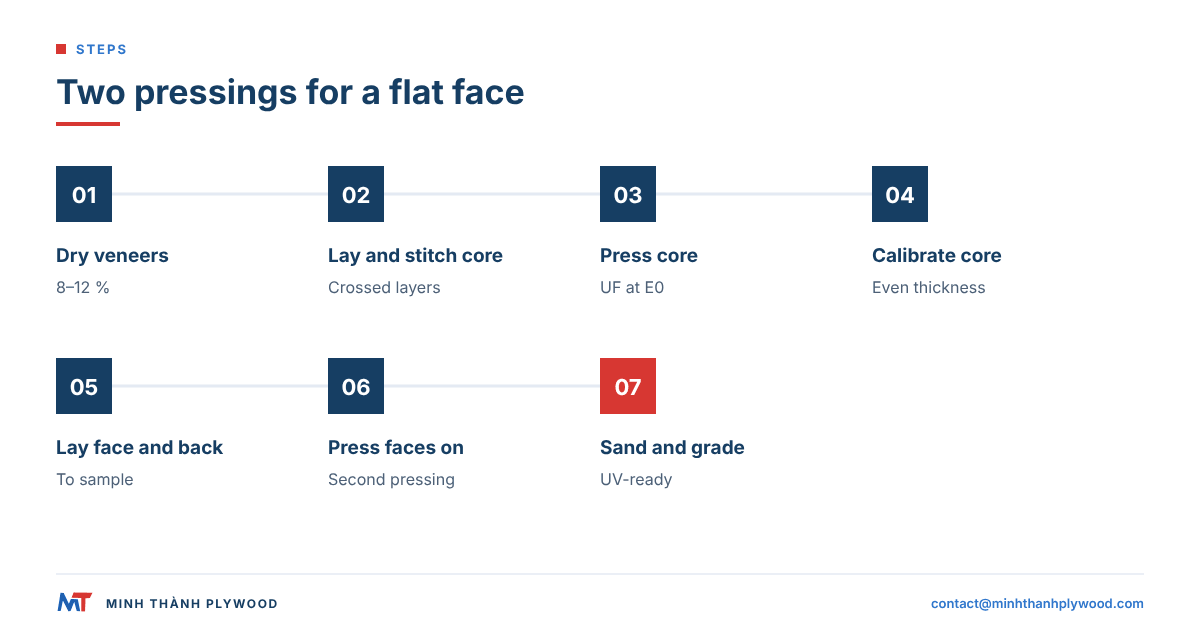
Minh Thanh presses decorative veneer on plywood in two pressings: first the core, then the faces. The order of steps below is the standard route for its furniture and interior panels.
- Peel and dry core veneers from plantation Styrax or Eucalyptus to 8–12 % moisture.
- Grade and lay the core, crossing the grain of each layer.
- Stitch the core horizontally and vertically, so layers stay closed in the press.
- Glue and hot press the core board with UF glue at E0 emission.
- Calibrate the core by sanding to an even thickness.
- Lay face and back veneers, matched to the approved sample.
- Press the faces on in a second pressing.
- Trim to size at ±2 mm on length and width.
- Sand and polish the faces, UV-ready on both sides.
- Grade against the approved sample, measure thickness, pack.
The second pressing is what separates furniture plywood from commercial plywood. Pressing faces onto a calibrated board gives a flat face and a tight tolerance, down to ±0.2 mm, so your UV coating or lacquer goes on without sanding through.
Why each step matters for a veneered panel:
- Drying to 8–12 % stops the face and core from moving apart after pressing.
- Stitching keeps core veneers closed, so no gaps telegraph through the thin face.
- Calibrating the core gives the face an even bed, so pressure is the same across the sheet.
- The second pressing bonds the face onto a finished, flat board instead of onto loose layers.
- Sanding and polishing give a face that takes UV coating or lacquer in your plant without further preparation.
- Grading against the approved sample keeps repeat orders the same as the first one.
The same route applies to EV, birch, poplar, okoume and the decorative faces pressed on request. Only the face and its grading change.
How to apply wood veneer to plywood in a workshop
To apply wood veneer to plywood, glue an oversize veneer to a flat, sanded panel, press it evenly until the glue sets, then trim and finish, and veneer the back the same way. The steps below suit a joinery or furniture workshop with a vacuum bag or press.
- Choose a flat plywood panel with a sanded, calibrated face and no core voids.
- Acclimatise veneer and panel in the same room for a few days.
- Cut the veneer oversize by a few millimetres on every side.
- Join narrow leaves into a full face with veneer tape, book or slip matched.
- Spread glue evenly on the panel, not the veneer: urea or PVA glue for a press or vacuum bag, contact adhesive only for paper-backed sheets.
- Lay the veneer with grain along the panel length, tape side up.
- Press evenly in a press or vacuum bag until the glue cures; roll paper-backed veneer with a J-roller.
- Veneer the back with a balancing leaf of similar thickness.
- Trim the edges flush with a sharp knife or router.
- Remove tape, sand lightly with fine grit, and finish.
For production volumes, buying ready-pressed veneer plywood is usually cheaper than splicing and pressing in-house. A mill press applies even pressure and heat across the full sheet and calibrates the core first.
Edge finishing on a wood veneer panel
A cut veneer panel shows its core at the edge, so every visible edge needs a finish: edge banding, solid wood lipping or an exposed, sanded plywood edge. The choice depends on the core and on the look.
| Edge finish | How it is done | Best on | Look |
|---|---|---|---|
| Veneer edge banding | Thin veneer strip glued on the edge by edgebander or iron | Plywood, MDF, particleboard | Matches face, thin edge |
| Solid wood lipping | Solid strip glued, then planed flush | Plywood and MDF tabletops, shelves | Durable, can be profiled |
| Exposed plywood edge | Sanded and lacquered, layers visible | Plywood with tight, void-free core | Modern, layered look |
| ABS or PVC band | Plastic band in matching print | Melamine and budget parts | Hard-wearing, not wood |
Exposed plywood edges are a design choice in modern furniture. They need a core with no gaps, overlaps or voids, which stitched cores and careful core grading give. Birch-faced and EV plywood with Styrax cores are common choices for exposed edges.
Edge choice also affects how panels are ordered. Panels that will be edge-banded in your plant can arrive full size. Panels for exposed-edge furniture need cores graded for edge appearance, which should be written on the order. Cut-to-size panels can arrive pre-cut, with edges left for your banding line.
Solid lipping is the choice for tabletops and shelves that take knocks. A lipping of the same species as the face, glued and planed flush, protects the thin face at the edge and can be profiled or rounded. It also lets a tabletop be sanded at the edge without cutting through the veneer.
Face grades, and sanded vs unsanded faces
Face grades describe how clean a face is: colour, joints, knots and repairs. Each species has its own ladder, and the buyer’s approved sample fixes the exact look. Panels are always quoted as a face/back pair.
- Birch faces: D+, D and E in Vietnam, low to high E, D, D+; individual D+ is about B, D about BB and E about CP/C on the European ladder.
- Poplar faces: A/A, A/B, B/B; also ordered by the codes B/BB, BB/CC and CP.
- Pine and Eucalyptus faces: A/A, A/B, B/B, with B/C for utility parts on pine.
- Decorative faces (oak, walnut, EV): graded by the approved sample on colour, match and defects.
Sanded or unsanded depends on the use:
| Panel type | Face preparation |
|---|---|
| Furniture and interior veneer plywood | Sanded and polished, UV-ready both faces |
| EV, birch, poplar, okoume faces for furniture | Sanded |
| Commercial plywood | Unsanded or lightly sanded |
| Packing plywood | Unsanded |
| Film-faced plywood | Film surface, not sanded |
Sanded faces cost more because they need calibrated cores and an extra sanding pass, but they take finish directly in your plant.
What to check on arrival of veneered panels:
- Face against the approved sample: colour, grain, match and defects, under daylight.
- Thickness at several points with a caliper, against the ordered tolerance.
- Flatness: lay a sheet on a flat surface and look for cup or twist.
- Edges: look for gaps, overlaps or voids in the core.
- Glue and sanding: no glue spots, no sand-through on the face.
- Labels and pack counts against the packing list.
Every Minh Thanh shipment is photographed and filmed before loading, and buyers get the photos and video, so the check on arrival starts from a record of what left the factory.
Does the face veneer change plywood weight and density?
The face veneer barely changes weight; the core species decides it. At 0.2–0.5 mm, two faces are a few per cent of an 18 mm panel’s thickness, so swapping oak for EV or poplar changes the sheet weight very little.
Reference core weights for an 18 mm sheet of 1220 × 2440 mm are about 26.8 kg on Styrax, 31.1 kg on Acacia and 34.8 kg on Eucalyptus; real sheets are weighed before a load plan is fixed. Many European furniture buyers choose Styrax cores because they are light and give a clean base for decorative faces.
What determines face veneer price on a veneered panel?
Species sets the base price of a face veneer, then cut, grade, matching and thickness move it. On a finished panel, the core, glue, calibration and sanding add as much again.
Face price drivers, from largest to smallest:
- Species: walnut and figured species highest, oak and ash in the middle, EV, poplar and okoume lowest.
- Cut: rift and quarter above crown, crown above rotary.
- Grade: clean, colour-matched faces cost more than faces with natural marks.
- Matching: sequence and book match above random.
- Thickness: a thicker face uses more log per square metre.
On top of the face come core species and grade, glue and emission class, single or double pressing, tolerance, sanding, size and the mix of specifications per container.
Minh Thanh’s furniture and interior plywood starts from US$350/m³ (October 2026); decorative faces are priced on the specification. Ask for the quote by face and core together, so two offers compare like for like.
Two offers for “oak veneer plywood” differ in price because they differ in build: core grade, stitching, pressing, glue, face preparation and tolerance. Line the quotes up on those lines, then compare price; a cheaper panel that needs extra sanding or telegraphs under lacquer costs more in your plant.
Mixing face veneers in one container
Different face veneers can share one 40HC container. The MOQ is one 40HC with mixed specifications by agreement: usually one or two specifications per container, three to six when agreed. Each face goes in its own packs with its own labels.
A 40HC holds 990 sheets of 18 mm on a Styrax core, 880 on Acacia and 795 on Eucalyptus (1220 × 2440 mm, 28,000 kg planning payload); the plan is worked out on the actual booking. Faces do not change the count much, because the core sets weight.
Emission, documents and certificates for veneer panels
For European and US furniture buyers, a veneered panel needs emission proof for its core glue and the origin documents for its timber. Minh Thanh supplies both with orders.
- Glue: UF glue at E0 emission for furniture and interior panels.
- CARB P2 / TSCA Title VI: held, ICTT mill no. 23024, hardwood plywood veneer core 3–50 mm.
- Chamber tests: six ASTM D6007 tests between April 2025 and June 2026 on 9, 15 and 18 mm panels averaged 0.014–0.032 ppm against the 0.05 ppm limit; three by Shanghai Hongjun, three by ICTT Vietnam.
- Third-party testing to the buyer’s method, for example EN 717-1, through SGS on request.
- TCVN 11902:2017 veneer-faced plywood certificate, VietCert 141.1-VNC-HC.
- ISO 9001:2015 quality management, KAC25/0185.
- EUDR: we supply the EUDR compliance dossier (origin records and geolocation files) with orders.
The TSCA Title VI limit for veneer-core hardwood plywood is set in 40 CFR 770.10. The EU deforestation regulation (EU) 2023/1115, checked on 20 October 2026, sets the due-diligence rules the EUDR dossier supports. Its application dates were amended by Regulation (EU) 2025/2650, which applies the EUDR to large and medium operators from 30 December 2026.
Per shipment we send the commercial invoice, packing list, B/L, certificate of origin, phytosanitary and fumigation certificates; certificate files, test reports and the EUDR dossier go out on order.
For US orders, panels carry the TSCA Title VI label with producer, lot and certifier number TPC-43, and the commercial invoice and B/L state TSCA Title VI compliance. We supply face and core species and the Vietnamese harvest origin for the importer’s Lacey Act declaration.
What to write on a wood veneer panel order
Write the core, the face and the back as separate lines, then the panel and packing. A veneered panel order that names only the face can come back on any core.
- Application: doors, carcasses, wall panels, shelves; interior.
- Core: plywood with Styrax or Eucalyptus core, stitched, double-pressed; or MDF for flat non-load panels.
- Glue and emission: UF glue at E0 emission; CARB P2 / TSCA Title VI for the US.
- Face: species, cut, match, grade, thickness; EV colour code.
- Back: species and grade that balance the face.
- Panel: thickness, size, tolerance, sanded and UV-ready, edge finish if cut-to-size.
- Packing and quantity: packs, number of panels, mixed specifications, destination port.
A filled line reads: “18 mm veneered plywood, Styrax core stitched and double-pressed, UF glue at E0 emission, oak veneer face quarter cut slip match, oak back B grade, 1250 × 2500 mm, ±0.2 mm, sanded and UV-ready, mixed with EV walnut-look faces, one 40HC, CIF Hamburg.”
Send it through the quote form or to contact@minhthanhplywood.com. We reply within hours and send free samples of the faces and cores you are comparing.
Buyer questions, answered
What is a veneered panel?
A veneered panel is a board with a thin layer of real wood glued to its faces. The core, usually plywood, MDF or particleboard, gives strength and flatness; the veneer gives the look of the chosen wood.
What is veneer plywood?
Veneer plywood is plywood whose outer faces are decorative wood veneers, such as oak, walnut, birch or engineered veneer, pressed over a core of crossed veneer layers. It is the standard board for veneered furniture that needs strength and screw holding.
Is veneered MDF or veneered plywood better?
Veneered plywood is lighter, holds screws better in the edge and resists sag and damp, so it suits doors, shelves and carcasses. Veneered MDF is flatter and cheaper, so it suits flat panels with high-gloss finishes that carry no load.
Why does a veneered panel need a back veneer?
A veneer pulls on the core as it dries and as humidity changes. A matching veneer on the back pulls the other way and keeps the panel flat; a one-sided panel cups towards its face.
What is telegraphing on a veneered panel?
Telegraphing is when flaws in the core, such as gaps, overlaps or sanding marks, show through the thin face as dents or lines, most visibly under gloss. A calibrated, stitched core prevents it.
How do you apply wood veneer to plywood?
Sand the plywood flat, cut the veneer oversize, spread glue on the panel, lay the veneer and press it evenly in a press or vacuum bag, then trim, sand lightly and finish. Veneer the back too, so the panel stays flat.
Does the face veneer change the weight of plywood?
Very little. The face is 0.2–0.5 mm thick, so the core species sets the weight: Styrax cores are about 500 kg/m³, Acacia about 580 and Eucalyptus about 650 kg/m³.
Can different face veneers be mixed in one container?
Yes. A 40HC can carry mixed specifications by agreement, usually one or two per container and three to six when agreed. Each face is packed and labelled in its own packs.
Which face veneers are sanded and which are unsanded?
Furniture faces such as EV, birch, poplar, okoume, oak and walnut are sanded, and at Minh Thanh both faces are UV-ready. Commercial and packing faces are usually unsanded or lightly sanded, and film-faced panels are not sanded.
Is EV plywood from Vietnam good quality?
Yes, when the core and pressing are right. Check for a stitched, calibrated core, double pressing, tight thickness tolerance, colour match to the approved sample and CARB P2 / TSCA Title VI proof for emissions.
What determines plywood face veneer price?
Species first, then cut, grade, matching and face thickness. On a pressed panel the core species, glue and emission class, calibration and sanding add as much as the face.
What is an oak veneer panel used for?
Oak veneer panels are used for kitchen and wardrobe doors, wall panelling, shopfitting and office furniture. Crown-cut oak gives arched grain; quarter-cut and rift-cut oak give straight grain for modern interiors.