
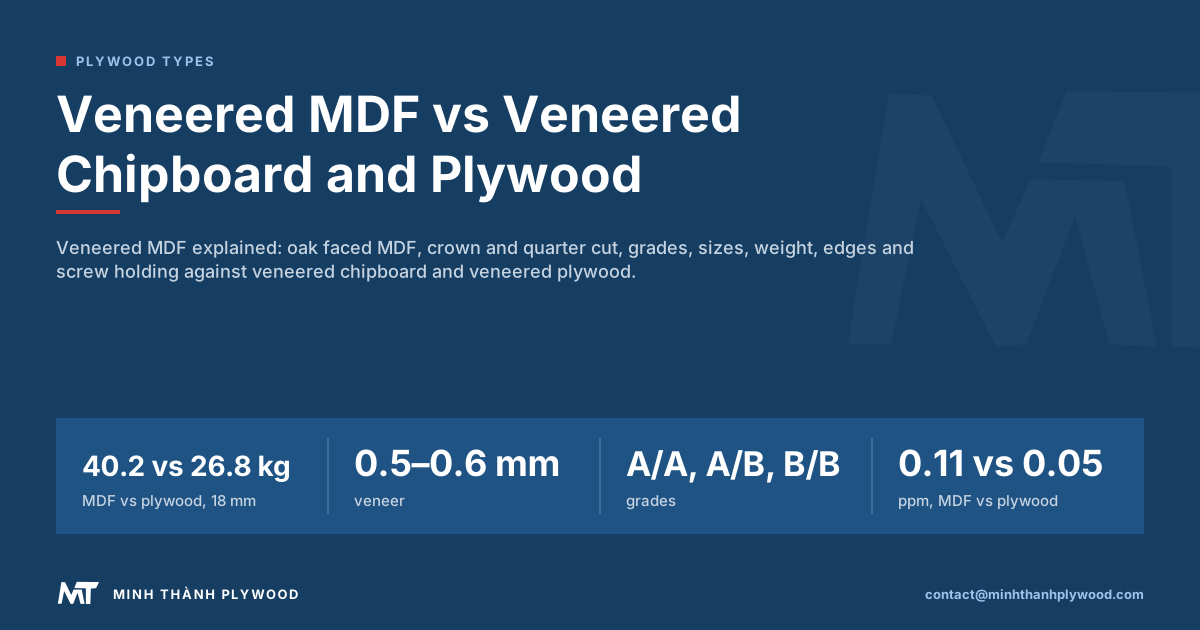
Veneered MDF is a medium-density fibreboard core with a thin real wood veneer pressed on each face, most often oak. It gives a flat, stable decorative panel at a lower cost than solid wood. Minh Thanh Plywood compares the same faces on MDF, chipboard and plywood cores: an 18 mm sheet weighs about 40.2 kg on MDF against 26.8 kg on a Styrax plywood core.
What is veneered MDF?
Veneered MDF is a board of medium-density fibreboard with a thin leaf of real wood, usually 0.5–0.6 mm thick, pressed onto each face. The front carries the show veneer, often oak, walnut, ash or maple; the back carries a balancing veneer that keeps the board flat.
Wood veneer MDF is the standard decorative panel for doors, wall panelling, shop fittings and furniture that must look like solid wood without its cost or movement.
The core is wood fibre bonded with a synthetic resin and pressed to an even density, typically around 700–800 kg/m³. That even, grainless core is what makes veneered MDF so flat: the veneer has nothing underneath to telegraph through. Its weak points are weight, edges and moisture, and that is where veneered chipboard and veneered plywood come in.
Veneer MDF, veneered MDF and wood veneered MDF all name the same product. In the trade it is sold by species, cut, grade and thickness, as in “crown cut oak, A/B, 19 mm”.
How veneered MDF is made
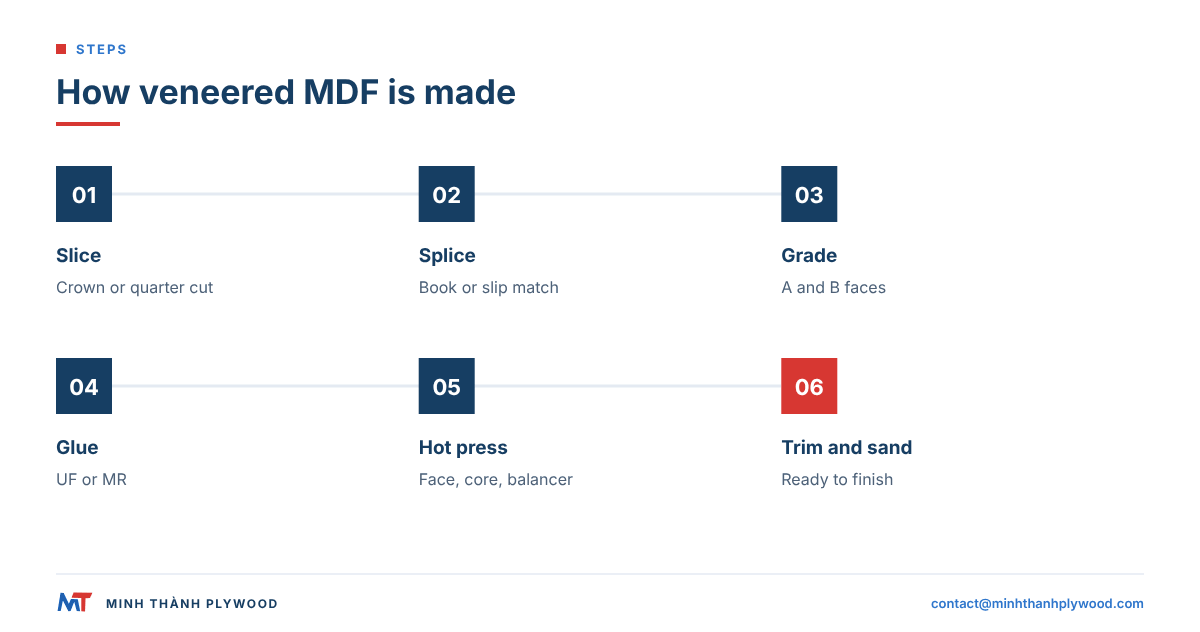
Wood veneered MDF is made in six steps, and the same steps apply to veneered chipboard and veneered plywood:
- Slice the veneer. Logs are sliced into leaves of about 0.5–0.6 mm, crown cut or quarter cut, and kept in log order.
- Joint and splice. Leaves are trimmed straight and spliced edge to edge into a full-size face, book matched or slip matched.
- Grade the faces. Spliced faces are graded for colour, figure and defects into A, B and lower faces.
- Spread the glue. Adhesive is spread on the core; UF and melamine-fortified glues are the common choices.
- Hot press. Face, core and balancer go into a hot press; the glue cures in minutes.
- Trim and sand. Panels are trimmed to size and the faces lightly sanded, ready for finishing.
On plywood the step before is the important one. Minh Thanh presses furniture-grade panels twice as standard: the core board is pressed and calibrated, then face and back are pressed on. Calibrating the core first gives the flat base a thin decorative veneer needs, which is the main reason buyers once chose MDF for veneering.
Oak faced MDF: crown cut and quarter cut
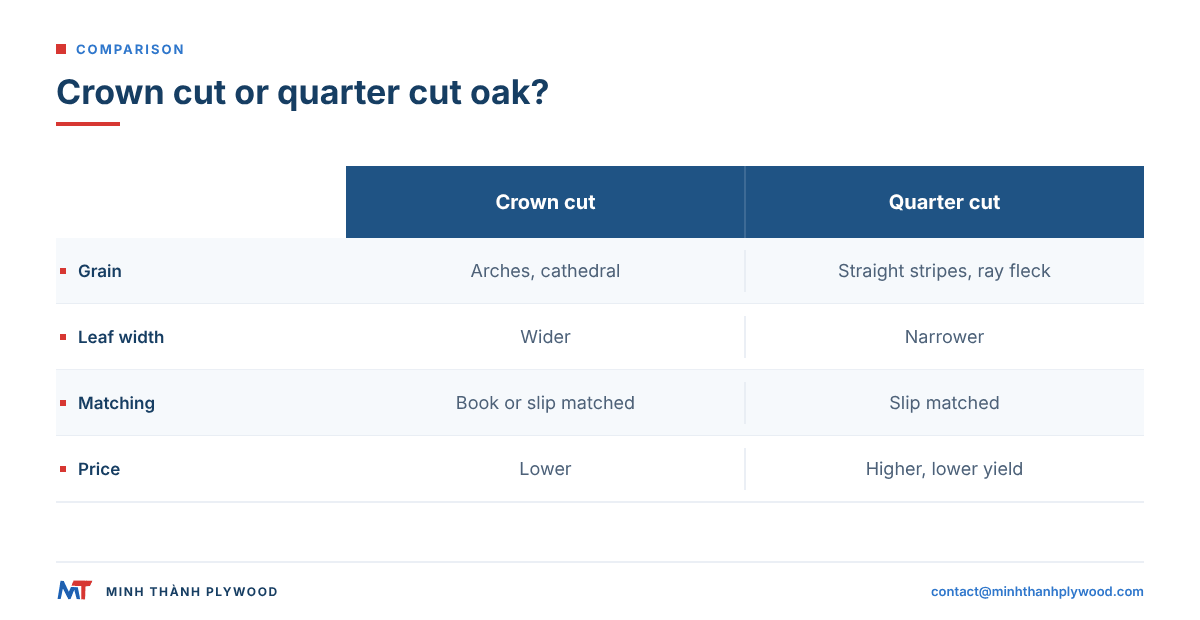
Oak faced MDF is the most sold veneered MDF in the UK and Ireland, and it comes in two cuts that look quite different. Crown cut oak is sliced flat through the log and shows the arched cathedral figure in the middle of each leaf, with straighter grain at the edges. Quarter cut oak is sliced across the growth rings and shows straight, parallel stripes, often with the silver flecks of the medullary rays.
| Crown cut oak | Quarter cut oak | |
|---|---|---|
| Figure | Arches, cathedral | Straight stripes, ray fleck |
| Leaf width | Wider | Narrower |
| Matching | Book or slip matched | Slip matched, even |
| Look | Traditional, lively | Modern, calm |
| Price | Lower | Higher, lower yield |
Veneered oak MDF is made from European oak or American white oak. European oak gives warmer, more varied colour; American white oak gives paler, more even leaves. Both take stain, oil and lacquer well. For long runs of identical doors, an EV oak-look face gives the same figure on every sheet: EV is the face Minh Thanh produces most, on plywood.
Oak veneer on MDF vs solid oak
Oak veneer on MDF looks like solid oak on the face but behaves like a man-made board: flat, stable and cheaper, with edges that need covering. Solid oak moves with humidity across its width; a wide oak panel cups or splits if it is fixed rigidly, while a veneered panel stays flat.
Where solid oak still wins:
- Edges and profiles. Solid oak can be moulded, rounded and sanded at the edge; veneered MDF shows fibre the moment the face is cut through.
- Repair. A deep scratch in solid oak sands out; a veneer of 0.6 mm allows only a light sand.
- Outdoor and wet use. White oak resists decay; MDF swells.
Where oak veneer on MDF wins: large flat areas such as wall panels, wardrobe doors, table tops with lipped edges and shop fit-outs. Most “oak” kitchens and office furniture are oak veneer on MDF, chipboard or plywood, with solid oak only in frames and edges.
Veneered MDF grades: A/A, A/B, B/B and balancers
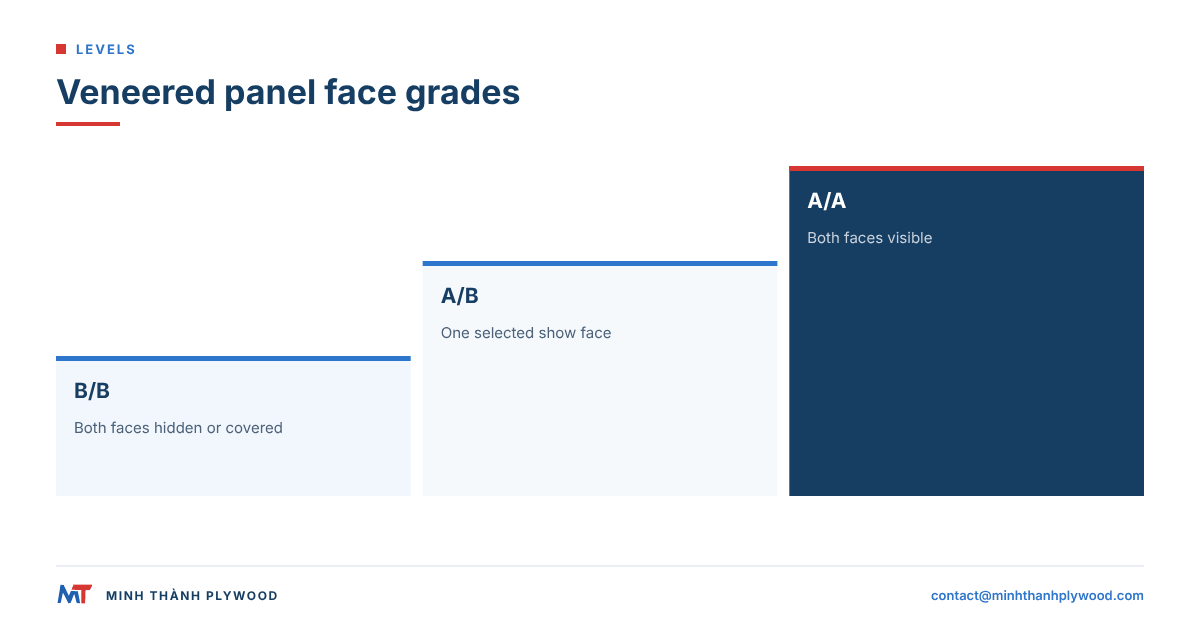
Veneered MDF is graded by its two faces, written face/back: A/A, A/B and B/B in most UK and European trade. An A face is a selected, well-matched face with few natural marks; a B face allows more colour variation, small knots and repairs.
- A/A: both faces visible, such as free-standing partitions and cabinet doors seen from both sides.
- A/B: one show face, the B face inside the cabinet or against a wall. The most common grade.
- B/B: both faces painted, stained dark or hidden, or for budget fit-outs.
- A/balancer: one show face and a lower or different veneer on the back, for wall panels fixed flat.
Every veneered panel needs a veneer on both faces. A board veneered on one side only bows as the veneer takes up and loses moisture. Plywood follows the same face/back logic. Minh Thanh quotes poplar-faced panels as A/A, A/B and B/B, matched to the buyer’s approved sample, and eucalyptus-faced panels on the same ladder.
Veneered MDF sizes and thicknesses
Veneered MDF is sold mainly in 2440 × 1220 mm sheets, with longer 3050 × 1220 mm sheets from some mills. Thicknesses are nominal: a veneered 19 mm board is an 18 mm MDF core plus a veneer on each face, and the UK trade lists 6, 9, 13, 19 and 26 mm.
UK stock ranges run from 4 to 31 mm. The table shows what a full 2440 × 1220 mm sheet cost at one UK stockist, Sheet Materials Wholesale, in October 2026, for crown cut A/B faces veneered on both sides:
| Sheet (2440 × 1220 mm) | Price ex VAT |
|---|---|
| 4 mm oak | £52.95 |
| 6 mm ash | £47.29 |
| 6 mm black walnut | £82.78 |
| 6 mm maple | £84.25 |
UK stock is FSC-labelled on many lines and made to the E1 or E05 emission class; MDF Direct cuts boards to size to ±0.1 mm and adds delivery of £25 plus VAT in England and Wales.
A veneered plywood panel of the same face is lighter, 26.8 kg against about 40.2 kg at 18 mm, and Minh Thanh’s furniture plywood starts from US$350/m³ FOB (October 2026), made to CARB P2 / TSCA Title VI with the EUDR dossier supplied for EU orders; a container buyer compares that with the shelf prices above. A niche option on UK shelves is veneer on a black-dyed 9 mm MDF core, such as the oak and walnut boards CNC Creations lists.
Grain direction matters when ordering. Long grain runs along the 2440 mm length; cross grain runs across the 1220 mm width. Doors and wall panels are cut to suit, so the cutting list should state grain direction for every part.
Plywood offers more size choice from a mill. Minh Thanh supplies 1220 × 2440 and 1250 × 2500 mm, plus custom sizes such as 1220 × 2500 and 1220 × 2280 mm, in thicknesses from 3 to 40 mm, and cut-to-size orders where one panel is cut into 4, 6 or 8 pieces.
Walnut veneered MDF and other species
After oak, walnut veneered MDF is the next most common, followed by ash, maple, cherry, sapele and beech. MDF with walnut veneer gives a dark, premium look; American black walnut is the usual species. Ash and maple give pale Scandinavian looks; sapele gives a striped red-brown.
Natural veneers vary from log to log, which is part of their appeal and a problem for long production runs. Two batches of crown cut walnut rarely match side by side. Engineered veneer solves that: fast-grown veneer is dyed, glued into a block and sliced again, so every leaf repeats the same figure. Furniture plants that ship the same door for years often specify an EV face for that reason. Minh Thanh’s EV plywood puts those faces on a plywood core.
Veneered MDF vs veneered chipboard vs veneered plywood
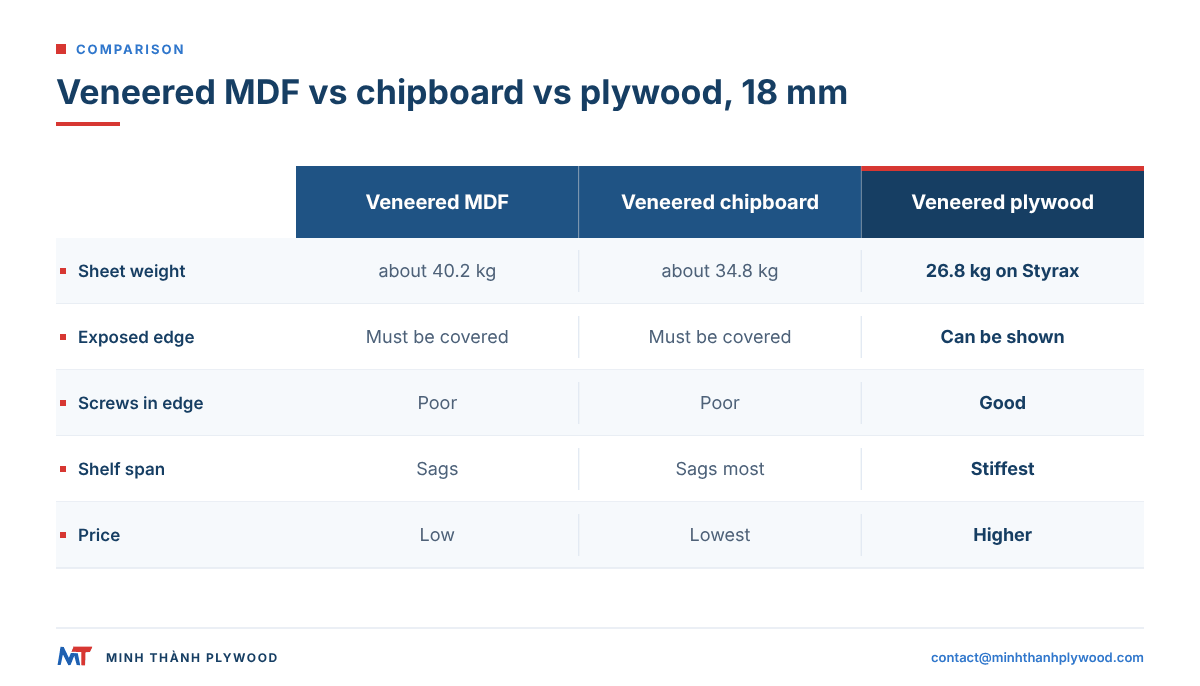
The same decorative face can sit on three cores, and the core decides weight, edges, screw holding, moisture tolerance and cost. The table compares 18 mm cores in 1220 × 2440 mm.
| Veneered MDF | Veneered chipboard | Veneered plywood | |
|---|---|---|---|
| Typical core density | about 750 kg/m³ | about 650 kg/m³ | 500–650 kg/m³ by core species |
| Sheet weight, 18 mm | about 40.2 kg | about 34.8 kg | 26.8 kg on Styrax, 34.8 kg on Eucalyptus |
| Face flatness | Best | Good | Very good when calibrated |
| Exposed edge | Fibre, must be covered | Coarse chips, must be covered | Layered edge, can be shown |
| Screw holding in the face | Good | Fair | Very good |
| Screw holding in the edge | Poor, splits | Poor | Good |
| Long shelf span | Sags over time | Sags most | Stiffest |
| Moisture tolerance | Edges swell | Edges swell | Best with the right bond |
| Price | Lowest per sheet | Lowest per sheet | Higher |
Weights are sheet volume times density: 1.22 × 2.44 × 0.018 m is about 0.0536 m³, so 750 kg/m³ gives about 40.2 kg. The plywood weights are Minh Thanh’s reference values for 18 mm on Styrax (500 kg/m³) and Eucalyptus (650 kg/m³) cores.
Is veneered plywood a better choice than MDF?
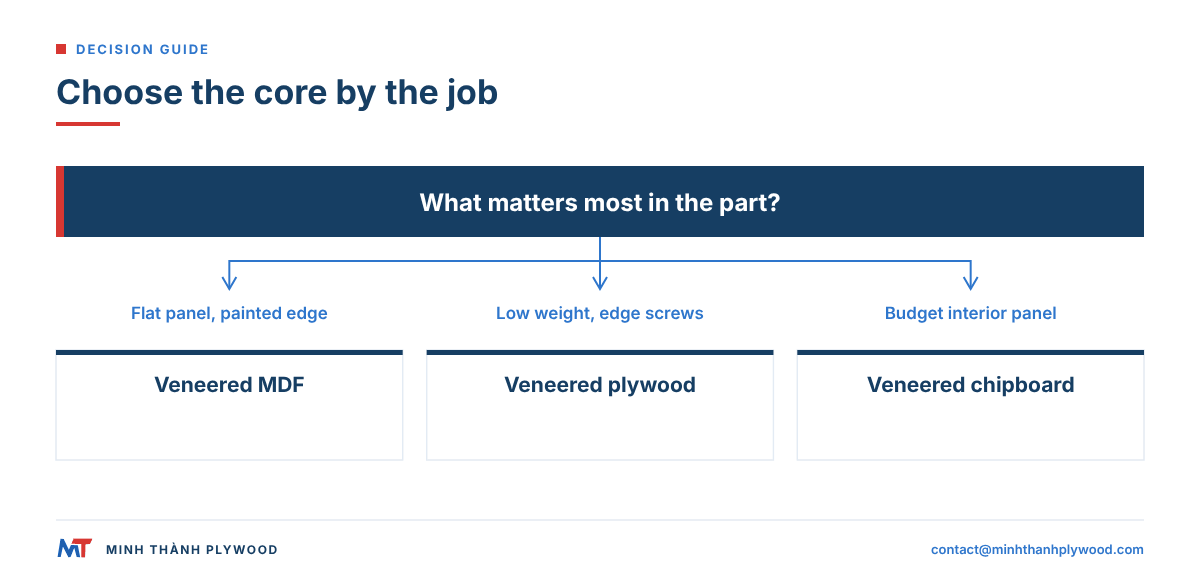
Veneered plywood is the better choice for carcasses, shelves, long spans and anything screwed into its edge; veneered MDF is the better choice for flat, profiled or painted-edge door and wall panels on a tight budget.
Choose veneered plywood when:
- Weight counts. An 18 mm Styrax-core sheet at 26.8 kg is a third lighter than MDF at about 40.2 kg, which shows in flat-pack cartons, wall-hung cabinets and freight.
- Fixings go into the edge. Hinges, cam fittings and screws hold in plywood’s crossed layers.
- Spans are long. Shelves and worktops sag less.
- Moisture is likely. Kitchens and bathrooms.
Choose veneered MDF when the panel is a flat door or wall panel, when the edge is moulded and painted, or when price per sheet decides. Many cabinet makers use both: plywood carcasses with MDF doors. Our comparison of plywood vs MDF goes deeper on the cores.
Edges: lipping, edge banding and exposed plywood
Every veneered MDF or chipboard edge must be covered, because the core shows the moment the panel is cut. There are three ways:
- Iron-on or pre-glued veneer edging. A matching veneer strip, applied by hand or edge bander. Cheap and fast; the thinnest protection.
- ABS or real-wood edge banding by machine. Typically 0.5–2 mm on furniture production lines; tough and consistent.
- Solid wood lipping. A strip of solid timber, 5–10 mm, glued on before or after veneering, so the edge can be rounded and takes knocks.
Plywood adds a fourth option: show the edge. A birch or Styrax-core plywood with stitched, void-free core layers gives a clean striped edge that many designers now leave exposed under lacquer. Minh Thanh stitches core layers both horizontally and vertically, which keeps those edge lines tight.
Screw holding and hinges
Plywood holds screws best, MDF holds them well in the face and poorly in the edge, and chipboard holds them least. The reason is structure: plywood’s crossed veneers grip a thread from every direction, MDF’s fine fibres grip in the face but split along the edge, and chipboard’s coarse particles crumble under repeated fixing.
What this means in production:
- Hinges on doors. All three cores take 35 mm cup hinges in the face; plywood and MDF hold them better under repeated opening than chipboard.
- Edge screws. On MDF and chipboard, use dedicated screws or inserts and pre-drill; on plywood, standard wood screws hold.
- Knock-down fittings. Cam and dowel fittings in chipboard and MDF need exact drilling; worn holes cannot be re-used.
For furniture that is assembled, taken apart and moved, such as office and contract furniture, plywood carcasses last longer.
Moisture and veneered MDF
Standard veneered MDF is an interior, dry-area board; its edges swell when water gets in, and the swelling does not go back. For humid areas, specify a moisture-resistant core: class MDF.H under EN 622-5, sold as MR MDF and usually dyed green. For chipboard the matching classes under EN 312 are P3 for humid, non-load-bearing use and P5 for humid, load-bearing use. These standards sit under the EU Construction Products Regulation, Regulation (EU) No 305/2011 (checked 20 October 2026), when the board is used in construction.
Plywood’s moisture behaviour depends on its glue. Interior furniture plywood uses UF glue; melamine-fortified (MR) and phenolic (WBP) bonds are made to the customer’s specification for humid and exterior uses. Minh Thanh dries veneers and finished panels to 8–12 % moisture content at dispatch, the normal range for furniture plywood. Our guide Is plywood waterproof? explains the bond classes.
Which is the best substrate for veneering?
MDF is the best substrate for the flattest, cheapest veneered panel; plywood is the best for a lighter, stronger panel that holds fixings. Baltic birch and other birch plywood are the classic plywood substrates for fine veneering.
The old objection to plywood was telegraphing: the grain or core joints of the plywood show through a thin face veneer under a gloss finish. A plywood core avoids it when:
- The core is calibrated before the face goes on, so its surface is flat to fractions of a millimetre.
- Core joints are stitched and closed, so no gap sits under the face.
- The cross-band runs at right angles to the face veneer.
- Thickness tolerance is tight: Minh Thanh holds sanded furniture panels to ±0.2–0.3 mm, down to ±0.2 mm.
Minh Thanh presses furniture panels twice for this reason, and both faces are UV-ready, to the standard customers need to apply their own UV coating.
Formaldehyde: E1, E0 and CARB limits for veneered boards
Every veneered board carries the emission class of its core and glue, and the limits differ by core. In the US, CARB Phase 2 and TSCA Title VI set 0.05 ppm for hardwood plywood with a veneer core, 0.09 ppm for particleboard, 0.11 ppm for MDF and 0.13 ppm for thin MDF; see EPA’s TSCA Title VI emission standards (checked on 3 November 2026).
In the EU, Commission Regulation (EU) 2023/1464 (checked 20 October 2026) limits formaldehyde released from furniture and wood-based articles to 0.062 mg/m³ from 6 August 2026, tighter than the old E1 class. E0 is a lower emission class used in purchasing, not a type of glue.
Minh Thanh furniture plywood uses UF glue at E0 emission and is certified CARB P2 / TSCA Title VI (ICTT mill no. 23024). Six ASTM D6007 chamber tests between April 2025 and June 2026 on 9, 15 and 18 mm panels averaged 0.014–0.032 ppm against the 0.05 ppm limit. See our CARB P2 and TSCA Title VI page.
Finishing veneered MDF and veneered plywood
Veneered panels arrive sanded and unfinished, and both faces must be sealed. The sequence is the same on MDF, chipboard and plywood:
- Light sand with 180–240 grit; never sand through a 0.6 mm veneer.
- Stain if needed, after a test on an offcut.
- Seal both faces and every edge with lacquer, oil or a UV coating.
- Top coat to the sheen required.
Finishing both faces at the same time keeps the panel balanced. For factory finishing lines, UV coatings cure in seconds; Minh Thanh’s both-faces UV-ready panels go straight onto those lines. Minh Thanh also holds a TCVN 11902:2017 certificate for veneer-faced plywood (VietCert 141.1-VNC-HC).
How to specify veneered panels in an RFQ
Write the face, the cut, the grade, the core and the emission class into the RFQ, and send a sample or photo of the look:
18 mm veneered plywood, 1220 × 2440 mm; face: EV oak-look by approved sample, back: B grade balancer; core: Styrax, calibrated and double pressed; UF glue at E0 emission, CARB P2 / TSCA Title VI; sanded, thickness ±0.3 mm; both faces UV-ready; 1×40HC CIF your port.
For MDF, add the core class (MDF or MDF.H) and the emission limit. Minh Thanh makes veneered plywood, not MDF, and sends free samples: contact@minhthanhplywood.com or WhatsApp +84 988 586 601, with replies within hours. Furniture and interior plywood starts from US$350/m³ (October 2026).
Buyer questions, answered
What is veneered MDF?
Veneered MDF is an MDF board with a thin sheet of real wood veneer, usually 0.5–0.6 mm, glued and pressed onto each face. The front carries the show veneer and the back a balancing veneer.
Is veneered MDF real wood?
The surface is real wood; the core is wood fibre bonded with resin. It looks and finishes like solid wood on the face, but its edges show MDF unless they are lipped or edge-banded.
Is veneered plywood a better choice than MDF?
For carcasses, shelves, long spans and parts with screws in the edge, yes: veneered plywood is about a third lighter and holds fixings better. For profiled, painted-edge or very flat door panels, veneered MDF is the cheaper, flatter choice.
What thickness does veneered MDF come in?
In the UK trade it is commonly sold in nominal 6, 9, 13, 19 and 26 mm, which is a standard MDF core plus a veneer on each side, in 2440 × 1220 mm sheets.
What is the difference between crown cut and quarter cut oak?
Crown cut oak is sliced flat through the log and shows the arched cathedral figure; quarter cut oak is sliced across the growth rings and shows straight, even stripes, often with silver ray flecks.
Do you need to finish veneered MDF?
Yes. The veneer arrives sanded but unfinished; seal it with lacquer, oil or a UV coating before use, on both faces, so moisture enters the panel evenly.
Can veneered MDF be used in a bathroom?
Only on a moisture-resistant core (MR MDF, class MDF.H under EN 622-5), sealed on every face and edge and kept away from standing water. Plywood with a water-resistant bond is the safer core for wet areas.
How heavy is an 18 mm veneered MDF sheet?
About 40.2 kg for 1220 × 2440 mm at a typical 750 kg/m³ density, against about 34.8 kg on chipboard at 650 kg/m³ and 26.8 kg on a Styrax-core plywood.
What is the best substrate for veneering?
MDF for the flattest, cheapest base; plywood for lighter weight, screw holding and strength. A calibrated, double-pressed plywood core gives a flat face without MDF's weight.
What is a balancing veneer?
The veneer on the back face of a veneered board. It matches the pull of the show face as the panel takes up and loses moisture, so the board stays flat.