
Plywood is produced in more than 100 countries, but China makes and exports by far the most: about a third of world plywood exports by value in 2023. Indonesia, Brazil, Finland, Malaysia and Vietnam follow, and the United States, Japan and Germany import the most. Minh Thanh Plywood, a Vietnamese manufacturer, sets out who produces, ships and buys plywood worldwide.
Where is plywood produced: the short answer
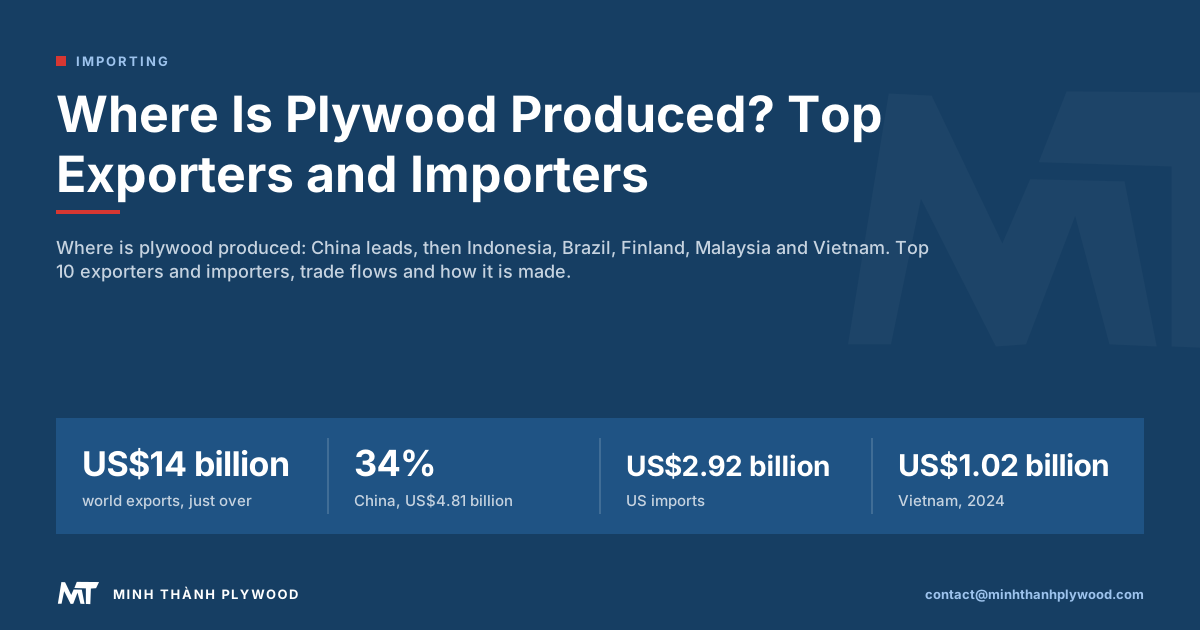
Plywood is produced worldwide, but China dominates: it shipped US$4.81 billion of plywood and similar laminated wood in 2023, about 34% of world exports. Indonesia, Brazil, Finland, Malaysia and Vietnam are the next large exporters, each with its own species and panel type.
- Top producer and exporter: China, mostly poplar and eucalyptus cores.
- Tropical hardwood plywood: Indonesia and Malaysia.
- Plantation hardwood plywood: Vietnam, on acacia, eucalyptus and Styrax cores.
- Softwood plywood: Brazil, Chile, Canada and the United States, on pine.
- Birch plywood: Finland and the Baltic states.
- Largest importers: the United States, Japan, Germany and the United Kingdom.
World trade in plywood (HS 4412) was worth just over US$14 billion in 2023, according to TrendEconomy’s analysis of UN Comtrade data (read 20 October 2026).
Where is most plywood manufactured?
Most plywood is manufactured in Asia, and China alone makes the largest share. FAO statistics for 2020 put China at 44% of world wood-based panel production, ahead of the United States at 9% and Russia at 4%; Germany, India, Canada, Brazil and Poland each made about 3%.
| Producer of wood-based panels, 2020 | Share of world production |
|---|---|
| China | 44% |
| United States | 9% |
| Russian Federation | 4% |
| Germany | 3% |
| India | 3% |
| Canada | 3% |
| Brazil | 3% |
| Poland | 3% |
Source: FAO forest product consumption and production, read 20 October 2026. Wood-based panels include plywood, particleboard, OSB and fibreboard, so the shares show where panel industries sit, not plywood alone.
World panel output reached 381 million cubic metres in 2023, the only main wood product that grew that year, according to FAO’s Global forest products facts and figures 2023. Asia-Pacific drove the growth.
Which country exports the most plywood?
China exports the most plywood, with US$4.81 billion in 2023, nearly three times the second exporter, Indonesia. The top ten exporters shipped about 74% of world plywood exports by value.
| Rank | Exporter, 2023 | Value (US$ million) | Share of world exports (%) | Main panel type |
|---|---|---|---|---|
| 1 | China | 4,814 | 34.3 | Poplar and eucalyptus core, film-faced, decorative |
| 2 | Indonesia | 1,731 | 12.3 | Tropical hardwood plywood |
| 3 | Brazil | 695 | 5.0 | Pine plywood |
| 4 | Finland | 643 | 4.6 | Birch and spruce plywood |
| 5 | Malaysia | 545 | 3.9 | Tropical hardwood plywood |
| 6 | Canada | 488 | 3.5 | Softwood plywood |
| 7 | Italy | 410 | 2.9 | Poplar and decorative plywood |
| 8 | Chile | 405 | 2.9 | Radiata pine plywood |
| 9 | Latvia | 373 | 2.7 | Birch plywood |
| 10 | Germany | 330 | 2.4 | Specialty panels |
Source: TrendEconomy, UN Comtrade data, HS 4412, 2023. Vietnam and Russia are missing from this table because neither reported 2023 trade data to UN Comtrade, not because their exports were small.
Export value falls when prices fall: world plywood exports dropped from US$17.8 billion in 2022 to just over US$14 billion in 2023, and China’s exports fell 14.4% in value.
Where does Vietnam rank among plywood exporters?
Vietnam is a major plywood exporter: its customs declarations under HS 4412 add up to about US$1.02 billion in 2024, more than any 2023 exporter in the table except China and Indonesia. In 2022, the last year Vietnam reported to UN Comtrade, it held 5.62% of world plywood exports.
| Vietnam plywood exports | Value | Volume |
|---|---|---|
| 2024, full year | about US$1.02 billion | 3.27 million m³ |
| First half of 2026 | US$543 million | 1.65 million m³ |
Vietnam’s panels are built on plantation acacia, eucalyptus and Styrax cores grown in the country, so core veneer supply does not depend on imported logs. Korea, Malaysia, the United States and Japan are its largest buyers, and the European Union has become the fastest-growing one. Our page on who imports plywood from Vietnam gives the top 15 destinations and the product mix.
Who is the biggest importer of plywood?
The United States is the biggest importer of plywood, with US$2.92 billion in 2023, about 21% of world imports. Japan, Germany and the United Kingdom follow, and Europe as a whole is the largest importing region.
| Rank | Importer, 2023 | Value (US$ million) | Share of world imports (%) |
|---|---|---|---|
| 1 | United States | 2,919 | 20.9 |
| 2 | Japan | 1,163 | 8.3 |
| 3 | Germany | 959 | 6.9 |
| 4 | United Kingdom | 686 | 4.9 |
| 5 | Netherlands | 498 | 3.6 |
| 6 | Australia | 450 | 3.2 |
| 7 | France | 445 | 3.2 |
| 8 | Mexico | 434 | 3.1 |
| 9 | Canada | 419 | 3.0 |
| 10 | Italy | 400 | 2.9 |
Source: TrendEconomy, UN Comtrade data, HS 4412, 2023. World plywood imports were just over US$13.9 billion in 2023, down from US$19.5 billion in 2022.
Germany, the Netherlands, France and Italy together imported about US$2.3 billion, close to the United States. The Netherlands and Belgium also re-export: part of what they import moves on to other European buyers.
Where does America get its plywood?
America makes most of its structural softwood plywood at home and imports hardwood, decorative, formwork and specialty plywood, worth US$2.92 billion in 2023. Imports come from Asia, South America and Canada.
- Domestic production: pine and fir structural plywood for sheathing, subfloors and roofs, made to PS 1-22, the US voluntary standard for structural plywood (read 20 October 2026).
- Canada: British Columbia mills make Douglas fir and softwood plywood to the Canadian standards CSA O121 and CSA O151, used for sheathing and concrete forms (naturally:wood, checked on 21 October 2026).
- Imports from the Americas: Brazil, Chile and Canada, three of the top ten exporters, ship softwood plywood.
- Imports from Asia: hardwood and decorative plywood, film-faced panels and flooring components. Vietnamese customs records show US$260 million shipped from Vietnam to the United States in 2024.
- Trade measures: US anti-dumping duties apply to hardwood plywood from China, and new anti-dumping and countervailing duty cases on hardwood and decorative plywood from Vietnam reached final determinations in July 2026.
Every hardwood plywood panel sold in the United States must meet TSCA Title VI formaldehyde rules, whatever its origin. The EPA’s guidance (read 20 October 2026) explains the certification and labelling.
Where do the UK and the EU source plywood?
The UK and the EU source plywood mainly from China, Finland, Brazil, Indonesia and the Baltic states, and since 2025 increasingly from Vietnam. Russian plywood, once a large source of birch panels, has been banned in the EU since 2022.
| UK plywood imports, 2023 | Value (US$ million) | Share (%) |
|---|---|---|
| China | 255 | 37 |
| Finland | 83 | 12.1 |
| Brazil | 67 | 9.9 |
| Indonesia | 47 | 6.9 |
| Latvia | 41 | 6.1 |
| Poland | 24 | 3.6 |
| Malaysia | 23 | 3.4 |
Source: TrendEconomy, UK imports of HS 4412, 2023, read 20 October 2026. Total UK imports were US$685 million.
- Russia: Council Regulation (EU) 2022/576 added wood products of chapter 44, plywood included, to the EU import ban from 9 April 2022.
- China: Regulation (EU) 2025/2333 sets anti-dumping duties of 43.3% and 86.8% on hardwood plywood from China within its stated scope.
- Vietnam: the ITTO puts EU+UK plywood imports from Vietnam at close to 229,000 m³ in the first half of 2026, against fewer than 29,000 m³ a year earlier (ITTO market report, 16–30 September 2026).
The largest plywood importers in the UK are timber merchants and panel distributors that buy by container from mills and sell to builders and joinery shops.
Who are the biggest plywood exporters in Asia?
The biggest plywood exporters in Asia are China, Indonesia, Malaysia and Vietnam; China, Indonesia and Malaysia alone shipped about half of world plywood exports by value in 2023, and Vietnam adds about US$1 billion a year. Each makes a different panel from different timber.
| Country | Main core timber | Typical export panels |
|---|---|---|
| China | Poplar, eucalyptus, mixed hardwood | Film-faced, commercial, decorative, birch-faced |
| Indonesia | Tropical hardwood, plantation species | Tropical hardwood plywood, marine and floor base |
| Malaysia | Tropical hardwood | Tropical hardwood plywood, floor base, concrete panels |
| Vietnam | Acacia, eucalyptus, Styrax | Furniture plywood, film-faced, commercial, LVL |
Vietnamese plywood cores come only from acacia, eucalyptus and Styrax, with rubberwood as a niche core in the south; there is no poplar or birch core. Faces such as birch, okoume, bintangor or gurjan are glued on as veneers. Our guide to Vietnamese plywood quality explains how these cores compare.
Where was plywood first produced?
Layered wood goes back to ancient Egypt, from about 2600 BC, but plywood was first produced on an industrial scale in the 1850s in New York, and flat plywood boards were first mass-produced in the 1880s by A. M. Luther in Reval, then in the Russian Empire, now Tallinn, Estonia. That is why the Baltic region and Finland still make birch plywood today.
| Year | Place | Milestone |
|---|---|---|
| about 2600 BC | Egypt | Thin wood layers glued in crossed directions |
| 1858 | New York, United States | John Henry Belter patents moulded plywood furniture |
| 1867 | New York, United States | A 107-foot moulded plywood railway tube is shown at the American Institute Fair |
| 1880s | Russian Empire (Baltic) | A. M. Luther mass-produces plywood boards for tea chests and packing cases |
| 1932 | Finland | Alvar Aalto designs the Paimio armchair in bent plywood |
| 1937 | Madison, United States | The US Forest Products Laboratory shows a prefabricated plywood house |
| 1941 | United Kingdom | The de Havilland Mosquito, with a moulded plywood fuselage, enters RAF service |
| 1940s | United States | Charles and Ray Eames mould plywood splints, then chairs |
Source: Victoria and Albert Museum, A history of plywood in ten objects (updated 17 April 2024, checked on 21 October 2026). Between 1850 and 1890, the V&A notes, moulded plywood for furniture was the most common form of the material. Production then moved to where large logs and cheap glue were: North American softwood mills from the 1930s, Japan and then South-East Asia after the war, China from the 1990s, and plantation-core mills in Vietnam since the 2000s.
Where is plywood manufactured for each type of panel?
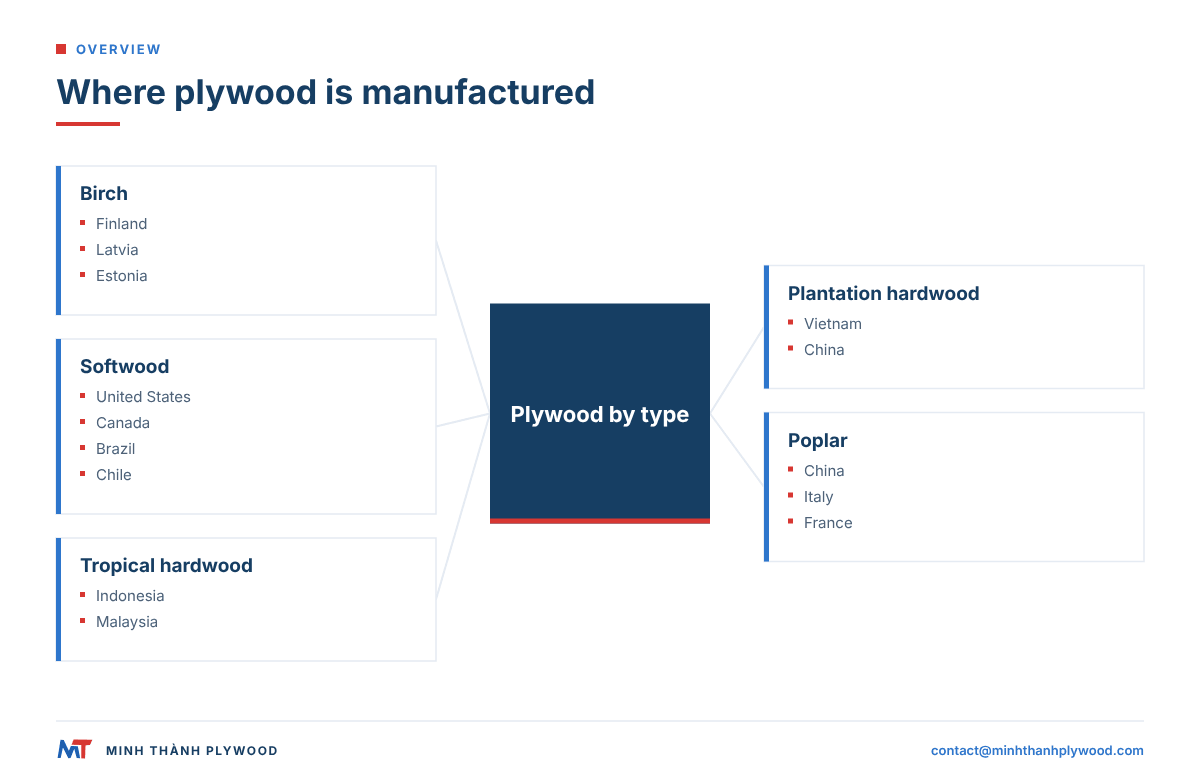
Where plywood is manufactured depends on the panel: birch plywood comes from Finland and the Baltic states, softwood structural plywood from the Americas, tropical hardwood plywood from Indonesia and Malaysia, and plantation-core furniture and formwork plywood from Vietnam and China.
| Panel type | Main producing countries | Typical use |
|---|---|---|
| Birch plywood | Finland, Latvia, Estonia, China | Furniture, transport floors, formwork |
| Softwood structural plywood | United States, Canada, Brazil, Chile | Sheathing, subfloors, roofs |
| Tropical hardwood plywood | Indonesia, Malaysia | Construction, floor base, marine |
| Poplar plywood | China, Italy, France | Furniture, packaging, light panels |
| Plantation hardwood plywood | Vietnam, China | Furniture, interiors, formwork, packing |
| Okoume plywood | Gabon, France, China | Marine and light furniture panels |
A panel’s country of origin is where it was made into plywood, not where its face veneer grew. A Vietnamese birch-faced panel is Vietnamese plywood with an imported birch face on a Vietnamese core.
How is plywood produced?
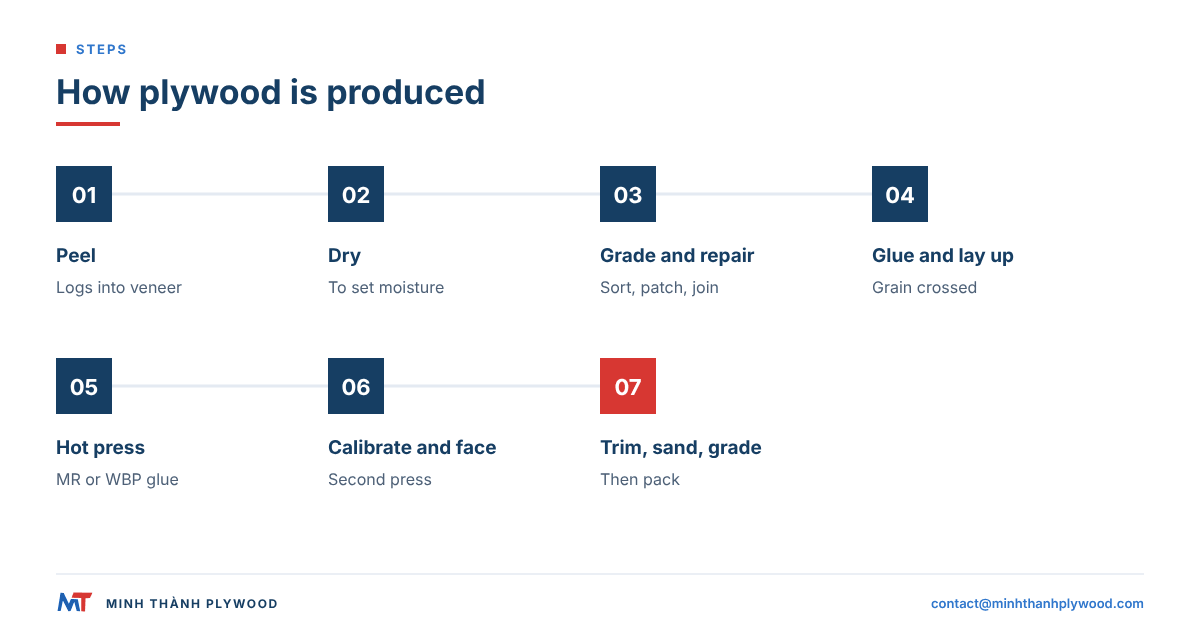
Plywood is produced by peeling logs into thin veneers, drying and grading them, gluing them in layers with the grain crossed, and pressing the stack under heat. The steps are the same in every country; the timber, glue and care at each step make the difference. The process figures for soaking and drying below are those published by the Lithuanian-Latvian mill Paged Plywood (checked on 21 October 2026); press temperatures, stitching and tolerances are our own.
- Soak and peel: hardwood logs are first conditioned in water at 40–60 °C, depending on species, so the wood peels without splitting; the logs are then turned on a lathe and peeled into veneer sheets. Core veneers are usually 1.4–2.0 mm thick and face veneers 0.2–0.5 mm.
- Dry: green veneer comes off the lathe at 30–120% moisture content and runs through a dryer at 160–180 °C. At our factory veneers and finished panels are dried to 8–12% moisture content, the normal range for furniture plywood.
- Grade and repair: veneers are sorted by quality; core gaps are patched and joined.
- Glue and lay up: glue is spread and veneers are laid with the grain of each layer at right angles to the next.
- Press: the stack is hot-pressed, at about 110–120 °C for MR glue and 130–145 °C for WBP glue.
- Calibrate and face: for furniture plywood, the core board is pressed and calibrated first, then the face and back are pressed on.
- Trim, sand and grade: panels are cut to size, sanded and graded by face, then packed.
At our factory, core layers are stitched both horizontally and vertically, and furniture-grade panels are pressed twice as standard, which keeps the surface flat for coating. Sanded furniture panels hold a thickness tolerance down to ±0.2 mm.
Where is plywood sourced: checks on the country of origin
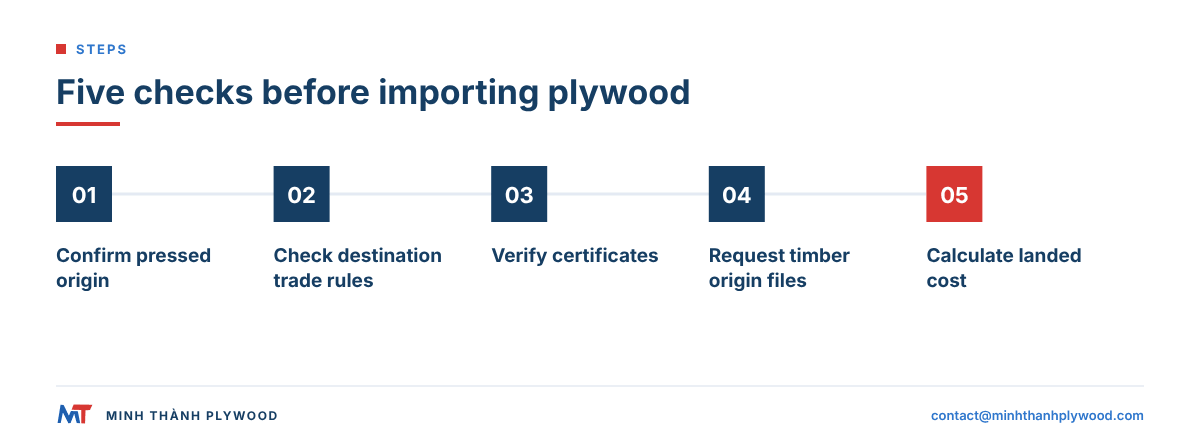
When plywood is sourced from another country, check five things: the real origin, the trade measures at destination, the emission and quality certificates, the timber origin file, and the landed cost. These checks matter more than the country’s ranking.
- Real origin: the country where the plywood was pressed, shown on the certificate of origin.
- Trade measures: duties or bans at your destination on that origin.
- Certificates: CARB P2 / TSCA Title VI for the United States, E1 or REACH test reports for Europe, quality management such as ISO 9001.
- Timber origin: EUDR geolocation files for the EU, species and harvest country for the US Lacey Act.
- Landed cost: price plus freight, duty and the share of panels you can use.
We hold CARB P2 / TSCA Title VI certification (ICTT mill no. 23024) and ISO 9001:2015, and supply the EUDR compliance dossier (origin records and geolocation files) with orders.
What products are made from plywood?
Plywood is made into furniture, cabinets, interior panels, concrete formwork, floors, roofs, packing crates, vehicle floors and boats. The country of origin usually follows the use: furniture panels from Vietnam and Finland, structural sheathing from North America, formwork from China and Vietnam.
- Furniture and cabinets: sanded faces, tight thickness tolerance, low emission.
- Interiors: wall panels, ceilings and shopfitting with decorative faces.
- Construction: formwork, sheathing, subfloors and roofs.
- Packing: crates and pallets.
- Transport: vehicle and container floors.
LVL, a related product with all veneers in one direction, is made into beams, frames and door cores.
What the global plywood map means for your order
The global map shows that one country leads in volume, but each producing country has a specialty, so choose the origin that makes your panel type best and meets your market’s rules. For furniture and interior plywood with European documents, Vietnam is one of the strongest options today.
Our factory in Ha Hoa, Phu Tho makes top-grade furniture and interior plywood, with Europe as its main market, at 50,000+ m³ a year; we also produce commercial, packing and film-faced plywood.
- Application: furniture, interiors, formwork or packing.
- Core: Styrax or Eucalyptus.
- Glue and emission: UF glue at E0 emission; MR or WBP to specification.
- Face: birch, poplar, EV, okoume, pine and more.
- Size and thickness: 1220 × 2440 mm or 1250 × 2500 mm, 3–40 mm.
- Packing and quantity: from one 40HC, mixed specifications by agreement.
Free samples are available. See furniture plywood from Vietnam, read which country makes the best plywood, or compare prices in the plywood price guide.
Buyer questions, answered
Where is most plywood made?
Most plywood is made in China, which also produces 44% of the world's wood-based panels according to FAO data for 2020. Indonesia, Brazil, Finland, Malaysia, Vietnam, Russia and the United States are the other large producers.
Which country exports the most plywood?
China exports the most plywood: US$4.81 billion in 2023, about 34% of world exports under HS 4412. Indonesia was second with US$1.73 billion.
Who is the biggest importer of plywood?
The United States is the biggest importer of plywood, with US$2.92 billion in 2023, about 21% of world imports. Japan and Germany follow.
Where does America get its plywood?
The United States makes most of its own softwood structural plywood and imports hardwood, decorative and formwork panels from Asia and South America. Vietnam shipped US$260 million of plywood to the United States in 2024.
Who are the biggest plywood exporters in Asia?
China, Indonesia, Malaysia and Vietnam are the biggest plywood exporters in Asia. Vietnam's customs declarations add up to about US$1.02 billion of plywood exports in 2024.
Where does the UK get its plywood?
In 2023 the UK imported US$685 million of plywood, 37% of it from China, followed by Finland, Brazil, Indonesia and Latvia.
How is plywood produced?
Logs are peeled into thin veneers, dried, graded and glued in layers with the grain crossed, then pressed hot, trimmed, sanded and graded. Furniture plywood is often pressed twice for a flat surface.
Is plywood made in Vietnam?
Yes. Vietnam has hundreds of plywood mills using plantation acacia, eucalyptus and Styrax cores; 793 companies filed plywood export declarations in the first half of 2026.
What products are made from plywood?
Plywood is made into furniture, kitchen cabinets, interior panels, concrete formwork, floors and roofs, packing crates, vehicle floors and boats. LVL, a related product, is made into beams and frames.
Where was plywood invented?
Glued wood layers date back to ancient Egypt, about 2600 BC. Plywood became an industrial material in New York in the 1850s, and A. M. Luther in the Baltic began mass-producing flat plywood boards in the 1880s.
Why do trade figures for plywood differ between sources?
Export and import statistics come from different countries, use different values and years, and some countries do not report every year. Use one source per comparison and note its year.