
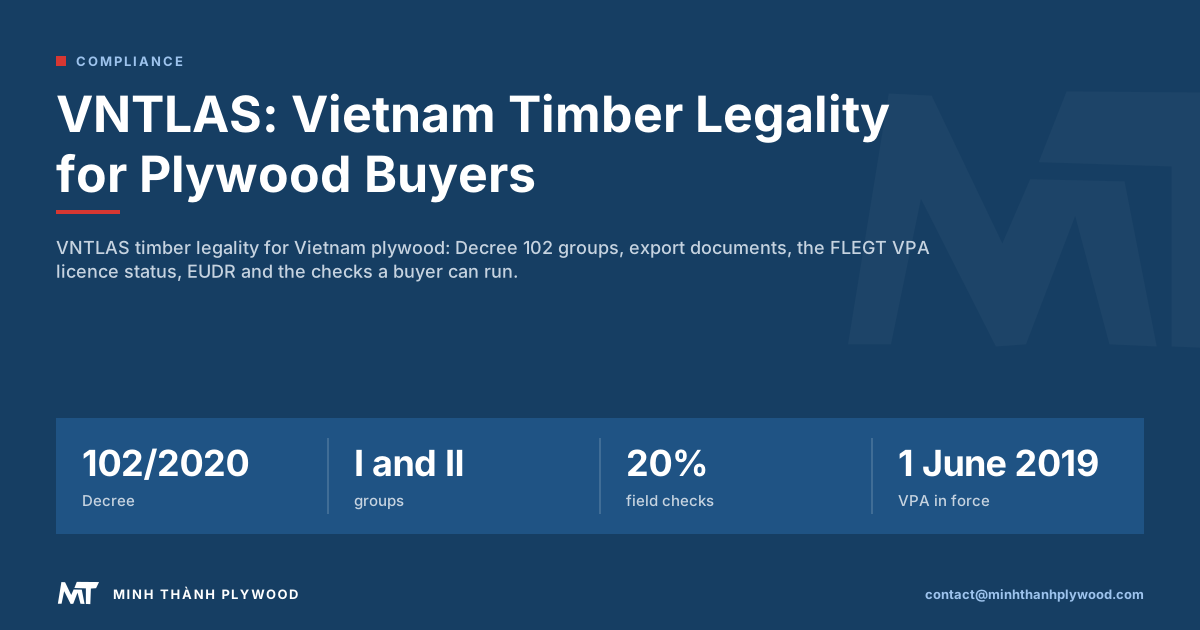
VNTLAS, the Vietnam Timber Legality Assurance System, is the national system that controls imported timber, verifies exported timber and classifies every timber processor and exporter into Group I or Group II. It was set up by Decree 102/2020/ND-CP under Vietnam's FLEGT agreement with the EU. Minh Thanh Plywood explains what it means for a plywood shipment and the checks a buyer can run.
What is VNTLAS timber legality for Vietnam plywood?
VNTLAS timber legality for Vietnam plywood means that every log in the panel can be traced to a legal source under Vietnamese law, and that the exporter is classified and checked by the forest protection authority. For a buyer, it is the Vietnamese legality system that sits behind the shipment documents.
The system was set up by Decree 102/2020/ND-CP of 1 September 2020 (English text, read 20 October 2026), in force from 30 October 2020 and amended by Decree 120/2024/ND-CP of 30 September 2024.
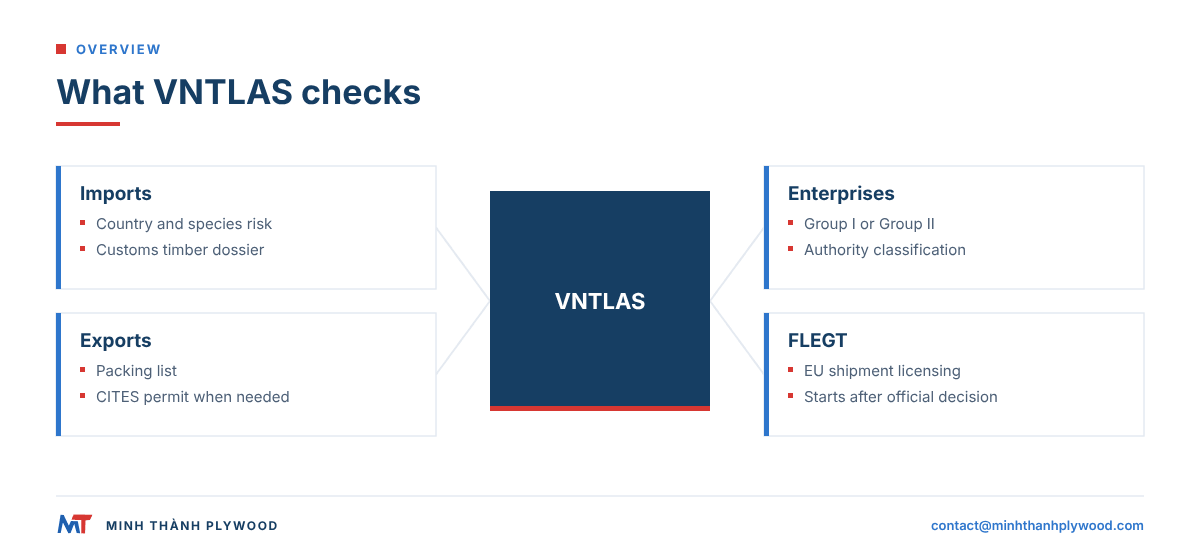
The decree has four working parts:
- Imported timber: every import is risk-checked by country and species, with a timber dossier at customs.
- Exported timber: export shipments carry a CITES permit, a FLEGT licence or a packing list, depending on species and market.
- Classification of enterprises: every timber processor and exporter is placed in Group I or Group II.
- FLEGT licences: licences for shipments to the EU, issued by Vietnam’s CITES authority once licensing starts.
The legal base is the Voluntary Partnership Agreement on Forest Law Enforcement, Governance and Trade (VPA/FLEGT) between Vietnam and the EU, in force from 1 June 2019.
How does VNTLAS classify timber enterprises into Group I and Group II?
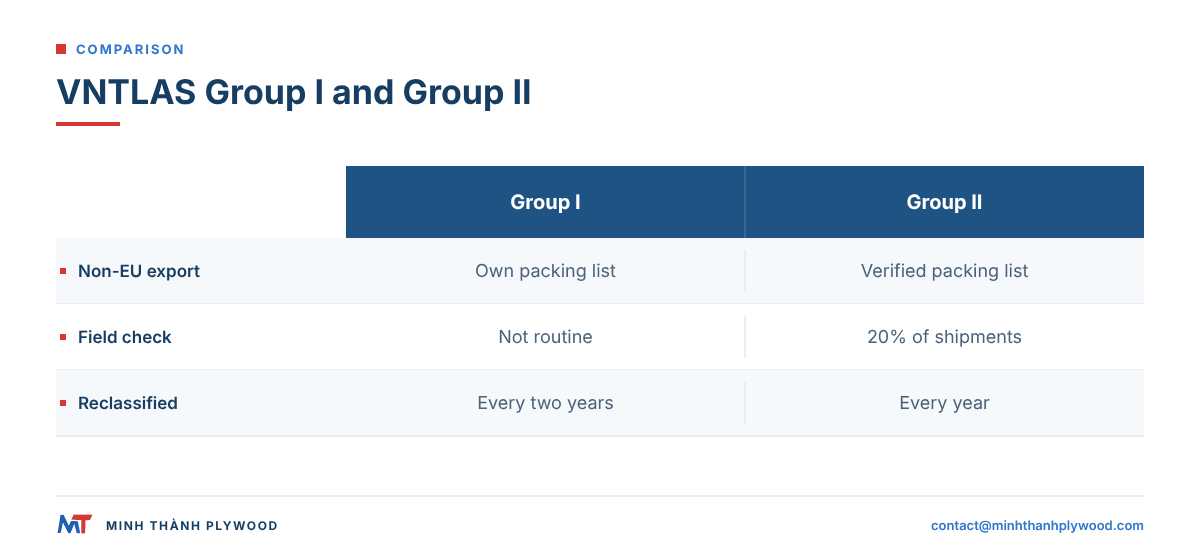
VNTLAS classifies every timber processor and exporter through an online enterprise classification system run by the forest protection authority. Group I (Category I in the official English text) is the compliant group; any enterprise that fails one criterion is Group II.
| Criterion for Group I (Decree 102, Article 12) | What the authority checks |
|---|---|
| Registered and operating for at least one year | Business registration date |
| Complies with the timber legality rules | Records against Appendix II of the decree |
| Files reports and keeps original documents | Reports to the forest protection authority |
| No violations listed in Article 13 | Enforcement records |
How the two groups differ in practice:
| Group I | Group II | |
|---|---|---|
| Export to non-EU markets | Own packing list | Packing list verified by the forest protection authority before loading |
| Field check | Not routine | 20% of shipments checked at the warehouse |
| Reclassification | Every two years | Every year |
| Published | On the authority’s list | On the authority’s list, with the reason for any downgrade |
The classification rules took effect 18 months after the decree, in April 2022.
Decree 120/2024/ND-CP (checked on 21 October 2026). Decree 120/2024/ND-CP, issued 30/09/2024, amends Decree 102/2020 and updates the classification of enterprises and the documents that go with it; its scope now names forest-planting enterprises as well as timber processors, importers and exporters (English text, LuatVietnam, checked on 21 October 2026).
The roll-out was not smooth: in November 2024 the Thanh Hoa Wood and Forest Products Association told Cong Thuong newspaper that exporters were confused about who must be classified and when, for example wood-chip businesses (vietnam.vn report, checked on 21 October 2026). The criteria in the table above come from Decree 102; check the current amended text of Article 12 or ask the mill for its classification letter. A mill’s group is public: ask for it, then check it on the forest protection authority’s list.
What does VNTLAS require for a plywood export shipment?
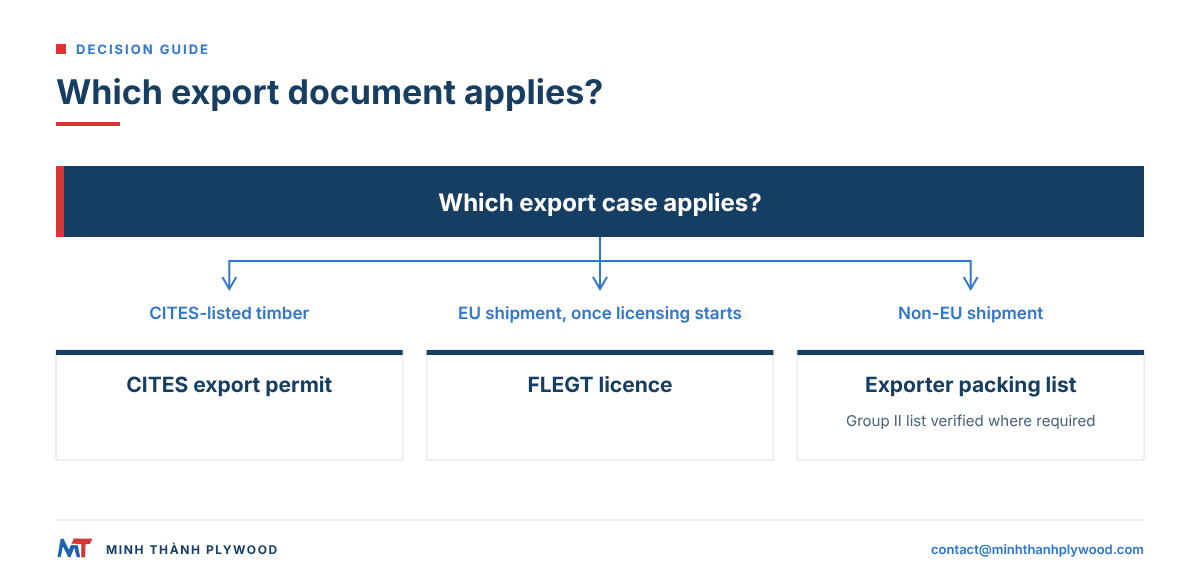
For a plywood export shipment, VNTLAS requires one of three documents at customs, decided by the species and the market (Decree 102, Article 10):
- CITES-listed timber: a CITES export permit from Vietnam’s CITES authority.
- Shipments to the EU: a FLEGT licence, once licensing starts.
- Shipments to non-EU markets: the exporter’s packing list; a Group II exporter’s list is verified by the forest protection authority first.
Article 9 adds an important exemption: verification “is not required for shipments of timber derived from domestic cultivated forests for export to non-EU markets”. Plywood with a plantation core of eucalyptus, acacia or Styrax, sold outside the EU, travels on the exporter’s packing list.
Where verification applies, the authority checks the application within one working day, completes a field check within three working days, compares weight, quantity, species and origin with the documents, and certifies the packing list.
Is there a FLEGT licence for Vietnam?
There is a FLEGT licensing system in Vietnamese law, but no licence can be issued until the Prime Minister sets its start date. Decree 102, Article 28(2), says the export rules and FLEGT licensing take effect by a Prime Minister’s decision after Vietnam and the EU agree, in their Joint Implementation Committee, that the system is ready.
What the decree already fixes:
- One FLEGT licence per export shipment to the EU, issued electronically by Vietnam’s CITES authority.
- A licence is not needed for a shipment that already has a CITES permit.
- Licensed shipments get priority at Vietnamese customs.
Public reports up to 2025 said licensing had not yet begun. Check the current status on the EU FLEGT pages or with your competent authority before you count on a licence; until then, EU due diligence rules apply as for any other origin.
EU import requirements for plywood from Vietnam: FLEGT VPA rules
EU import requirements for plywood from Vietnam under the FLEGT VPA depend on whether licensing has started: without FLEGT licences, the importer runs its own due diligence, under the EU Timber Regulation until 29 December 2026 and under the EU Deforestation Regulation (EUDR) from 30 December 2026.
| Period | Rule for an EU importer of plywood | Role of VNTLAS documents |
|---|---|---|
| Until 29 December 2026 | EUTR due diligence (Regulation 995/2010) | Evidence of legal harvest and supply chain |
| From 30 December 2026 | EUDR due diligence statement before customs clearance | Evidence for the legality part; geolocation still needed |
| Once FLEGT licensing starts | A licence per shipment from Vietnam | The licence itself |
The EUTR still applies until 31 December 2029 to timber produced before 29 June 2023 and placed on the market from 30 December 2026. Micro and small operators not already under the EUTR start on 30 June 2027. See our EUTR vs EUDR guide and the EUDR timeline.
EUDR, VPA and FLEGT: Vietnam timber legality for plywood
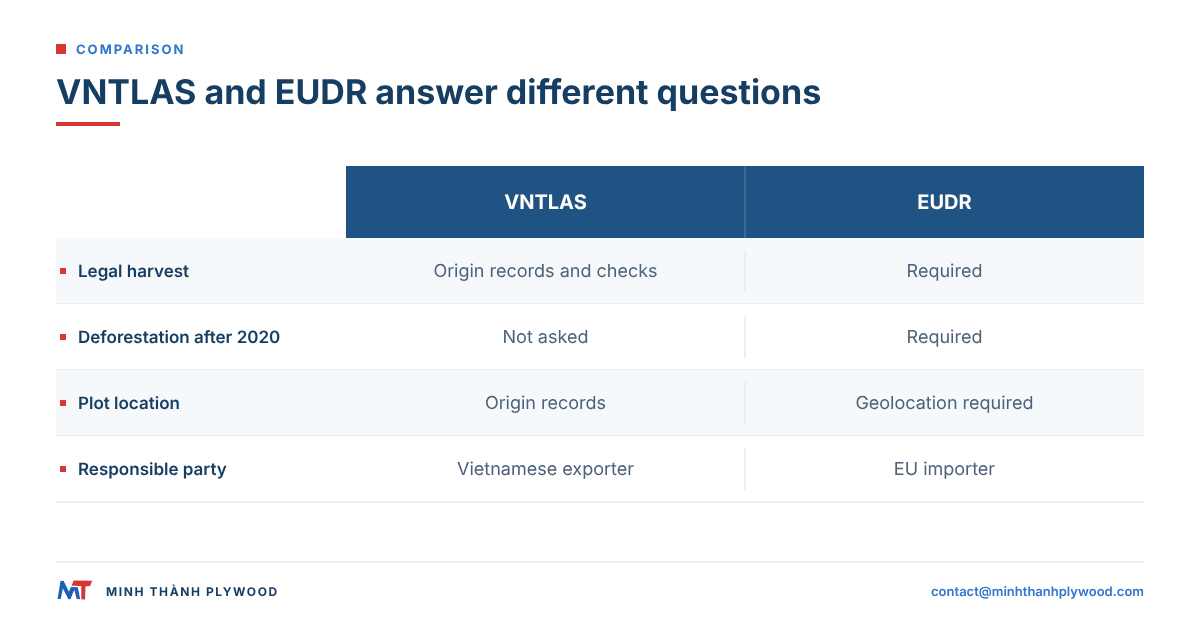
The EUDR, the VPA and FLEGT answer different questions about the same panel. VNTLAS shows the timber is legal under Vietnamese law; the EUDR also asks that it is deforestation-free and that every plot is located; a FLEGT licence, once issued, is Vietnam’s government proof of legality for an EU shipment.
| Question | VNTLAS (Decree 102) | EUDR (Regulation 2023/1115) |
|---|---|---|
| Is the timber legal where it was harvested? | Yes, by origin records and checks | Yes, required |
| Was the land deforested after 31 December 2020? | Not asked | Required |
| Where exactly was it grown? | Origin records | Plot geolocation, polygons over 4 ha |
| Who files? | The Vietnamese exporter | The EU importer, as operator |
| Species | Listed on the packing list | Common and scientific names of core, face and back |
Only four countries sit in the high-risk band of the EU benchmark: Belarus, Myanmar, North Korea and Russia. Vietnam is classed as low risk under Implementing Regulation (EU) 2025/1093, which allows simplified due diligence when every input, including imported faces, comes from low-risk countries. Simplified does not mean none: the statement is still filed, with geolocation.
VNTLAS covers timber legality inside Vietnam, including imported veneer, but the EUDR also asks where the imported veneer’s tree grew. For a Vietnamese panel with a face sliced abroad, the importer needs the face veneer’s plot geolocation as well as the Vietnamese records (EUDR documents to ask for).
Which imported logs are banned in Vietnam, and what are the rosewood laws?
Vietnam’s import control under Decree 102 works by risk, not by a list of banned logs. Imports are sorted by the country of harvest and by species; a high-risk combination needs more evidence at customs, and CITES species need CITES permits.
High-risk species (Article 6) are those that:
- Are listed in any CITES Appendix.
- Are critically endangered species in Vietnam’s groups IA and IIA.
- Are imported into Vietnam for the first time.
- Are threatened in their country of harvest or flagged as illegally traded by the ministries.
Low-risk countries (Article 5) are those with an operating FLEGT licensing system, a due diligence framework recognised by Vietnam, or good governance scores plus a bilateral agreement or recognised certification. The Ministry publishes both lists on kiemlam.org.vn and updates the species list every six months, on 30 June and 31 December.
For imports, the dossier at customs is the timber packing list plus a CITES permit, a FLEGT licence from the exporting country, or the importer’s declaration of origin (Article 7).
Rosewood laws: rosewoods of the genus Dalbergia are listed in the CITES Appendices, so Vietnam treats them as high risk; they need CITES permits on import and a CITES permit from Vietnam on export. Furniture and commercial plywood from Vietnam uses plantation cores and does not involve them.
What documents come with a plantation-timber plywood shipment?
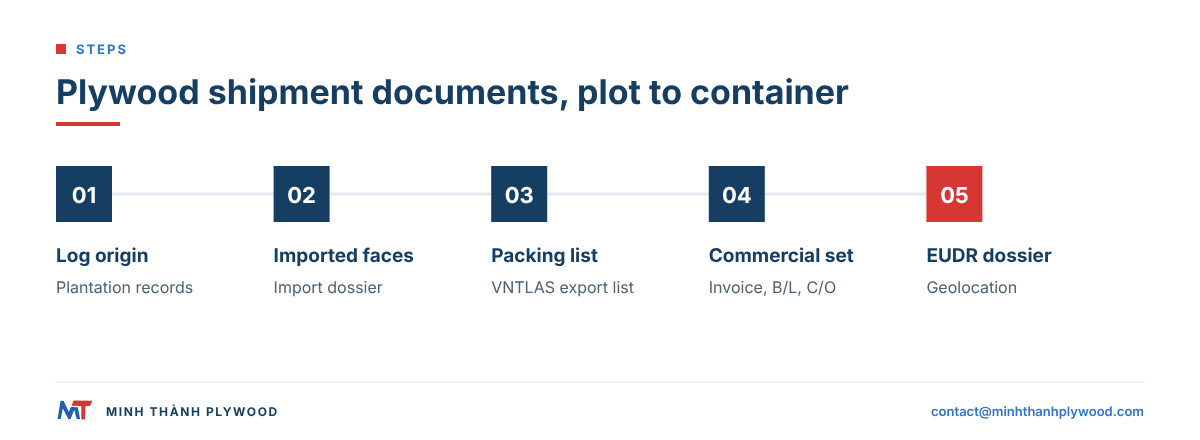
A plantation-core plywood shipment from a Vietnamese mill should be traceable from the plot to the container through five groups of documents. Ask for them by name.
| Document | What it covers | Who provides it |
|---|---|---|
| Origin records of domestic plantation logs | Harvest, sale and transport of the core logs under the forest product traceability rule, Circular 26/2022/TT-BNNPTNT of the Ministry of Agriculture | Mill, from its log suppliers |
| Import dossier of imported faces | Packing list and CITES permit, FLEGT licence or origin declaration | Mill, from its veneer suppliers |
| Export packing list | Species, volume and origin of the shipment; verified if the exporter is Group II | Exporter |
| Commercial documents | Invoice, packing list, B/L, certificate of origin (EUR.1 for the EU) | Exporter |
| EUDR dossier | Species, quantity, country and plot geolocation with production dates | Mill, for the EU importer |
The species list should name core, face and back separately, with common and scientific names: Styrax (Styrax tonkinensis), eucalyptus (Eucalyptus spp.) or acacia (Acacia spp.) for the core, and the face species you ordered.
How do I avoid illegally sourced plywood from Vietnam?
Avoid illegally sourced plywood by checking the mill, the species and the paper trail before the order, not after the container lands. Seven checks a buyer can run:
- Company: the mill’s registration, address and factory, matched to the contract and the export documents.
- VNTLAS group: Group I or Group II, checked on the forest protection authority’s list.
- Species: core, face and back named in the quote; compare with the sample and the panel weight.
- Domestic origin: plantation log origin records for the core, by region and supplier.
- Imported faces: the import dossier for each imported veneer species.
- EUDR dossier: plot geolocation and production dates for EU orders.
- Shipment proof: photos and video of loading, lot marks on packs and documents.
A mill that hesitates on step 3 or step 4 is the warning sign. See also our guide to checking whether Vietnamese plywood is made in China.
How does Minh Thanh Plywood document timber legality?
Minh Thanh Plywood is a manufacturer in Ha Hoa, Phu Tho, using locally grown plantation timber for its cores, and supplies the EUDR compliance dossier (origin records and geolocation files) with orders.
What a buyer receives:
- Species and origin: white Styrax or Eucalyptus cores as standard, Acacia and Pine on order; face species named on every quote, including imported birch and okoume.
- EUDR dossier: origin records and geolocation files with EU orders. Details on our EUDR traceability page.
- Shipping documents: commercial invoice, packing list, B/L, certificate of origin (EUR.1 for the EU), and certificate files on order.
- Loading proof: every shipment photographed and filmed before loading, sent to the buyer.
- Certificates: CARB P2 / TSCA Title VI (ICTT mill no. 23024), ISO 9001:2015, TCVN 11902:2017; FSC® and CE available*.
*Supplied directly or through qualified partner mills.
The specification line to send
“Furniture plywood, 18 mm, 1220 × 2440 mm, Eucalyptus core, birch face D/D, UF glue at E0; species list for core, face and back; EUDR dossier with geolocation; one 40HC, CIF your port.”
Send it to contact@minhthanhplywood.com, or ask for free samples. See the furniture plywood range.
Buyer questions, answered
What is VNTLAS?
The Vietnam Timber Legality Assurance System, set up by Decree 102/2020/ND-CP. It controls timber imports by country and species risk, verifies timber exports and classifies timber processors and exporters into Group I or Group II.
Is there a FLEGT licence for Vietnam?
Decree 102 provides for FLEGT licences on shipments to the EU, but licensing starts only after a decision by the Prime Minister. Public reports up to 2025 said licensing had not yet begun; check the current status with the EU before relying on a licence.
What is a Group I timber enterprise in Vietnam?
An enterprise registered for at least one year that complies with the timber legality rules, files its reports, keeps original records and has no listed violations. Group I exporters certify their own packing lists for non-EU markets.
Does VNTLAS replace EUDR due diligence?
No. VNTLAS documents help prove the legality part, but from 30 December 2026 an EU importer of plywood still files its own EUDR due diligence statement with origin and plot geolocation.
Which imported logs are banned in Vietnam?
Decree 102 works by risk rather than a ban list: species in the CITES Appendices, critically endangered species, species imported for the first time and species flagged as illegally traded are high risk and need extra documents. CITES Appendix I species can be traded only under its strict permit rules.
What are the rosewood laws for timber from Vietnam?
Rosewoods of the genus Dalbergia are listed in the CITES Appendices, so Vietnam treats them as high-risk imports that need CITES permits, and their export needs a CITES permit from Vietnam's CITES authority. Plantation plywood does not use them.
How do I avoid illegally sourced plywood from Vietnam?
Ask for the mill's VNTLAS group, the species list for core, face and back, origin records for the plantation core, import papers for imported faces, and the EUDR dossier; then check the company registration and the group on the official list.
Is Vietnam low risk under the EUDR?
Yes. Implementing Regulation (EU) 2025/1093 classes Vietnam as low risk, which allows simplified due diligence when every input comes from low-risk countries.
Does plantation timber need export verification in Vietnam?
Not for non-EU markets: Decree 102 exempts timber from domestic planted forests exported to non-EU markets from origin verification. Shipments to the EU follow the EU rules.