
The difference between WBP and MR glue is the resin and what the bond survives: MR is melamine-fortified urea glue that resists humidity and short wetting, WBP is phenolic glue that survives boiling water and weather. MR suits kitchens, bathrooms and humid furniture; WBP suits exterior, formwork and wet uses. Minh Thanh Plywood makes both bonds to order, and this guide gives the tests, the standards and a decision table by application.
What is the difference between WBP and MR glue?
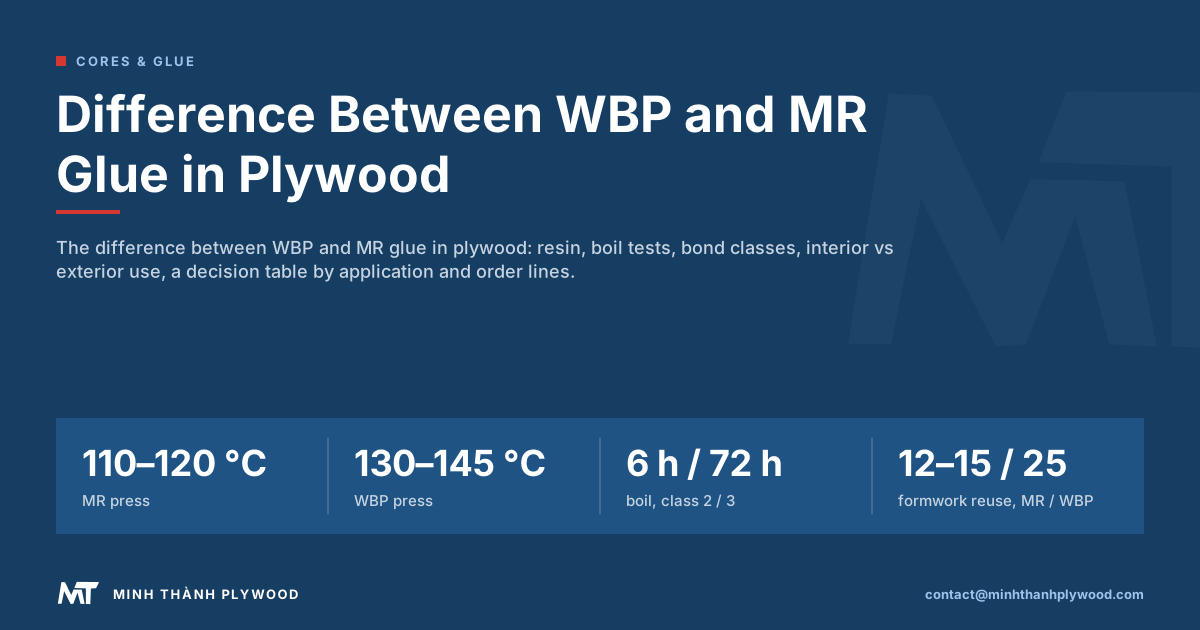
The difference between WBP and MR glue is the resin and what the bond survives. MR (moisture resistant) glue is urea-formaldehyde fortified with melamine; it survives humidity and short wetting. WBP (weather and boil proof) glue is phenol-formaldehyde; it survives boiling water, rain and repeated wetting and drying.
| Metric | MR glue | WBP glue |
|---|---|---|
| Resin | Melamine-urea-formaldehyde (MUF) | Phenol-formaldehyde (PF) |
| Glue line colour | Light, almost invisible | Dark brown to black |
| Survives | Humidity, splashes, short wetting | Boiling water, weather, wet-dry cycles |
| EN 314-2 bond class aimed at | Class 2 | Class 3 |
| Whole panel, EN 636 | EN 636-2, humid | EN 636-3, exterior |
| Hot-press temperature | 110–120 °C | 130–145 °C |
| Boil hours a buyer can expect (Asian trade ladder) | About 4–8 h for ordinary melamine WBP, 10–20 h for better melamine | 24–72 h for phenolic |
| Relative cost | Lower | Higher |
| Typical uses | Kitchens, bathrooms, humid furniture | Exterior, formwork, vehicle floors |
Only a phenolic bond reliably passes the 72 h boil of EN 314-2 Class 3. The hours are a trade ladder, not a test result: they also depend on how well the mill presses the panel, so ask for the boil test report with the sample. In US terms, MR sits near PS 1 Exposure 1 (a bond built to survive construction-time wetting, the grade of CDX sheathing) and WBP near PS 1 Exterior, which is the bond for long-term weather; APA warns that CDX is sometimes mistaken for an Exterior panel.
The short rule: MR for humid interiors, WBP wherever the panel meets the weather or liquid water for long. Plain UF glue, the third bond, is for dry interiors.
What is MR glue?
MR glue is melamine-urea-formaldehyde (MUF): standard urea-formaldehyde glue with melamine added so the cured bond resists moisture. The melamine makes the glue network harder and less prone to breaking down in water, while keeping the light colour and moderate cost of a urea glue.
MR is the bond most often ordered for humid furniture: kitchen carcasses, bathroom vanities, wardrobes in damp climates and shop fittings near sinks. It presses at about 110–120 °C. Because the glue line is light, a sanded MR edge looks like the wood itself, which matters for furniture with exposed edges.
The word MR is used loosely on quotations. Some sellers write MR for plain UF glue. Ask which resin is used and which test the bond passes; our guide to what melamine is explains the chemistry behind the name.
What is WBP glue?
WBP glue is phenol-formaldehyde (PF), a dark resin that cures into a bond that survives boiling water and weather. WBP stands for weather and boil proof, a name from the old British standard; today the European equivalent is bond class 3 of EN 314-2.
Phenolic glue presses hotter and longer than MR, at about 130–145 °C, and costs more per cubic metre of plywood. It leaves a dark brown line between every ply. In return the bond outlasts the wood: in an exposed WBP panel, the face weathers before the plies separate.
WBP is the bond for exterior plywood, concrete formwork, vehicle and trailer floors and marine-type uses. For the full background on WBP, its boil tests and its limits, see WBP plywood explained.
How are MR and WBP bonds tested?
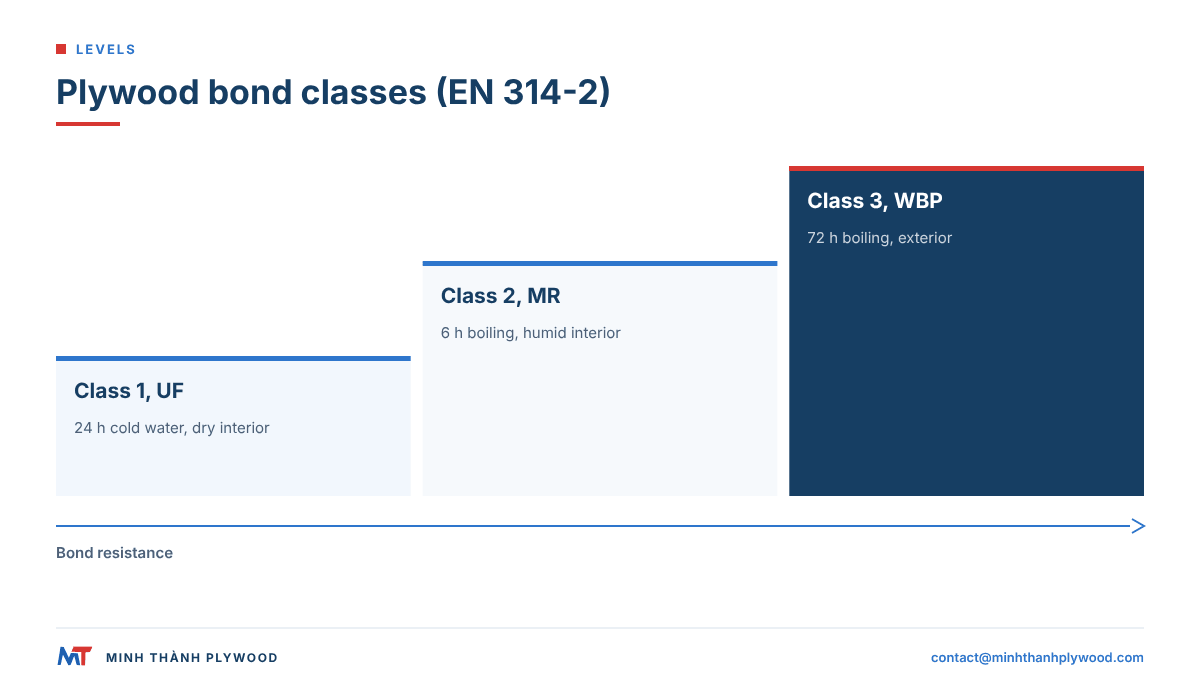
MR and WBP bonds are tested by soaking or boiling small test pieces and then pulling them apart in shear, under EN 314-1 (the method) and EN 314-2 (the requirements). The pretreatment decides the class: the harder the treatment a bond survives, the higher its class.
| EN 314-2 bond class | Use | Pretreatment before the shear test | Usual glue |
|---|---|---|---|
| Class 1 | Dry interior | 24 hours in cold water | UF |
| Class 2 | Humid interior, covered exterior | 6 hours boiling, 1 hour cooling in cold water | MR (MUF) |
| Class 3 | Exterior | 4 hours boiling, 16–20 hours drying at 60 °C, 4 hours boiling, 1 hour cooling; or 72 hours boiling, 1 hour cooling | WBP (PF) |
After the pretreatment, the piece is pulled apart and judged on its shear strength and on how much wood, rather than glue, tore. A bond that fails in the glue line has failed the class.
EN 314-2 is the European standard for plywood bonding quality requirements (checked on 21 October 2026). Third-party testing to the buyer’s method is arranged through SGS on request.
What is the difference between interior and exterior plywood?
The difference between interior and exterior plywood is the glue bond: interior plywood is bonded with UF or MR glue for dry or humid rooms, exterior plywood with a WBP phenolic bond that survives weather and boiling water. Face grade, core and thickness can be the same; the bond decides where the panel may go.
| Point | Interior plywood | Exterior plywood |
|---|---|---|
| Bond | UF (dry) or MR (humid) | WBP (phenolic) |
| EN 636 class | EN 636-1 dry, EN 636-2 humid | EN 636-3 exterior |
| Faces | Furniture grades, sanded | Often utility C/D faces |
| Edge glue lines | Light | Dark |
| Uses | Furniture, cabinets, wall panels | Sheathing, stair treads, hoardings, formwork |
Minh Thanh’s exterior plywood uses utility C/D faces with water-resistant melamine-fortified or phenolic (WBP) glue, for outdoor uses such as stair treads and wall sheathing. Our furniture panels are interior plywood, with UF glue at E0 emission as standard and MR on order.
18 mm moisture resistant plywood: where is MR enough?
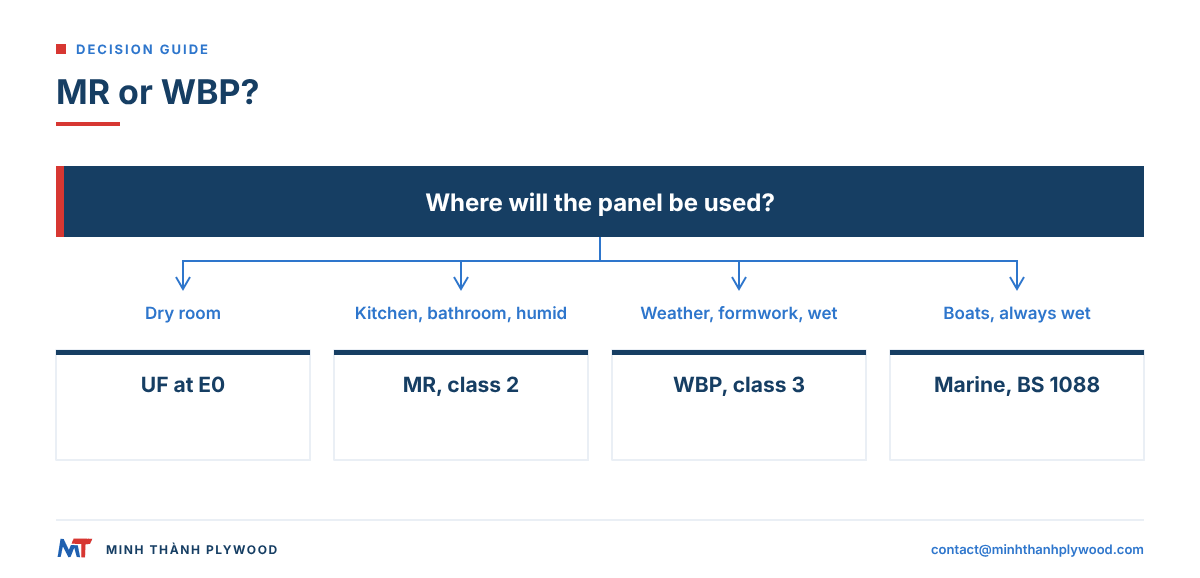
An MR bond is enough wherever the plywood sees humidity and occasional splashes but not the weather or standing water. That covers most uses of 18 mm moisture resistant plywood: kitchen and bathroom carcasses, wardrobes in humid climates, shop counters and interior wall panels.
An 18 mm Vietnamese furniture panel has 11–13 plies, most often 11. With an MR bond and sealed edges it handles the steam over a hob and the humidity under a sink. Three conditions keep it there:
- Seal every cut edge, including the bottoms of carcasses and the holes for pipes.
- Keep it off wet floors with legs or a plinth, so water does not soak into the bottom edge.
- Keep it indoors. Rain, sun and wet-dry cycles call for WBP.
A sheet of 1220 × 2440 × 18 mm plywood on a white Styrax core weighs about 26.8 kg, on Eucalyptus about 34.8 kg. Kitchen plants that hang carcasses on walls often choose the lighter core.
Where do you need WBP?
You need WBP wherever the panel meets the weather, liquid water for long periods or repeated wetting and drying. MR glue in those places fails at the glue line: plies separate, faces blister and the panel loses strength.
Typical WBP uses:
- Exterior building: wall sheathing, roof decks, soffits, stair treads and hoardings.
- Concrete formwork: wet concrete, cleaning and repeated pours.
- Vehicle and trailer floors: water, cleaning and wheel loads, often with an anti-slip film.
- Outdoor furniture and play equipment: with a coating on faces and edges.
- Boats and docks: marine plywood to BS 1088, which adds durable species and a gap-free core to the WBP bond.
If a panel is covered but outdoors, such as under a roof overhang, MR can be enough; if it gets rained on, choose WBP.
Which glue for which application?
This decision table puts the glue, bond class, emission line and relative cost next to each common application. Use it as the starting point for an order.
| Application | Glue | Bond class (EN 314-2) | Emission line to add | Relative cost |
|---|---|---|---|---|
| Wardrobes, beds, dry furniture | UF at E0 emission | Class 1 | E0, CARB P2 / TSCA Title VI | Lowest |
| Kitchen cabinets | MR | Class 2 | E0 or E1 to the buyer’s method | Low to medium |
| Bathroom vanities | MR | Class 2 | E0 or E1 to the buyer’s method | Low to medium |
| Shop fittings near water | MR | Class 2 | As the market requires | Low to medium |
| Packing and crates | UF or MR | Class 1 or 2 | Usually not specified | Lowest |
| Exterior sheathing, stair treads | WBP | Class 3 | As the market requires | Higher |
| Concrete formwork | WBP with phenolic film | Class 3 | Usually not specified | Higher |
| Trailer and truck floors | WBP, often anti-slip film | Class 3 | As the market requires | Higher |
Two notes on the table. Packing plywood is usually bonded for transport and storage, and its glue matters less than its thickness tolerance. Kitchen cabinets are the line buyers most often over-specify: an MR bond with sealed edges does the job there, and WBP adds cost and dark edges without a gain indoors.
Why are glue type and emission class two lines?
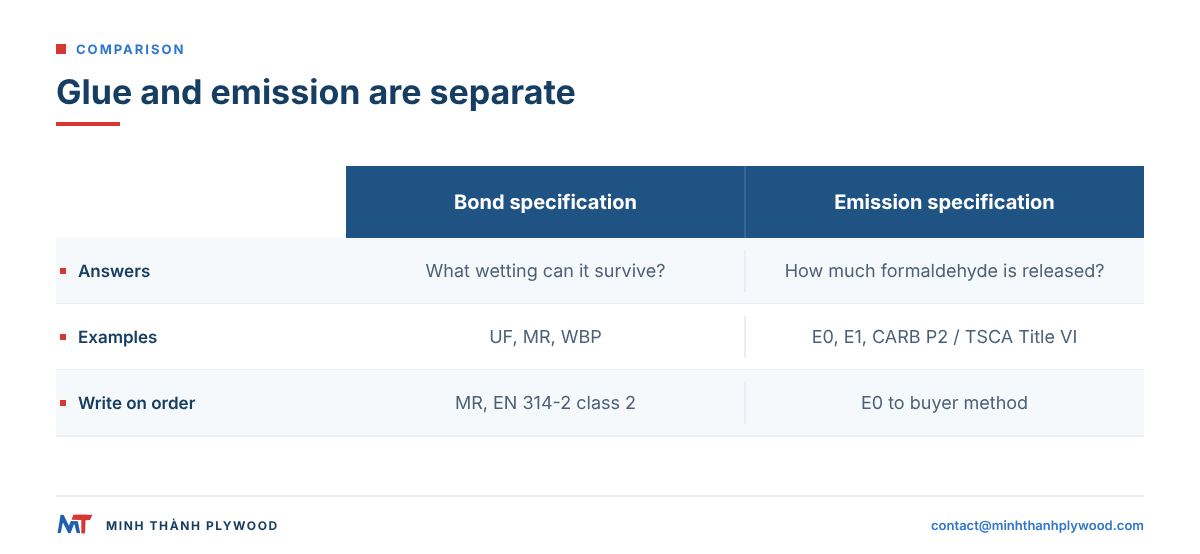
Glue type and emission class are two separate specifications: the glue says what the bond survives, the emission class says how much formaldehyde the finished panel releases. E0 and E1 are emission classes, not glues; UF, MR and WBP are glues. An order that says “E0 glue” leaves the bond undefined.
Write the two lines like this:
- Bond: MR (melamine-fortified), EN 314-2 class 2.
- Emission: E0 to the buyer’s method, or CARB P2 / TSCA Title VI.
For US orders, CARB Phase 2 and EPA TSCA Title VI set a limit of 0.05 ppm for veneer-core hardwood plywood under 40 CFR 770.10 (checked on 21 October 2026). Minh Thanh’s furniture plywood is certified under ICTT mill no. 23024; six ASTM D6007 chamber tests between April 2025 and June 2026, on 9, 15 and 18 mm panels, averaged 0.014–0.032 ppm. Three were run by Shanghai Hongjun and three by ICTT Vietnam. Our emission classes page explains the European side.
What do other markets call MR and WBP?
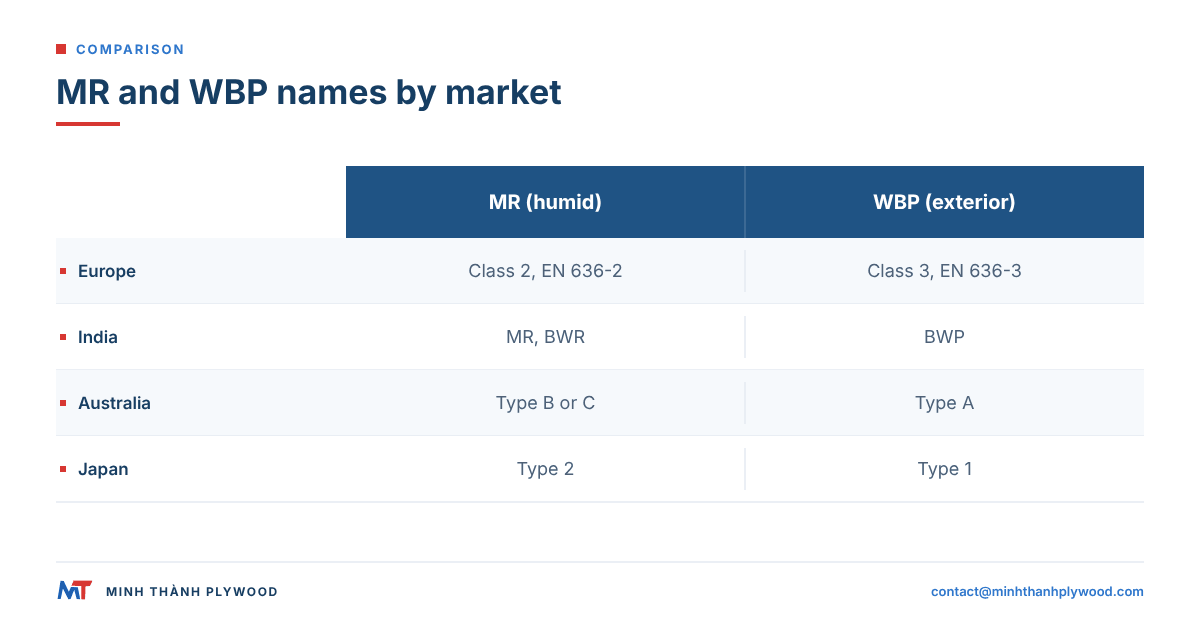
Each market has its own name for the humid-interior bond and the exterior bond. The table maps them so an order from any market can be written in the same two lines.
| Market | Humid-interior bond (MR) | Exterior, boil-proof bond (WBP) | Standard |
|---|---|---|---|
| Europe | Bond class 2, EN 636-2 | Bond class 3, EN 636-3 | EN 314-2, EN 636 |
| United Kingdom | MR | WBP | EN 314-2 class 2 and 3 today |
| India | MR, BWR (boiling water resistant) | BWP (boiling water proof) | IS 303; IS 710 for marine |
| Australia and New Zealand | Type B or C bond | Type A bond (phenolic) | AS/NZS 2754.1; AS/NZS 2271 exterior |
| United States | Exposure 1, for temporary weather | Exterior | PS 1 |
| Japan | Type 2 | Type 1 (and Special) | JAS |
The names differ, the logic does not: a melamine-fortified bond for humidity, a phenolic bond for weather. When a buyer writes “type 1 plywood” or “BWP”, the line on our quotation reads WBP phenolic, EN 314-2 class 3.
How do you tell WBP from MR glue?
Tell WBP from MR first by the glue line colour, then prove it with a boil test. Phenolic WBP glue leaves a dark brown line between plies; MR and UF glue lines are light. Colour cannot tell MR from plain UF, and a dark line can come from a dyed glue, so the boil test settles it.
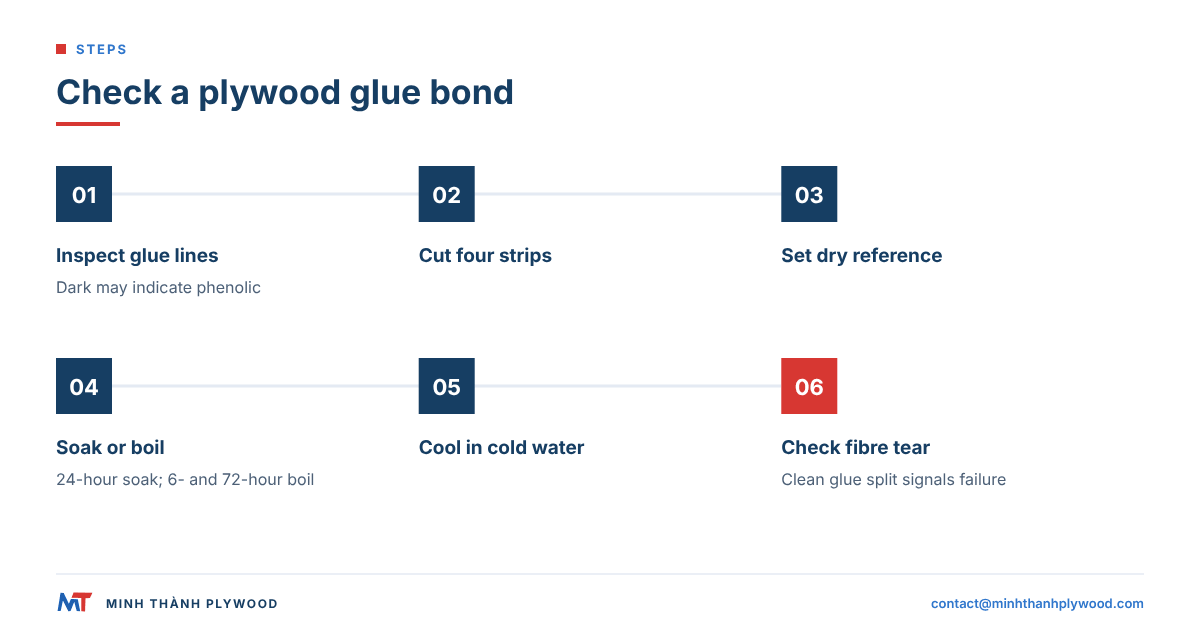
A simple boil check on a sample, four steps:
- Cut four strips about the width of a hand from different sheets.
- Soak one in cold water for 24 hours, boil one for 6 hours, boil one for 72 hours, keep one dry as the reference.
- Let them cool in cold water, then try to split the plies with a chisel at the glue line.
- Judge the break: a good bond tears wood fibres; a failed bond separates cleanly at the glue.
UF should pass the soak, MR the 6-hour boil and WBP the 72-hour boil. A buyer test is a check, not a certificate; for a formal result, a laboratory runs EN 314 on the panel.
Which glue is correct for concrete formwork?
WBP phenolic glue is correct for concrete formwork, under a phenolic film face. Formwork is wet, alkaline, vibrated and reused: a boil-proof phenolic bond gives the most pours (up to about 25), while a melamine-fortified build suits formwork with fewer pours (about 12–15), with proper handling, release agent and edge sealing.
The glue shows in the number of reuses. With proper handling, release agent and edge sealing, film-faced plywood bonded with melamine-fortified glue reaches about 12–15 reuses, and with phenolic glue up to about 25. Reuse also depends on the core, the film weight and how the panels are transported and stored, so it is a target for a given build and site practice, not a fixed property of the sheet.
Minh Thanh’s film-faced plywood is quoted with the glue and film named on separate lines, so the buyer chooses between a lower-cost MR build for fewer pours and a WBP build for more.
Does WBP glue cost more than MR?
WBP glue costs more than MR, for three reasons: phenolic resin costs more than melamine-fortified urea resin, phenolic glue presses hotter and longer, and the dark glue line limits WBP panels to uses where edges are covered or not visible.
The saving from MR is real only where MR does the job. Over-specifying WBP for kitchen cabinets pays for a boil-proof bond that will never meet boiling water. Under-specifying MR for formwork or exterior sheathing costs far more, in delaminated panels and replaced work.
How much more? A manufacturer comparison puts phenolic glue itself at roughly 50–80 % above MR and melamine glue, and the finished phenolic panel at about 10–18 % above an MR panel of the same thickness (plywood.cc, undated page, so read it as a range to test against quotations). The panel premium is smaller than the glue premium because glue is a minor share of the panel cost; longer pressing and thicker core veneers add the rest. At the US$350/m³ furniture starting price below, a 10–18 % step is US$35–63/m³.
The right way to compare quotations is by bond class, not by the word on the invoice. As an indicative start in October 2026, Minh Thanh’s commercial plywood starts from US$250/m³ and furniture and interior plywood from US$350/m³; the glue is one of the lines that sets the final price.
Is WBP plywood waterproof?
WBP plywood has a waterproof bond, not waterproof wood. Waterproof plywood grades are really bond grades: the WBP glue line survives boiling, but the veneers still absorb water, swell, grey in the sun and, in non-durable species, decay without protection.
For outdoor use, three things keep WBP plywood sound:
- a coating on faces, such as paint, stain or film;
- sealed edges, where water enters fastest;
- detailing that lets water run off rather than stand.
Marine plywood adds durable species and a gap-free core to the WBP bond, for boats and permanently wet structures. For moisture-resistant fibreboards and how they compare with plywood, see moisture-resistant MDF.
How do you write the glue on a purchase order?
Write the glue by resin and bond class, then the emission class on its own line. Five lines settle it:
- Resin: UF, MR (melamine-fortified) or WBP (phenolic).
- Bond class: EN 314-2 class 1, 2 or 3, or the market equivalent (BWR, BWP, type A, type 1).
- Emission: E0, E1 or CARB P2 / TSCA Title VI, with the test method.
- Use: the application in a few words, so the mill can flag a mismatch.
- Test on request: EN 314 or the buyer’s boil test on the pre-shipment sample.
Write the face, core, thickness, tolerance and packing on their own lines, as on any plywood order.
What to send for a quotation
Send the bond line with the rest of the specification and we quote within hours. A prefilled line for kitchen carcasses reads:
- Application: kitchen carcasses, humid interior
- Core: white Styrax or Eucalyptus, stitched, pressed twice
- Glue and emission: MR melamine-fortified bond, EN 314-2 class 2; emission E0 to the buyer’s method
- Face: poplar, birch or EV, grade pair to sample, sanded
- Size and thickness: 1220 × 2440 mm, 18 mm, ±0.2 mm
- Packing and quantity: export packs, one 40HC, port of discharge
For exterior or formwork panels, change the glue line to WBP phenolic, class 3, and the face to C/D or film. Production takes 15–45 days after the 30% deposit, and samples are free. Send it through the quotation form or to contact@minhthanhplywood.com.
Buyer questions, answered
What is the main difference between WBP and MR glue in plywood?
MR glue is melamine-fortified urea-formaldehyde that resists humidity and short wetting; WBP glue is phenol-formaldehyde that survives boiling water and weather. MR is for humid interiors, WBP for exterior and wet uses.
Can I use MR glue plywood in high-humidity environments?
Yes. Kitchens, bathrooms and humid furniture are what MR plywood is made for. Seal cut edges and keep it out of standing water and the weather, where it needs a WBP bond.
Which glue type is correct for concrete formwork?
WBP phenolic glue, usually under a phenolic film face. Formwork is wet, alkaline and reused: a boil-proof phenolic bond gives the most pours (up to about 25), while a melamine-fortified build suits formwork with fewer pours (about 12–15).
Does WBP glue cost more than MR?
Yes. Phenolic resin costs more than melamine-fortified urea resin, and WBP presses hotter and longer, at 130–145 °C against 110–120 °C for MR. Pay for WBP where water or weather requires it.
How do I identify WBP vs MR glue by inspection?
Look at the glue lines on the edge: phenolic WBP glue leaves dark brown lines, MR glue light ones. To prove the bond, boil a strip from the sample for 72 hours and try to split the plies.
Is WBP plywood waterproof?
The WBP bond is boil-proof, but the wood is not. WBP plywood resists delamination in water; the faces and edges still need a coating outdoors to stop the wood from weathering.
What is the difference between interior and exterior plywood?
The glue bond. Interior plywood uses UF or MR glue for dry or humid rooms; exterior plywood uses a WBP phenolic bond that survives weather and boiling water.
Is MR plywood the same as BWR plywood?
They are close relatives. BWR (boiling water resistant) is the Indian name for a melamine-fortified bond stronger than plain interior MR; both stop short of the boil-proof WBP bond.
What is type 1 plywood?
In Japan, Type 1 is the exterior, boil-resistant bond, close to WBP; Type 2 is the humid-interior bond, close to MR. In Europe the matching labels are EN 314-2 class 3 and class 2.
Is E0 a glue type?
No. E0 is an emission class, how much formaldehyde the finished panel releases. UF, MR and WBP are glue types; the order needs one line for each.
What thickness of moisture resistant plywood do kitchens use?
18 mm is the usual carcass thickness. In a Vietnamese furniture panel it has 11–13 plies, and an MR bond with sealed edges covers the humidity under sinks and around dishwashers.