
The best plywood in the world depends on the job: Finland and the Baltic states make the reference birch plywood, Chile and Brazil the leading pine plywood, Indonesia and Malaysia tropical hardwood panels, and Vietnam furniture and formwork plywood on plantation hardwood cores. Minh Thanh Plywood, a Vietnamese manufacturer for European furniture buyers, compares fourteen origins on species, use, trade rules and what to check.
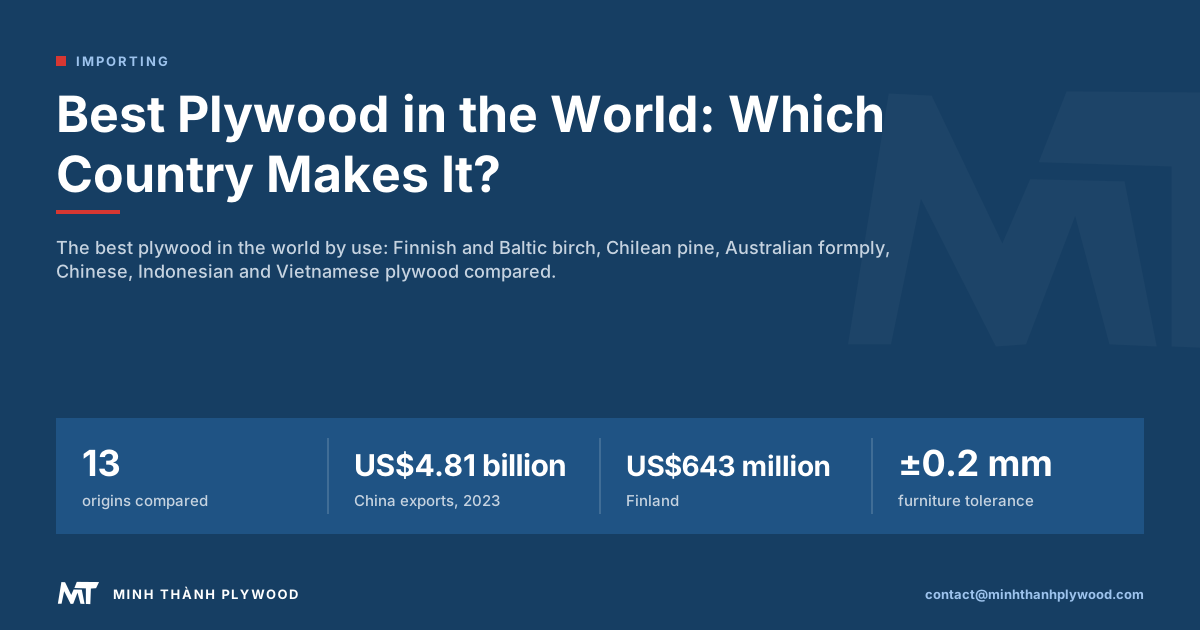
What is the best plywood in the world?
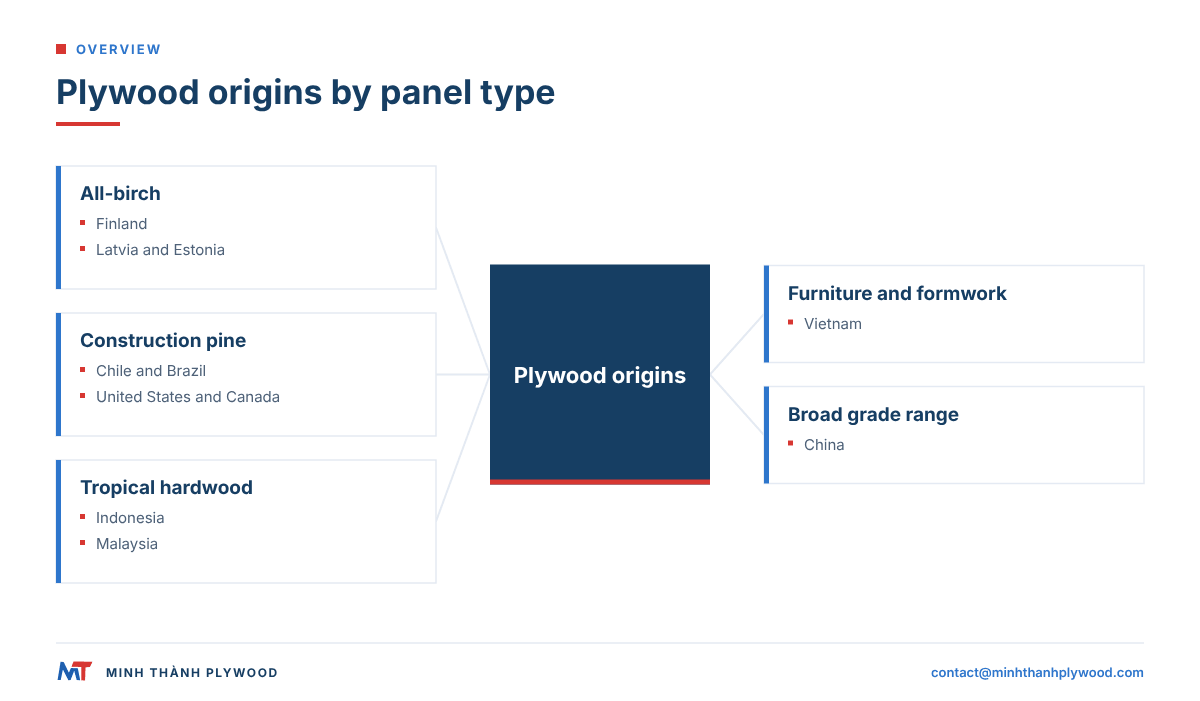
The best plywood in the world is the panel built for your job, and different countries lead in different jobs: birch from Finland and the Baltics, pine from Chile and Brazil, tropical hardwood from Indonesia and Malaysia, and plantation-core furniture and formwork plywood from Vietnam. No country is best at every panel.
- Birch plywood for stiffness and edges: Finland, Latvia, Estonia.
- Pine plywood for construction: Chile, Brazil, the United States, Canada.
- Tropical hardwood plywood: Indonesia, Malaysia.
- Furniture and formwork plywood on plantation hardwood cores: Vietnam.
- Widest range at every price: China.
The rest of this guide compares fourteen origins on the same criteria and gives a verdict by use.
How to judge the best plywood: seven criteria
Judge plywood by seven criteria that you can measure: core, glue, face, thickness tolerance, emission, certificates and consistency between shipments. The country on the label tells you none of these on its own.
- Core: species, density, number of plies and whether the core layers are gap-free.
- Glue: UF, melamine-fortified (MR) or phenolic (WBP), chosen for the exposure.
- Face: species, grade and veneer thickness, usually 0.2–0.5 mm.
- Thickness tolerance: ±0.2 mm on top furniture panels, ±0.5 mm on commercial and film-faced panels.
- Emission: CARB P2 / TSCA Title VI for the United States; E1 or a REACH test for Europe.
- Certificates and documents: quality management, chain of custody, timber origin files.
- Consistency: the same panel in the tenth container as in the sample.
A sample can be measured, cut and boiled in a day. Do that for every origin you compare, and the “best country” question becomes a question about one mill’s panel.
Plywood quality by country: comparison table
The table compares fourteen plywood origins on main species, the use each does best, its relative price position and the trade point a buyer checks. Price positions are relative to each other, not quotes.
| Origin | Main species | Best known for | Price position | Trade point to check |
|---|---|---|---|---|
| Finland | Birch, spruce | All-birch and film-faced birch panels | Premium | None for EU buyers |
| Latvia, Estonia | Birch | All-birch panels | Premium | None for EU buyers |
| Chile | Radiata pine | Pine plywood for construction and industry | Mid | Structural marks per market |
| Brazil | Plantation pine | Pine plywood for construction and industry | Mid | Structural marks per market |
| Russia | Birch | All-birch panels | Not available in the EU | EU import ban since 2022 |
| China | Poplar, eucalyptus, mixed hardwood | Every grade, decorative to formwork | Wide range | EU and US anti-dumping duties |
| Indonesia | Tropical hardwood, plantation species | Tropical hardwood plywood, floor base | Mid | Timber legality documents |
| Malaysia | Tropical hardwood | Tropical hardwood plywood, floor base | Mid | Timber legality documents |
| Vietnam | Acacia, eucalyptus, Styrax | Furniture, interior and film-faced plywood | Mid | US duty cases since 2023 |
| India | Mixed hardwood, gurjan faces | Domestic furniture and interiors | Domestic market | Local standards IS 303, IS 710 |
| Korea | Imported and local cores | Domestic construction and interiors | Domestic market | Mostly an importer |
| Thailand | Rubberwood, mixed hardwood | Domestic and regional panels | Mid | Small plywood exporter |
| Türkiye | Poplar, birch | Regional and decorative panels | Mid | EU measures on re-routed birch plywood |
| Australia, New Zealand | Radiata pine, hoop pine | Structural plywood and F17 formply | Mid to premium | AS/NZS 2269 branding on every sheet |
The table shows a pattern: premium origins are those with one species and a long history in one panel type, while large origins such as China and Vietnam make many grades at many prices. With a large origin, the mill matters more than the country.
Finnish and Baltic birch plywood
Finnish and Baltic birch plywood is the reference for all-birch panels: thin birch veneers throughout the panel give high stiffness, clean edges and a uniform face, valued in furniture, vehicle floors and formwork. Finland exported US$643 million of plywood in 2023 and Latvia US$373 million, according to UN Comtrade data analysed by TrendEconomy.
- Strengths: all-birch construction, many thin plies, stiff and stable, edges that can stay visible.
- Typical uses: furniture with exposed edges, transport floors, film-faced formwork, laser cutting.
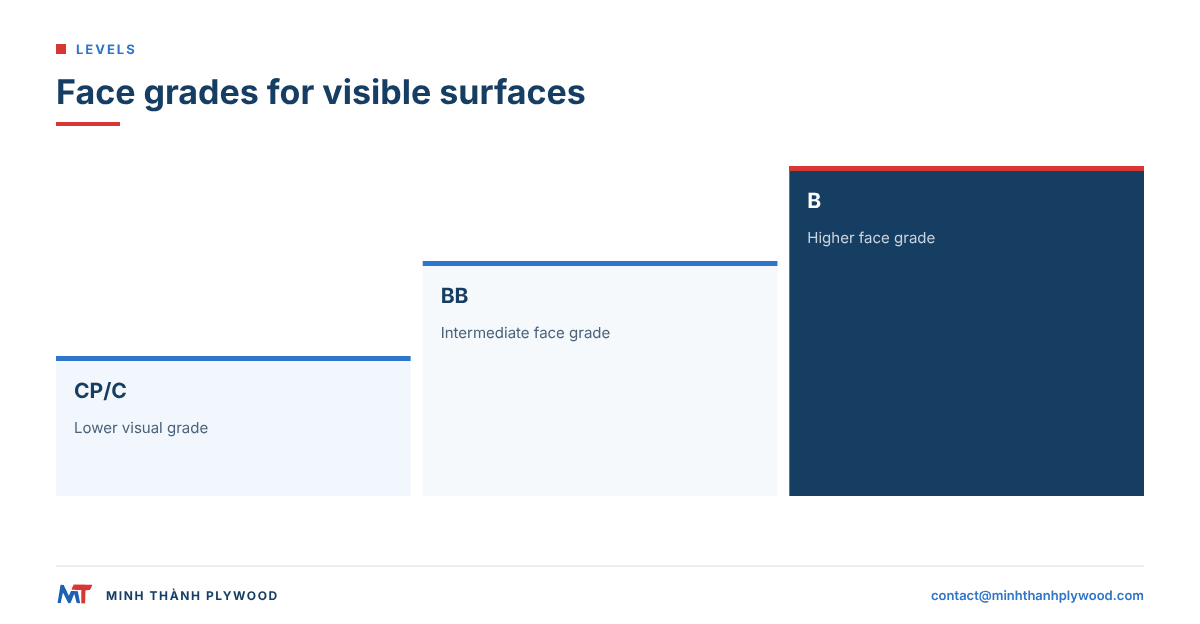
- What to check: the face grade on the European scale (B, BB, CP, C) and the glue class.
Supply of all-birch panels tightened after Russian birch plywood left the EU in 2022. A birch-faced panel, with a birch face on another core, gives a birch look at a lower weight and price. Our birch-faced panels use D+, D and E factory face grades, comparable to the European ladder: D+ ≈ B, D ≈ BB, E ≈ CP/C. See birch-faced plywood.
Brazilian plywood and Chilean pine plywood
Brazilian plywood and Chilean plywood are mainly plantation pine plywood, made in large mills for construction, packaging and industrial uses in the Americas and Europe. Brazil exported US$695 million of plywood in 2023 and Chile US$405 million.
- Species: plantation pine in Brazil; radiata pine in Chile.
- Panels: structural and sheathing plywood, concrete form panels, industrial and packing plywood.
- Markets: the United States, Europe and Latin America; Brazil supplied 9.9% of UK plywood imports by value in 2023.
- What to check: the structural mark your market requires, such as PS 1 in the United States or CE marking to EN 13986 in Europe, and the moisture content on arrival.
Pine plywood is lighter and softer than hardwood plywood. It suits structural and industrial work; for fine furniture with a sanded face, buyers usually pick birch or a hardwood-faced panel.
Chinese plywood
Chinese plywood covers every grade and price, from single-use formwork and packing panels to premium decorative plywood. China shipped US$4.81 billion in 2023, about 34% of world plywood exports.
- Cores: poplar, eucalyptus and mixed hardwood; combination cores with hardwood outer plies.
- Strengths: scale, range of faces and sizes, fast response.
- What to check: the core and glue of the exact offer, the emission certificate, and duties at your destination.
Trade measures apply in two of the largest markets. In the EU, Regulation (EU) 2025/2333 sets anti-dumping duties of 43.3% and 86.8% on hardwood plywood from China within its scope (read 20 October 2026). The United States applies anti-dumping and countervailing duties on Chinese hardwood plywood under orders issued in 2018.
Indonesian and Malaysian plywood
Indonesian and Malaysian plywood is known for tropical hardwood panels: dense, strong plywood for construction, floor base and concrete forms, sold widely to Japan, Korea, the Middle East and Europe. Indonesia exported US$1.73 billion of plywood in 2023 and Malaysia US$545 million.
- Species: tropical hardwoods and, increasingly, plantation species.
- Panels: construction plywood, floor base plywood, concrete panels, marine and decorative grades.
- Markets: Japan, Korea, the United States, the Middle East, Europe.
- What to check: timber legality documents and species declarations, which your importer needs for due diligence.
Both countries have long plywood industries and large export mills. For buyers who want a tropical hardwood panel, they are the natural first origins.
Vietnamese plywood
Vietnamese plywood is furniture, interior, film-faced and commercial plywood built on plantation acacia, eucalyptus and Styrax cores. Its supply to Europe is growing fast: the ITTO market report for 16–30 September 2026 puts EU+UK imports from Vietnam at close to 229,000 m³ in the first half of 2026, against fewer than 29,000 m³ a year earlier. Vietnam’s customs declarations add up to about US$1.02 billion of plywood exports in 2024.
- Cores: acacia, eucalyptus and white Styrax, grown in Vietnam; no poplar or birch cores.
- Faces: birch, poplar, EV, okoume, pine, bintangor, eucalyptus and others, glued on as veneers.
- Strengths: furniture panels with tight tolerance, film-faced panels on dense cores, flexible faces and sizes.
- What to check: the duty cases on hardwood and decorative plywood from Vietnam in the United States, and the mill’s own certificates.
At our factory, furniture panels are pressed twice as standard: the core board is pressed and calibrated, then the face and back are pressed on. Core layers are stitched both horizontally and vertically, sanded panels hold ±0.2 mm, and UF glue at E0 emission is standard. Six third-party chamber tests (ASTM D6007) between April 2025 and June 2026 on 9, 15 and 18 mm panels averaged 0.014–0.032 ppm, against the CARB Phase 2 limit of 0.05 ppm. Read more in is Vietnamese plywood good quality.
Korean plywood: what Korea makes and buys
Korean plywood is mostly imported plywood: Korea has a domestic panel industry but buys large volumes from Vietnam, Indonesia, Malaysia and China. In the first half of 2026 Korea was the largest buyer of Vietnamese plywood, with US$113 million.
- What Korea buys from Vietnam: 48% commercial plywood without a named face and 21% Bintangor-faced plywood, by value.
- Volume: about 434,000 cubic metres of Vietnamese plywood in six months, the largest of any market.
- Uses: construction, interiors, furniture and packaging.
For a buyer outside Korea, “Korean plywood” rarely means a Korean export panel; Korean mills serve their home market first. The panels Korea imports show which origins its buyers trust for repeat volume. See who imports plywood from Vietnam for the full table.
Indian, Thai and Turkish plywood
Indian, Thai and Turkish plywood serve mainly their home and regional markets: India has a large domestic plywood industry with its own standards, Thailand is a larger producer of other wood panels than of plywood, and Türkiye supplies poplar and decorative panels to nearby markets.
- India: domestic furniture and interior plywood graded to Indian standards such as IS 303 and IS 710, often with gurjan faces. India also imports plywood and LVL, including from Vietnam.
- Thailand: rubberwood-based panel industry; plywood is a smaller part of its exports.
- Türkiye: poplar and decorative plywood for regional furniture markets. The EU extended its anti-dumping measure on birch plywood from Russia to consignments from Türkiye and Kazakhstan under Regulation (EU) 2024/1287 (read 20 October 2026), so European buyers check the origin of Turkish birch panels.
These origins can be good choices close to home; for long-haul furniture programmes buyers more often compare Europe, Vietnam, China and Indonesia.
Australian and New Zealand plywood: AS/NZS 2269 and F17 formply
Australian and New Zealand plywood is best known for structural plywood and formply made from plantation radiata pine and, in Queensland, hoop pine, graded and branded to AS/NZS 2269. For formwork the F17 stress grade is the common order, and AS 6669 adds the formply requirements.
- Standards: AS/NZS 2269.0:2012 sets the manufacture, grading, finishing and branding of structural plywood (checked on 21 October 2026). AS 3610 requires formwork plywood to be structurally rated to it.
- Branding: each sheet carries its stress grade (for example F11, F14 or F17), bond type and standard number. The EWPAA (Engineered Wood Products Association of Australasia) publishes the conformance and branding rules (checked on 21 October 2026).
- Known makers: Austral Plywoods and Big River Group in Australia; Carter Holt Harvey (Ecoply) in New Zealand.
- Imports: Australia imported about US$450 million of plywood in 2023, and imported formply from Asia must carry the same branding; NT WorkSafe has warned about panels sold as F17 that failed testing (read 21 October 2026).
For an Australian buyer, the best plywood is a branded AS/NZS 2269 panel for structure and formwork, and a sanded furniture panel with a CARB P2 or E0 test report for joinery and cabinets. Our plywood prices in Australia and New Zealand guide gives the landed figures.
Russian plywood after the 2022 ban
Russian birch plywood was a large source of all-birch panels before 2022, but the EU has banned imports of Russian wood products, plywood included, since 9 April 2022. Council Regulation (EU) 2022/576 added chapter 44 wood products to the ban (read 20 October 2026), and the UK applies a similar ban.
- Effect on supply: European buyers moved birch purchases to Finland, the Baltic states and other origins, and part of the demand to birch-faced and other hardwood plywood.
- Re-routing risk: the European Commission warns about Russian plywood relabelled through third countries, so buyers check the origin documents of any birch panel.
- Elsewhere: Russian plywood still trades to markets without such bans.
For a European buyer today, the practical question is not whether Russian plywood was good but which available panel replaces it in each use.
Which country makes the best plywood for each use?
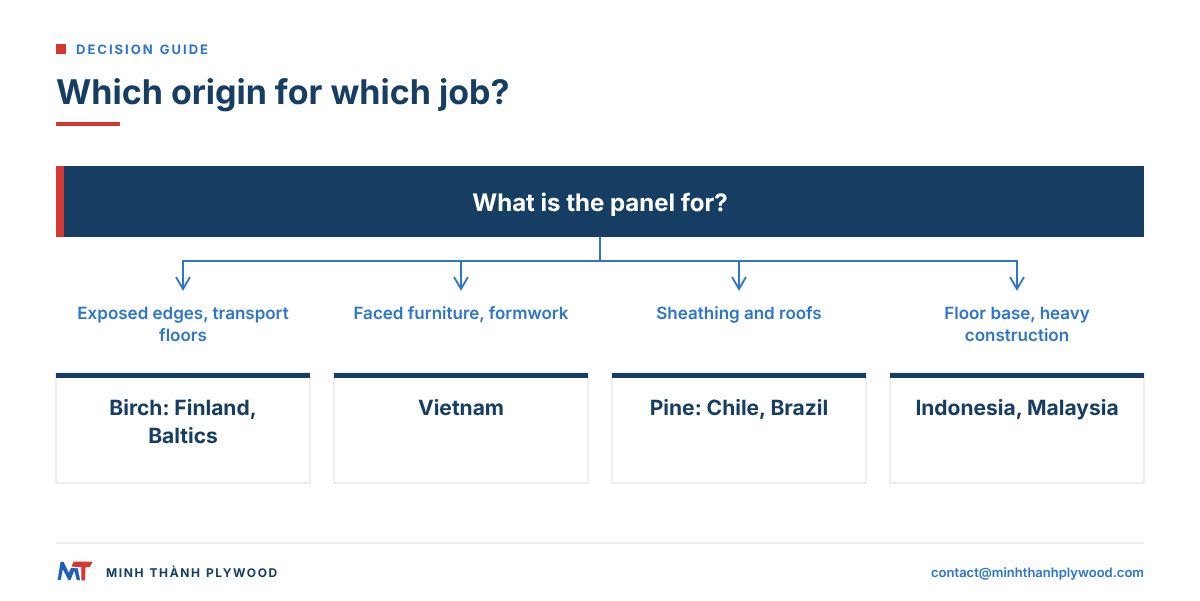
The best origin depends on the use: birch from Finland and the Baltics for exposed edges and transport floors, Vietnamese plywood for furniture and formwork, Chilean and Brazilian pine for structural work, and Indonesian and Malaysian hardwood for floor base and heavy construction.
| Use | Strong origins | Why |
|---|---|---|
| Furniture with exposed edges | Finland, Latvia, Estonia | All-birch plies show a clean edge |
| Furniture and cabinets, faced and coated | Vietnam, Finland, China | Sanded faces, tight tolerance, many faces |
| Painted and coated furniture parts | Vietnam | Calibrated cores, faces ready for the buyer’s coating |
| Concrete formwork | Vietnam, Finland, China | Dense cores, phenolic film, many pours |
| Structural sheathing and roofs | Chile, Brazil, United States, Canada | Pine plywood with structural marks |
| Floor base and heavy construction | Indonesia, Malaysia | Dense tropical hardwood |
| Packing and crates | Vietnam, China | Cost-effective cores in volume |
| Lightweight furniture panels | Vietnam on Styrax core | Styrax at 500 kg/m³ reference density |
At 18 mm and 1220 × 2440 mm, a Styrax-core sheet weighs about 26.8 kg and a Eucalyptus-core sheet about 34.8 kg at reference densities, so core choice also changes freight and handling.
Which brand of plywood is best? How to compare manufacturers
No single plywood brand suits every job. Choose the manufacturer whose panel matches your specification and proves it, shipment after shipment, with certificates, test reports and samples. The best-known brands each lead in one panel type, so compare a brand inside its own specialty.
| Brand | Home origin | Known for |
|---|---|---|
| UPM Plywood (WISA) | Finland | Birch and spruce plywood, film-faced and transport panels |
| Metsä Wood | Finland | Birch and spruce plywood, Kerto LVL |
| Latvijas Finieris (Riga Wood) | Latvia | All-birch plywood, film-faced and floor panels |
| Arauco | Chile | Radiata pine plywood for construction and industry |
| Weyerhaeuser, Georgia-Pacific, Boise Cascade | United States | Softwood structural plywood to PS 1 |
| West Fraser | Canada | Softwood plywood and engineered wood |
| Austral Plywoods, Carter Holt Harvey | Australia, New Zealand | Structural plywood and formply to AS/NZS 2269 |
| Sveza | Russia | All-birch plywood; not available in the EU since 2022 |
Online “top 10 plywood manufacturers” lists rank these names differently, because no public source measures every company’s output. A brand name also does not travel with every panel: for furniture plywood from Asia, the mill’s own certificates and your sample test are the brand check.
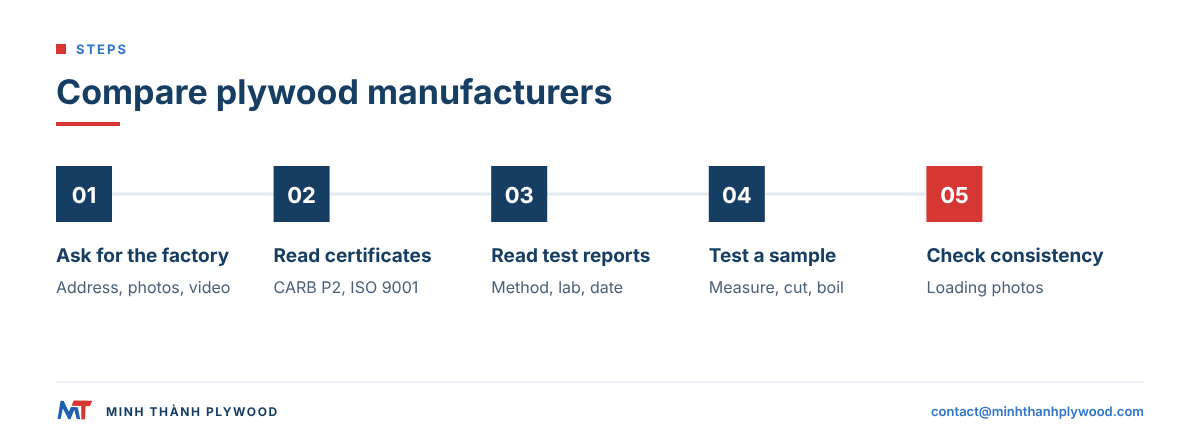
- Ask for the factory: address, production photos and video.
- Read the certificates: emission (CARB P2 / TSCA Title VI), quality management (ISO 9001), chain of custody if you need it.
- Read the test reports: method, laboratory, date and panel thickness.
- Test a sample: thickness at several points, ply count, boil test, machining and coating.
- Check consistency: ask for loading photos and compare the first container with the sample.
We are a manufacturer, not a trading company: our certificates are CARB P2 / TSCA Title VI (ICTT mill no. 23024), ISO 9001:2015 and TCVN 11902:2017, and every shipment is photographed and filmed before loading, with the photos and video sent to the buyer.
Glue and emission: the specification that beats the country
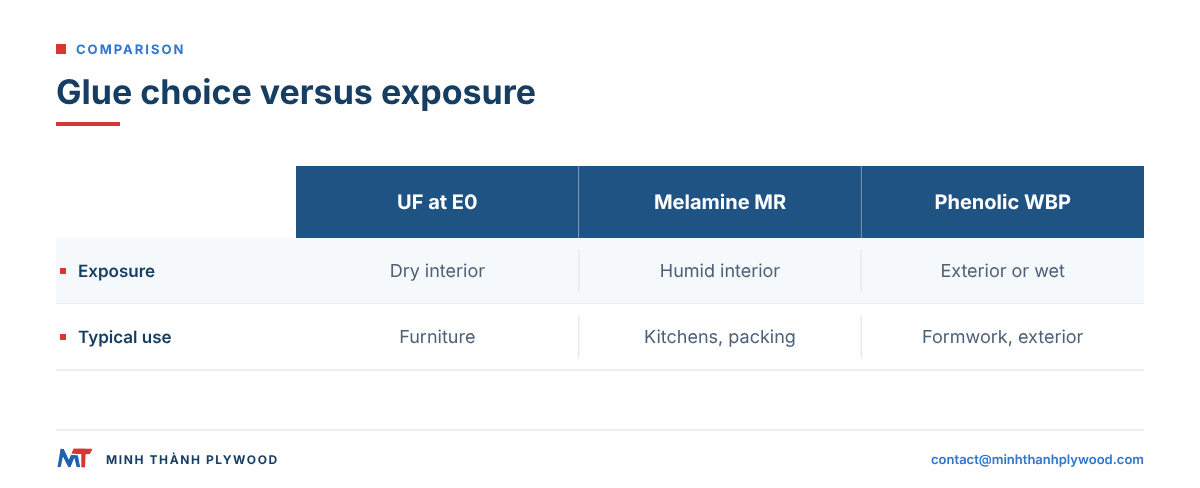
The glue decides where plywood can be used, and the emission class decides where it can be sold, so both matter more than the country of origin. Write them as two separate lines on the order.
| Glue | Exposure | Typical use |
|---|---|---|
| UF glue at E0 emission | Dry interior | Furniture, cabinets, interior panels |
| Melamine-fortified (MR) | Humid interior | Kitchens, bathrooms, packing, medium-reuse formwork |
| Phenolic (WBP) | Exterior and wet | Concrete formwork, exterior use |
As a guide, melamine-fortified glue gives film-faced plywood about 12–15 uses and phenolic glue up to about 25, with proper handling, release agent and edge sealing. Emission is a separate line: E0, E1 or CARB P2 describe formaldehyde release, not the glue’s water resistance.
What this means for your plywood order
Choose the origin that leads in your panel type, then choose the mill inside it by sample and documents. For furniture and interior plywood with European documents, send us your specification and compare our sample with your current panel.
Our factory in Ha Hoa, Phu Tho makes top-grade furniture and interior plywood, with Europe as our main market and repeat orders into Italy, at 50,000+ m³ a year.
- Application: furniture, cabinets, interiors, formwork or packing.
- Core: Styrax or Eucalyptus; Acacia and Pine on order.
- Glue and emission: UF glue at E0 emission; MR or WBP to your specification.
- Face: birch, poplar, EV, okoume, pine and 10+ face veneers, with the face/back grade.
- Size and thickness: 1220 × 2440 mm or 1250 × 2500 mm, 3–40 mm.
- Packing and quantity: from one 40HC, mixed specifications by agreement; destination port.
Free samples are available. See furniture plywood from Vietnam, read the best plywood for furniture, or see where plywood is produced for the trade figures behind this guide.
Buyer questions, answered
Which country has the best plywood in the world?
No single country makes the best plywood for every use. Finland and the Baltic states set the reference for birch plywood, Chile and Brazil for pine plywood, and Vietnam is a strong origin for furniture and film-faced plywood on dense plantation cores.
What is the best plywood in the world for furniture?
For furniture, the best plywood has a flat, sanded face, a tight thickness tolerance, a void-free core and low formaldehyde emission. All-birch plywood from Finland or the Baltics and furniture plywood from Vietnam with birch, poplar or EV faces both meet that brief.
Which brand of plywood is best?
The best-known plywood brands lead in one panel type each: UPM (WISA) and Metsä Wood for Finnish birch and spruce, Latvijas Finieris (Riga Wood) for Baltic birch, Arauco for Chilean pine, and Weyerhaeuser, Georgia-Pacific, Boise Cascade and West Fraser for North American softwood plywood. For your order, choose the mill whose panel matches your specification and proves it with certificates and a tested sample.
What is the best plywood in Australia?
In Australia the best plywood for building and formwork is structural plywood branded to AS/NZS 2269, with formply also branded to AS 6669; F17 is the stress grade most formwork crews ask for. For furniture and joinery, Australian buyers use imported birch and hardwood-faced panels from Europe and Asia.
Who is the largest plywood manufacturer in the world?
By country, China exported US$4.81 billion of plywood in 2023, about 34% of world plywood exports. No public ranking measures every plywood company's output, so company league tables online are estimates.
Is Brazilian plywood good?
Brazilian plywood is mainly plantation pine plywood, made in large volumes for construction and industrial uses in the Americas and Europe. Brazil exported US$695 million of plywood in 2023.
Is Korean plywood good?
Korea makes some plywood but imports most of what it uses. In the first half of 2026 Korea bought US$113 million of plywood from Vietnam, more than any other country, mostly commercial and Bintangor-faced panels.
Is Vietnamese plywood good quality?
Vietnamese plywood ranges from packing grade to top furniture grade, built on acacia, eucalyptus and Styrax cores. Furniture-grade panels are pressed twice and sanded to a thickness tolerance down to ±0.2 mm at mills like ours.
Is Chinese plywood bad?
Chinese plywood covers every grade, from single-use panels to premium decorative plywood. Judge each offer by core, glue, emission certificate and a tested sample, and check the trade measures at your destination.
Can I still buy Russian birch plywood in Europe?
No. The EU has banned imports of Russian wood products, plywood included, since 2022 under Regulation (EU) 2022/576. European buyers now source birch plywood from Finland, the Baltic states and other origins.
Which glue makes the best plywood?
The best glue depends on exposure: UF glue at E0 emission for dry interior furniture, melamine-fortified (MR) for humid interiors, and phenolic (WBP) for exterior use and concrete formwork.