
For most furniture parts the best Baltic birch plywood supplier is a birch-faced manufacturer: Minh Thanh Plywood gives the same D+/D (about B/BB) birch face, ±0.2 mm tolerance and 26.8 kg per 18 mm sheet on a Styrax core, against about 36 kg for all-birch. Keep an all-birch mill or stockist only where the layered edge is the design or a few sheets are needed this week.
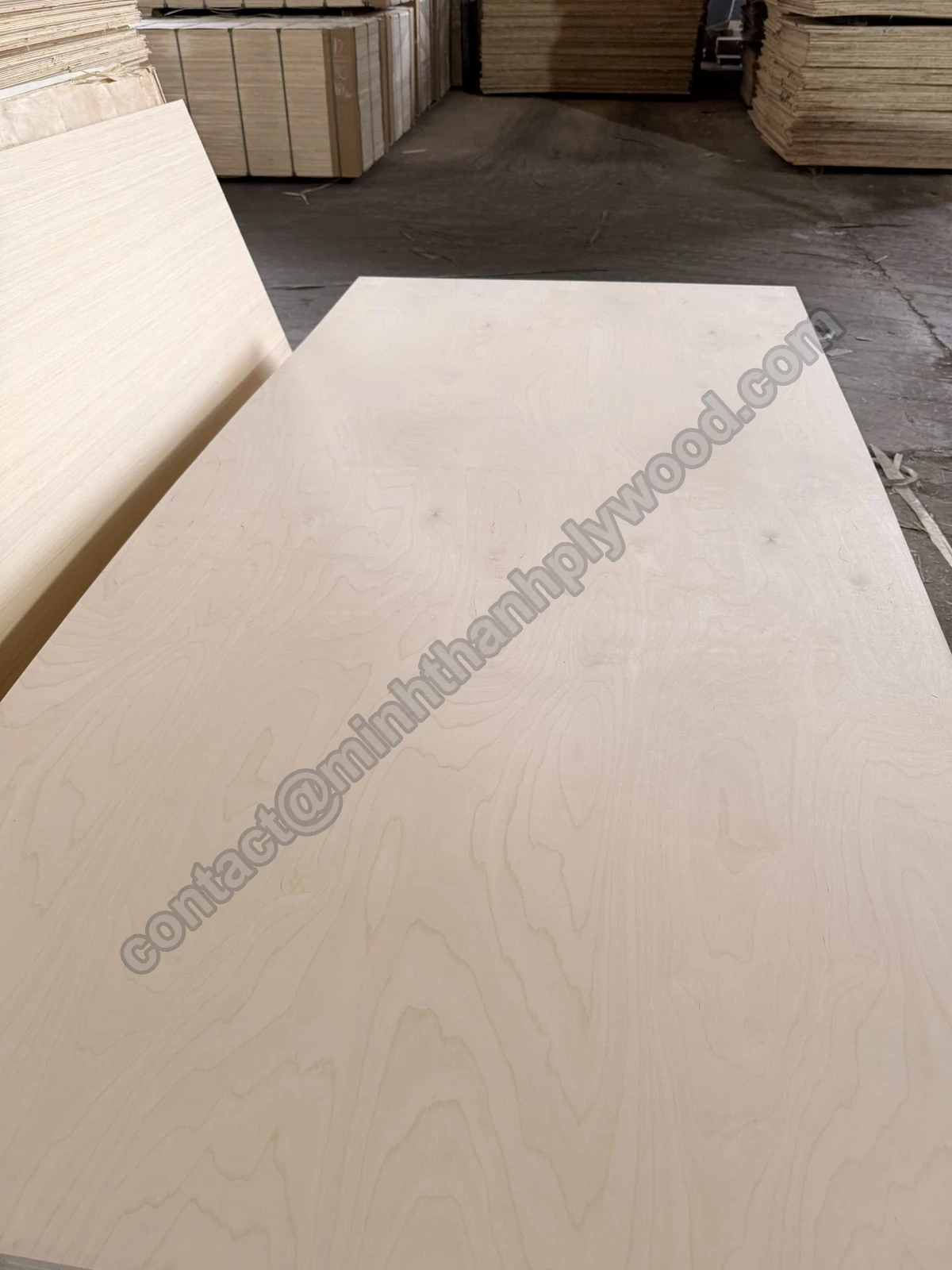
Where is Baltic birch plywood for sale for your order size?
Baltic birch plywood for sale reaches buyers through three routes; buy through the supply route which matches the quantity, urgency and product identity you need. A specialist stockist suits a few sheets or an immediate workshop job. A regional importer can replenish a production line, while an identified mill suits a qualified repeat volume order.
Start with the component rather than a list of companies. Write down whether the drawing requires all-birch internal veneers, an exposed layered edge, a particular finish or a tested panel performance. That tells you which supplier offers can enter the comparison. A birch face alone is insufficient for a drawing that requires an all-birch construction.
For a local search, give the supplier your delivery area and ask what is physically available in the requested thickness, format and face/back grade. Ask whether the quote covers full sheets, cut panels or finished pieces. A stock page without those details is only the start of the buying conversation.
For an import order, identify the producing mill and the offered product before negotiating a shipment. A good quotation connects its construction declaration with the sample, order code and pack labels. That connection is what purchasing needs to repeat the same panel after the first successful run.
What must “Baltic birch” mean in your purchase order?
Define Baltic birch in the order as the actual construction and product identity you require. If every internal veneer must be birch, write that requirement explicitly. A geographic trade name is less precise than an identified producer, declared species and agreed layup.
The all-birch distinction matters because furniture plywood can use birch faces over another core. Both constructions have legitimate applications. The buying error occurs when the order assumes one construction and the delivered panel has another. Separate the decorative face from the internal species before comparing appearance or machining.
The manufacturer’s WISA birch construction reference, accessed 8 October 2026, describes its birch panels as using the same species through the panel. That is a useful example of a specific all-birch product declaration. Apply the offered producer’s own documentation to your order.
| Specification | Typical all-birch (Baltic birch) | Minh Thanh birch-faced |
|---|---|---|
| Core | Birch veneers throughout | White Styrax or Eucalyptus, stitched both ways |
| Formats | 1525 × 1525, 1220 × 2440, 1250 × 2500 mm | 1220 × 2440, 1250 × 2500 mm; 1220 × 2500 and 1220 × 2280 mm custom |
| Plies | 5 at 6.5 mm, 9 at 12 mm, 13 at 18 mm | Built to thickness, 3–40 mm |
| Density | About 680 kg/m³ | 500 kg/m³ Styrax; 650 kg/m³ Eucalyptus |
| 18 mm sheet, 1220 × 2440 mm | About 36.4 kg | 26.8 kg Styrax; 34.8 kg Eucalyptus |
| Face grades | B, BB, CP, C | D+, D, E (D+ ≈ B, D ≈ BB, E ≈ CP/C) |
| Thickness tolerance | Producer schedule | ±0.2–0.3 mm sanded, down to ±0.2 mm |
The table shows where the alternative earns its place: same face grade, tighter calibration, a lighter sheet and more sheets per container. The Baltic birch plywood guide covers the all-birch product in depth.
Minh Thanh’s birch-faced plywood is a different furniture construction (compare them in birch vs Baltic birch plywood): birch faces over Styrax or Eucalyptus cores. Use it for cabinet carcasses, shelves, doors and painted or edge-banded parts; keep the all-birch route for exposed layered edges.
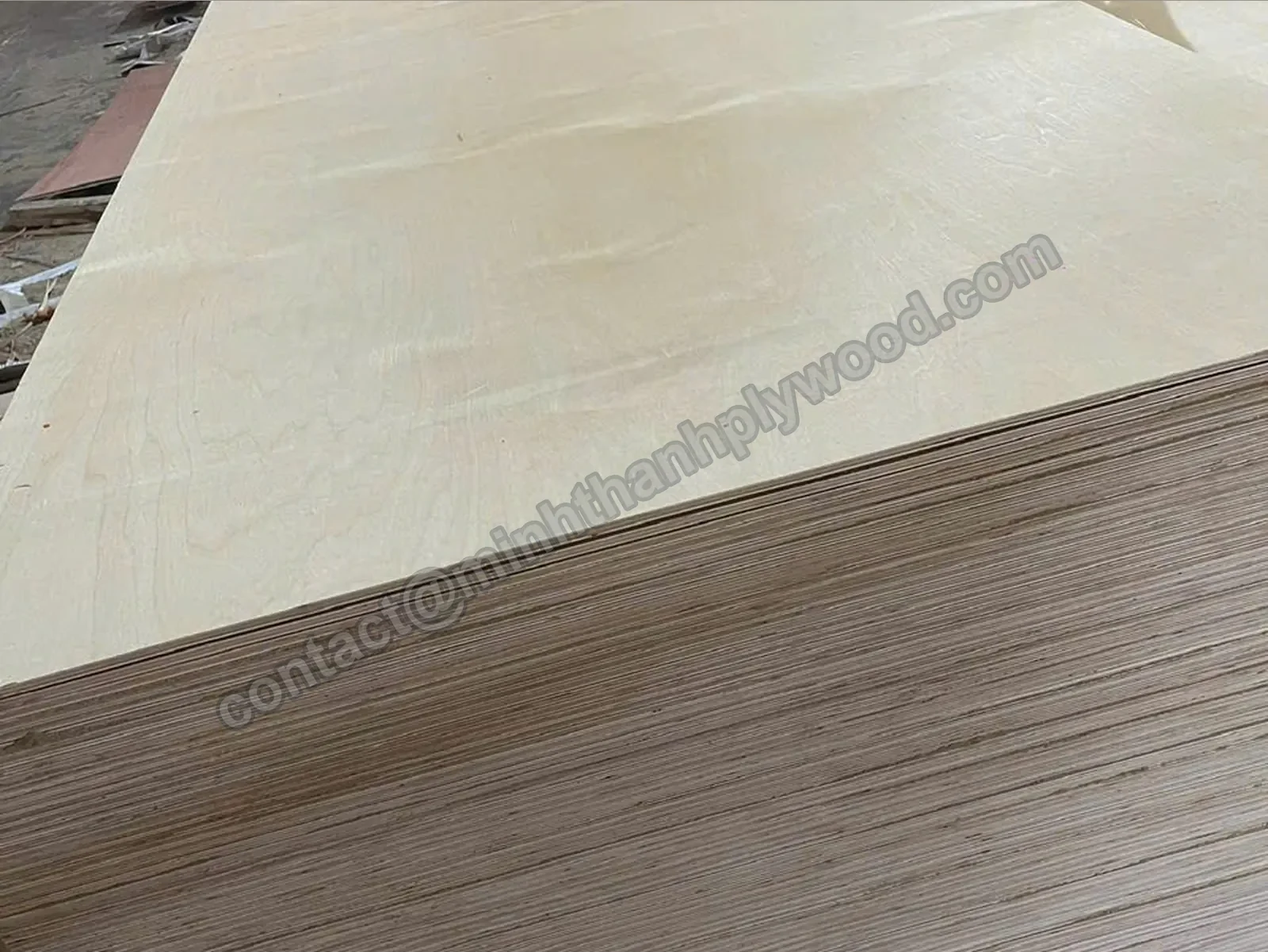
Which Baltic birch plywood supplier fits small and repeat orders?
Choose the buying channel by the service you need after the panel is qualified. Local availability, repeat stock and direct production scheduling are different benefits. The best route for a prototype can be different from the route for a regular furniture program.
| Route | Best fit | What the quotation should identify | Buyer task |
|---|---|---|---|
| Specialist local stockist | Small quantities, immediate trials and changing cut lists | Producer, construction, current stock, sheet format and local delivery | Inspect the stocked product and check the full-sheet or cut-piece yield |
| Regional importer or distributor | Repeat consumption with local replenishment | Repeat product identity, stocking plan, grade and delivery coverage | Agree substitute controls and the inventory responsibility |
| Identified all-birch mill | Stable volume with an all-birch specification | Internal species, layup, product data, inspection and shipment terms | Qualify components and plan inbound stock around production and transit |
| Birch-faced furniture manufacturer | Components permitting a qualified alternative core | Birch face, named core, face/back pair, tolerances and finish preparation | Record the changed construction and approve the complete component |
A local offer can cost more per sheet and still reduce your total expenditure when it avoids holding a large stock. A direct import can suit repeat volume but adds the buyer’s responsibility for inbound scheduling, receiving and storage. Compare those responsibilities alongside the material itself.
Once a birch-faced panel is approved on a sample part, the order repeats on that sample and the material comparison does not restart.
What should you ask a local stockist?
Ask for the producer, the core (all-birch or birch-faced), face/back grade, thickness, format and pieces in stock, plus a photo of a fresh edge. Confirm whether cutting and delivery are included. A stockist is the right route for a few sheets or a prototype; repeat volume costs less direct from a mill.
What must Baltic birch plywood manufacturers put on a quotation?
Baltic birch plywood manufacturers and importers should state the offered panel, the supplied quantity and the delivery responsibility. Its material description should be precise enough to become the purchase-order line. Its shipping terms should let the buyer calculate the cost to the receiving factory.
For all-birch, request the producing mill and product identity, face/back grade system, internal species, thickness, sheet format, bond, emission documentation and intended application. Include the agreed inspection method. A phrase such as “Baltic type” should lead to a construction declaration rather than end the specification.
For a birch-faced alternative, retain the same component drawing but make the changed core explicit. Request its dimensional tolerance, face preparation and sample. The alternative needs its own accepted reference part, even if the visible birch surface resembles the previous material.
Connect production lead time with the replenishment plan. Distinguish the date the material is manufactured from vessel departure and delivery to your warehouse. Keep the destination port in the enquiry and local delivery requirements in the importer comparison. A quote on one delivery basis should not be ranked directly against a different basis.
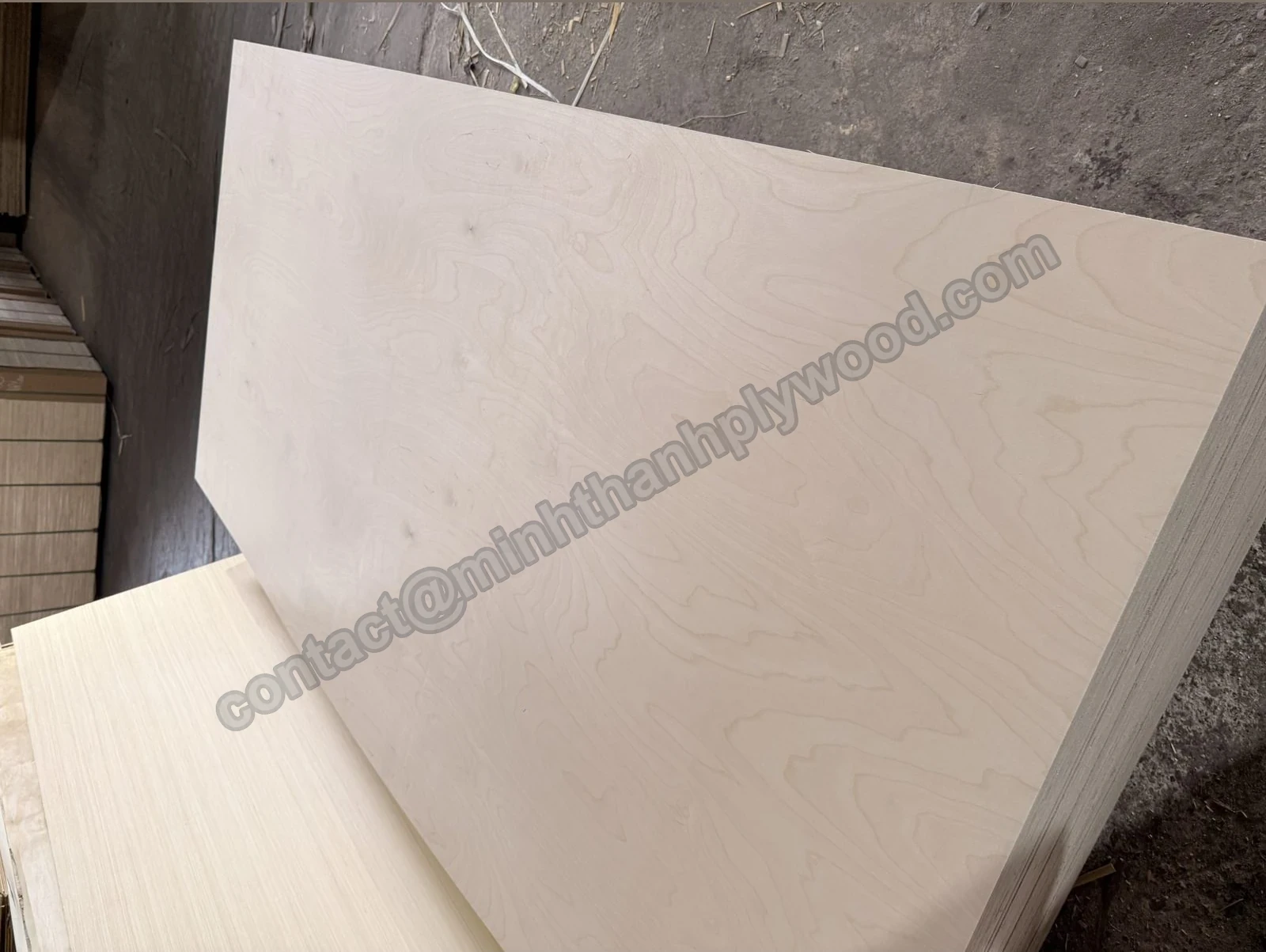
How can you verify the declared core construction?
Verify core construction with the producer’s specification and fresh cuts through representative sample panels. The product declaration identifies the species and layup; the cut shows the physical arrangement and continuity. Both are useful because appearance at one factory-trimmed edge is incomplete evidence.
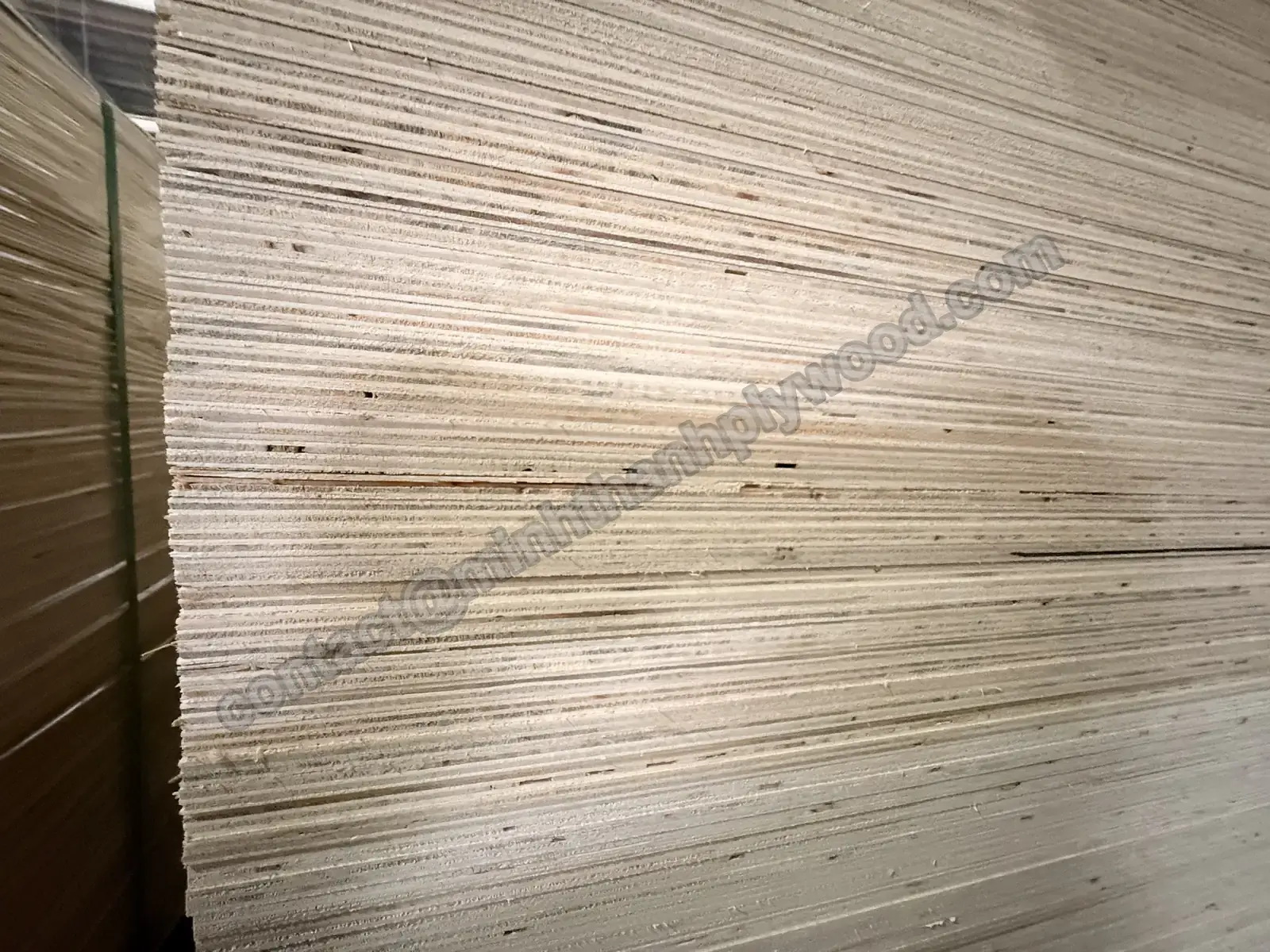
Inspect strips taken in both sheet directions and look at the layers reached by your grooves or hardware bores. Count the plies and compare them with the declared layup. Look for gaps and overlapping veneers which affect a component’s exposed edge or connector position.
Ply count does not identify the wood species. Many thin layers can occur in more than one construction, and edge colour changes with veneer, adhesive and lighting. Use material documentation and appropriate technical identification where species is contractually essential. Keep the sample identity attached to the inspection record.
For Minh Thanh furniture panels, the standard cores are white Styrax or Eucalyptus. Core veneers are stitched horizontally and vertically, and the furniture panel is double pressed. A fresh cut shows the joined core plies under the birch face.
How should you choose face and back grades?
Choose the face/back pair from the visible surfaces and finishing schedule of the component. Both sides of an open shelf need an appearance decision. A cabinet side covered on one face can use a different back requirement, provided the hidden face still meets its machining and assembly needs.
Ask an all-birch supplier for the definitions used by the actual producer. Letter pairs such as B/BB and BB/BB describe appearance within a particular grading system. They do not replace the agreed limits for patches, colour differences, closed splits and surface preparation. Review repaired areas after the intended finish.
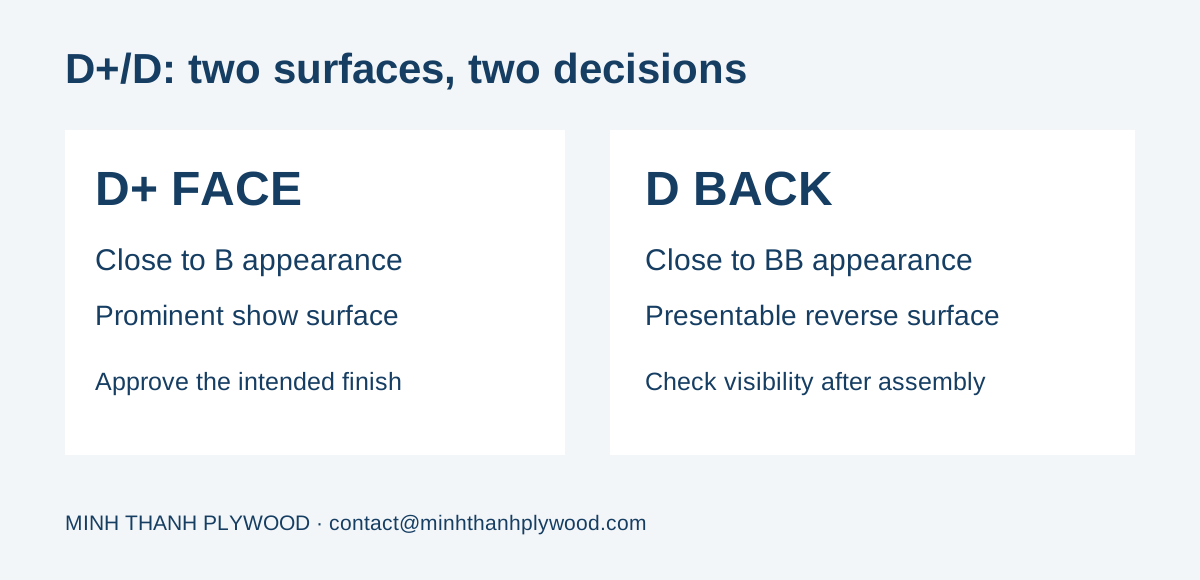
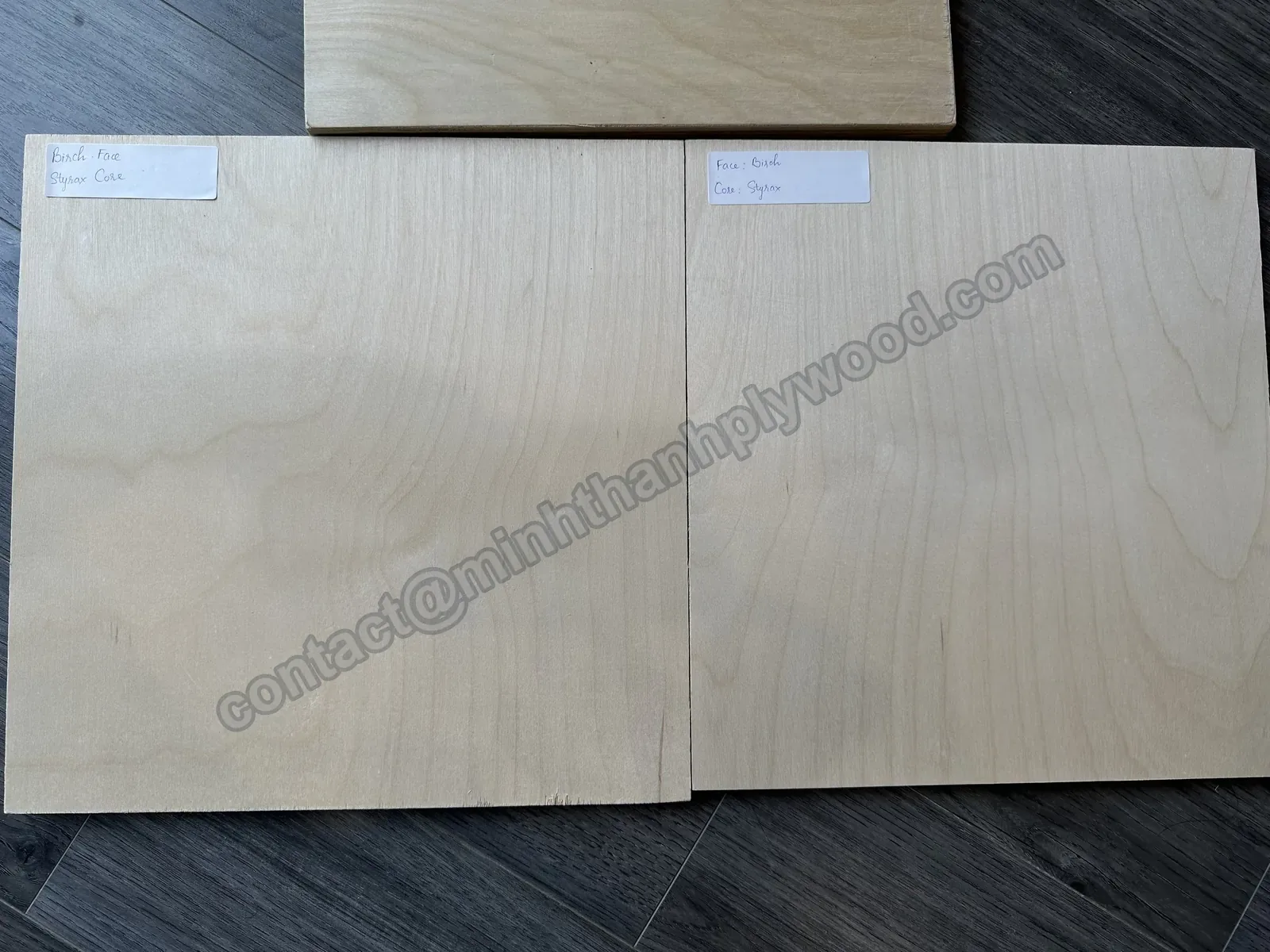
Minh Thanh uses the Vietnamese birch grades D+, D and E. Individual faces compare approximately as D+ to B, D to BB, and E to CP/C. D+/D therefore compares approximately with B/BB, and D/D with BB/BB. The approved sample fixes the order appearance.
Make colour and repair decisions at component scale. A patch outside a door blank can be irrelevant to that door but important to another part in the same nest. Share the visible-part layout with the supplier so purchasing understands whether it is ordering a sheet-wide appearance requirement or a component-specific selection.
Which format and machining trial should precede a volume order?
Buy the format that gives the most accepted parts after grain direction, trim and saw kerf; the sheet-size guide helps with the layout. All-birch mills publish their own schedules, such as the WISA-Birch product range (accessed 8 October 2026). Baltic birch stockists also sell the 1525 × 1525 mm square sheet, which Windsor Plywood (accessed 8 October 2026) describes as the standard European production size. Minh Thanh birch-faced sheets come in 1220 × 2440 and 1250 × 2500 mm, with 1220 × 2500 and 1220 × 2280 mm to order, 3–40 mm thick.
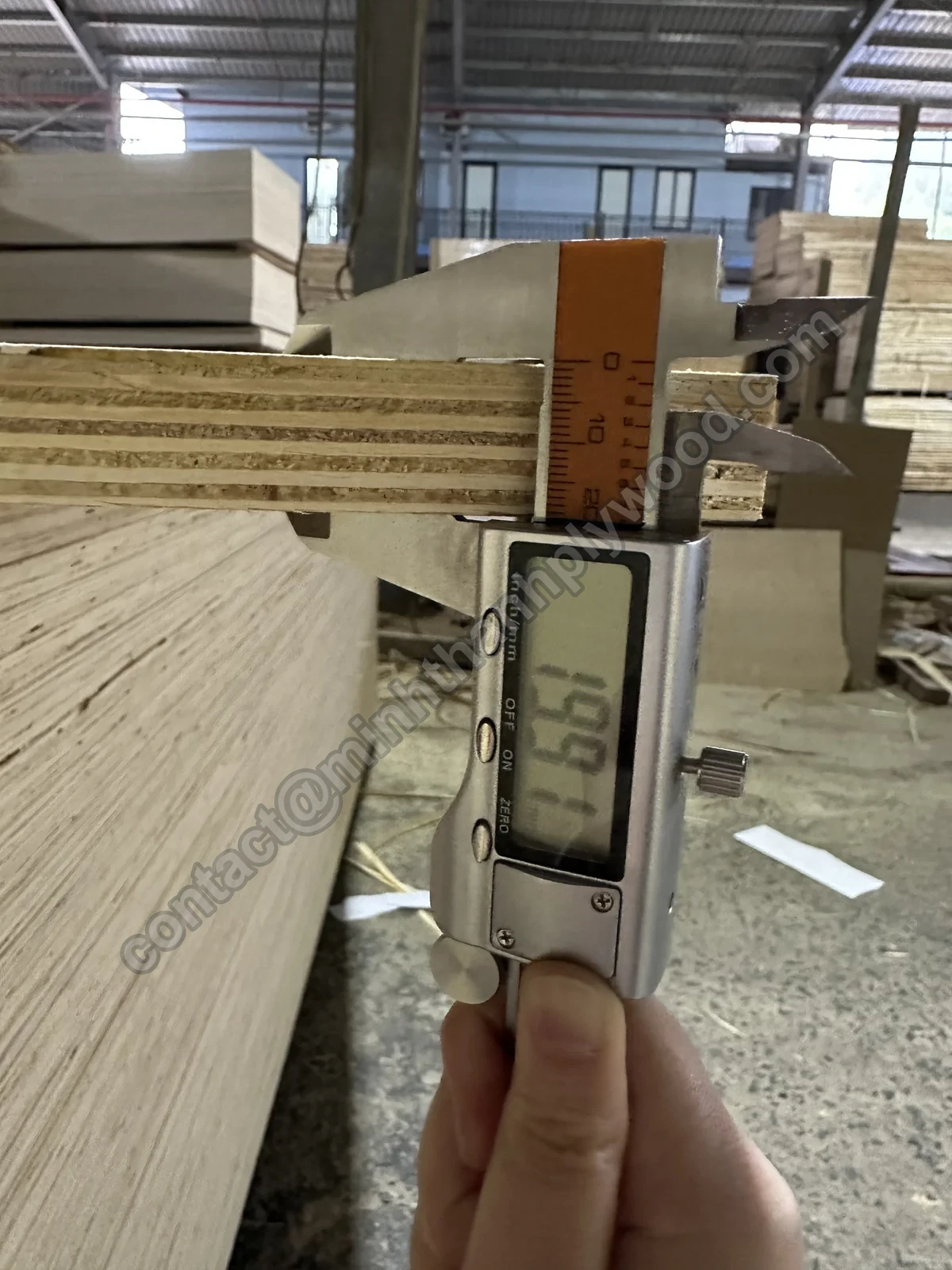
Before the volume order, run the part’s hardest operations on the sample: cross-grain cuts, connector pockets, grooves, hardware holes and the edge finish, then coat and cure. Covered and edge-banded edges pass on a birch-faced panel; a clear-coated layered edge is where all-birch stays.
When is an all-birch specification essential?
Keep all-birch when the design or validated component specification requires birch internal veneers. Examples include a particular exposed layered edge or a component qualified against an identified all-birch product’s performance data. Changing the core in those cases is a material substitution requiring a new approval.
A decorative birch face is a different requirement. A cabinet carcass with covered edges can be a candidate for birch-faced furniture plywood when its machining, finish, hardware and loading requirements are met.
For a load-bearing shelf, compare the actual panel properties and test the intended span and support. Do not use solid-birch hardness as a plywood bending value. A face veneer contributes to the panel, but it does not reveal its complete layup or direction-dependent behaviour.
The types-of-plywood guide explains the difference between species, core construction and use classification. Those distinctions let purchasing keep a strict all-birch item on one line and a qualified birch-faced furniture item on another, with neither silently substituted for the other.
What does a Minh Thanh birch-faced alternative offer?
Minh Thanh offers birch-faced furniture and interior plywood with Styrax or Eucalyptus cores. It is an option for components whose specification permits that construction. The offer combines an agreed birch appearance with furniture-panel calibration, surface preparation and export ordering.
Furniture panels are pressed twice: the core board is pressed and calibrated, then the face and back are pressed on. The process prepares the substrate before applying the finish veneer. Both faces are UV-ready for the buyer’s coating line; the supplied preparation is distinct from a coating applied to a completed component.
The standard furniture bond is UF glue at E0 emission. Resin and emission requirement are separate specification lines, and other bonds are ordered for the intended service. The standard sanded furniture thickness tolerance is ±0.2–0.3 mm, with specifications down to ±0.2 mm.
Start with the existing all-birch component drawing and identify which requirements are essential. Retain visible face quality, groove fit, hardware and the complete finish in the trial. The birch product page supplies the offered panel context; quality control supplies the order checks for qualifying it.
Which documents should you request for the destination?
Request the documents required for the purchased panel, intended use and destination. Keep product construction, emission compliance, origin and shipment documents as identifiable parts of the order.
For US interior hardwood plywood, the EPA composite-wood stakeholder guidance, checked 8 October 2026, explains the regulated product scope and supply-chain roles. Write the applicable TSCA Title VI requirement into the order and connect its producer and certification records with the panels delivered.
Our certificates are listed on the quality page. We supply the EUDR compliance dossier, comprising origin records and geolocation files, with orders. Third-party testing to the buyer’s method, including EN 717-1, is arranged through SGS on request.
Send the destination market’s component specification at the enquiry stage. Identify whether the panel is for furniture or a construction use with its own technical requirements. Minh Thanh holds CARB P2 / TSCA Title VI certification (ICTT mill no. 23024); six ASTM D6007 chamber tests averaged 0.014–0.032 ppm against the 0.05 ppm limit.
How do delivered cost and stock responsibility change the choice?
Compare the cost of accepted finished parts delivered to the workshop, including the stock needed to keep production running. Sheet price is a starting input. Cutting yield, rejection, finishing work and inventory responsibility determine whether a supply route actually saves money.
Request quotes for equivalent construction, grade, thickness, format and delivery basis. Then add transport, unloading, storage, machining and the approved finishing sequence. Use your trial yield rather than an unsourced industry rejection percentage.
With local stock, the supplier holds inventory and provides replenishment within its service area. With direct import, the buyer plans incoming containers and stock coverage. Include the production schedule, sea transit and receiving time separately so a delay in one stage is visible.
Minh Thanh’s minimum order is one 40HC, with mixed specifications agreed in the order. Production is 15–45 days after deposit. FOB Hai Phong, CFR and CIF are available delivery bases. Compare that route with your regional stock offer using a common destination and the same accepted component specification.
What should happen before shipment and on receipt?
Before shipment, connect the order specification with inspection records and the packed product. On receipt, preserve the pack identity while checking condition and quantities. This closes the gap between a good sample and the stock which enters production.
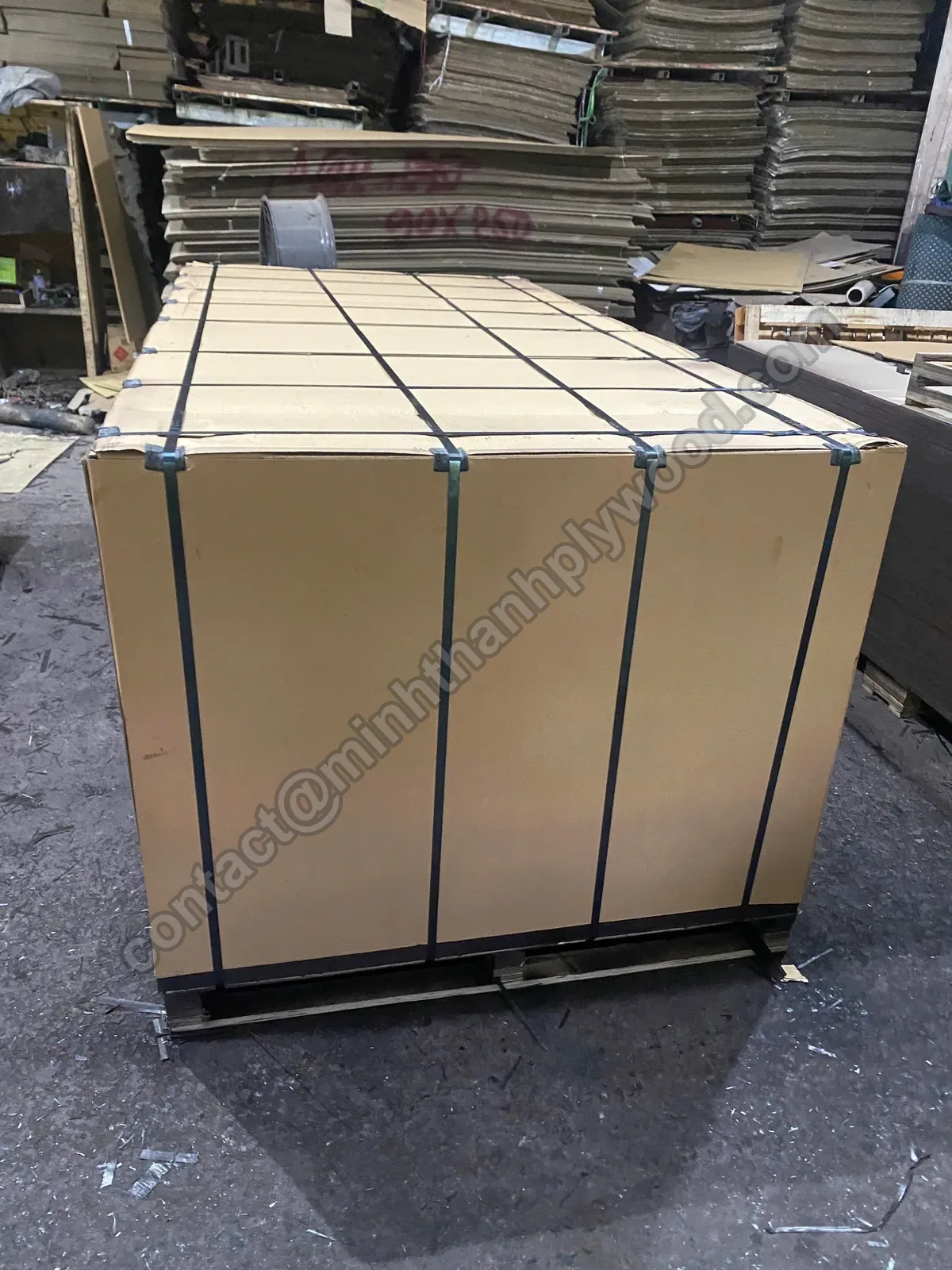
Request photographs of faces, measured thickness, selected cut edges and completed packs. Define the reference part and acceptable defects in advance. If the shipment includes different thicknesses or face/back pairs, identify them in the pack schedule so the warehouse does not have to infer the specification from appearance.
Minh Thanh photographs and films each shipment before loading and shares those records with buyers. Furniture veneers and finished panels are dried to 8–12% moisture content at dispatch. Store the received plywood flat and protected, and let representative panels reach workshop conditions before a new machining qualification.
Inspect visible transport damage before removing the protective packaging. Then compare sample sheets from the received stock with the retained reference and the order. Keep a record of the pack, component and drawing revision used for the first production run. The packing page explains the shipment context.
What is the next step for an all-birch or birch-faced order?
Send an all-birch supplier a construction-specific enquiry when all-birch is essential, or send Minh Thanh the component for a birch-faced furniture quotation when another core is permitted. Both enquiries should preserve the features which determine acceptance. This keeps the supply comparison practical and the material identities clear.
For a Minh Thanh alternative, include the application and drawing; Styrax or Eucalyptus core; bond and emission requirement; birch face/back pair; thickness and tolerance; sheet or component dimensions; grain direction; edge finish; packing; quantity; and destination port. Include the existing panel specification and a finished reference where colour or exposed edges matter.
We offer free samples so the buyer can qualify the construction in its actual workshop. Standard payment is a 30% deposit and 70% against scanned B/L, or an irrevocable L/C at sight. Put the sample decision and the production schedule into the order before planning replenishment.
Request a birch-faced plywood quotation with the specification and component layout. The result should be an identified panel, a qualified part and a delivery plan which purchasing can repeat, whether the final choice is a required all-birch product or Minh Thanh’s furniture construction.
Buyer questions, answered
Where can I buy Baltic birch plywood for a few sheets?
Start with a specialist hardwood or panel stockist serving your delivery area. Ask for the producer, actual core construction, face/back grades, sheet format and stock quantity. Compare delivered full sheets with cut-to-size pieces against your component layout.
Where should a factory buy Baltic birch plywood in bulk?
Use an importer with an identified repeat product or buy from a mill that can document the required all-birch construction. Qualify a sample and the finished component before the volume order. Agree product identity, inspection records, packing, delivery terms and responsibility for stock replenishment.
Is all birch-faced plywood Baltic birch?
No. Birch-faced plywood has birch on its visible surfaces and needs the internal species specified separately. An all-birch panel uses birch internal veneers as well. Minh Thanh's birch-faced furniture panels use Styrax or Eucalyptus cores.
How do I know whether a supplier offers all-birch plywood?
Ask for the producer's construction declaration and cut a fresh edge on the sample. All-birch shows uniform pale plies through the thickness, 13 plies at 18 mm; a birch-faced panel shows a different core species under the face.
Does Baltic birch automatically mean a flawless face?
No. Core construction and face appearance are different specifications. Ask for the mill's face/back grade definitions and approve acceptable patches, colour variation and other repairs on finished samples. Order both faces to the required appearance where both remain visible.
Can I replace Baltic birch with Vietnamese birch-faced plywood?
Yes, for cabinet sides, shelves, doors and painted or edge-banded parts. Minh Thanh birch-faced plywood on a Styrax core gives the same D+/D (about B/BB) face, ±0.2 mm tolerance and 26.8 kg per 18 mm sheet instead of about 36 kg. Keep all-birch only where the exposed layered edge is the design.
Does Minh Thanh manufacture Baltic all-birch plywood?
No. Minh Thanh makes birch-faced furniture plywood with white Styrax or Eucalyptus cores, double pressed and calibrated. It replaces all-birch in furniture parts with covered or edge-banded edges at a lower weight and price.
What sizes does Minh Thanh offer for a birch-faced alternative?
Minh Thanh offers 1220 × 2440 mm and 1250 × 2500 mm sheets, with custom formats including 1220 × 2500 mm and 1220 × 2280 mm. The furniture range is 3–40 mm thick. Send the component layout and grain direction with your chosen format.
Is Baltic birch always waterproof?
No. Interior Baltic birch is UF-bonded for dry use; exterior grades use phenolic WBP glue. Write the bond you need on the order, because the name alone does not set it.
Is an E0 label enough for a US furniture order?
Write the applicable TSCA Title VI requirement into the US order and obtain the producer, certifier, label and shipment records. E0 is an emission class that needs its test method named. Minh Thanh panels for US orders carry the TSCA Title VI label from certifier TPC-43.
Should I choose a local supplier or import directly?
Choose local stock for small quantities, rapid replenishment or frequent changes in the cut list. Direct mill supply suits qualified repeat volume with a stable specification and a workable container schedule. Compare delivered accepted-part cost and stock responsibility, not sheet price alone.
What should I send for a birch-faced furniture quotation?
Send the application and drawing, required core, bond and emission specification, face/back appearance, thickness, sheet or component size, tolerances, packing and quantity. Include the destination port and existing Baltic birch specification if evaluating a replacement. Minh Thanh offers free samples for qualification.