
To import birch plywood, write face, back and core as separate lines, approve a free sample, and give your broker the species and harvest origin of every layer. Minh Thanh Plywood makes birch-faced furniture panels on Styrax or Eucalyptus cores, grades D+/D/E, with CARB P2 / TSCA Title VI, EUDR dossier and 990 sheets of 18 mm per 40HC.
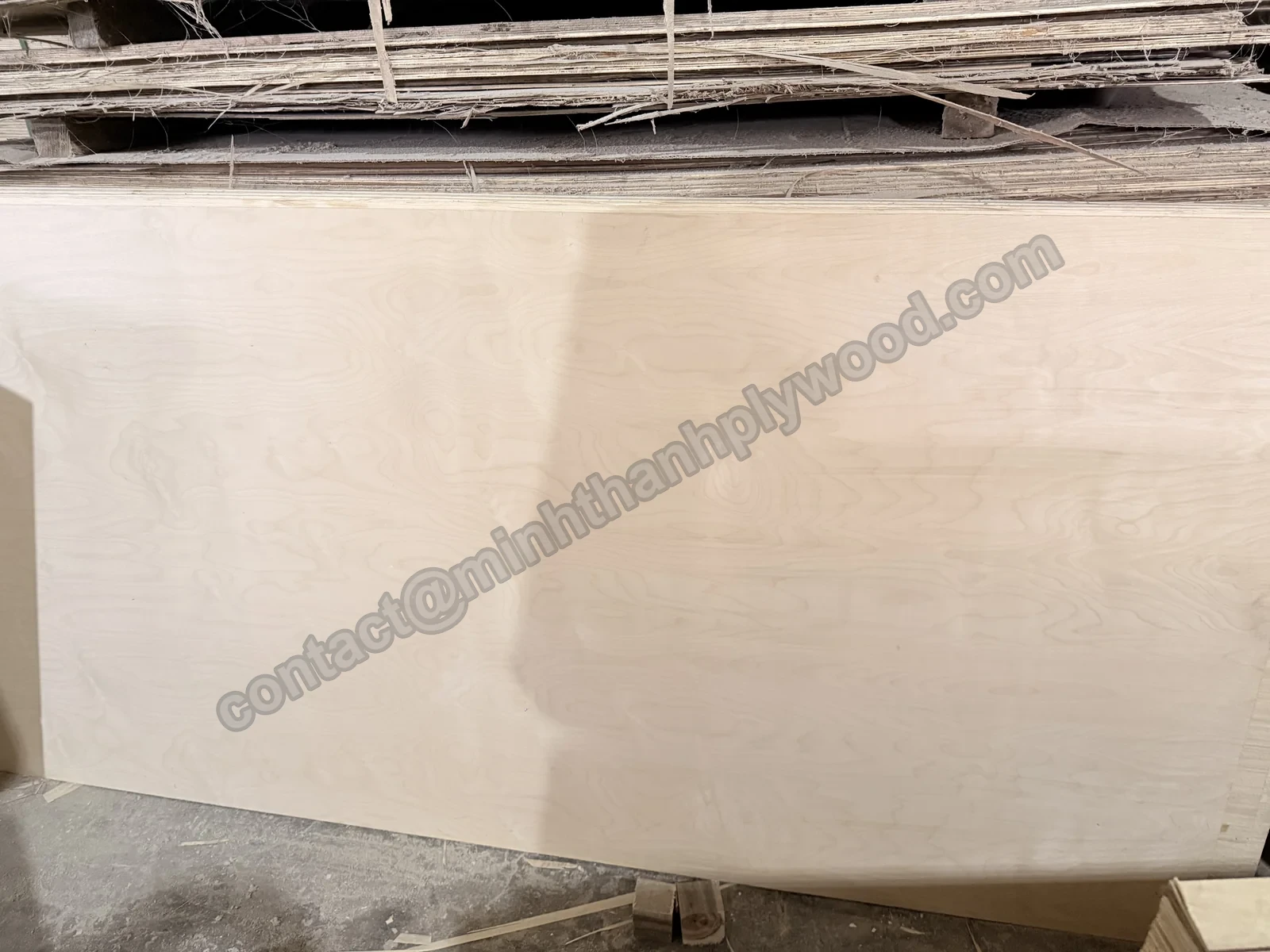
What exactly is imported birch plywood?
Buy the complete panel construction, not just the word birch on the quotation. An outer birch veneer says what you see; it does not identify the inner layers, glue bond or performance of the finished sheet. A furniture factory buying pale faces for cabinet components has a different specification from a processor buying all-birch edges for exposed joinery.
For Minh Thanh birch-faced plywood, the standard furniture cores are white Styrax or Eucalyptus. Record that construction in the purchase specification and give the same description to the customs broker. An accurate description helps the broker classify the goods and helps your receiving team recognize the right panels.
If your existing drawings call for all-birch construction, qualify any alternative through the actual machining, hardware and finishing operations. Keep the original product and proposed replacement clearly identified throughout the trial. An acceptable pale surface does not settle screw holding, edge appearance or the weight of an assembled component.
The import specification should have a revision number shared by purchasing, production and logistics. A later decision to change the core can affect sheet weight, packing and declarations, even when the face grade stays the same. Release the revised description to every party before the factory packs the order.
Which specification lines should go in the purchase order?
Write face, core, bond and emission as separate lines, followed by dimensions and acceptance criteria. A short phrase such as “18 mm B/BB birch” leaves too much open for an international order.
| Order line | What to write | What the receiving team checks |
|---|---|---|
| Application | Cabinet parts, furniture components or another stated use | Panels go to the approved production process |
| Face and back | Birch on the required sides; stated appearance pair and sample reference | Both faces match the approved appearance range |
| Core | Styrax or Eucalyptus; any special lay-up explicitly described | Cut edges and machining trial match the ordered construction |
| Bond | Resin/bond requirement and service exposure | Product and requested bond evidence agree |
| Emission | Class, destination requirement and requested test method | Certificate/report scope matches the panel |
| Dimensions | Thickness, sheet size, tolerances and grain direction | Measurements use the agreed points and method |
| Delivery | Quantity by specification, packing, named port and term | Counts, package IDs and shipping documents agree |
Minh Thanh birch face grades use D+, D and E, quoted as face/back pairs. D+ is approximately comparable to B, D to BB and E to CP/C for buying appearance. That comparison helps buyers discuss the finish; the approved sample defines the ordered appearance. See the birch grade acceptance checklist for writing repair and visible-zone criteria.
Furniture panels use UF glue at E0 emission as standard. A requirement for a water-resistant bond belongs on a separate line, rather than treating “E0” as a glue formulation. The same separation is useful when your downstream buyer requests a particular emission method or moisture exposure.
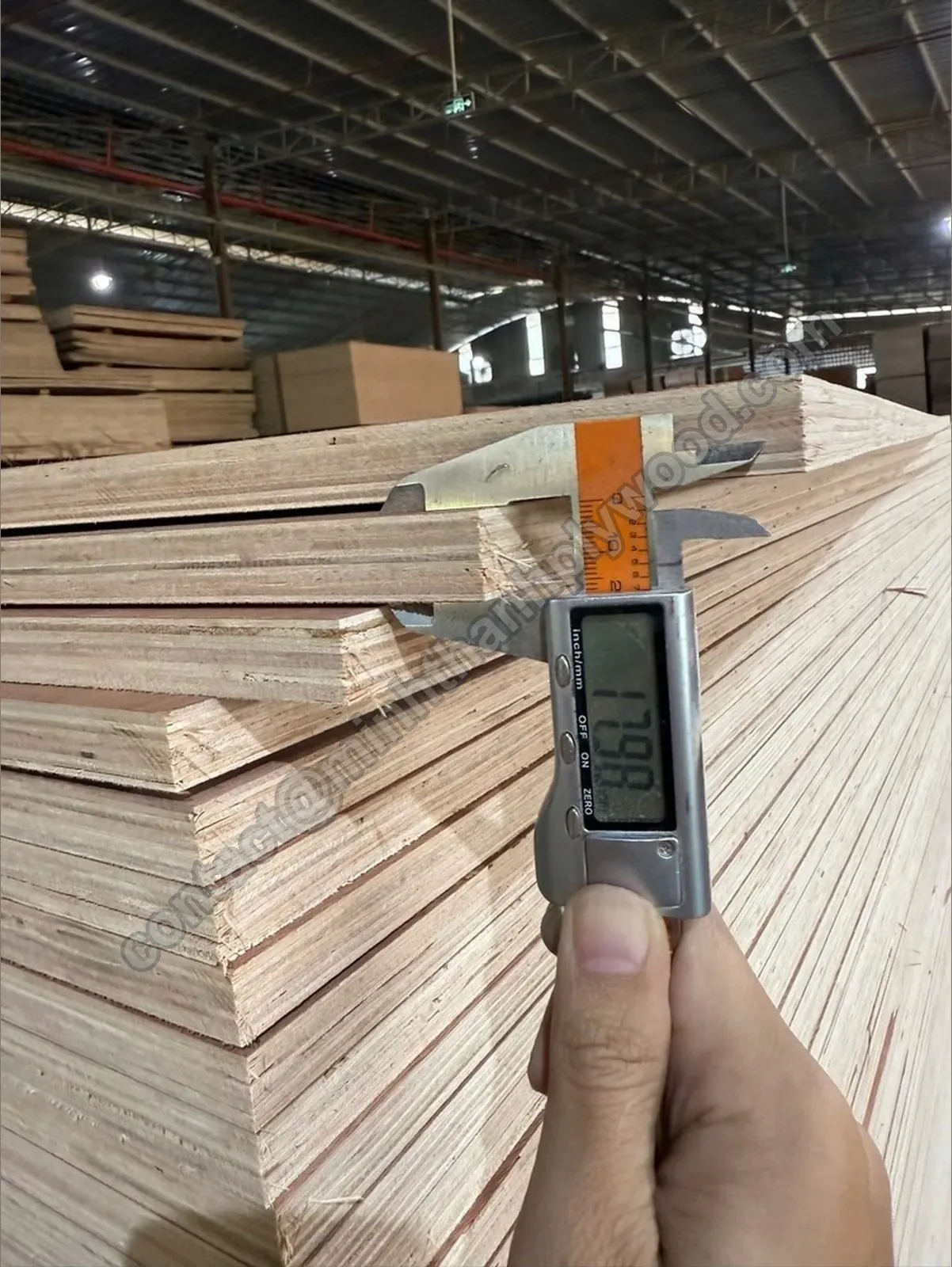
Use the measurement locations agreed in the order specification.
How should you approve the sample before paying a deposit?
Approve a sample through your finishing and machining route, then retain a matching reference for shipment inspection. A photograph helps with appearance but cannot reproduce the whole production trial.
- Identify the sample’s face/back pair, core, thickness and bond in writing.
- Cut representative components, including a visible face and a hardware-bearing edge.
- Use the production tooling, adhesive and finish intended for the order.
- Photograph accepted repairs, color variation and exposed edges under consistent lighting.
- Record the accepted result and attach the sample reference to the purchase specification.
A polished raw face can look different after a clear finish. A repair that disappears under an opaque paint may remain visible under a pale stain. Decide which face is exposed and which is concealed in the finished product before selecting the grade pair. Paying for two high-appearance faces is useful only where the product needs them.
For cut-to-size parts, include the face grain direction on the drawing and describe the packing sequence. A correct material delivered in an inconvenient orientation can still slow the production line. Minh Thanh offers free samples; use them to settle the actual process rather than treating sample approval as a color-only exercise.
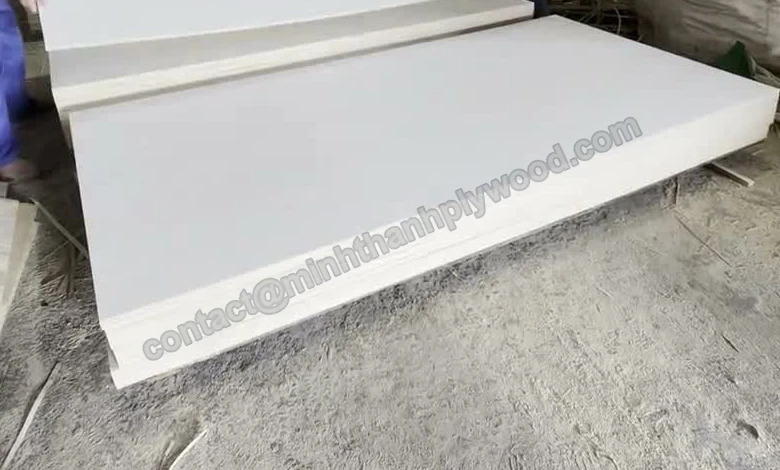
The layered edge is a separate inspection surface from the face veneer.
What should the broker know before classifying the goods?
Give the broker a construction sheet and the destination, not a supplier’s generic code alone. Plywood normally sits within HS heading 4412, but the full import code and applicable measures need a destination-specific classification.
Identify the face, back and core species, their harvest origins, overall thickness and any coating or further processing. Explain whether the cargo is full sheets or components and state the intended application. A birch face over plantation hardwood core should be described as that actual combination throughout the file.
Separate tariff classification from preferential origin. A Vietnamese manufacturing address, a Vietnamese invoice and eligibility for a trade-agreement preference are different items. Ask the broker to assess the product-specific rule and evidence before you put any preference into your landed-cost model. For EU imports, the Commission’s Access2Markets trade assistant provides the route for checking the product, exporting country and destination; consulted 8 October 2026.
 The broker needs the species of the birch face and of the core layers you see at the edge.
Keep the classification advice attached to the exact specification revision. If the next order changes face species or processing, review the description again. Do the same for any sanctions or trade-remedy scope affecting the product and supply chain. A fixed tariff statement on a purchasing spreadsheet can become stale between quotation and entry.
Which documents belong in the shipment file?
Minh Thanh prepares the shipment file and sends the drafts to you and your broker before the bill of lading is issued. The commercial invoice, packing list and bill of lading are the core set; the rest follow your destination.
| Document or record | Check before release | Typical mismatch to catch |
|---|---|---|
| Commercial invoice | Buyer, seller, description, quantity, currency and delivery term | Generic birch description hides the core |
| Packing list | Pack IDs, sheet counts, dimensions and net/gross weights | Totals differ from the invoice or loading record |
| Bill of lading | Parties, ports, container and release instructions | Consignee spelling or destination differs |
| Origin evidence | Required form and product-specific preference basis | Manufacturing origin confused with harvest origin |
| Emission file | Product scope, certifier and ordered construction | Report for an unrelated configuration |
| Timber-origin file | Species and origins across face, back and core | Only the plantation core is documented |
| Packaging file | Materials, treatments/marks where required | Solid-wood bearers missed beneath processed panels |
| Insurance under CIF | Policy/certificate and agreed cover | Buyer assumes every moisture claim is covered |
Minh Thanh supplies the commercial invoice, packing list, B/L, certificate of origin, phytosanitary and fumigation certificates, with insurance on CIF shipments. For EU orders we add the EUDR dossier; for US orders, the TSCA labels and Lacey species data. Your broker confirms the list once against your destination.
Resolve document spellings early. The consignee’s customs identity, delivery recipient and notify party can serve different roles. A wrong company field is harder to fix after a carrier issues the final document. For mixed loads, use clear line-level pack references so the receiving team can separate each specification without unpacking the whole container to identify it.
What changes for US birch furniture plywood imports?
For US furniture-grade hardwood plywood, review TSCA Title VI and Lacey Act requirements as separate workstreams. Emission certification addresses the composite panel; timber declarations address the plant material and applicable import entry.
Minh Thanh holds CARB P2 / TSCA Title VI certification, ICTT mill no. 23024. For US orders, the panel or bundle labels identify the producer, lot, TPC-43 and TSCA Title VI compliance. The commercial invoice and B/L state compliance, and we supply face/core species and harvest-origin information for the importer’s Lacey declaration.
The EPA stakeholder guidance, consulted 8 October 2026, explains regulated panel/bundle labels, records and import certification. Your broker files the import certification; the labels and invoice statement we supply match it.
The APHIS Lacey Act declaration guidance, updated 6 January 2026 and consulted 8 October 2026, provides the declaration route. Give your agent the actual species and harvest information for every wood component. Imported birch faces and a Vietnamese plantation core can require different origin information within the same panel.
We send the label data and Lacey information with the draft documents, before the vessel sails, so your broker can file on time.
What do birch plywood importers UK and EU buyers need?
Birch plywood importers UK and EU buyers need an EORI number, a timber due-diligence file, origin proof for any duty preference and emission evidence for furniture use. Name the receiving jurisdiction on the RFQ: Great Britain, Northern Ireland and the EU each check a different file.
| Market | Timber file | Emission evidence | Origin and duty |
|---|---|---|---|
| European Union | EUDR due diligence; we supply origin records and geolocation files | Our certification and chamber tests; SGS test to EN 717-1 on request | EUR.1 or origin statement for the EU–Vietnam preference |
| Great Britain | UK Timber Regulations due diligence | Same evidence; buyer’s downstream method on request | UK tariff and UK–Vietnam agreement origin rules |
| Northern Ireland | Separate check against the applicable regime | Same evidence | Broker confirms the applicable regime |
| United States | Lacey Act declaration with species and harvest country | TSCA Title VI label and invoice statement | HTS code and trade-measure scope through the broker |
For EU orders, Minh Thanh supplies the EUDR compliance dossier with origin records and geolocation files for face, back and core. You use it for your due-diligence statement. The Commission’s due-diligence guidance, consulted 8 October 2026, explains the information, risk-assessment and risk-mitigation sequence.
Yes, our CARB results serve European furniture buyers: they accept our certification and six ASTM D6007 chamber tests (0.014–0.032 ppm, limit 0.05 ppm; three by Shanghai Hongjun, three by ICTT Vietnam). If your customer needs EN 717-1, we arrange SGS testing to that method.
For Great Britain, the UK timber and FLEGT guidance, consulted 8 October 2026, describes the UK timber due-diligence framework. Northern Ireland requires a separate check against its applicable regime. Birch plywood importers UK should therefore state whether the receiving market is Great Britain, Northern Ireland or an onward EU market when requesting the document package.
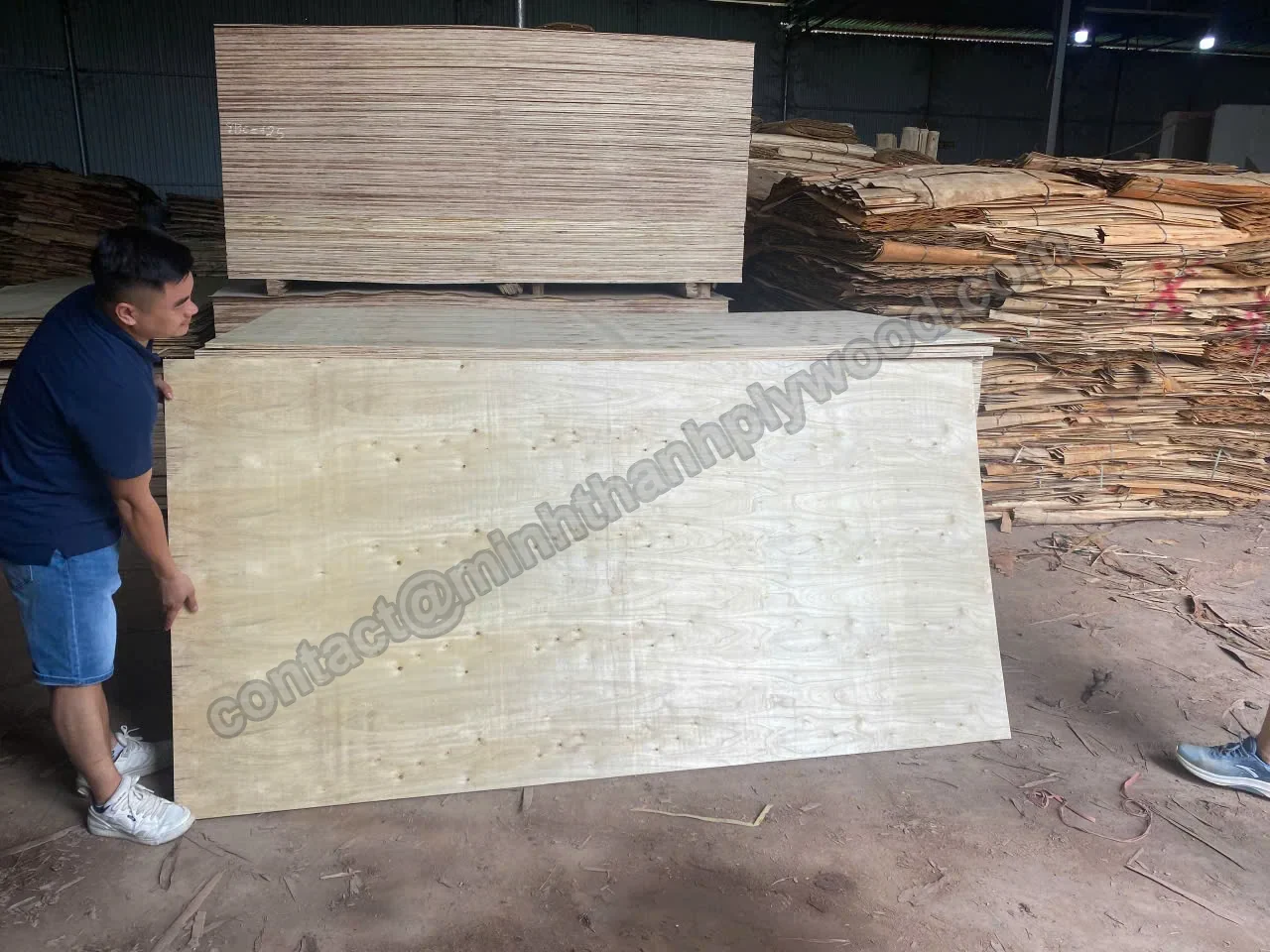
Physical inspection and document review cover different parts of shipment acceptance.
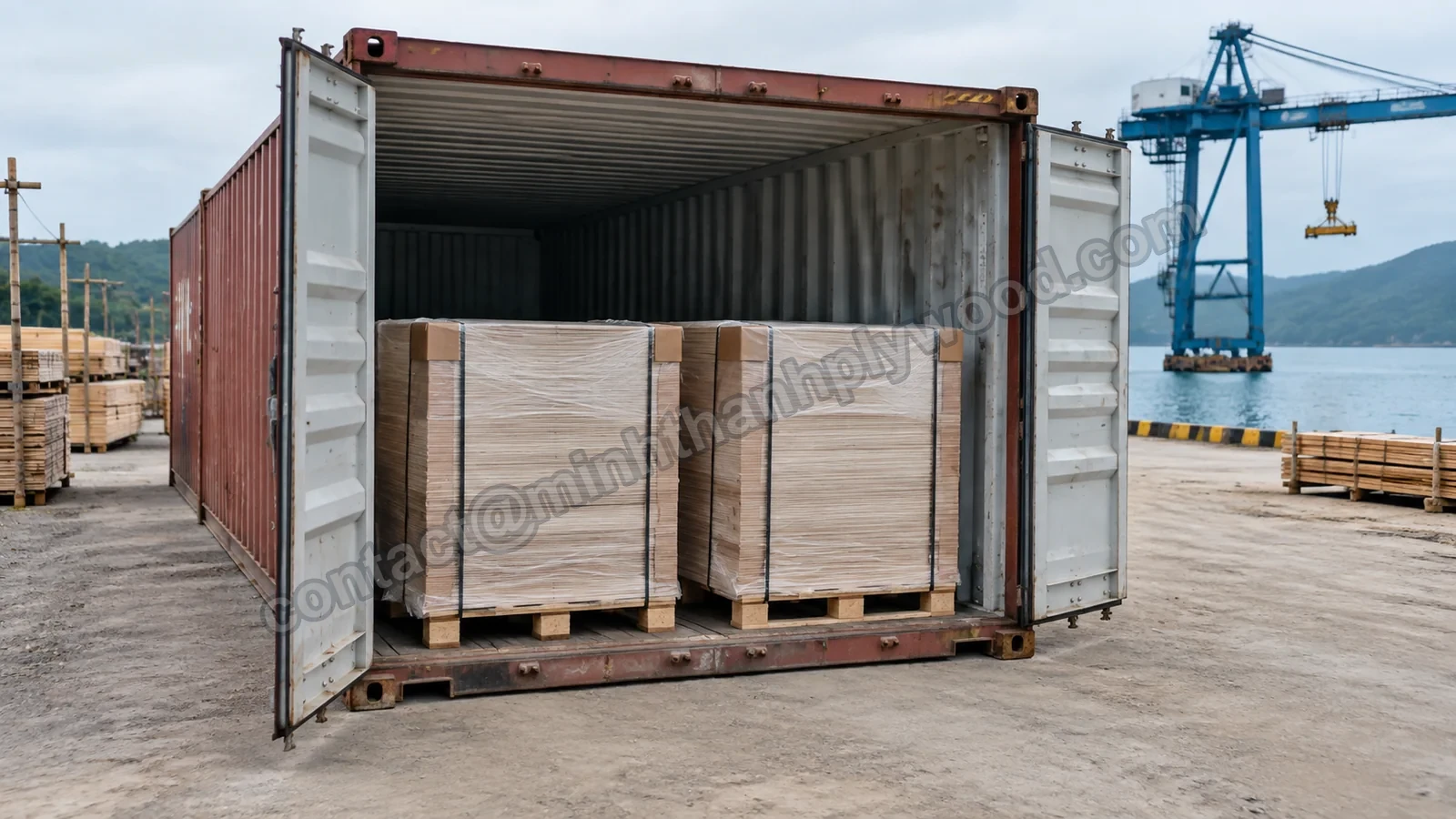 Strapped, film-wrapped packs on pallet bases, ready for forklift unloading at the terminal.
How do FOB, CFR and CIF change the import plan?
Compare the allocation of costs and risk, then add the destination services you actually need. Minh Thanh quotes FOB Hai Phong, CFR or CIF; write the named port and Incoterms edition into the contract.
Under FOB, the buyer arranges the main carriage; under CFR and CIF, the seller arranges the agreed main freight. CIF also includes the seller’s insurance obligation. These sea terms transfer risk at shipment, not only after arrival. The ICC explanation of C-rule risk transfer, consulted 8 October 2026, explains why a named destination and the delivery/risk point can be different.
Ask the forwarder for a destination cost schedule covering terminal handling, documentation, customs services, inspection, storage, trucking and unloading. Identify which charges are included in the freight arrangement and which are billed locally. Put the agreed free-time and return arrangements in your logistics file rather than assuming the shipment can sit until your workshop has space.
For container movements, ICC’s 2024 Incoterms checklist also discusses FCA for delivery to a carrier or terminal. Ask the parties to select a rule that matches the actual handover. Where the contract remains FOB, CFR or CIF, record how the earlier container-terminal movement is handled. Payment method, ownership and bill-of-lading release need their own written agreement.
How should you calculate quantity and weight?
Calculate volume from the actual sheet dimensions, then cap the load using gross cargo weight and the booked transport limits. “One container” is not a consistent unit of plywood across different cores and thicknesses.
For a nominal 1220 × 2440 × 18 mm panel, volume is 1.220 × 2.440 × 0.018 = 0.0535824 m³. Using the reference Styrax density of 500 kg/m³, the calculated panel weight is about 26.8 kg. This is a planning calculation; the actual order’s measured weight is the loading input.
Our 40HC plan for 1220 × 2440 × 18 mm birch-faced panels is 990 sheets on Styrax core (55 sheets × 18 packs, about 53 m³) and 795 sheets on Eucalyptus core (53 × 15 packs, about 43 m³), on a 28,000 kg planning payload. If your booking caps cargo lower, we recalculate from measured pack weights before loading.
Eucalyptus changes the result even at the same face grade and size. At the 650 kg/m³ reference density, the same nominal panel calculates to about 34.8 kg. A purchase decision based on appearance alone can therefore change freight allocation and the number of sheets that fit the approved weight plan.
Use the plywood packing calculator as a planning aid and ask for a packing list by specification. Keep net panel volume, net panel mass and gross package mass in separate columns. Round only after the calculation; a rounded per-sheet figure multiplied across a whole load can obscure the available weight margin.
What should the packing and container inspection show?
Inspection should connect the panels to identifiable packs and the packs to the shipment record. A loading photograph is most useful when the receiving team can recognize the pack ID and position it documents.
Check face protection, squared stacks, supported corners and strap contact areas. Specify how packs can be lifted without damaging the edges. If two appearance grades share a container, label them so an opened pack can still be traced after the outer wrap is removed. For cut parts, identify bundle quantities and the packing sequence before production starts.
Inspect the empty container for visible water entry, residue and floor damage before loading. Record the loaded arrangement and door-area protection, then the seal and shipment identity. Minh Thanh photographs and films each shipment before loading; ask for the pictures relevant to the ordered specification and pack sequence.
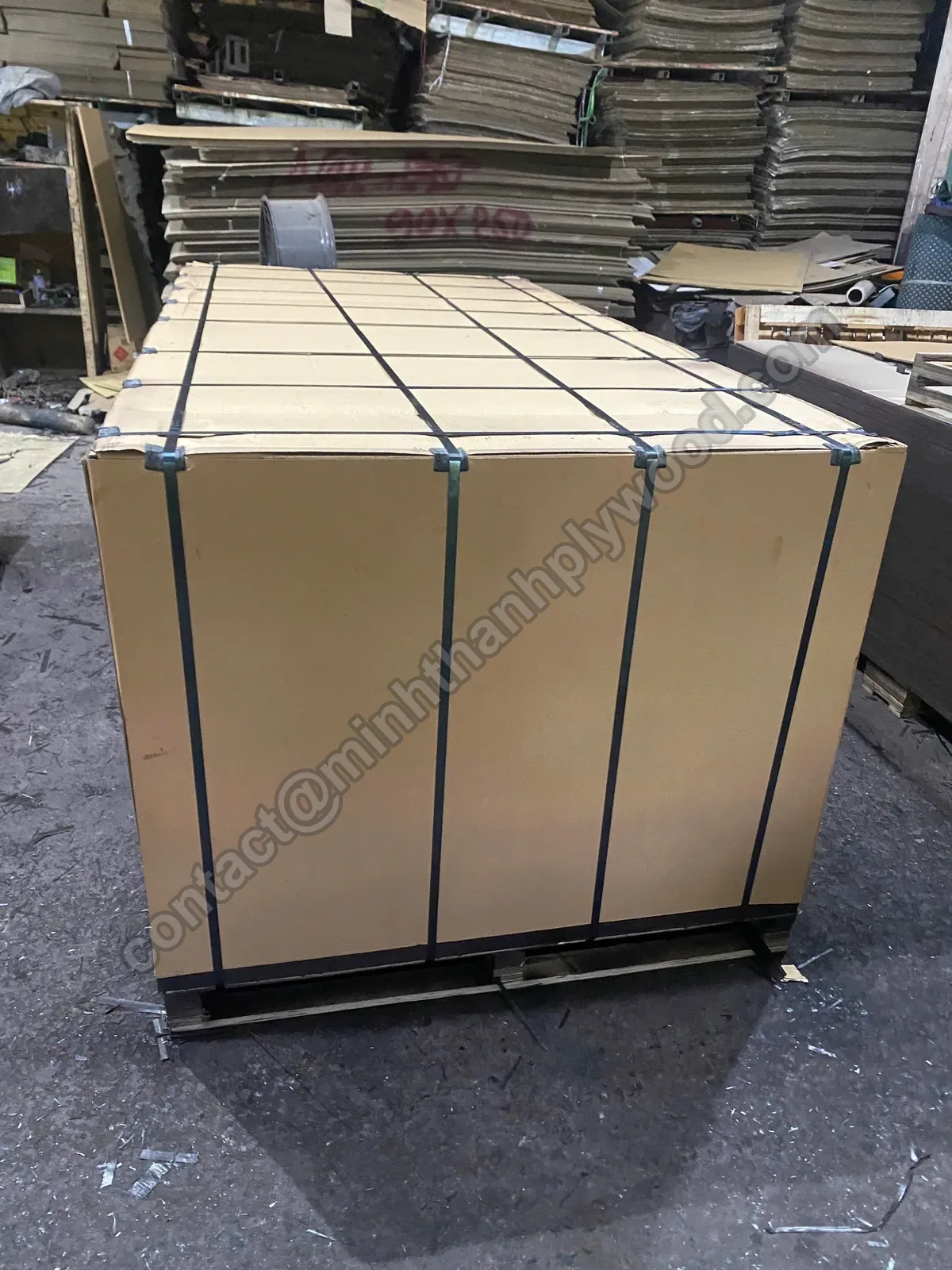
Wrapping, straps and the pallet base are separate elements of the packing specification.
Check packaging materials against the route’s plant-health requirements. The IPPC ISPM 15 standard, consulted 8 October 2026, exempts packaging made wholly from processed wood such as plywood. Solid-wood bearers or blocks carry the ISPM 15 treatment mark where the destination requires it.

Record the seal identity alongside the loaded container and pack list.
How do you schedule production, transport and receiving?
Plan separate milestones for manufacturing, departure, document release and warehouse receipt. Minh Thanh’s standard production time is 15–45 days after deposit; sea transport and clearance are additional stages.
Set the target stock date by working backwards from your production demand. Include technical approval, any requested laboratory testing, packing inspection, vessel cut-off and destination arrangements. Give each milestone an owner and a completion record. A booked sailing is useful only when panels, paperwork and inland transport are ready for its cut-off.
Standard payment is a 30% deposit and 70% against the scanned B/L, with T/T or an irrevocable L/C at sight. Align the contract and document-release instructions before paying. For an L/C, send us the draft first and we confirm the document list matches what we and the carrier issue.
At arrival, photograph the seal and container condition before unpacking. Compare pack IDs, quantities and visible damage with the approved loading file. Separate transit observations from manufacturing observations in the inspection report. Dry storage with flat support preserves the reference condition while your team completes the agreed checks.
What should you send to import birch plywood from Minh Thanh?
Send a complete panel description and destination so the factory can quote the right goods and packing. Use this RFQ structure, filling the technical choices from your approved sample and process trial:
- Application and downstream market: furniture components, cabinet parts or another defined use.
- Face/back: birch appearance pair, visible sides, permitted repairs and sample reference.
- Core: Styrax or Eucalyptus, with any specified edge or machining requirement.
- Bond and emission: stated separately, with the requested test method and document scope.
- Dimensions: thickness, sheet or cut size, tolerances and grain direction.
- Packing and quantity: count by specification, pack protection and handling constraints.
- Delivery: destination port, Incoterm, requested production window and broker’s document checklist.
For a broader first-container plan, use the guide to import plywood from Vietnam, and compare face and core costs in birch plywood 18mm price. For a construction comparison, read Baltic birch vs Vietnamese birch plywood. The importing guide collection groups related logistics subjects.
Send the RFQ through Contact or email international sales. Free samples are available and we reply within hours. A clear sample reference and document checklist let the quotation answer the real buying decision.
Buyer questions, answered
Is imported birch plywood always all-birch plywood?
No. Birch-faced plywood has birch outer veneers and can have another core species. Minh Thanh furniture panels use Styrax or Eucalyptus cores; specify every layer family separately when comparing with all-birch panels.
What documents do I need to import birch plywood?
The commercial invoice, packing list and bill of lading, plus a certificate of origin, phytosanitary and fumigation certificates and, under CIF, insurance. Minh Thanh adds the emission file, the EUDR dossier for EU orders and Lacey species data for US orders, and sends drafts for your broker before shipment.
Which HS code applies to birch plywood?
Heading 4412. Your broker sets the full destination code from the face and core species and thickness, which we write on the invoice.
Does manufacturing in Vietnam establish timber harvest origin?
No, they are two records. The panel is made in Vietnam on a Vietnamese plantation core, and the birch faces are imported. We supply species and harvest origin for face, back and core with the shipment file.
What emission paperwork is needed for US furniture plywood?
TSCA Title VI certification, panel or bundle labels and the compliance statement on the invoice. Minh Thanh holds CARB P2 / TSCA Title VI certification under ICTT mill no. 23024 and labels US orders with producer, lot and TPC-43.
Can I use a CARB test result as a European test result?
Yes. European furniture buyers accept our CARB P2 / TSCA Title VI certification and six ASTM D6007 chamber tests (0.014–0.032 ppm, limit 0.05 ppm). If your customer needs EN 717-1, we arrange SGS testing to that method.
Is CIF the same as delivery to my warehouse?
No. CIF covers sea freight and insurance to your destination port; import clearance, destination charges and trucking to your warehouse are on your side. Risk passes to you when the goods are loaded at Hai Phong, and the CIF insurance covers the sea leg.
How long does a Minh Thanh birch plywood order take?
Standard production is 15–45 days after deposit, then 30–40 days at sea to Northern Europe from Hai Phong. Add clearance and inland delivery for your warehouse date.
Must the plywood sheets have an ISPM 15 mark?
No. ISPM 15 covers solid-wood packaging and exempts packaging made wholly from processed wood such as plywood. Solid-wood pallet bearers carry the ISPM 15 treatment mark where the destination requires it.
What should birch plywood importers UK specify first?
The panel construction first: birch face/back pair, Styrax or Eucalyptus core, bond, emission requirement and end use. Then name Great Britain or Northern Ireland, since each checks a different timber file, and the destination port.