
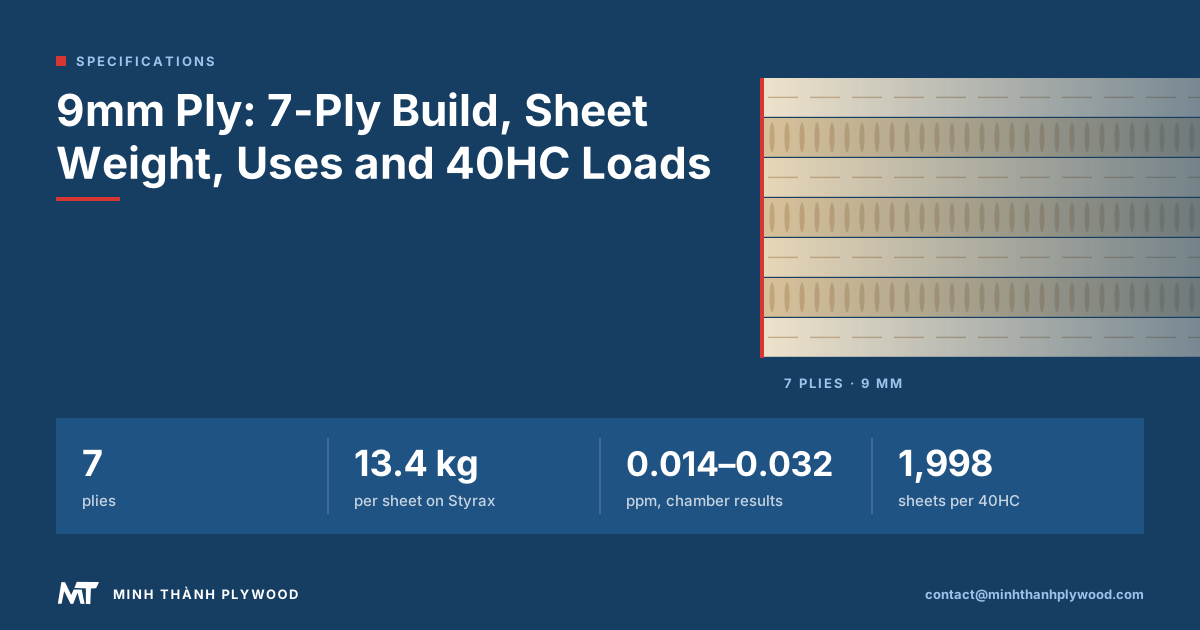
9mm ply is the thin structural-feel panel of a furniture range: drawer sides and bottoms, cabinet backs that stiffen the carcass, linings, display units and crates. A 1220 × 2440 mm sheet weighs 13.4 kg on a white Styrax core. Minh Thanh Plywood builds it with 7 plies, presses it twice, sands it to ±0.2–0.3 mm and loads 1,998 sheets into one 40HC.
What is 9mm ply, and where does it sit between 6 and 12 mm?
9mm ply is a plywood panel nine millimetres thick, built from seven veneers glued with their grain alternating, and it is the thinnest panel most furniture plants will screw through, groove and edge-band as a working part. It sits one step above 6 mm plywood, which closes backs, and one step below 12 mm plywood, the usual drawer-box and carcass board for lighter furniture.
Buyers use several names for the same panel: ply wood 9mm, 9 mm plywood, plywood sheet 9mm and, in the UK, 9mm ply or 8 x 4 plywood 9mm. They all describe one thickness. What changes between offers is the core, the face, the glue and how tightly the thickness is held.
Minh Thanh makes 9 mm on the same lines and to the same checks as its 15 and 18 mm furniture panels. The plywood thickness guide places 9 mm in the full 3–40 mm range.
How is 9 mm ply wood built for furniture?
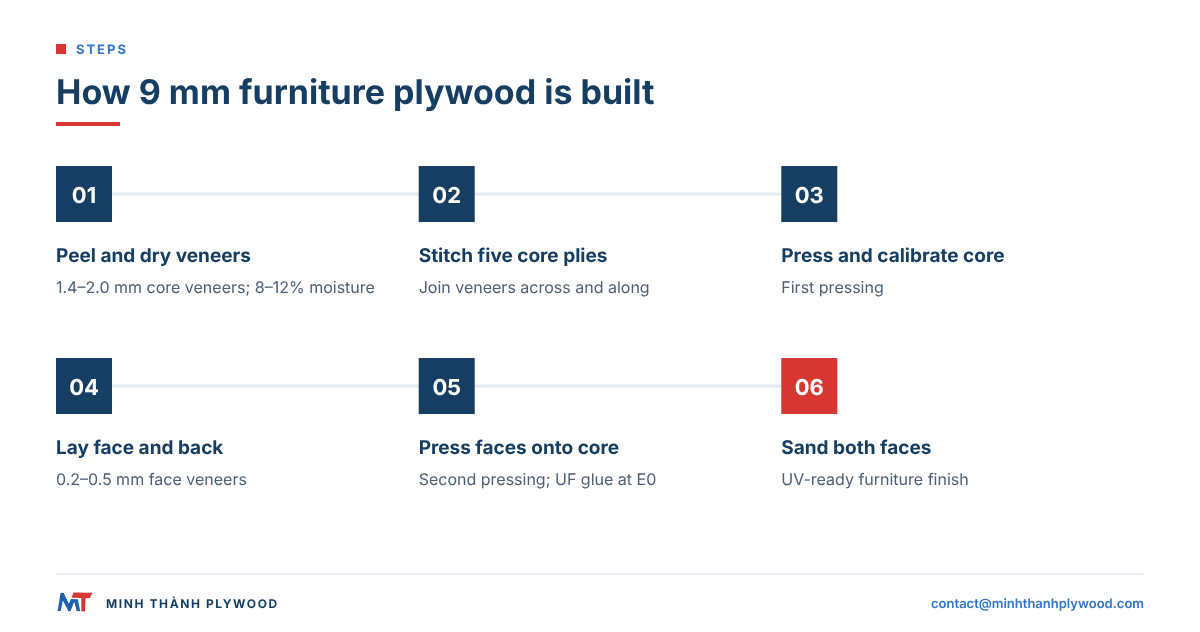
A 9 mm furniture panel from Minh Thanh has 7 plies: five core veneers and a face and back veneer, a stitched core, and two pressings. The order of work keeps a thin panel flat once it is cut into parts.
- Core veneers: white Styrax or Eucalyptus, peeled 1.4–2.0 mm thick and dried to 8–12 % moisture content.
- Core stitching: core veneers stitched horizontally and vertically, so joints stay closed in the press.
- First pressing: the five-veneer core board is pressed and calibrated to an even thickness.
- Face and back: face and back veneers, 0.2–0.5 mm thick, are laid on the calibrated core.
- Second pressing: face and back are pressed on with UF glue at E0 emission.
- Sanding: both faces sanded, or polished where the order asks, and left UV-ready for the buyer’s own coating.
| Layer | Count | Grain |
|---|---|---|
| Face veneer | 1 | Along the sheet |
| Core veneers | 5 | Alternating across, along, across, along, across |
| Back veneer | 1 | Along the sheet |
| Total | 7 plies | Odd and balanced around the centre veneer |
Pressing twice separates a furniture panel from a commercial one. The calibrated core gives a flat base for the face, so a 9 mm drawer side or door panel stays straight when it is cut free of the sheet.
How thick is 9 ply plywood, and how many plies does 9 mm have?
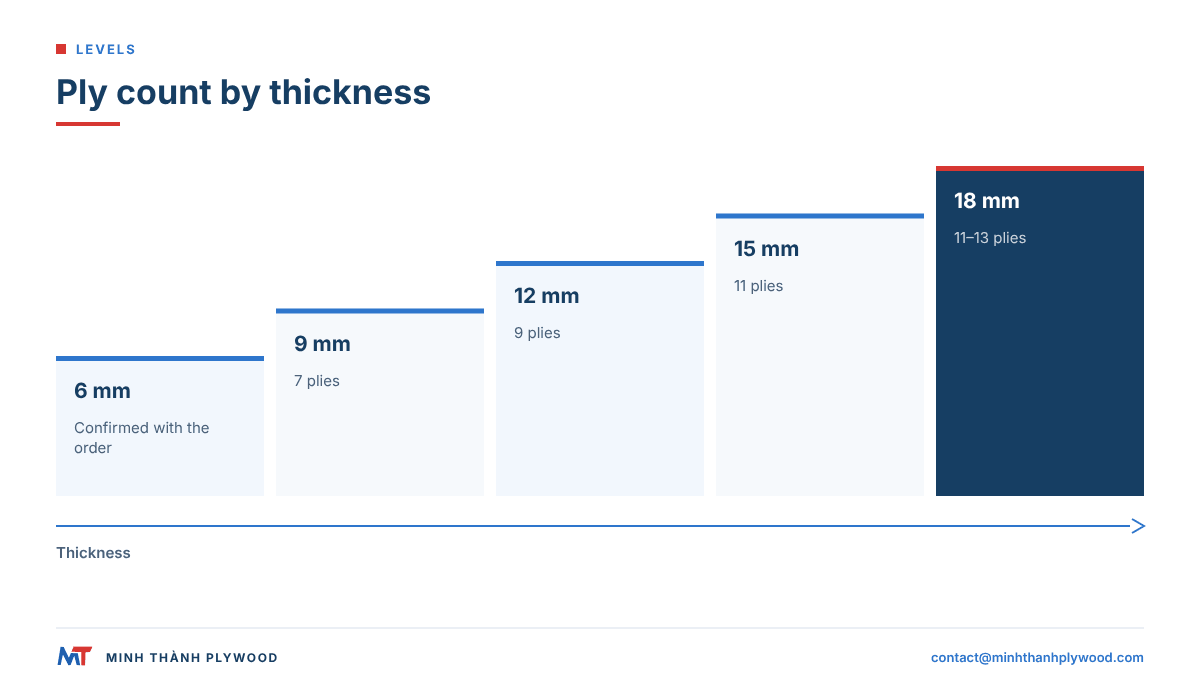
A ply count names the number of veneers, not the thickness, so 9-ply plywood and 9 mm plywood are two different panels. In Minh Thanh’s builds 9 mm has 7 plies and 12 mm has 9 plies.
| Panel | Plies | Where it is used |
|---|---|---|
| 6 mm | Confirmed with the order | Backs, linings |
| 9 mm | 7 plies | Drawer boxes, stiff backs, linings, crates |
| 12 mm | 9 plies | Drawer boxes, light carcasses |
| 15 mm | 11 plies | Doors, drawer fronts, shelves |
| 18 mm | 11–13 plies | Carcasses, worktops, long shelves |
More plies at the same thickness mean thinner core veneers and more glue lines. That gives better screw hold and fewer voids, which is why a buyer comparing two 9 mm offers should ask for the ply count and the core species on the same line, then look at a cut edge on the sample.
Which core should you choose for 9 mm: Styrax, Acacia or Eucalyptus?
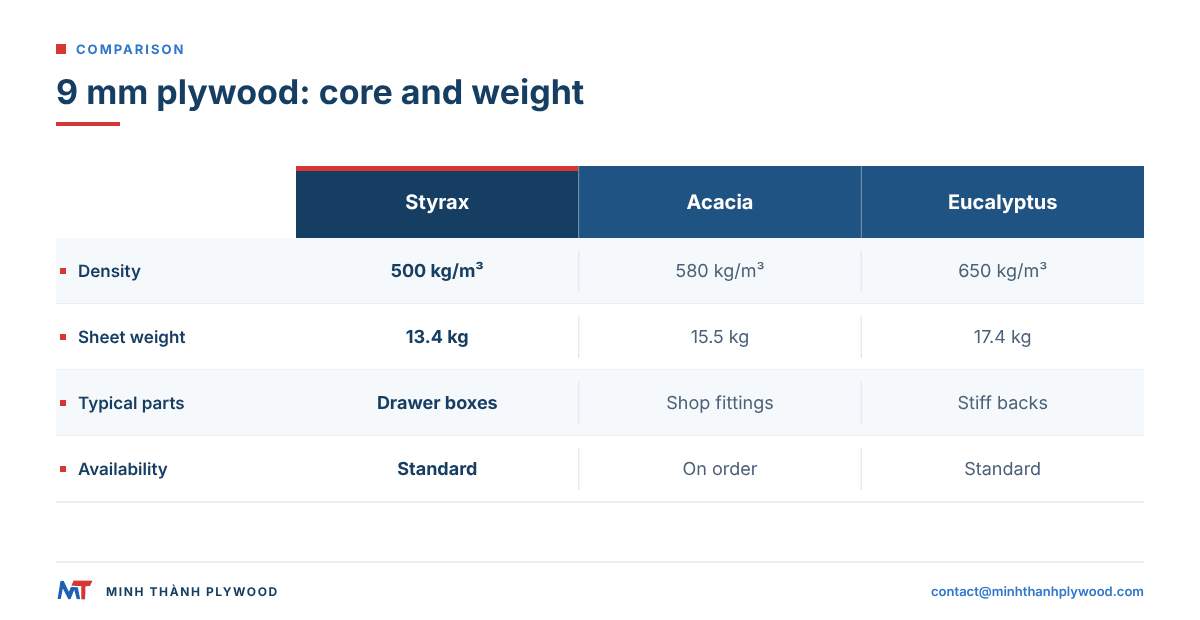
Choose white Styrax for the lightest 9 mm panel, Eucalyptus for the stiffest, and Acacia for a mid-weight core on order. Styrax and Eucalyptus are the standard furniture cores; Acacia and Pine cores are made on order.
| Core | Planning density | Weight per 1220 × 2440 × 9 mm sheet | Best 9 mm parts |
|---|---|---|---|
| White Styrax | 500 kg/m³ | 13.4 kg | Drawer boxes, flat-pack parts, linings |
| Acacia (on order) | 580 kg/m³ | 15.5 kg | Shop fittings, crates, general parts |
| Eucalyptus | 650 kg/m³ | 17.4 kg | Stiff backs, vehicle linings, parts that take screws |
The weights follow sheet volume times density: a 1220 × 2440 × 9 mm sheet holds about 0.027 cubic metres of wood. Many European furniture buyers choose the Styrax core because it is light and gives a clean, pale base for the face veneer. The plywood weight calculator runs the same sum for other sizes.
How strong is 9mm plywood, and how much weight can it hold?
9mm plywood is strong for its weight when it is fixed to a frame: as a drawer side, a cabinet back screwed to the carcass or a lining on battens it carries everyday loads without sagging. On its own between two supports it is a light-duty board, so shelves, floors and worktops belong to thicker panels.
What decides how much a 9 mm part holds:
- Span: the distance between supports. Halve the span and the panel deflects far less.
- Support: a back fixed on all four edges stiffens a whole wardrobe; the same sheet laid loose on two battens bends.
- Core: Eucalyptus is stiffer than Styrax at the same thickness, because it is denser.
- Grain: a panel is stiffer along the grain of its face veneer, so lay a shelf-like part with the face grain across the supports.
Minh Thanh does not publish load tables for 9 mm, because the answer depends on the span and fixing of each design. For parts that carry weight between supports, such as shelves on long spans, step up to 15 mm or 18 mm plywood; 9 mm then does the backs and drawer boxes of the same piece.
Types of 9mm ply: which build for which job?
Nine-millimetre plywood comes in seven common builds, and the right one follows the job: furniture panels for cabinets, birch throughout for visible edges, softwood for site work, exterior for damp, marine for boats, fire-retardant where a fire class is written into the spec, and film-faced for floors and linings in vans. UK merchants such as Sheet Materials Wholesale list all of them in 9 mm.
| Type of 9 mm ply | Build | Use | Minh Thanh |
|---|---|---|---|
| Furniture plywood, poplar or birch face | Hardwood face veneers over a Styrax or Eucalyptus core, UF glue at E0 | Cabinets, drawers, backs, shelves | Standard, birch D+/D or poplar A/B |
| Birch throughout, BB/BB | Birch in every layer, so edges show a uniform pale line | Visible edges, joinery, laser cutting | Not made: our birch is a face over a hardwood core |
| Softwood and sheathing | Pine face and core, commercial grade | Backing, temporary work, site boards | Commercial grade with Pine on order |
| Exterior, WBP | Phenolic glue, exterior-type build | Covered outdoor use, wall sheathing | Made to order, seal the edges |
| Marine, BS 1088 | Certified marine build | Boats, lockers, permanent wet areas | Not sold; our 9 mm is an interior panel |
| Fire-retardant | Treated board with a Euroclass rating | Public interiors where a fire class is written in | Send the class you need with the enquiry |
| Film-faced | Phenolic film on both faces | Van and trailer floors, formwork, wear surfaces | Quoted to order; state the thickness and film weight |
What is 9mm ply used for?
9mm ply is used for parts that must hold a fixing and stay flat but do not carry a load across a span. Furniture and interior plants order it for:
- Drawer boxes: sides, backs and bottoms of larger drawers, often with a dovetail or dowel joint.
- Cabinet and wardrobe backs that stiffen the carcass and take hanging rails or wall fixings.
- Linings: inside cupboards, chests, vans and motorhomes.
- Door and wall panels: frame-and-panel doors, wall cladding over battens.
- Display units and shop fittings: painted or laminated over a poplar face.
- Crates and packaging: on a commercial or packing-grade build with a lighter face.
Furniture plants often pair thicknesses in one container: 18 mm carcasses, 9 mm drawer boxes and backs, and 5 mm plywood for drawer bottoms of smaller drawers.
Which plywood sheet 9mm sizes can you order, including 8 x 4?
9 mm plywood is made in 1220 × 2440 mm and 1250 × 2500 mm as standard, with custom sizes such as 1220 × 2500 and 1220 × 2280 mm on order. The 8 x 4 plywood 9mm sheet of UK and US merchants is the 1220 × 2440 mm sheet.
- 1220 × 2440 mm: the nominal 8 x 4 ft sheet. A 9mm plywood 2400 x 1200 listing describes a smaller metric sheet, so use the actual dimensions when comparing prices and cutting yield.
- 1250 × 2500 mm: the European size, common in Germany, Scandinavia and Benelux.
- 1220 × 2500 and 1220 × 2280 mm: lengths matched to a part list, so less is cut to waste.
- Cut-to-size: one panel cut into 4, 6 or 8 pieces at the mill, shipped regularly to Italy and other European markets.
A drawer-box line that repeats the same side thousands of times is often cheaper as cut-to-size plywood than as full sheets: the mill cuts at the press line, and the furniture plant saves a cutting step.
Is 9mm ply the same as 3/8 inch?
The fractions convert to different metric sizes: 3/8 inch is about 9.5 mm, while 11/32 inch is about 8.7 mm. A performance category specifies an allowed thickness range rather than one exact finished thickness. Check the measured panel before substituting metric 9 mm in a furniture drawing.
| Thickness designation | Approximate equivalent in mm | Nearby metric size |
|---|---|---|
| 11/32 inch | 8.7 mm | 9 mm |
| 3/8 inch | 9.5 mm | 9 mm or 10 mm |
| 9 mm | 9 mm | 9 mm |
| 15/32 inch | 11.9 mm | 12 mm |
US structural plywood uses performance categories linked to nominal thickness designations, with actual-thickness ranges defined in Voluntary Product Standard PS 1-22 (NIST, October 2023). Check the measured panel thickness before machining grooves or choosing replacement stock for a furniture drawing. The 3/8 plywood article covers the inch size in full.
Which faces and grades are ordered in 9 mm?
Any of Minh Thanh’s 10+ face veneers can go on a 9 mm panel, quoted as a face/back pair and matched to the approved sample. Poplar, birch, engineered veneer (EV), okoume and pine are the faces made most often.
| Face | Grades quoted | Typical 9 mm use |
|---|---|---|
| Poplar | A/A, A/B, B/B | Painted drawer boxes, laminated linings |
| Birch | D+/D, D/E (D+ is close to European B, D to BB) | Visible drawer boxes, open backs, display units |
| Eucalyptus | A/A, A/B, B/B | Warm-toned visible parts |
| Pine | A/A, A/B, B/B | Pine-look furniture and joinery |
| EV and okoume | Matched to the colour reference | Decorative door panels, interior linings |
Choose A/A where both faces show, such as a drawer side seen inside and out. A/B suits backs with one show face. B/B is for parts that will be painted, laminated or hidden. A birch-faced 9 mm panel has birch faces on a Vietnamese core; it is not a birch-throughout board, so the edge shows the core species.
Is 9 mm plywood suitable for damp places, or is it marine plywood?
Standard 9 mm furniture plywood is an interior panel glued with UF glue at E0 emission, and it is not marine plywood. Marine plywood is a separate product built to BS 1088, and Minh Thanh’s okoume-faced 9 mm is sold as an interior panel, not as a marine board.
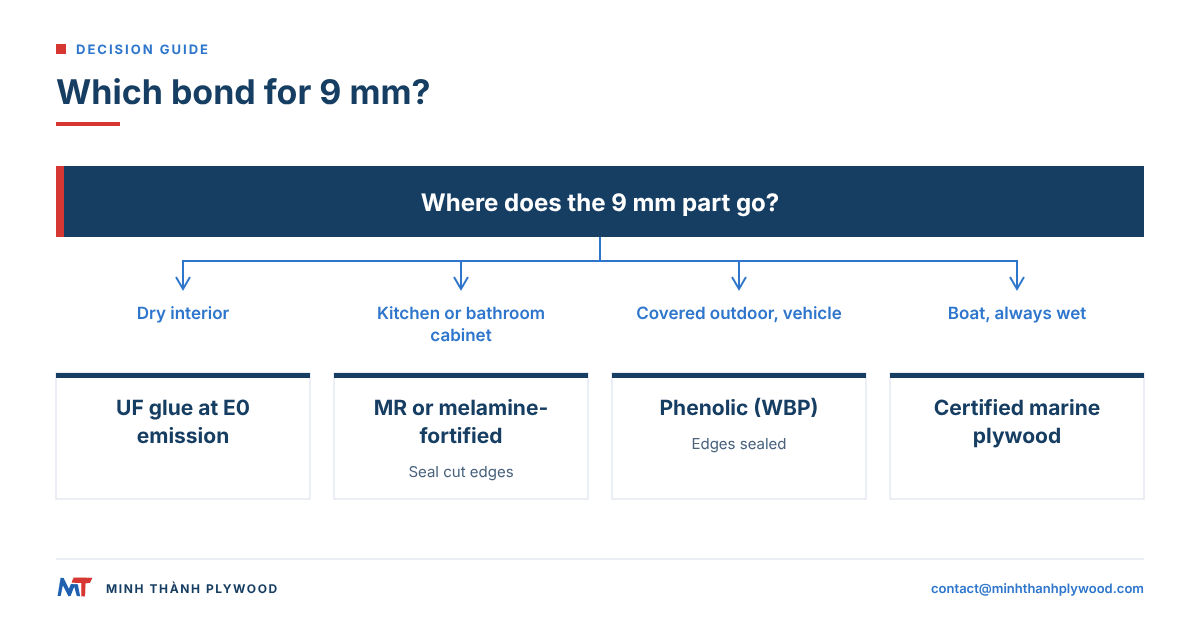
For places that get damp, order the bond to match:
| Where the 9 mm part goes | Bond to order | Note |
|---|---|---|
| Dry interiors: furniture, linings | UF glue at E0 emission | Standard furniture build |
| Kitchens and bathrooms, inside cabinets | MR or melamine-fortified | Seal cut edges |
| Covered outdoor uses, vehicle floors and linings | Phenolic (WBP) | Exterior-type build, edges sealed |
| Boats and permanently wet places | Certified marine plywood | Not a standard 9 mm furniture panel |
Minh Thanh makes exterior and CDX-type panels with water-resistant melamine-fortified or phenolic (WBP) glue for uses such as stair treads and wall sheathing. The glue type and the emission class are written on separate lines of the specification.
Has 9 mm plywood been emission tested?
Yes. 9 mm is one of the three thicknesses in Minh Thanh’s chamber-test record: six ASTM D6007 tests between April 2025 and June 2026, on 9, 15 and 18 mm panels, averaged 0.014–0.032 ppm. The limit for veneer-core hardwood plywood is 0.05 ppm under EPA’s TSCA Title VI emission standards (TSCA Title VI, which CARB Phase 2 matches).
Three of the tests were run by Shanghai Hongjun and three by ICTT Vietnam. The mill is certified under CARB P2 / TSCA Title VI as ICTT mill no. 23024, and 9 mm panels for US orders carry the TSCA Title VI label. See CARB P2 and TSCA Title VI certification for the reports.
For European buyers the panels meet the emission and quality requirements furniture plants there ask for. Third-party testing to the buyer’s own method, for example EN 717-1, is arranged through SGS on request.
What does a UK spec line for 9 mm plywood look like?
UK retailers print four things on a 9 mm sheet: BS EN 13986, a bond class to EN 314-2, an emission class and FSC. Wickes lists its 9 mm non-structural hardwood sheet as BS EN 13986, BS EN 314-2 Class 2, FSC certified and formaldehyde class E1. Ask your supplier for the same four lines and you can compare sheets like for like.
The bond class comes from EN 314-2, the standard for plywood bonding-quality requirements. Where a fire class is written into the spec, untreated plywood at least 9 mm thick can be classed D-s2,d0 without further testing only when it meets the minimum density and the specified no-air-gap mounting conditions on a qualifying substrate under Commission Decision 2007/348/EC.
| UK spec line | What it means | What we supply on 9 mm |
|---|---|---|
| BS EN 13986 | Harmonised standard for wood-based panels in construction, behind the CE mark | CE available on request, supplied directly or through qualified partner mills |
| EN 314-2 bond class | Class 1 dry, Class 2 humid, Class 3 exterior | UF for Class 1, MR or melamine-fortified for Class 2, phenolic (WBP) for Class 3 |
| Formaldehyde class | E1 is the European limit, E0 is lower | UF glue at E0 emission; CARB P2 / TSCA Title VI |
| FSC | Chain-of-custody certification for the timber | FSC on request, supplied directly or through qualified partner mills |
What tolerance should you ask for on 9 mm?
Ask for ±0.2–0.3 mm on sanded 9 mm furniture panels, and ±0.2 mm when drawer sides are grooved for a bottom or machined on CNC to a fixed depth. Length and width are held to ±2 mm.
| Product line at 9 mm | Thickness tolerance | Typical use |
|---|---|---|
| Sanded furniture plywood | ±0.2–0.3 mm, down to ±0.2 mm | Drawer boxes, backs in grooves, CNC parts |
| Commercial plywood | ±0.5 mm | Linings, painted parts, shop fittings |
| Film-faced plywood | ±0.5 mm | Vehicle floors, formwork |
| Packing plywood | ±0.5–1.0 mm | Crates and pallets |
At 9 mm a drift of half a millimetre between sheets shows up at every joint: a drawer side that is thicker than its partner leaves the front proud, and a back that is thinner rattles in its groove. Measure arrivals with a caliper at the four corners and the centre of sheets taken from several packs.
What size screws should you use for 9mm plywood?
Through the face of 9 mm plywood into a frame, use a screw long enough to pass the sheet and bite at least twice the panel thickness into the timber behind it, and drill a pilot hole within a few centimetres of an edge. Countersink the head so it sits flush with the face veneer.
- Into the face: holds well, because the screw crosses all seven plies and their glue lines.
- Into the edge: weak in 9 mm, because the screw runs between plies and can split them; glue and pin edge joints, or use 12 mm and up where the edge takes a screw.
- Hinges and runners: screws into the face of a 9 mm drawer side hold drawer runners; concealed hinge cups need a thicker door.
- Staples and pins: for backs and linings fixed into a rebate.
A Eucalyptus core holds screws better than Styrax, because it is denser. If the design screws hardware straight into 9 mm panels, put that on the order and choose the core with it.
How many 9 mm sheets fit in a 40HC?
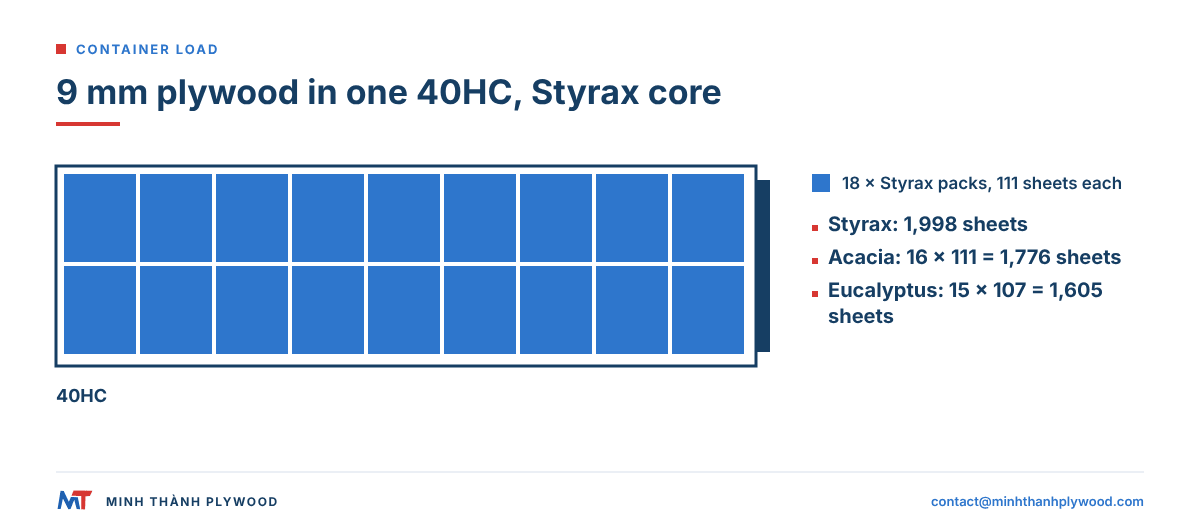
One 40HC takes 1,998 sheets of 1220 × 2440 × 9 mm on a Styrax core, 1,776 on Acacia and 1,605 on Eucalyptus. Each pack is about one metre high, so it holds 111 sheets at 9 mm, and the heaviest core stops earlier because of weight.
| Core | Packs × sheets | Sheets per 40HC | Volume | Net weight |
|---|---|---|---|---|
| White Styrax | 18 × 111 | 1,998 | 53.53 m³ | 26,764 kg |
| Acacia | 16 × 111 | 1,776 | 47.58 m³ | 27,597 kg |
| Eucalyptus | 15 × 107 | 1,605 | 43.00 m³ | 27,950 kg |
The plan uses a 28,000 kg planning payload. On Eucalyptus a full 111-sheet pack would take the load past that figure, so each pack is cut to 107 sheets. If your booking allows less, for example 26,000 kg, the sheet count drops to match. The 18 Styrax packs go in as 16 lying flat and 2 standing upright at the door end; container loading shows the order of work.
What does 9 mm plywood cost, and what drives the price?
In October 2026, furniture and interior plywood from Minh Thanh started from US$350/m³ and commercial plywood from US$250/m³, FOB Hai Phong. One cubic metre holds about 37 sheets of 1220 × 2440 × 9 mm, so the cubic-metre price becomes a sheet price on the quotation.
The lines that move a 9 mm price:
- Face and grade: birch and A/A faces cost more than B/B poplar.
- Core: Styrax, Eucalyptus, or Acacia on order.
- Glue: UF at E0 against melamine-fortified or phenolic.
- Tolerance and finish: ±0.2 mm, polished and UV-ready faces.
- Size and quantity: custom lengths, cut-to-size, mixed loads.
- Delivery term: FOB Hai Phong, CFR or CIF.
A 9 mm sheet of 1220 × 2440 mm holds 0.0268 m³, so the raw FOB example is about US$6.7 at US$250/m³ and about US$9.4 at US$350/m³, before the face, core, glue and quantity set the final price. They are not sheet prices. In the UK, Wickes sells its 9 mm non-structural hardwood sheet at £25.60 including VAT, and Sheet Materials Wholesale lists 9 mm birch throughout BB/BB at about £47 and fire-retardant 9 mm at about £46 per sheet ex VAT in trade quantities. Compare those with the landed cost of a container, not the FOB figure.
Retail prices for single sheets in the UK or Cyprus are not a guide to container prices: a 40HC of 9 mm on Styrax carries about 53 m³ of panels priced by the cubic metre.
How do you write 9mm ply on a quotation request?
Write 9mm ply on a quotation request as one line in the order a mill quotes it: application, core, glue and emission, face and grade, size, tolerance, packing and quantity.
9 mm furniture plywood for drawer boxes · 7-ply, white Styrax core, stitched, pressed twice · UF glue at E0 emission · birch face D/E, sanded, UV-ready · 1220 × 2440 mm · ±0.2 mm · export packs · 1 × 40HC, FOB Hai Phong.
Add a second line for any other thickness in the same container; the minimum order is one 40HC with mixed specifications by agreement. After the specification is agreed, production takes 15–45 days after the 30% deposit, and the 70% balance is paid against the scanned B/L or by irrevocable L/C at sight. Send the line to [email protected] for a quotation within hours and free samples. Furniture plywood from Vietnam lists the full range.
Buyer questions, answered
What is 9mm ply?
9mm ply is a plywood panel nine millimetres thick, built from seven veneers glued with their grain alternating. It is used for drawer boxes, cabinet backs, linings, display units, vehicle linings and crates.
How many plies does 9 mm plywood have?
Seven. A 9 mm furniture panel from Minh Thanh has five core veneers and a face and a back veneer, an odd and balanced build that keeps the sheet flat.
How thick is 9 ply plywood?
There is no fixed answer: 9-ply describes the number of veneers, not the thickness. In Minh Thanh's builds 9 plies is a 12 mm panel, and a 9 mm panel has 7 plies.
Is 9mm plywood strong?
Strong enough for drawer sides, carcass backs, linings and crates fixed to a frame. It is not a floor, worktop or long-shelf board; use 15 to 18 mm where a panel spans between supports and carries weight.
How much does a 9 mm plywood sheet weigh?
A 1220 × 2440 × 9 mm sheet weighs about 13.4 kg on a white Styrax core, 15.5 kg on Acacia and 17.4 kg on Eucalyptus, at planning densities of 500, 580 and 650 kg/m³.
What size screws should I use for 9 mm plywood?
Through the face into a frame, use a screw that passes the 9 mm sheet and bites at least twice that depth into the timber behind, with a pilot hole near edges. Avoid screwing into the 9 mm edge; glue and pin it, or use a thicker panel.
Is 9mm ply the same as 3/8 inch?
The sizes are close: 3/8 inch is about 9.5 mm and 11/32 inch about 8.7 mm. Metric 9 mm is a separate thickness; check the declared category, measured thickness and fit before substituting it.
What size is an 8 x 4 sheet of 9mm plywood?
An 8 x 4 ft sheet is approximately 2440 × 1220 mm; the 2400 x 1200 format is a separate, smaller metric sheet. Minh Thanh makes 1220 × 2440 mm and the European 1250 × 2500 mm as standard, plus custom lengths and cut-to-size parts.
Is 9 mm plywood marine plywood?
Not as standard. Marine plywood is a separate product built to BS 1088. Minh Thanh's okoume-faced 9 mm is an interior panel; for damp places order the phenolic (WBP) bond and seal the edges.
How many sheets of 9 mm plywood fit in a 40HC?
On 1220 × 2440 mm sheets: 1,998 on Styrax core (18 packs of 111), 1,776 on Acacia (16 × 111) and 1,605 on Eucalyptus (15 × 107, capped by the 28,000 kg payload).
How much is 9 mm plywood from Vietnam?
In October 2026 furniture plywood from Minh Thanh started from US$350/m³ and commercial plywood from US$250/m³, FOB Hai Phong. One cubic metre holds about 37 sheets of 1220 × 2440 × 9 mm.
Has 9 mm plywood been emission tested?
Yes. 9 mm is one of the three thicknesses in Minh Thanh's six ASTM D6007 chamber tests (April 2025 to June 2026), which averaged 0.014–0.032 ppm against the 0.05 ppm CARB Phase 2 / TSCA Title VI limit.