
Alder wood is a light, soft hardwood, mostly red alder from the Pacific Northwest, with an even grain that stains to look like cherry or walnut. It is the budget-friendly cabinet wood of North America, sold clear or knotty. Minh Thanh Plywood, a Vietnamese furniture plywood mill, gives the numbers and what to specify when you want an alder look on panels.
What is alder wood?
Alder wood is the timber of trees in the genus Alnus, a member of the birch family. In trade, “alder” nearly always means red alder (Alnus rubra), the most important hardwood of the Pacific Northwest of North America, as described in the USDA Forest Service Silvics of North America. European black alder (Alnus glutinosa) is the second species buyers meet.
Alder is light, soft and even. Freshly sawn it turns orange-red, then dries to a pale tan or light reddish-brown. Its fine, uniform grain takes stain so evenly that it is often finished to look like cherry or walnut, at a lower price.
This guide covers what alder is, its properties, where it works, how it compares with maple and cherry, and how to get an alder look on a furniture panel.
Is alder a hardwood?
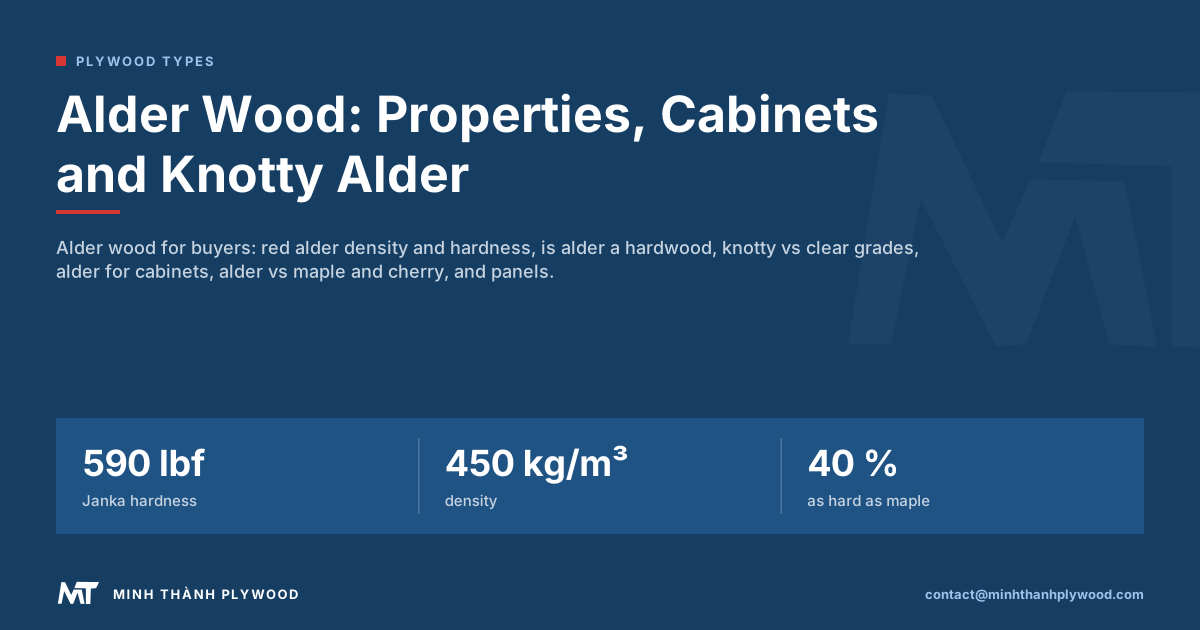
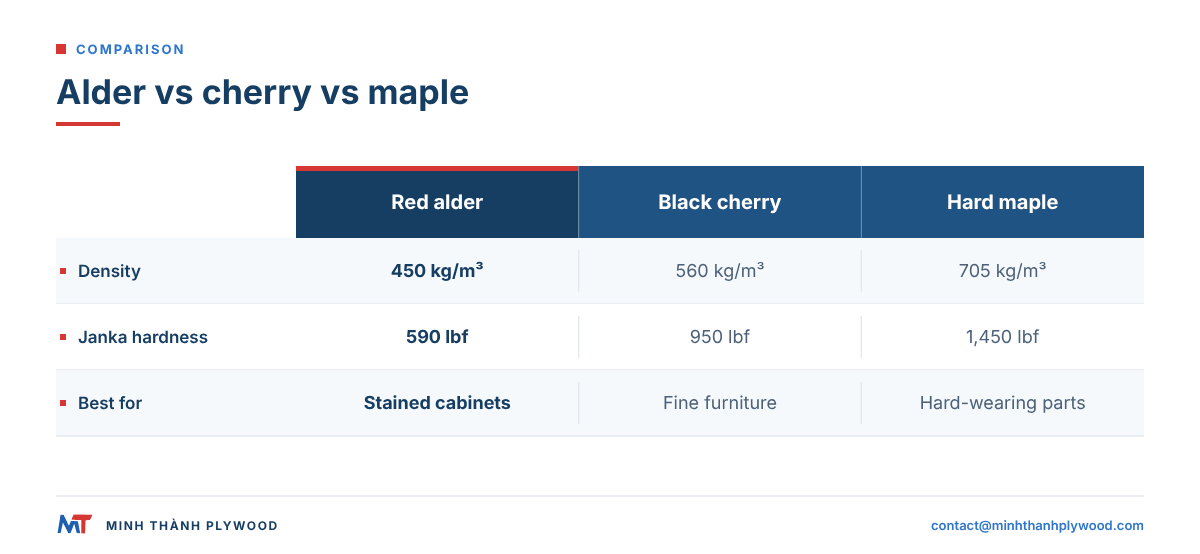
Yes, alder is a hardwood, because it grows on broadleaf flowering trees, not conifers. It is one of the softest hardwoods in cabinet use, though: red alder scores 590 lbf (2,620 N) on the Janka hardness test, below cherry at 950 lbf and well below hard maple at 1,450 lbf.
The word “hardwood” describes the tree, not the surface. Balsa and basswood are hardwoods too, while some softwoods such as yew are harder than alder. For a buyer, the Janka figure says more than the label.
Alder wood properties at a glance
Red alder is a medium-light, soft, stable wood with moderate strength. The numbers below are averages at about 12 % moisture content, from The Wood Database (read 20 October 2026).
| Property (12 % MC) | Red alder | Black cherry | Hard maple | Yellow poplar |
|---|---|---|---|---|
| Average dried density | 450 kg/m³ | 560 kg/m³ | 705 kg/m³ | 455 kg/m³ |
| Janka hardness | 590 lbf | 950 lbf | 1,450 lbf | 540 lbf |
| Modulus of rupture | 67.6 MPa | 84.8 MPa | 109.0 MPa | 69.7 MPa |
| Modulus of elasticity | 9.52 GPa | 10.30 GPa | 12.62 GPa | 10.90 GPa |
| Volumetric shrinkage | 12.6 % | 11.5 % | 14.7 % | 12.7 % |
| Decay resistance | Non-durable | Very durable | Non-durable | Moderate to non-durable |
Sources: The Wood Database, Red Alder, Black Cherry, Hard Maple, Yellow Poplar, read 20 October 2026.
- Density of about 450 kg/m³ makes alder light to handle and cheap to ship, lighter than a Styrax-core plywood panel at 500 kg/m³.
- Hardness is the weak point: alder dents under heavy use.
- Stability is good for a hardwood. Its shrinkage is moderate, so doors and panels stay flat once dry.
- Strength is close to yellow poplar: fine for doors, frames and carcass parts, not for long, heavily loaded shelves.
Alder colour, grain and texture
Alder is pale tan to light reddish-brown, with no clear difference between sapwood and heartwood. That evenness is its main appeal: a whole kitchen of alder doors has one tone before staining.
- Grain: straight to slightly wavy, with a fine, even texture and small, diffuse pores.
- Figure: mostly plain; occasional burls and the dark knots of knotty grades.
- Colour change: the orange-red of fresh-cut wood fades to tan as it dries and ages.
- Staining: takes stain evenly, though soft areas can blotch; a pre-stain conditioner helps.
The same plain look is why alder is a common “stain-grade” wood: finishers turn it into a convincing cherry or walnut. For the real thing, see our guide to walnut wood.
Red alder vs European black alder
Red alder and European black alder look and work alike, but they reach buyers through different trades. Red alder is sawn in large volumes in Washington, Oregon and British Columbia and shipped worldwide; black alder is mostly sawn locally in Europe.
| Point | Red alder (Alnus rubra) | Black alder (Alnus glutinosa) |
|---|---|---|
| Native range | Pacific coast of North America | Europe, western Asia, North Africa |
| Main trade | Graded lumber, veneer, export | Local joinery, turnery, veneer |
| Look | Pale tan, even | Pale tan to reddish, even |
| Water behaviour | Rots above ground in damp | Very durable fully under water |
| Typical use | Cabinets, doors, guitar bodies | Clogs, turnery, piles, toys |
Black alder is famous for lasting under water: the piles under Venice and many old European bridges are alder. Above ground and in damp air, both species are non-durable.
Alder wood for cabinets: pros and cons
Alder wood for cabinets is a sound choice when the doors will be stained or the design is rustic, and the kitchen is not a heavy-wear one. It is the most common stain-grade cabinet wood in the western United States.
What alder does well in cabinets
- Machines, routes and sands easily, so profiled doors come out clean.
- Takes stain and glaze evenly, from honey to dark walnut tones.
- Is light, which helps on tall doors and wall units.
- Knotty alder gives a rustic look that would cost more in other species.
Where alder falls short
- Dents more easily than maple, cherry or oak: worktops and drawer fronts at kick height show wear.
- Has a plain grain, so in a clear natural finish it can look flat next to oak or ash.
- Rots if it stays wet, so sink-base cabinets need a sealed finish.
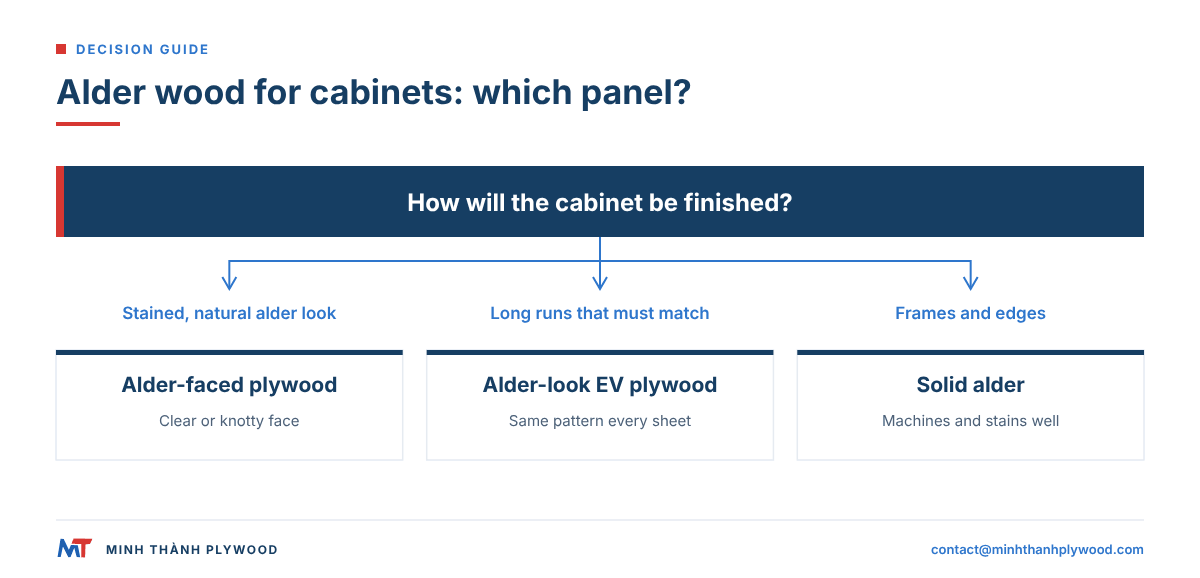
Most alder kitchens use solid alder for door frames and alder-faced plywood for door panels, sides and shelves. Our guide to plywood for kitchen cabinets covers the carcass side.
Knotty alder vs clear alder
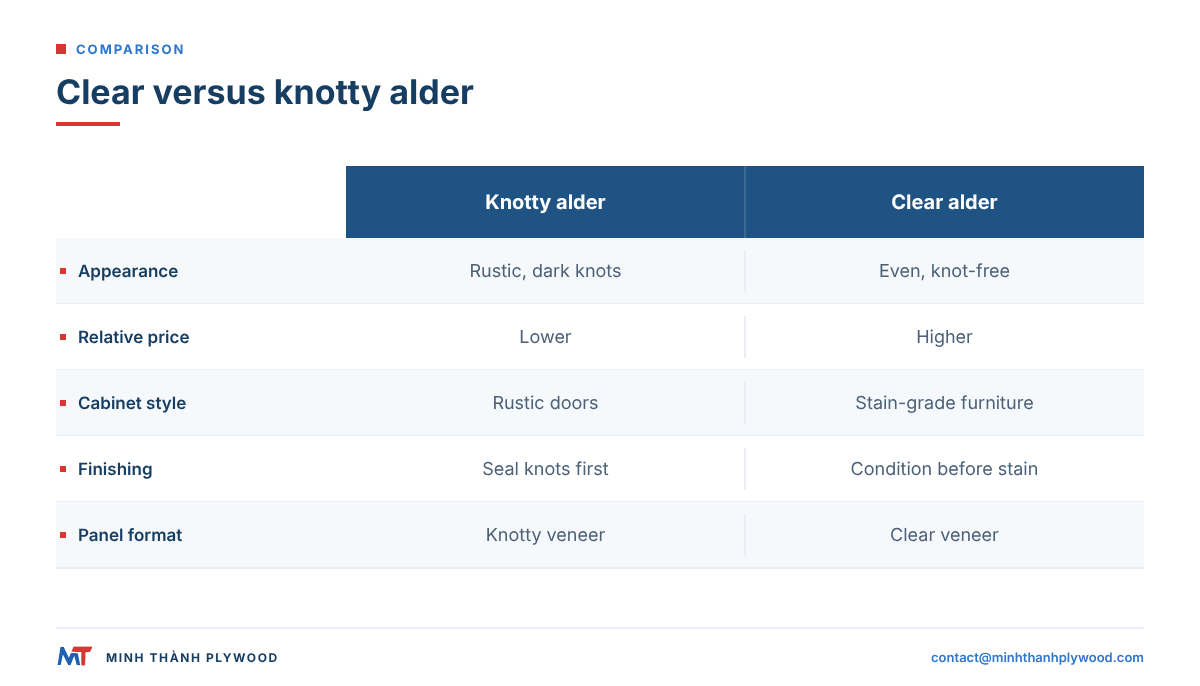
Knotty alder is alder graded to keep its small, sound knots; clear alder is cut for faces free of knots. They come from the same logs and differ in look and price.
| Point | Knotty alder | Clear alder |
|---|---|---|
| Look | Rustic, small dark knots | Even, plain, knot-free |
| Price | Lower, similar to utility woods | Higher, near cabinet hardwoods |
| Typical use | Rustic cabinets, doors, panelling | Stain-grade cabinets, furniture |
| Finishing | Knots seal before staining | Even staining with conditioner |
| Panel format | Knotty alder veneer on plywood | Clear alder veneer on plywood |
Knotty alder plywood is a common request from importers in Asia and North America who build rustic doors and wall panelling. It is alder face veneer with sound knots on a plywood or MDF core; the core and glue decide flatness and emissions, as with any decorative panel.
Alder vs maple vs cherry for furniture
Alder is the lightest, softest and usually cheapest of the three; cherry is the richest in colour; maple is the hardest. Pick by wear and by finish.
- Choose alder for stained cabinets and furniture on a budget, and for rustic knotty looks.
- Choose cherry for a natural reddish colour that deepens with age and a finer, more valuable look.
- Choose maple for kitchens and children’s furniture that take daily knocks, or for a light, smooth painted or clear finish.
Alder stained to a cherry tone fools most visitors, but not a fingernail: press the surface and alder gives first. Read more on maple wood and on wood species compared.
What is alder wood used for?
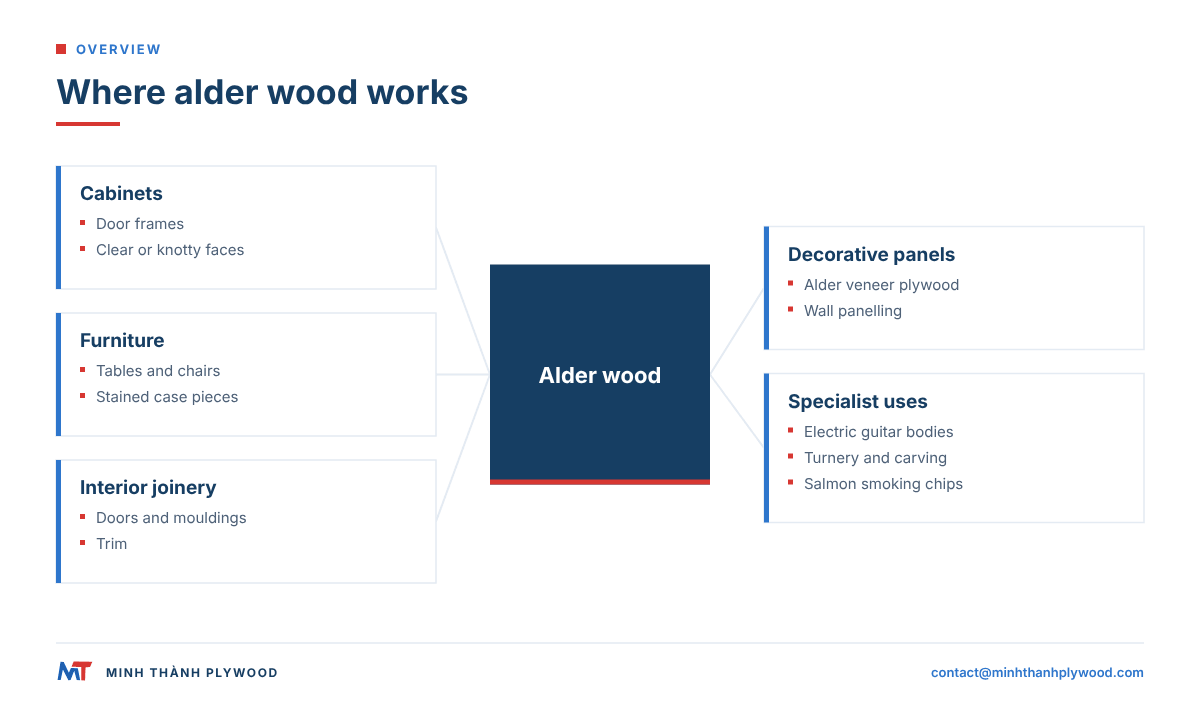
Alder is used for cabinets, furniture, doors, mouldings, guitar bodies and veneer, plus pallets and pulp in lower grades. Its even texture and easy machining are what each of these uses relies on.
- Kitchen and bath cabinets: doors, frames and faces, often knotty.
- Furniture: chairs, tables and case pieces, usually stained.
- Doors and millwork: interior doors, mouldings and trim.
- Electric guitar bodies: a classic tonewood for solid-body guitars.
- Veneer and plywood: alder faces on plywood for cabinet sides and wall panels.
- Turnery and carving: bowls, toys and carved items in black alder.
- Smoking wood: alder chips are the traditional wood for smoking salmon in the Pacific Northwest.
Working and finishing alder
Alder is one of the easiest hardwoods to work by hand and machine, and its only real trap is blotchy staining. Plan the finish before cutting.
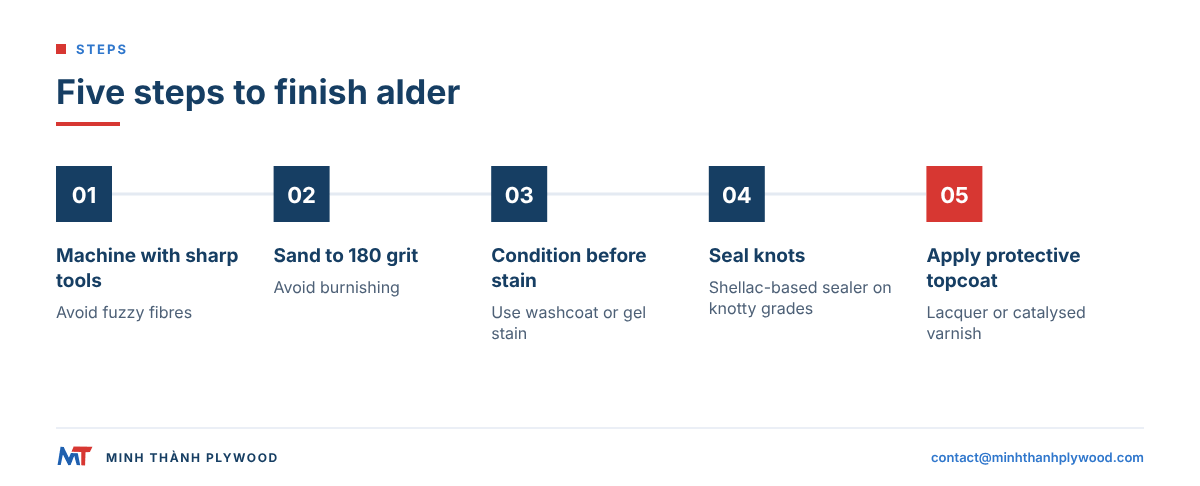
- Machine with sharp tools: soft fibres can fuzz with dull cutters.
- Sand to 180 grit: alder sands fast; stop before burnishing the surface.
- Condition before staining: a washcoat or gel stain keeps the colour even.
- Seal knots: on knotty grades, a shellac-based sealer keeps knots from bleeding.
- Topcoat: lacquer or catalysed varnish protects the soft surface in kitchens.
Alder glues well with PVA and urea glues and holds screws adequately; use pilot holes near edges, where it can split.
Alder plywood and alder-look panels
An alder plywood panel is an alder veneer face, clear or knotty, on a stable core. It is the standard way to build alder cabinet sides, backs, shelves and wall panels at full sheet sizes.
At Minh Thanh, decorative faces go on white Styrax or Eucalyptus cores as standard, with the core stitched in both directions and the panel pressed twice: core first, then face and back. That keeps the thin face flat, which matters on a plain species like alder, where every bump shows under stain. Select natural alder veneer or an alder-look engineered veneer (EV) against an approved appearance sample; see EV plywood.
| Panel point | What to specify | Minh Thanh standard |
|---|---|---|
| Face | Clear or knotty alder, or alder-look EV | Faces matched to the approved sample |
| Core | Light or harder screw-holding | Styrax (about 500 kg/m³) or Eucalyptus (650–750 kg/m³) |
| Glue and emission | Furniture grade | UF glue at E0 emission |
| Thickness tolerance | Sanded | ±0.2–0.3 mm |
| Moisture | Dried for furniture | 8–12 % at dispatch |
How alder timber is graded and sold
Red alder lumber is often sold under mill and regional grade names rather than only the standard hardwood grades, because the logs are small and knots are common. The main sorts are clear (often sold as Superior or Select), knotty (often sold as Cabinet or Frame grade) and a rustic or character sort.
- Clear grades: long clear cuttings for stain-grade doors, furniture and mouldings.
- Knotty grades: sound knots kept as a feature for rustic cabinets and panelling.
- Thickness: sawn in quarters of an inch, 4/4 to 8/4, kiln-dried for furniture.
- Moisture: dried to about 8–12 % for indoor use, the same range Minh Thanh dries its veneers and panels to before dispatch. For the principles of wood drying and moisture content, see the Wood Handbook of the US Forest Products Laboratory.
- Veneer: the best alder logs are rotary-peeled or sliced for plywood faces, in clear and knotty grades.
Because alder grows fast and regenerates readily after logging, it is one of the most available hardwoods of western North America, and its price has stayed below cherry and walnut.
What does alder lumber cost and weigh?
Clear red alder costs about US$7.60 per board foot in 4/4 at a US lumber dealer, and knotty alder about US$3.10 (indicative retail, 9 July 2026). A board foot of alder weighs about 2.3 lb, from the 450 kg/m³ density in the table above.
| Alder lumber, US retail | 4/4 | 5/4 | 6/4 | 8/4 |
|---|---|---|---|---|
| Clear alder, US$ per board foot | 7.60 | 7.90 | 8.10 | 8.30 |
| Knotty alder, US$ per board foot | 3.10 | 3.50 | 3.70 | 3.80 |
Source: Forest Products Supply, domestic lumber price list, 9 July 2026. Other US dealers list 4/4 clear or Superior alder at US$6.50 to US$9.30 per board foot, so treat the table as a mid-market guide, not a quote (Groff’s Lumber, Woodvendors, checked on 21 October 2026).
Grade names change from dealer to dealer. FAS or Select and Superior mean long clear cuttings; Cabinet, Frame, Knotty or Rustic mean sound knots allowed. Ask which one the price is for.
What to look for when buying alder
- Grade: clear for stain-grade doors, knotty for rustic looks; check the percentage of clear face the dealer promises.
- Moisture: kiln-dried to about 8–12 % for indoor work; a damp board cups after machining.
- Knots: sound and tight, with no loose or black-rimmed knots that bleed through stain.
- Colour match: pick boards from one lot; alder ranges from pale tan to reddish-brown and the stain will show it.
- Flatness: sight along each board for bow and twist, and check that thickness is even for planing.
For volume buyers, an alder-look panel is the other route. Minh Thanh’s indicative starting price for furniture and interior plywood is from US$350/m³ (October 2026); the final quotation depends on face, core, glue, thickness, size, quantity and delivery term. See the panel table above.
What this means for your order
For an alder look on panels, send the face, the core, the glue and the size, and a mill can quote one build, not a range. Alder itself is not the cost driver; the core, thickness and sanding are.
- Application: cabinet doors, sides, wall panelling or furniture.
- Face: clear alder, knotty alder or alder-look EV; face/back grades for one or two visible sides.
- Core: Styrax for light weight or Eucalyptus for screw-holding.
- Glue and emission: UF glue at E0 emission. Our panels carry CARB P2 / TSCA Title VI certification (ICTT mill no. 23024), and six chamber tests from April 2025 to June 2026 averaged 0.014–0.032 ppm. The limit for hardwood plywood with a veneer core is 0.05 ppm under EPA’s TSCA Title VI guidance.
- Size and thickness: 1220 × 2440 or 1250 × 2500 mm, 3–40 mm, or cut-to-size.
- Quantity and port: from one 40HC; production 15–45 days after the deposit.
Furniture and interior plywood starts from US$350/m³ (October 2026), and free samples are available. Write to contact@minhthanhplywood.com, or compare alder with other species in the pillar on types of wood.
Buyer questions, answered
Is alder a hardwood?
Yes. Alder comes from broadleaf trees of the genus Alnus, so it is a hardwood, but a soft one: red alder scores 590 lbf on the Janka test, softer than cherry, maple or oak.
Is alder wood good for cabinets?
Yes, for cabinets that are stained or that suit a rustic look. Alder machines and sands easily and takes stain evenly; its softness means doors dent more easily than maple or oak in a busy kitchen.
What is knotty alder?
Knotty alder is red alder graded to keep its small, sound knots as a design feature. It is used for rustic cabinets, doors and panelling, and costs less than clear alder.
Is alder cheaper than maple or cherry?
Usually yes. Knotty alder is priced like other domestic utility woods, and clear alder sits closer to the cabinet hardwoods but still below cherry in most markets.
What does alder wood look like?
Fresh-cut alder is pale tan to light reddish-brown, with no clear line between sapwood and heartwood. The grain is straight and the texture fine and even, with few visible pores.
Does alder wood dent easily?
Yes, more than most cabinet hardwoods. At 590 lbf Janka, red alder is about 40 % as hard as hard maple, so tabletops and floors in alder show dents from heavy use.
Is alder good for outdoor use?
No. Alder is rated non-durable to perishable against decay, so it is an indoor wood. Outdoor use needs a durable species or treated wood.
Is there alder plywood?
Yes. Alder veneer is pressed onto plywood or MDF cores, in clear and knotty grades, for cabinet doors, sides and wall panels. Specify the face appearance and the core separately.
Where does alder wood come from?
Most commercial alder is red alder from the Pacific coast of North America, from Alaska to California. European black alder grows across Europe and is used for joinery, turnery and the classic underwater piles of Venice.
Is alder good for guitars?
Yes. Alder is a classic electric guitar body wood: light, even and resonant, and it takes paint and stain well.