
Ash wood is a pale, straight-grained hardwood from Fraxinus trees, about as hard as oak but lighter in colour and famous for bending without breaking. It goes into tool handles, sports gear, chairs, flooring and veneered panels. Minh Thanh Plywood, a Vietnamese furniture plywood mill, sets out the numbers, the supply risks and how to order an ash look on a panel.
What is ash wood?
Ash wood is the timber of trees in the genus Fraxinus, a group of about 45 to 65 broadleaf species in the olive family. Two species supply most of the world trade: white ash (Fraxinus americana) from eastern North America and European ash (Fraxinus excelsior) from Europe and western Asia.
Ash is pale, straight-grained and ring-porous, with clear growth rings that give it a pattern close to oak. It is hard, stiff and, above all, tough: it absorbs shock without splitting. That is why ash has been the handle wood for axes, hammers and spades for centuries.
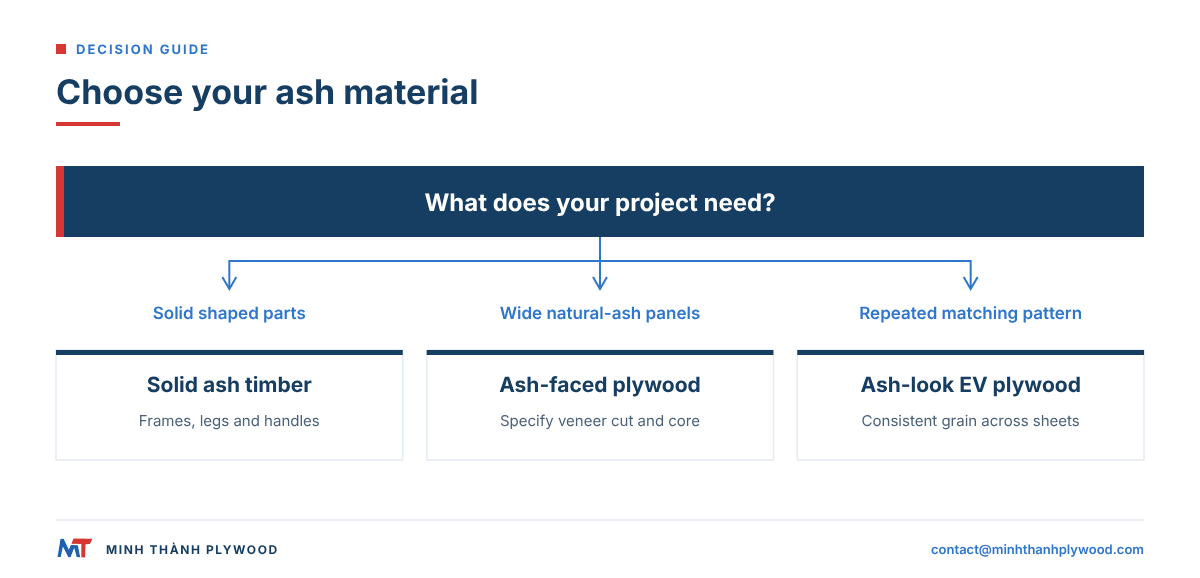
For panel buyers, ash means one of two things: solid ash timber for frames and solid parts, or ash veneer on a plywood or MDF core for doors, wall panels and furniture tops. This guide covers both, with the numbers you need for an order.
Is ash a hardwood?
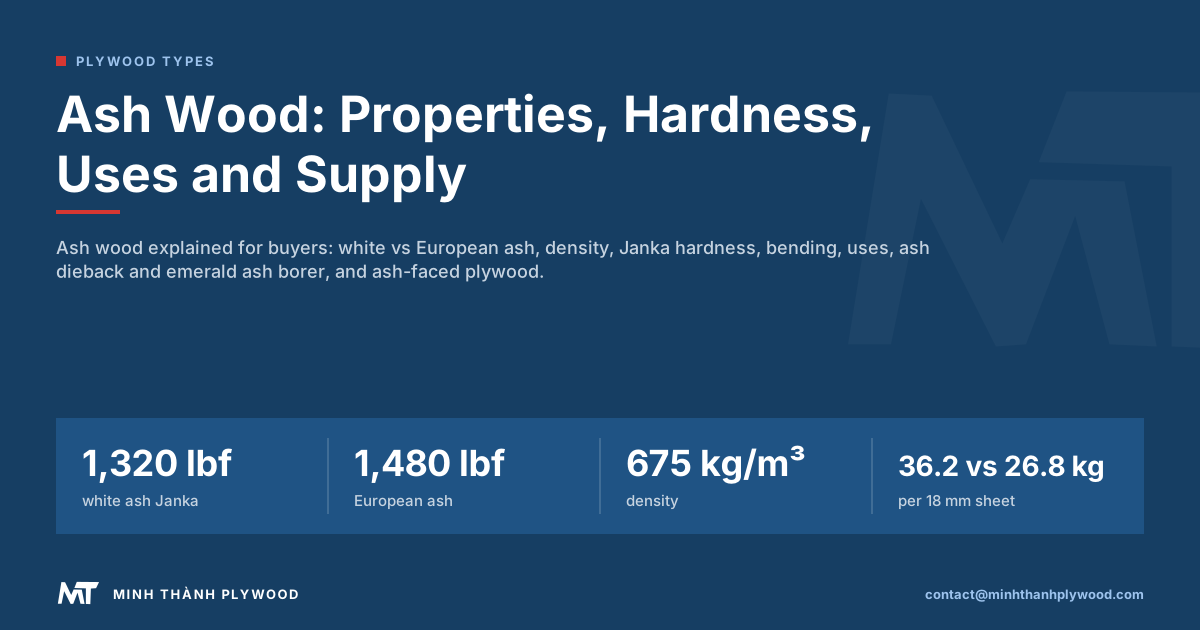
Yes, ash is a hardwood. “Hardwood” is a botanical term for wood from flowering broadleaf trees, and ash is one; it is also hard in the everyday sense. White ash scores 1,320 lbf (5,870 N) on the Janka test and European ash 1,480 lbf (6,580 N), in the same band as red oak.
Ash is classed as a temperate hardwood with a ring-porous structure: large pores in the earlywood each spring, dense latewood after. The pores take stain readily, which is why stained ash can pass for oak at a distance.
Ash wood properties: density, hardness and strength
Ash wood properties sit in the upper middle of the temperate hardwoods. The table compares the two main ash species with hard maple and red alder, all at about 12 % moisture content, from The Wood Database species pages (read 20 October 2026).
| Property (12 % MC) | White ash | European ash | Hard maple | Red alder |
|---|---|---|---|---|
| Average dried density | 675 kg/m³ | 680 kg/m³ | 705 kg/m³ | 450 kg/m³ |
| Janka hardness | 1,320 lbf | 1,480 lbf | 1,450 lbf | 590 lbf |
| Modulus of rupture | 103.5 MPa | 103.6 MPa | 109.0 MPa | 67.6 MPa |
| Modulus of elasticity | 12.00 GPa | 12.31 GPa | 12.62 GPa | 9.52 GPa |
| Crushing strength | 51.1 MPa | 51.0 MPa | 54.0 MPa | 40.1 MPa |
| Volumetric shrinkage | 13.3 % | 15.3 % | 14.7 % | 12.6 % |
Sources: The Wood Database, White Ash, European Ash, Hard Maple, Red Alder, read 20 October 2026.
What the numbers mean for a buyer:
- Density of about 675–680 kg/m³ makes ash a heavy wood: a solid ash part weighs about a third more than the same part in a Styrax-core plywood panel at 500 kg/m³.
- Hardness of 1,320–1,480 lbf resists dents from chair legs and dropped objects, which is why ash is used for floors and stair treads.
- Bending strength of about 103.5 MPa and the high stiffness carry loads in shelves, frames and handles.
- Shrinkage is above average (European ash 15.3 % volumetric), so solid ash needs good drying and room to move.
Ash wood characteristics: colour, grain and texture
The main ash wood characteristics are a pale colour, a straight, open grain and a coarse, even texture. The sapwood is wide and creamy white to light beige; the heartwood is light to medium brown and not always sharply separated from it.
- Colour: most ash sold for furniture is pale sapwood or light heartwood. Light colour is the main reason designers pick ash over oak.
- Olive ash: some European ash grows dark brown streaks in the heartwood. Sawn and veneered, it is sold as olive ash for its marbled look.
- Grain: straight, with a clear contrast between porous earlywood and dense latewood. Crown-cut veneer shows a cathedral pattern; quarter-cut shows straight stripes.
- Texture: coarse, with open pores. A clear finish leaves the pores visible; a smooth, glassy finish needs pore filler.
- Smell and taste: none when dry, which is why ash has been used for food boxes and tool handles.
Ash shares its open-pore look with oak. Compare the two in our guide to oak wood.
White ash vs European ash: which to specify?
White ash and European ash are close enough to swap in most furniture, but they come from different supply chains. White ash comes mainly from the eastern United States and Canada; European ash from France, Germany, the Balkans and Ukraine.
| Point | White ash (Fraxinus americana) | European ash (Fraxinus excelsior) |
|---|---|---|
| Native range | Eastern North America | Europe to western Asia |
| Density | 675 kg/m³ | 680 kg/m³ |
| Janka hardness | 1,320 lbf | 1,480 lbf |
| Colour | Pale sapwood, light brown heart | Pale, often with olive streaks |
| Main threat | Emerald ash borer | Ash dieback fungus |
| Typical use | Bats, flooring, furniture | Furniture, bent work, veneer |
European ash is slightly harder and shrinks more. White ash is the classic baseball bat wood. For a veneered panel, the face looks the same at arm’s length; the decision is usually price and origin paperwork.
Other ashes reach the market too. Black ash (Fraxinus nigra) is softer and used for baskets; green ash is often mixed into white ash shipments in North America; Japanese ash (tamo) is valued for its figured veneer.
What is ash wood used for?
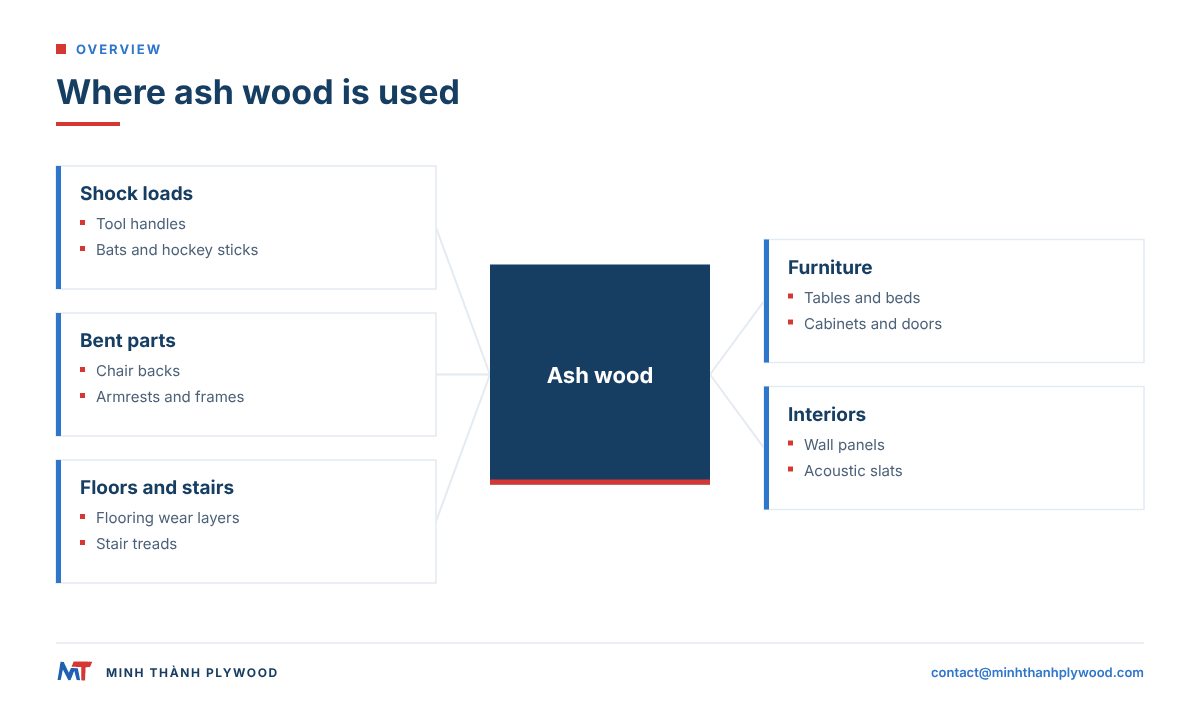
Ash wood is used wherever a part must take shock or bend: tool handles, bats, hockey sticks, oars, ladders and bent chair backs. It is also a standard furniture and interior wood, used for tables, chairs, beds, kitchen cabinets, flooring, stairs and wall panelling.
- Handles and sports gear: axe and hammer handles, baseball bats, hockey sticks, oars, billiard cues.
- Bent furniture: chair backs, armrests and frames shaped by steam bending.
- Floors and stairs: solid strips, engineered flooring wear layers, stair treads.
- Cabinets and furniture: frames from solid ash, doors and panels from ash-faced plywood or MDF.
- Interiors: wall panels, ceilings, shopfitting and acoustic slats with an ash face.
- Boxes and crates: in North America, lower grades go to pallets and crates.
For cabinets and wall panels, buyers usually choose an ash veneer on a plywood core rather than solid ash: the panel stays flat in wide sizes and uses a fraction of the ash.
Ash timber grades and how it is sold
Ash timber is sold sawn, kiln-dried and graded by the clear area a board yields. American ash follows the NHLA rules (FAS, Select, #1 Common and lower); European ash is graded by each sawmill, usually as prime, select or rustic, sometimes with “white” for sapwood-only boards.
- Thickness: sawn timber is sold in quarters of an inch (4/4 for about one inch, 8/4 for about two inches) in North America and in millimetres in Europe.
- Drying: kiln-dried to about 8–12 % for furniture, the same moisture range Minh Thanh dries its veneers and finished panels to before dispatch.
- Colour sorting: white (sapwood), brown (heart) or olive is often a separate sort, priced differently.
Ash lumber sizes sold in the US
| Product | Rough thickness | Finished (surfaced) thickness | Typical size and use |
|---|---|---|---|
| 4/4 dimensional lumber | 1 in | 13/16 in (20.6 mm) | Boards up to 48 in long; doors, frames, tabletops |
| 5/4 dimensional lumber | 1-1/4 in | 1-1/16 in (27 mm) | Thicker tops, stair parts |
| 6/4 dimensional lumber | 1-1/2 in | 1-5/16 in (33 mm) | Legs, chair parts, thick tops |
| Thin stock | 1/8, 1/4, 3/8, 1/2 in | as sold | Lengths 3 to 48 in; boxes, inlays, laminating |
| Turning and bat blanks | 1.5 to 3 in square | hit-or-miss, about 1/16 in under nominal | Handles, spindles, baseball bats |
White ash weighs about 3.5 lb per board foot at 12 % moisture and scores 1,320 lbf on the Janka test, about 8 % softer than hard maple, per North Castle Hardwoods. Sizes follow the retail listings of North Castle and Barrington Hardwoods, checked on 21 October 2026.
For veneer, the grade describes the leaf: clear and matched for furniture faces, with knots and colour streaks allowed in lower grades.
Ash dieback and emerald ash borer: what they mean for supply
Ash supply is under pressure from two pests: ash dieback in Europe and the emerald ash borer in North America. Both kill trees, and both have shifted where ash comes from and how it is regulated.
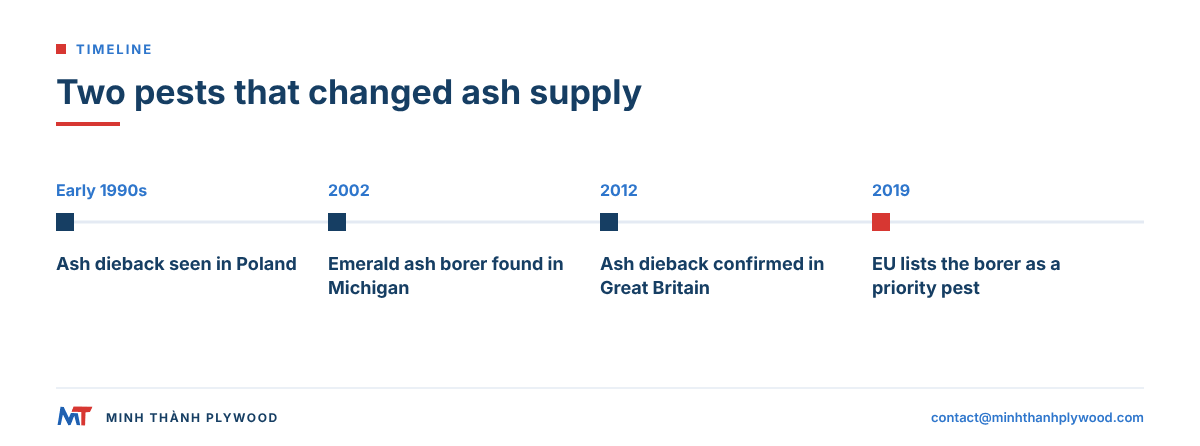
Ash dieback is a disease caused by the fungus Hymenoscyphus fraxineus. It was first seen in Poland in the early 1990s and has since spread across most of Europe; in Great Britain it was confirmed in 2012 (Forest Research, ash dieback, read 20 October 2026). Infected trees lose their crowns and many die. Felling of diseased trees has kept timber on the market, but long, clear logs for veneer are becoming scarcer.
Emerald ash borer (Agrilus planipennis) is a beetle native to Asia. It was first found near Detroit, Michigan, in 2002, and its larvae kill trees by feeding under the bark; hundreds of millions of ash trees have died in the United States and Canada. The International Union for Conservation of Nature (IUCN) now lists white ash as critically endangered for that reason (The Wood Database, White Ash, read 20 October 2026).
In the EU, the emerald ash borer is a priority quarantine pest under Commission Delegated Regulation (EU) 2019/1702, and ash wood from countries where it occurs may enter only under the special requirements of Implementing Regulation (EU) 2019/2072. For buyers, that means more paperwork for North American ash timber, and a good reason to look at ash veneer or an ash-look engineered face for panels.
Ash plywood and ash veneer panels
Ash plywood is a plywood panel with an ash veneer face on one or both sides. The core is usually another species: birch, poplar or eucalyptus in most markets, Styrax or Eucalyptus at Minh Thanh. The face is a thin slice of ash, normally 0.2–0.5 mm thick, with about 0.3 mm the usual European choice.
An ash-faced panel gives the look of ash across a full 1220 × 2440 mm or 1250 × 2500 mm sheet without the movement of solid wood. That is the format kitchen, wardrobe and wall-panel makers buy.
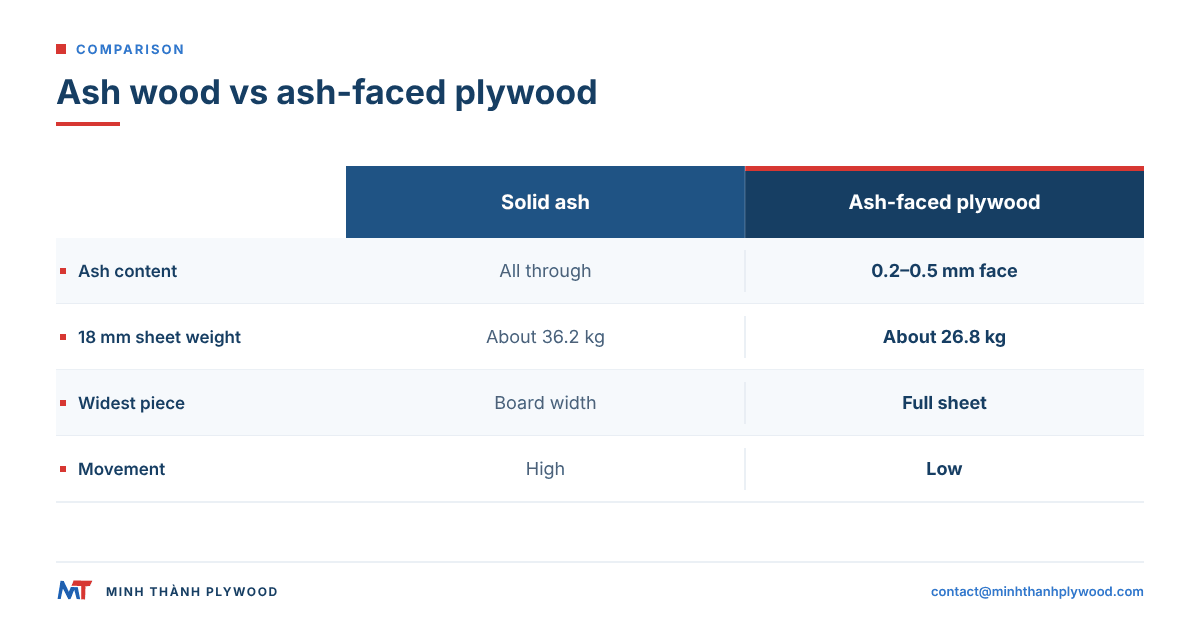
| Point | Solid ash board | Ash-faced plywood |
|---|---|---|
| Ash content | Ash all through | Ash face, 0.2–0.5 mm |
| Weight of a 1220 × 2440 × 18 mm piece | About 36.2 kg at 675 kg/m³ | About 26.8 kg on Styrax core |
| Widest single piece | Board width, glued up for panels | Full sheet |
| Movement | High: 13.3 % volumetric shrinkage | Low: cross-laminated layers |
| Refinishing | Can be sanded many times | Light sanding only |
| Best for | Frames, legs, handles, bent parts | Doors, carcasses, wall panels, tops |
The weights are calculated: 1.22 m × 2.44 m × 0.018 m = 0.0535824 m³, times the density.
Engineered veneer: an ash look without the ash supply risk
Engineered veneer (EV) reproduces an ash grain pattern from plantation veneers that are dyed, laminated into a block and sliced again. The result is a face that looks like ash and repeats the same way on every sheet.
EV suits large runs where every door must match: hotel rooms, office fit-outs, flat-pack furniture. It is also free of the ash pests above, since no ash is used. EV is the face Minh Thanh produces most; see EV plywood for the builds. Natural ash faces are quoted on request on the same cores.
Working, gluing and finishing ash
Ash machines, glues and finishes well, with a few habits to follow. It is hard on blunt tools, so sharp cutters give the cleanest edge, and its open pores show every stain step.
- Machining: cuts and planes cleanly with sharp tools; end grain can tear out on routers without a backing board.
- Steam bending: among the best woods for it, with oak, beech and elm.
- Gluing: glues well with PVA, urea and polyurethane glues.
- Staining: takes stain unevenly between earlywood and latewood; a washcoat first evens it out.
- Finishing: oil, lacquer and white-pigmented finishes are common; for a flat, glassy surface, fill the pores first.
- Outdoors: ash heartwood is rated perishable to slightly durable for decay. Untreated ash is an indoor wood; thermally modified ash is used outdoors.
Ash vs oak vs maple for furniture
Ash, oak and maple are the three classic light hardwoods for furniture, and they differ more in look than in strength. Choose ash for a light, open-grained look and toughness; oak for the deeper colour and ray fleck; maple for a smooth, closed grain and the hardest surface.
| Choice | Ash | Oak (white) | Hard maple |
|---|---|---|---|
| Look | Light, open, straight grain | Warm brown, ray fleck on quarter cut | Creamy white, fine closed grain |
| Hardness | 1,320 lbf (white ash) | 1,350 lbf | 1,450 lbf |
| Shock resistance | Best of the three | Good | Good |
| Outdoor durability | Low | Good (white oak) | Low |
| Typical panel use | Doors, wall panels, Scandinavian style | Cabinets, floors, classic style | Kitchens, worktops, children’s furniture |
White oak hardness is from The Wood Database, White Oak, read 20 October 2026. For more species side by side, see wood species compared and the overview of types of hardwood.
What does ash wood cost?
Ash is a mid-priced American hardwood: about US$5.20 per board foot for 4/4, US$6.20 for 5/4 and US$6.50 for 8/4 at a US lumber dealer (indicative retail, 9 July 2026). That is below walnut at US$14.00 for 4/4 on the same list, and close to maple. Prices move with the pests above. Prime, wide, white European ash and clear American ash carry a premium; rustic and olive grades are priced by look.
| Ash lumber, US retail | 4/4 | 5/4 | 8/4 |
|---|---|---|---|
| Ash, US$ per board foot | 5.20 | 6.20 | 6.50 |
Source: Forest Products Supply, domestic lumber price list, 9 July 2026.
For volume buyers, ash-faced 4 x 8 ft panels are the alternative to paying per board foot. The ash face is a small part of the cost: the core, glue, thickness and sanding set most of the price. Minh Thanh’s indicative starting price for furniture and interior plywood is from US$350/m³ (October 2026); natural ash faces are quoted per order.
What this means for your order
If you want an ash look on panels, write the face, the core, the glue and the size on your request. That is enough for a mill to quote one build, not a range.
- Face: natural ash (white or European, crown or quarter cut), or ash-look EV; face/back grades for one or two visible sides.
- Core: Styrax for light weight (about 500 kg/m³) or Eucalyptus for harder screw-holding; both are stitched and double-pressed for a flat face.
- Glue and emission: UF glue at E0 emission for furniture. Our panels hold CARB P2 / TSCA Title VI certification (ICTT mill no. 23024); six chamber tests between April 2025 and June 2026 averaged 0.014–0.032 ppm. The limit for veneer-core hardwood plywood is 0.05 ppm under 40 CFR 770.10.
- Thickness and tolerance: 3–40 mm, sanded to ±0.2–0.3 mm.
- Size: 1220 × 2440 or 1250 × 2500 mm, or cut-to-size.
- Quantity and port: one 40HC is the minimum order; production takes 15–45 days after the deposit.
Free samples are available. Send these lines to contact@minhthanhplywood.com, or read the pillar on types of wood to compare ash with the other species first.
Buyer questions, answered
Is ash a hardwood?
Yes. Ash comes from Fraxinus, a genus of broadleaf flowering trees, so it is a hardwood botanically and in practice: white ash scores 1,320 lbf on the Janka hardness test, close to red oak.
What is ash wood used for?
Ash is used for tool handles, baseball bats, hockey sticks, bent chair parts, flooring, stair parts, kitchen cabinets, furniture and decorative veneer. Its toughness and steam-bending response make it the classic wood for parts that take shock.
Is ash wood good for furniture?
Yes. Ash is strong, takes stain and oil well and has an open grain that reads clearly through a clear finish. It is used for tables, chairs, beds and cabinet fronts, both as solid wood and as ash-faced panels.
Is ash stronger than oak?
They are close. White ash and red oak have similar bending strength and hardness; European ash is slightly harder than white ash. Ash is tougher under shock, which is why it is preferred for handles and bats.
Is ash wood good for outdoor use?
No, not untreated. Ash heartwood is rated perishable to slightly durable against decay, so it rots outdoors unless it is thermally modified or kept dry and finished.
What colour is ash wood?
Ash sapwood is creamy white to pale beige and the heartwood light brown. Some European ash has dark streaks in the heartwood, sold as olive ash. The grain is straight and open, similar in pattern to oak.
Why is ash wood getting harder to buy?
Two diseases are killing ash trees: ash dieback, a fungus spreading across Europe, and the emerald ash borer, a beetle that has killed hundreds of millions of ash trees in North America. Supply is still available, but long clear logs are scarcer.
Can I get ash-faced plywood?
Yes. Ash veneer is pressed onto plywood cores for furniture and wall panels. Minh Thanh Plywood quotes natural ash faces on request and also makes engineered veneer (EV) faces with an ash grain look.
How heavy is ash wood?
White ash averages about 675 kg/m³ dried and European ash about 680 kg/m³. A solid ash board the size of a 1220 × 2440 × 18 mm sheet would weigh about 36.2 kg.
Does ash wood bend well?
Yes. Ash is one of the best woods for steam bending, alongside oak, beech and elm. Straight-grained, air-dried stock bends best.