
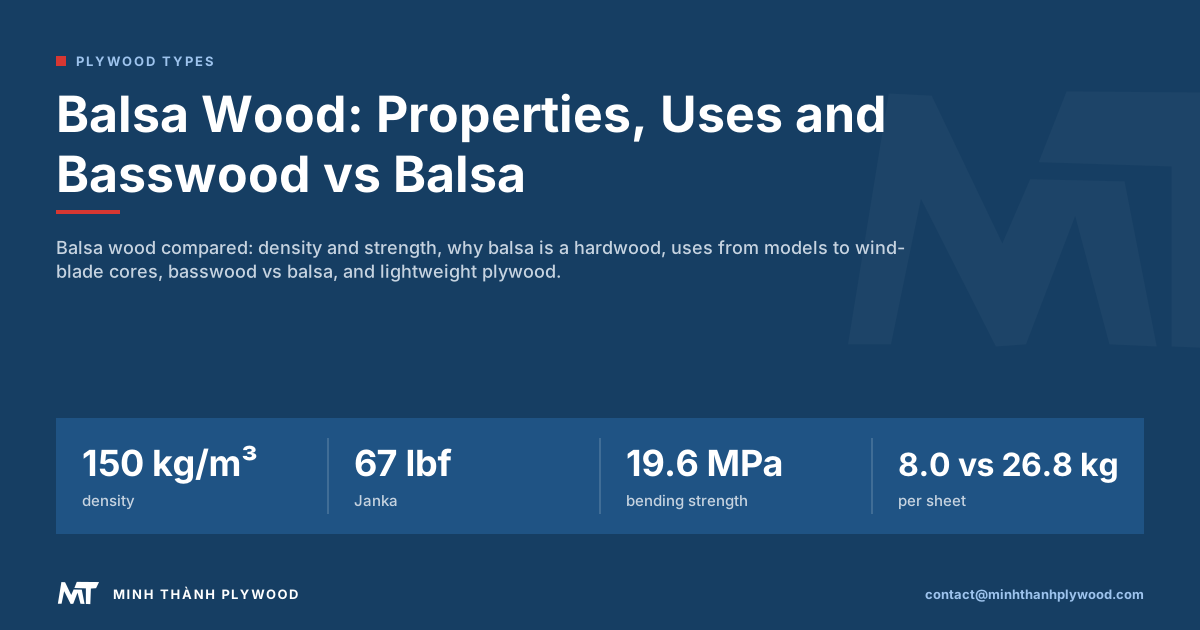
Balsa wood is the lightest commercial timber, averaging about 150 kg/m³ dried, yet it is botanically a hardwood from the tropical tree Ochroma pyramidale. That rare mix of low weight and useful stiffness puts it in model aircraft, surfboards and the cores of wind-turbine blades. Minh Thanh Plywood, a Vietnamese plywood mill, compares balsa with basswood, poplar and light plywood.
What is balsa wood?
Balsa wood is the timber of Ochroma pyramidale, a fast-growing tropical tree in the mallow family, native to Central and South America. It is the lightest wood sold commercially: kiln-dried balsa averages about 150 kg/m³, a quarter of the density of walnut.
Balsa trees can reach harvest size in six to ten years, and most of the world’s supply comes from plantations in Ecuador. The wood is pale, almost white to light tan, with a straight grain and a soft, velvety feel. Under the microscope, its cells are large and thin-walled and full of water in the living tree; dried, they become mostly air.
That cell structure gives balsa its useful paradox: very light, yet stiff enough along the grain to hold a shape. This guide compares it with the woods buyers most often weigh it against.
Is balsa wood a hardwood?
Yes, balsa wood is a hardwood. Botanically, hardwoods come from angiosperms, broadleaf flowering trees, and softwoods from conifers. Balsa is a broadleaf flowering tree, so it is a hardwood even though a fingernail can dent it. Botanical class and physical hardness are separate things, and balsa is soft by any measure.
The terms describe how the tree reproduces and how its wood is built, not how hard the wood is. Hardwoods have vessels (pores) that carry water; softwoods do not. Balsa has large, open vessels, which you can see as fine lines on a planed surface. Its Janka hardness is only about 67 lbf (300 N), against 1,010 lbf for black walnut.
Balsa wood properties in numbers
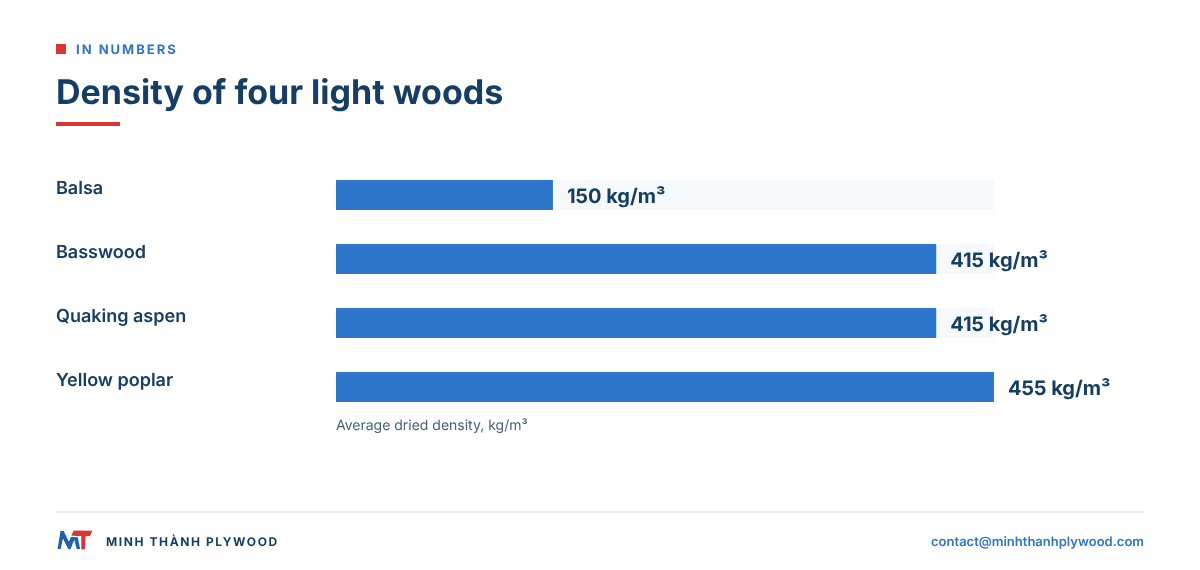
Balsa wood properties are best read as ratios to weight: it is very weak and soft in absolute terms but competitive per kilogram. The table gives averages at about 12 % moisture content from The Wood Database (read 20 October 2026).
| Property (12 % MC) | Balsa | Basswood | Quaking aspen | Yellow poplar |
|---|---|---|---|---|
| Average dried density | 150 kg/m³ | 415 kg/m³ | 415 kg/m³ | 455 kg/m³ |
| Janka hardness | 67 lbf | 410 lbf | 350 lbf | 540 lbf |
| Modulus of rupture | 19.6 MPa | 60.0 MPa | 57.9 MPa | 69.7 MPa |
| Modulus of elasticity | 3.71 GPa | 10.07 GPa | 8.14 GPa | 10.90 GPa |
| Crushing strength | 11.6 MPa | 32.6 MPa | n/a | 38.2 MPa |
| Volumetric shrinkage | 8.5 % | 15.8 % | 11.5 % | 12.7 % |
Sources: The Wood Database, Balsa, Basswood, Quaking Aspen, Yellow Poplar, read 20 October 2026.
- Density varies widely: commercial balsa runs from about 100 to 250 kg/m³. Model builders sort sheets by weight; light “contest” balsa and hard balsa can differ by a factor of two.
- Stiffness per weight: balsa’s modulus of elasticity of 3.71 GPa at 150 kg/m³ gives it more stiffness per kilogram than basswood, which is why it works as a sandwich core.
- Low shrinkage: 8.5 % volumetric, the lowest in the table, so dry balsa sheets stay flat.
- Soft surface: at 67 lbf, balsa dents from any knock and needs a skin or covering to survive handling.
Basswood vs balsa: which to choose?
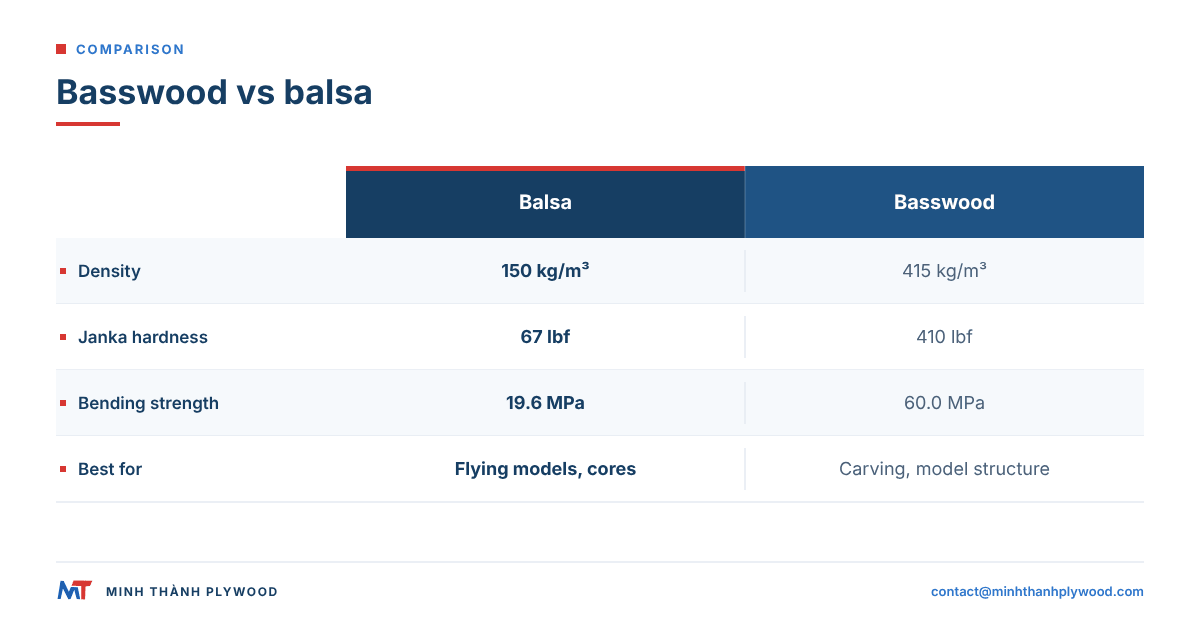
Basswood vs balsa comes down to weight against strength. Basswood (Tilia americana, lime or linden in Europe) is nearly three times as dense, about three times as strong in bending and six times as hard. Balsa is far lighter.
| Point | Balsa | Basswood |
|---|---|---|
| Density | 150 kg/m³ | 415 kg/m³ |
| Hardness | 67 lbf | 410 lbf |
| Bending strength | 19.6 MPa | 60.0 MPa |
| Carving detail | Crushes, fuzzy edges | Holds crisp detail |
| Screws and nails | Pull out | Hold in pilot holes |
| Cutting | Craft knife | Knife, saw, laser |
| UK price, 100 × 915 mm sheet | from £2.54 (102 × 915 mm) | from £2.50 to £3.53 |
| Best for | Flying models, cores, floats | Carving, model structures, laser-cut kits |
Verdict by use:
- Flying models and gliders: balsa, for weight; basswood or plywood only at load points.
- Architectural and railway models: basswood, for crisp edges and paint.
- Carving: basswood, the classic carving wood.
- Laser cutting: basswood and thin plywood cut cleaner; balsa chars and crushes.
- Sandwich cores: balsa, end grain.
Uses of balsa wood
The uses of balsa wood all exploit its low weight: in the air, on water, or as a core between strong skins. Most balsa today goes into composite cores.
- Wind-turbine blades: end-grain balsa core in the shells, between glass-fibre skins.
- Boats and surfboards: balsa cores in hulls, decks and boards; solid balsa surfboards were the original.
- Model aircraft and hobby models: sheets, sticks and blocks, sorted by weight.
- Transport panels: sandwich floors and walls in rail cars, refrigerated trucks and containers.
- Fishing lures and floats: crankbaits and floats that need buoyancy.
- Buoys, rafts and life-saving gear: the historic use; the Kon-Tiki raft of 1947 was built of balsa logs.
- Insulation and packing: cold-storage insulation and protective packing for fragile goods.
- Crafts and schools: bridges, models and science projects.
Why balsa is used in wind-turbine blade cores
End-grain balsa is used in wind-turbine blades because a thin, light core between two fibreglass skins makes a stiff sandwich shell at low weight. With the grain running through the thickness, the core resists crushing and shear while adding little mass.
Long blades need large shell areas that do not buckle, and the sandwich core is what stops them. Balsa competes there with PET and PVC foam cores: balsa is stiffer and stronger in shear for its weight, foams are more uniform and take up less resin. The same sandwich principle is used in boat hulls, rail-car floors and aircraft interiors.
The demand from wind energy is the main reason balsa prices and supply move today: when blade production rises, balsa for models and crafts gets harder to find.
Balsa vs plywood for light panels
Balsa is lighter than any plywood, but plywood is stronger, harder and holds fixings, so the two are rarely direct substitutes. For a buyer, the real choice is usually between a light-core plywood and a balsa-cored sandwich panel.
| Point | Solid balsa sheet | Balsa sandwich panel | Light-core plywood (Styrax) |
|---|---|---|---|
| Density | About 150 kg/m³ | Depends on skins | About 500 kg/m³ |
| Weight, 1220 × 2440 × 18 mm | About 8.0 kg | Depends on skins | About 26.8 kg |
| Surface hardness | Very soft | Hard, from the skin | Hard, sanded face |
| Screw holding | Poor | At inserts only | Good |
| Sizes | Narrow sheets and blocks | Made to order | 1220 × 2440, 1250 × 2500 mm |
| Typical use | Models, cores | Blades, boats, vehicles | Furniture, interiors, packaging |
Weights are calculated: 1.22 m × 2.44 m × 0.018 m = 0.0535824 m³, times the density.
A furniture buyer needs a large, flat, stable panel that takes screws, hinges and a decorative face. That is where light plywood belongs, not balsa.
Is there balsa plywood or lightweight plywood?
Yes, but it is a niche. “Balsa plywood” usually means thin aircraft or model plywood, or a balsa core laminated between thin veneers or fibreglass. Importers asking for “lightweight plywood” for furniture, caravans or packaging nearly always need a light-core plywood instead.
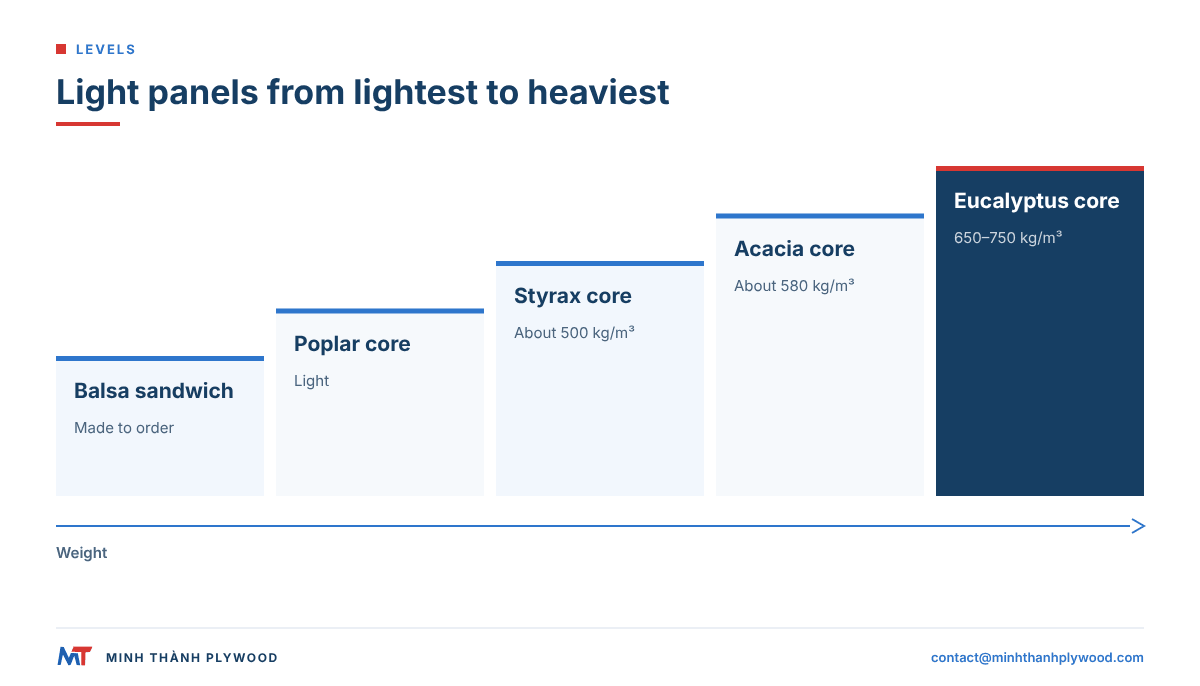
The light plywood options, from lightest to heaviest:
- Balsa-cored sandwich: lightest, made to order for transport and marine panels.
- Poplar-core plywood: light, made mainly in China.
- Styrax-core plywood: about 500 kg/m³, the standard light core in northern Vietnam and Minh Thanh’s main furniture core.
- Acacia-core plywood: about 580 kg/m³, for commercial uses.
- Eucalyptus-core plywood: 650–750 kg/m³, harder, for screw holding.
Plywood for dry, humid or exterior conditions is specified in BS EN 636:2012+A1:2015. Many European furniture buyers choose Styrax core because it is light and gives a smooth face. Read more in our guide to poplar wood and on poplar plywood, which pairs a poplar face with a Styrax or Eucalyptus core.
Where balsa comes from and how it is graded
Balsa is native to the tropical Americas, from southern Mexico to Bolivia, and Ecuador supplies most of the world’s commercial balsa from plantations. Papua New Guinea and a few other tropical countries also grow it.
Balsa is cut young, dried quickly to avoid stain and decay, and sorted by density and grain:
- A-grain: flat-sawn, flexible across the sheet, for curved skins.
- B-grain: mixed, the general-purpose sheet.
- C-grain (quarter grain): quarter-sawn, stiff across the sheet and mottled, for flat ribs and stiff panels.
Weight classes are sorted by the sheet: light, medium and hard. For cores, balsa is cut into end-grain blocks and bonded into blankets on a scrim cloth.
Balsa sheet sizes and prices in the UK
Inch sizes convert at exactly 25.4 mm to the inch (NIST). Balsa sheet in the UK is sold in 915 mm (36 in) and 1220 mm (48 in) lengths, and a 50 to 102 mm wide sheet costs from about £2 to £2.54 (indicative retail, October 2026). Prices rise with thickness, and the “from” price is the thinnest sheet.
| Balsa product | Size | UK retail, from |
|---|---|---|
| Sheet | 50 × 915 mm (2 × 36 in) | £1.98 |
| Sheet | 76 × 915 mm (3 × 36 in) | £2.16 |
| Sheet | 102 × 915 mm (4 × 36 in) | £2.54 |
| Sheet | 100 × 1220 mm (4 × 48 in) | £3.79 |
| Strip | 915 mm (36 in) | £0.41 |
| Strip | 1220 mm (48 in) | £0.55 |
| Dowel | 915 mm | £1.74 |
| Block | 36 in | £5.45 |
| Trailing-edge section | 915 mm | £1.94 |
Source: EC Fibreglass Supplies, balsa wood, checked on 21 October 2026. For comparison, a 100 × 915 mm basswood sheet was listed at £3.53 (Fred Aldous), checked on 21 October 2026.
These are craft and model sizes. Industrial buyers use end-grain balsa blocks bonded into blankets on a scrim cloth: more than 90 % of the world’s balsa volume goes into end-grain panels for composites, mostly structural cores in wind-turbine blades (Wikipedia, Ochroma, checked on 21 October 2026). The tree is listed as Least Concern by the IUCN, and plantation trees reach 27 m in 10 to 15 years, which is why supply is steady.
How to work balsa wood
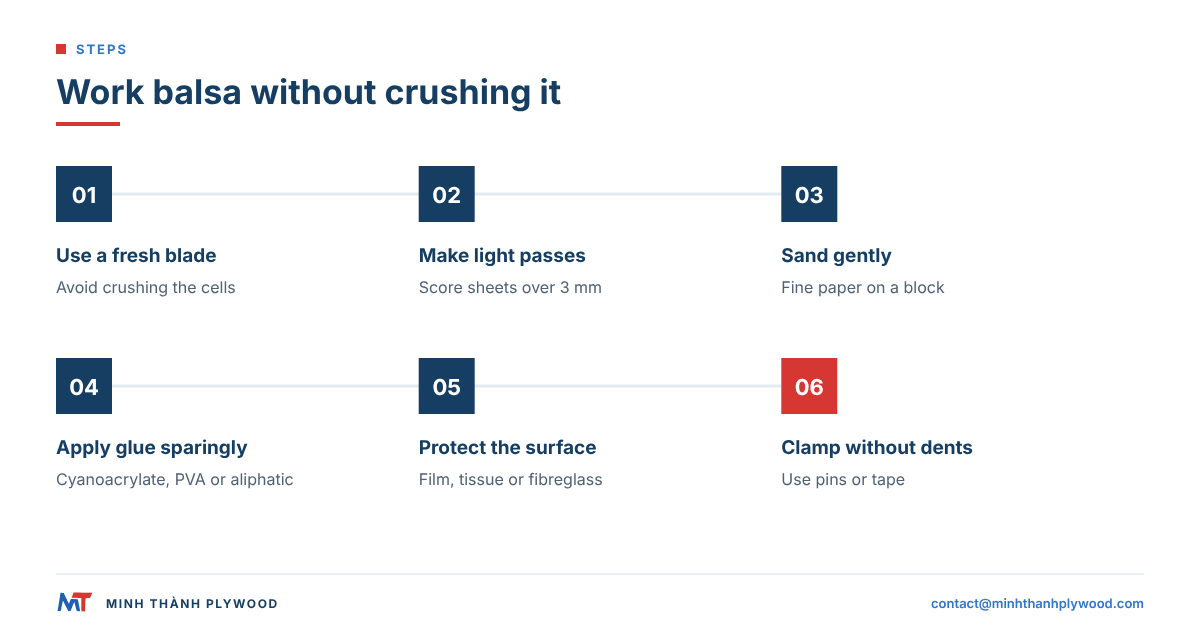
Balsa cuts with a sharp craft knife, sands in seconds and glues with almost any adhesive. Its softness is also the main hazard: it crushes under blunt tools and clamps.
- Cut with a fresh blade: a dull blade crushes the cells instead of slicing them.
- Use several light passes: for sheets over 3 mm thick, score, then cut through.
- Sand gently: fine paper on a block; balsa sands faster than you expect.
- Glue sparingly: cyanoacrylate, PVA or aliphatic glue all work.
- Protect the surface: a covering film, tissue and dope, or a fibreglass skin.
- Clamp with pins or tape: never with metal clamps directly on the wood.
Is balsa wood durable?
No, balsa is not durable on its own. It is rated perishable against decay, absorbs water when unsealed and dents at the lightest touch. In use it is always sealed, covered or locked between skins, which is how it lasts decades in boat hulls and blades.
For outdoor and wet uses, balsa must be fully encapsulated in resin. Buyers who need a durable, light panel without composites should look at plywood with a waterproof glue line instead, matched to the use.
Balsa wood properties vs other light woods: verdict by use
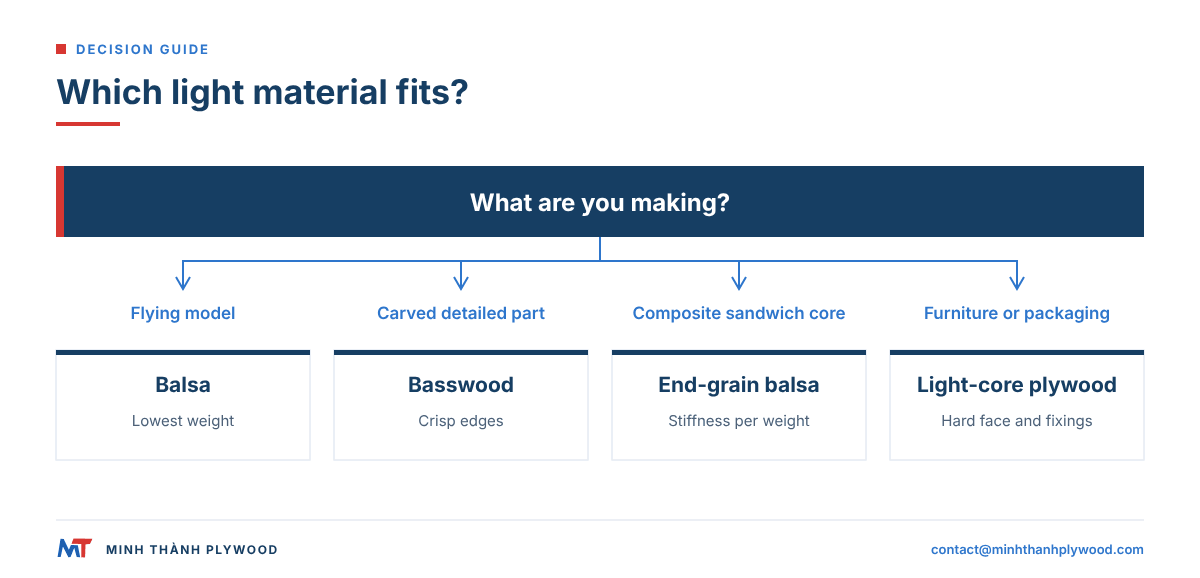
Balsa wins only where weight is the first requirement; for almost every other use, a denser wood or a light plywood does the job better. The verdict by use:
| Use | Best choice | Why |
|---|---|---|
| Flying model structure | Balsa | Lowest weight |
| Model at load points | Basswood or thin plywood | Holds screws and pins |
| Carving and detail | Basswood | Crisp edges |
| Sandwich core | End-grain balsa | Stiffness per weight |
| Furniture panels | Light-core plywood | Flat, hard face, holds fixings |
| Packaging cases | Light plywood | Strength and price |
| Painted joinery | Yellow poplar | Even, paint-grade surface |
Compare more species in types of hardwood and wood species compared.
What this means for your order
If your project needs a light panel for furniture, interiors or packaging rather than a composite core, specify a light-core plywood: you get a flat, hard, sanded face at full sheet size. Minh Thanh Plywood makes these panels and does not sell balsa.
- Core: white Styrax (about 500 kg/m³) for light weight; Eucalyptus where screws and hinges need more bite.
- Face: poplar, EV, birch, okoume or pine faces, matched to the approved sample.
- Glue and emission: UF glue at E0 emission for furniture. Our panels carry CARB P2 / TSCA Title VI certification (ICTT mill no. 23024); six chamber tests between April 2025 and June 2026 averaged 0.014–0.032 ppm. The limit for veneer-core hardwood plywood is 0.05 ppm under 40 CFR 770.10.
- Thickness: 3–40 mm; thin panels of 3–5 mm are always 5-ply.
- Size and quantity: 1220 × 2440 or 1250 × 2500 mm, cut-to-size on request; from one 40HC, production 15–45 days after the deposit.
Free samples are available. Send the lines to contact@minhthanhplywood.com, or start from the pillar on types of wood.
Buyer questions, answered
Is balsa wood a hardwood?
Yes. Balsa grows on a broadleaf flowering tree, Ochroma pyramidale, so it is botanically a hardwood, even though it is the softest and lightest commercial timber. Hardwood and softwood describe the tree type, not the hardness.
How light is balsa wood?
Kiln-dried balsa averages about 150 kg/m³, and commercial grades run from roughly 100 to 250 kg/m³. That is about a quarter the density of walnut and a third of basswood.
What is balsa wood used for?
Model aircraft and hobby models, surfboard and boat cores, the cores of wind-turbine blades and other sandwich panels, fishing lures, buoys and rafts, insulation and packing, and craft and school projects.
Which is better, basswood or balsa?
Basswood is better for carving, structural model parts and anything that must hold detail or screws; balsa is better where the lowest weight matters, such as flying models and sandwich cores. Many models use both.
Is balsa wood strong?
For its weight, yes: balsa has a good strength-to-weight ratio, especially along the grain. In absolute terms it is weak, with a modulus of rupture of about 19.6 MPa against about 60 MPa for basswood.
Where does balsa wood come from?
Balsa is native to the tropical Americas, from southern Mexico to Bolivia, and most of the world's supply comes from plantations in Ecuador. It is also grown in Papua New Guinea and elsewhere in the tropics.
Why is balsa used in wind turbine blades?
End-grain balsa is a light, stiff core between glass-fibre skins. The sandwich resists bending and buckling at very low weight, which is what long blade shells need.
Is there balsa plywood?
Yes. Thin aircraft-grade plywood and balsa-cored sandwich panels exist for models, boats and transport. For furniture and packaging, a light-core plywood such as Styrax or poplar is the usual alternative.
Does balsa wood float?
Yes. At about 150 kg/m³, balsa is roughly one seventh the density of water, which is why it has been used for rafts, buoys and life-saving floats.
Can you burn balsa wood?
Yes, it burns quickly because it is so light and porous. It gives little heat per volume, so it is used as kindling at most, never as fuel wood.