
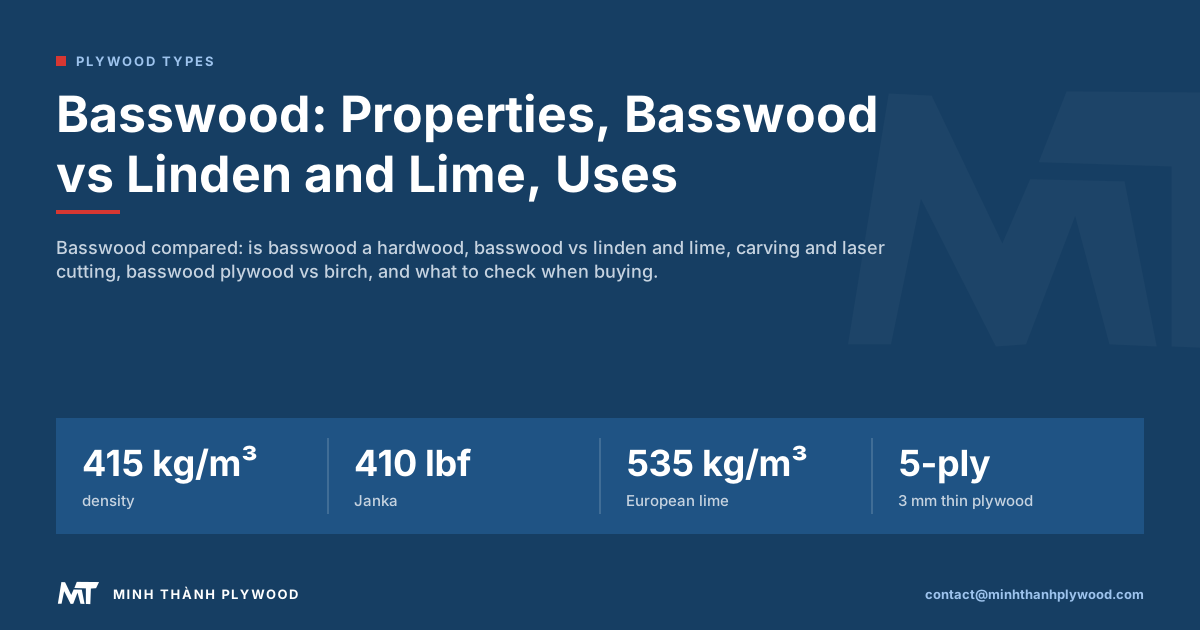
Basswood is the pale, soft, fine-textured wood of Tilia americana, the North American tree that Europeans call lime or linden. It weighs about 415 kg/m³ dry, carves cleanly and lasers evenly, which makes it the classic wood for carving, models and craft sheets. Minh Thanh Plywood compares it with linden, birch and balsa, and shows when thin plywood does the job better.
What is basswood?
Basswood is the wood of Tilia americana, a broadleaf tree of eastern North America. It is pale white to light brown with no clear line between sapwood and heartwood, a straight grain and a fine, even texture. Knots and defects are uncommon.
The trees grow 20-37 m tall with trunks 1-1.2 m across. The same genus, Tilia, grows across Europe and Asia, where its timber is called lime or linden. North American trade names include American basswood and American linden.
Basswood’s main qualities come from its even structure: it is light, soft, easy to cut in every direction, and its pale, plain surface takes paint and stain without a strong grain showing through.
Is basswood a hardwood?
Yes, basswood is a hardwood, because it comes from a broadleaf (angiosperm) tree, not a conifer. In use, though, it is one of the softest commercial hardwoods, softer than several softwoods. Its Janka hardness is 410 lbf, well below Douglas fir at 620 lbf.
The Janka hardness test shows how soft. Basswood scores 410 lbf (1,820 N), against the values below. The US Forest Products Laboratory’s Wood Handbook tabulates hardness for US species.
- Norway spruce, a softwood: 380 lbf.
- Eastern white pine, a softwood: 380 lbf.
- Scots pine, a softwood: 540 lbf.
- Douglas fir, a softwood: 620 lbf.
- Silver birch, a hardwood: 1,210 lbf.
Hardwood and softwood are botanical groups, not measures of hardness. Balsa, at 67 lbf, is a hardwood too.
Basswood vs linden vs lime: are they the same wood?
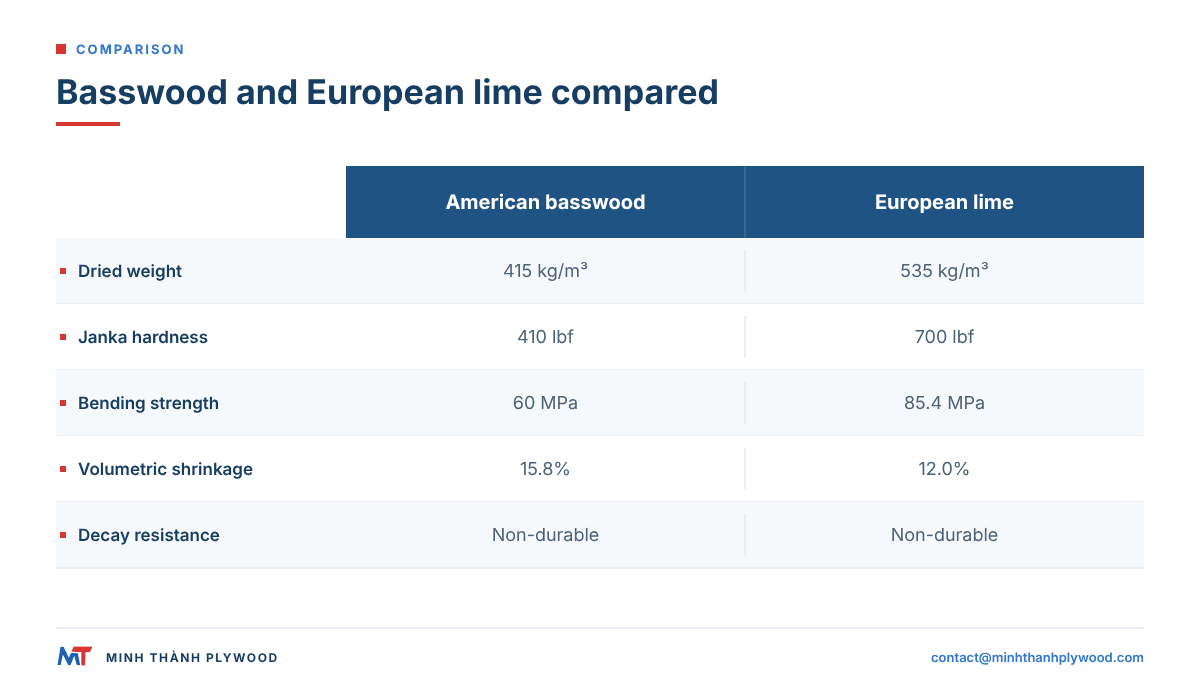
Basswood, linden and lime are names for trees of the same genus, Tilia. Basswood is the North American name for Tilia americana; lime and linden are the European names, most often for common lime (Tilia × europaea) and small-leaved lime (Tilia cordata). The wood is similar, though the European lime in trade is denser and harder.
| Metric | American basswood (Tilia americana) | European lime (Tilia × europaea) |
|---|---|---|
| Common names | Basswood, American linden | Lime, linden, common lime |
| Native range | Eastern North America | Europe |
| Average dried weight | 415 kg/m³ | 535 kg/m³ |
| Janka hardness | 410 lbf (1,820 N) | 700 lbf (3,100 N) |
| Modulus of rupture | 60 MPa | 85.4 MPa |
| Elastic modulus | 10.07 GPa | 11.71 GPa |
| Volumetric shrinkage | 15.8% | 12.0% |
| Colour | Pale white to light brown | Pale white to cream, ageing to a yellow tone |
| Decay resistance | Non-durable | Non-durable |
Lime is not related to the citrus fruit; the name comes from the older English “lind”. Asian Tilia species, such as Japanese linden, are also sold as linden, and craft plywood labelled basswood plywood often carries linden veneer from these species.
For a carver or a laser shop the practical difference is small: both are pale, even and easy to cut. European lime is slightly firmer and holds sharp edges a little better.
What are the properties of basswood?
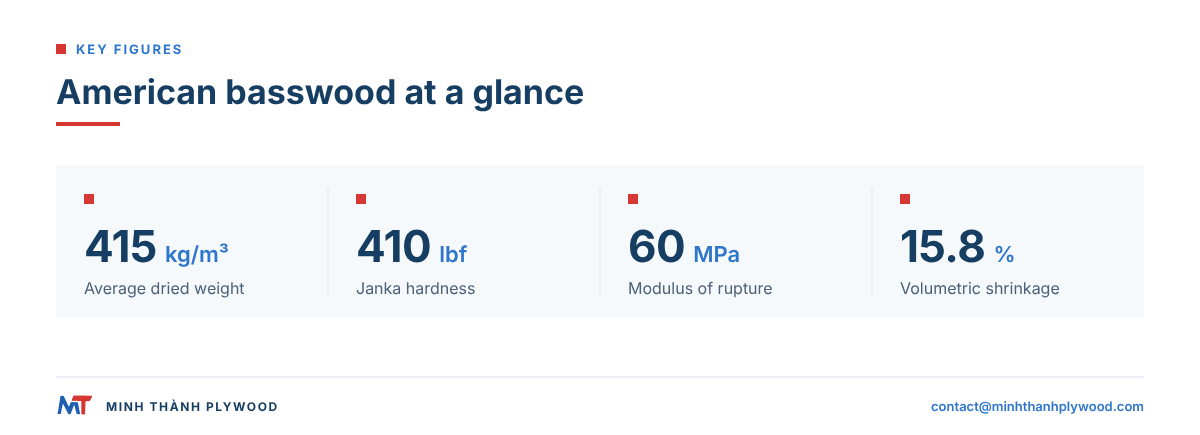
Basswood is light, soft and stiff for its weight, with high shrinkage while it dries and good stability once dry. The figures below are average values at 12% moisture content from The Wood Database, read 20 October 2026.
| Property | Basswood | What it means in use |
|---|---|---|
| Average dried weight | 415 kg/m³ | Light; models and blinds stay light |
| Specific gravity (basic, 12% moisture) | 0.32, 0.42 | Low |
| Janka hardness | 410 lbf (1,820 N) | Soft; carves easily, dents easily |
| Modulus of rupture | 60 MPa | Moderate bending strength |
| Elastic modulus | 10.07 GPa | Stiff for its weight |
| Crushing strength | 32.6 MPa | Low; not for load-bearing parts |
| Radial shrinkage | 6.6% | High while drying |
| Tangential shrinkage | 9.3% | High while drying |
| Volumetric shrinkage | 15.8% | High while drying; stable once dry |
| T/R ratio | 1.4 | Low; moves evenly |
Basswood glues and finishes well. It has poor steam-bending and nail-holding characteristics, and no characteristic smell.
Basswood vs balsa, poplar, pine and birch
Basswood sits between balsa and the furniture hardwoods: heavier and much stronger than balsa, softer and lighter than birch, and close to pine and poplar in weight. The table compares five light-coloured woods on the same basis.
| Metric | Basswood | Balsa | Black cottonwood (poplar) | Eastern white pine | Silver birch |
|---|---|---|---|---|---|
| Average dried weight | 415 kg/m³ | 150 kg/m³ | 385 kg/m³ | 400 kg/m³ | 640 kg/m³ |
| Janka hardness | 410 lbf | 67 lbf | 350 lbf | 380 lbf | 1,210 lbf |
| Modulus of rupture | 60 MPa | 19.6 MPa | 58.6 MPa | 59.3 MPa | 114.3 MPa |
| Elastic modulus | 10.07 GPa | 3.71 GPa | 8.76 GPa | 8.55 GPa | 13.96 GPa |
| Texture | Fine, even | Coarse, open | Medium, can be fuzzy | Medium, resin canals | Fine, even |
| Carving | Excellent | Too soft for detail | Fair; fuzzes | Good; resin and knots | Hard work |
| Decay resistance | Non-durable | Perishable | Non-durable | Moderate to low | Perishable |
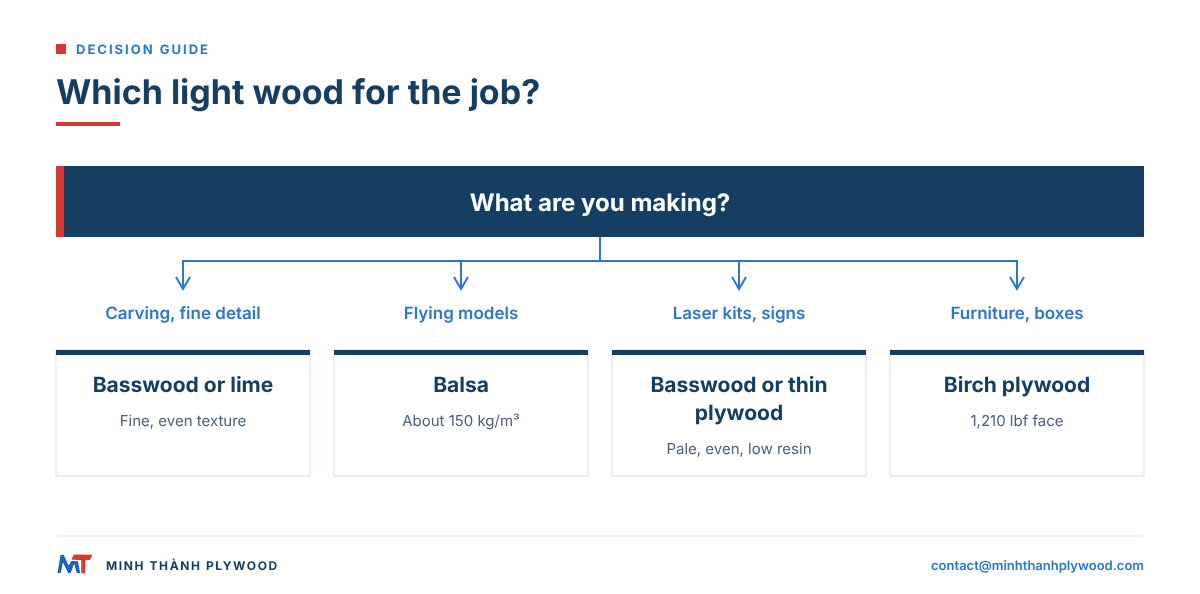
Verdict by use:
- Hand carving and fine detail: basswood or European lime.
- Flying models and light cores: balsa.
- Static models, dioramas, laser-cut kits: basswood sheets or thin plywood.
- Painted furniture parts and drawer sides: poplar or basswood.
- Furniture, cabinets and strong panels: birch, solid or as plywood.
Why is basswood the classic wood for carving?
Basswood is the classic carving wood because its fine, even texture cuts cleanly across and along the grain, holds small detail, and leaves a pale surface that does not compete with the carving. Carvers can work it with hand tools alone.
European lime has the same role in European art. The late-Gothic altarpieces of Tilman Riemenschneider and the 17th-century garlands of Grinling Gibbons were carved in limewood, chosen for the fine detail it holds.
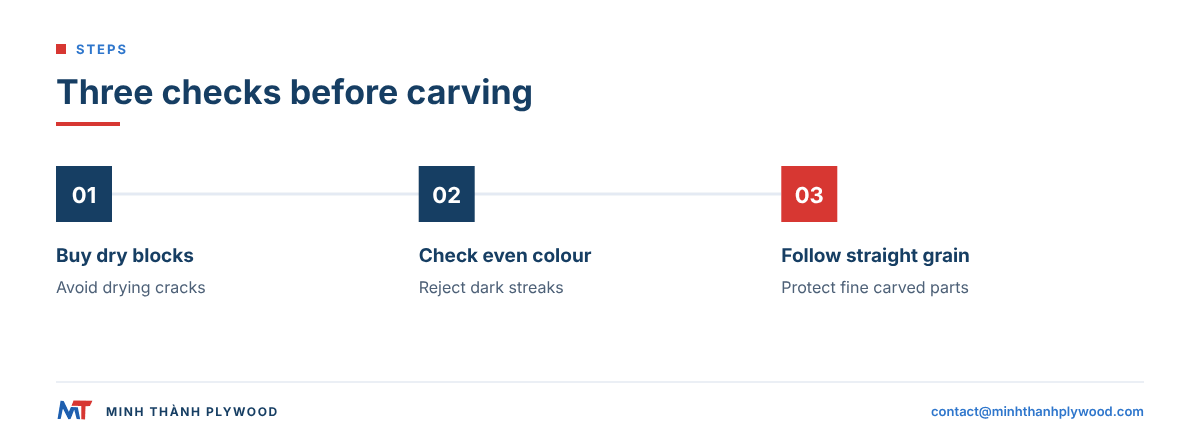
Carvers buy basswood as blocks and blanks in standard sizes, and three checks save waste:
- Dry blocks only, because basswood shrinks a lot while drying and green blocks crack.
- Even colour, without dark streaks, which signal mineral stain or decay.
- Straight grain through the block, so fine parts do not break off along the grain.
Is basswood good for laser cutting and engraving?
Yes. Basswood is one of the best woods for laser cutting and engraving: light, low in resin and even in density, so a laser cuts it fast with a narrow kerf and engraves it with an even, dark contrast against the pale surface.
Laser shops use basswood in two forms:
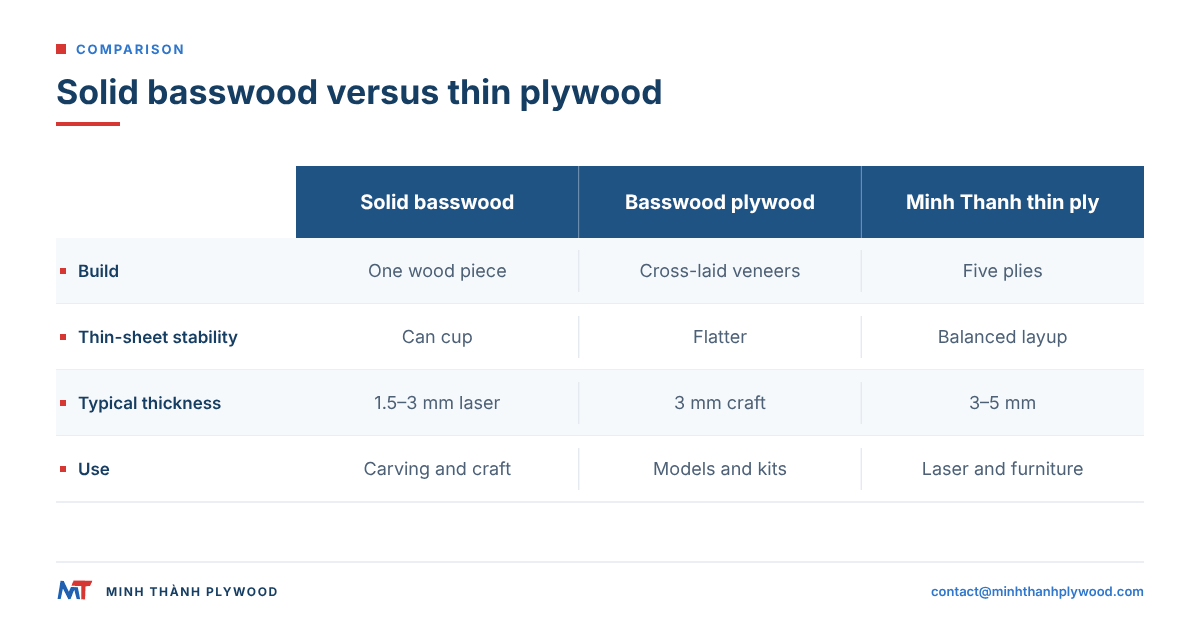
- Solid basswood sheets, typically 1.5-3 mm thick, often in 300 × 300 mm squares for craft lasers. They cut cleanly, but wide thin sheets can cup with humidity.
- Basswood plywood, usually 3-ply at 3 mm, flatter and stronger, but the cut depends on the glue lines: dense or uneven glue slows the laser and darkens the edge.
For workplace laser hazards, see the US Occupational Safety and Health Administration’s laser hazards page. For production laser work, the panel build matters more than the face species. The guide to the best plywood for laser cutting compares faces, cores and glues for laser shops.
What is basswood plywood, and is it the same as plywood?
Basswood plywood is plywood with basswood or linden veneer faces, and sometimes basswood in every ply. Basswood itself is a wood species; plywood is a panel built from thin veneers glued with the grain of each layer crossed at 90°, so the two terms are not the same.
The cross-grain build is what makes plywood flatter and stronger than a solid basswood sheet of the same thickness. Most craft basswood plywood is 3 mm, built as three plies.
A 5-ply build gives a flatter, more even panel at the same thickness. Minh Thanh makes its thin plywood of 3-5 mm always 5-ply: the 3 mm panel has one core veneer, two cross-band veneers and two face veneers; 4 and 5 mm panels have three core veneers and two faces. The core veneer thickness is set to the panel, for example three 1.3 mm Styrax core veneers in a 4 mm furniture panel.
Basswood plywood vs birch plywood: which is better?
Birch plywood is better for furniture, boxes and parts that carry loads or screws; basswood plywood is better for soft, light craft parts and fast laser cuts. The difference follows the woods: silver birch is about 640 kg/m³ and 1,210 lbf hard, basswood 415 kg/m³ and 410 lbf.
| Metric | Basswood plywood | Birch plywood |
|---|---|---|
| Face hardness | Soft, dents easily | Hard, resists dents |
| Weight | Light | Medium-heavy |
| Edge screw holding | Poor | Good |
| Laser cutting speed | Fast | Slower; harder wood |
| Engraving contrast | High on a pale face | Good on a pale face |
| Face appearance | Plain, pale, no figure | Pale with a fine, light figure |
| Best for | Models, kits, signs, decorations | Furniture, boxes, toys, jigs, laser parts that are handled |
Minh Thanh grades birch faces as D+, D and E in Vietnam, quoted in pairs such as D+/D or D/E and comparable to the European birch ladder (D+ about B, D about BB, E about CP/C). See birch plywood for builds and thicknesses.
What else is basswood used for?
Beyond carving and lasers, basswood is used wherever a light, stable, easily machined wood with a plain face is wanted:
- Window blinds and shutters, where light slats stay straight.
- Electric guitar bodies, light and with a neutral tone.
- Drawer sides, frames and hidden furniture parts, often painted.
- Pattern making and moulds, cut accurately and sanded smooth.
- Veneer and plywood, for craft sheets and light panels.
- Turnings and small wooden objects, which take paint well.
It also makes wood pulp and fibre products.
What are the disadvantages of basswood?
Basswood’s weaknesses come from the same softness that makes it easy to carve. Avoid it where these matter:
- Softness: it dents under knocks and pressure, so it is a poor choice for floors, worktops and table tops.
- Decay: the heartwood is non-durable, so it does not last outdoors or in damp rooms unless fully sealed.
- Fixings: nails and screws pull out more easily than in birch or pine.
- Bending: it steam-bends poorly.
- Drying: high shrinkage while drying means green wood cracks and warps; buy it dry.
For furniture panels that must resist wear, a harder face on plywood is the answer: birch on a stable core.
Basswood for sale: what sizes and prices can you buy in the US?
Basswood for sale in the US comes as carving blocks, craft sheets, sticks and lumber, mostly from hobby and hardwood shops. Retail prices below were read on 21 October 2026 from Barrington Hardwoods and National Balsa; they are shelf prices for small lots, not trade prices.
| Form | Stock sizes (inches) | Retail price read 21/10/2026 | What to check |
|---|---|---|---|
| Carving blocks, small | 1 × 1 × 6 (8 pieces); 2 × 2 × 6 (4 pieces) | US$14.95; US$18.95 per pack | Dry right through, no checks |
| Turning squares | 1.5 × 1.5 × 6 (4 pieces) | US$13.50 per pack | Surfaced size is about 1-1/4 in after cleanup |
| Carving blocks, large | 3 × 3 × 6 (2 pieces); 4 × 4 × 8 (actual 3-7/8 × 3-7/8); 4 × 6 × 8; 4 × 8 × 8 | US$19.95 per pack; US$23.95; US$29.95; US$42.95 | Blocks over 6 in are often glued from two pieces |
| Craft sheets, 4 in wide | 3/32, 1/8, 3/16, 1/4, 3/8 and 3/4 in thick, 24 or 48 in long | 1/8 × 4 × 24: US$3.03; 1/8 × 4 × 48: US$5.29; 3/4 × 4 × 24: US$9.81 | Flatness, even colour |
| Sticks | 1/16 to 3/4 in square, 36 or 48 in long | 1/8 × 1/8 × 48: US$0.67; 3/4 × 3/4 × 48: US$4.58 | Straight, no warp |
| Lumber | 4/4 boards, sold by the board foot | from about US$4.10 per board foot | Moisture, colour streaks, straight grain |
National Balsa lists 387 basswood products in thicknesses from 1/32 to 3/4 in and lengths of 6 to 48 in. It warns that blocks can be a quarter inch under nominal thickness after surfacing, and that any basswood over 9 in wide is glued from narrower pieces.
Thin plywood costs less per sheet than the same area of solid craft sheet. A 4 × 48 in solid sheet of 1/8 in basswood is 0.12 m² and costs US$5.29 at retail. At the starting price of US$350/m³, a 3 mm plywood panel of 1220 × 2440 mm works out to a raw FOB example of about US$3.1 for 2.98 m² of laser stock, before freight and duty.
Retail solid sheet is the right buy for a few parts; for a laser shop cutting hundreds of parts a month, yield decides the cost, and sheets that arrive cupped or with core voids are lost parts. Pre-cut panels sized to the laser bed remove most of that waste.
Pale thin plywood for craft and laser work from Minh Thanh
When you need a pale, flat sheet in volume rather than solid basswood, Minh Thanh Plywood makes thin plywood for craft and laser shops:
- Build: 3-5 mm, always 5-ply, so panels stay flatter than 3-ply sheets.
- Faces: poplar in A/A, A/B or B/B face/back pairs, or birch in D+/D or D/E, matched to your approved sample.
- Core: white Styrax, pale like the face, so cut edges look even.
- Glue: UF glue at E0 emission, with CARB P2 / TSCA Title VI certification.
- Tolerance: sanded panels down to ±0.2 mm, pressed twice for flat faces.
- Sizes: 1220 × 2440 mm and 1250 × 2500 mm, or cut to size into 4, 6 or 8 pieces per panel.
The limit for hardwood plywood with a veneer or composite core is 0.05 ppm formaldehyde under EPA’s TSCA Title VI guidance. The thin plywood and cut-to-size pages show builds and formats; poplar plywood shows the pale face grades.
What to send for a quote
Send one line per panel: application, core, glue and emission class, face and back, thickness and size, packing and quantity. A typical laser-shop request reads:
Thin plywood for laser cutting, poplar face A/B, white Styrax core, UF glue at E0 emission, 3 mm 5-ply, 1220 × 2440 mm cut into 8 pieces, sanded, 1×40HC, CIF Haifa.
Production runs 15–45 days after the 30% deposit, and free samples are available to test on your laser before ordering. Write to contact@minhthanhplywood.com or use the quote form.
Buyer questions, answered
Is basswood a hardwood?
Yes. Basswood comes from a broadleaf tree, so it is a hardwood botanically, but it is one of the softest commercial hardwoods. Its Janka hardness of 410 lbf is lower than Douglas fir's 620 lbf and close to spruce.
Is basswood the same as linden?
Yes, in the sense that both names cover trees of the genus Tilia. Basswood is the North American name for Tilia americana; linden and lime are the European names, most often for Tilia × europaea and Tilia cordata.
Is basswood the same as plywood?
No. Basswood is a wood species; plywood is a panel made of thin veneers glued with the grain crossed. Basswood plywood is plywood whose faces, and sometimes all plies, are basswood or linden veneer.
What is basswood used for?
Basswood is used for hand carving, scale models, laser-cut craft parts, window blinds and shutters, electric guitar bodies, drawer sides and pattern making. It is too soft and not durable enough for floors or outdoor work.
Is basswood good for laser cutting?
Yes. Its pale, even colour and low resin content give clean cuts and even engraving contrast. Thin sheets of 1.5-3 mm cut fast on low-power lasers; in plywood form, the glue lines decide the cut quality.
Is balsa or basswood better for models?
Balsa, at about 150 kg/m³, is lighter and better for flying models. Basswood, at about 415 kg/m³, is stronger and holds fine detail, so it suits static models, architectural models and parts that are handled.
Is basswood stronger than pine?
Basswood is stiffer than eastern white pine at a similar weight and about as hard, but softer than Scots pine and Douglas fir, with lower nail-holding. For structural or exposed work, pine or Douglas fir is the better choice.
Does basswood rot?
Yes. Basswood heartwood is rated non-durable and is easily attacked by decay and insects outdoors. Keep it indoors, or seal it fully for any piece that will meet moisture.
Can Minh Thanh supply plywood for laser cutting?
Yes. We make thin plywood of 3-5 mm, always 5-ply, with pale poplar or birch faces on a white Styrax core, and cut panels into 4, 6 or 8 pieces for craft and laser work.