
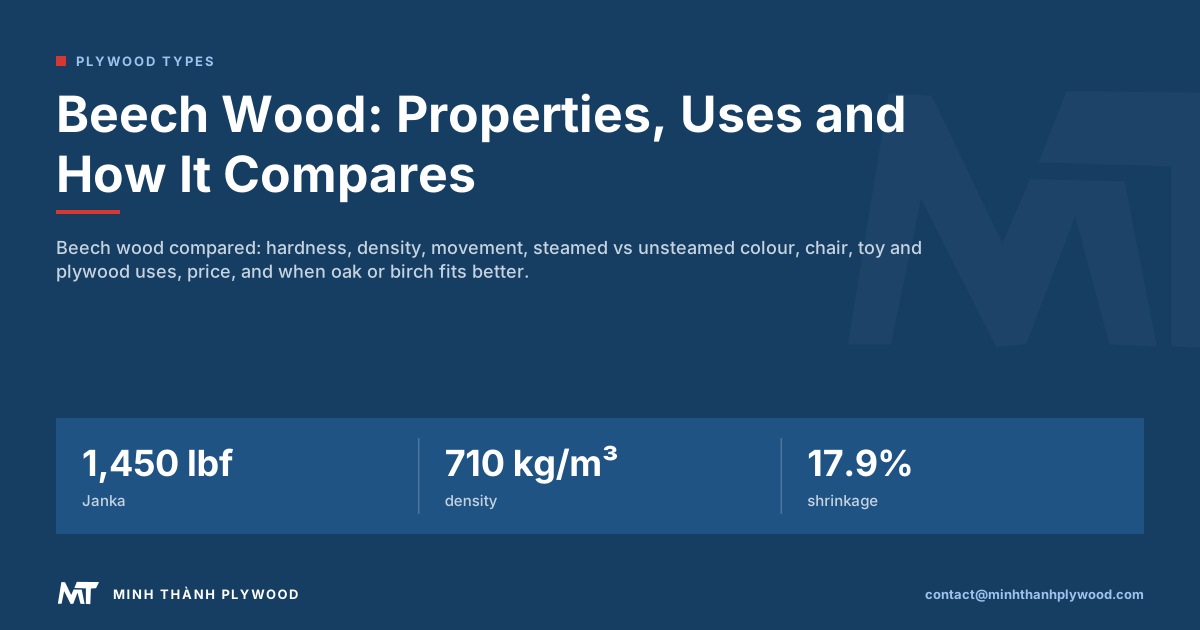
Beech wood is a hard, dense, close-grained European and American hardwood with a pale pinkish-cream colour, harder than oak but less stable and not durable outdoors. It suits chairs, bentwood, toys, worktops and plywood. This comparison from Minh Thanh Plywood sets beech against oak, birch and maple metric by metric, explains steamed and unsteamed beech, and gives a verdict by use.
What is beech wood?
Beech wood is the timber of trees in the genus Fagus: European beech (Fagus sylvatica), American beech (Fagus grandifolia) and oriental beech (Fagus orientalis). It is a diffuse-porous hardwood with a fine, even texture, a pale cream to pinkish-brown colour and small dark flecks from its rays on quarter-sawn faces.
European beech is one of the commonest broadleaved trees in Central Europe, so it is the most widely sawn hardwood in Germany, France, Denmark and the Balkans. That supply, its hardness and its ability to bend made it the standard wood for chairs, toys, tool handles and kitchenware.
For a buyer, beech is defined by three choices: species and origin, steamed or unsteamed colour, and grade, especially how much red heart is accepted. The types of wood guide places beech among the other European hardwoods.
Is beech a hardwood?
Yes, beech is a hardwood, both botanically and in practice. It comes from a broadleaved tree of the genus Fagus, and with a Janka hardness of about 1,450 lbf (6,460 N) European beech is harder than white oak, birch, cherry and walnut.
That hardness, with its fine texture, is why beech wears well in chair legs, stair treads, workbenches and flooring. It also means beech dulls tools faster than pine or poplar and needs pre-drilling near board ends. American beech is a little softer at about 1,300 lbf (5,780 N).
Hardness is not the same as durability. Beech is hard but perishable: it decays quickly outdoors or in damp. The elm wood guide shows the opposite case, a softer hardwood that lasts underwater.
Beech wood properties compared with oak, birch and maple
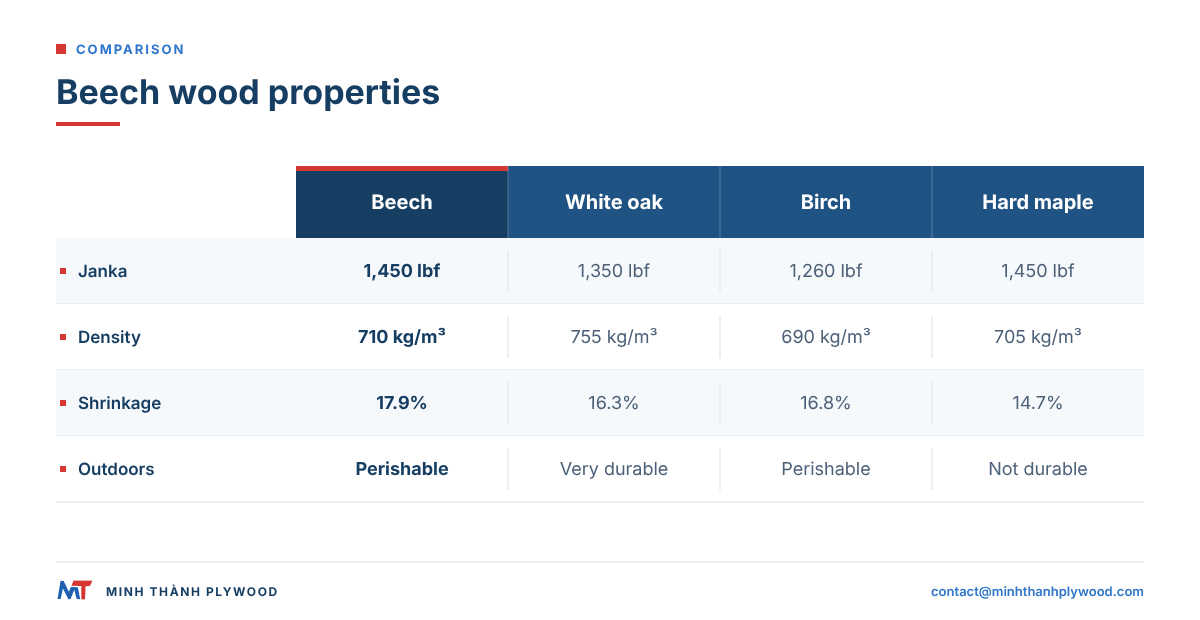
Beech wood is harder than oak, about as hard as hard maple, close-grained like birch, and less stable than all three. The table compares the four on one metric per row.
| Metric | European beech | White oak | Birch (yellow) | Hard maple |
|---|---|---|---|---|
| Janka hardness | 1,450 lbf (6,460 N) | 1,350 lbf (5,990 N) | 1,260 lbf (5,610 N) | 1,450 lbf (6,450 N) |
| Average dried density | 710 kg/m³ | 755 kg/m³ | 690 kg/m³ | 705 kg/m³ |
| Bending strength (modulus of rupture) | 110.1 MPa | 102.3 MPa | 114.5 MPa | 109.0 MPa |
| Volumetric shrinkage, green to oven-dry | 17.9% | 16.3% | 16.8% | 14.7% |
| Grain and texture | Fine, even, ray flecks | Coarse, open pores | Fine, even | Fine, even |
| Colour | Cream to pinkish-brown | Light to mid brown | Cream to light brown | Creamy white |
| Outdoor durability | Perishable | Very durable | Perishable | Not durable |
| Steam bending | Excellent | Good | Good | Fair |
Values are averages at about 12% moisture content from The Wood Database, checked 20 October 2026. Individual boards vary with growth and origin.
The row that matters most for furniture is shrinkage. Beech moves more than oak or maple, so it must be dried to the moisture content of the room where it will be used and finished on all faces. The birch wood guide covers birch, beech’s closest rival for pale furniture.
Characteristics of beech wood: colour, grain and figure
Beech heartwood and sapwood are both pale, from cream to light pinkish-brown, with no sharp colour boundary. The grain is usually straight and the texture fine and even. Quarter-sawn faces show small dark ray flecks, a typical feature of beech.
Older trees often form red heart, an irregular reddish-brown core that is sound wood but darker. Furniture grades limit red heart on visible faces; rustic grades accept it. Spalted beech, partly coloured by fungi before drying, is sold for turning and decoration.
Beech takes stain evenly and is often stained to imitate walnut, cherry or mahogany, a use that goes back to nineteenth-century furniture. Under a clear finish it yellows slightly over time. The wood colors guide places beech in the pink-to-salmon group alongside okoume and alder.
Steamed vs unsteamed beech: which should you order?
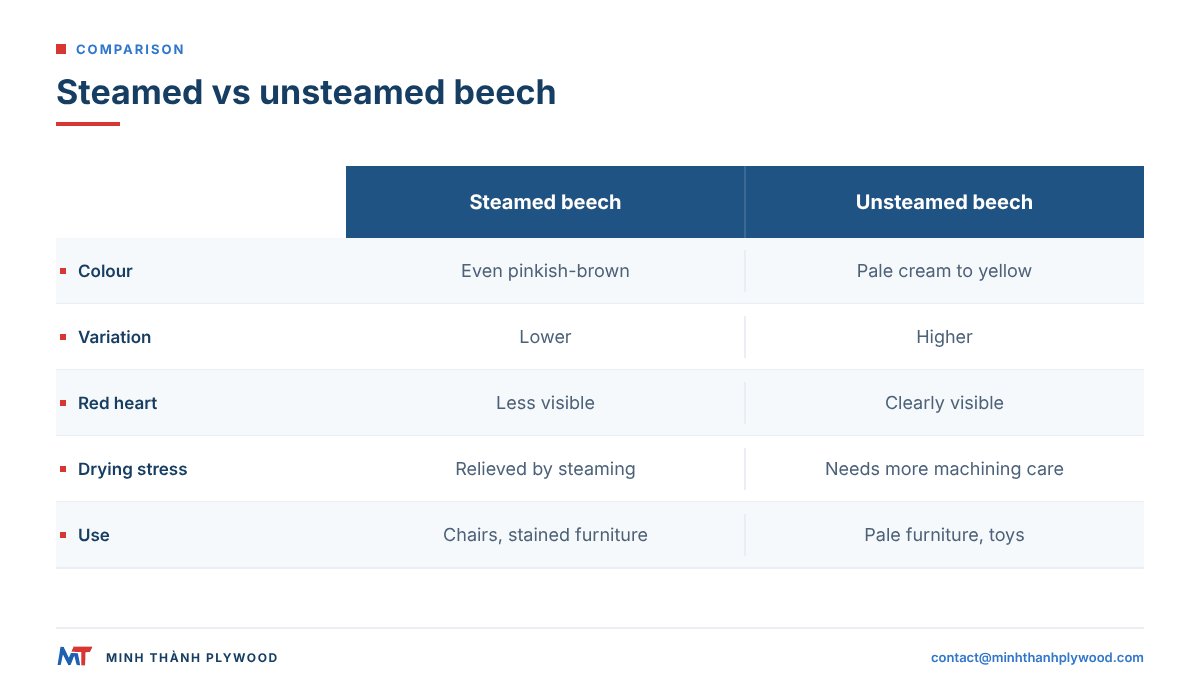
Order steamed beech for an even pinkish-brown tone and lower stress, and unsteamed (white) beech for a pale cream look. Steaming changes colour and evenness far more than it changes strength.
| Metric | Steamed beech | Unsteamed (white) beech |
|---|---|---|
| Colour | Even pinkish to reddish-brown | Pale cream to light yellow |
| Colour variation between boards | Low | Higher, sapwood and heart differences show |
| Red heart visibility | Masked by the overall tone | Clearly visible |
| Drying stresses | Relieved by steaming | Higher, more care in machining |
| Typical use | Furniture, chairs, joinery, stained work | Pale Scandinavian-style furniture, toys, kitchenware |
Steaming is done after sawing, in chambers for one to several days, before kiln drying. The colour change is permanent through the board, not a surface stain. Unsteamed beech is increasingly asked for in pale furniture designs, but it shows colour differences, so it needs a tighter grading rule or a sample per batch.
Beech wood uses: where it performs best
Beech wood uses follow from its hardness, fine grain and bending ability:
- Chairs and bentwood furniture: beech bends well when steamed, which made Thonet-style bentwood chairs possible.
- Tables, beds and cabinet frames in solid beech or beech-faced panels.
- Kitchen utensils and chopping boards: hard, odourless and close-grained.
- Toys and children’s furniture: smooth, does not splinter easily, takes paint well.
- Workbenches, tool handles and brush backs for wear resistance.
- Flooring and stair treads indoors.
- Plywood and laminated parts: chair shells, curved seats, heavy-duty panels.
- Laminated veneer lumber: beech LVL is used in structural beams in Europe.
Beech is a poor choice for outdoor furniture, cladding or decking without treatment. For those uses, oak, teak or treated softwood performs better. For sheet parts in furniture, beech’s weight and movement often push buyers to plywood panels with a beech or beech-look face.
Is beech wood expensive, and what drives the price?
Beech is one of the more affordable European hardwoods, cheaper than oak, cherry or walnut, because Central European forests supply it in large volume. The final price depends on grade, colour treatment, size and drying.
The main price drivers:
- Grade and red heart: clear boards with little red heart cost more than rustic boards.
- Steamed vs unsteamed: steaming adds a process step, while clean unsteamed boards with even colour are harder to sort.
- Width and length: wide, long clear boards are scarcer.
- Drying: kiln-dried stock costs more than air-dried, and beech must be dried carefully to avoid cracks.
- Freight: at about 710 kg/m³, beech is heavier than birch or poplar to ship.
Beech plywood follows the same logic, with a higher cost per sheet than birch or poplar plywood because of the dense veneer. The beech plywood guide covers the panel market separately.
How does beech machine, glue and finish?
Beech machines, turns and sands well and gives a smooth surface, but it dulls tools moderately and can burn under slow feed. It glues reliably, holds screws well and takes stain, paint and lacquer evenly.
- Drying: dry slowly to the moisture content of the end use; beech checks and warps if dried fast.
- Machining: sharp tools, steady feed; it turns and carves cleanly.
- Bending: steamed beech bends to tight radii, one reason it dominates chair making.
- Fixing: pre-drill near ends; it holds screws and dowels firmly.
- Finishing: takes stain evenly, paints smoothly, and is often lacquered or oiled for kitchen use.
Movement after machining is the main risk. A beech part machined at the wrong moisture content can cup in the finished piece. Our furniture plywood leaves the factory at 8–12% moisture content, the normal range for furniture panels, so beech solid parts dried to the same range move together with plywood carcasses.
Beech wood vs oak: which suits furniture better?
Choose beech for hard, smooth, painted or stained furniture and bent parts; choose oak for clear-finished furniture where grain and long-term stability matter, and for anything exposed to damp. Beech is harder and cheaper; oak is more durable and moves less.
Oak’s open pores and ray figure suit clear finishes and give a recognisable look. Beech’s even texture suits paint and stain. In service, beech chairs and frames perform as well as oak indoors, while oak lasts far longer outdoors or in bathrooms.
For panel parts in either design, plywood moves less than solid boards of both species. The oak wood guide covers oak species, grades and oak-look panels.
Beech wood vs birch: which suits plywood and furniture?
Choose birch for lighter, more stable plywood and pale furniture faces; choose beech where higher hardness and density are needed. Birch plywood is the standard pale furniture panel because birch peels into even veneer, is lighter to ship and moves less.
Beech plywood is heavier and harder-wearing. It is used for chair shells, bent seats and heavy-duty floors, and in Central Europe for some furniture panels. Birch-faced plywood gives a similar pale look over a lighter core at lower freight cost per sheet.
We press birch-faced plywood for furniture, with faces graded D+, D and E in Vietnam and quoted as face/back pairs such as D+/D, comparable to European B/BB. The core is white Styrax or Eucalyptus, and the panels are pressed twice as standard: the core board is pressed and calibrated, then face and back are pressed on. The birch plywood page gives the specification.
Which beech-look panel suits a furniture order?
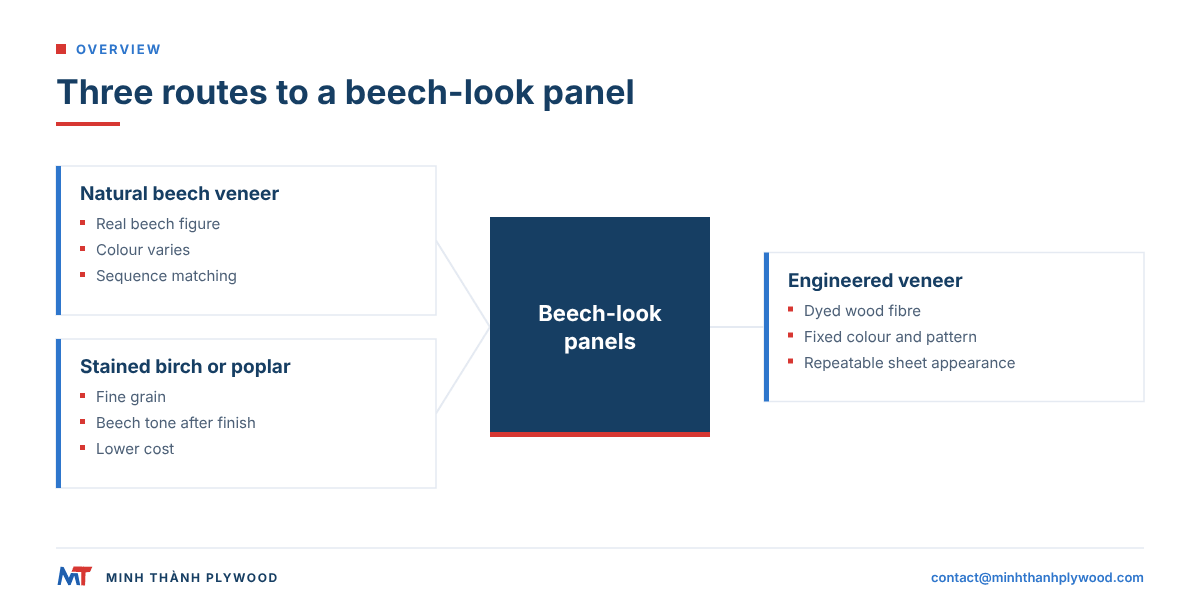
For panel parts in a beech design, a buyer has three routes: natural beech veneer on a plywood or MDF core, a pale face such as birch or poplar stained to the beech tone, or an engineered veneer (EV) face built to the beech colour and grain. Each gives a different balance of authenticity, evenness and cost.
- Natural beech veneer: real beech figure and flecks, colour varies between leaves; needs sequence matching.
- Stained birch or poplar face: close tone after finishing, lower cost, fine grain similar to beech.
- EV face: real wood fibre dyed and re-sliced to a fixed beech-like colour and pattern, the same on every sheet.
We press birch, poplar and EV faces on white Styrax or Eucalyptus cores, 3–40 mm, sanded and polished with both faces UV-ready for the customer’s coating. Thickness tolerance on sanded furniture panels goes down to ±0.2 mm, which helps when panels meet machined solid beech rails.
Panels sold into the US must meet the 0.05 ppm formaldehyde limit for veneer-core hardwood plywood set in EPA’s TSCA Title VI guidance. In the EU, the deforestation regulation applies from 30 December 2026 for large and medium operators. For carcass panels, BS EN 636 covers plywood for general-purpose use in dry, humid or exterior conditions, so name the service class on the order.
Verdict: when is beech the right wood?
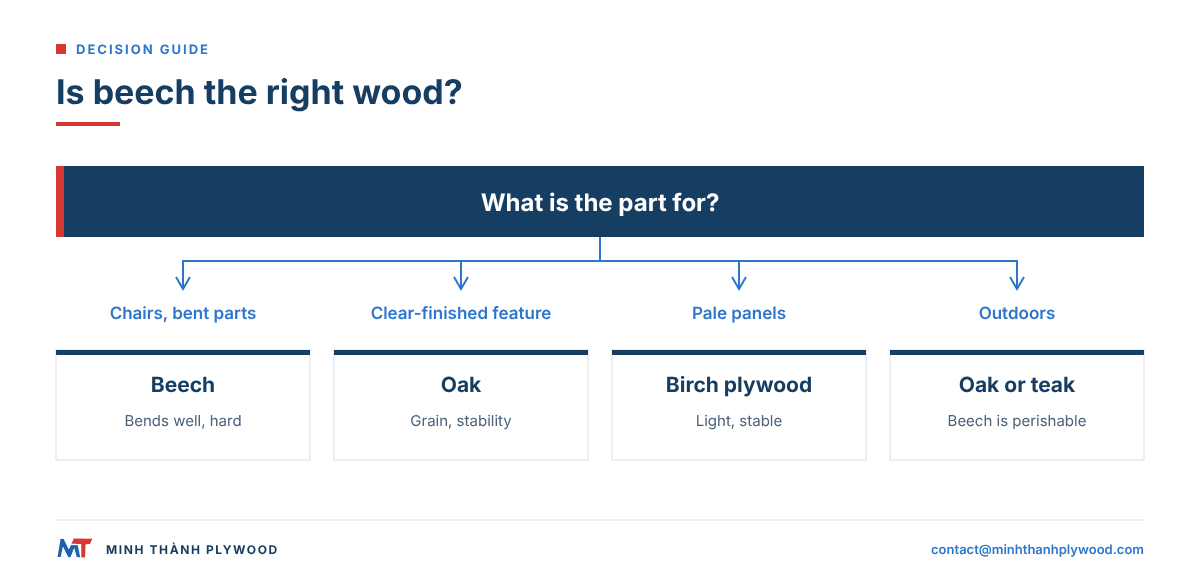
Beech is the right wood for hard, smooth indoor parts that are painted, stained or bent: chairs, toys, kitchenware, frames and worktops. It is the wrong wood for outdoor work, wet rooms and wide solid panels where movement would show.
| Use | Best choice | Why |
|---|---|---|
| Bentwood and chair frames | Beech | Bends well, hard, affordable |
| Painted or stained furniture | Beech or birch | Fine, even texture |
| Clear-finished feature furniture | Oak | Grain, stability, durability |
| Pale Scandinavian-style panels | Birch plywood | Even pale face, light, stable |
| Kitchen utensils, toys | Beech or maple | Hard, close-grained, odourless |
| Outdoor furniture | Oak or teak | Beech is perishable |
| Cabinet carcasses and shelves | Plywood | Flat, stable, lighter |
For a furniture order that combines solid beech parts with panels, send the panel specification with the beech reference: face species or EV colour and grade, core, UF glue at E0 emission, thickness and tolerance, size (1220 × 2440 mm or 1250 × 2500 mm, or cut to size), quantity and destination port. Contact Minh Thanh for free samples matched to the beech tone.
Buyer questions, answered
Is beech a hardwood?
Yes. Beech is a hardwood from broadleaved trees of the genus Fagus, and it is also hard in the everyday sense. European beech has a Janka hardness of about 1,450 lbf, higher than white oak, birch or black cherry.
Is beech wood expensive?
No, beech is one of the more affordable European hardwoods because large forests in Germany, France and Central Europe supply it in volume. Wide, clear, steamed boards cost more than narrow or unsteamed stock, and boards with red heart sell at a discount.
Is beech wood good for furniture?
Yes. Beech is one of Europe's main furniture woods, used for chairs, tables, beds, bentwood and kitchen utensils. It is hard, strong, bends well when steamed and takes paint, stain and lacquer evenly. It moves more than oak, so it needs careful drying.
What is the difference between steamed and unsteamed beech?
Steamed beech is heated in steam chambers after sawing, which turns it an even pinkish-brown and relieves stresses. Unsteamed, or white, beech stays pale cream to light yellow. The wood properties are almost the same; colour and evenness differ.
Is beech wood waterproof?
No. Beech is classed as perishable outdoors: it decays quickly in contact with soil or repeated wetting. It works for kitchen utensils and indoor worktops that are dried after use, but outdoor beech needs preservative treatment or another species.
Is beech harder than oak?
Yes, a little. European beech averages about 1,450 lbf on the Janka scale against about 1,350 lbf for white oak and 1,220 lbf for red oak. Beech also has a finer, more even texture, but oak is far more durable and more stable.
Is beech plywood good?
Beech plywood is strong, heavy and hard-wearing, with a smooth face for painting and lacquering. It suits chair shells, bent parts and heavy-duty floors. It is denser and costlier to ship than birch or poplar plywood, so it is chosen where its hardness is needed.
Why does beech wood crack or warp?
Beech has a high shrinkage, about 17.9% by volume from green to oven-dry for European beech, so it moves a lot with humidity. Boards dried too fast or used at the wrong moisture content can cup, twist or crack. Kiln drying to the room's moisture level prevents most problems.
What is red heart in beech?
Red heart is a darker reddish-brown false heartwood that forms in older beech trees. It is sound wood, but it changes the colour, so furniture grades limit it and rustic grades accept it.
Is beech wood safe for kitchen utensils and toys?
Yes. Beech is widely used for spoons, chopping boards and toys because it is hard, close-grained, odourless and does not splinter easily. Use food-contact oils or finishes rated for toys.