
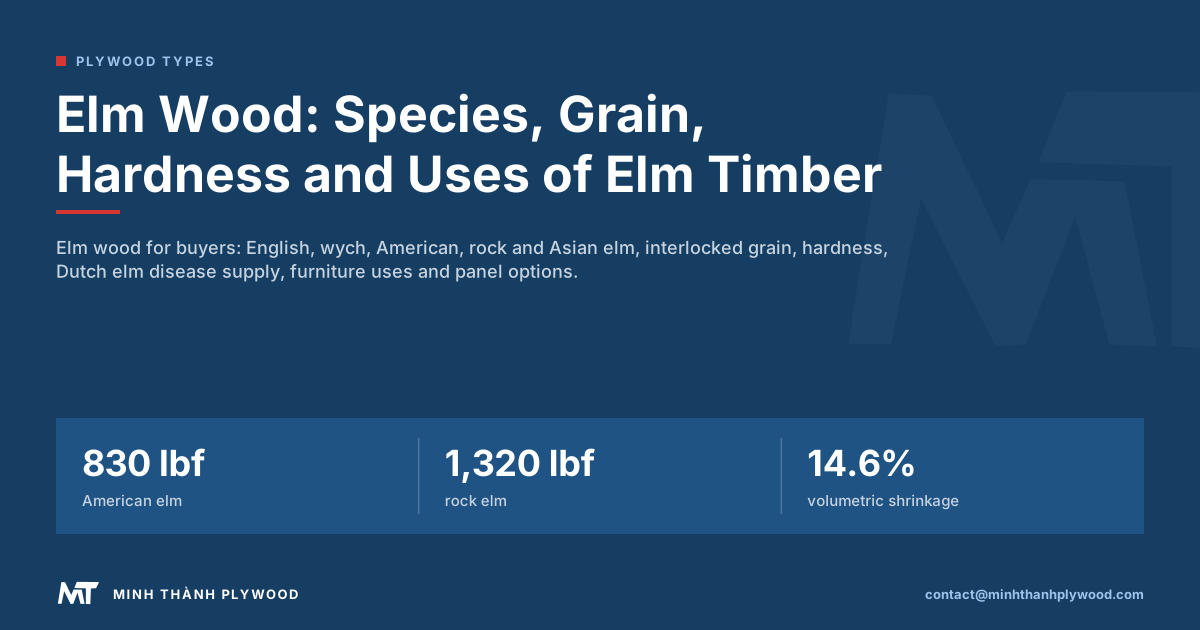
Elm wood is a ring-porous hardwood from Ulmus trees, light to mid brown with a bold, often interlocked grain that resists splitting. English, wych, American, rock and Asian elms differ in hardness and figure, and Dutch elm disease has made European elm timber scarce. This guide from Minh Thanh Plywood covers species, properties, supply, uses and the panel alternatives furniture makers order.
What is elm wood?
Elm wood is the timber of trees in the genus Ulmus, deciduous broadleaved trees native to Europe, Asia and North America. It is a ring-porous hardwood with light to mid brown heartwood, a coarse texture and a bold grain that is often interlocked, so boards resist splitting.
Elm was once one of the commonest timbers in Britain and Northern Europe, used for chair seats, wheel hubs, coffins, floors and anything that had to take nails without cracking. Elm timber still has that reputation for toughness and figure, but large European logs are scarce, so most furniture elm now comes from smaller trees, North America or Asia.
For a buyer, “elm” on a quotation covers several species with different hardness, colour and supply. Name the species and origin, the grade and the moisture content, and approve a finished sample. The types of wood guide puts elm alongside the other temperate hardwoods.
Is elm a hardwood?
Yes, elm is a hardwood. Hardwood means timber from a broadleaved flowering tree, not a measure of hardness, and elm belongs to that group. In hardness, common elms are moderate: softer than oak and beech, harder than pine and poplar.
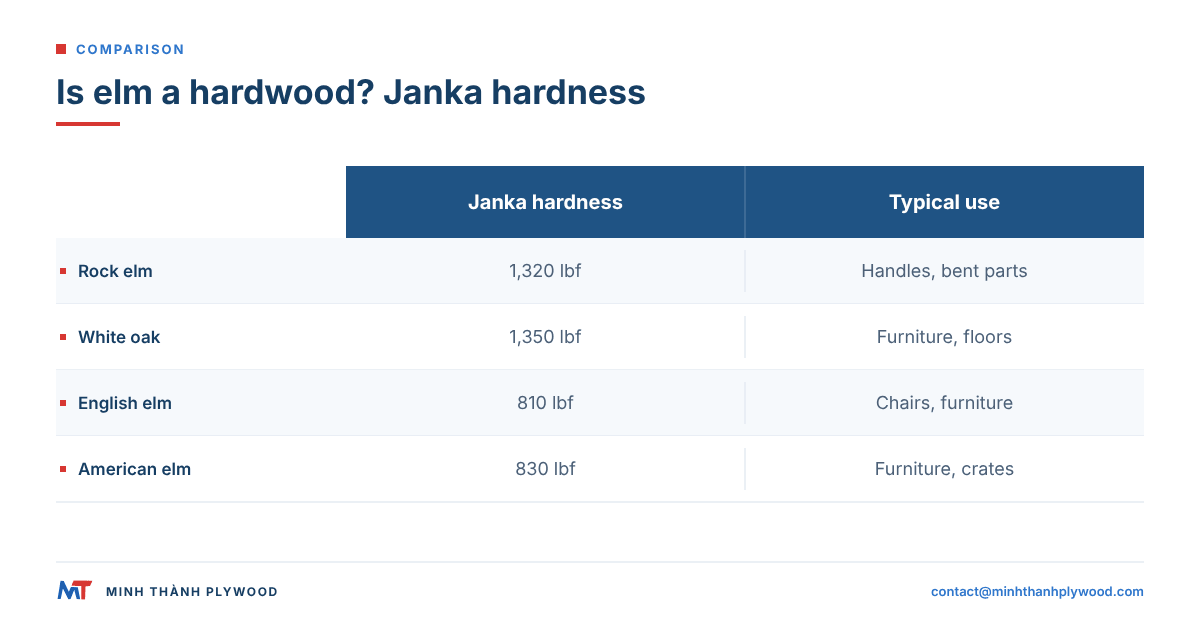
Janka hardness, the force to press a steel ball halfway into the wood, gives a clear comparison:
| Wood | Janka hardness | Typical use |
|---|---|---|
| Rock elm (Ulmus thomasii) | 1,320 lbf (5,870 N) | Tool handles, bent parts, hockey sticks |
| White oak | 1,350 lbf (5,990 N) | Furniture, flooring, barrels |
| European beech | 1,450 lbf (6,460 N) | Chairs, toys, workbenches |
| English elm (Ulmus procera) | 810 lbf (3,620 N) | Furniture, chair seats, coffins |
| American elm (Ulmus americana) | 830 lbf (3,690 N) | Furniture, crates, bent parts |
| Black cherry | 950 lbf (4,230 N) | Fine furniture, cabinets |
Hardness figures from The Wood Database, checked 20 October 2026, at about 12% moisture content. Rock elm is the exception among elms and is close to oak; the others sit nearer cherry. The beech wood guide covers a harder European furniture wood for comparison.
Which elm species are sold as timber?
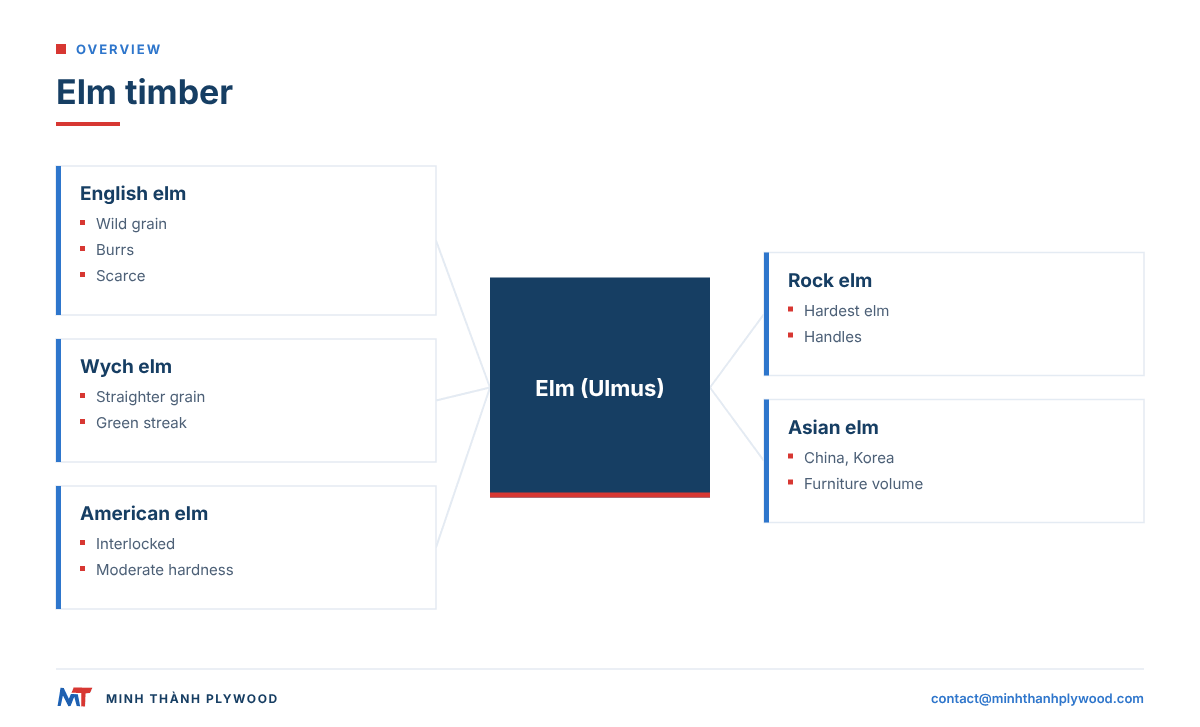
Five elm groups dominate the timber trade: English elm, wych elm, American elm, rock elm and Asian elms. They share the genus but differ in figure, hardness and supply.
- English elm (Ulmus procera, also classed as a form of Ulmus minor): warm brown with wild, often interlocked grain and burrs; the classic British furniture elm, now scarce.
- Wych elm (Ulmus glabra): the native elm of northern and western Britain and much of Europe; straighter grain, sometimes a greenish streak in the heartwood, called “green elm” by furniture makers.
- American elm (Ulmus americana) and red or slippery elm (Ulmus rubra): light to mid brown, interlocked grain, moderate hardness; used for furniture, crates and bent work.
- Rock elm (Ulmus thomasii): the hardest and densest common elm, with fine texture; used for tool handles, sports equipment and bent parts.
- Asian elms (Ulmus pumila, Ulmus davidiana and related species): grown in northern China, Korea and Japan; widely used in Chinese and Japanese furniture, often reclaimed.
Japanese zelkova (keyaki) is a close relative in the elm family, prized for its figure, but it is a different genus. Ask the supplier which species the boards are when “elm” alone appears on an offer.
Elm wood grain, colour and figure
Elm heartwood is light to medium reddish-brown, with a paler, almost white sapwood. It is ring-porous: large earlywood pores form a clear band each year, giving a bold, wavy growth-ring pattern on flat-sawn faces similar to ash or chestnut but warmer in colour.
The grain is frequently interlocked, which means the fibres spiral in alternating directions from one layer to the next. That gives elm its resistance to splitting and its shifting ribbon figure on quarter-sawn faces, and it makes planing harder because the grain changes direction across the board.
Burr elm, cut from the warty outgrowths on the trunk, shows tight swirls and small dark eyes and is sold as a decorative veneer. Elm darkens slowly to a warmer brown in light. Colour and figure vary widely between trees, so matched furniture runs need boards from one log or a matched veneer pack, approved as a finished sample. The wood colors guide shows where elm sits in the brown family.
Properties of elm timber: strength, movement and durability
Elm timber is tough and shock-resistant but only moderately strong and stiff, and it moves noticeably with changes in humidity. American elm averages about 560 kg/m³ when dried, light for a hardwood, with a volumetric shrinkage of 14.6% from green to oven-dry.
Toughness comes from the interlocked grain: elm absorbs impact and holds nails and screws close to the ends of boards without splitting, which is why it served for chair seats drilled for many legs and spindles. Stiffness is lower than oak or ash, so long elm shelves need more support.
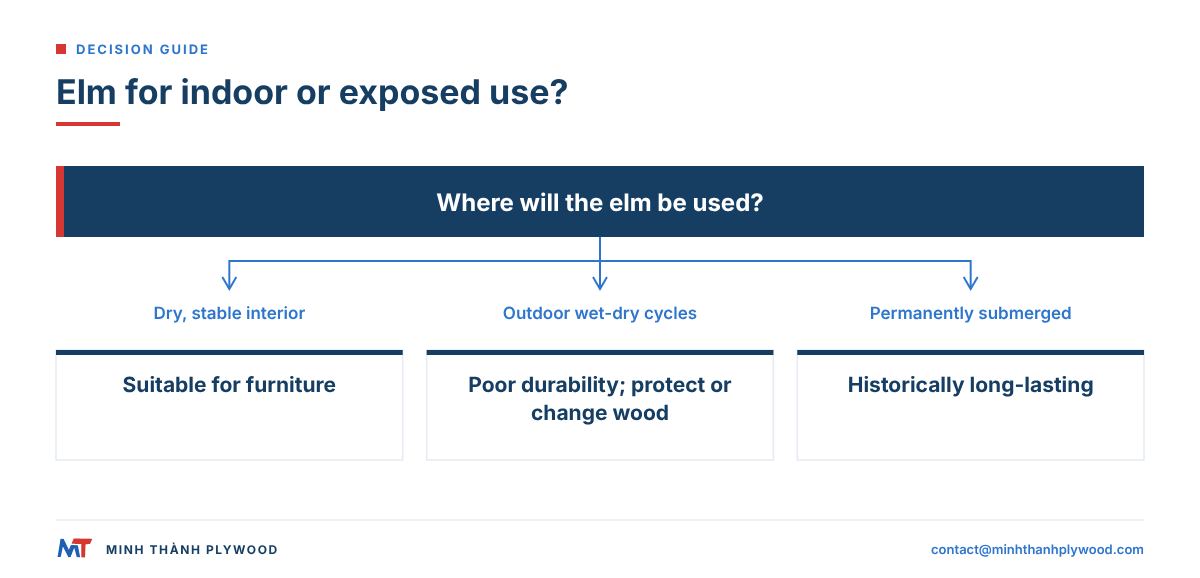
Durability depends on the conditions. Elm decays quickly in wet-dry cycles above ground or in soil contact, so it is a poor outdoor furniture wood. Kept permanently wet or submerged, it lasts for centuries, which is why towns once used hollowed elm trunks as water mains and shipwrights used it for keels and piles. Indoors at stable humidity it gives a long service life.
Dutch elm disease: what happened to elm supply?
Dutch elm disease is a fungal disease of elms carried by elm bark beetles; the fungus blocks the water-conducting vessels and kills the tree. It was named after the Dutch scientists who identified it in the 1920s, not after its origin. A far more aggressive strain, Ophiostoma novo-ulmi, spread through Europe and North America from the late 1960s.
The second epidemic killed most mature English elms in Britain within about two decades and destroyed large numbers of street elms in North American cities. Elm still regrows from roots and hedgerows, but young trees are usually reinfected once their bark is thick enough for the beetles, so few reach timber size. The UK Forest Research page on Dutch elm disease describes the cycle and the remaining populations.
The consequence for buyers is a fragmented supply. Wide English elm boards come mostly from isolated survivors, urban felling or old stock and are priced accordingly. Resistant cultivars are planted, but they will not supply large timber for decades.
Where does elm timber come from today?
Elm timber reaches the market today from four sources: European trees felled in disease-free areas or as urban removals, larger stands in France and Central and Eastern Europe, North American hardwood mills, and Asian elm from northern China, Korea and Japan.
Each source suits a different buyer. Small British and Irish sawmills sell English and wych elm in waney-edged boards and slabs for bespoke furniture. French and Eastern European mills supply more regular sawn elm in limited volume. North American mills sell American and rock elm by NHLA grade. Asian elm, including reclaimed boards from old buildings, supplies much of the volume furniture trade in Asia.
For any source, record the species, country of harvest and legality evidence. Wood placed on the EU market falls under Regulation (EU) 2023/1115 (EUDR), and the operator needs geolocation and legal-harvest records; the EUR-Lex text of the regulation sets out what the due diligence statement must contain.
The European Commission’s EUDR page gives 30 December 2026 as the application date for large and medium operators.
Buying elm in the UK
British buyers get elm as waney-edge boards (boards with the natural tree edge left on), slabs and burr. Boards run from about 20 to 75 mm thick, and the thickness decides what a board can become: 20 to 30 mm for panels and drawer parts, 54 mm and above for tabletops and benches.
Elm is sold by the cubic foot or by the board, and kiln-dried first-quality English elm has been listed from about GBP 60 per cubic foot (Sutton Timber’s trade list) up to GBP 178.50 ex VAT for a single 54 mm x 460 mm x 2.4 m board of 0.060 m³ (English Woodlands Timber, 2026). Burr elm and wide figured boards cost more. Prices vary by thickness, width, drying and figure, so treat these as signposts and ask for a current list.
UK sawmills and yards that stock elm include English Woodlands Timber, Sutton Timber, Nelson Butler & Son and Fallen & Felled in Brighton. Check the supplier’s legal-harvest papers, since British elm is mostly salvaged from felled and diseased trees.
Elm heartwood is slightly durable under EN 350, durability class 4 of five, so it needs protection in exposed use. That matches the practice of using elm indoors and in permanently wet work, and of choosing oak or a treated timber for outdoor furniture.
How to recognise an English elm tree, and why elm matters to wildlife
English elm is a tall tree, up to about 30 m, that can live for more than 100 years. Its leaves are 4 to 9 cm long, round to oval, toothed and rough, with the asymmetric leaf base that marks every elm: one side of the leaf stem is longer than the other. The bark is grey-brown, rough and fissured, and suckers often grow from the base of the trunk, which is how English elm survives as hedgerow regrowth after Dutch elm disease kills the tall tree.
Elm leaves feed the caterpillars of the white-letter hairstreak butterfly, and old elms shelter birds and bats, so a standing elm has a value far beyond its timber. In Britain, English elm is now found mainly in hedgerows and woodland in England and Wales. Wych elm, the other British native, has larger leaves and does not sucker.
What is elm wood used for?
Elm wood is used where toughness, resistance to splitting or a bold figure matters more than hardness:
- Chairs, especially Windsor chair seats drilled for legs and spindles.
- Dining tables, benches and live-edge slabs, valued for wild grain.
- Cabinets, sideboards and turned bowls in solid elm or elm veneer.
- Flooring, mainly wide-board rustic floors.
- Coffins, a traditional British use.
- Wet-service parts: historic water pipes, lock gates, keels and piles.
- Bent parts and handles, especially in rock elm.
- Decorative veneer, above all burr elm for boxes, panels and car interiors.
Many traditional uses, such as wheel hubs and pulley blocks, have passed to steel and plastics, so modern demand is mainly furniture and interiors. Those uses pair solid elm parts with sheet materials for carcasses, backs and shelves, which is where plywood comes in.
How does elm machine, dry and finish?
Elm machines reasonably with sharp tools, but its interlocked grain tears out under a high cutting angle, and it can warp if dried quickly. Planing with a low angle or a scraper and drying slowly under weight solve most problems.
- Drying: air-dry or kiln-dry slowly with boards stickered and weighted; elm twists and cups if rushed.
- Machining: sharp blades, slow feed and a low cutting angle; sand through grades on figured boards.
- Fixing: holds nails and screws well and seldom splits near ends.
- Gluing: glues well with standard wood glues.
- Finishing: takes oil, wax and lacquer evenly; open pores can be filled for a smooth finish.
For indoor furniture, solid elm parts should be at a moisture content close to the room in use. Our furniture plywood is dried to 8–12% moisture content at dispatch, the normal range for furniture panels, so plywood carcasses and solid elm parts made at matching moisture move together less.
Elm vs oak, ash and beech: which suits the job?
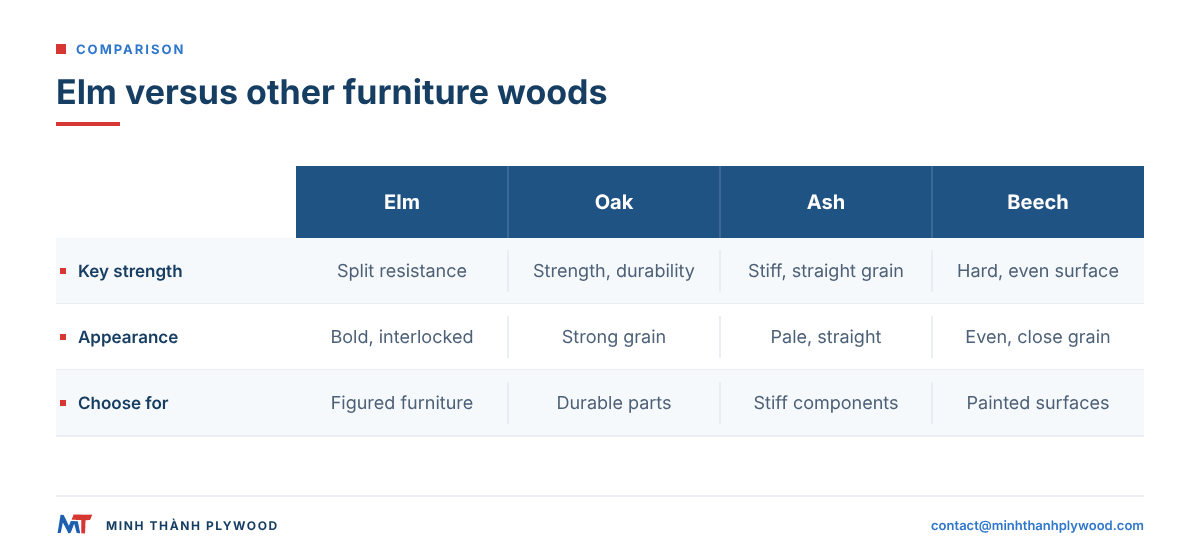
Choose elm for figure and split resistance, oak for strength and durability, ash for toughness with straight grain, and beech for hardness and an even surface. All four are European furniture hardwoods, but they solve different problems.
- Elm vs oak: oak is harder, stronger and more durable outdoors; elm is easier to nail near the ends and shows a wilder figure. The oak wood guide covers oak species and grades.
- Elm vs ash: both are ring-porous and tough; ash is stiffer, straighter and paler, elm warmer and more figured. Ash supply is also affected by ash dieback.
- Elm vs beech: beech is harder and close-grained with an even surface for painting; elm is softer with a bold grain for clear finishes.
For carcasses, doors and shelves behind any of these solids, a flat, stable plywood panel usually costs less and moves less than solid boards. The best plywood for furniture guide compares the panel options.
Elm veneer and panels: what do furniture makers order?
Furniture makers order elm in three forms: solid boards for frames, legs and tops; natural elm or burr elm veneer for decorative fronts; and engineered veneer faces with an elm-like pattern when many matching panels are needed.
Natural elm veneer gives authentic figure but varies strongly from leaf to leaf, so it needs sequence matching and a sample per batch. An engineered veneer (EV) face is real wood fibre peeled from plantation timber, dyed to a target colour, glued into a block and re-sliced, so colour and grain repeat on every sheet. EV faces can be built to a target colour and pattern matched to the buyer’s approved sample.
We press EV faces on white Styrax or Eucalyptus cores in 3–40 mm, sanded and polished, with both faces UV-ready for the customer’s coating. Furniture panels are pressed twice as standard: the core board is pressed and calibrated, then face and back are pressed on. The EV plywood page describes the construction.
What should you send for an elm-look panel quotation?
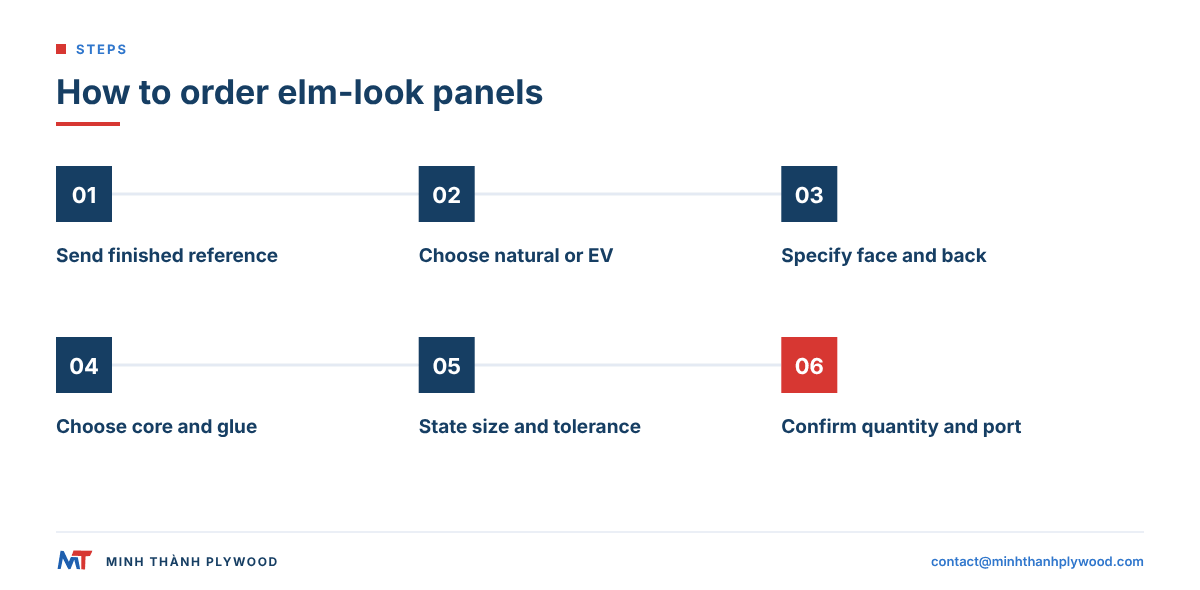
Send the elm reference, the part list and the panel specification, and say whether natural elm is required or an engineered veneer with an elm look is acceptable. That one decision sets the face, the price and the lead time.
- Reference: a finished elm sample or photos, and the finish system.
- Face and back: natural elm veneer or EV pattern and colour, with the grade for each side.
- Core: white Styrax for a pale edge, or Eucalyptus.
- Glue and emission: UF glue at E0 emission for interior furniture.
- Thickness and tolerance: for example 18 mm, down to ±0.2 mm on sanded furniture panels.
- Size: 1220 × 2440 mm or 1250 × 2500 mm, or cut to size.
- Quantity, packing and destination port; the minimum order is one 40HC, with mixed specifications by agreement.
Production runs 15–45 days after the deposit. Contact Minh Thanh with the reference and part list for free samples and a quotation.
Buyer questions, answered
Is elm a hardwood?
Yes. Elm is a hardwood because it comes from a broadleaved flowering tree of the genus Ulmus. Its hardness is moderate: American and English elm are softer than oak, while rock elm is close to hard maple.
What does elm wood look like?
Elm heartwood is light to medium reddish-brown, with paler sapwood. It is ring-porous, so it shows a bold growth-ring pattern, and many boards have wavy or interlocked grain. Burr elm shows dense swirls and small eyes.
Is elm wood good for furniture?
Yes. Elm is a traditional furniture wood, used for Windsor chair seats, tables, benches and cabinets. Its interlocked grain resists splitting, and its figure suits rustic and modern designs. It needs careful drying because it moves and can warp.
Is elm wood strong?
Elm is tough rather than very strong: it absorbs shock and resists splitting well. Its bending strength is moderate, similar to ash in toughness but lower in stiffness. Rock elm is the strongest of the common elms.
Is elm wood waterproof or rot resistant?
Elm is not rot resistant in wet and dry cycles outdoors. It lasts very well when kept permanently wet or underwater, which is why it was used for water pipes, piles and keels. For outdoor furniture, choose a durable species instead.
What is Dutch elm disease?
Dutch elm disease is a fungal disease spread by elm bark beetles that blocks the tree's water vessels. A more aggressive strain spread across Europe and North America from the late 1960s and killed most mature elms in Britain, which made large elm boards scarce.
Where does elm timber come from today?
European elm timber now comes mostly from trees felled in disease-free areas, hedgerows and urban removals, plus imports from France and Central and Eastern Europe. Asian elm from northern China, Korea and Japan supplies much of the furniture trade.
Is elm wood expensive?
English elm is expensive because wide, sound boards are scarce since Dutch elm disease. American and Asian elm are moderately priced. Burr elm veneer and wide slabs carry a premium for their figure.
Is elm wood easy to work?
Elm saws and planes reasonably but its interlocked grain can tear out, so sharp tools and a low cutting angle help. It holds screws and nails well without splitting, glues well and takes stain and finishes evenly.
Can elm be used for plywood?
Elm is uncommon as a plywood face in export trade. Elm veneer, especially burr elm, is used on decorative panels. For a repeatable elm-like look in volume, an engineered veneer face dyed and patterned to the reference is the usual route.