
Natural wood colors run from near-white holly, maple and sycamore through yellow, pink and red-brown species to near-black ebony, wenge and African blackwood. Colour comes from extractives in the heartwood, so sapwood is paler, and most woods change tone in light. This chart groups common timbers by colour and shows which plywood faces from Minh Thanh Plywood match each tone.
What decides the colour of wood?
Wood colour comes from extractives: tannins, phenols and other compounds a tree deposits in its heartwood as the inner wood stops conducting sap. Cellulose and lignin alone are pale, so a species with few extractives, such as holly or maple, stays near white, while ebony and wenge carry so many that they read as black.
Three other factors move the tone you see on a finished part. Growth conditions change colour within one species: walnut from different regions can range from grey-brown to chocolate. Drying changes it too, because kiln schedules and steaming darken or even out some timbers; steamed beech, for example, turns pinkish-brown. And the cut matters, since quarter-sawn faces show rays and flecks that look lighter than a flat-sawn face of the same board.
For a buyer this means a species name gives a colour range, not one colour. A purchase specification that fixes appearance needs a physical sample under the finish to be used. That rule applies equally to solid timber, natural veneer and plywood faces, and it is the reason we match each face order to an approved sample rather than to a species name.
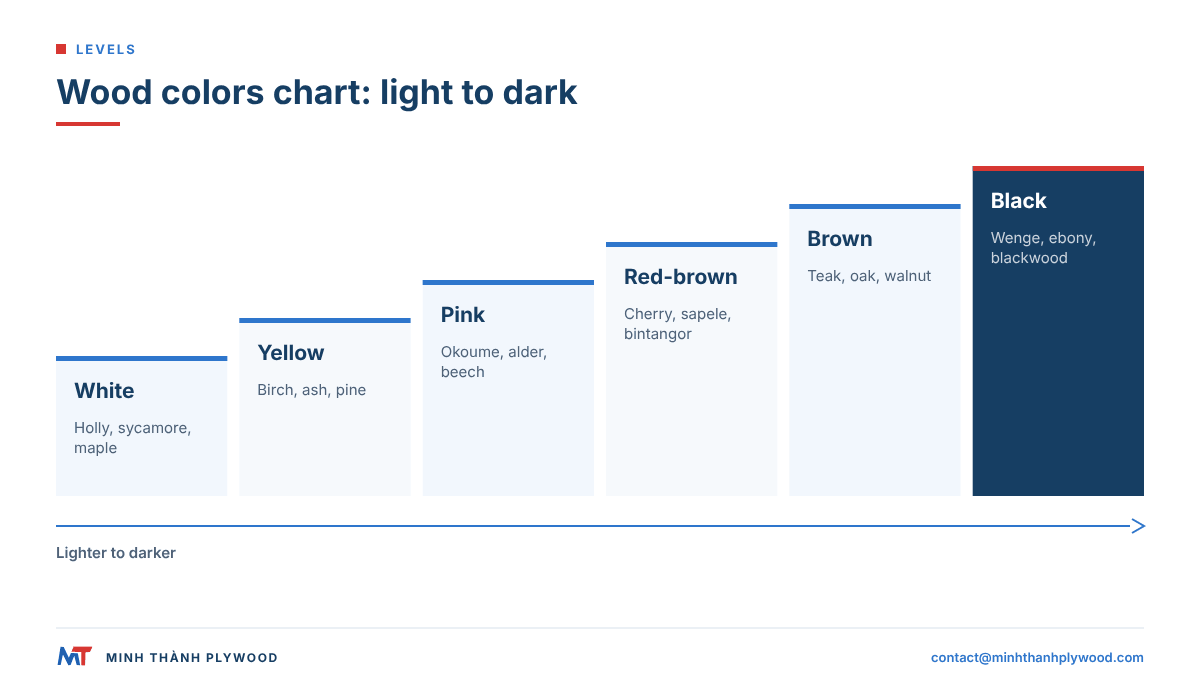
Wood colors chart: common timbers from white to black
The chart below groups common commercial timbers by heartwood colour after a clear finish. Each species covers a range, so treat the position as typical, not fixed. The plywood column shows which face veneers we press in a similar tone.
| Tone | Typical species | Colour after a clear finish | Plywood faces in a similar tone | Swatch (approx. hex) |
|---|---|---|---|---|
| White to cream | Holly, European sycamore, hard maple sapwood, basswood | Near white to pale cream, little figure | Poplar, birch, pale EV | #F3EBDD |
| Pale yellow | Birch, ash, spruce, pine | Cream to straw yellow | Birch, pine | #E8D3A2 |
| Pink to salmon | Okoume, alder, steamed beech, European cherry | Pinkish-beige to light pinkish-brown | Okoume, eucalyptus | #D9A98B |
| Red-brown | Black cherry, sapele, mahogany, bintangor, gurjan | Reddish-brown, deepens in light | Bintangor, gurjan, sapele on request, EV | #9A4F32 |
| Mid to dark brown | Teak, iroko, oak heartwood, walnut | Golden brown to chocolate brown | EV in oak or walnut tones | #6B4226 |
| Very dark to black | Wenge, Gabon ebony, African blackwood | Dark brown with black stripes to jet black | Dark EV, black film for formwork | #2B1D16 |
| Unusual | Purpleheart, padauk, yellowheart, poplar mineral streaks | Purple, orange-red, bright yellow, green-grey | Dyed EV for a fixed accent colour | #6A3D7C |
The hex values are approximate screen colours for a clear-finished face, for designers who need a swatch; wood varies board to board, so approve colour on a physical sample. The table below adds weight and hardness for nine of the species above, so a colour choice can be checked against the job.
| Species | Colour | Origin | Density | Janka hardness |
|---|---|---|---|---|
| Hard maple | Cream to light tan | North America | 705 kg/m³ | 6500 N |
| Ash | Pale straw to light brown | North America | 675 kg/m³ | 5870 N |
| Oak | Golden to mid brown | North America | 700 kg/m³ | 5430 N |
| Walnut | Chocolate brown | North America | 640 kg/m³ | 4490 N |
| Teak | Golden brown | South Asia | 655 kg/m³ | 4740 N |
| Mahogany | Reddish-brown | Africa | 640 kg/m³ | 4760 N |
| Wenge | Dark brown with black stripes | Central Africa | 870 kg/m³ | 8600 N |
| Purpleheart | Purple, turning brown | South America | 905 kg/m³ | 11190 N |
| Ebony (Ceylon) | Black to dark brown | South Asia | 915 kg/m³ | 10800 N |
Colour and hardness are separate: pale hard maple (6500 N) is harder than dark walnut (4490 N), and mahogany is among the softest of the dark woods. Figures are from the Woodwatch wood type guide (checked October 2026); other databases give slightly different averages.
Hardwood and softwood describe the tree, not the tone. Pine and spruce are pale softwoods, but yew, also a softwood, has orange-brown heartwood. The types of wood guide explains the botanical split; colour is a separate choice.
What is the lightest colored wood?
The palest commercial woods are holly, European sycamore, hard maple sapwood, basswood (lime), aspen and poplar. Holly is close to white with almost no figure, which is why marquetry makers use it for white inlay. Sycamore and maple are creamy white and close-grained, so they take a clear finish with very little colour.
Pale woods show defects and colour streaks that darker woods hide. Poplar can carry grey or green mineral streaks, birch has occasional brown heart, and maple yellows under light. A light-wood furniture order therefore needs a written rule for streaks, heart colour and patches on the face.
Birch and poplar are the two pale faces we press most often for light furniture. Birch faces are graded D+, D and E in Vietnam and quoted as face/back pairs such as D+/D; poplar faces are quoted as A/A, A/B and B/B against the approved sample. On a white Styrax core the pale face carries through to a pale panel edge, which suits exposed-edge furniture.
Dark wood: what are the darkest timbers?
The darkest wood in regular trade is African blackwood (Dalbergia melanoxylon), whose heartwood is close to jet black and is used for clarinets and oboes. Gabon ebony (Diospyros crassiflora) is almost as dark and very even. Wenge is very dark brown with fine black stripes, and Macassar ebony is dark brown with black streaks.
Most dark timbers are dense, slow to grow and scarce, which is why furniture rarely uses them in solid form. Walnut and fumed or smoked oak give a softer dark brown at lower cost, and stained or dyed veneer covers most commercial dark finishes. Buyers should note that several dark tropical species are regulated in trade, so the species name on a quotation needs to be exact.
For a dark furniture face over plywood, an engineered veneer (EV) dyed to a dark walnut or wenge tone gives the same colour sheet after sheet. The dye goes through the veneer before it is sliced, so light sanding does not expose a pale layer as it can with surface stain.
Types of wood colour: yellow, red, brown and unusual tones
Between white and black, wood colour falls into four broad families. Yellow woods include birch, ash, pine, osage orange and yellowheart. Pink to red woods include okoume, alder, cherry, sapele, mahogany, padauk and bloodwood. Brown woods include teak, iroko, oak heartwood and walnut. A small group shows unusual colours: purpleheart turns purple, padauk is orange-red, and poplar can show green.
Red and red-brown tropical faces are common in plywood because of the species that grow in South-East Asia and Central Africa. Bintangor has a redder-brown face with a straight, interlocked stripe; gurjan is reddish-brown with an even grain; okoume runs from pale pink to a warmer salmon between veneer batches.
Each family behaves differently under a finish. Yellow woods go warmer under oil, red woods deepen in daylight, and brown woods can lighten. The purpleheart wood guide explains the most dramatic colour shift in commercial timber, and the cherry wood guide follows the best known darkening.
Heartwood vs sapwood: why one board shows two colours
Heartwood is the older inner wood that carries the species colour; sapwood is the paler outer band that still conducts sap. In walnut the sapwood is creamy against chocolate heartwood, and in cherry it is pale against reddish-brown. In maple, birch, poplar and beech the contrast is small, so most of the log reads as one colour.
Sapwood also differs in use. It lacks the extractives that give heartwood its decay resistance, so a durable species such as teak or purpleheart is only durable in its heartwood. The Forest Products Laboratory’s chapter on commercially important woods describes the heartwood and sapwood of each species. For outdoor parts the specification should exclude sapwood, not only name the species.
Rotary-peeled plywood veneer runs around the log, so a face can include both heartwood and sapwood bands. Grading rules handle this: a top face grade limits colour variation, and a lower grade accepts it under paint or overlay. Write whether sapwood is accepted on visible faces and on backs when you order.
How light, air and time change wood colour
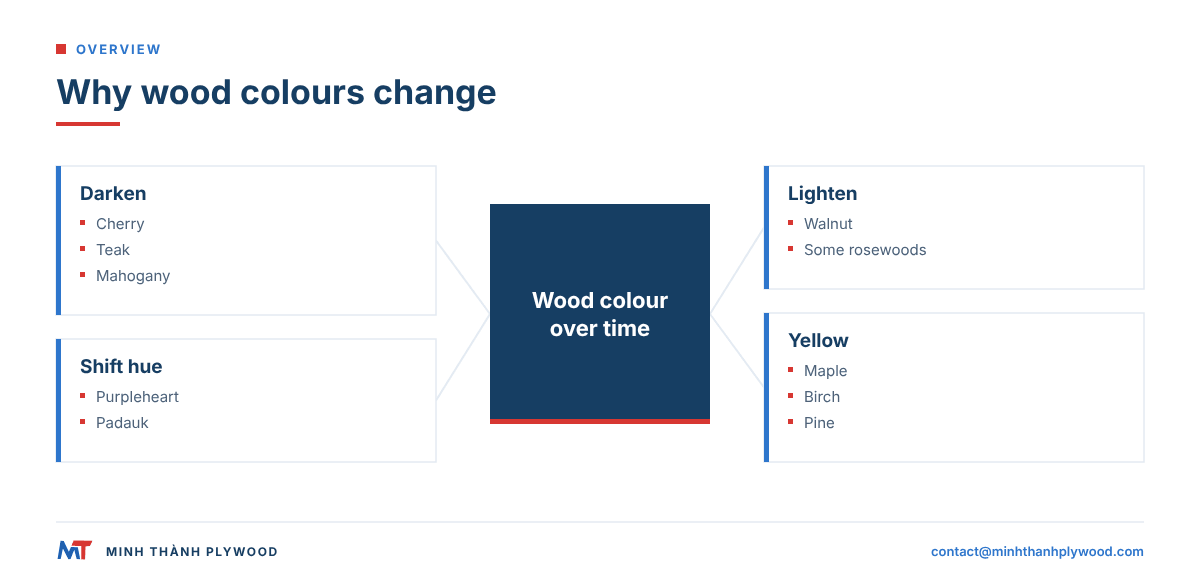
Wood changes colour because light, mainly ultraviolet, and oxygen react with lignin and extractives at the surface. The change is fastest in the first weeks and months after cutting or sanding, then slows. Indoors the shift is a darkening or warming; outdoors, unprotected wood turns silver-grey as the surface lignin breaks down and washes out.
The direction depends on the species:
- Darken: cherry, teak, mahogany, sapele, okoume and iroko deepen towards red-brown or gold-brown.
- Shift hue: purpleheart goes from grey-brown to purple, then slowly to brown; padauk goes from orange-red to dark brown.
- Lighten: walnut and some rosewoods fade towards a warmer, paler brown.
- Yellow: maple, birch, ash and pine turn more yellow or amber, especially under oil-based finishes.
The USDA Forest Products Laboratory Wood Handbook describes this weathering and the role of finishes. A UV-filtering coating slows the change but does not stop it. For matched furniture, approve the colour on a sample that has been coated and cured, and keep the approved piece out of direct light so it remains a fair reference.
Wooden colour in plywood: what colour is the panel?
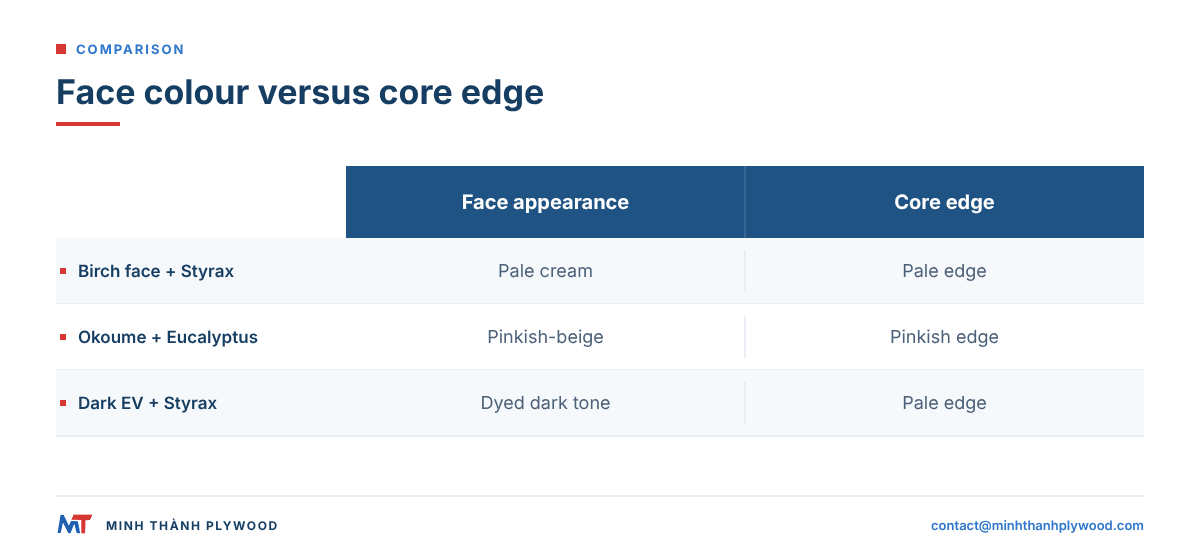
A plywood panel takes its colour from its face veneer, and its edge colour from the core. The face can be a natural species, a dyed engineered veneer, a film or an overlay. The core is often a different species with its own tone, which shows on any exposed edge. European face grades are set in BS EN 635-2, which classifies hardwood plywood by surface appearance.
The face veneers we press, with their usual tone:
- Birch: pale cream to light yellow, close grain.
- Poplar: creamy white, occasional grey or green streak.
- Pine: straw yellow with knots, graded A/A to B/B.
- Okoume: pinkish-beige to pale salmon with a soft, wavy figure.
- Eucalyptus: light pinkish-brown.
- Bintangor and gurjan: reddish-brown; bintangor with a straight interlocked stripe.
- EV (engineered veneer): dyed to the colour and grain pattern ordered.
On the inside, our furniture panels use a white Styrax core or a Eucalyptus core. A Styrax core keeps the edge pale under a pale face; a Eucalyptus core gives a pinkish edge. The types of plywood guide explains how face and core combine in each product.
Does plywood come in colours other than wood tones?
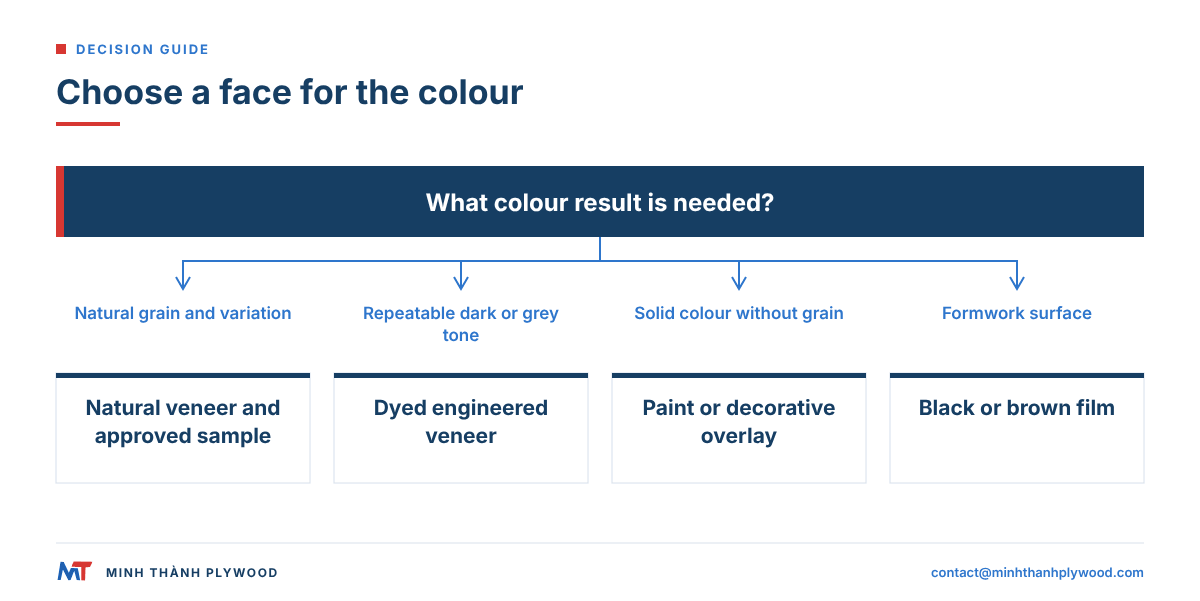
Plywood comes in non-wood colours through four routes: a dyed engineered veneer face, a stain or paint, a coloured film, or a decorative overlay such as melamine paper or high-pressure laminate. Each route suits a different use and price.
A dyed EV face is real wood fibre coloured right through, so it keeps a visible grain in grey, black, white-washed or other tones. Paint hides the grain and suits shop fittings and children’s furniture. Film-faced plywood for concrete formwork comes in black or brown, chosen for the site, not for decoration. Overlays give solid colours and patterns for kitchens and retail fit-outs.
Coloured plywood requests also arrive as multi-coloured or colour-core panels, where veneers dyed in different colours show as stripes on the edge. That is a speciality product built to a layout. For most furniture buyers, the practical choice is a natural or EV face, sanded and polished, then coated in the buyer’s own line. Both faces of our furniture panels leave the factory UV-ready for that coating.
How to match plywood faces to a wood colour
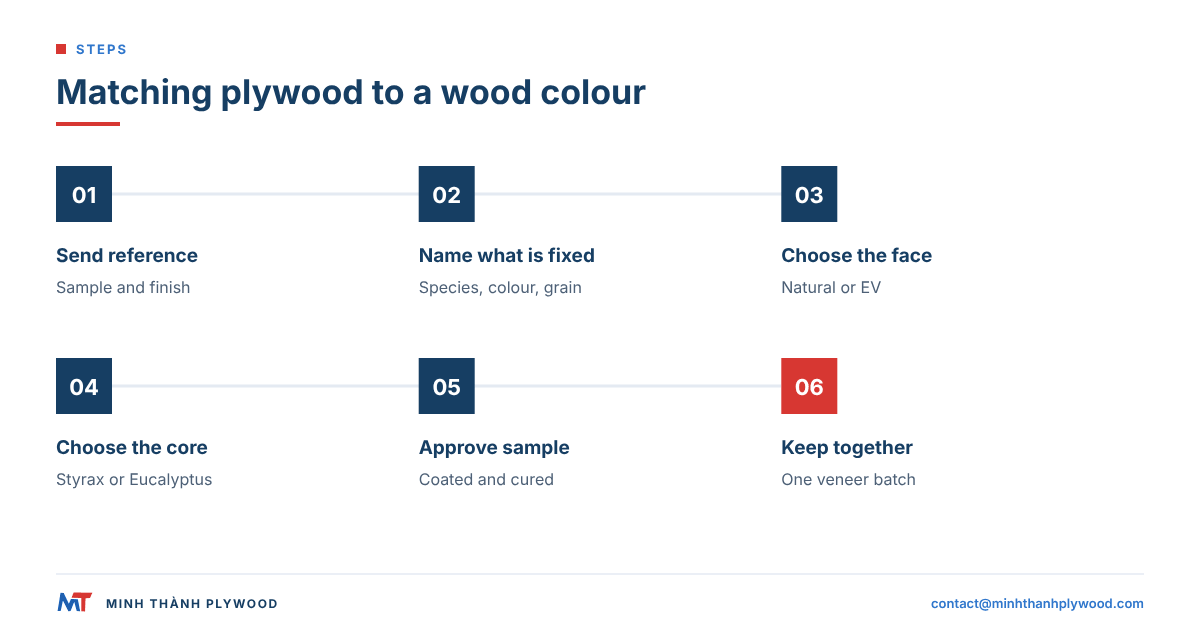
To match plywood to a target wood colour, decide whether the design needs the real species or only its tone, then pick a face, core and finish that hold that tone across the order. A natural face gives authentic figure with colour variation; a dyed EV face gives one repeatable colour.
- Send the reference. A finished sample, door or veneer leaf of the target colour, plus the finish system used on it.
- Name what is fixed. Species identity, colour, grain pattern, or all three.
- Choose the face. Natural birch, poplar, okoume or bintangor where the tone fits; EV where the colour must repeat.
- Choose the core. Styrax for a pale edge, Eucalyptus where the edge is covered.
- Approve a coated sample. Cure it, compare it in daylight and under the shop lighting, sign it.
- Keep sheets together. For a matched run, ask for one veneer batch per project and one pack sequence.
The EV plywood page shows the engineered-veneer construction. Natural faces vary between veneer batches, so for a clad wall or a long kitchen run we keep one batch together in the same bundles.
What colour finish suits each wood tone?
Pick the finish by what the tone should do over time. A clear water-based lacquer keeps pale woods closest to their raw colour, while oil and solvent lacquers warm them towards amber. Red and brown woods look richer under oil but also darken faster.
For pale faces such as birch, maple and poplar, use a non-yellowing water-based coat or a UV-cured lacquer. For pink and red faces such as okoume and bintangor, a light stain evens out batch-to-batch colour, and a stain-blocking primer stops tannin bleeding into white paint. For dark finishes on pale wood, a dye stain or a dark EV face gives a more even result than pigment stain, which can blotch on birch and maple.
Colour paint on plywood depends more on the face than on the paint. A smooth, sanded birch or poplar face shows the least grain through a light colour. Our sanded and polished faces are prepared for the customer’s own coating line, and the plywood staining guide covers stain choice in more detail.
Wood colours in furniture design: how is colour chosen?
Furniture designers usually fix the colour of a collection first and the species second. Pale oak, white-washed, grey, walnut and black tones all appear in current ranges, and each can be reached by more than one material, so the colour reference drives the order.
For a manufacturer the useful consequence is that colour is often specified apart from species. An oak-look tone can come from natural oak, from a stained pale veneer, or from an EV face; a walnut tone can come from walnut veneer or a dyed face. Our factory is built for top-grade furniture and interior plywood with Europe as its main market, so colour approval by sample is part of every furniture order.
Popular wood colours in UK and European interiors fall into a few groups, and each maps to a panel face a factory can press:
- Light oak and white-washed oak: the pale, low-contrast look in kitchens and bedrooms. Panel faces: pale EV in an oak tone, or birch and poplar finished clear.
- Ash grey and greige: a cool, pale grey-beige that suits minimal rooms. Panel faces: a grey-toned EV or a pale veneer stained to the reference.
- Natural birch: a warm cream with fine grain, common in Scandinavian-style furniture. Panel faces: birch, or poplar finished clear.
- Maple: a clean pale tone for minimal and Nordic styles. Panel faces: pale EV in a maple tone.
- Warm oak and cedar brown: a mid golden-brown for vintage and rustic rooms. Panel faces: oak-tone EV, or pencil cedar and bintangor for a red-brown.
- Warm walnut and mahogany red: a dark, deep brown or red for statement pieces. Panel faces: walnut-tone EV, or sapele, bintangor or gurjan for red-brown.
Mixed-tone designs, such as a pale carcass with dark fronts, need two face specifications on the same order. A single 40HC can carry several specifications by agreement, usually one or two per container, so a pale carcass panel and a dark front panel can ship together.
What should a colour specification for plywood include?
A colour specification for plywood states the face species or EV pattern, the colour reference, the grade, the core and the finish, all tied to a signed sample. Colour names such as “natural”, “light” or “walnut” are not enough on their own, because they mean different things in different factories.
Include these lines on the request:
- Face and back: species or EV pattern, colour reference, grade pair (for example D+/D for birch, A/B for poplar).
- Core: Styrax or Eucalyptus, and whether the edge will be exposed.
- Finish: sanded and polished for your own coating, and the coating system you will apply.
- Matching: one veneer batch per project, grain direction, book or slip match where relevant.
- Size, thickness and tolerance: for example 1220 × 2440 mm, 18 mm, ±0.2 mm on sanded furniture panels.
- Quantity, packing and destination port.
Send that list with photos of the reference and contact Minh Thanh for free samples in the matched colour. The approved sample then fixes the colour for every repeat order.
Buyer questions, answered
What is the darkest wood?
African blackwood (Dalbergia melanoxylon) is usually named the darkest wood, with heartwood close to jet black. Gabon ebony is almost as dark and more even. Wenge is very dark brown with black stripes rather than solid black.
What is the lightest coloured wood?
Holly is the whitest common timber, with almost no visible figure. European sycamore, hard maple sapwood, basswood and poplar are the next palest. Balsa is the lightest wood by weight, which is a different measure from colour.
What are the main types of wood colour?
Wood colours fall into six groups: white and cream, yellow, pink to red, brown, dark brown to black, and unusual tones such as purple or green. Each group is set mainly by extractives in the heartwood, so the same tree gives a paler sapwood.
Why does wood change colour over time?
Light and air oxidise the extractives and lignin near the surface. Cherry, teak and mahogany darken, purpleheart and padauk shift towards brown, walnut can lighten, and pale maple and birch turn more yellow. A UV-filtering finish slows the change but does not stop it.
What is the difference between heartwood and sapwood colour?
Heartwood is the older, inner wood where the tree deposits extractives, so it carries the species colour. Sapwood is the living outer band and is usually paler. Walnut and cherry show a strong contrast; maple, birch and poplar show very little.
What colour is plywood?
Plywood takes the colour of its face veneer. Birch and poplar faces are pale cream, okoume is pinkish-beige to pale salmon, bintangor and gurjan are reddish-brown, and engineered veneer (EV) is dyed to the colour ordered. Film-faced plywood is black or brown.
Does plywood come in colours?
Yes. Plywood comes in colours through its face species, a dyed engineered veneer face, a stain or paint, a coloured film, or a decorative overlay. For furniture, a dyed EV face gives the same tone on every sheet before any coating.
How do you make multi-coloured plywood?
Multi-coloured plywood is pressed from veneers dyed in different colours, so the edge shows coloured stripes. The dye goes through each veneer before pressing, and the colour layout is fixed in the lay-up. It is a speciality product ordered by layout, not a standard grade.
What colour paint is best for plywood?
Any colour works on a sound, sanded face once it is primed. Use a stain-blocking primer on tannin-rich faces such as okoume or bintangor, and choose a smooth pale face such as birch or poplar under light paint so the grain does not show through.
Is dark wood harder than light wood?
Not as a rule. Ebony and wenge are dark and hard, but hard maple is pale and harder than black walnut, and dark-looking stained pine stays soft. Compare the Janka hardness of the species, not its colour.
Can a light wood be stained to look like a dark wood?
Yes. Close-grained pale woods such as birch, maple and poplar take dark stains, though birch and maple can blotch without a conditioner. For a large furniture run, a dyed EV face gives a more even dark tone than stain on natural veneer.