
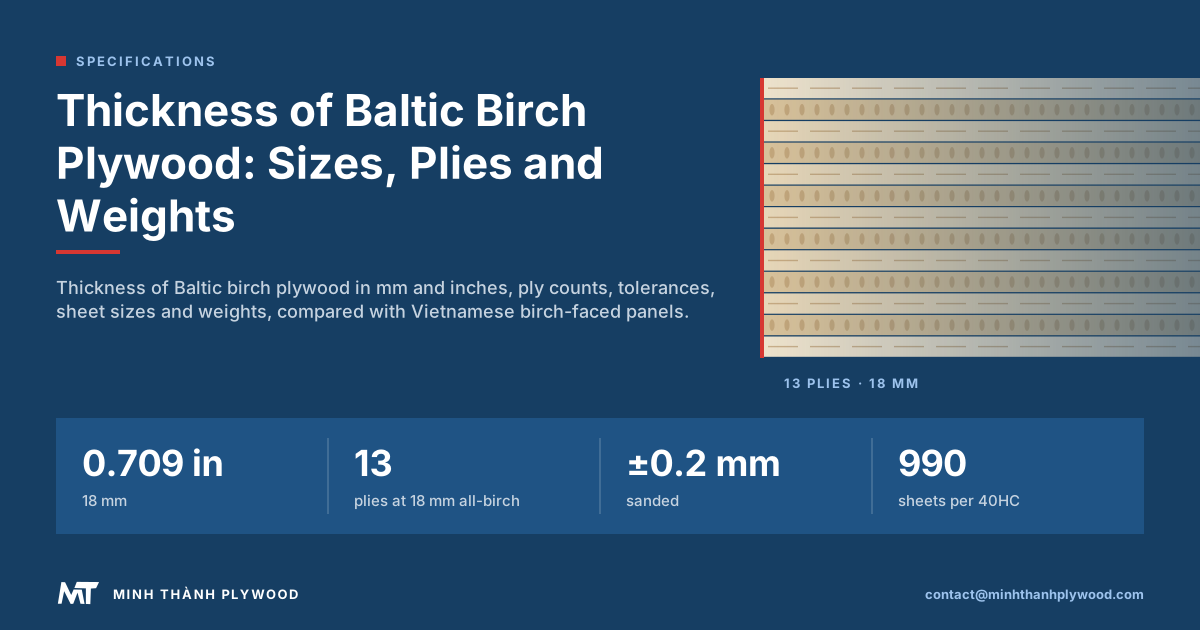
Baltic birch plywood is sold in metric thicknesses: 18 mm is a 13-ply panel that measures between 17.1 and 18.1 mm, a little under 3/4 inch. Birch-faced plywood from Vietnam follows the same metric ladder from 3 to 40 mm on a lighter core. Minh Thanh Plywood makes the birch-faced build in 1220 × 2440 and 1250 × 2500 mm, sanded to ±0.2–0.3 mm.
What is the thickness of Baltic birch plywood?
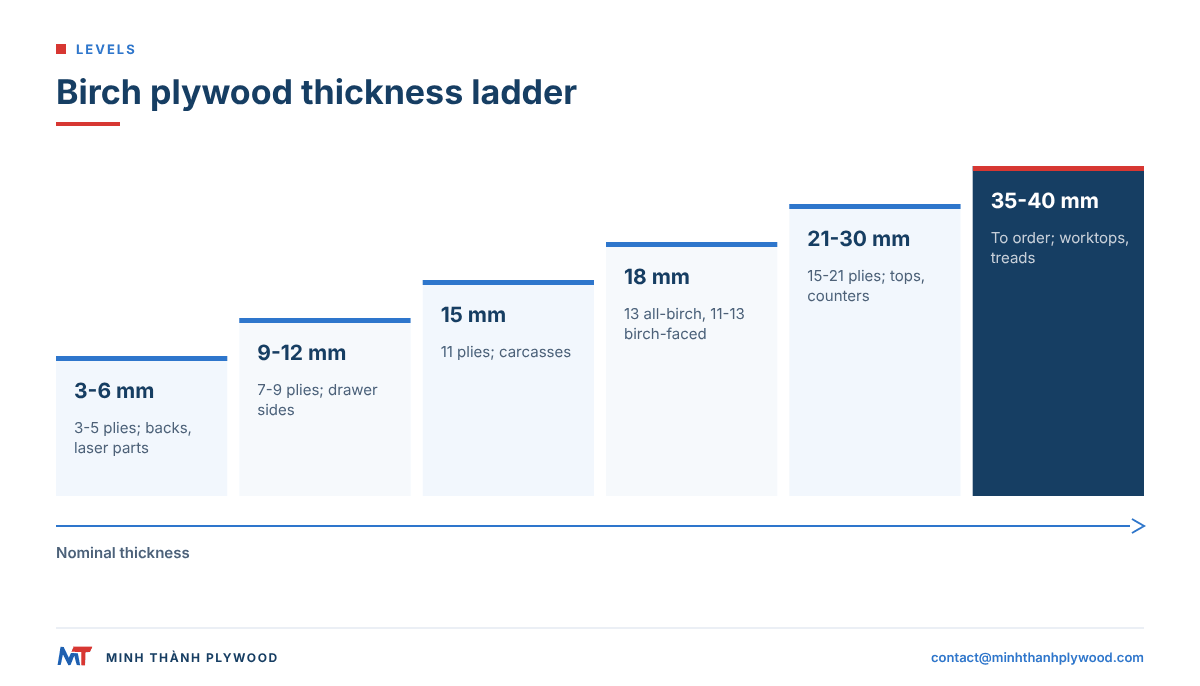
Baltic birch plywood is made in metric thicknesses, not in inches. The standard ladder runs 6.5, 9, 12, 15, 18, 21, 24, 27 and 30 mm, with thin 3 and 4 mm panels below it and thick panels above it. Each thickness has a fixed ply count, because every ply is a birch veneer of about 1.4 mm.
The figure on the label is the nominal thickness. The sheet you measure sits in a tolerance band around it, and sanded all-birch panels usually measure a little under the nominal value. At 18 mm the accepted band for Finnish all-birch panels is 17.1 to 18.1 mm.
| Nominal | Plies | Measured band (mm) | Nearest inch label | Inch equivalent of nominal |
|---|---|---|---|---|
| 6.5 mm | 5 | 6.1–6.9 | 1/4 in | 0.256 in |
| 9 mm | 7 | 8.8–9.5 | 3/8 in | 0.354 in |
| 12 mm | 9 | 11.5–12.5 | 1/2 in | 0.472 in |
| 15 mm | 11 | 14.3–15.3 | 5/8 in | 0.591 in |
| 18 mm | 13 | 17.1–18.1 | 3/4 in | 0.709 in |
| 21 mm | 15 | 20.0–20.9 | 13/16 in | 0.827 in |
| 24 mm | 17 | 22.9–23.7 | 15/16 in | 0.945 in |
| 27 mm | 19 | 25.2–26.8 | 1-1/16 in | 1.063 in |
| 30 mm | 21 | 28.1–29.9 | 1-3/16 in | 1.181 in |
Plies and measured bands for 6.5–30 mm are from a Finnish birch mill’s published technical fact sheet, which states that its tolerances meet EN 315 (sizes at 8–12 % moisture content, consulted 20 October 2026). The inch columns are conversions at 25.4 mm per inch.
The quick answer for a buyer: the thickness of Baltic birch plywood is always a millimetre value, and a sheet sold under an inch label is the nearest metric panel. Order in millimetres and you get exactly what the mill makes.
Why do nominal and actual thickness differ?
Nominal and actual thickness differ because a plywood panel is pressed from veneers, then sanded, and both steps take thickness away. The label names the target; the sheet measures inside a tolerance band that the standard or the mill sets.
Three things move the measured value:
- Press compression. Heat and pressure compress the wood a little as the glue cures, so the pressed panel is thinner than the stack of veneers that went in.
- Sanding. A sanded face and back lose a fraction of a millimetre each. Sanded furniture panels are therefore close to, and often slightly under, the nominal figure.
- Moisture. Wood swells and shrinks with moisture content. Tolerances in fact sheets are quoted at 8–12 % moisture content, the normal range for plywood at dispatch.
Imperial labels add a fourth reason. A panel sold as “1/2 inch” in North America is a 12 mm panel, which is 0.472 inch, not 0.500 inch. The difference is not a fault in the sheet: it is the gap between the inch label and the metric panel behind it.
For the buyer this means one rule: write the nominal thickness in millimetres and the tolerance you need on the same line. A mill can then quote a sanding plan that meets it.
The measured value also depends on where you measure. Readings taken a hand’s width in from the edge, at several points per sheet, describe the panel; a single reading at a corner, where sanding drums can round the face slightly, does not. Agree the measuring points with the mill when the tolerance is tight, and both sides read the same sheet the same way.
Baltic birch thickness chart: plies, measured band and weight
The Baltic birch thickness chart below adds weight to the ply counts, so one table answers the three questions a specifier asks first: how thick, how many plies, how heavy.
| Nominal | Plies | Min (mm) | Max (mm) | Weight per m² | Weight per 1525 × 1525 mm sheet |
|---|---|---|---|---|---|
| 6.5 mm | 5 | 6.1 | 6.9 | 4.4 kg | 10.2 kg |
| 9 mm | 7 | 8.8 | 9.5 | 6.1 kg | 14.2 kg |
| 12 mm | 9 | 11.5 | 12.5 | 8.2 kg | 19.1 kg |
| 15 mm | 11 | 14.3 | 15.3 | 10.2 kg | 23.7 kg |
| 18 mm | 13 | 17.1 | 18.1 | 12.2 kg | 28.4 kg |
| 21 mm | 15 | 20.0 | 20.9 | 14.3 kg | 33.3 kg |
| 24 mm | 17 | 22.9 | 23.7 | 16.3 kg | 37.9 kg |
| 27 mm | 19 | 25.2 | 26.8 | 18.4 kg | 42.8 kg |
Weights per m² are the fact-sheet values for all-birch panels; the sheet weight is that figure times the 2.33 m² area of a 1525 × 1525 mm panel. All-birch plywood is dense, around 680 kg/m³ by these figures, which is why a 5 × 5 ft sheet of 18 mm already weighs close to 30 kg.
Two patterns help when reading any birch chart:
- Plies rise by two for every 3 mm. Cross-laminated plywood keeps an odd number of plies, so the face grain runs the same way on both sides. Each step of two plies adds about 3 mm.
- The band widens with thickness. A thicker panel has more glue lines and more veneers, so its tolerance in millimetres is wider, although in percentage terms it stays close to the thin panels.
What does an inch label mean on birch plywood?
An inch label on birch plywood is a trade name for the nearest metric panel. Retail and US distributors sell Baltic birch as 1/8, 1/4, 1/2 and 3/4 inch, but the sheets are pressed as 3, 6.5, 12 and 18 mm.
| Inch label | Metric panel behind it | Nominal in inches | Short of the label by |
|---|---|---|---|
| 1/8 in | 3 mm | 0.118 in | 0.007 in |
| 1/4 in | 6 or 6.5 mm | 0.236–0.256 in | 0.014 in (6 mm); 6.5 mm is 0.006 in over |
| 3/8 in | 9 mm | 0.354 in | 0.021 in |
| 1/2 in | 12 mm | 0.472 in | 0.028 in |
| 5/8 in | 15 mm | 0.591 in | 0.034 in |
| 3/4 in | 18 mm | 0.709 in | 0.041 in |
| 1 in | 24 mm | 0.945 in | 0.055 in |
The gap grows with thickness. At 3/4 inch it is about a millimetre, enough to make a dado cut for a true 3/4 inch board visibly loose. Woodworkers who build from inch drawings buy undersize router bits made for metric plywood, or cut each joint to a measured offcut.
For a production buyer the answer is simpler: drop the inch label from the order. Specify “18 mm, 13 plies” for all-birch or “18 mm, birch-faced, Styrax core” for the Vietnamese build, and the conversion question disappears.
Baltic birch plywood sizes: which sheet formats exist?
Baltic birch plywood sizes start from the square 1525 × 1525 mm (5 × 5 ft) sheet, the format birch mills have pressed for decades. Larger presses also make long sheets in metric and inch-based formats, such as 1220 × 2440 mm, 1250 × 2500 mm and 5 × 10 ft sheets.
| Format | Size (mm) | Where it is common |
|---|---|---|
| 5 × 5 ft square | 1525 × 1525 | Classic Baltic birch, retail and workshop stock |
| 4 × 8 ft | 1220 × 2440 | North America, Asia, the Middle East, furniture lines |
| Euro long sheet | 1250 × 2500 | Continental Europe, shop fitting |
| 5 × 10 ft | 1525 × 3050 | Large-format birch, vehicle floors |
| 1500 × 3000 | 1500 × 3000 | Finnish and Baltic long sheets |
| Square 4 × 4 ft | 1220 × 1220 | Cut stock, small parts |
The same Finnish fact sheet lists standard birch formats of 1220, 1250, 1500 and 1525 mm width with lengths up to 3050 mm, and size tolerances of ±1 mm for standard and cut-to-size panels.
Grain direction matters when you read a birch size. Birch mills often write the grain-parallel dimension first, so 2500 × 1250 and 1250 × 2500 can be different panels: long grain or cross grain. On the order, say which side the face grain runs along.
For square 5 × 5 ft panels, plan the cutting list before you compare prices. A 1525 mm square sheet yields different part counts from a 1220 × 2440 mm sheet, and the cheaper sheet per m² can give the dearer part.
What is the thickness of birch plywood from Vietnam?
Birch plywood from Vietnam is birch-faced plywood: imported birch face and back veneers pressed onto a white Styrax or Eucalyptus core. Its thickness of birch plywood ladder is metric, from 3 to 40 mm, and the same nominal values buyers know from Baltic birch apply.
At Minh Thanh Plywood the birch-faced range is:
| Item | Minh Thanh birch-faced plywood |
|---|---|
| Thickness | 3–40 mm; common steps 3, 4, 5, 6, 9, 12, 15, 18, 21, 25 and 30 mm |
| Sheet sizes | 1220 × 2440 and 1250 × 2500 mm; custom 1220 × 2500 and 1220 × 2280 mm |
| Cut-to-size | One panel cut into 4, 6 or 8 pieces |
| Faces | Birch, graded D+, D or E, quoted as pairs such as D+/D or D/E |
| Core | White Styrax (500 kg/m³) or Eucalyptus; stitched horizontally and vertically |
| Glue and emission | UF glue at E0 emission; MR, melamine-fortified or phenolic (WBP) to order |
| Pressing | Twice: core board pressed and calibrated, then face and back pressed on |
| Thickness tolerance | Sanded ±0.2–0.3 mm, down to ±0.2 mm |
| Length and width tolerance | ±2 mm |
| Moisture at dispatch | 8–12 % |
The double pressing is what makes the tight tolerance possible. The core board is pressed and calibrated to thickness first; the birch faces then go on in a second pressing. A panel built that way is flat and even across the sheet, which is what a CNC nesting line or a UV coating line needs.
We do not press 1525 × 1525 mm sheets: the Vietnamese birch-faced build is made in the long formats furniture plants cut from. A buyer who needs the square format for an existing cutting list can redraw the nest for 1220 × 2440 mm, or use our cut-to-size service.
How many plies at each thickness: all-birch vs birch-faced?
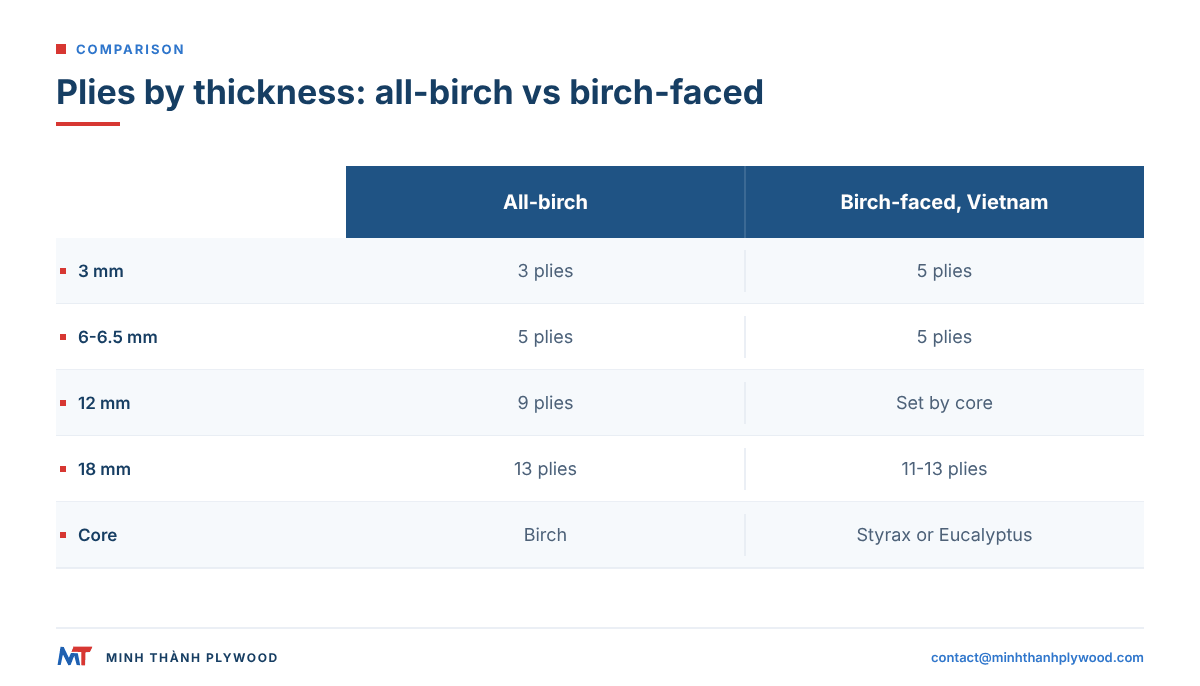
All-birch plywood has a fixed ply count per thickness; birch-faced plywood has a ply count that follows the core veneer thickness. At 18 mm, all-birch panels have 13 plies, and Vietnamese birch-faced panels are built with 11–13 plies.
| Thickness | All-birch plies | Birch-faced from Vietnam |
|---|---|---|
| 3 mm | 3 (thin birch veneers) | 5 plies: one core, two cross-bands, two faces |
| 4 mm | 3–5 | 5 plies: three core veneers (1.3 mm Styrax) and two faces |
| 6 mm / 6.5 mm | 5 | Confirmed with the order |
| 9 mm | 7 | Set by core veneer thickness |
| 12 mm | 9 | Set by core veneer thickness |
| 15 mm | 11 | Set by core veneer thickness |
| 18 mm | 13 | 11–13 plies |
Why the counts differ: a Baltic mill peels birch at about 1.4 mm for every ply, so the count is set by the thickness. A Vietnamese mill peels plantation core veneers whose thickness is chosen for the panel, then adds the birch face and back. Fewer, slightly thicker core plies give the same flat, stable sheet for furniture with banded or covered edges.
Ply count matters most where the edge is the design. Thirteen thin, even birch plies are the look of an exposed-edge drawer box. On a banded cabinet carcass the edge is hidden, and the core’s job is flatness, screw holding and weight, where a stitched white Styrax core does well.
Write the ply count on the order only when the edge shows. Otherwise write the core species and let the mill choose the veneer plan that meets your thickness and tolerance.
3mm baltic birch plywood 4x8 and other thin sheets
Thin birch plywood, 3 to 6 mm, is sold for laser cutting, model making, drawer bottoms, cabinet backs and curved work. The 3mm baltic birch plywood 4x8 sheet (1220 × 2440 mm) is the format buyers ask for when the parts are longer than a 5 × 5 ft sheet allows.
Thin panels are where builds differ most:
- All-birch 3 mm is usually three thin birch veneers. It is light and bends easily, and the edge shows birch all through.
- Birch-faced 3 mm from Minh Thanh is always five plies: one core veneer, two cross-band veneers and two birch faces. The extra cross-bands make the sheet flatter and less prone to splitting along the grain.
- 4 and 5 mm at Minh Thanh are three core veneers and two faces, with the core veneer thickness adjusted to the panel; a 4 mm furniture panel uses three 1.3 mm Styrax core veneers.
| Thin sheet, 1220 × 2440 mm | Minh Thanh build | Weight on Styrax core | Sheets per 40HC (Styrax) |
|---|---|---|---|
| 3 mm | 5 plies | 4.5 kg | 5,994 sheets |
| 4 mm | 5 plies | 6.0 kg | 4,500 sheets |
| 5 mm | 5 plies | 7.4 kg | 3,600 sheets |
| 6 mm | Confirmed with the order | 8.9 kg | 2,988 sheets |
Premium thin face veneer is scarce, so 4 mm birch-faced panels can take longer to make. We do not lower the face standard to finish faster. For a laser or CNC buyer, a sample in the exact thickness is the best test: send the part file and we cut the sample from the order build. Samples are free.
Thick birch plywood: 30, 35mm birch plywood and 36mm birch plywood
Thick birch plywood, from 25 mm up, is ordered for worktops, stair treads, shop counters, jigs and machine bases. The 35mm birch plywood and 36mm birch plywood buyers search for are made to order by most mills, because the standard stock ladder stops at 30 mm.
How the thick panels are built:
- All-birch adds two birch plies for every 3 mm, so a 30 mm panel has 21 plies and thicker panels follow the same rule. The panel is dense and heavy: at about 680 kg/m³, a 36 mm all-birch sheet of 1525 × 1525 mm is over 55 kg.
- Birch-faced from Vietnam builds the thickness in the core. Minh Thanh’s birch-faced range goes to 40 mm, so 35 and 36 mm sit inside it. On a white Styrax core the sheet is much lighter: a 35 mm sheet of 1220 × 2440 mm weighs about 52.1 kg at 500 kg/m³.
| Thick sheet, 1220 × 2440 mm | Weight, Styrax core (500 kg/m³) | Weight, Eucalyptus core (650 kg/m³) |
|---|---|---|
| 25 mm | 37.2 kg | 48.4 kg |
| 30 mm | 44.7 kg | 58.0 kg |
| 35 mm | 52.1 kg | 67.7 kg |
| 40 mm | 59.5 kg | 77.4 kg |
For a worktop or tread, choose the Eucalyptus core when stiffness and screw holding come first, and Styrax when weight on the job site matters. Thick panels are pressed in two stages like the furniture range, and the thickness tolerance on a sanded thick panel is the same ±0.2–0.3 mm band.
What thickness tolerance should you specify?
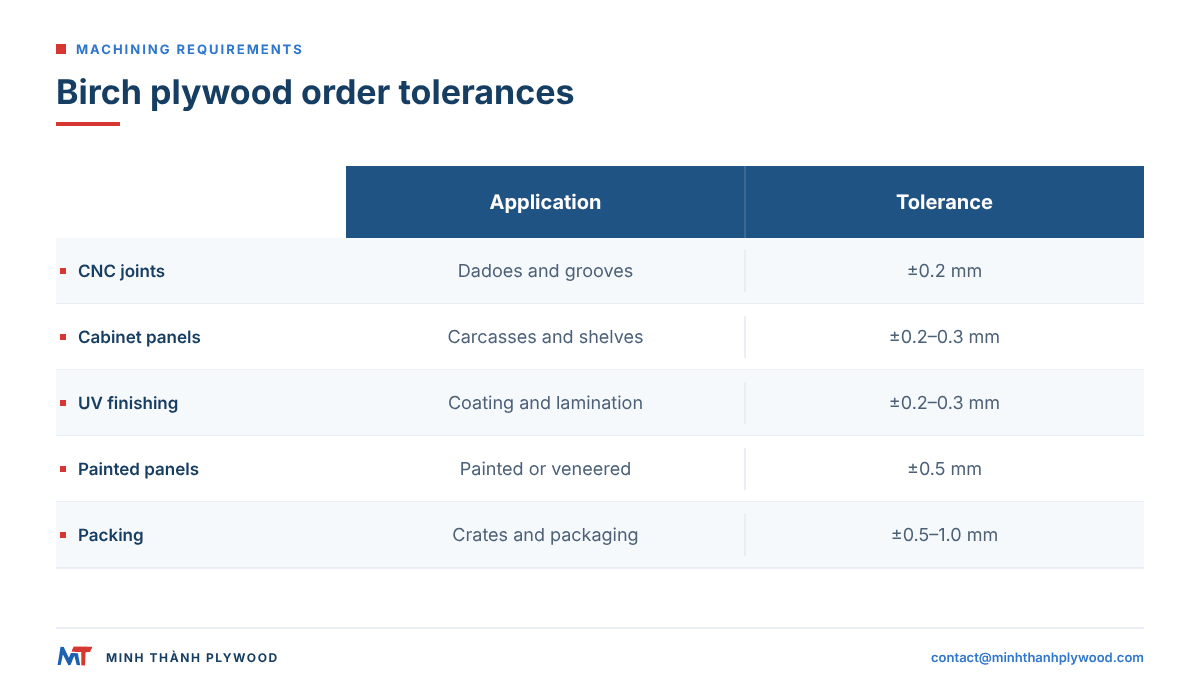
Specify the thickness tolerance your machining needs, not a generic one. Furniture lines that cut dadoes, grooves or hardware pockets need a tight band; packing and construction uses do not.
| Use | Tolerance to write | Why |
|---|---|---|
| CNC nesting, dado and groove joints | ±0.2 mm | Joints and drawer slides fit without shimming |
| Cabinet carcass, shelving | ±0.2–0.3 mm | Even panels on edge banders and hinges |
| UV coating and lamination lines | ±0.2–0.3 mm | The roller coater and press see a flat, even sheet |
| Painted or veneered panels | ±0.5 mm | Finish covers small variation |
| Packing and crates | ±0.5–1.0 mm | Strength matters, fit does not |
Finnish all-birch panels in the published fact sheet meet EN 315, with the 17.1–18.1 mm band at 18 mm shown in the thickness chart. Minh Thanh’s sanded furniture panels hold ±0.2–0.3 mm, down to ±0.2 mm, because the core board is calibrated before the faces are pressed on.
Also write length and width: ±2 mm is the standard for full sheets, and squareness matters for CNC lines that zero on a sheet corner. If your line references a corner, say so on the order.
Measure thickness the way the mill does: with a caliper or micrometer at several points along the edges, not with a tape. Measure at the moisture content the sheet arrived with, before it has acclimatised in a damp store.
How much does a birch plywood sheet weigh by thickness?
Sheet weight follows thickness and core density: weight = length × width × thickness × density. A 1220 × 2440 mm sheet of 18 mm birch-faced plywood on a white Styrax core weighs about 26.8 kg; on a Eucalyptus core about 34.8 kg; an all-birch sheet of the same size about 36.3 kg.
| Thickness, 1220 × 2440 mm | Styrax core (500 kg/m³) | Eucalyptus core (650 kg/m³) | All-birch (fact-sheet weight) |
|---|---|---|---|
| 6 mm / 6.5 mm | 8.9 kg | 11.6 kg | 13.1 kg (6.5 mm) |
| 9 mm | 13.4 kg | 17.4 kg | 18.2 kg |
| 12 mm | 17.9 kg | 23.2 kg | 24.4 kg |
| 15 mm | 22.3 kg | 29.0 kg | 30.4 kg |
| 18 mm | 26.8 kg | 34.8 kg | 36.3 kg |
| 21 mm | 31.3 kg | 40.6 kg | 42.6 kg |
Styrax and Eucalyptus weights are calculated at the reference densities of 500 and 650 kg/m³; the all-birch column multiplies the fact-sheet weight per m² by the 2.98 m² of a 1220 × 2440 mm sheet.
Weight is a buying figure, not only a handling one. A lighter core means fewer lifting injuries on the line, cheaper inland freight and more sheets before a container reaches its payload limit. It also tells you which core you received: a sheet that weighs far more than its declared core would is worth a cut sample.
Which birch plywood thickness for which part?
Choose the thickness by the part’s span, load and joinery, then choose the build by whether the edge shows. The table gives the starting point most furniture and joinery buyers use.
| Part | Thickness | Build that fits |
|---|---|---|
| Drawer bottoms, cabinet backs | 4–6 mm | Birch-faced 5-ply (3–5 mm) for flatness; all-birch for laser parts |
| Drawer sides with exposed edges | 12–15 mm | All-birch, 9–11 plies |
| Cabinet carcasses, banded edges | 15–18 mm | Birch-faced on Styrax core |
| Shelves up to normal kitchen spans | 18 mm | Birch-faced on Eucalyptus core for stiffness |
| Doors with UV or lacquer finish | 18 mm | Birch-faced, D+/D faces, sanded and UV-ready |
| Tables, desks, shop counters | 25–30 mm | Birch-faced on Eucalyptus, or all-birch where the edge is shown |
| Worktops, stair treads, benches | 30–40 mm | Thick birch-faced, Eucalyptus core |
| Jigs, templates, machine bases | 18–30 mm | All-birch for edge wear, or calibrated birch-faced |
Two notes on the table:
- Spans. A long shelf needs either more thickness or a stiffer core. Moving from Styrax to Eucalyptus core at the same 18 mm adds stiffness without changing the hardware.
- Hardware. European cabinet hinges and drawer systems are drawn for 16–19 mm sides. An 18 mm sheet held to ±0.2 mm keeps hinge cups and runners in line across a production run.
How many birch plywood sheets fit in a 40HC?
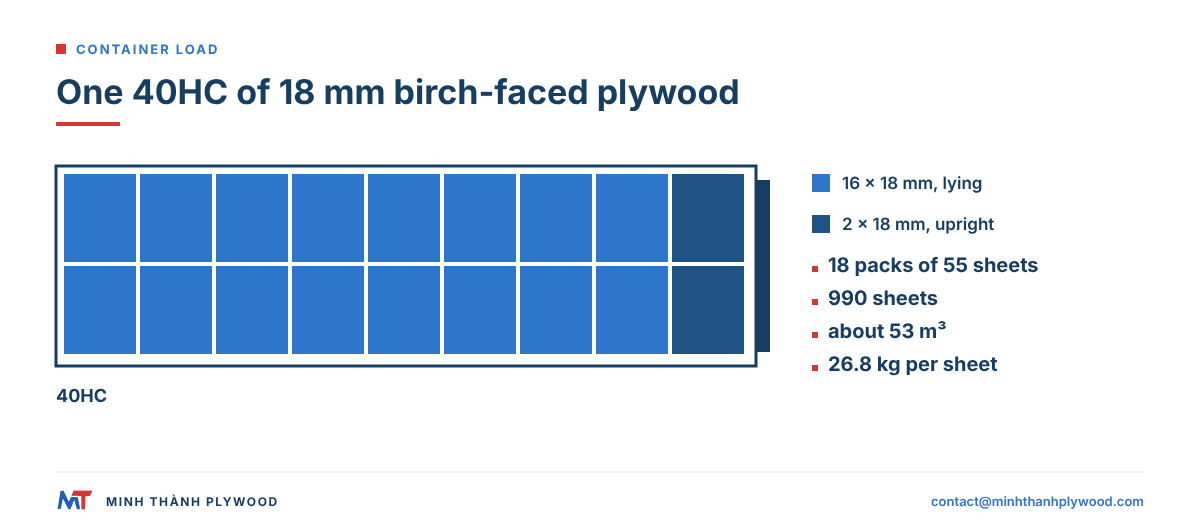
A 40HC container holds 990 sheets of 18 mm birch-faced plywood on a Styrax core, in 18 packs of 55 sheets: that is about 53 m³ and stays under the 28,000 kg planning payload. On a Eucalyptus core, the heavier sheets cut the count to 795 sheets in 15 packs.
| Thickness, 1220 × 2440 mm | Styrax core: sheets per 40HC | Sheets per pack | Eucalyptus core: sheets per 40HC | Sheets per pack |
|---|---|---|---|---|
| 9 mm | 1,998 sheets | 111 sheets | 1,605 sheets | 107 sheets |
| 12 mm | 1,494 sheets | 83 sheets | 1,200 sheets | 80 sheets |
| 15 mm | 1,188 sheets | 66 sheets | 960 sheets | 64 sheets |
| 18 mm | 990 sheets | 55 sheets | 795 sheets | 53 sheets |
| 21 mm | 846 sheets | 47 sheets | 675 sheets | 45 sheets |
| 25 mm | 720 sheets | 40 sheets | 570 sheets | 38 sheets |
The plan: packs about one metre high, 18 packs on Styrax core (16 lying and 2 standing) or 15 on Eucalyptus; sheets per pack = 1,000 ÷ thickness rounded down, then reduced so the load stays inside 28,000 kg. If your booking carries a lower payload, the counts fall with it, and we recalculate on the quotation.
Mixed loads are normal: one 40HC is our minimum order, with mixed specifications by agreement, so a buyer can combine 18 mm carcass panels with 6 mm backs in the same container.
Which birch sizes and thicknesses does each market order?
Each export market reads birch sizes through its own habits, so the same panel is ordered under different names. Matching the order to the market’s convention avoids recutting at the destination.
| Market | Sheet size buyers expect | Thickness habit | What to write on the order |
|---|---|---|---|
| United States and Canada | 1220 × 2440 mm (4 × 8 ft) and 1525 × 1525 mm | Inch labels: 1/4, 1/2, 3/4 inch | The metric panel (6, 12, 18 mm) next to the inch label |
| Continental Europe | 1250 × 2500 mm, also 1220 × 2440 mm | Metric: 12, 15, 18, 21 mm | Grain direction and the face pair |
| United Kingdom and Ireland | 1220 × 2440 mm and 1525 × 1525 mm | Metric, with inch names in retail | Metric thickness and tolerance |
| Australia and New Zealand | 1200 × 2400 mm habit, 1220 × 2440 mm supplied | Metric | Whether the sheet is trimmed to 1200 × 2400 mm at destination |
| Middle East and Asia | 1220 × 2440 mm | Metric: 9, 12, 15, 18 mm | Core species and emission class |
Cut-to-size panels, one sheet cut into 4, 6 or 8 pieces, ship regularly to Italy and other European markets, so the buyer’s line receives parts close to finished size.
For Europe, two trade notes apply to birch. The EU–Vietnam trade agreement has applied since 1 August 2020.
The Commission’s announcement of 14 May 2024 extended the anti-dumping duties on Russian birch plywood to cover circumvention.
Shipping time also follows the market. Typical days at sea from Hai Phong are 5–12 to South-East Asia, 15–25 to the Middle East, 25–35 to the Mediterranean, 30–40 to Northern Europe and 35–45 to the US East Coast, by carrier and route.
How do you check birch thickness and size on arrival?
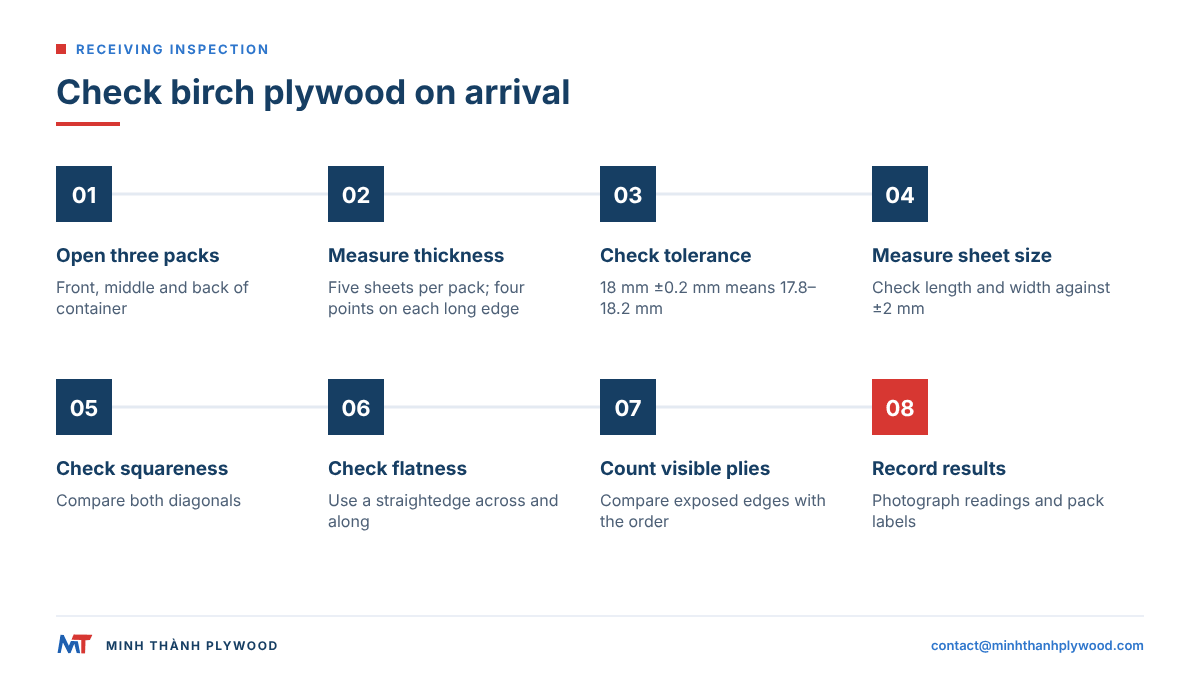
Check thickness and size on arrival with a caliper, a steel tape and a straightedge, on sheets drawn from several packs. Ten minutes per pack tells you whether the panels match the order line.
- Open three packs. One from the front of the container, one from the middle, one from the back.
- Measure thickness. Take a caliper reading at four points on each of the long edges, a hand’s width in from the corners, on five sheets per pack. Record each reading.
- Compare with the tolerance. For a panel ordered at 18 mm ±0.2 mm, every reading falls between 17.8 and 18.2 mm.
- Measure length and width. Steel tape across the face at both ends; the order allows ±2 mm.
- Check squareness. Measure both diagonals; on a square-cut sheet they match.
- Check flatness. Lay a straightedge across and along the sheet; a calibrated, double-pressed panel lies flat.
- Count plies where the edge shows. For an exposed-edge order, count the plies on a cut edge and compare with the order.
- Photograph and file. Keep the readings with the pack labels.
Every Minh Thanh shipment is photographed and filmed before loading, and buyers receive the photos and video, so the arrival check can be compared with the loading record pack by pack.
Common mistakes in birch thickness and size orders
Most birch thickness problems start on the order, not in the press. These are the ones we see most often in enquiries:
- Ordering in inches. “3/4 inch birch” can be read as 18 mm or 19 mm. Write millimetres.
- No tolerance. Without a tolerance line the mill quotes its standard band, which may be ±0.5 mm. If your joints need ±0.2 mm, write it.
- Mixing up all-birch and birch-faced. “Birch plywood” alone does not say what the core is. Name the build and the core species.
- Square-sheet nests on long sheets. A cutting list drawn for 1525 × 1525 mm wastes material on 1220 × 2440 mm unless it is redrawn.
- Forgetting grain direction. On a long sheet, say whether the face grain runs along the length. It decides how doors and shelves look.
- Weight surprises. A heavy core on a 40HC booking with a low payload means fewer sheets. Ask for the container plan with the quotation.
- No grade pair. “Birch faces” is not a grade. Write the face/back pair, for example D+/D for a door and D/E for a carcass.
Each of these is one line on the order. Together they decide whether the panels that arrive match the parts you designed.
Birch face grades and thickness: does grade change with thickness?
The face grade does not change with thickness; it is a separate line on the order. A 4 mm sheet and a 30 mm sheet can carry the same face pair, because the faces are graded veneers laid on whatever core builds the thickness.
Vietnamese birch faces are graded D+, D and E (from highest to lowest: D+, then D, then E) and quoted as face/back pairs such as D+/D or D/E. As a buying comparison with the European birch ladder, D+ is close to B, D close to BB and E close to CP/C; so D+/D reads roughly as B/BB. The approved sample fixes the look of your order.
Where grade and thickness meet is the use. A visible door at 18 mm usually takes D+/D; a carcass side at 15 mm takes D/E; a drawer bottom at 6 mm can take a lower back. Write each part’s thickness and grade pair together on the cutting list, and the mill presses the right panels for each.
Both faces are sanded and UV-ready, so a buyer who applies a UV lacquer in their own plant can coat either side. Faces are chosen for the look the buyer orders, and imported birch faces are matched to the approved sample sheet by sheet, so a door panel from the second container looks like the one from the first.
How to write birch thickness and size on the order
Write a birch order line so the thickness, size and build can only be read one way. A complete line has seven parts:
- Build and core: birch-faced on white Styrax (or Eucalyptus) core, or all-birch.
- Nominal thickness: in millimetres, for example 18 mm.
- Thickness tolerance: for example ±0.2 mm, sanded.
- Sheet size and grain: 1220 × 2440 mm, face grain along the 2440 mm side.
- Face pair: for example D+/D, both faces UV-ready.
- Glue and emission: UF glue at E0 emission, or the bond your use needs.
- Quantity and packing: sheets or m³, packs, marks, destination port.
A filled example: “Birch-faced plywood, white Styrax core, 18 mm ±0.2 mm sanded, 1220 × 2440 mm, grain along length, D+/D, UF glue at E0 emission, 990 sheets in 18 packs, CIF your port.”
Emission is a separate specification from the glue. Our furniture panels are covered by CARB P2 / TSCA Title VI certification (ICTT mill no. 23024). Six ASTM D6007 chamber tests between April 2025 and June 2026 on 9, 15 and 18 mm panels averaged 0.014–0.032 ppm. The limit for veneer-core hardwood plywood is 0.05 ppm under 40 CFR 770.10.
Send the line, or your cutting list, to contact@minhthanhplywood.com. Lisa replies within hours with the build, the container plan and a sample in your thickness; samples are free. Prices for furniture plywood start from US$350/m³ (October 2026), and production takes 15–45 days after the 30% deposit.
Birch-faced plywood or Baltic birch: which one for your sizes?
Choose Baltic all-birch when the edge is the design or you need the square 5 × 5 ft format; choose Vietnamese birch-faced plywood when the edge is banded and the long 1220 × 2440 or 1250 × 2500 mm sheet suits your cutting list. Many buyers run both, each where it fits.
| Question | Baltic all-birch | Vietnamese birch-faced (Minh Thanh) |
|---|---|---|
| Thickness ladder | 6.5–30 mm stock, thin and thick to order | 3–40 mm |
| 18 mm plies | 13 | 11–13 |
| 18 mm tolerance | 17.1–18.1 mm band (EN 315) | ±0.2–0.3 mm, down to ±0.2 mm |
| Formats | 1525 × 1525 mm and long sheets | 1220 × 2440, 1250 × 2500 mm, custom sizes |
| 18 mm sheet weight, 1220 × 2440 mm | about 36.3 kg | about 26.8 kg (Styrax core) |
| Edge | Even pale birch plies | White core between birch faces |
| Best for | Exposed edges, drawer boxes, laser parts | Banded carcasses, doors, UV-finished furniture |
The birch plywood page has the full build. For the difference in core and price, read Baltic birch plywood and how to choose a birch plywood supplier; for documents on a birch shipment, see birch plywood import and export requirements. Further reading as it is published: birch vs Baltic birch plywood and the best core for birch plywood.
Buyer questions, answered
What is the actual thickness of Baltic birch plywood?
Baltic birch is made in metric thicknesses. An 18 mm sheet measures about 17.1–18.1 mm and a 12 mm sheet about 11.5–12.5 mm, so a panel sold as 3/4 inch is usually 18 mm, about 0.71 inch.
What is the actual thickness of 1/2 inch Baltic birch plywood?
A 1/2 inch Baltic birch sheet is a 12 mm, 9-ply panel. 12 mm equals 0.472 inch, so it is about 0.03 inch thinner than a true half inch. Set dado and router bits to the measured sheet.
How many plies does 18 mm birch plywood have?
All-birch 18 mm panels have 13 plies of about 1.4 mm veneer. Vietnamese birch-faced 18 mm panels are built with 11–13 plies, depending on the core veneer thickness.
What thicknesses does birch plywood come in?
The common metric ladder is 3, 4, 6.5, 9, 12, 15, 18, 21, 24, 27 and 30 mm, with thicker panels made to order. Minh Thanh makes birch-faced plywood from 3 to 40 mm.
What sizes does Baltic birch plywood come in?
The classic Baltic birch sheet is 1525 × 1525 mm (5 × 5 ft). Mills also press 1220 × 2440, 1250 × 2500, 1525 × 3050 and 1500 × 3000 mm. Vietnamese birch-faced panels come in 1220 × 2440 and 1250 × 2500 mm and custom sizes such as 1220 × 2500 mm.
Is 18 mm birch plywood the same as 3/4 inch?
No. 18 mm is 0.709 inch, about 0.04 inch (1 mm) less than 3/4 inch. Joints cut for a true 3/4 inch board will be loose on 18 mm birch, so cut them to the measured panel.
Can you get 3 mm Baltic birch plywood in 4 x 8 sheets?
Yes. Thin birch plywood is made in 1220 × 2440 mm (4 × 8 ft) as well as the 5 × 5 ft format. Minh Thanh's 3 mm birch-faced panel is a 5-ply build in 1220 × 2440 mm.
Can I order 35 mm or 36 mm birch plywood?
Yes. Thick birch plywood of 35 or 36 mm is pressed to order. Minh Thanh's birch-faced range runs to 40 mm, in 1220 × 2440 or 1250 × 2500 mm sheets.
What is the thickness tolerance of birch plywood?
Published Finnish all-birch sheets meet EN 315: an 18 mm sheet measures 17.1–18.1 mm. Minh Thanh sands birch-faced furniture panels to ±0.2–0.3 mm, down to ±0.2 mm when the order asks for it.
How much does an 18 mm birch plywood sheet weigh?
An all-birch 18 mm sheet weighs about 12.2 kg/m², or 36.3 kg for 1220 × 2440 mm. A Vietnamese birch-faced 18 mm sheet on a Styrax core weighs about 26.8 kg.
Can you produce custom birch plywood sizes?
Yes. Besides 1220 × 2440 and 1250 × 2500 mm, Minh Thanh presses custom sizes such as 1220 × 2500 and 1220 × 2280 mm, and cuts panels into 4, 6 or 8 pieces for furniture lines.