
For most birch-faced furniture panels from Vietnam, white Styrax is the best core: light, pale under a thin birch face and flat after double pressing. Choose eucalyptus where parts take many edge screws and weight matters less. Vietnam makes birch-faced plywood on its own plantation cores, not all-birch panels. Minh Thanh Plywood compares every option and what it means for your order.
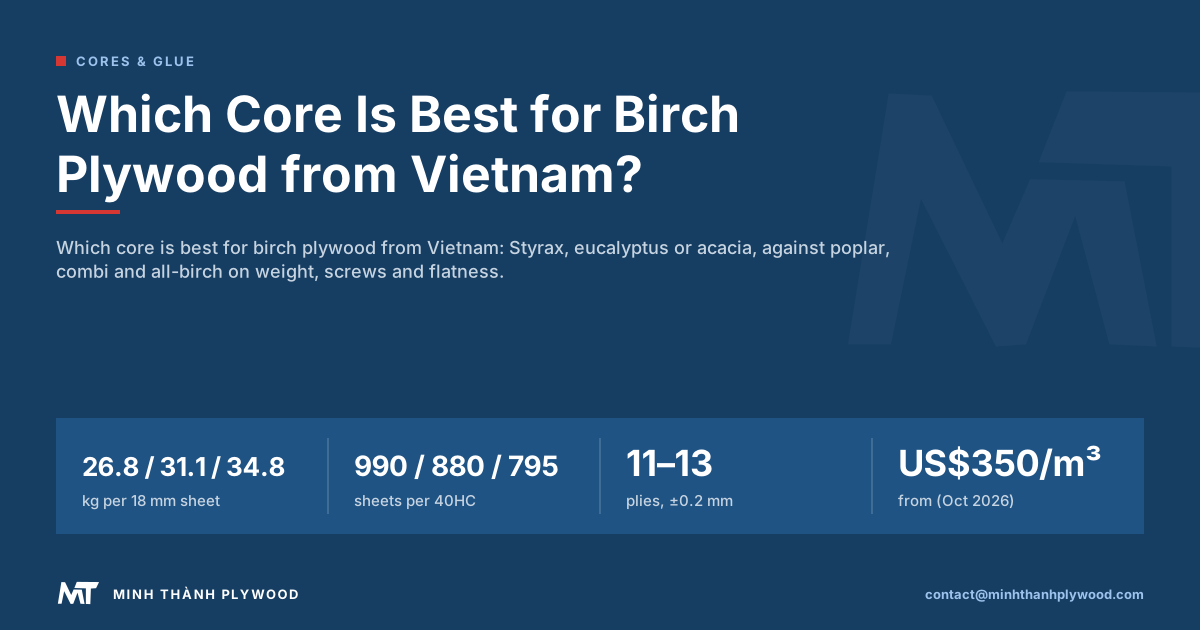
Which core is best for birch plywood from Vietnam? The short answer
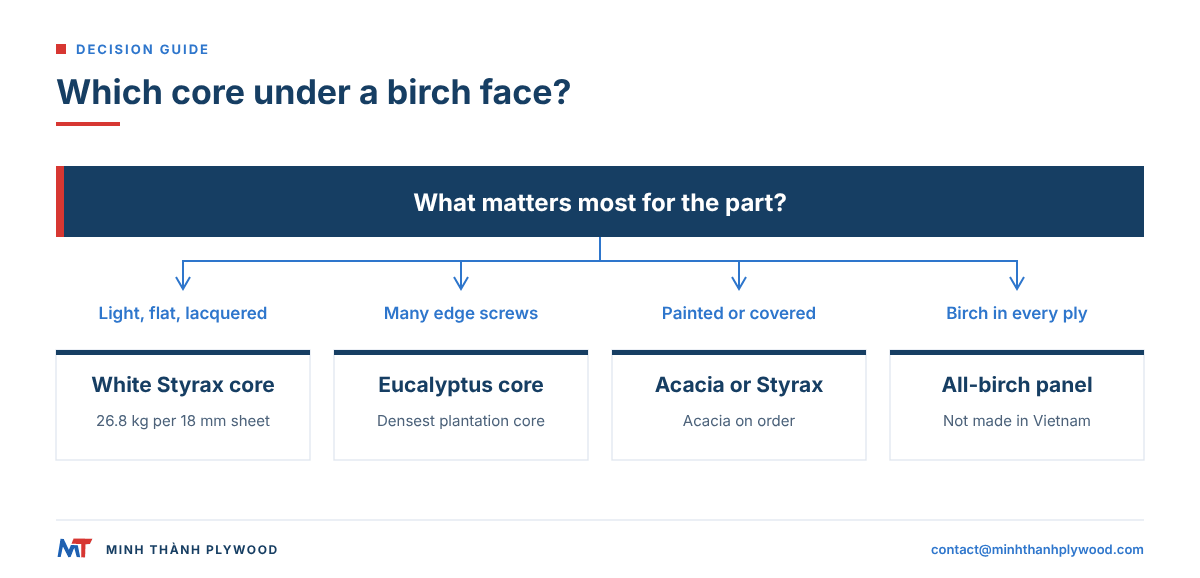
White Styrax is the best core for most birch-faced plywood from Vietnam, and eucalyptus is the best core where strength at the screw matters more than weight. Both are standard at Minh Thanh Plywood; acacia and pine cores are made on order.
| If you need | Choose | Why |
|---|---|---|
| A light, flat panel for lacquered or UV-coated furniture | White Styrax core | Pale core under a thin birch face, lowest weight, most sheets per container |
| Many edge screws, hinges and fittings | Eucalyptus core | Densest plantation core, best screw holding |
| A cost-effective panel for painted or covered parts | Acacia core (on order) | Medium weight, firm |
| Birch through every ply | All-birch (Baltic birch) panel | Not made in Vietnam |
The core species is only half of the answer. A grade A core, stitched and pressed twice, matters as much as the species, and the sections below explain both.
Why do UK and EU buyers source birch-faced plywood from Vietnam?
UK and EU importers can no longer buy Russian or Belarusian birch plywood (the EU bans are in Regulation (EU) 2022/576 for Russia and Regulation (EU) 2022/355 for Belarus), and Chinese hardwood plywood now carries heavy EU duty, so birch-faced plywood on a Vietnamese core is the open route to a birch look. The UK announced its ban on Russian wood products in April 2022 and extended its Belarus import ban to wood in June 2023. The EU applies a definitive anti-dumping duty of 86.8% on Chinese hardwood plywood from 21 November 2025.
The price gap explains the choice. TT Plywood, a Vietnamese maker, puts standard birch-faced plywood 40-60% below Baltic birch (January 2025). The gap comes from the build: Baltic birch is birch in every ply, with veneers of about 1.5 mm per ply, while a birch-faced panel carries birch only on the face and back, so its face is a thin sliced or peeled layer. Our furniture and interior plywood starts from US$350/m³ FOB (October 2026), and the core you pick moves the freight cost per sheet, as the container table below shows.
Can Vietnam produce full birch plywood with a birch core?
No. Birch does not grow in Vietnam, so no Vietnamese mill peels birch core veneer. Vietnamese birch plywood is birch-faced plywood: imported birch face and back veneer pressed onto a Vietnamese core.
Vietnamese plywood cores are peeled from three plantation species, Styrax, eucalyptus and acacia, or a mix of them. Poplar and birch cores are not made in Vietnam, and okoume, bintangor and gurjan are only ever used as faces. A quote for “Vietnamese birch core plywood” is therefore a description error worth questioning.
That is why the product is named after its face. The honest description of our panel is “birch-faced plywood on a white Styrax core” or “on a eucalyptus core”. If your drawing or your customer needs birch through every ply, an all-birch panel such as Baltic birch plywood is the right product; for most furniture parts, where only the face and edge are seen or the edge is banded, a birch face on a good Vietnamese core does the same job at a lower weight and price.
How do the cores for birch plywood compare?
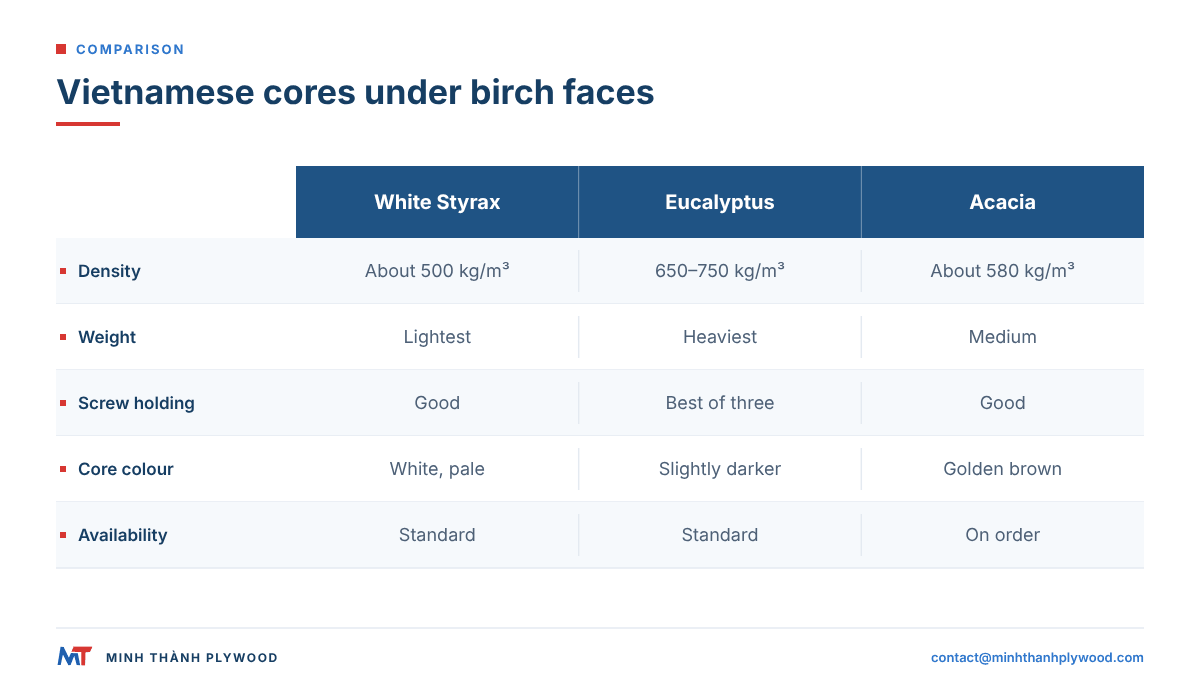
The cores differ in weight, screw holding, flatness under a thin face, and in where they are made. The table compares the three Vietnamese cores with the three options buyers usually weigh them against.
| Core | Made in | Weight | Screw holding | Under a thin birch face | Relative cost |
|---|---|---|---|---|---|
| White Styrax | Northern Vietnam | Lightest of the Vietnamese cores, about 500 kg/m³ | Good | White, flat, does not shadow | Cost-effective |
| Eucalyptus | Vietnam | Densest, 650–750 kg/m³ | Best of the plantation cores | Flat, slightly darker | Middle |
| Acacia (on order) | Vietnam | About 580 kg/m³ | Good | Golden brown, may shadow under very thin faces | Cost-effective |
| Poplar | China | Light | Lower | Pale, soft | Low |
| Combi (mixed veneers) | China | Varies with the mix | Varies | Depends on the mix | Low to middle |
| All-birch | Baltic region, Finland | Heavy | Very good | Birch throughout | Highest |
For a birch-faced furniture panel the deciding columns are weight, screw holding and the look under the face. Styrax wins on weight and look; eucalyptus wins on screw holding; all-birch wins on stiffness and exposed edges at the highest price.
White Styrax core under a birch face
White Styrax is the core most European furniture buyers choose under a birch face, because it is light, pale and machines cleanly. It grows only in northern Vietnam, and the area around our factory in Ha Hoa, Phu Tho is planted with it.
- Weight: at a reference density of about 500 kg/m³, an 18 mm sheet of 1220 × 2440 mm weighs about 26.8 kg, the lightest of the Vietnamese cores. Lighter parts are easier to handle on a furniture line and cheaper to ship.
- Colour: the white core does not shadow through a thin birch face, and a banded or lacquered edge stays pale.
- Flatness: a stitched Styrax core, pressed and calibrated before the face goes on, gives the flat surface a UV or lacquer finish needs.
- Thin panels: our 3–6 mm panels are built on Styrax; a 4 mm furniture panel takes three 1.3 mm Styrax core veneers between two faces.
Styrax holds screws well in normal furniture joints. For heavy hinges or knock-down fittings screwed into the edge, use inserts or dowels, or choose a eucalyptus core.
Eucalyptus core under a birch face
Eucalyptus is the best Vietnamese core when a birch-faced part must hold many screws, hinges or fittings. It is the densest of the plantation cores, at 650–750 kg/m³, and the stiffest.
- Screw holding: dense core layers grip edge and face screws better, which suits kitchen carcasses, shop fittings, shelving under heavy load and CNC-cut parts with many fixings.
- Weight: an 18 mm sheet of 1220 × 2440 mm weighs about 34.8 kg at the reference density, about 8 kg more than on Styrax.
- Look: eucalyptus is slightly darker than Styrax but still pale enough for most birch faces; under a clear-lacquered edge the colour difference shows.
- Freight: a container reaches its weight limit sooner, so you load fewer sheets per 40HC.
Eucalyptus is also the core we use for eucalyptus-faced panels, and it is a common core for film-faced and exterior panels where strength counts more than weight.
Acacia and other cores on order
Acacia and pine cores are made on order at Minh Thanh Plywood, for buyers who want a firmer core than Styrax at a lower cost or a specific look. Acacia sits between Styrax and eucalyptus at about 580 kg/m³.
Acacia is firm and cost-effective, but its golden-brown colour can shadow under a very thin, pale birch face. It suits birch-faced panels that will be painted, foiled or laminated, and parts where the edge is banded. An 18 mm acacia-core sheet weighs about 31.1 kg.
Mixed Vietnamese cores, for example eucalyptus outer core layers with Styrax inside, are another way to balance screw holding and weight; agree the layer plan in writing so every sheet is built the same.
Birch faced poplar plywood: what it is and the Vietnamese equivalent
Birch faced poplar plywood is a panel with birch face and back veneers on a poplar core, made mostly in China. Buyers like it because poplar is light and pale, so the panel is easy to handle and the face looks clean.
Vietnam has no poplar core. The Vietnamese panel that does the same job is birch-faced plywood on a white Styrax core: also light and pale, with a firm core that sands and machines cleanly. If you buy birch faced poplar plywood today and want a second source, ask for:
- The same face grade pair, for example D/E, matched to your current approved sample.
- A white Styrax core, grade A, stitched, pressed twice.
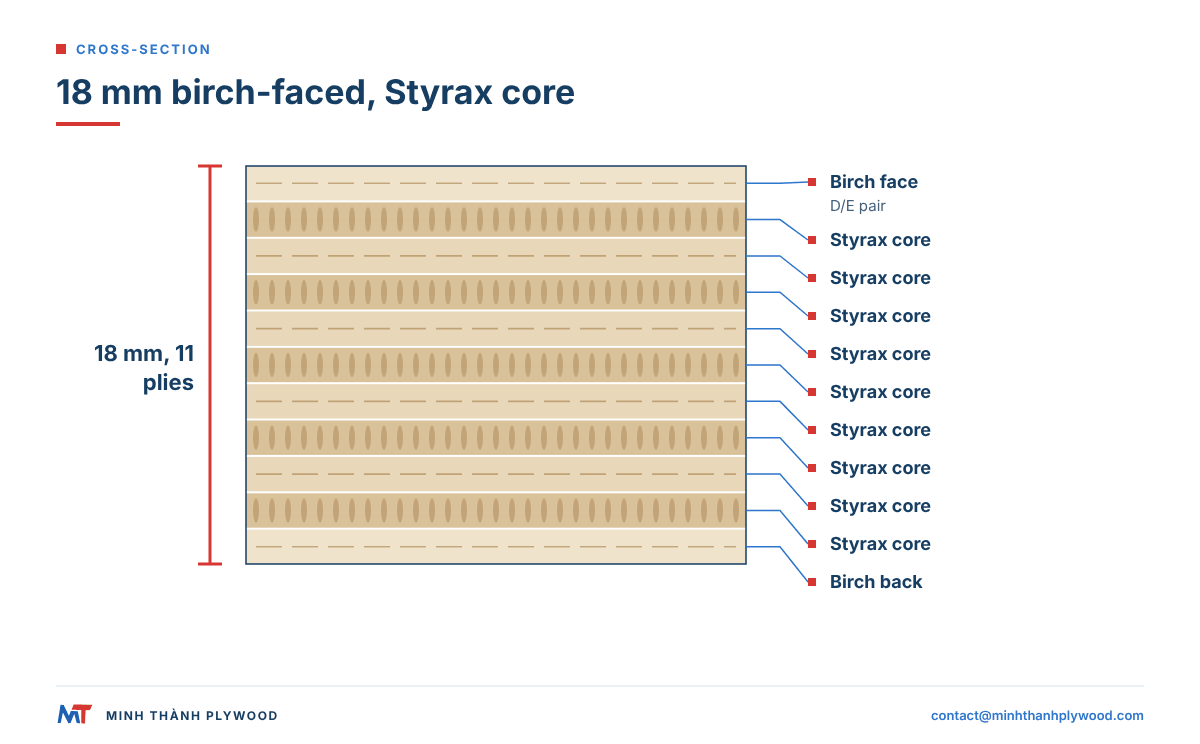
- The same ply count and thickness tolerance as your current panel, for example 11 plies at 18 mm, ±0.2 mm.
- The same glue and emission class, normally UF glue at E0 emission with CARB P2 / TSCA Title VI.
- Free samples first, then a trial container with your own inspection.
Expect the Styrax-core panel to weigh about the same per sheet as a poplar core. The best way to judge the swap is to run samples through your own line.
Combi core and all-birch core: how they compare
A combi core mixes veneers of different species in one core, and an all-birch core uses birch in every ply. Both are common in birch plywood from other origins; neither is a Vietnamese build.
- Combi core usually combines birch or hardwood outer core layers with poplar or other light veneers inside. It costs less than all-birch and can perform well when the layer plan is fixed, but quality depends on the mix in each lot. A fixed, written layer plan is the condition for accepting it.
- Face veneer: the face is where the price gap sits. A Baltic birch ply is about 1.5 mm; a birch-faced panel carries a thinner face over its core, which suits lacquer and UV finishes but not heavy sanding. Agree face thickness and sanding allowance in writing if you will refinish the surface.
- All-birch core (Baltic birch type) has many thin birch plies, high stiffness and an even edge that can be left exposed. It is the most expensive and heaviest option.
When to choose what: if the plywood edge is a design feature left bare, choose all-birch. If the edge is banded, painted or hidden, a birch face on a Styrax or eucalyptus core gives a flat, light panel at a lower cost, and a fixed layer plan you can repeat lot after lot.
How does the core change weight and container load?
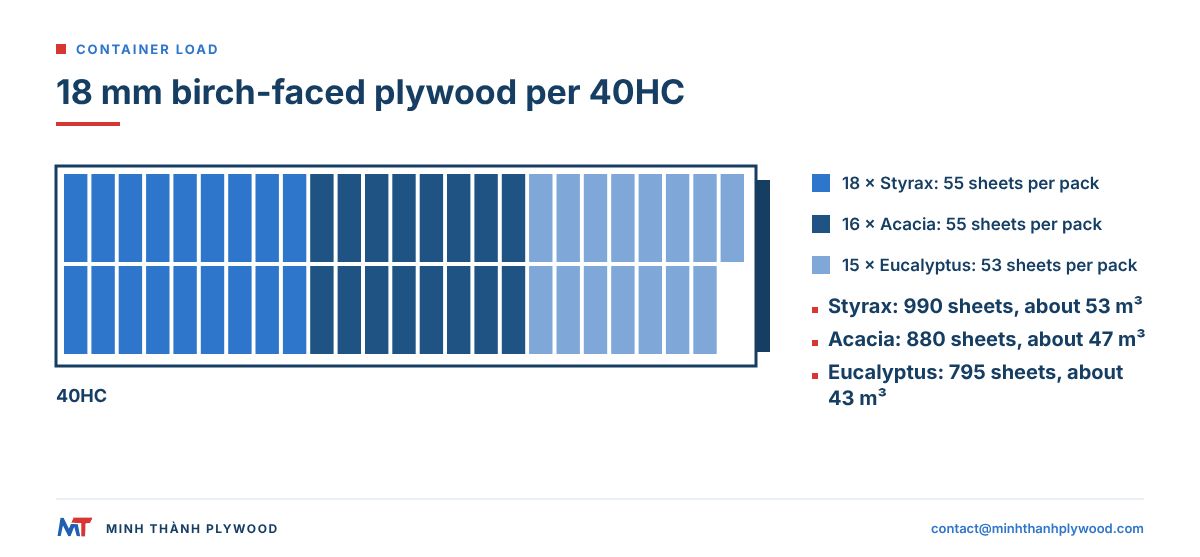
The core sets the weight of every sheet and, through it, how many sheets a container carries before its weight limit. The factory’s planning figures for 1220 × 2440 × 18 mm sheets on a 28,000 kg planning payload are:
| Core | Weight per sheet | Packs per 40HC | Sheets per 40HC | Volume |
|---|---|---|---|---|
| White Styrax | 26.8 kg | 18 (55 sheets each) | 990 | about 53 m³ |
| Acacia | 31.1 kg | 16 (55 sheets each) | 880 | about 47 m³ |
| Eucalyptus | 34.8 kg | 15 (53 sheets each) | 795 | about 43 m³ |
A Styrax core puts about 10 m³ more birch-faced plywood in each 40HC than eucalyptus at 18 mm, which lowers the freight cost per cubic metre. Use our packing calculator for other thicknesses or a lower booking weight.
Why the build matters as much as the species
A good species in a poor build makes a poor panel. Ask for the core build line by line, because it decides flatness, voids and how the birch face looks after finishing.
| Build line | What we use for birch-faced furniture panels | Why it matters |
|---|---|---|
| Core grade | Grade A core veneer | Whole sheets, no holes or open splits |
| Joining | Core layers stitched both horizontally and vertically | No gaps or overlaps to telegraph |
| Pressing | Pressed twice: core board pressed and calibrated, then face and back | The face goes onto a flat board |
| Ply count | 11–13 plies at 18 mm | Even, stiff panel |
| Tolerance | Sanded to ±0.2–0.3 mm, down to ±0.2 mm | Fits your CNC and edge-banding setup |
| Moisture | 8–12% at dispatch | Flat in a heated factory |
| Surface | Sanded and polished, UV-ready on both faces | Ready for your own UV or lacquer line |
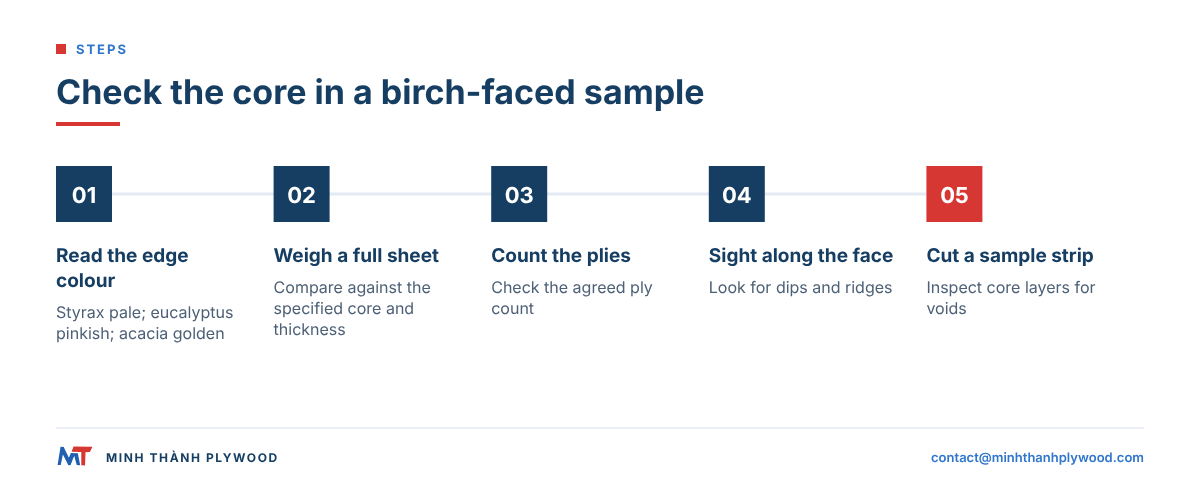
To check the core of a birch-faced sample yourself:
- Look at the edge colour: Styrax is white to pale cream, eucalyptus pale pinkish-brown, acacia golden brown.
- Weigh one full sheet: at 18 mm, a sheet far lighter than 26.8 kg suggests voids or a thin panel; one near 34.8 kg points to a eucalyptus core.
- Count the plies at the edge and compare with your specification.
- Sight along the face at a low angle for dips and ridges from gaps or overlaps in the core.
- Cut a strip across the sheet and look at every core layer for voids.
Our core veneer guide explains each of these steps and how to check them on a sample.
Birch face grades on a Vietnamese core
Birch face grades in Vietnam are named D+, D and E, from highest to lowest, and quoted as face/back pairs such as D+/D or D/E. The grade belongs to the face; the core decides how that face looks once finished.
| Vietnamese grade | Close European equivalent | Typical use |
|---|---|---|
| D+ | B | Clear-finished visible faces |
| D | BB | Visible faces with small, matched patches |
| E | CP/C | Backs, painted or covered faces |
As a guide, D+/D is close to B/BB and D/D to BB/BB. Each order is matched to the sample you approve, so the face you receive is the face you saw. Our birch plywood grades guide shows the acceptance criteria grade by grade.
Which core is best for your use?
Match the core to what the part has to do, then fix the face grade and the build. The table covers the common birch-faced plywood uses.
| Use | Best core | Face/back | Note |
|---|---|---|---|
| Lacquered or UV-coated furniture fronts | White Styrax | D+/D | Pale core, flattest finish |
| Wardrobes, shelving, carcasses | White Styrax | D/E | Light, many sheets per container |
| Kitchen carcasses with many hinges | Eucalyptus | D/E | Best screw holding |
| Shop fittings and displays | Eucalyptus | D+/D | Firm edges for fixings |
| Drawer bottoms and backs | Styrax thin plywood | D/E | 5-ply, 3–5 mm |
| Painted or laminated parts | Acacia or Styrax | E/E | Face is covered |
If you are unsure between Styrax and eucalyptus, order free samples of both on the same face and run them through your own drilling, edge-banding and finishing.
Emission and documents for birch-faced plywood
Birch-faced furniture plywood from our mill is bonded with UF glue at E0 emission and certified to CARB P2 / TSCA Title VI (ICTT mill no. 23024). The core species does not change that specification.
UK and EU buyers check a different set of papers from US buyers:
- EN 13986 and the CE or UKCA mark: EN 13986 is the harmonised standard for wood-based panels used in construction. Panels for construction use in Great Britain carry a UKCA mark and in the EU and Northern Ireland a CE mark, with a declaration of performance (TRADA guidance). Furniture-only panels are usually ordered on the emission and bond specification below; tell us if your end use needs the construction route.
- Bond class to EN 314-2: Class 1 is dry interior use, Class 2 humid or protected exterior, Class 3 full exterior. Birch-faced furniture plywood is a Class 1 panel; name the class on your order line.
- Emission to EN 717-1: E1 is the European formaldehyde class. We arrange EN 717-1 testing through SGS on request, next to the CARB P2 chamber results.
- Due diligence: we supply the EUDR dossier, with origin records and geolocation files, with orders; UK importers keep the same origin records for their own timber due-diligence file.
Six ASTM D6007 chamber tests between April 2025 and June 2026 on 9, 15 and 18 mm panels averaged 0.014–0.032 ppm, three by Shanghai Hongjun and three by ICTT Vietnam. The limit for veneer-core hardwood plywood is 0.05 ppm under CARB Phase 2 / TSCA Title VI, set in 40 CFR 770.10. For European buyers who want their own method, third-party testing to EN 717-1 or another method is arranged through SGS on request. US orders carry the TSCA Title VI label on the panels.
What this means for your birch plywood order
Write the core into your order as its own line, next to the face grade, the build and the glue. A complete line lets us quote exactly the panel you need and lets you compare quotes fairly.
Example order line: 18 mm birch-faced plywood, 1220 × 2440 mm; face/back D/E birch, matched to the approved sample; core: white Styrax, grade A, stitched both directions, 11 plies, pressed twice; glue: UF glue at E0 emission, CARB P2 / TSCA Title VI; sanded, tolerance ±0.2 mm, UV-ready; moisture 8–12%; export packing; one 40HC.
Indicative prices for furniture and interior plywood start from US$350/m³ (October 2026); the final price depends on the face grade, core, glue, thickness, size, quantity and delivery term. The minimum order is one 40HC, with mixed specifications by agreement, and production takes 15–45 days after the 30% deposit. Send your line through the birch plywood page or to [email protected]; we reply within hours and send free samples of Styrax and eucalyptus cores so you can choose on your own line.
Buyer questions, answered
Which core is best for birch plywood from Vietnam?
White Styrax for most furniture and interior panels, because it is light, pale under the birch face and flat. Eucalyptus is the better choice for parts that take many edge screws. Both are standard cores at Minh Thanh Plywood.
Can Vietnam produce full birch plywood with a birch core?
No. Birch does not grow in Vietnam, so Vietnamese mills import birch face veneer and press it onto a Vietnamese core of Styrax, eucalyptus or acacia. All-birch panels come from birch-growing regions such as the Baltic area and Finland.
What is birch faced poplar plywood?
A panel with a thin birch face and back on a poplar core, mostly made in China. The Vietnamese equivalent is birch-faced plywood on a white Styrax core, which is also light and pale.
Which core is best for furniture plywood: eucalyptus, acacia, poplar or birch?
For a birch or poplar face, a pale, flat core such as Styrax gives the best finish at the lowest weight; eucalyptus gives the best screw holding of the plantation cores; acacia is a cost-effective option; all-birch is the stiffest and the most expensive.
Is Styrax core plywood strong enough for furniture?
Yes. A grade A Styrax core, stitched and pressed twice, is widely used for European furniture panels. For parts that carry heavy loads on edge screws, choose eucalyptus or use inserts and dowels.
How heavy is an 18 mm birch-faced sheet on a Styrax core?
About 26.8 kg for 1220 × 2440 × 18 mm at the reference density, against about 31.1 kg on acacia and 34.8 kg on eucalyptus.
Is birch-faced plywood the same as Baltic birch?
No. Baltic birch is birch through every ply; birch-faced plywood has birch only on the face and back. Our Baltic birch plywood guide explains the difference and when each is the right buy.
Does the core affect the birch face grade?
Not the grade itself, but how the face looks after finishing. A pale, flat core keeps a thin birch face even under lacquer; a darker or uneven core can shadow or telegraph through it.
What birch face grades does Minh Thanh Plywood offer?
Birch faces are graded D+, D and E in Vietnam and quoted as face/back pairs such as D+/D or D/E. As a guide, D+ is close to European grade B, D to BB and E to CP/C, matched to your approved sample.
How many birch-faced sheets fit in a 40HC?
At 18 mm and 1220 × 2440 mm, about 990 sheets on a Styrax core, 880 on acacia and 795 on eucalyptus, within a 28,000 kg planning payload.