
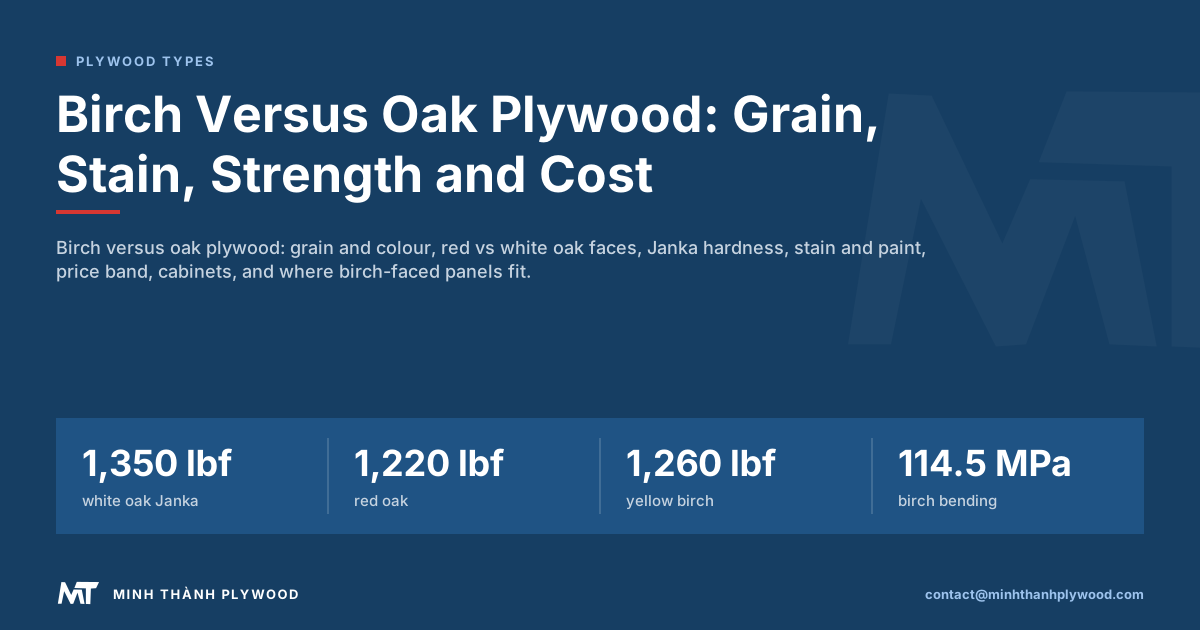
Birch versus oak is a choice between a smooth, pale, closed-grain face that paints well and a bold, open-grain face that stains evenly and shows its figure. Oak is slightly harder and costs more as a face; birch is stiffer in bending and the economical choice for painted work and carcasses. Minh Thanh Plywood makes birch-faced panels as a standard line and oak faces on request.
Birch versus oak: the short answer
Birch versus oak comes down to grain and finish. Birch has a fine, closed grain and a pale face that paints smoothly and costs less; oak has an open, bold grain that stains evenly and shows its figure, at a higher price. White oak is the harder of the two; birch is a little stiffer in bending.
- Painted doors and furniture: birch, for a smooth face without grain filling.
- Stained or clear-finished furniture: oak, for even colour and a strong grain.
- Modern straight-grain cabinets: rift or quarter-sliced white oak.
- Cabinet boxes, carcasses, drawers: birch-faced panels, for cost and a sound face.
- Damp-area cabinets: either face, on an MR or phenolic bond with sealed edges.
- Floors and engineered boards: oak, white oak above all; birch for dry rooms and budget.
The sections below set out each point with numbers, a comparison table and the lines to write on an order.
Birch vs oak for floors and engineered flooring
For floors, oak is the better wood: white oak wears, sands and refinishes better than birch, and it is the default wear layer on engineered boards. Birch is a softer, lower-cost floor that moves more with humidity, so it suits bedrooms and dry rooms better than kitchens and halls. Most buyers comparing birch and oak are choosing a floor, so here is the floor view first.
| Species | Janka hardness | Floor verdict |
|---|---|---|
| Hard maple | 1,450 lbf | Hardest; gym and busy-room floors |
| White oak | 1,360 lbf | Wears and refinishes best; the standard floor |
| Red oak (northern) | 1,290 lbf | Close to birch; the most common oak floor in the US |
| Yellow birch | 1,260 lbf | Hard enough for homes; shows dents and moves more than oak |
| Black walnut | 1,010 lbf | Soft; a premium look for low-traffic rooms |
| Black cherry | 960 lbf | Softest here; darkens with light |
The figures are the flooring-trade Janka values quoted by cabinet and floor makers such as Deslaurier (checked on 21 October 2026); the species averages from The Wood Database in the table below run a little lower for oak, and the ranking is the same.
- Wear and refinishing: oak floors take repeated sanding and keep a bold grain; birch dents earlier and its fine grain hides little.
- Humidity: birch swells and shrinks more across the board, so gaps open in a dry winter more often than on oak.
- Engineered flooring: an engineered board is a thin oak or birch wear layer glued on a plywood base. The base is where plywood does the work, and the wear layer carries the species. See our guides to plywood for flooring and engineered wood versus plywood.
- Cost: oak floors generally cost more than birch floors, and white oak and wide planks cost the most.
A flooring buyer who needs the plywood base or the wear-layer core can use the same stitched, twice-pressed cores described below, with the face species named on the order.
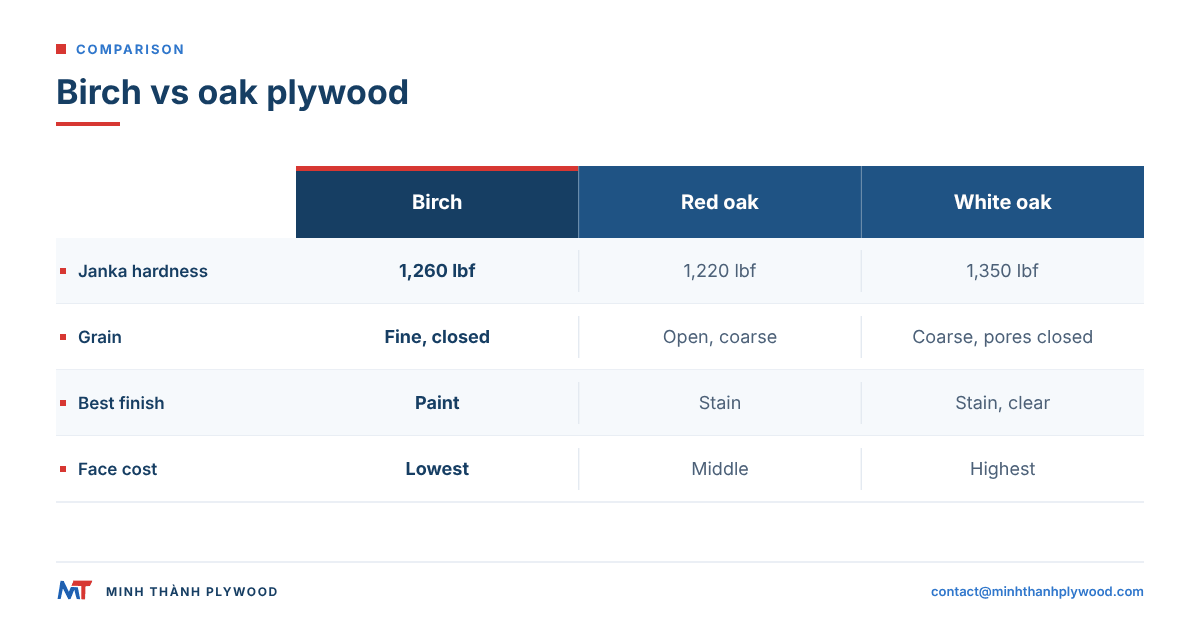
Birch vs oak plywood: the comparison table
This table compares birch vs oak plywood one metric per row: solid-wood values from The Wood Database (dried wood at 12 % moisture, read 20 October 2026) and the panel properties buyers order by.
| Metric | Yellow birch | Silver birch (Baltic) | Red oak | White oak |
|---|---|---|---|---|
| Janka hardness | 1,260 lbf (5,610 N) | 1,210 lbf (5,360 N) | 1,220 lbf (5,430 N) | 1,350 lbf (5,990 N) |
| Average dried density | 690 kg/m³ | 640 kg/m³ | 700 kg/m³ | 755 kg/m³ |
| Bending strength (MOR) | 114.5 MPa | 114.3 MPa | 99.2 MPa | 102.3 MPa |
| Stiffness (MOE) | 13.86 GPa | 13.96 GPa | 12.14 GPa | 12.15 GPa |
| Grain | Fine, closed | Fine, closed | Coarse, open pores | Coarse, pores mostly closed |
| Colour | Pale cream to light brown | Pale cream | Light brown, pinkish | Light tan to olive brown |
| Stain | Can blotch; washcoat or gel | Can blotch | Even, no blotch | Even, no blotch |
| Paint | Smooth, excellent | Smooth, excellent | Grain shows unless filled | Grain shows unless filled |
| Figure | Mild wave | Mild | Cathedral arches | Ray fleck when quartered |
| Face cost, same core | Lower | All-birch panels cost more | Higher than birch | Highest of the four |
For a buyer, the table says: oak for stain and figure, birch for paint and value. Hardness differences between birch and red oak are small; white oak is the hard one.
What is birch plywood?
Birch plywood is plywood with a birch face veneer, either over a core of other hardwood (birch-faced) or with birch in every ply (all-birch, often called Baltic birch). The two builds differ in weight, edge and price, so an order must say which one is meant.
- Birch-faced: birch face and back over a hardwood core; on our panels, white Styrax or Eucalyptus.
- All-birch: birch in every layer, dense and stiff, with an even striped edge.
- Face grades: on our panels the Vietnamese names D+, D and E, quoted as face/back pairs.
- Look: pale cream, fine and even, with a mild wave in rotary-cut faces.
Birch’s closed grain is why it paints so well, and its pale colour is why it suits Scandinavian and modern interiors. See our birch plywood page for sizes and grades.
What is oak plywood?
Oak plywood is plywood faced with red oak or white oak veneer over a hardwood or composite core. It is the classic face for stained cabinets, furniture and panelling, valued for its strong grain and the way stain soaks evenly into its open pores.
- Red oak: light brown with a pinkish cast; open pores; cathedral grain when plain-sliced.
- White oak: tan to olive brown; pores mostly blocked by tyloses; ray fleck when quarter-sliced.
- Plain-sliced: arches down the face, the most common oak look.
- Rift and quarter-sliced: straight stripes, the modern look, at a higher price.
- Rotary-cut: broad, varied grain for interiors and lower-cost faces.
As with birch-faced panels, the oak is only the outer skin. The core underneath decides flatness, weight and screw holding.
Red oak vs birch plywood
Red oak vs birch plywood is the most common comparison in cabinet shops, and the difference is mostly grain and finish. Red oak has an open, coarse grain with a pinkish tone that takes stain evenly; birch has a fine, closed grain and a pale face that paints smoothly. Their hardness is almost the same: about 1,220 lbf for red oak against 1,260 lbf for yellow birch.
| Point | Red oak plywood | Birch plywood |
|---|---|---|
| Look | Bold arches, pinkish brown | Pale, fine, even |
| Stain | Takes stain evenly | Can blotch; needs washcoat or gel |
| Paint | Needs grain filling for a smooth finish | Paints smoothly as delivered |
| Hardness | 1,220 lbf | 1,260 lbf (yellow birch) |
| Style | Traditional, rustic | Modern, Scandinavian, painted |
| Price, same core | Higher | Lower |
Red oak suits traditional stained kitchens and furniture. Birch suits painted cabinets and any part where cost matters more than grain.
White oak vs birch
White oak vs birch is a choice between the hardest, most figured face in this comparison and the most economical pale face. White oak, at about 1,350 lbf Janka and 755 kg/m³, is harder and heavier than birch, and rift or quarter-sliced white oak gives the straight-grain look of current modern furniture.
- Choose white oak for stained or clear-finished doors, tables and panelling where the grain is the design.
- Choose rift or quarter-sliced white oak for straight stripes and ray fleck in modern designs.
- Choose birch for painted fronts, carcasses and drawers, and for a light, even face at a lower cost.
- Water: solid white oak resists water better than red oak because tyloses block its pores; in plywood the glue bond decides water resistance.
White oak faces are the most expensive in this comparison. Where only the visible face needs to be oak, pair white oak doors with birch-faced carcasses.
Grain and colour: how birch and oak look under a finish
Birch looks smooth and pale under a finish; oak looks textured and warmer, and its grain stays visible through almost any finish. Under clear coats both darken a little, birch towards light amber and oak towards honey or olive tones.
| Finish | Birch face | Red oak face | White oak face |
|---|---|---|---|
| Water-based clear | Stays pale cream | Light pinkish brown | Light tan |
| Oil or oil-based clear | Warm light amber | Warm reddish brown | Honey to olive brown |
| Pigment stain | Can blotch | Even, grain darkens | Even, grain darkens |
| Paint | Smooth | Grain texture shows | Grain texture shows |
| White or light wash | Even pale look | Pink tone shows through | Clean pale look |
Approve the sample under the finish you will actually use. A raw birch or oak face and the same face under oil can look like two different woods.
Staining and painting: which face suits which finish?
Oak suits stain and birch suits paint. Oak’s open pores take stain deeply and evenly, so blotching is rare; birch’s closed, fine grain can blotch under thin pigment stains but gives a smooth, flat base for paint without filling.
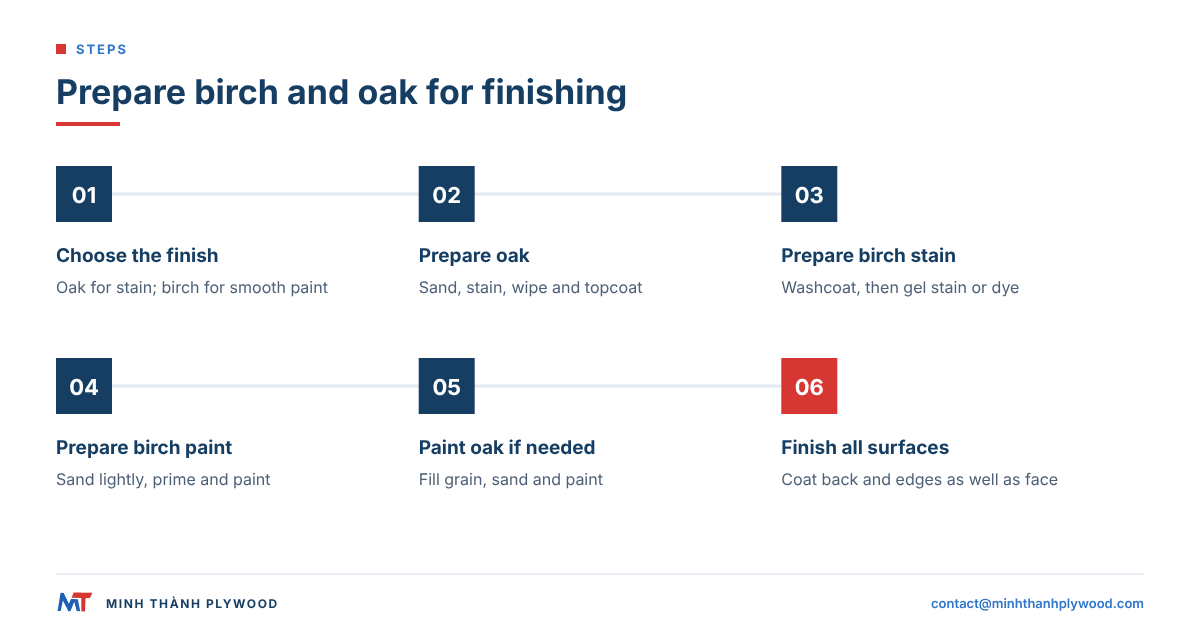
- For stain on oak: sand evenly, apply the stain, wipe off and topcoat; fill the grain only if a glass-smooth surface is wanted.
- For stain on birch: apply a washcoat (thin sealer) first, then a gel stain or dye; test on an offcut.
- For paint on birch: sand lightly, prime and paint; the face needs no filling.
- For paint on oak: fill the grain with grain filler or a high-build primer, sand, then paint.
- For UV lines: apply the UV coat to the sanded face; our birch faces are delivered UV-ready on both sides.
- On every panel: finish the back and edges as well as the face to keep it flat.
If the design is painted, paying for oak and then filling its grain is money spent twice. If the design is stained, oak gives an even colour with less work.
Strength and hardness: is oak harder than birch?
White oak is harder than birch, and red oak is about equal: Janka hardness is about 1,350 lbf for white oak, 1,220 lbf for red oak, 1,260 lbf for yellow birch and 1,210 lbf for silver birch. In bending, birch is stronger and stiffer: about 114.5 MPa and 13.86 GPa for yellow birch against about 102.3 MPa and 12.15 GPa for white oak.
On plywood, the face species sets only part of these numbers. A thin face veneer sits on a core of another density, so a dent depends on the face, the core and the finish together, and stiffness depends mostly on the core and thickness.
- Core density: our white Styrax core is about 500 kg/m³ and our Eucalyptus core 650–750 kg/m³; a denser core supports the face better.
- Core build: stitched horizontally and vertically, so there are no gaps under the face.
- Thickness: stiffness rises with the cube of thickness; 18 mm is far stiffer than 15 mm.
- Finish: a hard lacquer or UV coat adds surface resistance to either face.
For a heavy-use tabletop, a white oak face on a dense core under a hard finish is the strongest pairing. For cabinet sides, birch is strong enough.
Oak vs birch cabinets
For oak vs birch cabinets, choose by the finish and the part. Oak makes the better stained or clear-finished doors; birch makes the better painted doors and the more economical boxes, shelves and drawers. Many kitchens use both.
| Cabinet part | Recommended face | Why |
|---|---|---|
| Stained or clear doors | Red or white oak | Even stain, strong grain |
| Modern straight-grain doors | Rift or quarter white oak | Straight stripes, ray fleck |
| Painted doors | Birch | Smooth face, no grain filling |
| Visible end panels | Same face as the doors | Colour and grain match |
| Cabinet boxes | Birch-faced, D or D/E | Sound face at lower cost |
| Shelves | Birch or oak, 18 mm and up | Thickness beats species for sag |
| Drawer boxes | All-birch or birch-faced | Clean edges, good joints |
| Sink base | Either face, MR or phenolic bond | The bond resists damp |
One container can carry several specifications by agreement, so oak doors and birch carcasses can ship together. Our guide to birch plywood for kitchen cabinets covers the carcass side.
Cost: is oak plywood more expensive than birch?
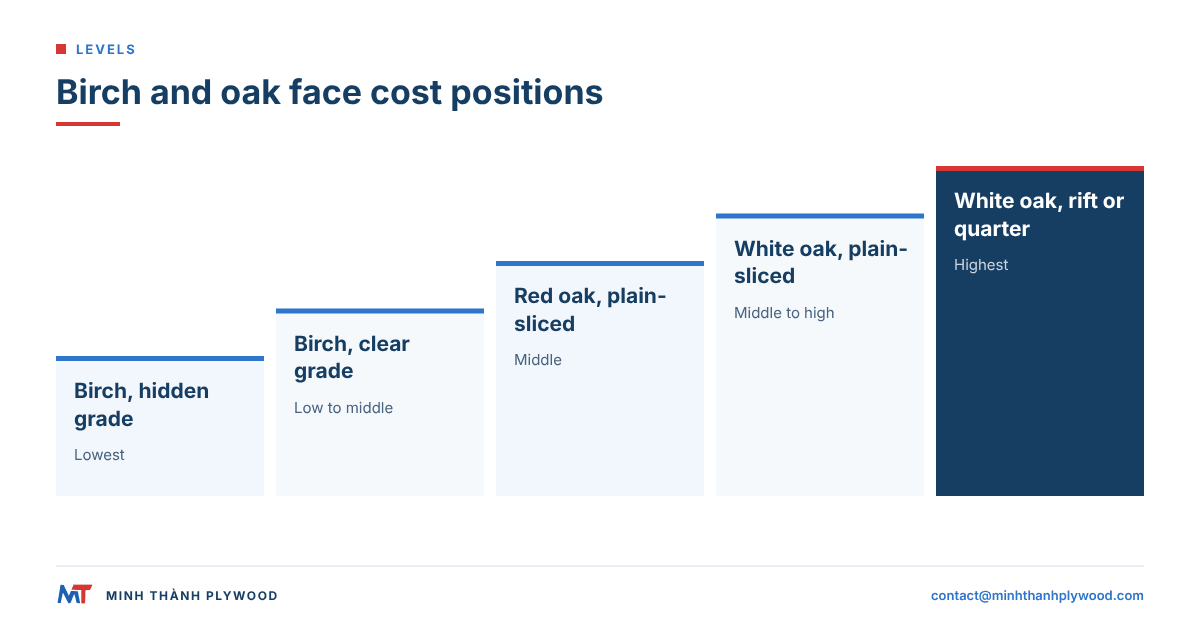
Oak-faced plywood usually costs more than birch-faced plywood of the same grade, core and thickness, and white oak costs more than red oak. Rift and quarter-sliced oak faces cost the most, because a log gives fewer leaves of straight grain. The core, grade and thickness still move the price as much as the species.
| Price band, same core and thickness | Typical position |
|---|---|
| Birch-faced, hidden-face grade | Lowest |
| Birch-faced, clear-finish grade | Low to middle |
| Red oak, plain-sliced | Middle |
| White oak, plain-sliced | Middle to high |
| White oak, rift or quarter-sliced | Highest |
| All-birch (Baltic type) | High, for the core rather than the face |
As a reference, furniture and interior plywood from our factory starts from US$350/m³ (October 2026). The final price depends on face, core, glue, thickness, size, quantity and delivery term, so we quote each specification and do not publish a list.
Walnut vs birch: the dark face against the pale one
Walnut and birch sit at opposite ends of the furniture palette: walnut has a dark chocolate-brown face and a high price, birch a pale cream face at a low one. Black walnut averages about 610 kg/m³ dried with a Janka hardness of about 1,010 lbf, softer than birch (The Wood Database, black walnut, read 20 October 2026).
- Walnut: feature furniture, accent walls, premium doors; usually clear oil or lacquer, no stain.
- Birch: painted work, light clear finishes, carcasses and drawers.
- Mixed designs: walnut fronts on birch-faced carcasses, a common pairing in modern furniture.
- Budget option: a walnut-look engineered veneer face, for even colour over many panels.
Engineered veneer (EV) is the face we produce most. It is real wood veneer dyed and resliced to repeat a chosen colour and grain, such as walnut or oak, at a lower cost than the natural species.
Where oak veneer and birch faces on Vietnamese plywood fit
Vietnamese plywood fits furniture and cabinet work that needs a sound face, a flat stitched core and tight thickness at a better price than comparable mills: birch-faced carcasses and painted fronts first, with oak faces on request on the same cores. Our factory in Ha Hoa, Phu Tho, uses locally grown plantation timber for its cores.
| Specification | Our panels |
|---|---|
| Faces | Birch (D+, D, E); EV (engineered veneer) in the colour you order; oak and other species on request |
| Core | White Styrax or Eucalyptus; Acacia and Pine on order |
| Core build | Stitched horizontally and vertically |
| Pressing | Twice: calibrated core board, then face and back |
| Glue and emission | UF glue at E0 emission; MR or phenolic (WBP) by order |
| Thickness | 3–40 mm; sanded tolerance down to ±0.2 mm |
| Sizes | 1220 × 2440 and 1250 × 2500 mm; custom sizes on order |
| Certification | CARB P2 / TSCA Title VI (ICTT mill no. 23024), ISO 9001:2015 |
Why a styrax core under birch: white Styrax is a light plantation hardwood (about 500 kg/m³) that keeps panels light and flat; Eucalyptus (650–750 kg/m³) is chosen when weight and screw holding matter more. We do not sell birch-faced panels as full birch.
Six ASTM D6007 chamber tests between April 2025 and June 2026 on 9, 15 and 18 mm panels averaged 0.014–0.032 ppm, against the 0.05 ppm limit.
That limit applies to hardwood plywood with a veneer core under 40 CFR 770.10. For furniture sold in the EU, formaldehyde from furniture and wood-based articles is limited to 0.062 mg/m³ from 6 August 2026 by Regulation (EU) 2023/1464. For damp-area cabinets, the bond of the panel is classed under BS EN 314-2, the bonding-quality standard for plywood.
Birch face grades: D+, D and E against European grades
Our birch faces are graded with the Vietnamese names D+, D and E (from low to high: E, D, D+), quoted as face/back pairs such as D+/D or D/E and matched to the approved sample. The ladder is comparable to the European birch grades.
| Our grade | Comparable European grade | Use |
|---|---|---|
| D+ | B | Clear-finished, high-visibility faces |
| D | BB | Painted or partly visible faces |
| E | CP / C | Hidden or covered faces |
D+/D is comparable to B/BB, and D/D to BB/BB. Oak faces are graded on their own scale, usually AA, A and B in North America, so compare by the job of the face rather than by the letter. Our guide to birch plywood grades shows each grade.
Which should you choose: a decision guide
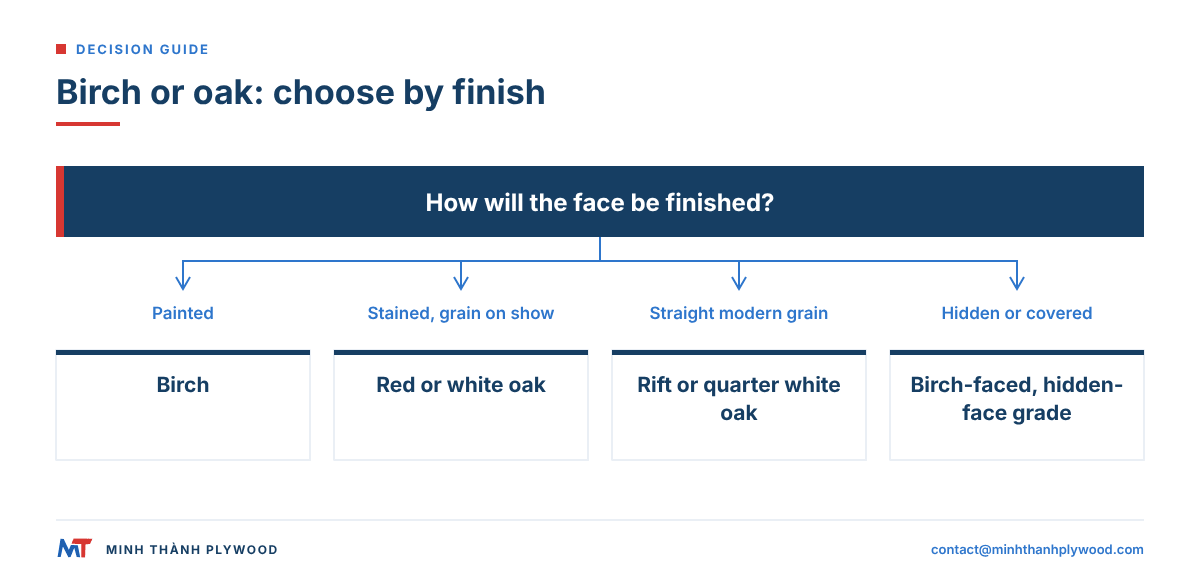
Choose by the finish first, then the part, then the budget. These five questions settle most specifications:
- Will it be painted? Birch.
- Will it be stained or clear-finished, with the grain on show? Oak; white oak for straight grain.
- Is it hidden or covered? Birch-faced in a hidden-face grade, or EV.
- Will the edge show? All-birch plywood, or edge banding on a faced panel.
- Is the budget tight across many panels? Birch for carcasses, or an oak-look engineered veneer for the visible faces.
When in doubt, order a sample of each face under your finish. The finished sample answers the question faster than any table.
What to write on a birch or oak plywood order
An order for birch or oak plywood that can be quoted the same day names the face, grade, core, glue, size and quantity. Send these lines:
- Application: cabinet doors, carcasses, drawers, shelving, furniture or panelling.
- Face: birch (D+/D, D/E), red or white oak (cut and grade), or EV colour.
- Core: white Styrax or Eucalyptus.
- Glue and emission: UF glue at E0 emission; MR or phenolic bond for damp areas.
- Size and thickness: for example 1220 × 2440 × 18 mm.
- Finish: sanded, or UV-ready faces.
- Packing and quantity: from one 40HC, mixed specifications by agreement; destination port.
Production is 15–45 days after the 30% deposit, FOB Hai Phong, CFR or CIF, with free samples. Read birch vs maple plywood for the pale-face comparison, the hardwood plywood guide for the full range, and hardwood vs softwood plywood for core choices.
Buyer questions, answered
Is oak or birch plywood better?
Neither is better for every job. Oak is better for stained, clear-finished furniture where a bold grain is wanted; birch is better for painted work, carcasses and drawer parts, where its smooth face and lower cost win.
Is oak harder than birch?
White oak is harder, at about 1,350 lbf on the Janka scale against about 1,260 lbf for yellow birch and 1,210 lbf for European silver birch. Red oak, at about 1,220 lbf, is close to birch.
What is the difference between red oak and birch plywood?
Red oak plywood has an open, coarse grain with a pinkish tone and stains evenly. Birch plywood has a fine, closed grain, a pale cream colour and paints more smoothly, usually at a lower price.
Is white oak or birch better for cabinets?
White oak suits stained or clear-finished cabinet doors, especially rift or quarter-sliced faces in modern designs. Birch suits painted doors, cabinet boxes and drawers at a lower cost.
Is oak plywood more expensive than birch?
Usually yes. Oak-faced plywood, and white oak most of all, costs more than birch-faced plywood of the same grade, core and thickness; rift and quarter-sliced oak faces cost the most.
Does oak plywood take stain better than birch?
Yes. Oak's open pores take stain evenly and rarely blotch, while birch can blotch under thin pigment stains unless a washcoat or gel stain is used.
Can you paint oak plywood?
Yes, but oak's open grain shows through paint unless it is filled first. For a smooth painted finish, birch or maple faces are easier and cheaper.
Is white oak plywood water resistant?
White oak's pores are blocked by tyloses, so solid white oak resists water better than red oak. In plywood, the glue bond decides water resistance, so order an MR or phenolic bond for damp areas.
What is walnut vs birch plywood?
Walnut plywood has a dark chocolate-brown face and costs far more; birch is pale and economical. Walnut is chosen for feature furniture, birch for painted or light-finished work and carcasses.
What face grade should I request for Vietnamese birch plywood?
Ask for the Vietnamese grade names: D+ for clear-finished faces, D for painted faces and E for hidden faces, quoted as face/back pairs such as D+/D or D/E, matched to an approved sample.
Is birch or oak better for flooring?
Oak is better for most floors: white oak is about 1,360 lbf on the Janka scale against about 1,260 lbf for yellow birch, sands and refinishes better, and moves less with humidity. Birch is a lower-cost floor for dry, low-traffic rooms.
Is birch or oak more expensive for floors?
Oak floors generally cost more than birch floors, white oak most of all. For engineered flooring the wear layer species sets the price, and the plywood base underneath is the same.