
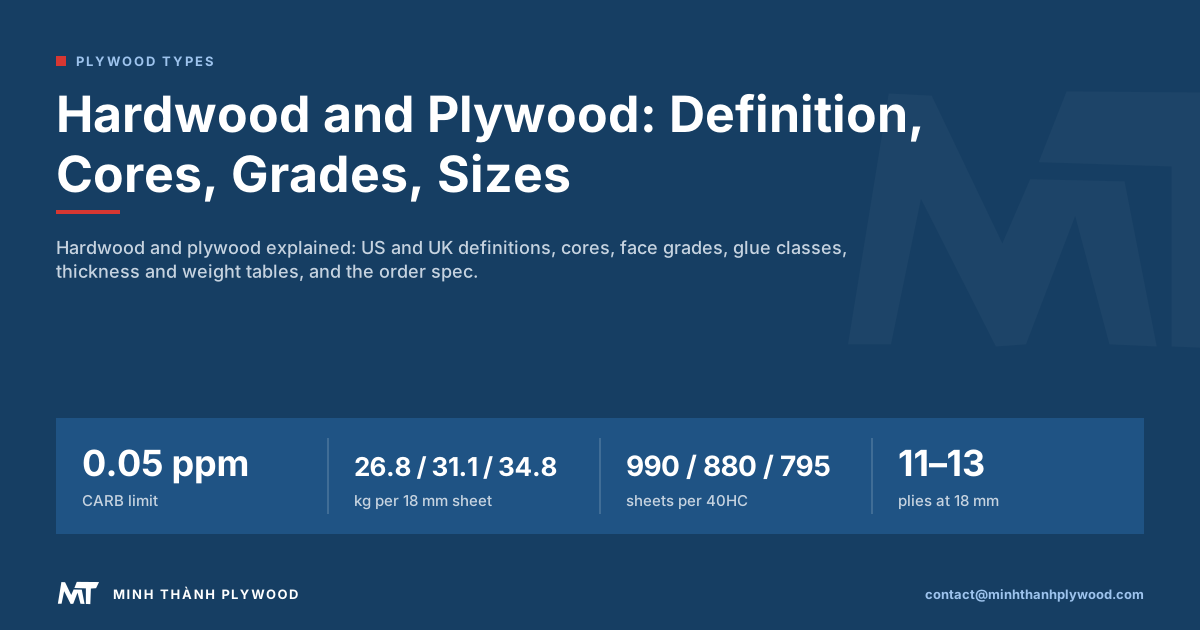
Hardwood plywood is plywood whose face and back veneers are hardwood species such as birch, poplar, eucalyptus, okoume or bintangor, glued over a veneer, MDF or combi core. In the US the term names a decorative interior panel; in the UK it names tropical and Far Eastern ply. Minh Thanh Plywood makes it in Phu Tho on Styrax and eucalyptus cores.
Hardwood plywood: the short definition
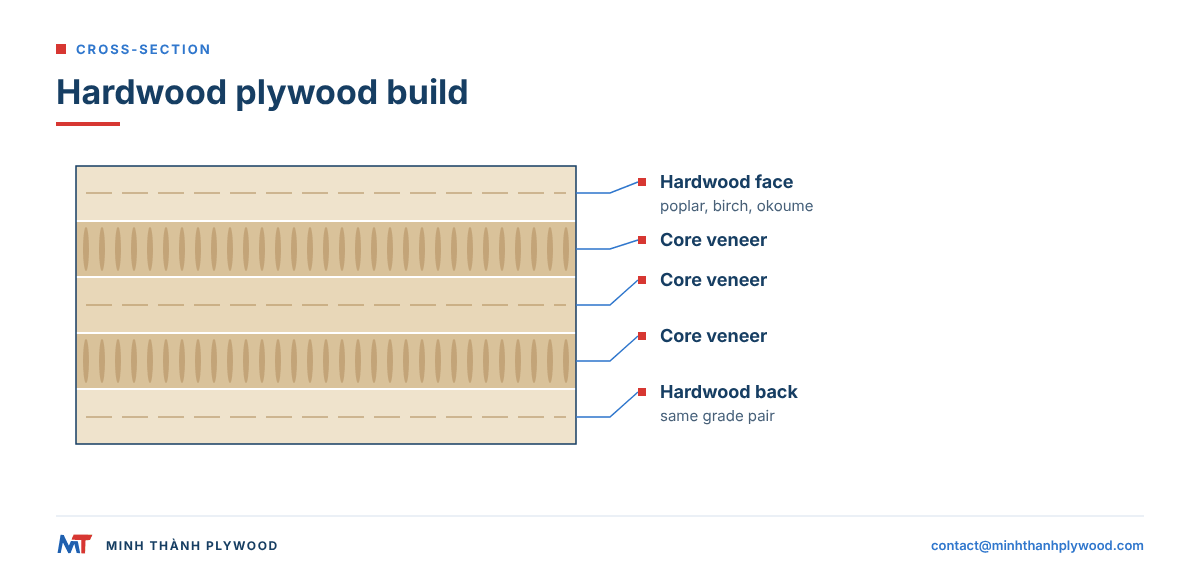
Hardwood plywood is a panel of cross-laid wood veneers whose visible face and back are hardwood. The core under those faces can be hardwood veneer, a mix of species, or a reconstituted board such as MDF. The face species gives the panel its name, its look and most of its price.
The term carries two meanings, depending on who uses it:
- In the US and Canada, “hardwood plywood” is the decorative, interior panel graded under ANSI/HPVA HP-1, sold for cabinets, furniture and millwork. The same name covers veneer, MDF, particleboard and combi cores.
- In the UK and Ireland, “hardwood ply” is the everyday merchant name for tropical and Far Eastern plywood: eucalyptus, meranti, okoume or bintangor faces over a hardwood core, often sold as a general-purpose sheet.
Both meanings describe the same idea: hardwood faces over a veneer or reconstituted core. The difference is the grade the buyer expects and the use it goes into. Before you compare two quotes, check which meaning each seller has in mind.
Is plywood a hardwood or a softwood?
Plywood is not a hardwood or a softwood in itself: it takes the name of the veneers it is made from. A panel faced with birch, poplar, eucalyptus, okoume or bintangor is hardwood plywood. A panel faced with pine, fir or spruce is softwood plywood.
Hardwood and plywood are often confused because “hardwood” is a botanical term, not a hardness rating. Hardwoods come from broadleaf trees; softwoods come from conifers. Some hardwoods are light and soft (poplar, Styrax), and some softwoods are hard and dense. Styrax is therefore a hardwood core material, even though it is one of the lightest core woods in use.
The core can also differ from the faces. A Vietnamese panel can carry pine faces over a eucalyptus core: it is sold as pine plywood because the buyer sees and pays for the face. Write both species on the order so that the name never decides the build.
Hard wood ply, hardwood ply wood, hardwood sheet: one panel, many names
Hard wood ply, hardwood ply wood, hardwood sheet and hardwood plywood sheets all name the same product: plywood with hardwood faces. The spelling changes with the market and the merchant, not with the panel. What changes the panel is the face species, the core and the grade pair, so those go on the order whatever name the price list uses.
- Hardwood ply / hard wood ply: the UK and Irish merchant name, usually a eucalyptus, meranti or bintangor face over a hardwood core, sold in 1220 × 2440 mm.
- Hardwood ply wood / hardwood sheet: search and catalogue spellings for the same sheet.
- Plywood hardwood 18mm / 12mm hardwood ply: a thickness added to the name; 18 mm is the furniture standard, 12 mm the drawer and shelf panel.
- Hardwood and decorative plywood: the US trade and regulatory name for faced interior panels.
When a quote says only “hardwood ply”, ask three questions back: which face species, which core, which grade pair.
Hardwood plywood vs softwood plywood: what changes for the buyer
Hardwood plywood is graded for appearance and machining; softwood plywood is graded mainly for structure. That single difference changes the face, the glue, the sanding and the uses.
| Feature | Hardwood plywood | Softwood plywood |
|---|---|---|
| Face species | Birch, poplar, eucalyptus, okoume, bintangor, oak and others | Pine, fir, spruce |
| Graded for | Appearance of face and back | Strength and bond, then appearance |
| Typical glue | UF for interiors; MR or phenolic to order | Phenolic (exterior) for structural grades |
| Surface | Sanded, often to a tight thickness | Often unsanded or touch-sanded |
| Typical uses | Furniture, cabinets, shelving, interiors, doors | Sheathing, subfloor, roof deck, formwork backing |
| Grading reference | ANSI/HPVA HP-1, EN 635-2 | US PS 1, EN 635-3, EN 636 |
For furniture and cabinets, hardwood plywood machines cleaner and takes paint, lacquer or laminate on a flatter face. For sheathing and roofs, softwood structural plywood or OSB is usually the cost-effective choice; our plywood vs OSB guide compares those.
Common hardwood face species and what each is chosen for
The face species decides how the panel looks, how it takes a finish and how much it costs. These are the faces most buyers order on hardwood plywood from Vietnam:
- Birch: fine, even grain and a hard face. Chosen for visible furniture parts, edges left on show and clear lacquer. In Vietnam birch faces are graded D+, D and E.
- Poplar: pale, light and smooth with little visible figure. Chosen for painted furniture, drawer parts, linings and packaging that must look clean. See our poplar plywood page.
- Eucalyptus: denser, light to reddish brown, a strong face. Chosen for furniture parts that carry load and for general-purpose panels.
- Okoume: pinkish, even and light. Chosen for interior furniture and decorative panels.
- Bintangor: reddish brown, the traditional face on commercial hardwood ply. Chosen for general-purpose and painted work.
- EV (engineered veneer): reconstituted veneer dyed and pressed to a repeatable grain such as oak or walnut. Chosen when every sheet in a project must match.
US cabinet and millwork buyers search by the natural face rather than the mill’s name for it. These are the faces on the US hardwood-plywood shelves, such as the Columbia Forest Products PureBond range at Home Depot and the species lists of makers like Toledo Plywood:
| US face | Look | Usual job |
|---|---|---|
| Red oak | Open grain, pink-brown | Cabinets and stained furniture |
| White oak | Tighter grain, grey-brown | Kitchens and modern interiors |
| Maple | Pale, fine, even | Clear-lacquered cabinets and shelving |
| Birch | Pale, fine, hard | Painted or clear furniture and Baltic-style shop plywood |
| Walnut | Dark brown | Visible furniture faces |
| Cherry | Red-brown, darkens with light | Furniture and millwork |
| Hickory | Strong colour contrast | Rustic cabinets and floors |
Minh Thanh Plywood reaches oak, walnut and similar looks with EV faces, which repeat the grain on every sheet, and with birch and poplar faces for painted and clear work. Natural-veneer faces are specified by sample on the order.
Minh Thanh Plywood offers 10+ face veneers. EV, poplar, birch, okoume and pine are made most often; bintangor, eucalyptus, gurjan and sapele are made on request. A face can also be laid over a different core, so the face name alone never tells you the core.
Cores: veneer core, combi core and MDF core
The core is most of the panel’s thickness, so it decides the weight, stiffness, screw holding and flatness more than the face does. Hardwood plywood comes on three main core types:
| Core type | Build | Strong points | Watch for |
|---|---|---|---|
| Veneer core | All layers are wood veneer, cross-laid | Screw holding, stiffness, low weight per strength | Core gaps or overlaps if the lay-up is careless |
| Combi core | Mixed-species veneer plies, or veneer core with MDF crossbands | Balance of weight, cost and stiffness | Specify the layer materials and lay-up |
| MDF or particleboard core | Hardwood faces on a fibre or chip board | Very flat face, uniform thickness | Weight, edge swelling, weaker screw holding at edges |
US combination (“combi”) core can include MDF crossbands over veneer inner plies, as in Columbia Forest Products’ Classic Core.
Vietnamese hardwood plywood is mostly veneer core, made from plantation timber grown near the mills. At Minh Thanh Plywood, furniture panels use white Styrax or eucalyptus cores as standard; acacia and pine cores are made on order. The core layers are stitched both horizontally and vertically, so joints between core veneers stay closed under the press.
The US emission rules name each core separately. Under CARB and TSCA Title VI, hardwood plywood with a veneer core has its own emission limit. It is 0.05 ppm of formaldehyde under EPA formaldehyde emission standards. That is the scope of our certification.
Vietnamese hardwood core: Styrax, acacia and eucalyptus compared
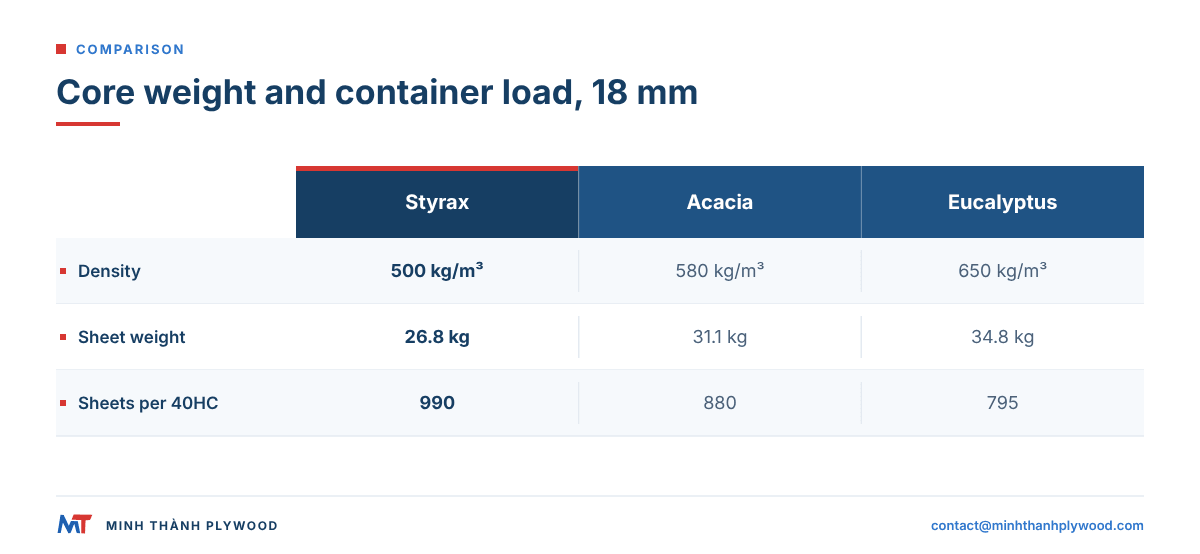
A Vietnamese hardwood core is chosen by weight first, then by stiffness and face support. The three core woods differ by about 30 % in density, which shows in the sheet weight and in how many sheets fit one container.
| Core (1220 × 2440 × 18 mm) | Reference density | Sheet weight | Sheets per 40HC | Approx. volume |
|---|---|---|---|---|
| Styrax (white) | 500 kg/m³ | 26.8 kg | 990 | 53 m³ |
| Acacia | 580 kg/m³ | 31.1 kg | 880 | 47 m³ |
| Eucalyptus | 650 kg/m³ | 34.8 kg | 795 | 43 m³ |
The container plan behind these numbers packs about 1,000 mm high, with 18 packs on Styrax, 16 on acacia and 15 on eucalyptus. Sheets per pack follow from the thickness, then the count is capped by weight against a planning payload of 28,000 kg. Our plywood weight calculator gives other thicknesses.
- Styrax is white, light and even. It suits furniture where weight, handling and a pale edge matter, and it fits the most cubic metres into a container.
- Eucalyptus is denser and stiffer. It suits shelves, bed parts and panels that carry load.
- Acacia sits between the two and is made on order.
Hardwood plywood grades: US, European and Vietnamese face grades
Hardwood plywood is graded on its face and back separately, and the grade pair is written face first. Three grading systems meet on a Vietnamese quote:
- US (ANSI/HPVA HP-1): face grades AA, A, B, C, D and E, from best to most defects, and back grades 1 to 4. A typical order reads A-1 or B-2.
- Europe (EN 635-2 for hardwood faces): classes E, I, II, III and IV, with E the highest.
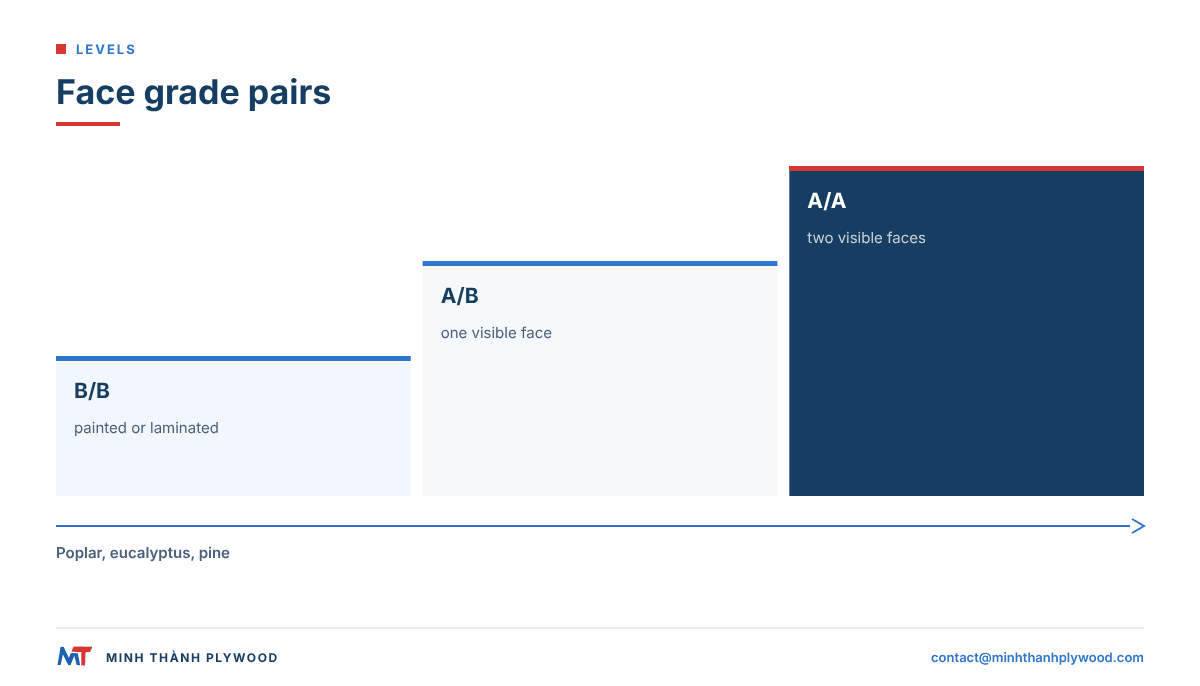
- Vietnam: letter pairs per face species. Poplar, eucalyptus and pine faces are quoted A/A, A/B and B/B. Birch faces use D+, D and E, comparable to the European birch ladder: D+ about B, D about BB, E about CP/C.
Poplar buyers also order by the Chinese codes B/BB, BB/CC and CP, which map onto the same ladder. Whatever the code, the grade is fixed by the approved sample: the mill matches the sample, and the sample settles any doubt at inspection.
- A/A for parts with two visible faces, such as open shelving and doors.
- A/B for one visible face, such as cabinet sides against a wall.
- B/B for painted or laminated work, where the face is covered.
Glue and emission: UF, MR and phenolic (WBP)
The glue sets where the panel can go; the emission class sets which markets accept it. They are two separate lines on the order.
- UF glue at E0 emission is the standard bond for furniture and interior hardwood plywood. E0 and E1 are emission classes, not glue types.
- MR, melamine-fortified glue resists humidity better. It suits kitchens, bathrooms and humid climates.
- Phenolic (WBP) glue is the exterior bond, used for outdoor parts and formwork.
For the US, hardwood plywood must meet CARB Phase 2 / TSCA Title VI. Minh Thanh Plywood is certified under ICTT mill no. 23024 for hardwood plywood veneer core, 3–50 mm. Six ASTM D6007 chamber tests between April 2025 and June 2026, on 9, 15 and 18 mm panels, averaged 0.014–0.032 ppm against the 0.05 ppm limit. Three were run by Shanghai Hongjun and three by ICTT Vietnam.
For Europe, the panels meet the emission and quality requirements European furniture buyers ask for; CARB P2 / TSCA Title VI is the accepted proof. Third-party testing to the buyer’s method, such as EN 717-1, is arranged through SGS on request. The CARB composite wood products programme publishes the limits and certifier list.
Is hardwood plywood waterproof?
No hardwood plywood is waterproof; the glue only decides how much moisture the bond survives. A UF-bonded interior panel is for dry rooms. An MR bond resists humidity and occasional splashes. A phenolic (WBP) bond survives wetting and drying cycles, but the face veneer still weathers if it is left bare.
For a wet or outdoor part, order three things together: a phenolic bond, a face that suits exterior use, and a finish or overlay that sheds water. Seal every cut edge, because water enters plywood through the end grain. Our guide is plywood waterproof? explains the bond classes in detail.
Minh Thanh Plywood makes MR, melamine-fortified and phenolic (WBP) bonds to the customer’s specification, alongside the standard UF glue at E0 emission for interiors.
Hardwood plywood thicknesses and sheet sizes
Hardwood plywood is sold mostly in 3, 6, 9, 12, 15 and 18 mm, with 21 and 25 mm for worktops, beds and heavy shelving. The panel is sanded to its final thickness, so the tolerance belongs on the order next to the nominal figure.
| Thickness | Typical uses | What to specify |
|---|---|---|
| 3–6 mm | Drawer bottoms, cabinet backs, linings, door skins | 5-ply (3–5 mm) build, face grade, flatness |
| 9 mm | Drawer sides, light partitions, backs that carry load | Core species, face/back pair |
| 12 mm | Drawer boxes, shelves on short spans, packaging that shows | Core, tolerance, sanding |
| 15 mm | Carcasses for light furniture, doors under laminate | Core, ply count, tolerance |
| 18 mm | Cabinet carcasses, shelves, tables, beds | 11–13 plies, core, tolerance ±0.2–0.3 mm |
| 21–25 mm | Worktops, heavy shelves, bed frames | Core, weight per sheet |
US shelves sell the same panels by a nominal fraction that is not the real thickness. Home Depot lists the actual size beside the name:
| US nominal, 4 ft × 8 ft | Example actual thickness | In metric |
|---|---|---|
| 1/4 in | 0.188–0.205 in | 4.8–5.2 mm |
| 1/2 in | 0.472 in | 12 mm |
| 3/4 in | 0.709 in | 18 mm |
Minh Thanh Plywood’s standard 1220 × 2440 mm sheet is a common metric counterpart to a nominal 4 ft × 8 ft panel. Actual thickness varies, so confirm the buyer’s dimensions before substituting 12 mm for a half-inch part or 18 mm for three-quarter. Write the metric thickness and tolerance on the order.
Minh Thanh Plywood makes 3–40 mm in 1220 × 2440 mm and 1250 × 2500 mm, plus custom sizes such as 1220 × 2500 mm and 1220 × 2280 mm. Thin plywood of 3–5 mm is always 5-ply. An 18 mm furniture panel is built of 11–13 plies. Our plywood thickness guide and plywood sheet sizes cover each step.
Thickness tolerance and flatness: what separates furniture-grade panels
Furniture-grade hardwood plywood is defined less by its face than by its tolerance and flatness. A cabinet plant that sets its machines once for a lot needs every sheet to measure the same.
- Sanded furniture panels: ±0.2–0.3 mm, down to ±0.2 mm.
- Commercial and film-faced panels: ±0.5 mm.
- Packing panels: ±0.5–1.0 mm.
- Length and width: ±2 mm.
Two factory steps make that tolerance possible. Furniture-grade panels are pressed twice as standard: the core board is pressed and calibrated first, then the face and back are pressed on. Veneers and finished panels are dried to 8–12 % moisture content at dispatch, the normal range for furniture plywood, so the panels stay flat after they reach a heated warehouse.
Ask any supplier for the tolerance in writing and measure samples with a caliper at the corners and mid-edges. A quote that names only “18 mm” leaves the real thickness open.
Where is hardwood plywood made?
Hardwood plywood is made wherever hardwood veneer is grown or imported: the Baltic region and Finland for birch, China for poplar and mixed cores, Indonesia and Malaysia for tropical faces, and Vietnam for plantation eucalyptus, acacia and Styrax cores. Each origin is known for one core, so the core you want often decides the country.
Vietnamese mills draw on the country’s plantation forests. Minh Thanh Plywood is in Ha Hoa, Phu Tho, where locally grown plantation timber supplies the cores. The factory is built for top-grade furniture and interior plywood, with Europe as its main market, and has a capacity of 50,000+ m³ per year.
US buyers should note the trade case that uses the same name. The final determination is Federal Register 2026-14614. The US Department of Commerce published final determinations in “Hardwood and Decorative Plywood from Vietnam” (A-552-851 and C-552-852) on 21 July 2026. Structural PS 1 and PS 2 plywood and phenolic film-faced plyform are outside its scope. Check the current status with your customs broker before you book.
How to specify hardwood plywood on an order
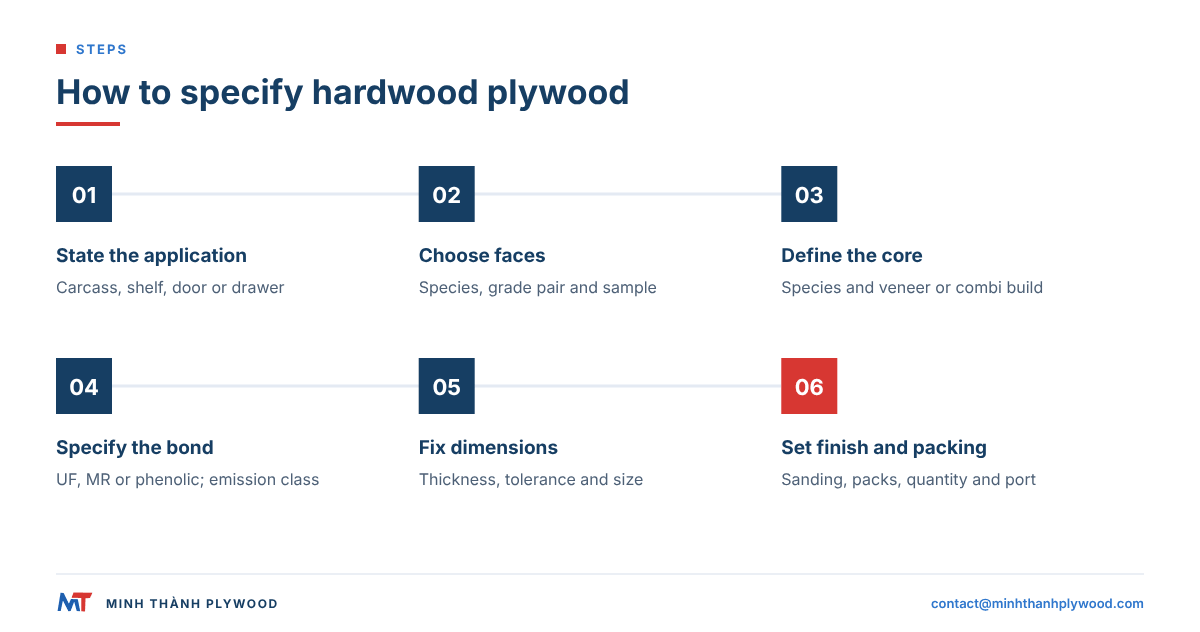
A hardwood plywood order is complete when two mills reading it would price the same panel. Write these lines, in this order:
- Application: the part the panel becomes (carcass, shelf, door, drawer, packaging).
- Face and back: species and grade pair, such as poplar A/B or birch D+/D, matched to an approved sample.
- Core: species (Styrax, eucalyptus, acacia, pine) and build (veneer core or combi).
- Glue and emission: UF at E0, MR or phenolic; CARB P2 / TSCA Title VI if the panels go to the US.
- Thickness and tolerance: for example 18 mm ±0.2 mm, with the ply count.
- Size: 1220 × 2440 mm, 1250 × 2500 mm or custom; cut-to-size if the parts are fixed.
- Sanding and face finish: sanded and polished, UV-ready if you coat the faces yourself.
- Packing and quantity: sheets per pack, number of packs, container, port.
Minh Thanh Plywood quotes from 1×40HC, usually with 1–2 specifications per container and more by agreement. Production takes 15–45 days after the 30% deposit; the balance of 70% is paid against the scanned B/L, or by irrevocable L/C at sight, on FOB Hai Phong, CFR or CIF terms.
What hardwood plywood costs from a Vietnamese mill
Hardwood plywood is priced per cubic metre at the mill. As of October 2026, Minh Thanh Plywood’s commercial plywood starts from US$250/m³ and furniture and interior plywood from US$350/m³. The final price follows the face, core, glue, thickness, size, quantity and delivery term.
The face species and grade move the price most among the visible lines; the core and ply count move it most among the hidden ones. A lighter Styrax core also lowers the freight per cubic metre, because 990 sheets of 18 mm fit one 40HC against 795 on eucalyptus. Compare quotes per cubic metre and per sheet, on the same Incoterm.
Hardwood plywood vs MDF and particleboard for furniture
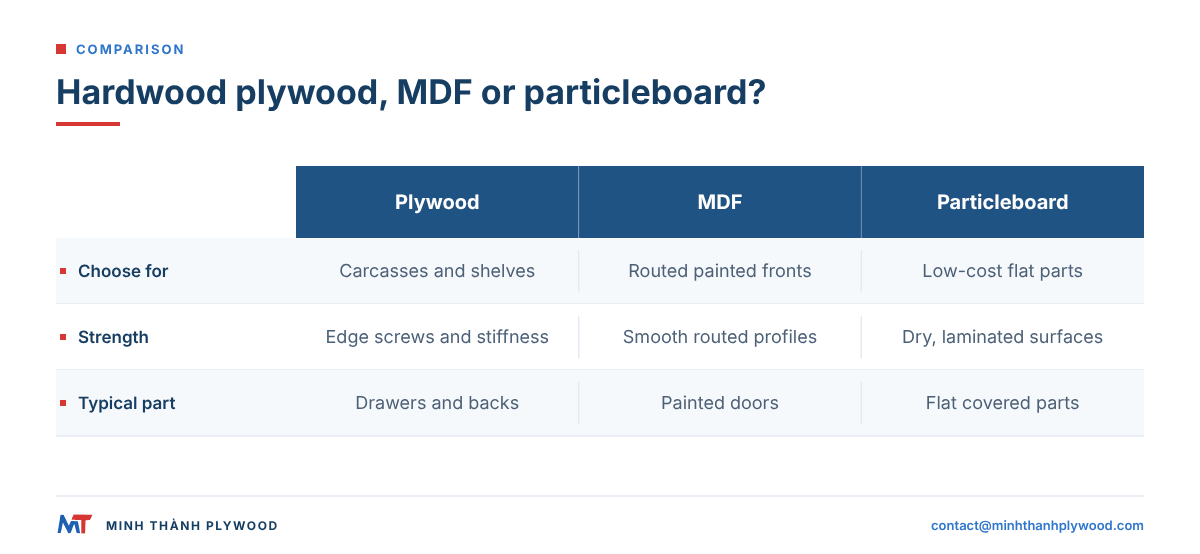
Hardwood plywood beats MDF and particleboard on weight, stiffness, screw holding and edge strength; MDF wins on a smooth, cheaply routed paint face. The choice is made part by part, not for the whole cabinet.
- Carcasses and shelves: plywood, for stiffness and screws that hold near the edge.
- Painted fronts with profiles: MDF, for a routed face that paints without grain.
- Low-cost flat parts in dry rooms: particleboard with a laminate face.
- Drawers and backs: thin plywood, for strength at low thickness.
Our plywood vs MDF and particle board vs plywood guides give the numbers for each part.
What this means for your hardwood plywood order
For a furniture or cabinet plant buying hardwood plywood from Vietnam, three decisions settle most of the order: the face grade pair, the core species and the tolerance. Fix them with an approved sample, then hold every lot to that sample.
Every Minh Thanh shipment is photographed and filmed before loading, and the buyer receives the photos and video. Documents per shipment are the commercial invoice, packing list, B/L and certificate of origin (EUR.1 for the EU), with phytosanitary and fumigation certificates. We supply the EUDR compliance dossier (origin records and geolocation files) with orders. Sea transit from Hai Phong is about 30–40 days to Northern Europe and 25–35 days to the Mediterranean, by carrier and route.
Ready to price it? Send the eight lines above to contact@minhthanhplywood.com or on WhatsApp at +84 988 586 601. We reply within hours and send free samples. See our commercial plywood and furniture plywood pages for the full range.
Buyer questions, answered
Is plywood a hardwood or a softwood?
Plywood is neither by itself: it takes the name of its veneers. Plywood faced with birch, poplar, eucalyptus or okoume is hardwood plywood; plywood faced with pine, fir or spruce is softwood plywood.
Is hardwood plywood waterproof?
No plywood is waterproof. Interior hardwood plywood with UF glue is for dry use; panels bonded with melamine-fortified or phenolic (WBP) glue resist humidity and weather far better, but the faces still need a finish outdoors.
What is the difference between hardwood plywood and softwood plywood?
Hardwood plywood has hardwood faces graded for appearance, sanded smooth, for furniture and interiors. Softwood plywood has pine, fir or spruce faces graded mainly for structure, for sheathing, floors and roofs.
What core does Vietnamese hardwood plywood use?
Mostly plantation hardwood veneer. Minh Thanh Plywood uses white Styrax or eucalyptus cores as standard, with acacia and pine cores on order.
What thicknesses does hardwood plywood come in?
Common stock thicknesses are 3, 6, 9, 12, 15 and 18 mm, with 21 and 25 mm for heavier parts. Minh Thanh Plywood makes 3–40 mm in 1220 × 2440 mm and 1250 × 2500 mm sheets.
How much does an 18 mm hardwood plywood sheet weigh?
A 1220 × 2440 × 18 mm sheet weighs about 26.8 kg on a Styrax core, 31.1 kg on acacia and 34.8 kg on eucalyptus, at reference densities of 500, 580 and 650 kg/m³.
Is hardwood plywood CARB compliant?
Hardwood plywood sold in the US must meet CARB Phase 2 / TSCA Title VI at 0.05 ppm. Minh Thanh Plywood is certified under ICTT mill no. 23024, and six chamber tests from April 2025 to June 2026 averaged 0.014–0.032 ppm.
What is 12 mm hardwood ply used for?
12 mm hardwood ply is used for drawer sides, cabinet backs that carry load, shelves over short spans, partitions and packaging that must look clean. For carcasses and long shelves most furniture plants step up to 15 or 18 mm.
Is hardwood plywood better than MDF?
For screw holding, weight, stiffness and resistance to moisture at the edges, yes. MDF gives a smoother paint face and cheaper routed profiles. Many kitchen and furniture plants use plywood for the carcass and MDF for painted fronts.
What is combi core plywood?
Combi core can mean mixed-species veneer plies or, in US catalogues, a veneer core with MDF crossbands. These constructions differ, so specify the core species, layer materials and lay-up on the order.
How do I order hardwood plywood from Vietnam?
Send the face species and grade pair, core species, glue and emission class, thickness with tolerance, sheet size, quantity and port. Minh Thanh Plywood replies within hours, sends free samples and ships from 1×40HC, 15–45 days after deposit.