
Plywood is neither hardwood nor softwood by itself: it takes the class of the veneers it is made from. Softwood plywood uses conifer veneers such as pine, fir or spruce; hardwood plywood uses broadleaf veneers such as birch, poplar, eucalyptus or Styrax. Minh Thanh Plywood builds hardwood-core panels in Vietnam, so here is the comparison from the mill side.
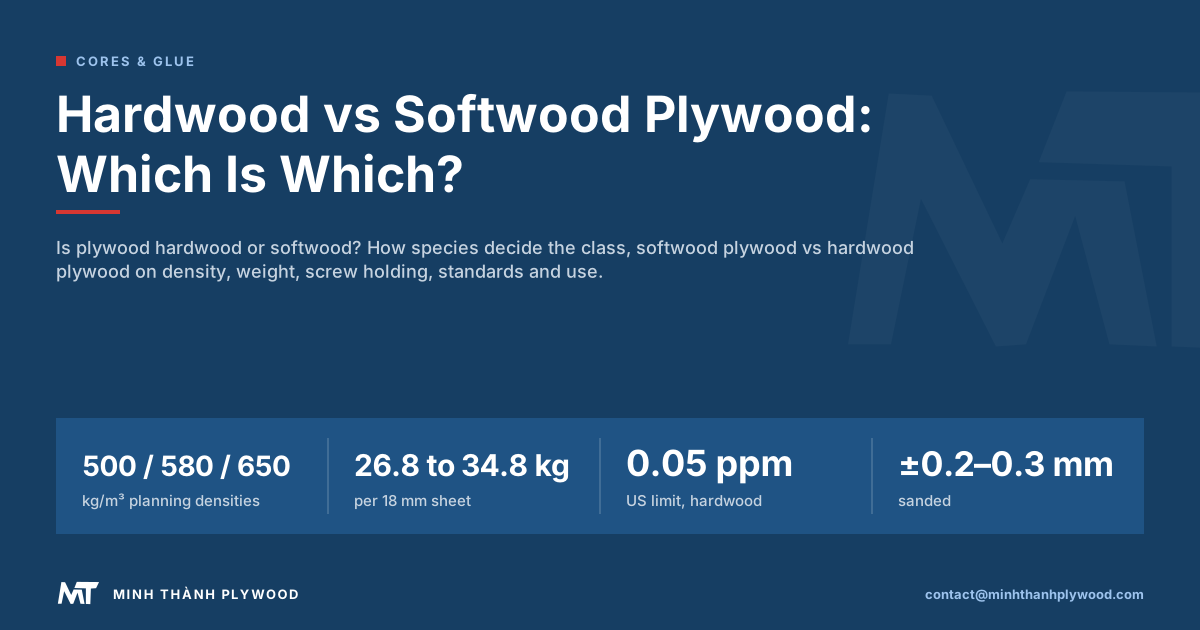
Is plywood hardwood or softwood?
Plywood is neither hardwood nor softwood by itself: it is an engineered panel, and it takes the class of the wood its veneers come from. A panel made of pine, fir or spruce veneers is softwood plywood; a panel made of birch, poplar, eucalyptus, Styrax or other broadleaf veneers is hardwood plywood.
Trade names follow two habits. In North America, “softwood plywood” is the structural sheathing and sanded panel, and “hardwood plywood” is the decorative panel with a hardwood face. The structural panels are made to Voluntary Product Standard PS 1. In Europe and Asia, buyers name plywood by the face species and then by the core, such as “poplar-faced plywood on Styrax core”.
| What you are holding | Face veneer | Core veneers | Class |
|---|---|---|---|
| CDX or sanded pine plywood | Pine | Pine | Softwood plywood |
| Douglas fir sheathing | Douglas fir | Douglas fir | Softwood plywood |
| Birch plywood (all-birch) | Birch | Birch | Hardwood plywood |
| Birch-faced plywood on Styrax core | Birch | Styrax | Hardwood plywood |
| Poplar-faced plywood | Poplar | Poplar or Styrax | Hardwood plywood |
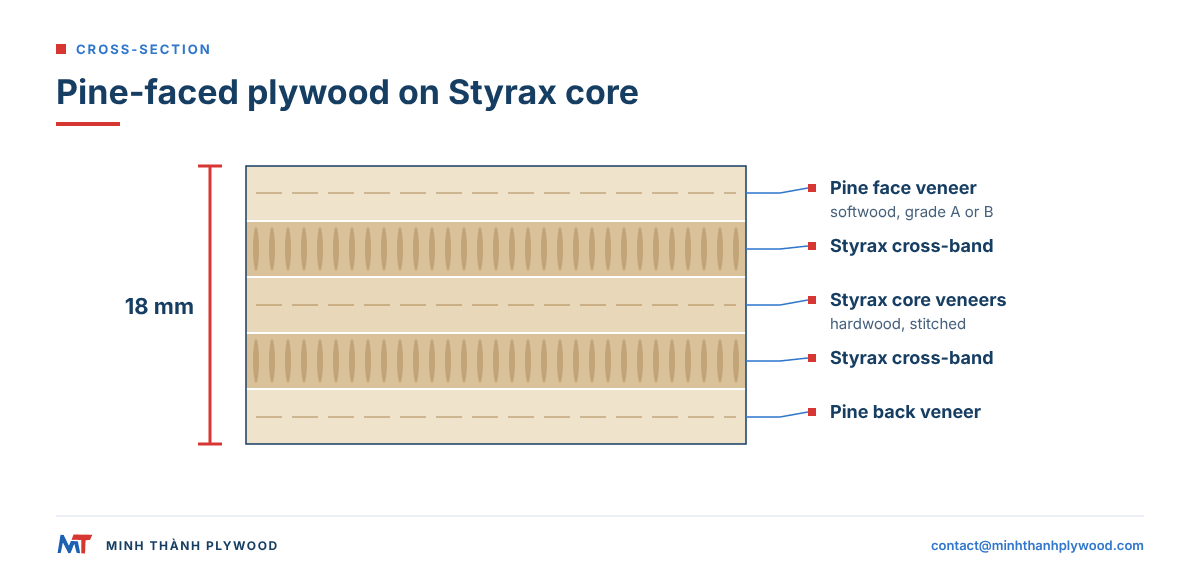
| Pine-faced plywood on Styrax core | Pine | Styrax | Mixed: softwood face, hardwood core |
The last row is the one that causes confusion, and it has its own section below.
Is pine or balsa a hardwood?
Pine is a softwood and balsa is a hardwood, because the two words name the tree family, not how hard the wood is. Hardwoods are angiosperms: broadleaf, flowering trees whose seeds sit inside a fruit. Softwoods are gymnosperms: conifers, mostly with needles and cones.
That is why the labels can mislead. Balsa is a hardwood and is one of the lightest woods traded. Yew is a softwood and is hard and heavy. Poplar and Styrax are hardwoods with low density; eucalyptus is a hardwood with high density.
Inside the panel, the difference shows in the wood cells:
- Softwood is made mostly of tracheids, long cells that carry water and give strength. Growth rings show a clear contrast between pale earlywood and dark latewood, which is why pine faces show strong grain and knots.
- Hardwood has vessels (pores) as well as fibres. The grain is usually finer and more even, which gives smoother sanded faces for paint, veneer or laminate.
Examples of softwood and hardwood species in plywood
Most softwood plywood is made from pine, Douglas fir or spruce; most hardwood plywood is made from birch, poplar, eucalyptus, acacia, okoume or Styrax. Softwoods are conifers and hardwoods are broadleaf trees. The table lists the species buyers meet in quotations, with planning densities.
| Species | Class | Planning density | Where the plywood is made | Typical panel |
|---|---|---|---|---|
| Radiata pine | Softwood | 450–550 kg/m³ | Chile, New Zealand | Sanded and structural pine plywood |
| Southern yellow pine, elliottii pine | Softwood | 450–550 kg/m³ | US, Brazil | Sheathing, CDX, sanded pine |
| Douglas fir | Softwood | 450–550 kg/m³ | US, Canada | Structural sheathing, formwork |
| Spruce | Softwood | 400–450 kg/m³ | Northern Europe | Construction plywood |
| Birch | Hardwood | 650–750 kg/m³ | Northern Europe, also as faces | Furniture, flooring, vehicle floors |
| Poplar | Hardwood | 400–450 kg/m³ | Asia, Europe | Light furniture plywood |
| Styrax | Hardwood | 500 kg/m³ | Northern Vietnam | Furniture plywood core |
| Acacia | Hardwood | 580 kg/m³ | Vietnam | Commercial and furniture core |
| Eucalyptus | Hardwood | 650–750 kg/m³ | Vietnam, South America | Stiff furniture parts, formwork |
| Balsa | Hardwood | 100–250 kg/m³ | Ecuador | Sandwich cores, not plywood |
Styrax, Acacia and Eucalyptus are the three Vietnamese plantation cores. At Minh Thanh, furniture panels use white Styrax or Eucalyptus cores as standard; Acacia and Pine cores are made on order.
Hardwood vs softwood plywood: the comparison table
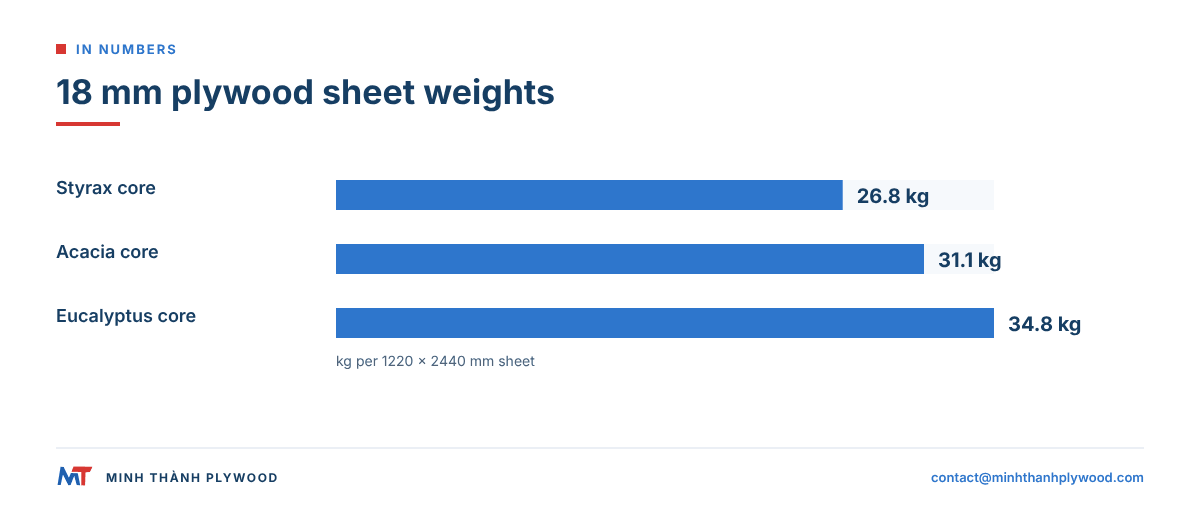
Hardwood plywood wins on face quality, screw holding and tolerance; softwood plywood wins on price and local availability for sheathing. The table compares a typical sanded hardwood furniture panel with a typical softwood panel of the same thickness.
| Metric | Softwood plywood (pine, fir) | Hardwood plywood (Styrax, eucalyptus, birch) |
|---|---|---|
| Density | 450–550 kg/m³ | 500 kg/m³ (Styrax) to 650–750 kg/m³ (eucalyptus, birch) |
| 18 mm sheet, 1220 × 2440 mm | about 24–30 kg | 26.8 kg (Styrax), 34.8 kg (eucalyptus) |
| US units: 4 x 8 ft sheet, 23/32 in (18 mm) | about 53–66 lb | 59 lb (Styrax), 77 lb (eucalyptus) |
| US face grades | A to D veneer grades and CDX under PS 1 (A, B, C plugged, C, D) | Face grades AA, A, B, C, D and E, and back grades 1 to 4, under ANSI/HPVA HP-1 |
| Face | Strong grain, knots and patches by grade | Fine, even grain; sanded for paint or overlay |
| Screw holding in the face | Good in latewood, weaker in earlywood | Even; better as density rises |
| Stiffness | Good for its weight | Higher with dense cores |
| Thickness tolerance | Sheathing grades are unsanded | Sanded furniture panels ±0.2–0.3 mm |
| Edge | Visible voids allowed in sheathing grades | Closed, stitched core in furniture grades |
| Usual standards | PS 1, CSA O121/O151, EN 636 | ANSI/HPVA HP-1, EN 636, EN 635-2 |
| Typical use | Roofs, walls, subfloors, crates | Furniture, cabinets, interiors, flooring |
| Price | Lower where grown locally | Higher for furniture grades |
The weight row is computed: 1.22 m × 2.44 m × 0.018 m = 0.0536 m³ per sheet, multiplied by the density. The US row converts the same weights at 2.2046 lb per kg. A US 3/4 in sheet is sold as 23/32 in actual, which is the 18 mm panel in this table. In the US grade row, softwood plywood is graded A to D by face veneer quality, with CDX meaning a C face, a D back and exterior glue; hardwood plywood is graded by HP-1 face grades AA to E, with the back graded separately from 1 to 4.
Density and sheet weight
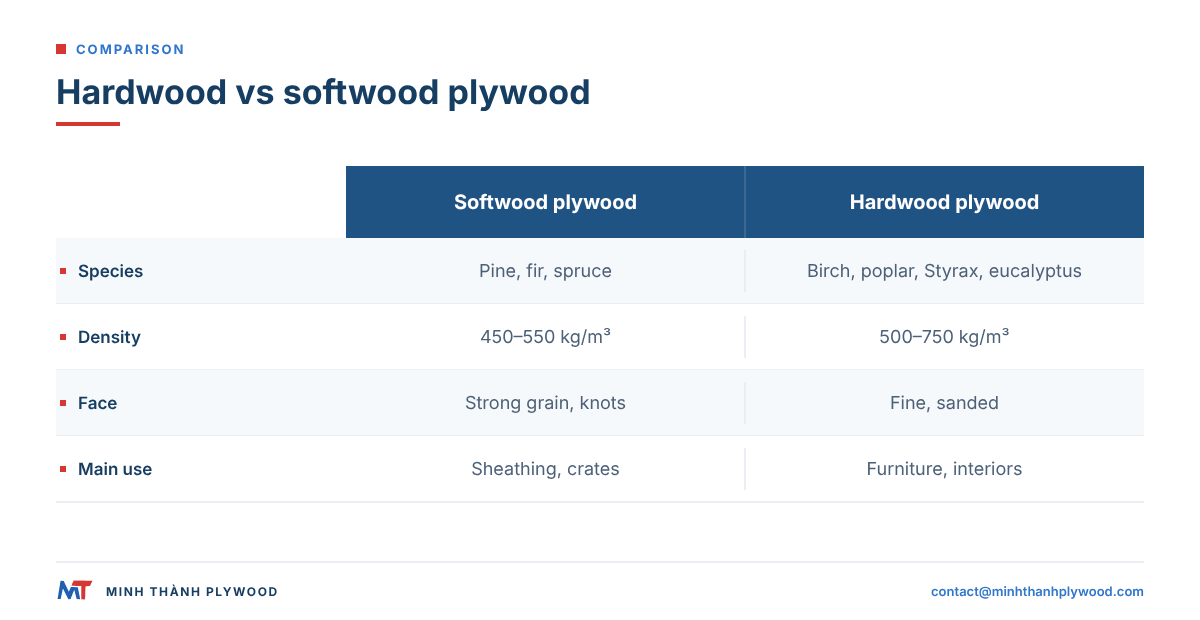
Density is the number that tells hardwood and softwood plywood apart in practice, and the overlap is large. A Styrax-core hardwood panel at 500 kg/m³ sits inside the pine range; a eucalyptus-core panel at 650 kg/m³ is about a third heavier.
Minh Thanh plans container loads with three reference core densities. For an 18 mm sheet of 1220 × 2440 mm:
| Core | Planning density | Sheet weight | 40HC load at 18 mm |
|---|---|---|---|
| Styrax | 500 kg/m³ | 26.8 kg | 990 sheets |
| Acacia | 580 kg/m³ | 31.1 kg | 880 sheets |
| Eucalyptus | 650 kg/m³ | 34.8 kg | 795 sheets |
The container plan uses packs about 1,000 mm high, capped by a planning payload of 28,000 kg unless the booking is lower. Heavier cores fill the weight limit before the volume, so the core choice changes the cost per sheet landed. The plywood weight calculator gives other thicknesses.
Strength, stiffness and screw holding
At the same thickness, a denser hardwood core gives a stiffer panel and stronger screw holding than a typical softwood panel. Bending strength and stiffness rise with density, and hardwood fibres hold a screw thread more evenly than softwood, where soft earlywood alternates with hard latewood.
Three points change the answer more than the species name:
- Core build. A stitched, closed core without gaps carries load across the whole sheet. A core with gaps fails at the gap, whatever the species.
- Ply count and lay-up. More, thinner plies spread defects and keep the sheet flat. Minh Thanh’s 18 mm furniture panels have 11–13 plies.
- Face direction. Plywood is stiffer along the face grain. A shelf cut with the face grain along the span carries more than one cut across it.
For shelf spans and load per sheet, read how much weight plywood can hold.
Is softwood plywood waterproof?
The glue decides how plywood behaves in water, and it is specified separately from the species. A hardwood panel bonded with interior glue is no more water-resistant than a softwood panel bonded with the same glue.
Bond classes come from EN 314-2, and use classes from EN 636: EN 636-1 for dry interiors, EN 636-2 for humid interiors and EN 636-3 for exterior exposure. In practice:
- UF glue at E0 emission is the standard for furniture and interior panels at Minh Thanh: dry use, low formaldehyde.
- MR or melamine-fortified (MUF) glue for humid interiors, such as kitchen carcasses.
- Phenolic (WBP) glue for exterior and formwork panels.
North American softwood sheathing is mostly made with exterior phenolic glue, which is why buyers sometimes link “softwood” with “outdoor”. The link is the glue, not the tree. More on the question in is plywood waterproof.
Hardwood plywood, softwood plywood and formaldehyde rules
In the US, the species class changes which formaldehyde rule applies. EPA’s TSCA Title VI rule and the California CARB Phase 2 rule limit hardwood plywood with a veneer core to 0.05 ppm, and exempt structural plywood made to PS 1, which is mostly softwood sheathing.
Minh Thanh’s hardwood plywood is certified CARB P2 / TSCA Title VI under ICTT mill no. 23024. Six ASTM D6007 chamber tests between April 2025 and June 2026, on 9, 15 and 18 mm panels, averaged 0.014–0.032 ppm against the 0.05 ppm limit; three were run by Shanghai Hongjun and three by ICTT Vietnam.
In the EU, Regulation (EU) 2023/1464 sets 0.062 mg/m³ for furniture and wood-based articles from 6 August 2026, whatever the species (EUR-Lex). European furniture buyers accept CARB P2 / TSCA Title VI and the chamber tests as proof, and third-party testing to EN 717-1 or the buyer’s own method is arranged through SGS on request.
Where each one wins: verdict by use
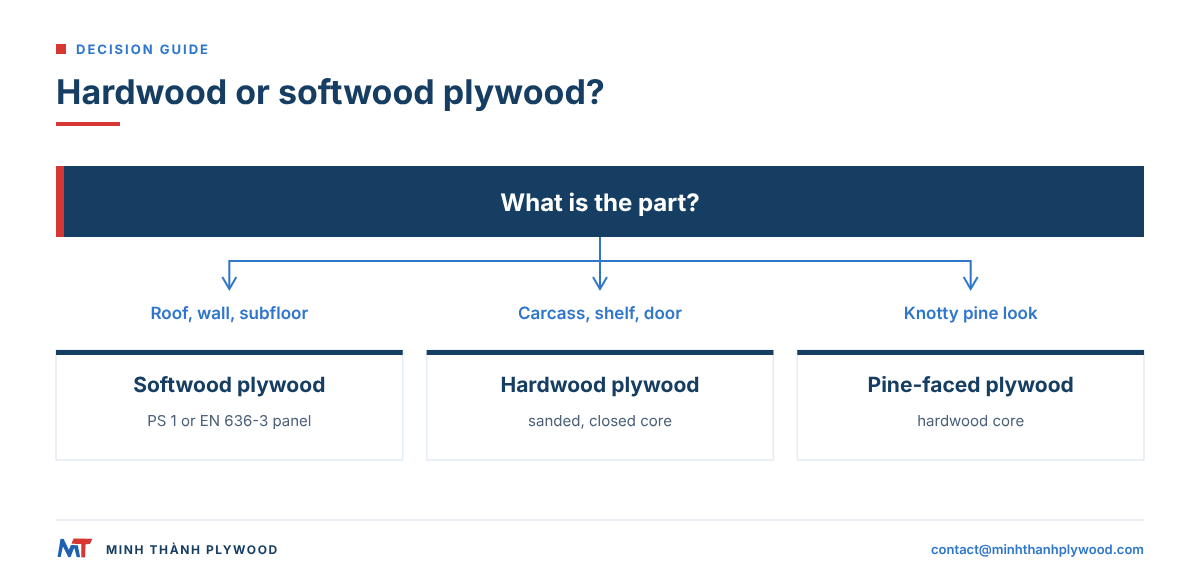
Choose softwood plywood for structural sheathing bought close to the forest; choose hardwood plywood for furniture, interiors and anything that is sanded, coated or machined. The verdict by use:
| Use | Better choice | Why |
|---|---|---|
| Roof and wall sheathing in North America | Softwood plywood | Local PS 1 panels, exterior glue, low price; see roof sheathing |
| Subfloors | Either, by the span rating | Structural rating matters more than species |
| Kitchen and bedroom carcasses | Hardwood plywood | Even screw holding, sanded faces, tight tolerance |
| Painted cabinet doors and panels | Hardwood plywood (poplar, EV, Styrax core) | Fine grain, few face repairs |
| Rustic or knotty-look furniture | Pine-faced plywood | The pine grain is the look |
| CNC-cut flat-pack parts | Hardwood plywood | Closed core edges, flat sheets |
| Concrete formwork, many reuses | Film-faced hardwood core, phenolic glue | Stiff core, sealed faces |
| Crates and pallets | Either packing grade | Price per cubic metre decides |
The best plywood for furniture guide goes deeper into furniture grades.
Pine-faced plywood on a hardwood core
Pine-faced plywood on a Styrax or Eucalyptus core is a mixed panel: a softwood face for the pine look, a hardwood core for flatness and screw holding. It is common in furniture plywood from Vietnam, and buyers should name both layers on the order.
Minh Thanh quotes pine-faced plywood as face/back grade pairs A/A, A/B and B/B (B/C for utility parts), matched to the buyer’s approved sample. The ladder is comparable to the European softwood face classes I to IV of EN 635-3 and the US A to D grades. The core stays white Styrax or Eucalyptus as standard, or Pine on order when the buyer wants an all-softwood panel.
How to describe it on paperwork: “pine-faced plywood, Styrax core” for the commercial invoice, with face and core species and Vietnamese harvest origin supplied for an importer’s Lacey Act declaration on US orders.
The birch vs pine plywood comparison covers the two faces side by side.
Vietnamese hardwood core vs pine plywood from Chile and Brazil
Pine plywood from Chile, Brazil or New Zealand is softwood through every ply; Vietnamese furniture plywood is a hardwood core with the face the buyer chooses. Both are traded worldwide, and each fits a different order.
| Point | Pine plywood (radiata, elliottii) | Vietnamese hardwood-core plywood |
|---|---|---|
| Core | Pine veneers | Styrax, Eucalyptus or Acacia veneers |
| Faces | Pine, by grade | Birch, poplar, EV, okoume, pine and others |
| Density | 450–550 kg/m³ | 500 kg/m³ (Styrax) to 650 kg/m³ (Eucalyptus) |
| Core build for furniture | Varies by mill and grade | Stitched horizontally and vertically, pressed twice |
| Thickness tolerance (sanded) | By grade and mill | ±0.2–0.3 mm, down to ±0.2 mm |
| Sizes | 1220 × 2440 mm, metric sizes by mill | 1220 × 2440 and 1250 × 2500 mm, plus 1220 × 2500 and 1220 × 2280 mm |
The Vietnamese core suits buyers who want one panel with a choice of faces. Furniture-grade panels at Minh Thanh are pressed twice as standard: the core board is pressed and calibrated, then face and back are pressed on. That is what gives the flat, even sheet that CNC lines and UV coating lines need.
Cost and availability
Softwood plywood is usually the cheaper panel where it is made locally, and hardwood furniture plywood costs more for its faces, core work and sanding. In North America and the Nordic countries, softwood sheathing is a commodity; in Europe’s furniture trade, hardwood plywood dominates.
For indicative starting prices in October 2026, Minh Thanh quotes commercial plywood from US$250/m³ and furniture or interior plywood from US$350/m³, FOB Hai Phong. The final price follows the face, core, glue, thickness, size, quantity and delivery term. Production takes 15–45 days after the 30% deposit; the minimum order is one 40HC, with mixed specifications by agreement.
How to specify hardwood or softwood plywood on your order
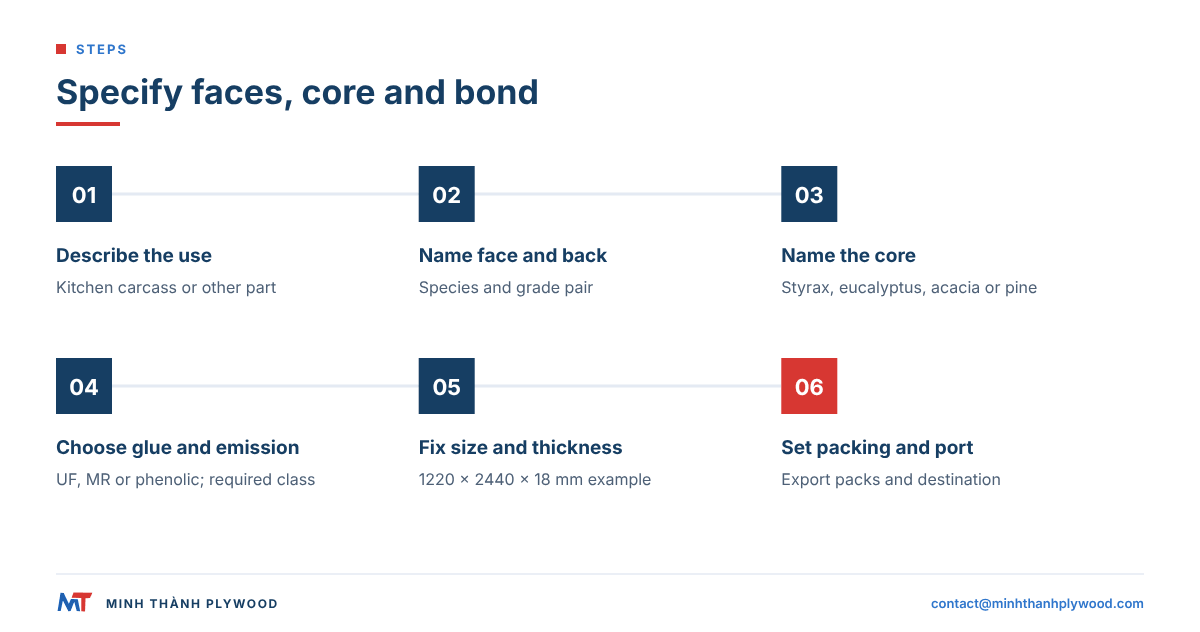
Write the species of every layer, the glue and the use; “hardwood plywood” alone leaves the core open. A complete line has six parts:
- Use: for example, kitchen carcasses in a humid interior.
- Face and back: species and grade pair, such as pine A/B or poplar B/B.
- Core: Styrax, Eucalyptus, Acacia or Pine, stitched.
- Glue and emission: UF glue at E0 emission, MR/MUF or phenolic (WBP), with CARB P2 / TSCA Title VI where needed.
- Size and thickness: 1220 × 2440 × 18 mm, sanded, tolerance ±0.2–0.3 mm.
- Packing and quantity: export packs, sheets or cubic metres, destination port.
A ready example: “Pine-faced plywood A/B, Styrax core stitched, UF glue at E0 emission, 1220 × 2440 × 18 mm sanded, export packs, one 40HC to Northern Europe.” Transit from Hai Phong to Northern Europe is 30–40 days at sea.
Send that line to [email protected] or through the quotation form, and ask for free samples of the face and core you are comparing. For the full species range, start with the types of plywood guide or the hardwood plywood guide.
Buyer questions, answered
Is plywood hardwood or softwood?
Plywood is an engineered panel, so it is neither. It is called hardwood plywood when its veneers come from broadleaf trees such as birch, poplar or eucalyptus, and softwood plywood when they come from conifers such as pine, fir or spruce.
Is pine a hardwood?
No. Pine is a softwood: it is a conifer with needles and cones. Pine plywood, made from radiata, southern yellow or other pines, is softwood plywood.
Is balsa a hardwood?
Yes. Balsa is a broadleaf flowering tree, so botanically it is a hardwood, even though it is one of the lightest woods in trade. Hardwood and softwood name the tree family, not the hardness.
What are examples of softwood?
Pine, spruce, fir, Douglas fir, larch, hemlock and cedar are softwoods. The main softwood plywood species are pine, Douglas fir and spruce.
Is hardwood plywood stronger than softwood plywood?
At the same thickness, a denser hardwood core usually gives higher stiffness and better screw holding. A light hardwood core such as Styrax weighs about the same as pine, so compare the panel's density and build, not only the label.
Is poplar plywood hardwood or softwood?
Poplar is a hardwood: it is a broadleaf tree. Poplar plywood is light and soft to the touch, but it is classed as hardwood plywood.
Which is better for furniture, hardwood or softwood plywood?
Hardwood plywood is the usual choice for furniture because of its smooth sanded faces, tight thickness tolerance and clean edges. Softwood plywood suits rustic or knotty-look furniture and pine-faced parts.
Is softwood plywood suitable for concrete formwork?
Yes, for basic forms with few reuses. Film-faced hardwood-core panels with phenolic glue are the usual choice where a form is reused many times.
Is softwood plywood cheaper than hardwood plywood?
In North America and Northern Europe, local softwood sheathing is usually the cheaper panel. Sanded hardwood plywood for furniture costs more because of the face veneer, the core work and the sanding.
Is Styrax a hardwood or a softwood?
Styrax is a broadleaf plantation tree, so it is a hardwood. It is light, around 500 kg/m³ for planning, which is why it gives furniture plywood a weight close to pine plywood.
Does hardwood or softwood decide the formaldehyde rules?
In the US it can. TSCA Title VI limits emissions from hardwood plywood to 0.05 ppm, while structural plywood made to Voluntary Product Standard PS 1 is exempt from that rule.