
Black film faced plywood and brown film faced plywood are the same product with a different dye in the film. Colour does not decide quality: film weight, glue, core and edge sealing do. A black sheet with 120 g/m² film on a loose core will fail sooner than a brown sheet with premium film on a dense Eucalyptus core. This guide from Minh Thanh Plywood shows what to specify instead, with a verdict by use.
Black film faced plywood vs brown: the short answer
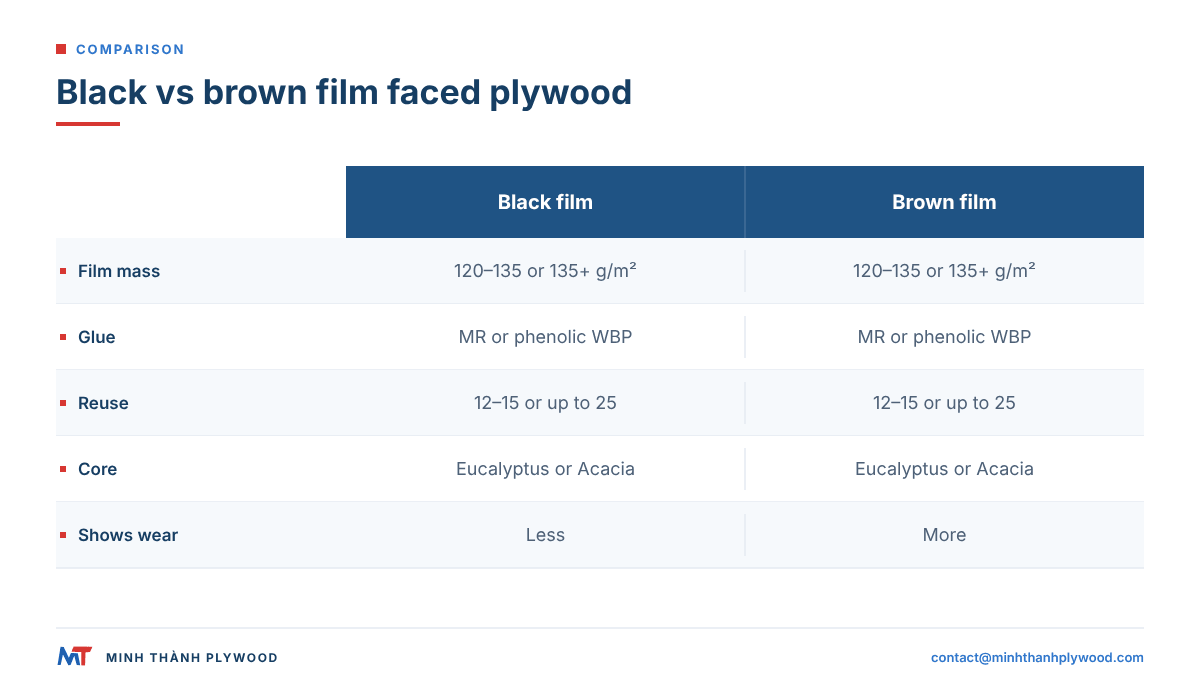
Black film faced plywood and brown film faced plywood differ only in the dye of the film. Performance comes from four lines on the quotation: film weight, glue, core and edge sealing.
| What you compare | Black film | Brown film | What really decides it |
|---|---|---|---|
| Film | Phenolic-resin paper, black dye | Phenolic-resin paper, brown dye | Film mass in g/m² |
| Standard film mass we quote | 120–135 g/m² | 120–135 g/m² | Same range for both colours |
| Premium film mass we quote | From 135 g/m² | From 135 g/m² | Same range for both colours |
| Glue | Melamine-fortified or phenolic WBP | Melamine-fortified or phenolic WBP | Glue type, not colour |
| Reuse with proper handling | About 12–15 (melamine), up to about 25 (phenolic) | About 12–15 (melamine), up to about 25 (phenolic) | Glue, care, release agent, edge sealing |
| Core | Eucalyptus or Acacia | Eucalyptus or Acacia | Core species and lay-up |
| Thickness tolerance | ±0.5 mm | ±0.5 mm | Calibration and pressing |
| Concrete finish | Smooth, uniform | Smooth, uniform | Film mass and clean faces |
| Shows scratches and wear | Less | More | Colour only |
| Market habit | Common across Asia and the Middle East | Traditional phenolic colour in Europe | Buyer preference |
Choose the colour your site, system or customers expect. Then compare film mass, glue and core between quotations, because those three lines decide how many pours you get.
What is black film faced plywood?
Black film faced plywood is plywood with a black phenolic-resin film pressed onto both faces and its edges sealed. It is a concrete formwork panel: the film gives a smooth concrete finish, releases cleanly and keeps water out of the face veneers.
Black film plywood starts as an ordinary plywood panel of cross-laid veneers. At Minh Thanh the core is Eucalyptus or Acacia, laid in alternate grain directions and bonded with melamine-fortified or phenolic WBP glue. Kraft paper impregnated with phenolic resin is then hot-pressed onto both faces, and the cut edges are sealed.
The black colour is a pigment in the resin paper. It hides scratches, release-agent stains and concrete residue, so a black panel still looks clean after many pours. That is why contractors in many Asian and Middle Eastern markets ask for black by habit.
Brown film faced plywood is built in exactly the same way. Brown is the natural colour of phenolic film without added black pigment, and it has long been the standard colour for European formwork panels. For a deeper look at the panel underneath the film, read what plywood is and how its layers work. For how overlaid and film-faced panels are classed in North American practice, see APA – The Engineered Wood Association.
What does the film colour actually signal?
The film colour signals the paper maker’s dye and the buyer’s market habit, nothing more. It does not tell you the film mass, the resin content, the glue or the core.
Film suppliers sell the same resin paper in several colours. A mill can press black, brown, red or green film of the same weight on the same core in the same week. Colour therefore cannot be a grade.
What colour can tell you is indirect:
- Brand habit. Some film brands are best known for one colour, so buyers use the colour as shorthand for a film they trust. Name the film brand and mass on the order instead.
- Market habit. A distributor whose customers ask for black will stock black. The colour follows the market, not the quality.
- Price tier in some markets. In some markets the cheapest panels share one colour, which builds a reputation. A premium panel in the same colour is still a premium panel.
Our rule for every quotation: we state film mass, glue and core on separate lines, and the film brand and colour are matched to the order. Colour is the last line, not the first.
Film weight: the number that matters more than colour
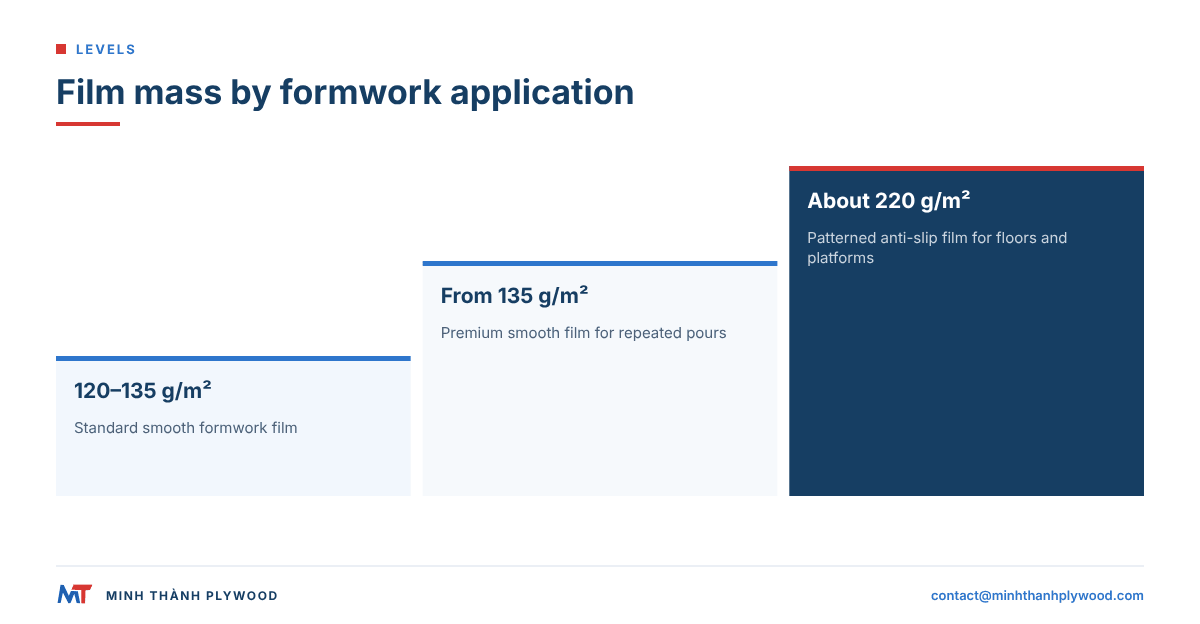
Film weight, in grams per square metre (g/m²), is the first number to compare between two film-faced quotations. Our standard film is 120–135 g/m² and premium film starts from 135 g/m².
A heavier film carries more resin on the face. More resin gives a harder, thicker surface that resists abrasion from vibrators, steel fixing and stripping, and keeps water out of the face veneer for longer. On a light film, the paper texture shows sooner and the face starts to absorb moisture.
How to compare film weight between offers:
- Ask each supplier for the film mass in g/m² for both faces.
- Ask for the film brand; the same brand and mass gives the same surface whatever the colour.
- Compare a sample of each: a premium film feels smooth and closed, a light film shows paper texture under a raking light.
- Keep the approved sample. Our quotation fixes the construction and the retained sample fixes the contact finish for repeat orders.
Anti-slip film is a separate product with a much heavier, patterned film of about 220 g/m² for floors and platforms. Do not compare it with smooth formwork film.
Glue: why it decides reuse and water resistance
Glue decides how long a film-faced panel survives wet concrete, and colour has no part in it. We make film-faced plywood with melamine-fortified glue or phenolic WBP glue, named as a separate line from the film and the emission class.
- Melamine-fortified glue suits standard formwork and humid, wet-use specifications with an agreed bond test. Panels give about 12–15 uses with proper handling, release agent and edge sealing.
- Phenolic WBP glue is the usual choice for repeated wet formwork and outdoor wetting. Panels give up to about 25 uses under the same care conditions.
WBP means weather and boil resistance in plywood trading. On our quotations we state the adhesive family and the bond-test requirement, so a buyer can compare a black offer and a brown offer on the same terms. Bonding-quality requirements for plywood are set in BS EN 314-2, and BS EN 636 covers plywood for dry, humid or exterior conditions.
A black sheet with melamine-fortified glue will not outlast a brown sheet with phenolic WBP glue, whatever the film. When two quotations differ in price, check the glue line first. Our guide to shuttering plywood explains how formwork contractors choose the bond.
Core and build: what sits under the film
The core decides stiffness, sheet weight and whether the panel stays flat after many wet cycles. Our film-faced panels use Eucalyptus or Acacia cores, the two species Vietnamese mills use for construction plywood.
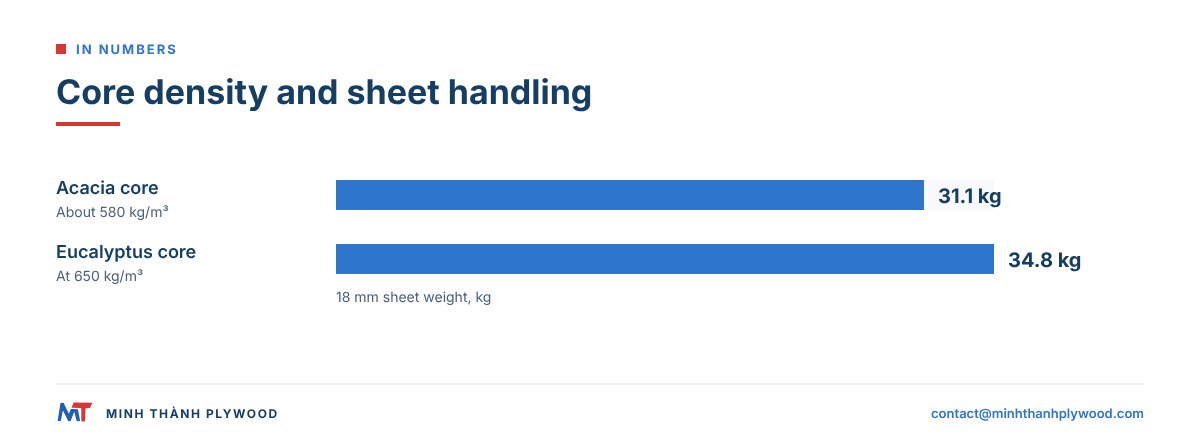
| Core | Planning density | 18 mm sheet, 1220 × 2440 mm | Where it fits |
|---|---|---|---|
| Eucalyptus | 650–750 kg/m³ | About 34.8 kg at 650 kg/m³ | Heavier-duty slabs, walls, columns |
| Acacia | About 580 kg/m³ | About 31.1 kg at 580 kg/m³ | Lighter handling, standard pours |
Sheet weights are planning values from the core density; weigh real sheets before booking freight. Eucalyptus is denser and stiffer, so it suits heavier-duty panel requirements. Acacia reduces sheet weight, which crews notice on every lift.
A loose or gapped core is the most common hidden fault in cost-focused film-faced plywood, in any colour. Core gaps let the film sink and crack, and they become water paths once the face is damaged. Ask for the core species, the core grade and a cut sample showing the edge.
Edge sealing and handling: where panels fail first
Most film-faced panels fail at the edges and corners, not in the middle of the face. Water enters where the film stops, so sealed edges and careful stripping matter as much as the film itself.
Our film-faced build has smooth film on both faces and sealed edges. Fresh cuts and drilled holes need edge sealer before the panel goes into service; an unsealed saw cut takes up water within a few pours.
On site, five habits decide whether a panel reaches its reuse target:
- Apply release agent before every pour.
- Strip with care and protect corners; avoid prying on the face.
- Clean the contact face after each use.
- Seal every new cut and hole.
- Store sheets flat, off the ground and covered between pours.
These rules apply to black, brown, red and green film alike. The reuse figures we quote always assume them.
Does black film faced plywood always give more reuse cycles?
No. Reuse depends on glue, film mass, core and site care. Black film faced plywood gives more pours than brown only when the black panel has a heavier film or a better glue.
With proper handling, release agent and edge sealing, our panels target:
| Build | Film | Glue | Reuse target |
|---|---|---|---|
| Standard | 120–135 g/m², black or brown | Melamine-fortified | About 12–15 uses |
| Premium | From 135 g/m², black or brown | Phenolic WBP | Up to about 25 uses |
The colour column is the same in both rows on purpose. If a supplier offers more pours for black than for brown with the same film, glue and core, ask what else changed. Our film-faced plywood page lists both builds.
Black vs brown film faced plywood price: what affects the cost?
The price of film-faced plywood follows the build, not the colour. Five lines move the price, in roughly this order of weight.
- Glue. Phenolic WBP costs more than melamine-fortified glue and buys more reuse.
- Film mass. Premium film from 135 g/m² costs more than standard 120–135 g/m² film.
- Core species and grade. Eucalyptus and Acacia differ in price and weight; a closed core costs more than a gapped one.
- Thickness. More veneer, more glue, more cost per sheet.
- Edge sealing and tolerance. Sealed edges and ±0.5 mm thickness tolerance take time on the line.
| Thickness, 1220 × 2440 mm | Market low end per piece | Raw FOB example at US$250/m³ |
|---|---|---|
| 12 mm | from about US$7 | about US$8.9 |
| 15 mm | about US$9 to 11 | about US$11.2 |
| 18 mm | up to about US$13 | about US$13.4 |
The market band comes from one maker’s guide that puts black film-faced plywood at US$7 to 13 per piece (Onsun, read 21 October 2026). The right column is arithmetic, not a quotation: the sheet volume multiplied by our starting price for commercial plywood of US$250/m³, FOB Hai Phong, October 2026, a raw FOB example and not a film-faced sheet price. Film-faced panels with premium film (from 135 g/m²), phenolic WBP glue or a Eucalyptus core price above that line and vary with each order; black and brown at the same build cost the same.
The final price also depends on size, quantity and delivery term: FOB Hai Phong, CFR or CIF. For dated indicative prices by market, read our guide to film-faced plywood prices.
When a brown offer and a black offer differ by more than a small margin, put them side by side on these five lines. The gap is almost always in glue, film or core.
Black vs brown film faced plywood cost: which gives better value per pour?
The better value is the panel with the lowest cost per usable pour, whatever its colour. Divide the delivered panel cost by the pours you actually get, then add cleaning, handling and replacement.
A worked comparison on the same site, with proper handling, release agent and edge sealing:
| Panel A | Panel B | |
|---|---|---|
| Film | Black, standard 120–135 g/m² | Brown, premium from 135 g/m² |
| Glue | Melamine-fortified | Phenolic WBP |
| Reuse target | About 12–15 uses | Up to about 25 uses |
| Delivered price | Lower | Higher |
| Cost per pour | Higher when pours are many | Lower when pours are many |
For a short project with a handful of pours, the standard panel is the cost-effective choice. For repeated wall and slab cycles, the premium phenolic panel usually costs less per pour. Colour plays no part in the arithmetic.
A trial set on your own site gives the real figure for your crews, release agent and stripping method. We supply free samples, and a first order can mix builds in one 40HC by agreement.
Black film faced plywood: advantages and best uses
Black film faced plywood is the right choice where a clean-looking panel matters after many pours and where your market expects black. Its practical advantage is visual: it hides wear.
Advantages buyers report for black film:
- Scratches, release-agent marks and concrete residue show less.
- Stock looks uniform on a distributor’s yard, which helps resale.
- Many Asian and Middle Eastern contractors specify it by habit, so it is easier to sell there.
Best uses:
- Slab and wall formwork with repeated cycles.
- Column moulds and beam sides.
- Rental formwork fleets, where panels must still look presentable after many hires.
- Temporary hoarding and site panels.
For repeated pours, pair black film with premium film mass and phenolic WBP glue. That build, not the colour, gives the reuse.
Brown film faced plywood: advantages and best uses
Brown film faced plywood is the right choice where your formwork system, engineer or customers expect brown, which is common in Europe. It performs exactly like black film of the same build.
Advantages of brown film:
- It is the traditional phenolic film colour, so European specifications and system suppliers often show it.
- Surface defects such as dry spots or poor pressing are easier to see on inspection.
- Panels from different lots are easy to match when the same film brand is used.
Best uses:
- Wall and slab formwork in system frames.
- Projects where the specification or a sample board names brown.
- Standard formwork where cost per pour matters more than looks after use.
Brown film shows wear sooner than black. That is cosmetic: the concrete finish depends on the film mass and on a clean face, not on the colour.
Red film faced plywood, green film faced plywood and white film faced plywood
Red, green and white films are less common colours of the same overlay idea. Each one is specified like black or brown: by film type, film mass, glue and core.
| Film colour | Where buyers order it | What to check |
|---|---|---|
| Red film faced plywood | Light-duty, cost-focused formwork in some Asian markets | Film mass and glue; red often marks a lighter build |
| Green film faced plywood | Sites or systems with a green colour standard; some green panels use a plastic overlay | Whether the overlay is phenolic film or plastic, and its thickness |
| White film faced plywood | Vehicle body linings, signboards, bright and easy-clean surfaces | Surface hardness and cleanability; white shows dirt |
Black and brown smooth films are the colours we quote as standard for formwork. Other colours, and the film brand, are matched to the order on request; send the colour, the film mass you need and the use, and we quote the build.
How to specify film-faced plywood so the colour does not mislead you
Write the specification so that any supplier must quote the same panel, then add the colour last. These lines make two offers comparable.
- Application: slab, wall, column or other use, and the number of pours you plan.
- Thickness and size: for example 18 mm, 1220 × 2440 or 1250 × 2500 mm.
- Core: Eucalyptus or Acacia.
- Glue and bond test: melamine-fortified or phenolic WBP, with the bond test your project needs.
- Film: mass in g/m² on both faces, film brand if you have one.
- Colour: black or brown, or another colour on request.
- Edges: sealed, and the edge colour if your yard uses one.
- Tolerance: ±0.5 mm on thickness for our film-faced range.
- Packing and quantity: pallets, sheets per pack, number of containers and destination port.
Attach the drawing and any named product classification the project requires. A specification like this is far more useful than a request for a generic “premium black waterproof sheet”.
Black film faced plywood from Vietnam: supply, loading and transit
Minh Thanh Plywood makes film-faced plywood alongside its furniture plywood at Ha Hoa, Phu Tho, and ships from Hai Phong in full 40HC containers. Orders start at one 40HC, and film colours, sizes and builds can be mixed by agreement. For the EU, Regulation (EU) 2023/1115 covers plywood (HS 4412), so the importer needs origin records with each order.
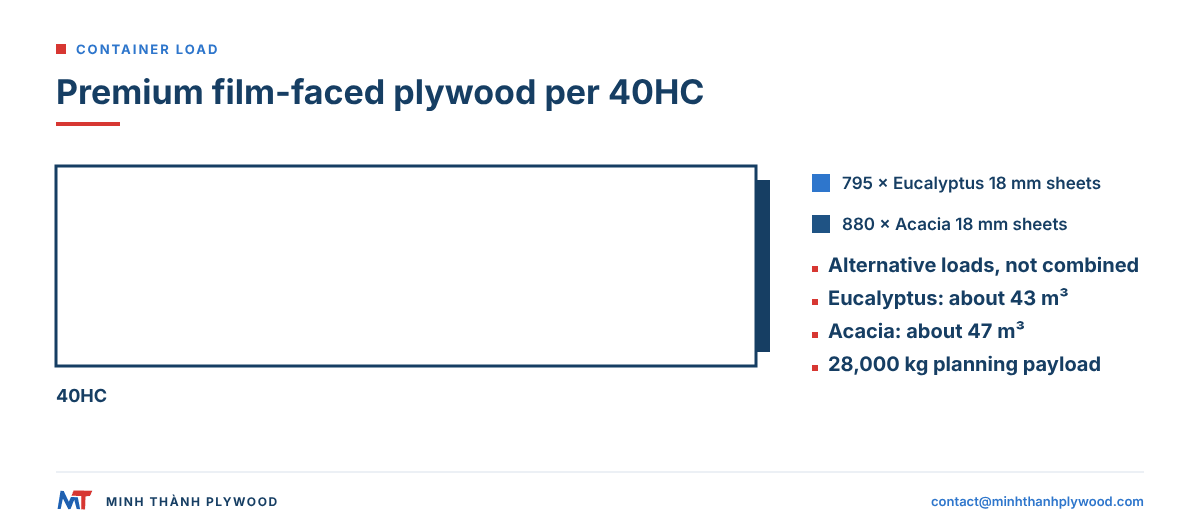
A 40HC of premium film-faced plywood holds about 43 m³ on Eucalyptus core or about 47 m³ on Acacia core. At 18 mm and 1220 × 2440 mm, that is about 795 sheets on Eucalyptus or about 880 sheets on Acacia, kept within the 28,000 kg planning payload unless your booking is lower.
Typical days at sea from Hai Phong, by carrier and route:
| Destination | Days at sea |
|---|---|
| South-East Asia, for example Brunei and Malaysia | 5–12 days |
| Middle East, for example Jordan via Aqaba | 15–25 days |
| Mediterranean | 25–35 days |
| Northern Europe | 30–40 days |
| West Africa | 35–50 days |
Production takes 15–45 days after the 30% deposit, with the 70% balance against the scanned B/L or an irrevocable L/C at sight. Every shipment is photographed and filmed before loading, and you receive the photos and video.
Delivery to Laos. Laos is landlocked, so a Laotian buyer takes the panels by road, not by sea. Trucks run from Phu Tho and Hai Phong to Vientiane through the Vietnam-Laos border gates, mainly Cau Treo to Nam Phao on the Vinh-Vientiane road, and the film colour does not change the freight or the price.
A bus covers Hanoi to Vientiane in about 22 hours, and freight forwarders quote one to two days by road for a loaded truck, plus border clearance. Mixed loads of black and brown, or of two thicknesses, go together by agreement. For proof of the bond, bond testing to EN 314-2 class 3 and a boil test report can be arranged through SGS on request.
What this means for your order
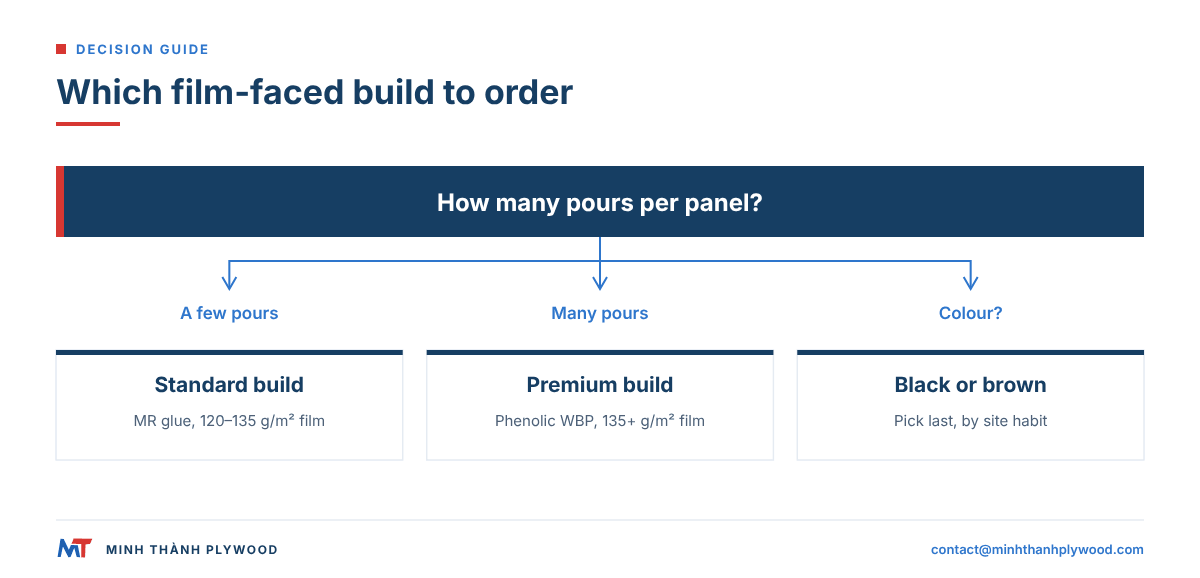
Order the film-faced plywood by build and pick the colour last. For most formwork buyers the right starting point is one of two builds.
- Standard formwork: 18 mm, Acacia or Eucalyptus core, melamine-fortified glue, 120–135 g/m² film, black or brown, sealed edges.
- Repeated pours: 18 mm, Eucalyptus core, phenolic WBP glue, film from 135 g/m², black or brown, sealed edges.
Send these lines to contact@minhthanhplywood.com or WhatsApp +84 988 586 601: application and pours, thickness and size, core, glue, film mass, colour, edges, quantity and port. We reply within hours and send free samples so your site can compare colours and builds before the first container. You can also compare film-faced panels with OSB for sheathing or browse all plywood types guides.
Buyer questions, answered
Is black film faced plywood better than brown film faced plywood?
Not by colour. Two sheets with the same film weight, glue, core and edge sealing perform the same whether the film is black or brown. Compare those four lines on the quotation and choose the colour your site or market prefers.
What is black film faced plywood?
Black film faced plywood is plywood with a black phenolic-resin film pressed onto both faces and sealed edges. It is used mainly as concrete formwork, where the smooth film releases from the concrete and protects the panel from water.
Is brown film faced plywood cheaper than black?
Only when the brown quotation carries a lighter film, a cheaper glue or a looser core. With the same build, the colour itself changes little in the price. Ask both suppliers for film mass in g/m², glue type and core species.
How many times can black film faced plywood be reused?
Panels with melamine-fortified glue give about 12–15 uses and phenolic WBP panels up to about 25, with proper handling, release agent and edge sealing. The film colour does not change these figures.
Does film colour affect waterproof performance?
No. Water resistance comes from the glue line and the sealed edges. Phenolic WBP glue resists repeated wetting best; the colour of the film has no effect on it.
What film weight should I order for formwork?
Standard film is 120–135 g/m² and premium film starts from 135 g/m². For repeated wall and slab pours, order premium film with phenolic WBP glue on a Eucalyptus or Acacia core.
What is red film faced plywood?
Red film faced plywood carries a red-dyed film. In many markets it is a light-duty, cost-focused formwork panel, so check the film mass and glue before comparing it with black or brown.
What is green film faced plywood?
Green film faced plywood carries a green-dyed or green plastic film. It is ordered where a site or brand standard uses green; specify the film type, mass and glue exactly as for black or brown.
What is white film faced plywood used for?
White film faced plywood is ordered for bright, easy-to-clean surfaces such as vehicle body linings, signboards and some formwork systems. The white surface shows dirt, so it is less common on rough sites.
Which thickness of black film faced plywood is most common?
18 mm is the usual formwork thickness. Minh Thanh makes film-faced plywood mostly in 12, 15, 18 and 21 mm, with 9 mm and thicker on order, with ±0.5 mm thickness tolerance in 1220 × 2440 and 1250 × 2500 mm sheets.
Can I order black film faced plywood from Vietnam to Brunei, Malaysia or Jordan?
Yes. Minh Thanh quotes FOB Hai Phong, CFR or CIF from one 40HC. Typical sea transit from Hai Phong is 5–12 days to South-East Asia and 15–25 days to the Middle East.