
Cherry wood is a fine-grained hardwood from Prunus trees, chiefly American black cherry and European cherry. Pale pinkish-brown when cut, it darkens to a rich reddish-brown in light within months. It is moderately hard, stable and easy to work, which makes it a classic furniture and cabinet wood. This guide from Minh Thanh Plywood covers species, properties, ageing, woodworking and cherry-look panels.
What is cherry wood?
Cherry wood is the timber of trees in the genus Prunus, mainly American black cherry (Prunus serotina) from eastern North America and European or sweet cherry (Prunus avium) from Europe and western Asia. It is a fine-grained, diffuse-porous hardwood with pale pinkish-brown heartwood that darkens to reddish-brown in light.
Cherry has been a premium furniture wood for centuries, used in American colonial, Shaker and French provincial furniture and in modern cabinets and joinery. Its appeal is a smooth, satiny surface, a straight grain and a colour that deepens with age.
For a buyer, “cherry” on an offer can mean either species, solid lumber or veneer, and sometimes a trade name for an unrelated wood. Name the species and origin, the grade and the product form. The types of wood guide places cherry among the other furniture hardwoods.
Is cherry a hardwood?
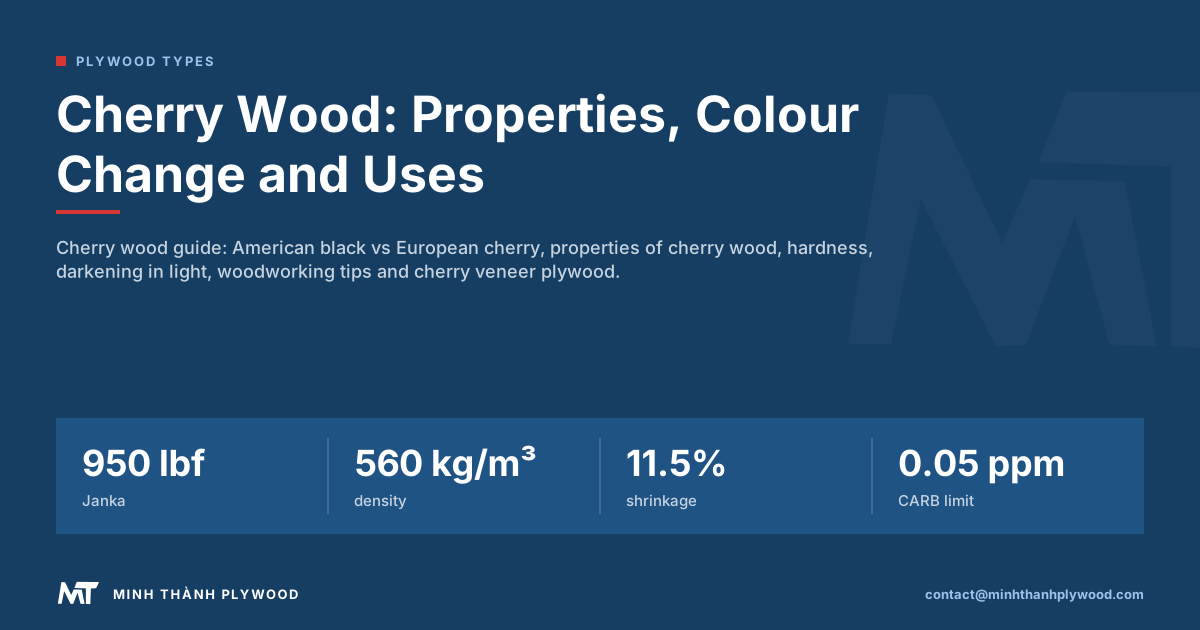
Yes, cherry is a hardwood: it comes from a broadleaved flowering tree. In hardness it is moderate. American black cherry averages about 950 lbf (4,230 N) on the Janka scale, softer than oak, maple or beech, while European cherry is harder at about 1,150 lbf (5,120 N).
That moderate hardness makes cherry easy to machine and carve but more prone to dents than oak in tabletops or floors. Tabletops in cherry need a hard-wearing finish. For high-traffic floors, harder species usually perform better.
Cherry is still strong for its weight and stable once dried, which is why it holds tight joints in cabinets and chairs. The beech wood guide compares a harder European furniture wood.
Properties of cherry wood: hardness, density and movement
The properties of cherry wood are moderate density, moderate hardness, good stability and good strength for its weight. American black cherry averages about 560 kg/m³ when dried; European cherry about 600 kg/m³.
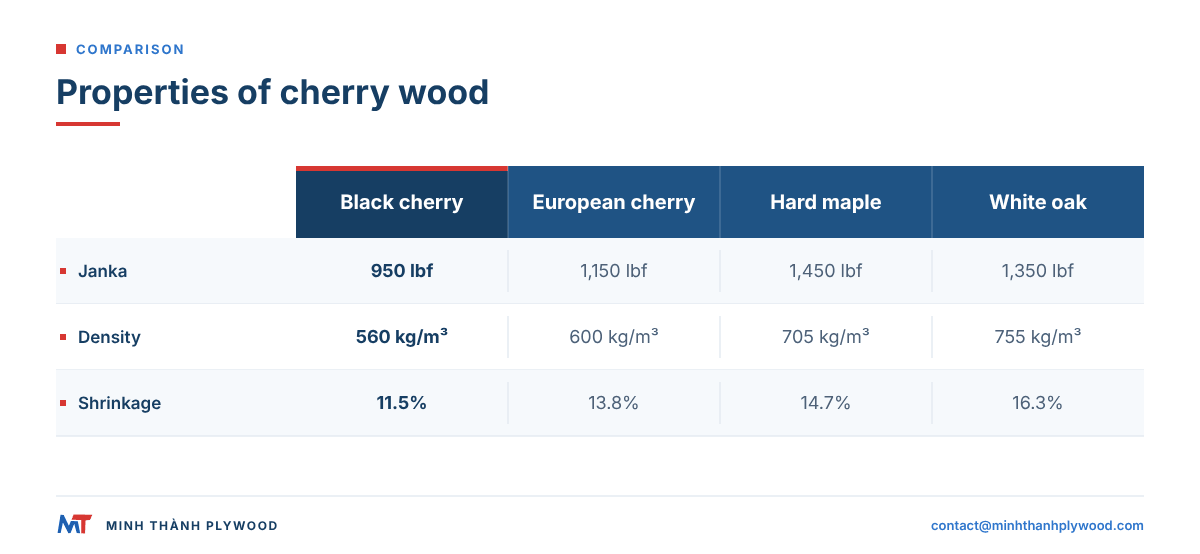
| Property | American black cherry | European cherry | Hard maple | White oak |
|---|---|---|---|---|
| Janka hardness | 950 lbf (4,230 N) | 1,150 lbf (5,120 N) | 1,450 lbf (6,450 N) | 1,350 lbf (5,990 N) |
| Average dried density | 560 kg/m³ | 600 kg/m³ | 705 kg/m³ | 755 kg/m³ |
| Bending strength (modulus of rupture) | 84.8 MPa | 103.3 MPa | 109.0 MPa | 102.3 MPa |
| Volumetric shrinkage, green to oven-dry | 11.5% | 13.8% | 14.7% | 16.3% |
| Colour when fresh | Light pinkish-brown | Light pinkish-brown, more golden | Creamy white | Light brown |
Values are averages at about 12% moisture content from The Wood Database, checked 20 October 2026.
The shrinkage row explains why cherry is valued for fine joinery: American black cherry moves less than maple, oak or beech, so drawers and frame-and-panel doors stay closer to size through the seasons.
American black cherry vs European cherry
Choose American black cherry for the classic deep red-brown cherry look and the widest supply; choose European cherry for a paler, more golden tone and slightly higher hardness. Both are fine-grained and work well.
- American black cherry (Prunus serotina): grows in eastern North America, with the best timber from Pennsylvania, New York and the Appalachian region. Heartwood is light pinkish-brown, darkening to rich reddish-brown. Available in good widths and lengths, graded under NHLA rules.
- European cherry (Prunus avium), also called sweet or wild cherry: grows across Europe; trees are smaller, so boards are narrower. Colour is lighter and more golden-pink and darkens less. Common in French and Central European furniture.
The AHEC American cherry profile describes American cherry’s grading and uses. Cherry shipped to the EU, from either source, needs origin records under the deforestation regulation, which applies from 30 December 2026 for large and medium operators. Brazilian cherry, sold for flooring, is jatoba, a different tropical species; Chilean or Patagonian cherry and others are also unrelated trade names.
Why does cherry wood darken, and how fast?
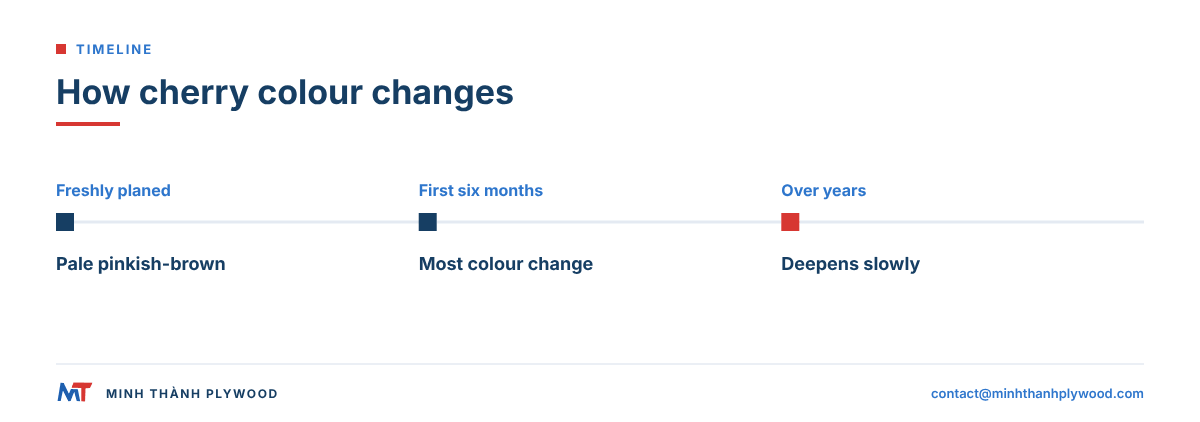
Cherry darkens because light, mainly ultraviolet, and air oxidise compounds in the wood surface. A freshly planed board is pale pinkish-brown; after months in daylight it becomes a medium to deep reddish-brown. Most of the change happens in the first six months, and the colour continues to deepen slowly for years.
The change is even across the surface unless something blocks the light. A bowl, a book or a lamp base left on a new cherry table leaves a pale shadow, which usually fades away after the object is moved and the area catches up. Sanding or planing removes the darkened layer and exposes pale wood again.
Woodworkers handle darkening in three ways:
- Let it age naturally and accept that a new piece will look pale at first.
- Pre-age in indirect sunlight for a few days before finishing, turning the piece for even exposure.
- Use an oil-based finish, which adds a warm amber tone that brings the colour forward.
Sapwood stays pale and does not darken to match, which is why furniture grades limit sapwood on visible faces. The wood colors guide compares cherry with species that lighten or shift hue.
Cherrywood wood grain, figure and defects
Cherrywood wood has a straight, fine, even grain with a satiny lustre. Figure is usually plain, but some boards show curly or wavy figure, which is priced as a premium. The heartwood is pinkish-brown; the sapwood is pale yellowish and often present along board edges.
Typical natural features are gum pockets and pith flecks: small dark streaks and spots left by the tree’s sap and insects. They are sound wood but darker, so grading rules limit them on visible faces. Mineral streaks are less common than in maple.
For matched furniture, sapwood and gum spots drive most sorting. A grading rule should state whether sapwood is accepted on visible faces, how many gum spots are allowed per part, and whether curly figure is wanted or excluded. Approve a finished sample from the same batch.
Cherry woodworking: machining, gluing and finishing
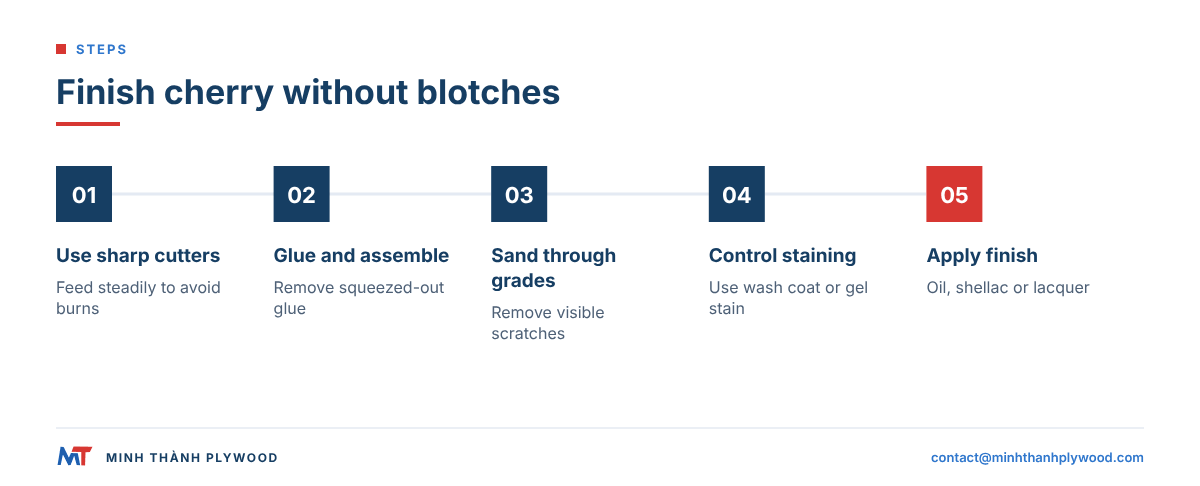
Cherry woodworking is straightforward: the wood saws, planes, routs and carves cleanly, glues well and sands to a smooth finish. It is one of the easiest hardwoods to work, with two cautions: it burns under dull or slow cutters, and it blotches under some stains.
- Machining: keep blades sharp and feed steadily; dwelling cutters leave dark burn marks that are hard to sand out.
- Gluing: standard wood glues bond well.
- Sanding: sand through the grades; cherry shows scratches under a clear finish.
- Staining: avoid pigment and dye stains on raw wood or use a wash coat or gel stain, since cherry blotches.
- Finishing: oil, shellac and lacquer all work; oil-based finishes warm the tone at once.
Cherry dust can irritate the airways, like most wood dust, so use dust extraction. Pre-finish parts before assembly where possible, because squeezed-out glue blocks finish and leaves pale spots.
What is cherry wood used for?
Cherry wood is used where a fine surface and warm colour matter more than maximum hardness:
- Fine furniture: tables, chairs, beds, chests and dressers.
- Kitchen and bathroom cabinets, in solid frames with cherry veneer panels.
- Interior joinery: doors, mouldings, staircases and wall panelling.
- Boat and vehicle interiors for the warm tone.
- Musical instruments: guitar bodies, ukuleles and parts.
- Turned and carved items: bowls, boxes and handles.
- Veneer for panels, doors and architectural woodwork.
Most furniture made in cherry combines solid parts for frames and edges with cherry veneer on panels, because wide solid cherry boards are costly and panels move less than solid boards. Cherry flooring exists but dents more readily than oak or maple.
Is cherry wood expensive?
Cherry is a mid to upper-priced hardwood, usually above oak, beech and maple and below walnut. The price depends on grade, width, sapwood content and figure.
The main drivers:
- Grade and sapwood: clear boards with little sapwood cost more.
- Width and length: wide boards are scarcer, especially in European cherry.
- Figure: curly or wavy cherry is sold at a premium.
- Form: sliced veneer spreads the cost of a log over many square metres, so cherry veneer panels cost far less than solid cherry of the same area.
In the US, black cherry lumber sells for roughly US$3 to US$10 per board foot (2026), with 4/4 clear boards at the low to middle of that range and wide or figured boards at the top. A board foot is 144 cubic inches of wood, and cherry weighs about 3 lb per board foot, so a 10 board foot order ships near 30 lb before packing. US lumber yards sell cherry by nominal thickness in quarters of an inch, and the surfaced thickness is thinner:
| Nominal thickness | Surfaced thickness (S4S) | Typical use |
|---|---|---|
| 4/4 | 13/16 in | Cabinet doors, face frames, tabletops |
| 5/4 | 1-1/16 in | Table legs, thick tops |
| 6/4 | 1-5/16 in | Legs, posts, thick rails |
| 8/4 | 1-3/4 in | Heavy legs, turned parts |
For a cabinet plant the other route is a veneered panel: cherry veneer plywood comes in 4 x 8 ft sheets, in thicknesses from 1/4 to 3/4 inch (6 to 18 mm), so a flat cherry surface covers a whole door or end panel without gluing up boards.
For panel parts, a veneered plywood panel gives cherry’s look at a fraction of the wood cost. A dyed engineered veneer face is the next step down in cost and gives a fixed colour.
Cherry veneer plywood: what buyers should specify
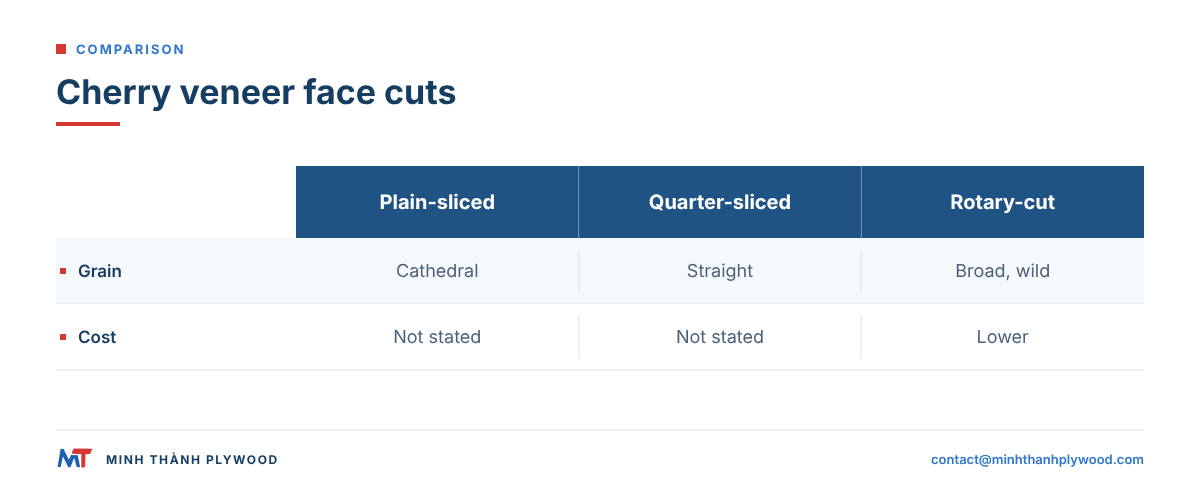
Cherry veneer plywood is a plywood panel with a thin cherry face, sliced or rotary-cut, over a core of another species. It gives cherry’s look for doors, cabinet sides and wall panels with better flatness and lower cost than solid cherry. The buyer specifies the face, the back, the core, the glue and the size.
- Face cut: plain-sliced gives cathedral grain; quarter-sliced gives straight grain; rotary-cut gives a wilder, broad figure at lower cost.
- Matching: book match, slip match or random, with a rule for sapwood and gum spots.
- Back: a lower grade or a balancing species for hidden sides.
- Core: a stable, flat core so the thin face does not telegraph defects.
- Heartwood share: cherry lumber is graded by how much of the face is red heartwood against pale sapwood; turning blanks, for example, are sold at 90 to 95 percent heartwood. State the heartwood share you accept on the visible face.
- Weight and size: a panel’s weight comes from its core, not the thin face, while solid cherry runs about 3 lb per board foot. Quote the sheet as 4 x 8 ft (1220 × 2440 mm).
- Glue and emission: for US furniture, CARB Phase 2 / TSCA Title VI compliance.
The TSCA Title VI limit for veneer-core hardwood plywood is 0.05 ppm under 40 CFR 770.10, and CARB Phase 2 sets the same figure.
For the plywood itself, BS EN 636 covers plywood for general-purpose use in dry, humid or exterior conditions, so name the service class on the order. Our furniture panels are CARB P2 / TSCA Title VI certified (ICTT mill no. 23024), and six ASTM D6007 chamber tests between April 2025 and June 2026 on 9, 15 and 18 mm panels averaged 0.014–0.032 ppm.
If you need cherry-look 4 x 8 ft panels in container volume, with the CARB P2 certificate on file, send the face, back and thickness you want and Minh Thanh Plywood will quote cherry veneer or engineered-veneer cherry panels with a free sample.
How to get a cherry look on plywood panels
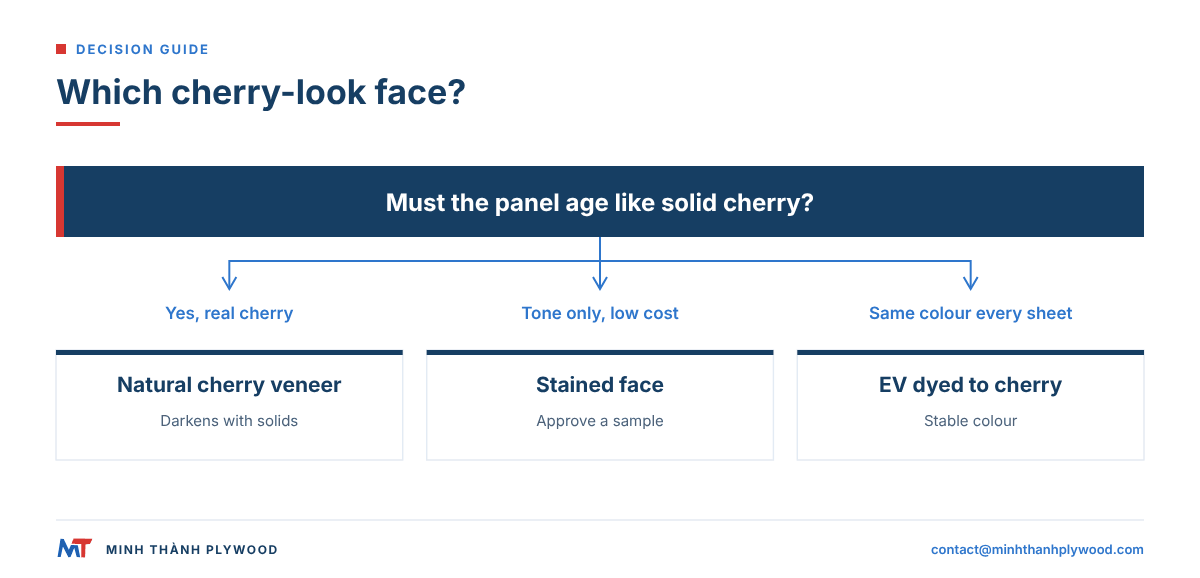
There are three routes to a cherry look on plywood: natural cherry veneer, a stained pale or reddish face, or an engineered veneer (EV) face dyed to cherry. Choose by whether the design needs real cherry and its ageing, or only its colour.
| Route | Look | Colour over time | Repeatability | Relative cost |
|---|---|---|---|---|
| Natural cherry veneer | Real cherry figure and gum spots | Darkens like solid cherry | Varies between leaves | Highest |
| Stained pale or reddish face | Cherry tone after finishing | Depends on stain and face | Good with a sample | Lower |
| EV face dyed to cherry | Fixed cherry-like grain and colour | Stable, does not darken like cherry | Same on every sheet | Lower |
An EV face is real wood fibre peeled from plantation timber, dyed to a target colour, glued into a block and re-sliced. We press EV faces on white Styrax or Eucalyptus cores, 3–40 mm, sanded and polished, with both faces UV-ready for the customer’s coating. Panels are pressed twice as standard, so the face sits on a calibrated, flat core. The EV plywood page shows the construction.
What should you send for a cherry-look panel quotation?
Send the cherry reference and say whether natural cherry veneer is required or a cherry-look EV face is acceptable. That decision sets the face, the cost and whether the panels will darken with the solid parts.
- Reference: a finished cherry sample, ideally aged to the target tone, and the finish system.
- Face and back: natural cherry veneer or EV colour and pattern, with grades for each side.
- Core: white Styrax for a pale edge, or Eucalyptus.
- Glue and emission: UF glue at E0 emission; CARB P2 / TSCA Title VI for US orders.
- Thickness and tolerance: for example 18 mm, down to ±0.2 mm on sanded furniture panels.
- Size: 1220 × 2440 mm or 1250 × 2500 mm, or cut to size.
- Quantity, packing and destination port; minimum order one 40HC, mixed specifications by agreement.
Production runs 15–45 days after the deposit. Contact Minh Thanh for free samples of cherry-tone faces and a quotation.
Buyer questions, answered
Is cherry a hardwood?
Yes. Cherry is a hardwood from broadleaved trees of the genus Prunus. American black cherry is moderately hard at about 950 lbf on the Janka scale, softer than oak or maple; European cherry is harder at about 1,150 lbf.
Why does cherry wood darken?
Light, mainly ultraviolet, and air react with compounds in the wood surface. Fresh cherry is pale pinkish-brown and darkens to medium reddish-brown, with most of the change in the first months. It is a natural process, sometimes called patina.
How long does it take cherry to darken?
Most of the change happens in the first six months in normal daylight, and the colour keeps deepening slowly for years. Placing a new piece in indirect sunlight for a few days speeds the first stage evenly.
What is the difference between American cherry and European cherry?
American black cherry (Prunus serotina) is lighter, softer and darkens to a deeper red-brown. European or sweet cherry (Prunus avium) is a little harder and denser, with a paler, more golden-pink tone. Both are fine-grained furniture woods.
Is cherry wood expensive?
Cherry is a mid to upper-priced hardwood, usually more expensive than oak, beech or maple and less than walnut. Wide, clear boards with little sapwood cost the most.
Is cherry wood good for furniture?
Yes. Cherry is one of the classic furniture woods, valued for its fine grain, smooth finish and deepening colour. It is stable once dried, machines cleanly and suits tables, cabinets, chairs and fine joinery.
Is Brazilian cherry the same as cherry wood?
No. Brazilian cherry is a trade name for jatoba (Hymenaea courbaril), a much harder, denser and redder tropical wood. It is not a Prunus species and does not behave like true cherry.
Does cherry wood blotch when stained?
Yes, cherry can blotch under pigment or dye stains because its density varies across the board. Most woodworkers avoid staining and let the wood darken naturally, or use a gel stain or wash coat first.
What is cherry veneer plywood?
Cherry veneer plywood is a plywood panel with a thin cherry face over a core of another species. It gives the look of cherry for doors, cabinets and wall panels at lower cost and with better flatness than solid cherry.
Can I get a cherry look without natural cherry veneer?
Yes. An engineered veneer (EV) face can be dyed to a cherry tone and grain pattern matched to an approved sample. It gives the same colour on every sheet, but it will not darken the way natural cherry does.
Is cherry wood toxic?
The dried timber is safe for furniture and kitchen use. Like most wood dust, cherry sawdust can irritate the airways, so use dust extraction when machining. Leaves, bark and seeds of the living tree are the toxic parts.