
Shipping container flooring is almost always 28 mm hardwood plywood of 19 or 21 plies, bonded with phenolic glue, treated against insects and screwed to steel cross members. It must carry a loaded forklift driven inside the box. This guide gives the specification, explains the floor test, separates new-build from repair panels and lists what to write on an order. Minh Thanh Plywood, a Vietnamese plywood manufacturer, wrote it for depots, repair yards and importers.
Shipping container flooring: the short specification
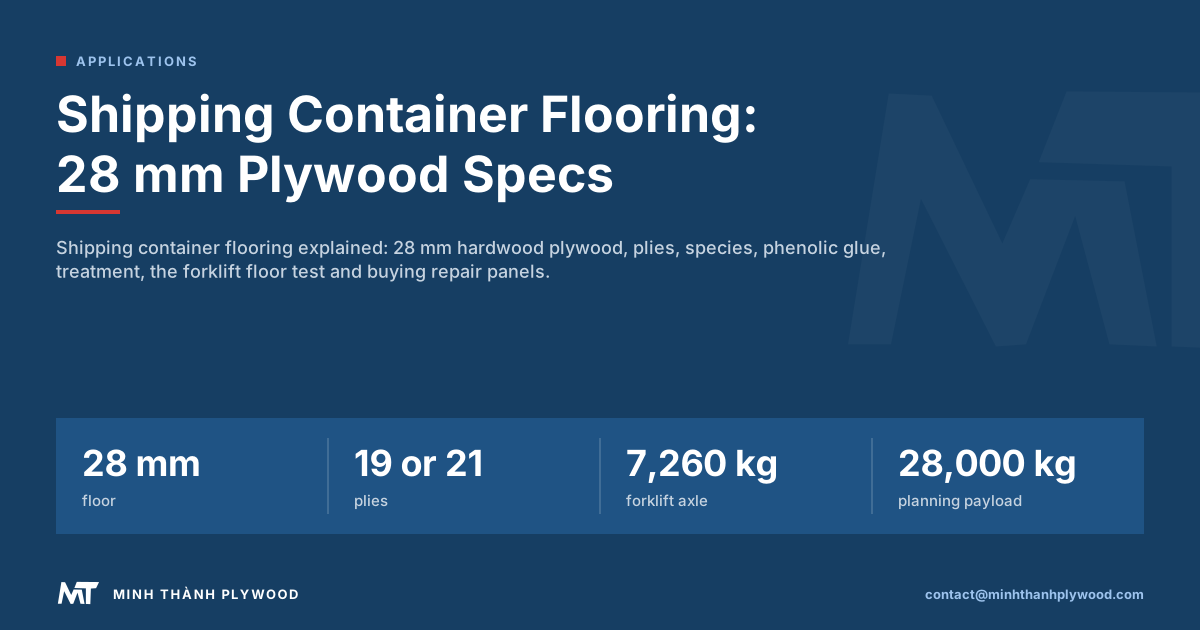
Shipping container flooring is 28 mm hardwood plywood, 19 or 21 plies, phenolic-bonded, insect-treated, screwed to the steel cross members of the container. That one line covers the floors of nearly every standard dry container in service. The floor is the only wooden structural part of the box, and the one most often repaired.
| Item | Typical specification |
|---|---|
| Thickness | 28 mm (about 1-1/8 in) |
| Plies | 19 or 21 hardwood veneers |
| Species | Keruing or apitong; eucalyptus, birch, larch or bamboo composite in newer builds |
| Glue | Phenolic (WBP), boil-proof |
| Treatment | Insecticide to quarantine requirements; underside coating |
| Panel size | About 2,400 mm long, 1,160 mm or 1,220 mm wide |
| Edges | Shiplap or square, sealed |
| Fixing | Self-tapping screws into steel cross members |
| Strength test | Forklift front axle load 7,260 kg (16,000 lb) |
The rest of this guide explains why each line is there and what changes for repair panels.
What thickness is shipping container flooring?
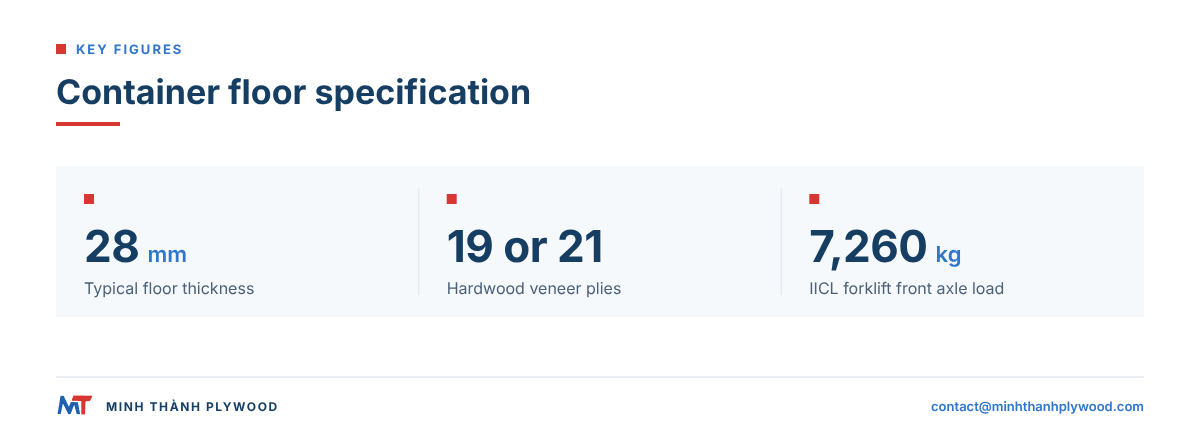
Container flooring is 28 mm thick because that thickness of dense hardwood plywood carries the forklift wheel loads between cross members with very little bending. The steel cross members sit under the floor at close spacing, and the plywood has to bridge each gap while a loaded truck turns on it.
Three loads decide the thickness:
- Forklift wheels. A lift truck loading pallets inside the box puts most of its weight on two front wheels with small contact areas.
- Cargo point loads. Machinery feet, coils and crates press on small areas for weeks at sea.
- Lashing and impact. Dropped loads, pallet jacks and dragged cargo bruise and cut the surface.
A thinner panel would deflect between members and split along screw lines. A thicker panel would add tare weight and cost. The industry standard of 28 mm settled as the balance. The ply count matters as much as the thickness: 19 or 21 thin plies spread a wheel load better than fewer, thicker veneers.
Which wood species are used for shipping container plywood?
Shipping container plywood was traditionally made from keruing and apitong, dense tropical hardwoods of the Dipterocarpus genus. These species are hard, heavy and resistant to wear, which suits forklift traffic.
Supply of those logs has tightened, and container builders now use other constructions that pass the same floor test:
- Plantation eucalyptus: dense and strong, grown on short rotations in Asia and South America.
- Birch: used in some European and Asian floors, with thin, uniform veneers.
- Mixed hardwood cores with hardwood faces: a dense face for wear over a mixed core.
- Bamboo and wood composites: bamboo mats or strips with hardwood veneers, used by several builders.
- Larch and other dense softwoods: in limited use.
Species alone does not decide quality. Veneer thickness, glue spread, press pressure and the closing of core gaps decide whether the floor survives. Our eucalyptus planning density is 650–750 kg/m³, which is why eucalyptus is one of the plantation woods used for heavy-duty floors.
What is the IICL container floor test?
The IICL container floor test is a forklift test: a truck with a front axle load of 7,260 kg (16,000 lb) drives over the floor, and the floor must carry it without permanent damage. Leasing companies apply the test to new containers.
The Institute of International Container Lessors (IICL) writes those specifications, and the test is stricter than the floor strength requirement of ISO 1496-1 for general cargo containers, which uses a 5,460 kg (12,000 lb) axle load. The test simulates the worst normal use: a loaded forklift working inside the box. It checks the plywood, the screws and the cross members together. A floor panel that passes in one container design can fail in another with wider member spacing, so container builders qualify the floor in their own design.
For a repair yard, the practical point is simple. Replacement panels must restore a floor that meets the same strength, so they must match the original thickness, ply count and density class.
How are container floor panels built? Plies, glue and treatment
A container floor panel is built from 19 or 21 hardwood veneers of about 1.3 to 1.5 mm, cross-laminated, bonded with phenolic resin and hot-pressed to 28 mm. After pressing, the panel is sized, edge-profiled, treated and coated.
- Veneer preparation. Logs are peeled, veneers dried and graded. Core veneers are jointed so no gaps or overlaps remain.
- Glue spread. Phenolic resin is rolled onto the veneers. Phenolic glue is boil-proof, which a container floor needs because it sees rain, condensation and washing.
- Lay-up. Veneers are laid with grain directions alternating, keeping the panel balanced so it stays flat.
- Pressing. The panel is hot-pressed until the glue cures through 28 mm, a much longer cycle than a furniture panel.
- Sizing and profiling. Panels are cut to length and width, and edges are profiled for shiplap or square joints.
- Treatment. An insecticide is applied to meet quarantine rules for timber floors.
- Coating. The underside and edges are coated to slow moisture entry from road spray.
At our own mill, furniture panels are pressed twice as standard: the core board is pressed and calibrated, then face and back are pressed on. The same principle explains why heavy floor panels need controlled core preparation: a flat, closed core is what spreads the wheel load.
Shipping container floor thickness and panel sizes
The shipping container floor thickness is 28 mm for standard dry containers in 20 ft, 40 ft and 40 ft high-cube sizes. The panels run across the container, from side rail to side rail, with joints over cross members.
| Container use | Floor | Panel notes |
|---|---|---|
| 20 ft and 40 ft dry, 40 ft high-cube | 28 mm hardwood plywood | About 2,400 × 1,160 mm or 2,400 × 1,220 mm |
| Open top and flat rack | 28 mm hardwood plywood, sometimes thicker | Heavier local loads |
| Refrigerated container | Aluminium T-floor | Not plywood, for air flow |
| Repair stock | 28 mm sheets 1220 × 2440 mm | Cut to fit the gap |
Container floor panel size in inches, pack count and price
US buyers order by the inch. A new-build panel is 1-1/8 in x 45.67 in x 94.49 in (28 x 1,160 x 2,400 mm) and weighs about 119 to 139 lb (54 to 63 kg), depending on species density. A US retailer lists the same panel as IICL T7 rated (Pacific Marine, 2026).
That rating means the panel is tested to a floor strength of at least 7.2 tons and passes the IICL short-span bending test; it is rated to the 7,260 kg (16,000 lb) forklift axle test; each sheet weighs about 62 kg (137 lb), packed 32 sheets to the pallet. Plywood is processed wood and sits outside the scope of ISPM 15, while solid-wood pallet bearers fall inside it.
| Item | Figure | Source |
|---|---|---|
| Panel, imperial | 1-1/8 x 45.67 x 94.49 in | 28 x 1,160 x 2,400 mm converted |
| Sheet weight | 119-139 lb | 54-63 kg converted |
| Pallet | 32 sheets, about 1,984 kg | Pacific Marine pallet count x 62 kg |
| One 40HC at a 28,000 kg planning payload | 14 pallets, 448 sheets, about 35 m³ | Our plan; weight sets the load |
| Retail, one sheet, USA | US$139.99 list for a 95 x 46 in panel, 16,000 lb rated | Mytee Products, October 2026 |
| Wholesale, Asian factory listings | about US$32 to US$44 per sheet at 50 to 268 sheet minimums | Made-in-China and Alibaba listings, October 2026 |
The retail row is what a US depot pays for one panel. A buyer who needs a full 40ft floor, which takes about ten 2,400 x 1,160 mm boards plus fill pieces, saves most of that gap by ordering a pallet or a container load from the factory. The wholesale figures are listing prices without freight or duty, so ask for a quotation against your specification before comparing.
Some buyers ask for 28mm container flooring plywood in 1220 × 2440 mm sheets for trailers, truck bodies and workshop floors. Thickness and ply count are the same; the panel is simply cut to a standard sheet size.
Weight matters for both the container and the freight. A 28 mm sheet of 1220 × 2440 mm holds about 0.0834 m³ of wood. At our eucalyptus planning density of 650–750 kg/m³, that sheet weighs about 54 to 63 kg.
New-build floors and repair panels: what is the difference?
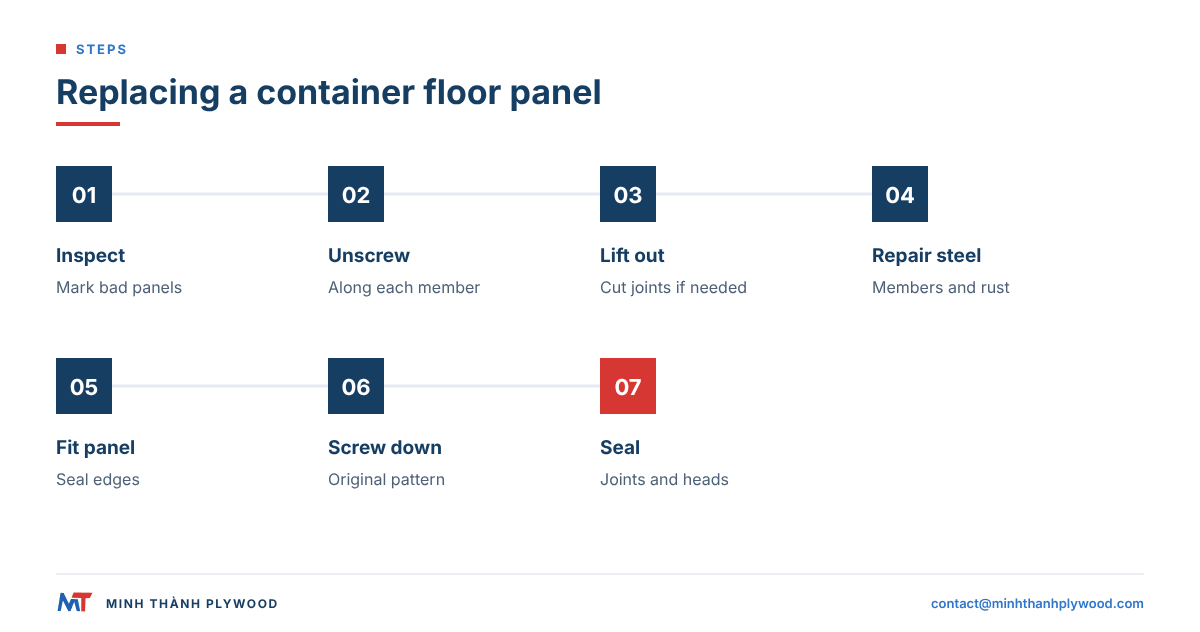
New-build floors are made to the container builder’s drawing and qualified by test; repair panels only need to restore the floor to the lessor’s repair standard. The construction is similar, but the buying process differs.
New-build panels are ordered by container plants against a full specification: species, density, ply count, moisture, glue, treatment chemical and loading, coating, and the floor test result in that container design.
Repair panels are bought by depots and repair yards. They must match the thickness and strength of the original and carry the treatment the destination requires. Lessors publish repair criteria; the IICL repair manuals are the common reference, and most leasing companies set their own acceptance rules.
Repair yards usually stock:
- full-width panels to replace a whole bay,
- standard sheets of 1220 × 2440 mm cut to fit,
- small sections for patching between cross members,
- floor screws and sealant to match.
How is a shipping container floor replaced?
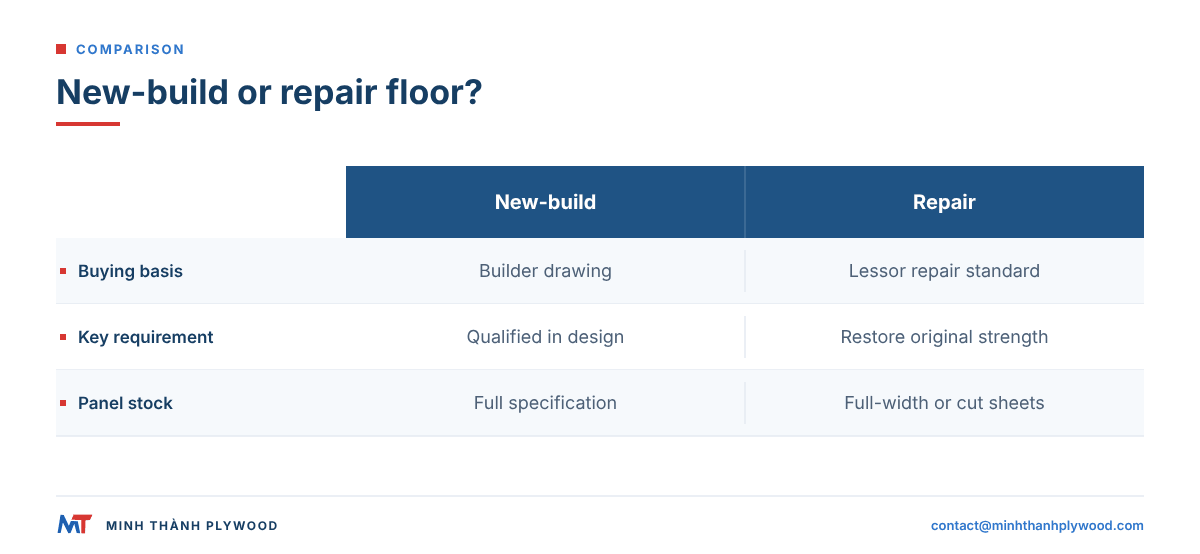
A shipping container floor replacement means removing the damaged panel from the cross members and fitting a new 28 mm panel in its place. Most repairs replace one or two panels where forklift damage, delamination or rot is worst.
- Inspect. Mark soft, delaminated, cracked or contaminated panels, and check the steel cross members under them.
- Remove screws. Drill out or unscrew the floor screws along each member.
- Lift the panel. Cut along the joints if needed and lift the panel out.
- Repair steel. Straighten or replace damaged cross members and treat rust.
- Fit the new panel. Cut to size, seal the edges, and lay it with joints over members.
- Screw down. Drive self-tapping floor screws into every member on the original pattern.
- Seal. Seal joints and screw heads, and coat the underside where it is exposed.
Old floor panels carry insecticide residue. Cutting them creates dust that needs a mask and extraction, and offcuts should go to approved disposal rather than burning.
How do you finish and maintain a container floor for living or storage?
For living or storage you either seal the original floor or cover it, and for a long-term home you replace it. Sealing means sanding the surface, filling screw heads and joints, and rolling on two coats of an epoxy or encapsulating sealer so insecticide residue stays under a barrier. Covering means a 12 to 18 mm plywood subfloor laid over the sealed floor, then vinyl, laminate or tile on top. Replacing means fitting new 28 mm untreated panels, the choice for kitchens, bedrooms and animal housing.
Maintenance of a plywood container floor is a short list:
- Sweep and wash with low water. Standing water is what delaminates a panel edge.
- Reseal worn patches. Coat bare wood where a forklift or pallet jack has scraped the surface.
- Check screw heads. Re-tighten or replace loose floor screws, since a raised head cuts tyres and pallet bases.
- Keep ventilation open. Condensation under a closed box rots a floor faster than rain does.
- Watch the underside. Rust on a cross member lets moisture work upward into the panel.
Why is shipping container flooring treated, and is it safe?
Shipping container flooring is treated with insecticide to stop wood-boring insects travelling between countries. Australia’s biosecurity rules are the strictest and most quoted: timber container floors must be treated with an approved product, or the container is treated on arrival, under the import conditions listed in BICON. Builders worldwide treat floors so every new container meets them.
For the people who reuse containers, this has three consequences:
- Living spaces. Container homes and offices often replace the floor, or seal it under a barrier and a new deck.
- Food and animals. Food storage and animal shelters should not use the original treated floor.
- Cutting and disposal. Treated wood needs dust control when cut and should not be burned.
A buyer reusing a container can ask the seller for the floor treatment record shown on the container’s data plate or certificate. When in doubt, a new plywood deck over a sealed original floor is the usual solution.
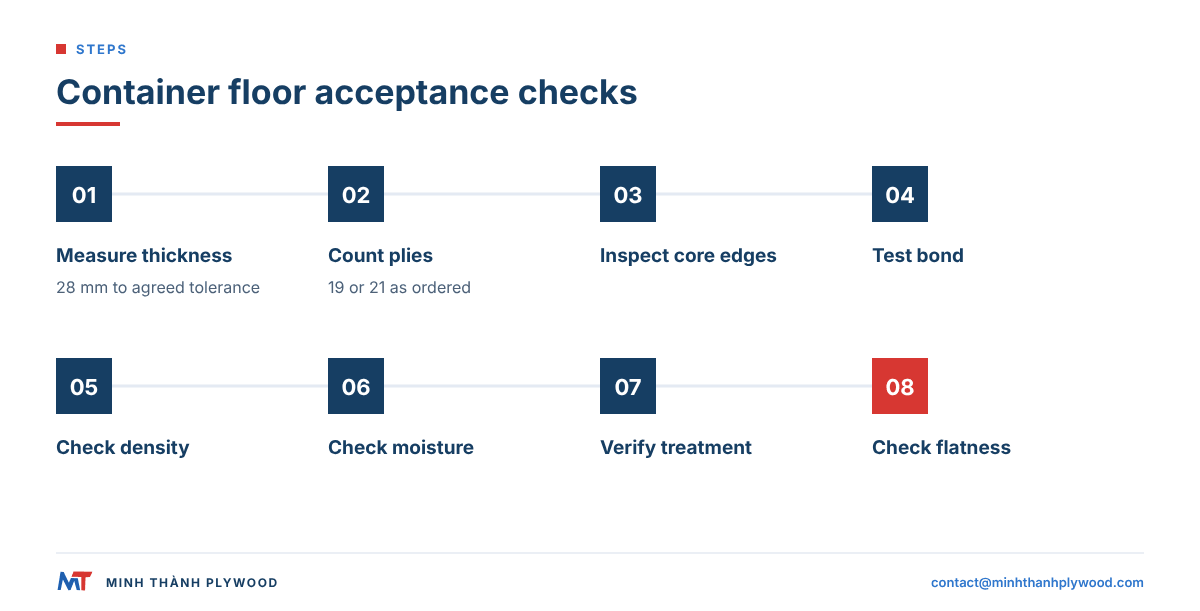
What does a buyer check on container floor panels?
A buyer checks container floor panels for thickness, ply count, bond, density, moisture, core gaps and treatment before accepting a shipment. These checks need only a caliper, a moisture meter, a scale and a saw.
| Check | How | What passes |
|---|---|---|
| Thickness | Caliper at 4 corners and centre | 28 mm to the agreed tolerance |
| Ply count | Count plies on a cut edge | 19 or 21 as ordered |
| Core gaps | Look along all 4 edges | No open gaps or overlaps |
| Bond | Boil test on a sample strip | No delamination after boiling |
| Density | Weigh a sheet, divide by volume | Within the agreed density class |
| Moisture | Pin meter on several sheets | Within the agreed range |
| Treatment | Treatment certificate | Chemical and retention as ordered |
| Flatness | Straightedge across the sheet | No bow beyond the agreed limit |
Write the acceptance values in the purchase order before production. A panel can only be rejected against a number that both sides signed.
Shipping cost per CBM: how density changes freight
Dense plywood fills a container by weight before it fills it by volume, so the freight cost per cubic metre rises with core density. A container rate is charged per box, and the box has a payload limit.
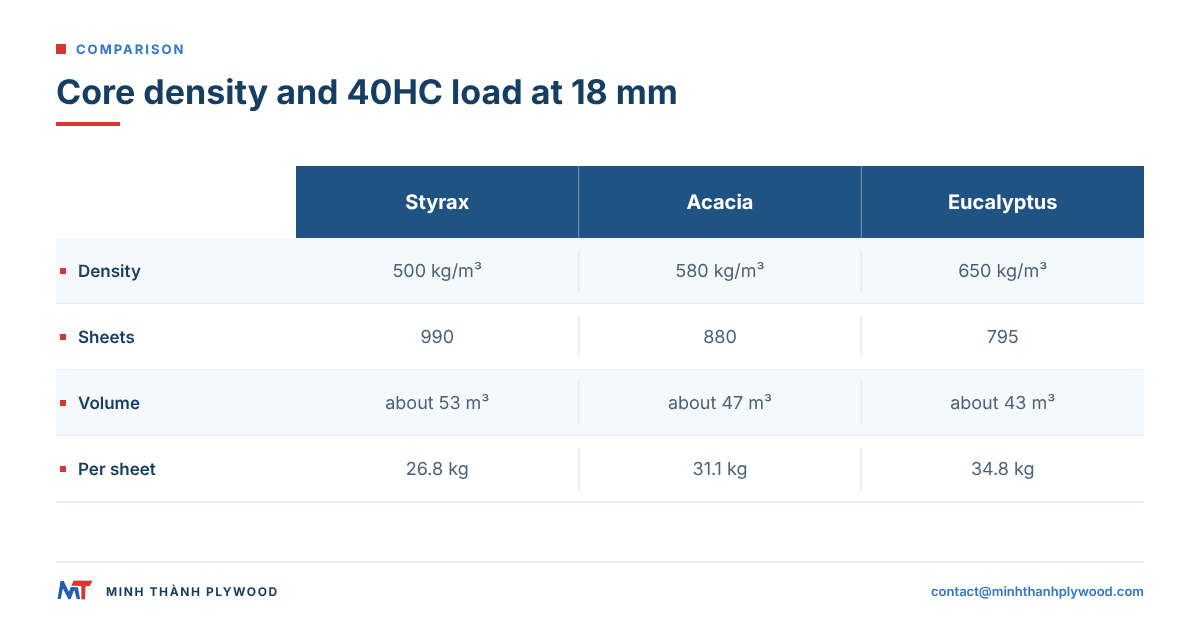
Our 40HC plan shows the effect at 18 mm and 1220 × 2440 mm, with a 28,000 kg planning payload:
| Core | Density | Sheets | Volume | Weight per sheet |
|---|---|---|---|---|
| Styrax | 500 kg/m³ | 990 | about 53 m³ | 26.8 kg |
| Acacia | 580 kg/m³ | 880 | about 47 m³ | 31.1 kg |
| Eucalyptus | 650 kg/m³ | 795 | about 43 m³ | 34.8 kg |
The same freight is divided by 53 m³ in the first case and 43 m³ in the last. Heavy floor plywood behaves like the eucalyptus row, or heavier: at 28 mm the payload, not the space, sets the load. To estimate cost per m³, divide the all-in freight per container by the cubic metres the weight limit allows.
Packing efficiency is the second factor. Packs about 1,000 mm high stack cleanly, and sheets per pack equal 1,000 divided by the thickness, rounded down, then capped by weight.
Can you mix plywood specifications in one container?
Yes, mixing specifications in one 40HC is normal and reduces the stock a buyer must hold. Our minimum order is one 40HC with mixed specifications by agreement: usually one or two specifications per container, three to six by agreement.
Mixing works best when:
- every specification fills whole packs, so packs stay square and stable,
- heavy packs go at the bottom and towards the container centre,
- the weight of every pack is calculated from size × density, plus packing, before booking,
- each pack carries a mark the receiving yard can read without opening it.
A repair yard can combine 28 mm floor stock with thinner panels for walls, shelving or trailer floors in the same box. The weight plan, not the volume, decides how much of the heavy stock fits.
What to write on a container flooring plywood order
A container flooring plywood order fixes every property that the floor test and the lessor depend on. Write each line with a number.
- Use: new-build floor for a stated container design, or repair stock.
- Size and thickness: for example 2,400 × 1,160 × 28 mm, with tolerances.
- Plies and species: 19 or 21 plies; face and core species.
- Density: the minimum density class for the floor.
- Glue: phenolic, boil-proof, with the bond test method.
- Treatment: the chemical, the retention and the certificate the destination requires.
- Edges and coating: shiplap or square, edge seal, underside coating.
- Moisture: the dispatch range.
- Packing: sheets per pack, pack weight, pack marks, pallets.
- Documents: treatment certificate, test report, packing list, certificate of origin.
Plywood for trailer, truck and platform floors
Trailer, truck-body and van floors use the same principles as container floors at lower loads: a dense, phenolic-bonded panel with a wear-resistant face. Many buyers choose film-faced or anti-slip plywood for these floors because the surface is easy to clean and safer to walk on.
Minh Thanh Plywood makes film-faced plywood and accepts anti-slip plywood on order, in thicknesses from 3 to 40 mm and standard sizes of 1220 × 2440 mm and 1250 × 2500 mm. Commercial and film-faced panels are made to ±0.5 mm thickness tolerance. Our guide to plywood for trailer flooring compares anti-slip, phenolic, marine and hardwood floors.
Every shipment is photographed and filmed before loading, and buyers receive the photos and video. Certificates and test records are on our quality page. Free samples let a body builder test fixing, wear and slip behaviour before ordering a container.
Send your floor drawing, thickness, surface, quantity and destination port to [email protected]. We reply within hours with a quotation for the specification you send.
Buyer questions, answered
What thickness is shipping container flooring?
Standard dry container floors are 28 mm (about 1-1/8 in) marine-type hardwood plywood. Some refrigerated and special containers use other floor systems, such as aluminium T-floors.
What is the IICL container floor test?
It is the floor strength test that lessors require, set above the 5,460 kg (12,000 lb) axle load of the ISO 1496-1 floor test: a forklift with a 7,260 kg (16,000 lb) front axle load is driven over the floor, which must show no permanent deformation that impairs use. IICL is the Institute of International Container Lessors.
What wood is used for container floors?
Traditionally keruing or apitong tropical hardwood. Many new containers now use plantation hardwoods such as eucalyptus, birch, or bamboo-and-wood composite boards made to the same strength test.
How many plies does container flooring plywood have?
A 28 mm container floor panel usually has 19 or 21 plies of veneer. The higher ply count spreads forklift wheel loads and limits splitting at the screws.
Is container flooring treated with chemicals?
Yes. Container floors are treated with an insecticide to meet quarantine rules, notably Australia's, and the underside is often coated. Wear a mask when cutting old floors and do not burn the offcuts.
Can you replace a shipping container floor?
Yes. Damaged panels are unscrewed from the cross members, cut out and replaced with new 28 mm panels of matching ply count, or patched following the lessor's repair rules.
What size are container floor panels?
New-build panels are commonly about 2,400 mm long and 1,160 mm or 1,220 mm wide at 28 mm, laid across the steel cross members. Repair yards also buy 1220 × 2440 mm sheets and cut them to fit.
Is reused container flooring safe for a house?
Old container floors carry insecticide treatment, so they are not suited to living spaces, animal housing or food storage without removal or sealing. Many tiny-home builders replace or cover the floor.
How does core density affect plywood shipping cost per container?
A denser core makes each sheet heavier, so a container reaches its weight limit with fewer cubic metres on board. Freight per cubic metre rises as density rises, even when the box is not full.
Can I mix different plywood specs in one 40HC?
Yes, by agreement. Our minimum is one 40HC with mixed specifications; usually one or two specifications per container, and three to six by agreement.