
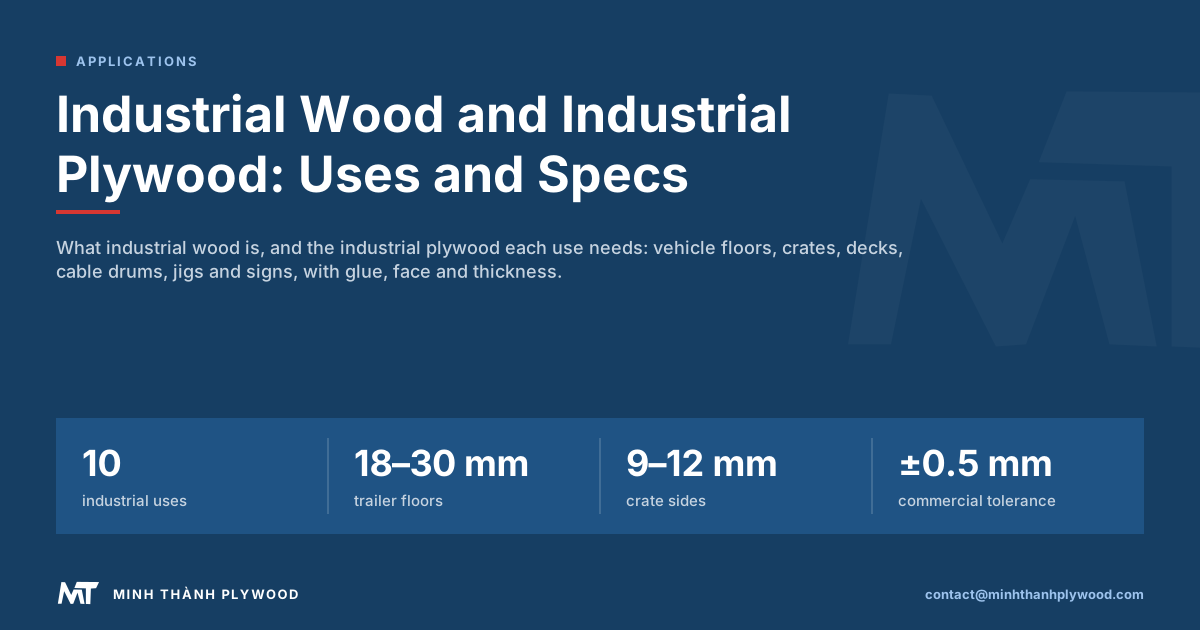
Industrial wood is wood used as a raw material for industry, such as sawn timber, veneer and panels, rather than as fuel. Industrial plywood is the panel part of it: plywood made for vehicles, packaging, construction, decks and workshop equipment, where the glue, core and face are chosen for load and exposure instead of looks. Minh Thanh Plywood makes packing, film-faced, anti-slip, exterior and commercial plywood and LVL in Vietnam; this guide maps each industrial use to the panel it needs.
What is industrial wood?
Industrial wood is wood used as a raw material for industry, such as logs for sawmills, veneer, plywood and pulp, rather than wood burned for fuel. Forestry statistics call it industrial roundwood, and the FAO forest products statistics report it apart from wood fuel for that reason.
Industrial wood materials fall into three families:
- Solid wood: sawn timber, beams, boards, pallet timber and blocks.
- Veneer-based panels: plywood and LVL (laminated veneer lumber), made from thin peeled veneers glued under heat and pressure.
- Particle and fibre panels: OSB, particleboard and MDF.
Industrial plywood is the plywood made for industrial end uses: vehicle floors, crates, decks, formwork, cable drums, signs and workshop equipment. Where furniture plywood is chosen for a clean face and low emission, industrial plywood is chosen for load, fixings and exposure. The glue, the core and the face grade are set by what the panel has to survive.
Which industrial wood types are there, and when does plywood win?
Buyers asking for “industrial wood” are usually choosing between six engineered boards: plywood, MDF, HDF, particleboard (MFC when melamine-faced), OSB and finger-joint laminated board, plus LVL for beams and planks. Plywood or LVL wins when the part needs screw-holding, bending strength along the panel, or wet service; the fibre and chip boards win on flat, paint-ready faces at lower cost.
| Material | Common thickness | Density | Glue | Typical industrial use | Where plywood or LVL wins |
|---|---|---|---|---|---|
| Plywood | 3–25 mm | 500 kg/m³ (Styrax), 580 kg/m³ (Acacia), 650–750 kg/m³ (Eucalyptus) | UF, MR or phenolic WBP | Floors, crates, decks, formwork, jigs | Reference material for this guide |
| MDF | 3–25 mm | 700–800 kg/m³ | UF-based resin | Furniture parts, displays, router work | Plywood holds screws on edge and tolerates damp; MDF swells at cut edges |
| HDF | 3–25 mm | Over 800 kg/m³ | UF-based resin | Door skins, flooring cores | Plywood is lighter and stiffer per kilo at 12 mm and above |
| Particleboard / MFC | Board-specific | 600–750 kg/m³ | UF-based resin | Cabinet carcasses, shelving, worktop cores | Plywood carries point loads and edge fixings better |
| OSB | Board-specific | About 600–640 kg/m³ | Water-resistant resin | Wall and roof sheathing, crates | Plywood gives a flatter face and tighter thickness |
| Finger-joint laminated board | 12 mm and 18 mm | Species-specific | PVAc or similar | Shelves, stair parts, tops | Plywood is stable across the sheet; finger-joint board is solid wood and moves |
| LVL | Sections and planks | Manufacturer-declared | Phenolic | Beams, skids, rails, scaffold planks | LVL replaces sawn timber where a long straight member is needed; plywood where a flat sheet is |
Densities for the fibre and chip boards are typical ranges from the European MDF association and panel guides, and each product’s data sheet gives its own figure. For plywood they are our core planning densities.
Industrial Wood Products and other US scaffold-plank sellers sell “industrials, scaffold plank and boards” under the same search term. Scaffold planks are a separate product from plywood decks: LVL planks of 225 × 38 mm are the common size, proof-tested to AS/NZS 1577 in Australia and New Zealand and spanning up to about 1.8 m between tube-and-clamp supports. Minh Thanh makes LVL as well as plywood; the LVL vs plywood guide and the scaffold panel load capacity guide set out when each one belongs under a platform.
What is industrial plywood used for?
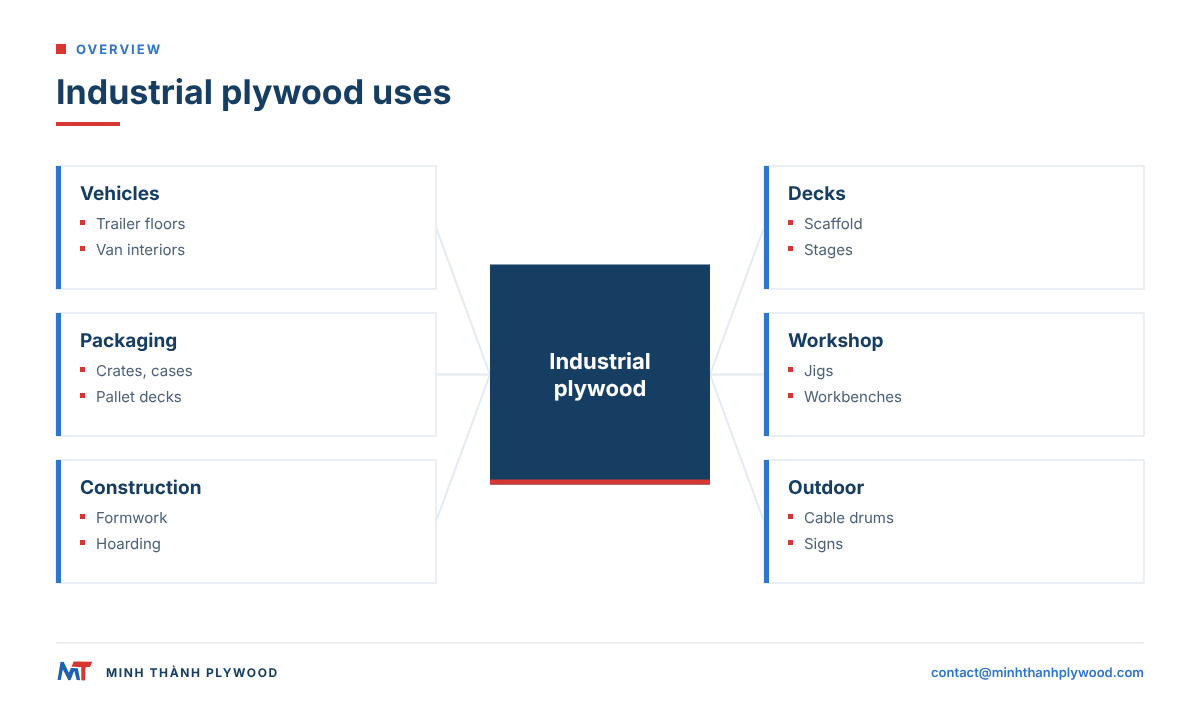
Industrial plywood is used wherever a flat panel must carry load, hold fasteners or survive water: truck and trailer floors, crates and cases, pallet decks, scaffold and stage decks, concrete formwork, cable drums, signs, jigs and workbenches. Each use needs its own glue, core, face and thickness.
The map below sets out what each use needs. It is the specification an engineer or buyer should write before asking for prices.
| Industrial use | Plywood type | Glue | Face | Typical thickness |
|---|---|---|---|---|
| Truck and trailer floors | Anti-slip film-faced, dense core | Phenolic WBP | Textured film top, smooth film underside | 18–30 mm |
| Shipping container floors | Specialist container flooring panel | Phenolic | Treated hardwood | 28 mm |
| Scaffold and stage decks | Anti-slip film-faced | Phenolic WBP | Textured film | 18–21 mm |
| Concrete formwork | Film-faced plywood | MR or phenolic WBP | Smooth resin film | 12–21 mm |
| Crates and cases | Packing plywood | UF, MR or WBP by exposure | Packing grade | 9–18 mm |
| Pallet decks | Packing plywood or LVL | MR or WBP | Packing grade | 9–18 mm |
| Cable drum flanges | Thick exterior plywood | Phenolic WBP | Utility C/D | 18–30 mm |
| Outdoor signs | Exterior plywood, paintable face | Phenolic WBP | Smooth, filled | 9–18 mm |
| Jigs, fixtures, workbenches | Dense-core sanded plywood | UF or MR | Sanded, flat | 18–30 mm |
| Vehicle interiors and linings | Light-core plywood | UF or MR | Sanded or laminated | 3–15 mm |
Our product lines cover most of this map: packing plywood, film-faced plywood, anti-slip plywood, exterior plywood, commercial plywood and LVL, all 3–40 mm on 1220 × 2440 or 1250 × 2500 mm sheets.
How is industrial ply different from furniture plywood?
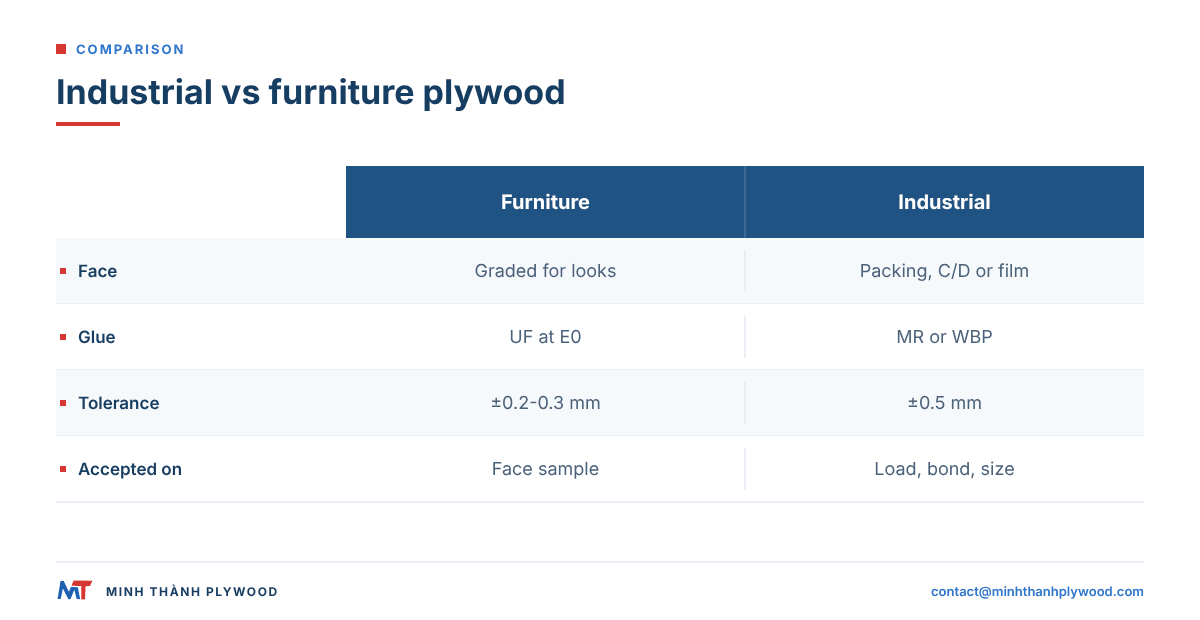
Industrial ply is specified for strength, fixings and exposure; furniture plywood is specified for face, flatness and emission. The two can come off the same press line, but the order describes a different panel: a utility or film face instead of a sanded decorative face, and often an exterior glue.
| Specification line | Furniture plywood | Industrial plywood |
|---|---|---|
| Face | Birch, poplar, EV, okoume; graded for looks | Packing, utility C/D, or resin film |
| Glue | UF glue at E0 emission | MR or phenolic WBP for wet service |
| Core | White Styrax or Eucalyptus | Acacia or Eucalyptus for stiffness; Styrax for light crates |
| Thickness tolerance | ±0.2–0.3 mm sanded | ±0.5 mm commercial and film-faced; ±0.5–1.0 mm packing |
| What decides acceptance | Approved face sample | Load, bond and size |
The tolerance figures are ours: sanded furniture panels ±0.2–0.3 mm, down to ±0.2 mm; commercial and film-faced ±0.5 mm; packing ±0.5–1.0 mm; length and width ±2 mm on all of them. A crate panel does not need furniture tolerance, and paying for it adds cost without adding performance. A jig or fixture plate is the exception: there, flatness and thickness accuracy are the job.
Which core species suit industrial plywood?
Dense cores suit industrial plywood that carries load: Eucalyptus at 650–750 kg/m³ and Acacia at about 580 kg/m³ are stiffer and hold fasteners better. White Styrax at about 500 kg/m³ suits light crates, linings and anything where weight matters more than stiffness.
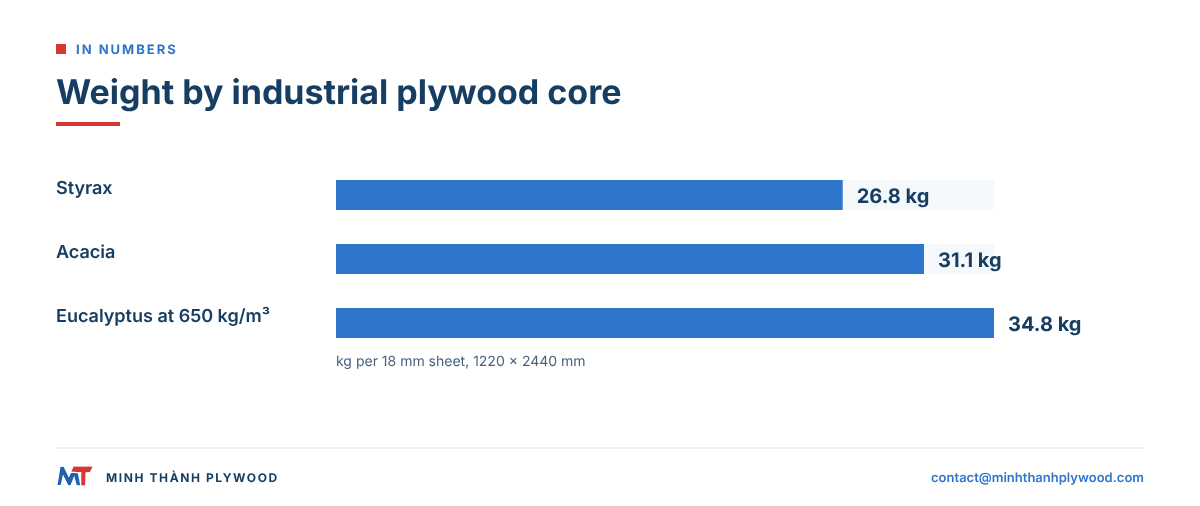
Sheet weight follows density × volume. For a 1220 × 2440 × 18 mm sheet at the reference densities:
| Core | Reference density | 18 mm sheet | Where it fits |
|---|---|---|---|
| White Styrax | About 500 kg/m³ | About 26.8 kg | Light crates, air-freight cases, linings |
| Acacia | About 580 kg/m³ | About 31.1 kg | Crates and decks, general industrial |
| Eucalyptus | 650–750 kg/m³ | About 34.8 kg at 650 kg/m³ | Floors, formwork, heavy bases |
Vietnamese plywood is made on plantation-grown cores. Our furniture panels use white Styrax or Eucalyptus as standard, and Acacia and Pine cores are made on order. Core layers are stitched both horizontally and vertically, which closes gaps inside the panel where a screw or a nail would otherwise find air.
Which glue does each industrial use need?
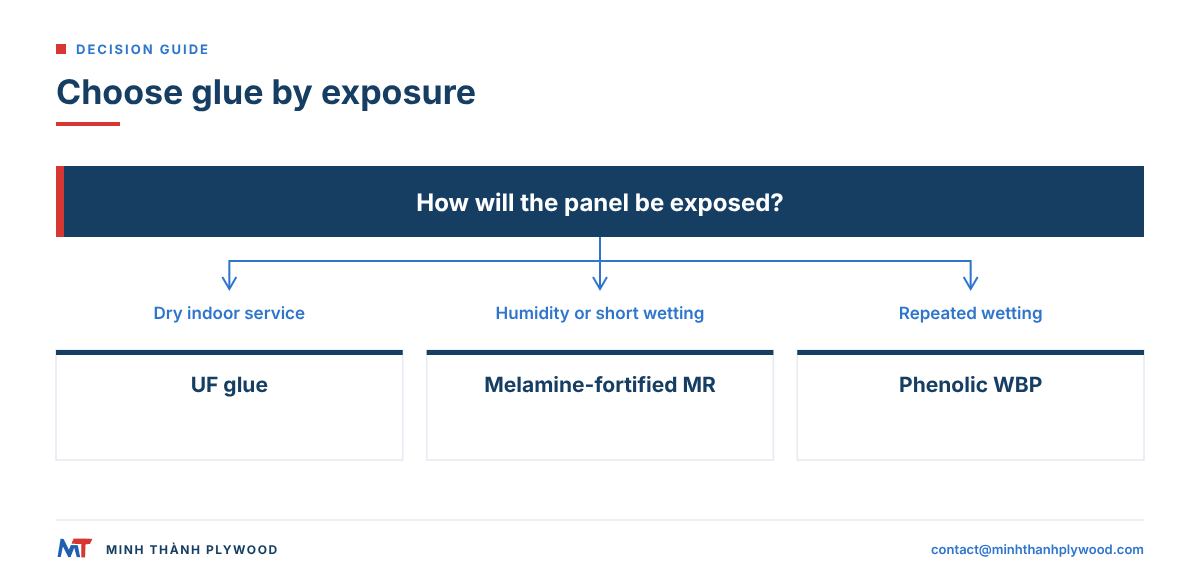
The glue follows the exposure: UF glue for dry indoor service, melamine-fortified MR for humid service and short wetting, phenolic WBP for floors, decks, formwork and anything wetted repeatedly. Glue type and emission class are separate specifications; write both on the order.
- UF (urea-formaldehyde): dry crates and cases, interior jigs, vehicle interiors. Our furniture panels use UF glue at E0 emission.
- MR (melamine-fortified): crates exposed to humid sea freight, budget formwork, interior parts near water.
- Phenolic WBP: trailer floors, scaffold decks, cable drums, outdoor signs, formwork with many pours.
Emission matters wherever people work or sleep near the panel: vehicle cabins, campervans, offices built from plywood. Our panels are certified to CARB Phase 2 / TSCA Title VI (ICTT mill no. 23024), and six ASTM D6007 chamber tests between April 2025 and June 2026 averaged 0.014–0.032 ppm against the 0.05 ppm limit. The rule itself is on the EPA formaldehyde standards page.
What thickness plywood is used for industrial crates?
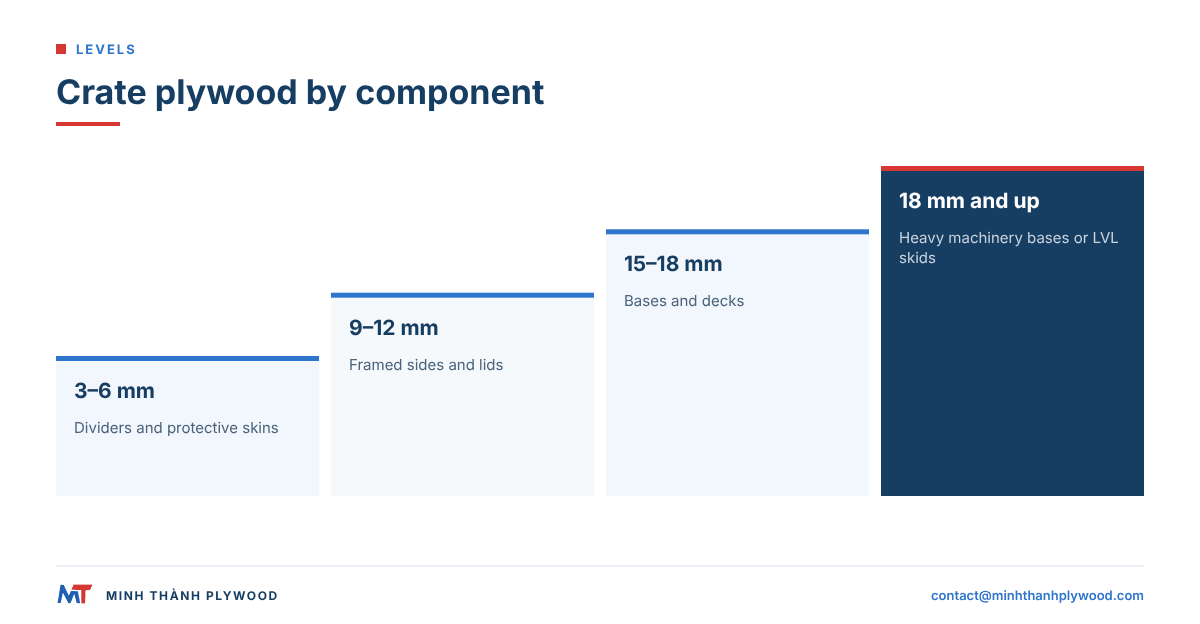
Industrial crates usually use 9–12 mm plywood for sides and lids and 15–18 mm for bases and decks, with 3–6 mm panels for dividers and protective skins. The final thickness comes from the load, the frame spacing, the fixing detail and the handling method.
| Crate part | Typical thickness | Note |
|---|---|---|
| Dividers, skins, inner covers | 3–6 mm | Supported on frames; five-ply (3–5 mm) keeps thin panels flat |
| Sides and lids | 9–12 mm | Framed; thicker for wide unsupported spans |
| Bases and decks | 15–18 mm | Carry the goods and forklift loads |
| Heavy machinery bases | 18 mm and up, or LVL skids | Point loads from feet and lifting lugs |
Orient the face grain across the shorter span between supports: plywood is stiffer along its face grain. Test the assembled crate with the proposed panel before volume production. Our sibling guide on plywood for crates and packaging covers crate design, and the wood packaging comparison sets plywood against solid wood and LVL.
Which plywood suits truck, trailer and vehicle floors?
Truck and trailer floors use anti-slip film-faced plywood on a dense core with phenolic WBP glue, usually 18–30 mm thick. The textured film gives grip for boots and pallet trucks; the phenolic bond keeps the plies together through rain, washing and freeze-thaw.
What to write on a floor order:
- Face: textured anti-slip film on top, smooth film underneath.
- Core: Eucalyptus or Acacia for stiffness and fastener holding.
- Glue: phenolic WBP.
- Thickness and size: to the chassis drawing; sheets can be cut to the floor layout.
- Edges: sealed at the factory; reseal every cut on site.
Anti-slip plywood is accepted on order at our factory. For light vehicles and conversions, where weight matters more than wear, our guide to plywood for campervan conversions and the planned trailer and truck floor guide go into detail. Caravan builders will find thin wall and ceiling panels in the caravan and RV plywood guide.
Which plywood suits scaffold decks, stages and platforms?
Scaffold decks, stages and work platforms use anti-slip film-faced plywood, usually 18–21 mm, with phenolic WBP glue. The panel spans between frame members, takes point loads from feet and equipment, and must grip when wet.
Two differences from a trailer floor:
- Span over thickness. Decks span open frames, so thickness is set by the frame spacing and the rated load of the deck system.
- Both faces work. Many stage and event decks are turned over; specify the film on both faces.
For permanent mezzanines and walkways, the system’s designer gives the panel class. For temporary decks, film-faced or anti-slip panels in 18 mm cover most systems built on 1220 × 2440 mm grids.
Which plywood suits formwork and construction?
Concrete formwork uses film-faced plywood, 12–21 mm, with melamine-fortified or phenolic WBP glue on Eucalyptus or Acacia cores. The film gives a smooth concrete finish and many pours; 18 mm is the standard sheet for walls and columns.
Our film-faced panels carry standard film of 120–135 g/m² or premium film from 135 g/m², at ±0.5 mm in thickness. Melamine-fortified panels give about 12–15 uses and phenolic WBP panels up to about 25, with proper handling, release agent and edge sealing.
Plain exterior plywood with utility C/D faces and phenolic WBP or melamine-fortified glue covers hoarding, temporary works and outdoor uses such as stair treads and wall sheathing. Our shutter ply board guide decodes the formwork names and thicknesses.
Which plywood suits cable drums, signs, jigs and workbenches?
Cable drum flanges and outdoor signs need thick exterior plywood with phenolic WBP glue; jigs, fixtures and workbenches need flat, dense-core sanded plywood held to tight thickness. The first group is about water; the second is about flatness and accuracy.
- Cable drums: 18–30 mm flanges, WBP glue, utility faces. Drums stand outdoors on site for months.
- Outdoor signs: 9–18 mm exterior plywood with a smooth face that takes paint or a printed overlay. Seal every edge.
- Jigs and fixtures: 18–30 mm, dense Eucalyptus core, sanded both faces. Our sanded panels are held to ±0.2–0.3 mm, down to ±0.2 mm, and pressed twice for flatness.
- Workbench tops: 18 mm and up, often two layers glued, with a hard-wearing face or a replaceable top sheet.
- Shop fittings and displays: 12–18 mm with a paintable poplar or EV face.
For beams, skids and rails where a long, straight member is needed, LVL (laminated veneer lumber) does the job of solid timber with straighter, more predictable stock. Our LVL vs plywood comparison explains when to use each.
Who supplies industrial and packing plywood from Vietnam?
Minh Thanh Plywood, in Ha Hoa, Phu Tho, is a Vietnamese manufacturer that supplies industrial and packing plywood alongside its main furniture line: packing, film-faced, anti-slip, exterior and commercial plywood and LVL, 3–40 mm thick, for packaging makers, contractors and distributors.
What a packaging company or industrial buyer gets from a factory order:
- Cores: white Styrax for light panels, Eucalyptus and Acacia for dense ones.
- Sizes: 1220 × 2440 and 1250 × 2500 mm, custom sizes such as 1220 × 2500 mm, and cut-to-size panels from one sheet into 4, 6 or 8 pieces.
- Volume: 50,000+ m³ per year; minimum order one 40HC, usually with one or two specifications and up to six by agreement.
- Price guide: commercial plywood from US$250/m³ (October 2026); the final price depends on face, core, glue, thickness, size, quantity and delivery term.
- Proof: CARB Phase 2 / TSCA Title VI certification (ICTT mill no. 23024), ISO 9001:2015 quality management (KAC25/0185), TCVN 11902:2017 veneer-faced plywood certification (VietCert 141.1-VNC-HC), six ASTM D6007 chamber tests, and photos and video of every shipment before loading.
A packaging maker in the Netherlands or elsewhere in Northern Europe can plan on 30–40 days at sea from Hai Phong, after production of 15–45 days from the 30% deposit.
How does EUDR apply to industrial plywood from Vietnam?
EUDR applies to plywood imported into the EU, and Vietnam is classed as a low-risk country under it, which lets EU operators use simplified due diligence when every commodity in the product comes from low-risk countries. Plywood made in Vietnam from plantation-grown cores can carry full origin records to the plot.
The facts an EU importer of industrial plywood needs:
- The rule: Regulation (EU) 2023/1115 covers plywood (ex HS 4412).
- Dates: it applies from 30 December 2026 for large and medium operators and for micro and small operators already covered by the EU Timber Regulation, and from 30 June 2027 for other micro and small operators.
- Vietnam’s class: low risk, under Implementing Regulation (EU) 2025/1093.
- What the importer files: a due diligence statement, built on the product description, species, quantity, country of production and plot geolocation.
We supply the EUDR compliance dossier, with origin records and geolocation files, with orders. Our EUDR traceability page shows what the dossier contains.
What should an industrial plywood order say?
An industrial plywood order should say the use, the core, the glue, the face, the thickness and tolerance, the size, the quantity and packing and the delivery term. The use comes first, because it decides every other line.
Two examples:
Crate panels: packing plywood, Acacia core, MR glue, packing-grade faces, 12 mm ±0.5–1.0 mm, 1220 × 2440 mm; plus 18 mm for bases; 1×40HC, mixed; FOB Hai Phong.
Trailer floor: anti-slip film-faced plywood, Eucalyptus core, phenolic WBP glue, textured film top and smooth film underside, 21 mm ±0.5 mm, 1250 × 2500 mm, edges sealed; 1×40HC; CIF [your port].
Free samples are available. Send the drawing or the part list with the specification lines through our quotation page, and we reply within hours during Vietnam office hours.
Buyer questions, answered
What is industrial wood?
Industrial wood is wood used as a raw material for products and construction, such as logs for sawmills, veneer and panel mills, rather than wood burned as fuel. Plywood, LVL, sawn timber and pulp are all made from it.
What is industrial plywood used for?
Industrial plywood is used for truck and trailer floors, crates and cases, pallet decks, scaffold and stage decks, concrete formwork, cable drums, signs, jigs and workbenches: anywhere a panel must carry load, take fixings or survive moisture.
What thickness plywood is used for industrial crates?
Crate sides and lids are usually 9–12 mm and bases and decks 15–18 mm, with 3–6 mm for dividers and skins. The final thickness comes from the load, the frame spacing and how the crate is handled.
What is the difference between industrial plywood and furniture plywood?
Furniture plywood is chosen for a clean face, low emission and tight tolerance; industrial plywood is chosen for load, fixings and exposure, with faces graded for use rather than looks. Many industrial jobs need an exterior glue that furniture plywood does not.
Which glue should industrial plywood have?
UF glue for dry indoor uses such as crates kept dry, melamine-fortified MR for humid exposure and phenolic WBP for floors, decks, formwork and anything wetted repeatedly. Write the glue and the emission class as separate lines.
Is industrial packaging plywood exempt from ISPM 15?
Yes. ISPM 15 does not apply to processed wood such as plywood, made with glue, heat and pressure. Solid-wood parts in the same package, such as skids, blocks or dunnage, do fall under it and need treatment and marking.
Does Vietnamese plywood meet EUDR requirements?
Vietnam is classed as a low-risk country under the EU Deforestation Regulation, and Minh Thanh supplies the EUDR compliance dossier, with origin records and geolocation files, with orders for the EU.
How long does plywood take to ship from Vietnam to Saudi Arabia?
Typical time at sea from Hai Phong to Middle East ports is 15–25 days, by carrier and route, after production of 15–45 days from the deposit.
Which wood is used for industrial plywood cores in Vietnam?
Vietnamese plywood is made on plantation-grown cores: white Styrax for light panels, Acacia and Eucalyptus for denser, stiffer panels. Eucalyptus and Acacia suit floors, decks and formwork; Styrax suits light crates and linings.