
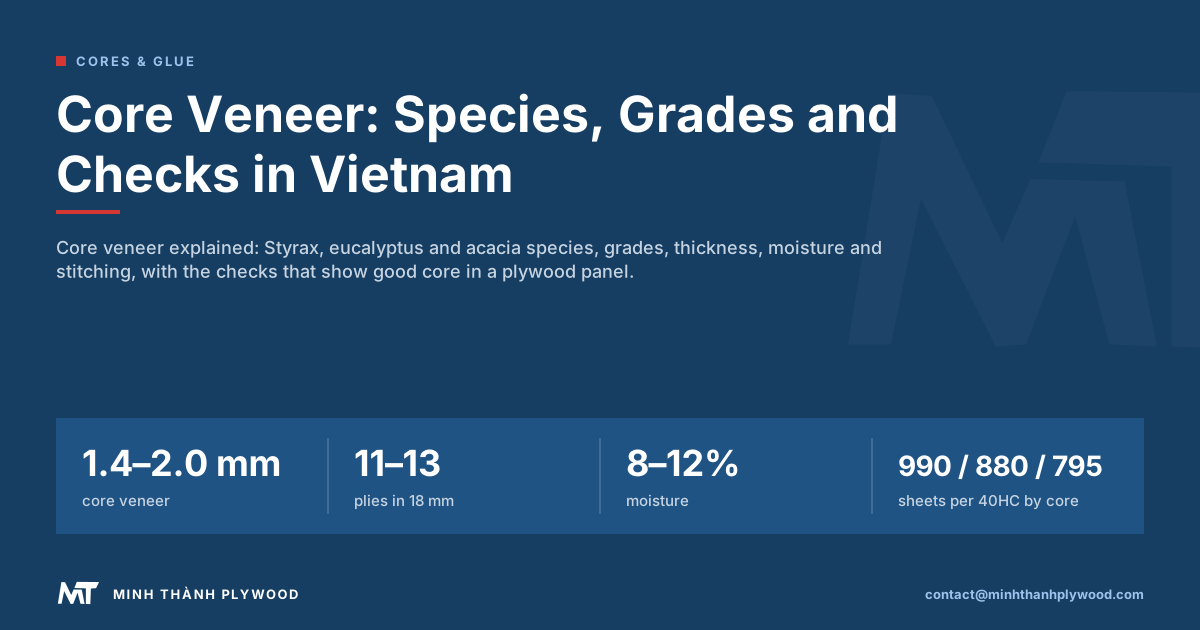
Core veneer is the rotary-peeled wood that forms the inner layers of plywood, usually most of the panel's thickness, so it decides weight, flatness, screw holding and bond more than the face does. In Vietnam it is peeled from plantation Styrax, eucalyptus and acacia. This guide from Minh Thanh Plywood shows how core veneer is made, graded and checked, and what to write on your order.
What is core veneer?
Core veneer is the thin sheet of wood, peeled from a rotating log, that forms the inner layers of a plywood panel. The face and back veneers are what you see; the core veneers between them carry the load, hold the screws and keep the panel flat.
A plywood panel is built from an odd number of veneer layers, each laid with its grain at right angles to the one before. In an 18 mm furniture panel, usually 11–13 plies, two are the face and back and the rest are core and cross-band layers. Face veneer is thin, 0.2–0.5 mm and commonly 0.3 mm for European furniture work. Core veneer is much thicker, so it makes up most of the panel’s thickness and weight.
That is why the core decides how a panel behaves in the factory where you use it:
- Weight and freight: the species of the core sets the density of the panel, and so how many sheets fit in a container before it reaches its weight limit.
- Flatness: an even core, pressed and calibrated, gives a flat panel that lays up and laminates without waves.
- Screw holding: dense, solid core layers grip edge and face screws; voids and soft spots do not.
- Bond: veneer at the right moisture takes glue evenly; wet or contaminated veneer leaves weak glue lines.
- The face itself: gaps and overlaps in the core telegraph through a 0.3 mm face as dips and ridges, most visibly under lacquer or a high-gloss coating.
“Veneer core plywood” is the name for a panel built entirely from veneer layers, as opposed to a panel with an MDF, particle board or sawn-lumber core. Our plywood core types guide compares those other cores.
Veneer core vs MDF core vs combination core vs lumber core
For furniture and cabinet panels, a veneer core is the lightest of the four common cores at the same thickness, holds edge screws well and stays stable, while an MDF core gives the flattest face and a lumber core is the traditional import choice. US buyers meet all four in 4 × 8 ft sheets (1220 × 2440 mm) at 3/4 in, which is close to our 18 mm panel; the table uses the 18 mm sheet.
| Core | Weight of one 1220 × 2440 × 18 mm sheet | Edge screw holding | Face flatness | Cost |
|---|---|---|---|---|
| Veneer core, Styrax | 26.8 kg (59 lb) | Good | Flat when stitched and pressed twice | Cost-effective |
| Veneer core, eucalyptus | 34.8 kg (77 lb) | Best of the veneer cores | Flat, firm | Middle |
| MDF core | about 32–43 kg (71–95 lb) | Weakest; screws pull out of the fibre on repeat assembly | Very flat | Middle |
| Combination core (veneer cross-bands over an MDF or lumber centre) | Between veneer and MDF | Good in the face, depends on the centre in the edge | Very flat; used for thick panels | Higher |
| Lumber core | Varies with the species | Good along the edge | Can telegraph the strips | Higher |
The MDF weight is calculated from the typical MDF density of 600–800 kg/m³ (read October 2026); a Styrax veneer-core sheet is therefore about 5–16 kg lighter, which cuts handling effort and freight per sheet. Combination and MDF cores give the flattest, most consistent face, which is why US distributors such as Hood Distribution call MDF core the preferred choice for frameless “32 mm system” cabinet construction. For most work, a graded veneer core is the better value. Our plywood core types guide goes through each core in more detail.
How is core veneer made, from log to dry sheet?
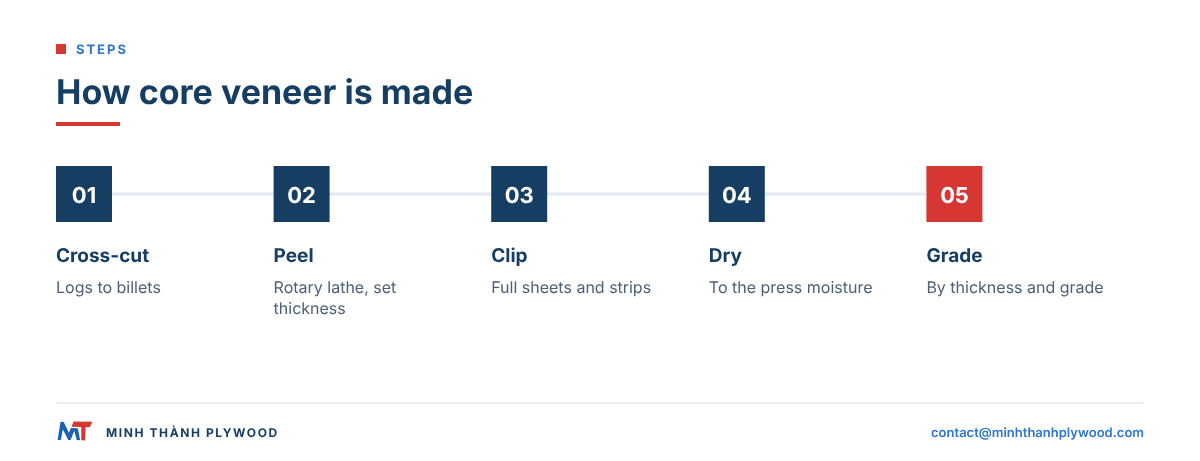
Core veneer is made in five steps: the log is cut to length, peeled on a rotary lathe, clipped into sheets, dried and then sorted by grade. Each step leaves a mark you can check later in the panel.
- Cross-cutting. Plantation logs are cut to billets a little longer than the panel length or width they will cover.
- Rotary peeling. The billet turns against a long knife that peels a continuous ribbon of veneer at a set thickness, much like unrolling paper from a roll. Lathe setting and knife sharpness decide whether the thickness is even and the surface is smooth or torn.
- Clipping. The ribbon is clipped into full sheets and narrower strips. Full sheets become long-grain core layers; strips are later joined or stitched into whole cross-band layers.
- Drying. Fresh veneer is wet. It is dried in the sun or in a dryer down to the moisture the press needs; uneven drying leaves wet patches that later blister.
- Sorting and grading. Dry sheets are sorted by thickness and by grade, so that each layer of a panel gets veneer of the same thickness and quality.
At a furniture mill, the core then goes through a further sequence before any face is applied: the core layers are glued, laid up, pressed and calibrated as a core board, and only then are face and back pressed on. We cover that in the section on stitching and double pressing below, and in our plywood manufacturing process page.
Core veneer in Vietnam: which species are used?
Core veneer in Vietnam is peeled from three plantation species: white Styrax, eucalyptus and acacia, plus mixed cores of these. Vietnamese plywood has no poplar or birch core; birch, okoume, bintangor and gurjan arrive as face veneers and are pressed onto a Vietnamese core.
| Species | Reference density | Colour in the edge | Typical use in Vietnamese plywood |
|---|---|---|---|
| Styrax (white core) | about 500 kg/m³ | White to very pale cream | Light furniture and interior panels, thin plywood |
| Eucalyptus | 650–750 kg/m³ | Pale pinkish-brown, denser grain | Furniture panels needing screw holding, film-faced and exterior panels |
| Acacia | about 580 kg/m³ | Light brown to golden brown | Commercial and film-faced panels, furniture panels on order |
Styrax grows only in northern Vietnam, and the area around Ha Hoa, Phu Tho, where our factory stands, is planted with it. That is the reason many European furniture buyers choose a white Styrax core: it is light, pale enough not to shadow through a thin birch or poplar face, and it puts more cubic metres in each container.
At Minh Thanh Plywood, furniture panels use white Styrax or eucalyptus cores as standard. Acacia and pine cores are made on order. Our guide on which core is best for birch plywood from Vietnam compares the cores for birch-faced panels in detail.
How is core veneer graded?
Core veneer is graded by eye after drying, sheet by sheet, into a top grade for furniture cores and lower grades for commercial and packing cores. Vietnamese mills usually call these grade A, grade AB (A and B mixed) and lower grades for packing.
| Grade | What the sheets look like | Where it goes |
|---|---|---|
| A | Whole, even sheets; no holes, no open splits, no rot, even thickness | Furniture and interior panels, thin plywood |
| AB | Mostly whole sheets with some splits, small holes and patched pieces | Commercial plywood, film-faced panels |
| Lower grades | Broken sheets, many splits and short pieces | Packing plywood |
The grade of the core follows the product line. A furniture panel uses grade A core, stitched and sanded; a commercial panel uses AB core, laid loose or joined; a packing panel uses AB core laid loose. Two quotes for the same thickness can therefore describe very different cores, and the core grade is one of the first lines to compare.
Our page on how we grade veneer shows the same sorting for face veneers.
What thickness should core veneer be?
Core veneer in Vietnamese plywood is usually peeled at 1.4–2.0 mm. The exact thickness is chosen so that the right number of layers adds up to the panel thickness after pressing and sanding.
- 18 mm furniture panels are usually built with 11–13 plies; more plies mean thinner layers and a more even, stiffer panel.
- Thin plywood of 3–5 mm is always 5-ply at our mill. A 3 mm panel has one core veneer, two cross-band veneers and two faces; 4 and 5 mm panels have three core veneers and two faces, with the core thickness adjusted to the panel. A 4 mm furniture panel, for example, takes three 1.3 mm Styrax core veneers.
- Thickness sorting matters as much as the nominal value: veneer of mixed thickness in one layer leaves thick and thin spots that sanding cannot correct.
For you as a buyer, the veneer thickness shows in two lines of the specification: the ply count and the panel thickness tolerance. Sanded furniture panels at our mill are held to ±0.2–0.3 mm, down to ±0.2 mm; commercial and film-faced panels to ±0.5 mm; packing panels to ±0.5–1.0 mm.
Why does moisture in core veneer matter?
Moisture matters because wet veneer turns to steam in the hot press. The steam weakens the glue line, causes blisters and leaves panels that warp after delivery as they dry out in a heated building.
Drying is therefore a controlled step, not a weather report. Furniture veneers are dried before gluing, and our veneers and finished panels are dried to 8–12% moisture content at dispatch, the normal range for furniture plywood.
How to check it:
- Take sheets from the middle of the bundle or stack, not only the top.
- Measure with a pin or pinless moisture meter at several points on each sheet or panel.
- Look for spread as well as the average: one wet patch in an otherwise dry sheet is a blister waiting to happen.
- On finished panels, read the moisture at the edge and in the middle of the sheet.
Moisture is also a pressing parameter. MR-type glue lines are typically pressed at about 110–120 °C and WBP glue lines at 130–145 °C; veneer that is too wet for those temperatures is the commonest root of plywood delamination.
Stitched, jointed or loose-laid core: what is the difference?
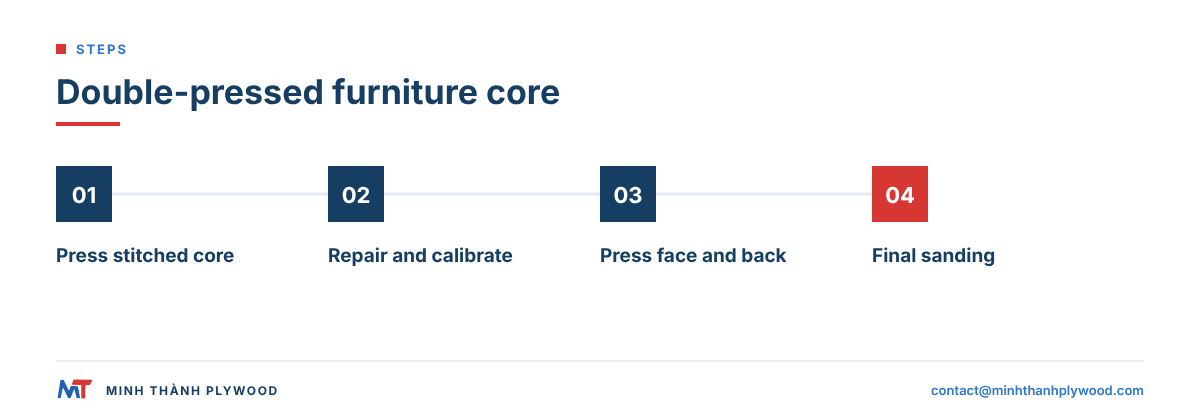
The difference is how the narrow pieces of veneer become one full layer. A stitched core is sewn into one continuous sheet; a jointed core is edge-glued or spliced; a loose-laid core is simply placed piece by piece.
| Construction | How the layer is made | What you see in the panel |
|---|---|---|
| Stitched core | Pieces sewn edge to edge with thread before layup | No gaps or overlaps; flat face; thread lines visible in a cut core |
| Jointed core | Pieces joined at the edges by glue or splicing | Few gaps; joints show as fine lines |
| Loose-laid core | Pieces placed side by side by hand | Gaps and overlaps; dips, ridges and voids |
At Minh Thanh Plywood the core layers of furniture panels are stitched both horizontally and vertically, so each layer goes into the press as one sheet. Stitching costs labour, which is why commercial and packing plywood across the industry use loose-laid or jointed cores.
Do not confuse a stitched or jointed core veneer with a finger-joint core. A finger-joint core is made of solid blocks, often reclaimed plywood, joined end to end with interlocking fingers; our guide to finger joint plywood explains where that build fits.
Why is a furniture core pressed twice?
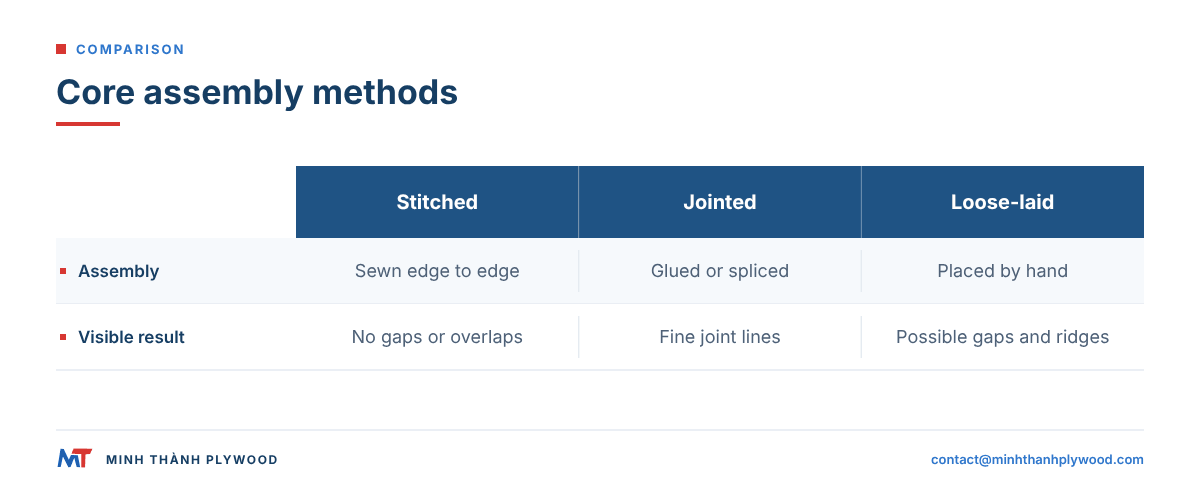
A furniture core is pressed twice so that the face goes onto a flat, calibrated board rather than onto loose veneer. Furniture-grade panels at our mill are pressed twice as standard: the core board is pressed and calibrated, then face and back are pressed on.
- First press: the glued, stitched core layers are pressed into a core board.
- Repair and calibration: the core board is checked, any defects are patched, and the board is sanded to an even thickness.
- Second press: face and back veneers are glued and pressed onto the calibrated board.
- Final sanding: the panel is sanded and polished to the ordered thickness and tolerance.
A single-pressed panel puts the face straight onto the raw core, so every step in the core shows in the face. Double pressing is the reason a 0.3 mm birch or poplar face stays flat under a UV or lacquer finish, and it is why our faces are UV-ready for buyers who apply their own coating.
Which core defects matter, and how do you spot them?
Six core defects matter for a buyer of finished plywood, and each can be spotted without a laboratory. Check the edge, the face and one cut sheet.
| Defect | What causes it | How you spot it |
|---|---|---|
| Core gap (void) | Loose-laid pieces that did not meet | Dark slot in the edge; soft spot under thumb pressure; hollow sound when tapped |
| Overlap | Two pieces laid on top of each other | Ridge on the face, often visible against the light after sanding |
| Missing or doubled ply | Layup error | Edge ply count differs from the specification or from corner to corner |
| Blister | Wet veneer or weak glue line | Raised, hollow-sounding area on the face |
| Split or crack in the core | Veneer dried too fast or rough handling | Crack line in the edge; panel breaks unevenly when cut |
| Rot or stain | Logs or veneer stored wet | Dark or blue-black streaks in the edge; soft, crumbly wood |
The quickest test is to cut one panel across and look at the cut. A sound veneer core shows straight, even layers of one colour per species, with tight glue lines and no gaps. Our plywood delamination guide covers the bond failures in more depth.
How do you check core quality in finished plywood?
You check core quality in finished plywood with a short routine: measure, count, look, tap and cut. It takes minutes per sample and works on a pre-shipment inspection as well as on the samples you receive.
- Measure the thickness at the four corners and mid-edges with a caliper and compare it with the tolerance on your order.
- Count the plies at the edge and compare with the specification.
- Look along the face at a low angle against the light for dips and ridges that come from the core.
- Tap the face across the sheet; a hollow note marks a void or blister.
- Read the moisture at the edge and in the middle of the sheet.
- Weigh one sheet and compare with the weight expected for the core species.
- Cut a strip across the sheet and look at every core layer for gaps, overlaps and colour.
Weighing is a useful check of species. An 18 mm sheet of 1220 × 2440 mm weighs about 26.8 kg on a Styrax core, 31.1 kg on acacia and 34.8 kg on eucalyptus at the reference densities. A panel far lighter than its stated species suggests a different or mixed core.
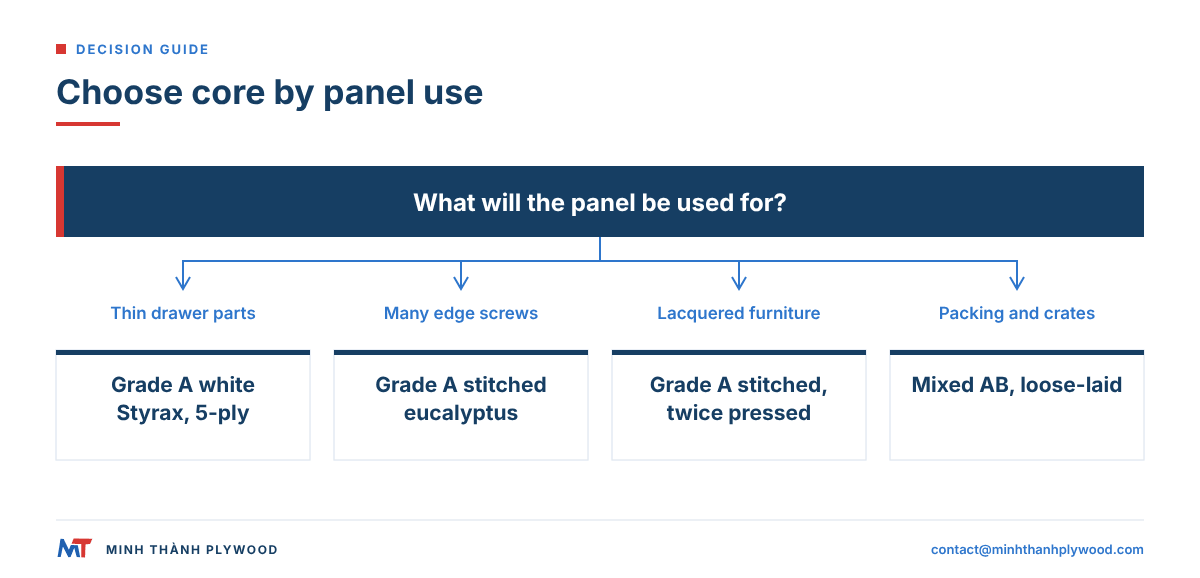
Which core should you choose for your use?
Choose the core by what the panel has to do in your product, not by price alone. The table matches common uses to the core build that serves them.
| Your use | Core species | Core build | Glue and emission |
|---|---|---|---|
| Lacquered or UV-coated furniture, cabinets | White Styrax or eucalyptus | Grade A, stitched, pressed twice | UF glue at E0 emission; CARB P2 / TSCA Title VI |
| Thin panels for drawer bottoms and backs | White Styrax | Grade A, 5-ply | UF glue at E0 emission |
| Furniture parts with many edge screws | Eucalyptus | Grade A, stitched | UF glue at E0 emission |
| Commercial interior use | Acacia, eucalyptus or mixed | AB, jointed or loose-laid | To the order |
| Film-faced formwork | Acacia or eucalyptus | AB or A, by reuse target | Melamine-fortified or phenolic |
| Packing and crates | Mixed | AB, loose-laid | To the order |
TSCA Title VI limits formaldehyde from hardwood plywood with a veneer core to 0.05 ppm under 40 CFR 770.10. The core build does not change that limit, the glue and its control do. In the EU, Regulation (EU) 2023/1464 sets 0.062 mg/m³ for furniture and wood-based articles from 6 August 2026. For lacquered furniture, the core build matters more than the species: a grade A stitched core, pressed twice, keeps a thin face flat. For packing, a loose-laid core is fine and keeps the cost down.
Core veneer and container weight
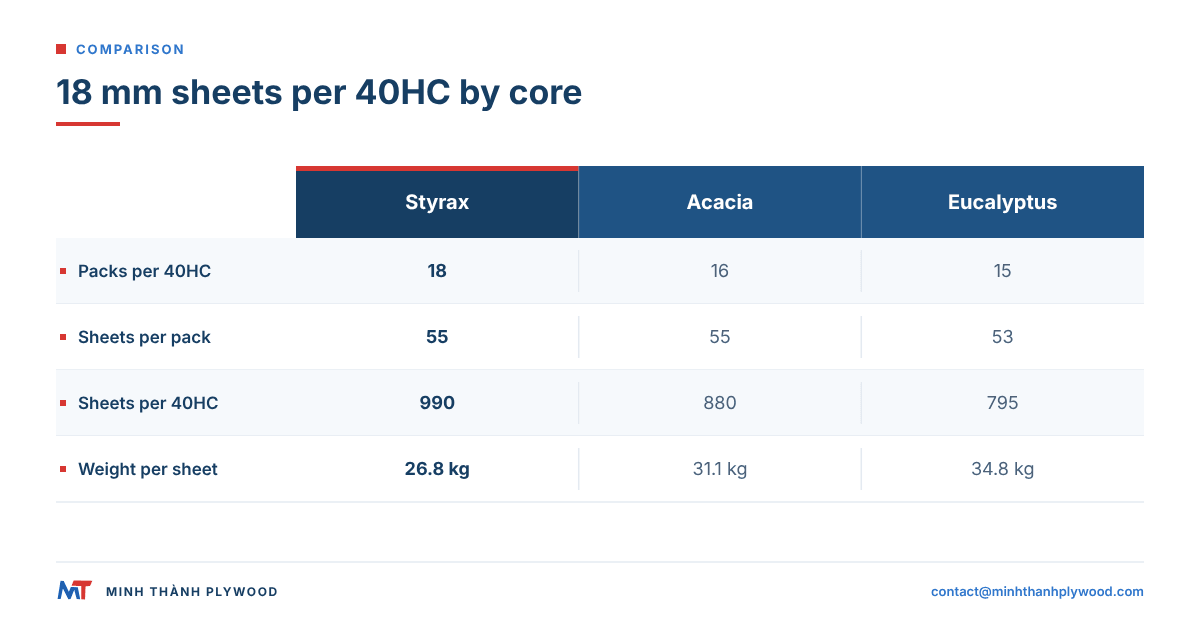
The core species decides how many sheets a container carries, because a 40HC reaches its weight limit before it is full when the core is dense. The reference plan for 1220 × 2440 × 18 mm sheets on a 28,000 kg planning payload shows the effect.
| Core | Packs per 40HC | Sheets per 40HC | Volume | Weight per sheet |
|---|---|---|---|---|
| Styrax | 18 (55 sheets each) | 990 | about 53 m³ | 26.8 kg |
| Acacia | 16 (55 sheets each) | 880 | about 47 m³ | 31.1 kg |
| Eucalyptus | 15 (53 sheets each) | 795 | about 43 m³ | 34.8 kg |
These counts are the factory’s planning figures for one standard pack height; a lower booking weight lowers them. Our packing calculator gives the figures for other thicknesses and payloads.
Choosing a core veneer supplier in Vietnam: what to check
If you are buying loose core veneer from Vietnam for your own press, check the supplier on six points before the first container: species, grade split, thickness and tolerance, moisture, sheet size and packing.
| Point | What to agree in writing |
|---|---|
| Species | Styrax, eucalyptus or acacia, not “hardwood” |
| Grade | The share of grade A and lower grades in each bundle |
| Thickness | Nominal thickness and the tolerance per sheet |
| Moisture | The moisture at loading and how it is measured |
| Sheet size | Full sheets and strips, with their size tolerance |
| Packing and count | Sheets per bundle, bundle marking, how the count is checked |
Ask also for the origin records your own due diligence needs. Under the EU Deforestation Regulation, the application date is 30 December 2026 for large and medium operators.
Loose veneer is a different trade from finished plywood. Minh Thanh Plywood does not sell core veneer: we grade and use our veneer in our own panels and sell finished plywood. Most importers who start by asking about core veneer want a panel with a better core, and buying the finished panel from a mill that stitches and double-presses its cores puts the quality control in one place.
What should you write on your plywood order about the core?
Write the core as a full line of the specification, not as a word in the product name. A good order line names the species, the grade, the build, the ply count and the checks.
Example order line: 18 mm birch-faced plywood, 1220 × 2440 mm; core: white Styrax, grade A, stitched both directions, 11 plies, pressed twice; glue: UF glue at E0 emission, CARB P2 / TSCA Title VI; face/back: birch D/E to the approved sample; sanded, tolerance ±0.2 mm; moisture 8–12% at dispatch; export packing; quantity: one 40HC.
That line also makes quotes comparable, because each mill has to price the same core. Send it to us through the EV plywood page or the furniture plywood page, or write to [email protected]; we reply within hours with a written quote and can send free samples so you can cut the core yourself.
Buyer questions, answered
What is veneer core plywood?
Veneer core plywood is plywood whose inner layers are all sheets of rotary-peeled veneer, laid with the grain crossing from layer to layer. It is the standard build for furniture and cabinet plywood, as opposed to MDF, particle board or lumber cores.
What is veneer core plywood used for?
Furniture carcasses, kitchen and wardrobe cabinets, shelving, interior joinery, drawer parts and wall panels. The cross-laminated veneer holds screws along the edge better than MDF or particle board at a lower weight.
Is veneer core plywood good?
Yes, when the core is graded, dried and stitched properly. A good veneer core panel is lighter and stronger than an MDF-core panel of the same thickness and holds edge screws well; a loosely laid, low-grade core shows gaps, telegraphing and weak spots.
What thickness is core veneer in Vietnamese plywood?
Core veneer in Vietnamese plywood is usually peeled at 1.4–2.0 mm. Thin panels use thinner veneer: a 4 mm furniture panel takes three 1.3 mm Styrax core veneers between two faces.
Which Vietnamese core species is best for furniture-grade plywood?
White Styrax for light, pale, flat furniture panels, and eucalyptus where you need more density and screw holding. Acacia is a cost-effective option made on order. All three are plantation species grown in Vietnam.
What is the difference between stitched and loose-laid core veneer?
In a stitched core the veneer pieces are sewn edge to edge into one continuous sheet before layup, so there are no gaps or overlaps. In a loose-laid core the pieces are laid side by side, which leaves gaps and overlaps that can show through the face.
How do you check moisture content in core veneer?
With a pin or pinless moisture meter on sheets from the middle of the bundle, at several points. For finished furniture panels, Minh Thanh Plywood dries veneers and panels to 8–12% moisture content at dispatch.
How can I spot defects in core veneer without a lab test?
Look at the panel edge for gaps, overlaps and missing plies, sight along the face for dips and ridges, tap for hollow spots, and cut one sheet across to see every core layer. These checks catch most core faults in minutes.
Can I buy core veneer from Minh Thanh Plywood?
No. We use our core veneer in our own panels and sell finished plywood, not loose veneer. If you are comparing core quality, we can send free samples of finished panels so you can cut and check the core yourself.
Does the core species change the weight of a container?
Yes. An 18 mm sheet of 1220 × 2440 mm weighs about 26.8 kg on a Styrax core, 31.1 kg on acacia and 34.8 kg on eucalyptus, so a 40HC carries 990, 880 or 795 sheets before reaching its weight limit.
Do Vietnamese mills use poplar or birch core?
No. Vietnamese plywood cores are Styrax, eucalyptus, acacia or a mix of these. Birch, okoume, bintangor and gurjan are used as face veneers on top of a Vietnamese core.