
Finger joint plywood is plywood whose core is made of short wood blocks joined end to end with interlocking finger joints, often cut from reclaimed plywood, then faced with new veneer and usually film. It is cheaper per sheet than veneer-core plywood but flexes, bonds and lasts differently. Minh Thanh Plywood explains the build, the price drivers and when the cheaper core is acceptable.
What is finger joint plywood?
Finger joint plywood is plywood with a core of short wood blocks joined end to end by interlocking finger joints, covered on both sides with new veneer and usually a film. The fingers are wedge-shaped cuts that mesh and are glued, so short pieces become one long core.
The core is what makes it different. A normal plywood core is made of whole sheets of rotary-peeled veneer laid with their grain crossing; a finger joint core is made of solid blocks, often cut from reclaimed plywood or offcuts. That is why the same product is sold as finger joint core plywood, finger-jointed core plywood and recycled core plywood.
Most finger joint plywood in the market is film-faced and sold for concrete formwork, where a low price per sheet matters. It looks like any film-faced panel from the face; the difference shows only at the edge and in use.
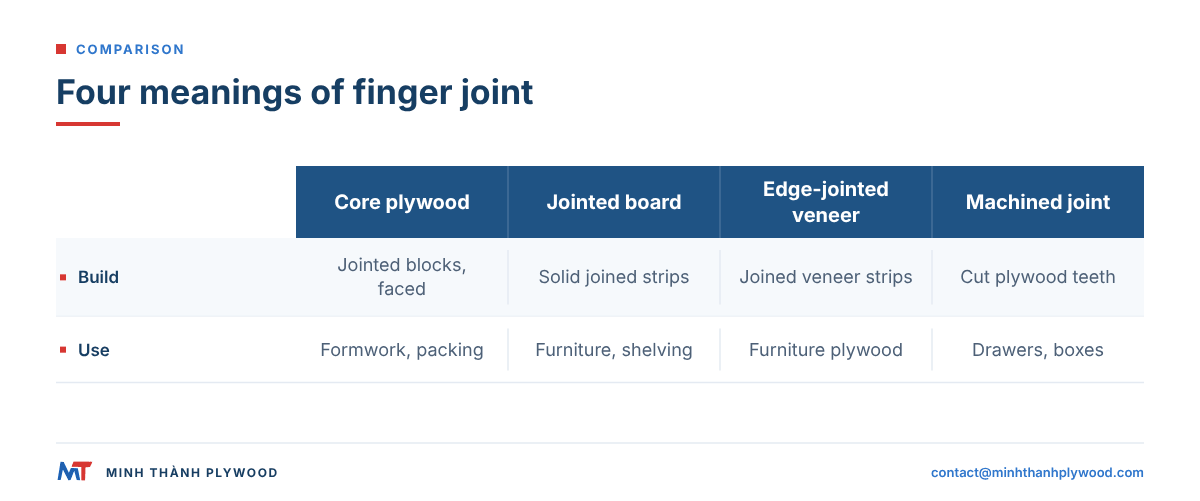
Four products buyers call “finger joint”
Four different products travel under the words “finger joint” in plywood enquiries, and they are priced and used very differently. Name the one you mean before comparing quotes.
| Product | What it is | Typical use |
|---|---|---|
| Finger joint core plywood | Core of jointed blocks, often reclaimed plywood, with new veneer and film on both sides | Low-cost formwork, hoarding, packing |
| Finger-jointed board | Solid timber strips joined end to end and edge-glued into a board, no veneer | Furniture parts, shelving, stair parts, joinery |
| Edge-jointed core veneer | Whole veneer strips joined along their edges into full layers of a veneer core | Commercial and furniture plywood |
| Machined finger joints in plywood parts | Box or finger joints cut by CNC to join plywood parts | Drawers, boxes, furniture assembly |
Only the first is the subject of this guide. Edge-jointed and stitched veneer cores are normal veneer-core builds, explained in our core veneer guide.
Finger-jointed board: sizes and what it is not
A finger-jointed board is solid timber, not plywood, so size, species and grade replace ply count and glue class on the order. Retail panels are laminated from finger-jointed strips, for example an 18 mm knot-free pine panel at 2440 × 1215 mm (read October 2026), and reclaimed-teak versions are sold as 4 × 8 ft sheets at 1/4 in. They are bought for visible, solid-wood faces. They are not a substitute for a veneer-core panel in formwork or in cabinets that need cross-laminated stability.
| Spec to give | Finger-jointed board | Finger joint core plywood |
|---|---|---|
| Size | Panel 2440 × 1220 mm or cut-to-length strips | 1220 × 2440 mm, 1250 × 2500 mm |
| Thickness | Set by the strip, quoted per board | Quoted per panel, with the film and core named |
| Faces | Solid timber, grade by knots and colour | Film or veneer over a jointed core |
| Sold for | Furniture parts, shelving, stair parts | Low-reuse formwork, hoarding |
Joining plywood sheets: finger, puzzle and scarf joints
If you searched for “finger joint plywood” to join two sheets into a longer one, a scarf joint is the strongest way and a finger or puzzle joint is the easier one. Boatbuilders on the boatdesign.net finger-jointing thread hold that only a scarf passes the stress through the whole panel and so reaches at least 95% of the panel’s strength. A scarf cuts both sheets to a long slope, with a length of 8 to 12 times the thickness, and glues them with epoxy.
A 12:1 slope is the usual recommendation to reach about 90% of solid timber, while 8:1 is common on lightly loaded panels. A finger or puzzle joint cuts interlocking teeth with a router bit; it is quicker to cut and fine for boxes and furniture, but it has steps in the load path and is weaker in bending.
Before you joint, check whether a longer sheet is simpler. Standard 1220 × 2440 mm sheets cover most jobs; for long panels such as hoardings or shopfit, 1250 × 2500 mm is a standard size, and a whole sheet has no joint to fail. Our core veneer guide explains why a continuous veneer layer carries load better than jointed pieces.
How is finger-jointed core plywood made?
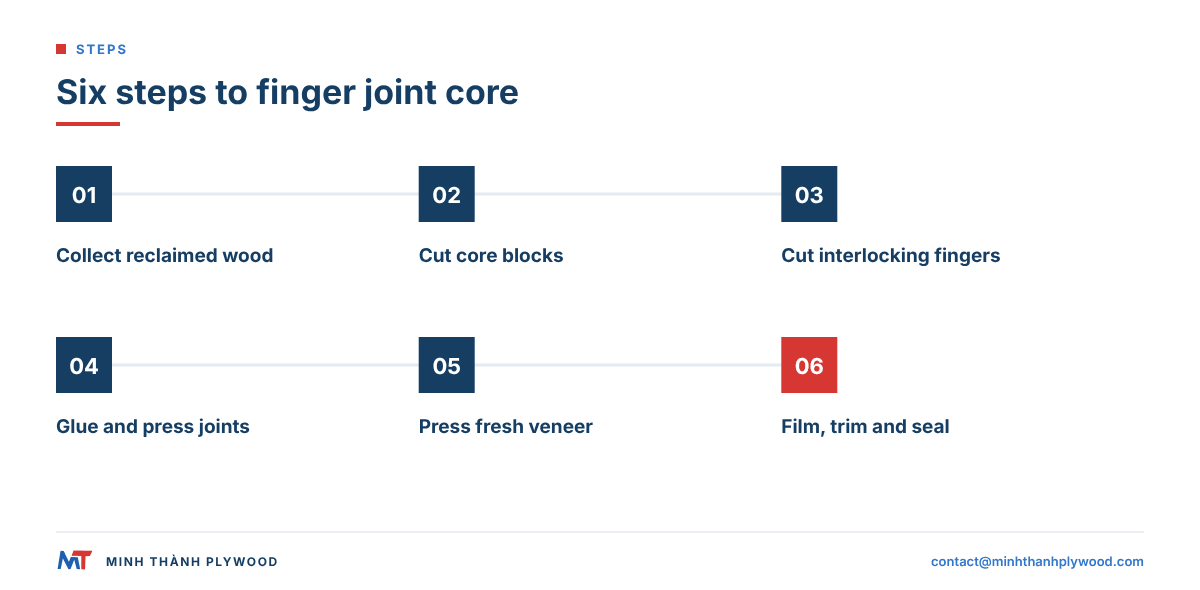
Finger-jointed core plywood is made in six steps, from reclaimed wood to a faced and filmed panel. Each step adds a variable that a veneer core does not have.
- Collect the core material: used plywood, mill offcuts or short timber.
- Cut into blocks: the material is ripped and cross-cut into blocks of the core thickness.
- Cut the fingers: a shaper cuts interlocking fingers into the block ends.
- Glue and press the joints: blocks are glued end to end into long lengths, then laid side by side into a core panel.
- Add new veneer: one or more layers of fresh veneer are pressed on both sides to cover the blocks and give a smooth base.
- Film and finish: a phenolic or melamine film is pressed on, the edges are trimmed and painted.
The new veneer and the film make the face look like any formwork panel, while the core inside holds the joints, old glue and mixed species of the reclaimed material.
Recycled core plywood: what goes into the core?
Recycled core plywood has a core made from reclaimed wood, most often used plywood and offcuts cut into blocks. Its properties depend on whatever went into the core, which changes from batch to batch.
- Mixed species and densities: blocks from different panels sit side by side, so weight and stiffness vary across one sheet.
- Old glue lines: reclaimed plywood brings its own glue lines, often of unknown type, and sometimes old film.
- Joints in every row: each finger joint is a point where the core relies on glue, not on continuous fibre.
- Unknown emission: the formaldehyde released by old glue in the core is not controlled by the mill that makes the new panel.
Recycled core plywood is therefore a cost product, not a quality product. It has honest uses, set out below, but it is not a substitute for a veneer core where flatness, bond or emission are specified.
Finger joint core film faced plywood for formwork
Finger joint core film faced plywood is used for concrete formwork where the panel will be used a few times and price per sheet is the deciding factor. It gives a smooth first pour, but the jointed core sets a low limit on reuse.
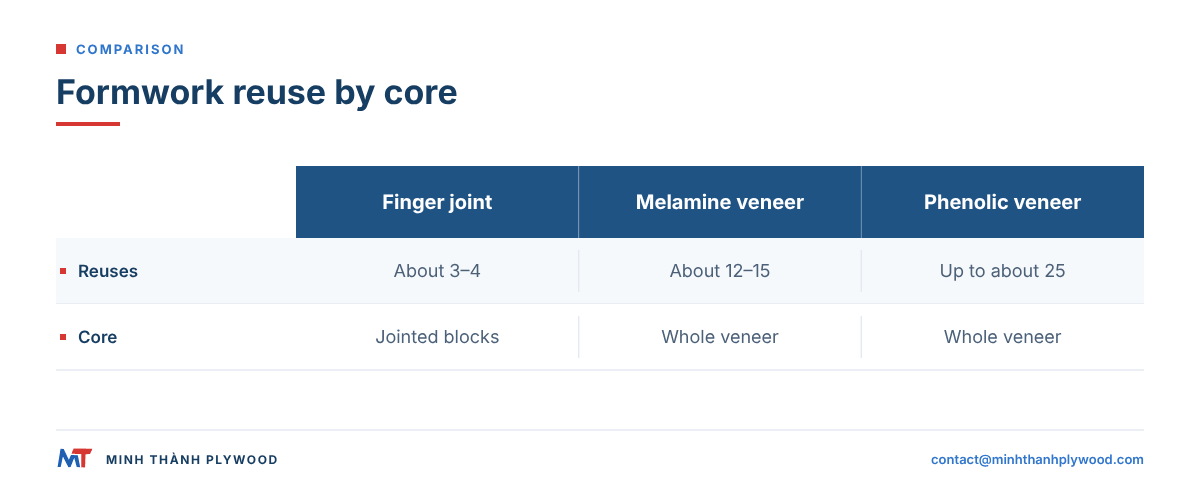
| Panel | Reuses with proper handling |
|---|---|
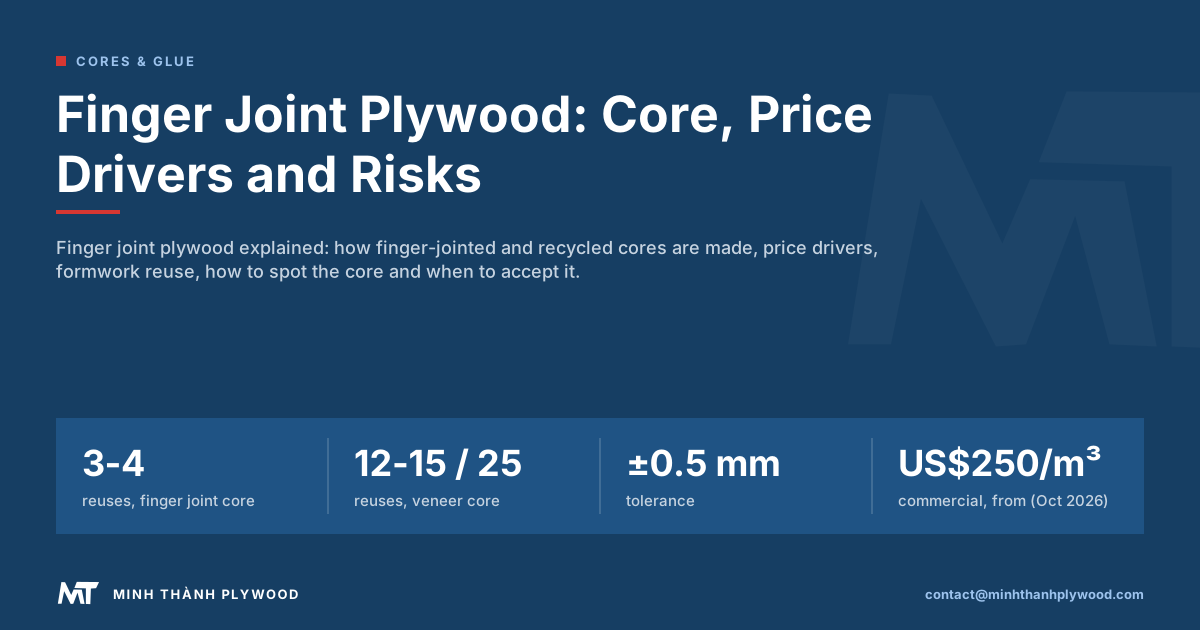
| Finger joint core film-faced | About 3–4, as published by producers in China (2021) |
| Veneer core, melamine-bonded film-faced | About 12–15 |
| Veneer core, phenolic-bonded film-faced | Up to about 25 |
Reuse depends on site practice as much as on the panel: edges sealed after every cut, release agent before every pour, careful stripping and dry storage add pours to any panel. In the US, formwork for cast-in-place concrete is covered by OSHA standard 1926.703, which makes the load a panel carries a safety question as well as a cost one. What the jointed core cannot give is the even bond of whole veneer layers: water that enters at a cut edge or a nail hole reaches the finger joints and old glue lines, and the panel swells, bows or opens at the joints sooner.
Finger joint core film-faced plywood works for walls and columns cast once or twice, and for temporary or one-off pours. For slabs, fair-faced concrete and rental formwork, a veneer-core film-faced panel costs less per pour. Our film-faced plywood price guide shows what the veneer-core alternative costs.
Finger joint plywood vs veneer core plywood
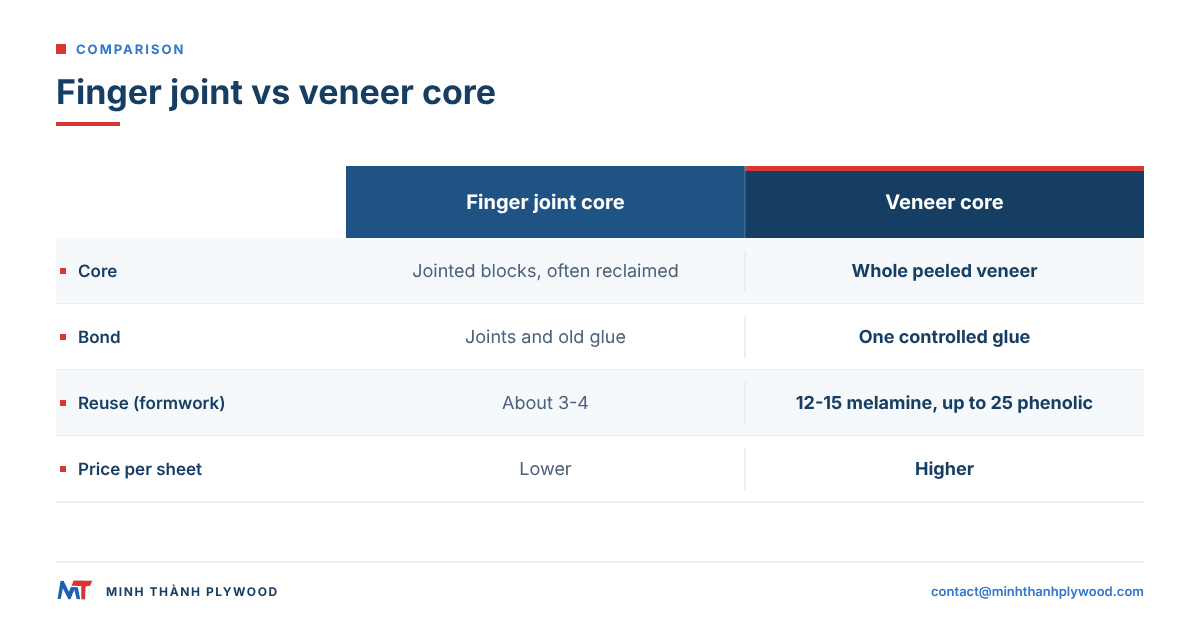
Finger joint plywood costs less per sheet than veneer core plywood, and veneer core plywood performs more evenly in almost every other line. The table compares them for the same thickness and film.
| Finger joint core | Veneer core | |
|---|---|---|
| Core material | Jointed blocks, often reclaimed | Whole rotary-peeled veneer, cross-laminated |
| Flatness | Good when new; joints can show after wetting | Even; best when the core is pressed twice |
| Bond | Depends on the joints and the old glue in the blocks | One glue system, controlled by the mill |
| Stiffness and bending | Weaker at each joint | Even along the sheet |
| Screw and nail holding | Varies block to block | Even |
| Weight per sheet | Varies with the reclaimed material | Set by the core species |
| Thickness tolerance | Depends on calibration of the blocks | ±0.5 mm for commercial and film-faced panels at our mill |
| Emission certification | Hard to certify, old glue in the core | Certifiable, CARB P2 / TSCA Title VI for our furniture panels |
| Reuse in formwork | About 3–4 | About 12–15 melamine, up to about 25 phenolic |
| Price per sheet | Lower | Higher |
The line to compare is the one that matters for your use: price per sheet for a single pour, cost per pour for formwork, and flatness and certification for anything inside a building.
Finger joint plywood price: what drives it?
Finger joint plywood price is driven mostly by the core, then by the film, the glue, the thickness and the quantity. Because the core is most of the panel’s volume, the reclaimed core is where the saving comes from, so ask what the core is before you compare quotes.
| Price driver | What lowers the price | What raises it |
|---|---|---|
| Core source | Reclaimed plywood and offcuts | New timber blocks, sorted by density |
| Veneer over the core | One thin layer | Two layers or thicker veneer |
| Film | Light film, plain colour | Heavier phenolic film |
| Glue | UF or light melamine | Phenolic for joints and faces |
| Thickness and tolerance | Loose tolerance | Calibrated, tight tolerance |
| Edge sealing | Basic paint | Full sealing of all four edges |
| Quantity and loading | Full containers of one size | Small, mixed orders |
| Origin and freight | Close to the job site | Long sea freight for a heavy, low-value panel |
Two ways to read a finger joint plywood price:
- Per sheet, for packing, hoarding and single-use forms, where the cheapest panel that survives one job wins.
- Per pour, for formwork used more than a few times: divide the panel price by the reuses you can expect. A panel that costs far less but gives a quarter of the pours usually costs more per pour.
For reference, our veneer-core commercial plywood starts from US$250/m³ and furniture and interior plywood from US$350/m³ (October 2026); the final price depends on face, core, glue, thickness, size, quantity and delivery term. We do not make finger joint core plywood, so we do not quote it.
How to spot a finger-joint or recycled core
You can spot a finger-joint or recycled core in a few minutes, on a sample or at inspection. The face hides it; the edge and a cut show it.
- Look at the edge: zigzag lines across the core, blocks of different colour and grain, and dark lines of old glue or film inside the core mean a jointed or recycled core.
- Cut one sheet across: a veneer core shows continuous, straight plies from edge to edge; a jointed core shows separate blocks.
- Weigh several sheets: large differences in weight between sheets of the same size point to mixed core material.
- Flex a strip: cut a strip across the sheet and bend it; a jointed core tends to break at a joint.
- Boil a sample: soak or boil a cut piece to the test on your order; joints and old glue lines open first.
- Ask for the core in writing: the quote should name the core material; “hardwood core” or “mixed core” leaves it open.
When is the cheaper core acceptable?
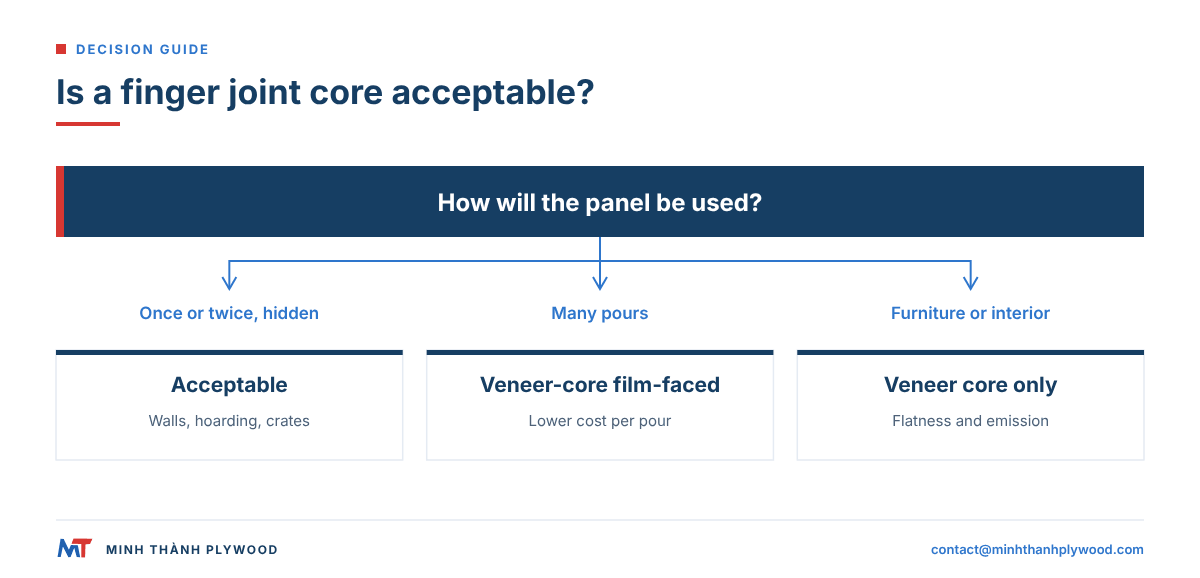
The cheaper core is acceptable when the panel is used once or twice, hidden and not certified for emission. It is not acceptable where flatness, long life, bond or certification are part of the job.
| Use | Finger joint or recycled core | Why |
|---|---|---|
| Walls and columns cast once or twice | Acceptable | Low price per pour for few pours |
| Site hoarding, temporary covers | Acceptable | Short life, appearance secondary |
| Crates and one-way packing | Acceptable, or use packing plywood | Single use; check the import rules for wood packaging |
| Slab formwork, rental formwork | Not advised | Many reuses, deflection under load |
| Fair-faced or architectural concrete | Not advised | Joints can mark the concrete |
| Furniture, cabinets, interior panels | Not acceptable | Flatness, screw holding and emission certification |
| Flooring, structural or exterior use | Not acceptable | Even bond and strength needed |
For packing, a packing plywood panel on a veneer core is often only a little dearer and far more even.
Risks of finger joint core plywood
The risks of finger joint core plywood come from the joints and from the unknown material in the core. They show up after delivery, on site or in the customer’s product, not in a sample photo.
- Swelling and opening at joints: water reaching the core through cut edges or nail holes swells the blocks and opens the joints.
- Deflection under concrete load: joints reduce bending stiffness, so a panel can bow more than a veneer-core panel of the same thickness.
- Delamination: the new veneer bonds to a core of mixed blocks and old glue, and can lift where the bond is weak.
- Weight and thickness variation: reclaimed blocks vary, so sheets in one lot differ in weight and, without calibration, in thickness.
- Emission and documents: old glue in reclaimed blocks is outside the mill’s control, which makes emission certification for indoor use difficult; US rules for hardwood plywood set 0.05 ppm for veneer-core panels in 40 CFR 770.10.
Write the core into the contract so that a lower-cost core cannot be substituted for the one you paid for. Our plywood delamination guide covers the bond failures in detail.
Finger-jointed core plywood suppliers: what to ask before you buy
Ask a finger-jointed core plywood supplier six questions before you pay a deposit. The answers tell you whether the low price buys a usable panel or a claim.
- What is the core made of? New timber blocks, mill offcuts or used plywood, and in what share.
- Which glue joins the fingers and bonds the faces? Phenolic, melamine-fortified or UF, and which boil test the panel passes.
- How many veneer layers cover the core? One thin layer shows the blocks through the film sooner than two.
- How is thickness controlled? Calibrated blocks and a written tolerance, or nominal thickness only.
- What reuse does the supplier state, and under which site conditions? A number without conditions is a sales figure.
- Can you see a cut sample from production? A cross-cut of a real sheet, not a showroom sample, shows the blocks, joints and old glue lines.
If the answers are vague, price a veneer-core film-faced or packing panel for the same job and compare the cost per pour or per crate.
Why we build on whole veneer cores
Minh Thanh Plywood builds every panel on whole peeled veneer cores of Styrax, eucalyptus or acacia; we do not make finger joint or recycled cores. Vietnamese plywood cores are peeled from plantation timber, and the area around our factory in Ha Hoa, Phu Tho supplies it locally.
What that gives you in each product line:
- Furniture and interior panels: grade A core, stitched both horizontally and vertically, pressed twice, sanded to ±0.2–0.3 mm, UF glue at E0 emission with CARB P2 / TSCA Title VI.
- Commercial plywood: veneer core with ±0.5 mm thickness tolerance, glue to the order.
- Packing plywood: veneer core with ±0.5–1.0 mm tolerance, for crates and pallets at a low cost per sheet.
- Film-faced plywood: veneer core with melamine-fortified or phenolic glue, for formwork that is reused.
Moisture at dispatch is 8–12% for veneers and finished panels, and every shipment is photographed and filmed before loading, so you see the panels you are paying for.
What to write on your order
Write the core material on the order in words that exclude what you do not want. “Hardwood core” or “good quality” leaves the core open; a named build closes it. For the bond, name the class from EN 314-2, the European standard for plywood bonding quality.
Example order line for formwork: 18 mm film-faced plywood, 1220 × 2440 mm; core: whole veneer, eucalyptus or acacia, no finger-joint or recycled core; glue: phenolic (WBP), 72-hour boil; film both sides, edges sealed; thickness tolerance ±0.5 mm; quantity: one 40HC.
Example order line for packing: 12 mm packing plywood, 1220 × 2440 mm; core: veneer core, loose-laid accepted; glue to the destination’s emission rule; tolerance ±0.5–1.0 mm.
The minimum order is one 40HC, with mixed specifications by agreement, and production takes 15–45 days after the 30% deposit. Send your line through the commercial plywood page or to [email protected]; we reply within hours and send free samples, so you can cut the core and see the whole veneer plies yourself.
Buyer questions, answered
What is finger joint plywood?
Plywood whose core is built from short blocks or strips of wood joined end to end with interlocking finger joints, then covered with new veneer on both sides. The core is often cut from reclaimed plywood, which is why it is also called recycled core plywood.
Is finger joint core plywood good for formwork?
For a few pours on walls and columns, yes. For slabs, fair-faced concrete or many reuses, a veneer-core film-faced panel lasts far longer: melamine-bonded panels give about 12–15 reuses and phenolic-bonded panels up to about 25 with proper handling.
How many times can finger joint film faced plywood be reused?
Producers of the panel in China publish about 3–4 reuses (2021). Site practice, edge sealing and release agent change the real number, but the jointed core sets a low ceiling.
Why is finger joint plywood cheaper?
Because the core is made from offcuts and reclaimed panels instead of whole peeled veneer, and needs less grading and stitching. The saving is in the core, which is most of the panel's volume.
What is recycled core plywood?
Plywood whose core is made from reclaimed wood, usually used plywood or offcuts cut into blocks and joined. Its glue, density and emission vary with what went into it.
How can I tell if plywood has a finger-joint core?
Look at the edge for zigzag joint lines, blocks of different colours and old dark glue or film lines inside the core. Cut one sheet across: a veneer core shows continuous straight plies, a finger-joint core shows blocks.
Is finger joint plywood the same as finger-jointed board?
No. Finger-jointed board is solid timber, short strips joined end to end and edge-glued into a panel, used for furniture and shelving. Finger joint plywood has a jointed core under veneer faces.
Does Minh Thanh Plywood make finger joint core plywood?
No. Our panels are built on whole peeled veneer cores of Styrax, eucalyptus or acacia. For low-cost uses we offer commercial and packing plywood on veneer cores.
Is finger joint plywood strong?
It carries normal loads in the direction the panel is supported, but each joint is a weak point in bending and the core density varies from block to block, so screw holding and stiffness are less even than in a veneer core.
What is the price of finger joint plywood?
It is priced below veneer-core film-faced plywood of the same thickness, by core source, film, glue and quantity. For comparison, our veneer-core commercial plywood starts from US$250/m³ and furniture plywood from US$350/m³ (October 2026).