
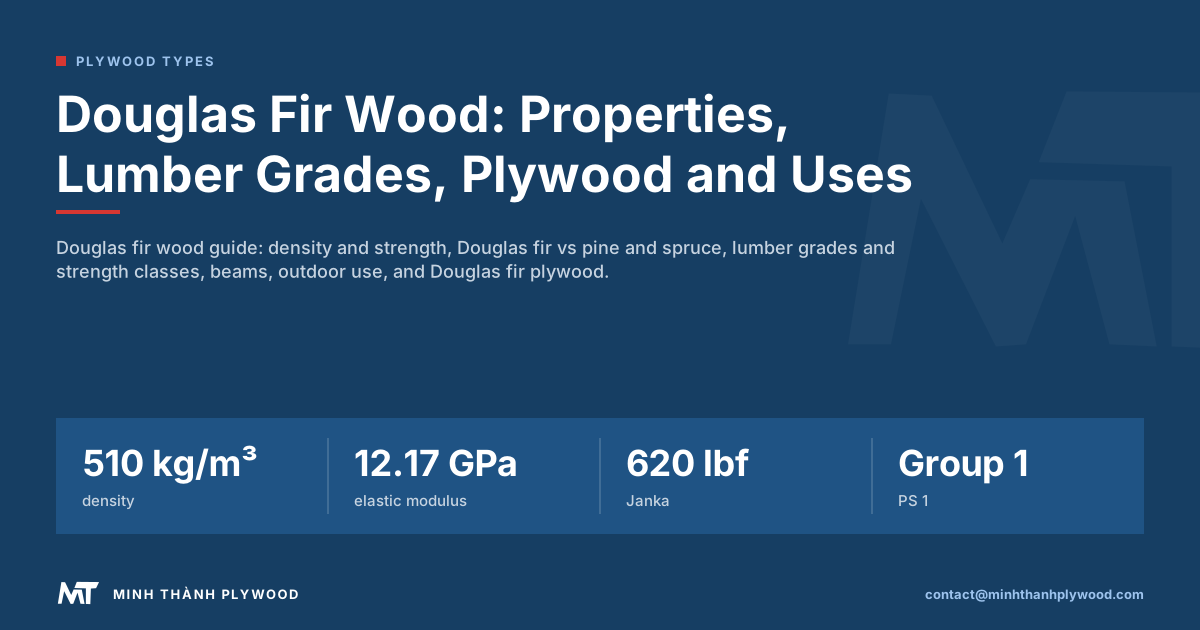
Douglas fir wood comes from Pseudotsuga menziesii, a western North American conifer that is not a true fir. It is one of the stiffest and strongest softwoods for its weight, about 510 kg/m³ dry, and the classic species for framing lumber, heavy beams and structural plywood. Minh Thanh Plywood compares it with pine and spruce, explains the grades, and shows what to order for panels.
What is Douglas fir wood?
Douglas fir wood is the timber of Pseudotsuga menziesii, a large conifer native to western North America. Despite the name it is not a true fir: true firs belong to the genus Abies, and Douglas fir has its own genus, Pseudotsuga.
The common name honours David Douglas, the Scottish botanist who sent its seed to Britain; the scientific name honours Archibald Menzies, who first described the tree in the 1790s. The trees grow 60-75 m tall with trunks 1.5-2 m across, which yields long, clear sections and large veneer logs.
Two varieties reach the trade:
- Coast Douglas fir (var. menziesii), from the Pacific coast from British Columbia to California: the larger, faster-growing tree and the main source of beams and plywood.
- Rocky Mountain Douglas fir (var. glauca), from the interior: slower-grown, smaller trees.
Douglas fir is also grown on plantations outside its range, notably in France, Germany, the United Kingdom and New Zealand. In some markets old stock is still sold as Oregon pine.
What are the properties of Douglas fir wood?
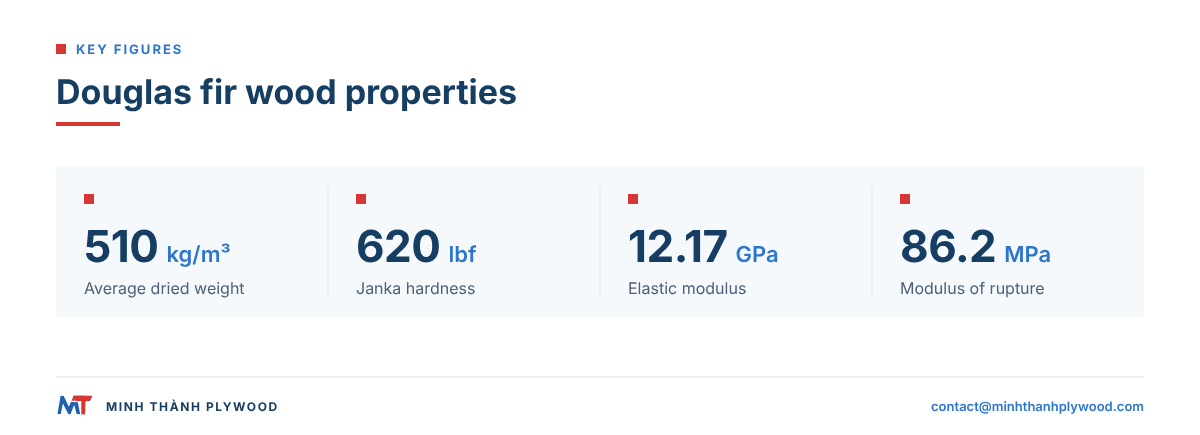
Douglas fir is a medium-weight softwood with very high stiffness and strength for its weight. The figures below are averages at 12% moisture content from The Wood Database, read 20 October 2026; they average four growing regions.
| Property | Douglas fir | What it means in use |
|---|---|---|
| Average dried weight | 510 kg/m³ | Light enough to handle long lengths on site |
| Specific gravity (basic, 12% moisture) | 0.45, 0.51 | Heavy for a softwood |
| Janka hardness | 620 lbf (2,760 N) | Among the hardest North American softwoods |
| Modulus of rupture | 86.2 MPa | High bending strength |
| Elastic modulus | 12.17 GPa | Very stiff; less deflection over a span |
| Crushing strength | 47.9 MPa | Good for posts and columns |
| Radial shrinkage | 4.5% | Moderate |
| Tangential shrinkage | 7.3% | Moderate |
| Volumetric shrinkage | 11.6% | Moderate |
| T/R ratio | 1.6 | Low; flat-sawn boards cup little |
The heartwood is light brown with a red or yellow tint and darker growth rings. Latewood is much denser than earlywood, which gives high grain contrast: straight and plain on quarter-sawn faces, wild and figured on flat-sawn faces and rotary-peeled veneer.
Douglas fir vs pine vs spruce: which is stronger?
Douglas fir is stronger and stiffer than spruce and the common pines, and lighter than the dense southern pines that match it. The table compares average values at 12% moisture content.
| Metric | Douglas fir | Scots pine | Norway spruce | Longleaf pine | Western larch |
|---|---|---|---|---|---|
| Average dried weight | 510 kg/m³ | 550 kg/m³ | 405 kg/m³ | 650 kg/m³ | 575 kg/m³ |
| Janka hardness | 620 lbf | 540 lbf | 380 lbf | 870 lbf | 830 lbf |
| Modulus of rupture | 86.2 MPa | 83.3 MPa | 63.0 MPa | 100.0 MPa | 89.7 MPa |
| Elastic modulus | 12.17 GPa | 10.08 GPa | 9.70 GPa | 13.70 GPa | 12.90 GPa |
| Crushing strength | 47.9 MPa | 41.5 MPa | 35.5 MPa | 58.4 MPa | 52.6 MPa |
| Heartwood durability | Moderately durable | Moderately durable to non-durable | Slightly to non-resistant | Moderately resistant | Moderately durable |
Verdict by use:
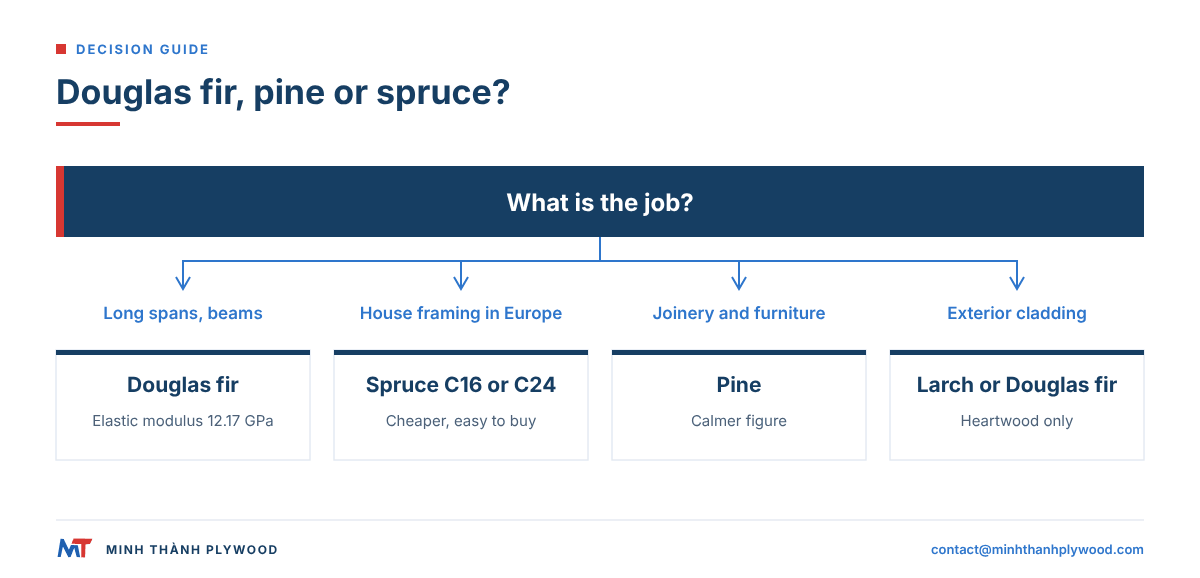
- Long spans, beams and heavy framing: Douglas fir. Its stiffness per kilogram is the reason it dominates North American beams.
- House framing in Europe: spruce in C16 or C24, which is cheaper and easier to buy; Douglas fir where a longer span or a larger section is needed.
- Joinery and furniture: pine, which machines more evenly and has a calmer figure.
- Exterior cladding: larch or Douglas fir heartwood, both moderately durable.
- Decking with heavy wear: the dense southern pines, usually pressure-treated.
Douglas fir timber in Europe: strength classes and durability
European-grown Douglas fir timber is graded under EN 14081-1 and given a strength class from EN 338, mostly C16 to C24. It is faster-grown than old coastal North American stock, so wider growth rings and more knots put most of it in the lower classes.
EN 350 rates Douglas fir heartwood moderately to slightly durable (durability class 3–4) against decay fungi, and the sapwood not durable. For cladding, the heartwood performs well above ground; for posts in the ground it needs treatment or a more durable species.
Douglas fir is also sold in the UK and Ireland for structural carcassing, glulam lamellas and large visible beams, where its red-brown colour suits exposed timber frames. Kiln-dried stock is the norm for joinery and cladding; sawn carcassing is bought to the C16 or C24 stamp that its grading mark shows.
Douglas fir lumber grades in North America
Douglas fir lumber is graded under rules approved within the American Softwood Lumber Standard (PS 20), mostly by the Western Wood Products Association and the West Coast Lumber Inspection Bureau. It is sold in the species group Douglas fir-larch (DF-L), together with western larch, which has similar strength.
| Grade family | Grades | Typical use |
|---|---|---|
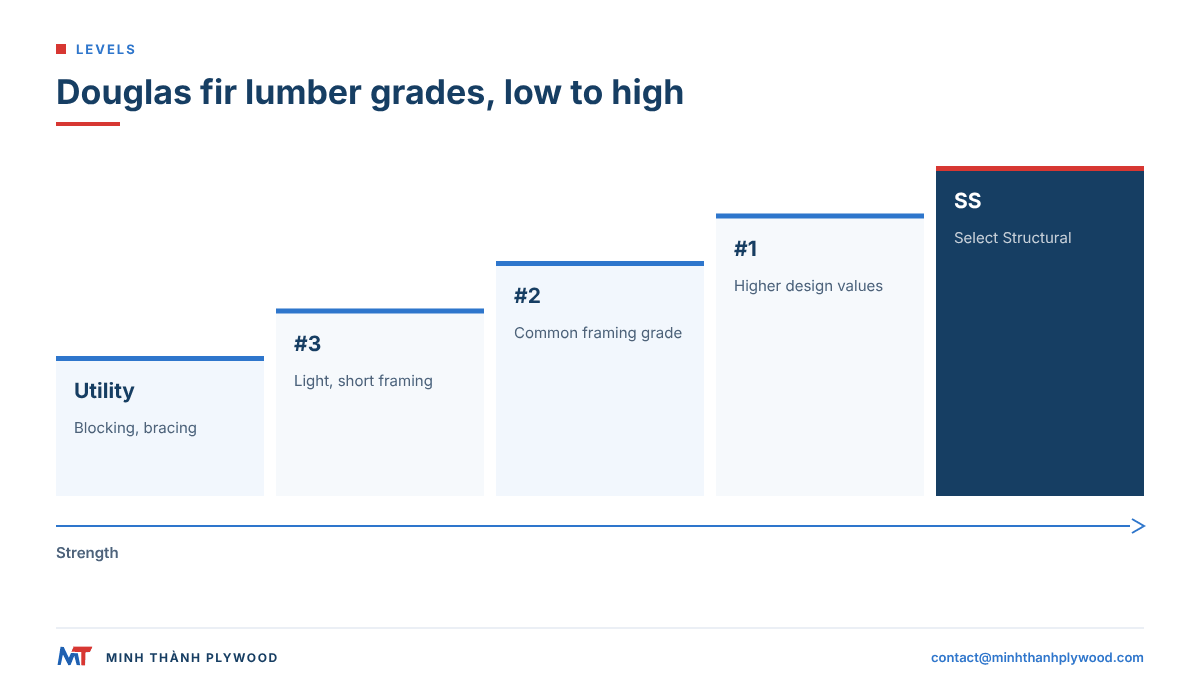
| Structural joists and planks | Select Structural, #1, #2, #3 | Floor joists, rafters, headers; #2 is the common framing grade |
| Light framing | Construction, Standard, Utility | Blocking, bracing, short framing |
| Studs | Stud | Wall studs up to standard wall heights |
| Timbers (5 inches and more) | Select Structural, #1, #2 | Posts, beams, heavy timber frames |
| Appearance (Selects) | C and Better Select, D Select | Trim, mouldings, visible joinery |
Two further terms matter on a Douglas fir order:
- VG (vertical grain): growth rings at a steep angle to the face, for doors, windows and stair parts.
- FOHC (free of heart centre): timbers sawn to exclude the pith, which reduces checking and twisting in large sections.
How is Douglas fir used for beams and heavy timbers?
Douglas fir is the standard North American species for solid beams, posts and heavy timber framing, because large trees yield long, wide sections with high stiffness. Sawn beams, glulam made of Douglas fir lamellas and large-section posts are all common.
Large sections dry slowly and form surface checks as they do. Three steps limit the problem:
- Order FOHC timbers for visible work, sawn away from the pith.
- Let green timbers acclimatise in the building before finishing, or order them kiln-dried where the section allows.
- Size joints for shrinkage across the grain, especially in pegged timber frames.
Where a beam must carry a calculated load with less variation than solid wood, engineered products take over. LVL and glulam spread knots and defects through many thin layers, so their strength values are higher and more even than a sawn piece of the same size.
Is Douglas fir good for outdoor use?
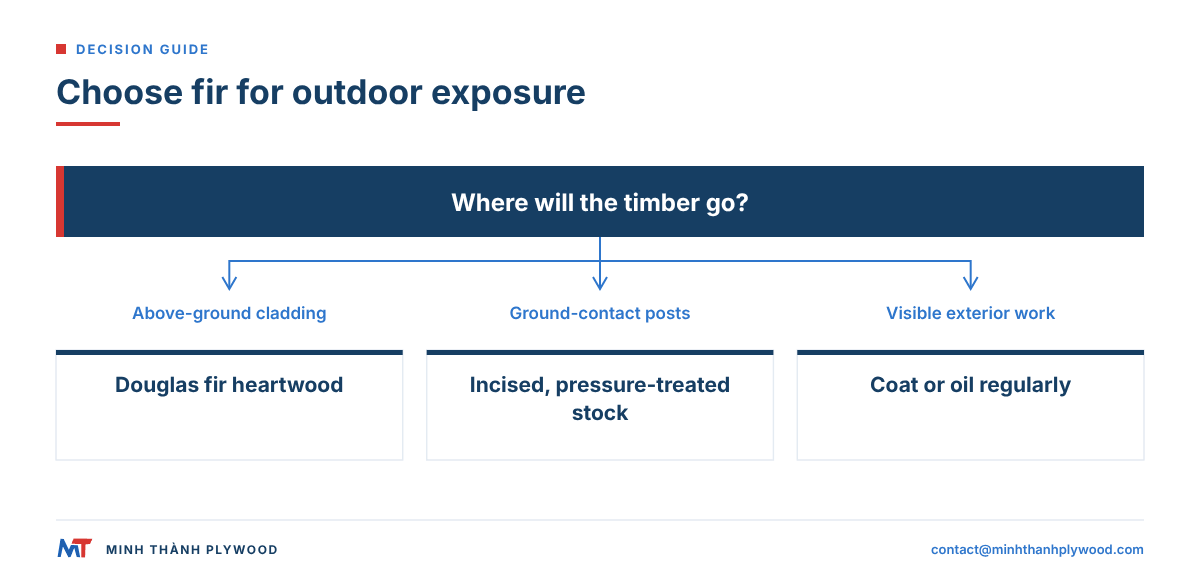
Douglas fir heartwood is moderately durable outdoors: it suits cladding, decking and pergolas above ground in many climates, but not ground contact without treatment. It is also susceptible to insect attack.
Douglas fir is hard to impregnate with preservative, so treaters often incise it, cutting small slits in the surface that let the preservative in. For an outdoor order, specify:
- Heartwood for any part that stays wet.
- Incised and pressure-treated stock for posts and ground contact.
- A coating or regular oiling to slow weathering and surface checking.
- Stainless or coated fixings, as the wood is mildly acidic when wet.
Is Douglas fir plywood good and strong?
Yes. Coast and northern Douglas fir (“Douglas-fir 1”) is a Group 1 species under the US Voluntary Product Standard PS 1, the group with the highest stiffness and strength; interior “Douglas-fir 2” from the southern Rockies is Group 2. It is a standard structural panel for roof and wall sheathing, subfloors, concrete formwork and industrial crates.
Douglas fir plywood is made from rotary-peeled veneer, so its face shows the wild, high-contrast figure of flat-sawn fir. Common grades are CDX sheathing, sanded A-C and B-C panels, and overlaid formwork panels. The face can raise its grain and check when exposed, which is why many furniture makers choose a calmer face for visible panels.
For the US grades and how CDX compares with sanded panels, see CDX vs ACX and BCX plywood.
Is Douglas fir plywood marine grade?
Douglas fir plywood is marine grade only when it is made and stamped as marine grade under PS 1. That grade allows only Douglas fir or western larch veneers, needs solid jointed cores with tightly limited core gaps, A or B faces and an exterior bond.
Ordinary Douglas fir sheathing and sanded panels are exterior-glued but not marine plywood: their cores can contain gaps and patches. In Europe, marine plywood is more often specified to BS 1088, a standard written for tropical hardwood veneers. The marine plywood buying guide compares both routes.
What is VG fir, and where do European buyers find it?
VG fir is vertical-grain Douglas fir, cut so the growth rings run at a steep angle to the face. It shows tight straight lines, moves less across its width than flat-grain fir, and is prized for doors, windows, mouldings and stair parts.
Vertical-grain faces come from quarter-sawn boards or quarter-sliced veneer, not from rotary peeling, so VG fir is a premium, short-supply material. European buyers source it as solid stock or sliced veneer from North American mills and specialist importers.
For large flat panels with a straight softwood look, pine-faced plywood is the practical route: a quieter face, stable sheets and furniture-grade sanding. The next sections show how to specify it.
How do you work Douglas fir?
Douglas fir machines well and takes glue, stain and finish, with a moderate blunting effect on cutters. Its hard latewood and soft earlywood make three habits worthwhile:
- Sharp tools and light final passes, to avoid crushing the soft earlywood.
- A sanding sealer before stain on flat-sawn faces, so the stain takes evenly across the growth rings.
- Pilot holes near ends, where the wood can split under screws and nails.
Douglas fir has a distinct resinous smell when cut. Its dust can cause skin irritation, and splinters are prone to infection, so gloves and dust extraction belong in the workshop.
How is Douglas fir lumber sold, and what affects its price?
Douglas fir lumber is sold by the board foot in North America and by the cubic metre or by the length in Europe, priced by grade, section, length and drying. It is widely available as construction lumber at a modest price; clear, vertical-grain and old-growth or reclaimed stock costs far more.
The main price drivers:
- Grade: Select Structural and appearance grades cost more than #2 framing.
- Grain: VG costs more than flat grain.
- Section and length: long, large timbers and FOHC sections carry a premium.
- Drying: kiln-dried costs more than green.
- Origin: imported North American fir in Europe carries ocean freight; European-grown fir is cheaper but grades lower on average.
- Documents: Douglas fir placed on the EU market falls under Regulation (EU) 2023/1115, the EUDR, so the importer needs the geolocation of the harvest plots for its due diligence.
What does Douglas fir cost in the UK?
UK merchants sell Douglas fir cut to size and as ready-made cladding and decking. Timber2uDirect cuts Douglas fir from 6 to 90 mm thick and 15 to 250 mm wide in lengths of 2.1 to 3.6 m, at an average density of 530 kg/m³ and a lead time of 10-12 working days. Timberulove lists finished profiles priced per length, including VAT, checked on 21 October 2026:
| Profile | Price range per length, inc VAT |
|---|---|
| Tongue and groove cladding, 20 mm | £13.34 to £22.25 |
| Yorkshire boarding cladding, 20 mm | £14.11 to £22.46 |
| Smooth A-grade decking, 20 mm | £17.78 to £22.46 |
| Smooth A-grade decking, 28 mm | £27.14 to £45.24 |
The spread inside each row comes from the length and the grade. Other UK profiles on the same sites are shadow gap, shiplap and hidden-fix cladding. Prices are retail, with VAT, for small orders; a container buyer compares them with a mill quote ex VAT.
What to order instead of Douglas fir plywood for panels
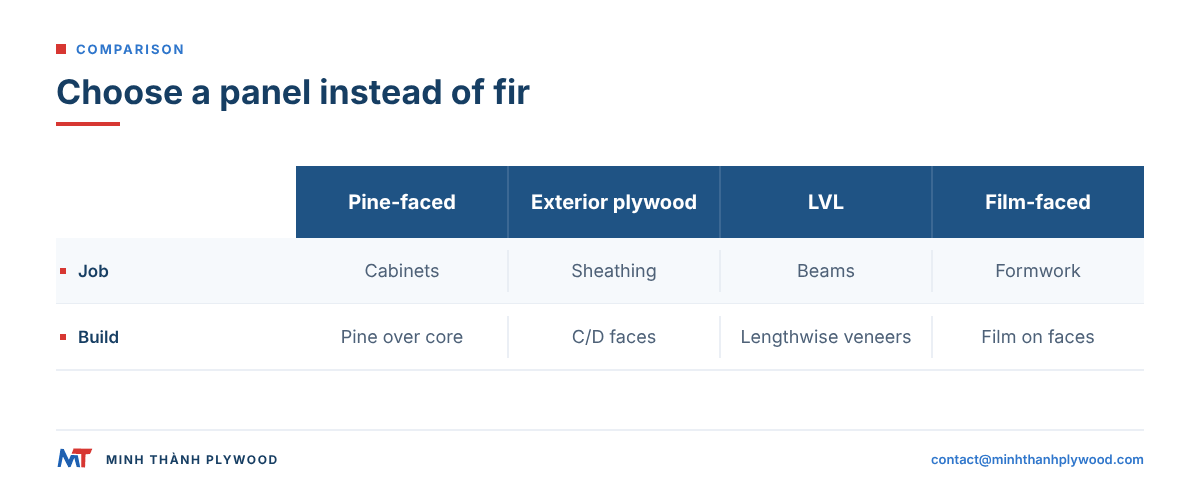
For furniture and interior panels, order pine-faced plywood; for sheathing, an exterior CDX-type panel; for beams and rails, LVL. Minh Thanh Plywood does not peel Douglas fir, and makes these three alternatives:
| Need | Panel | Specification |
|---|---|---|
| Cabinets, shelving, wall panels with a softwood look | Pine-faced plywood | Face/back A/A, A/B or B/B (B/C for utility parts), matched to your approved sample; Styrax or Eucalyptus core; UF glue at E0 emission |
| Wall and roof sheathing, stair treads | Exterior / CDX-type plywood | C/D face/back; melamine-fortified (MR) or phenolic (WBP) glue |
| Beams, rails, door frames, packing frames | LVL | Veneers with the grain running one way, to your section and length |
| Concrete formwork | Film-faced plywood | Film faces on both sides for repeated pours |
The pine face grades A/A to B/C are comparable to the European softwood face classes I to IV and the US A to D grades, so a US buyer can order against a familiar grade. Furniture panels are pressed twice, the core calibrated before the faces go on, for a thickness tolerance down to ±0.2 mm.
For a panel buyer the price basis is the cubic metre: furniture and interior plywood starts from US$350/m³ FOB and commercial plywood from US$250/m³, quoted per container with free samples. See pine plywood, exterior plywood and LVL for sizes and cores.
What to send for a quote
Send the application, core, glue and emission class, face grade, size, packing and quantity in one line per panel type. For a softwood-look cabinet panel, a typical request reads:
Pine-faced plywood, A/B to our sample, Styrax core, UF glue at E0 emission, 18 mm, 1220 × 2440 mm, sanded, 1×40HC, CIF Antwerp.
Production runs 15–45 days after the 30% deposit, with free samples to approve the face first. Write to contact@minhthanhplywood.com or use the quote form, and the reply comes within hours.
Buyer questions, answered
Is Douglas fir a hardwood or softwood?
Douglas fir is a softwood, the wood of a conifer. It is among the hardest and heaviest softwoods sold in North America, with a Janka hardness of 620 lbf.
Is Douglas fir a true fir?
No. True firs belong to the genus Abies, while Douglas fir has its own genus, Pseudotsuga, which means false hemlock. It is named after the Scottish botanist David Douglas.
Is Douglas fir stronger than pine?
Yes, for most structural uses. Douglas fir has an elastic modulus of 12.17 GPa against 10.08 GPa for Scots pine and a higher bending strength, so it spans further at the same section.
Is Douglas fir good for outdoor use?
The heartwood is moderately durable, enough for cladding and decking above ground in many climates. For ground contact it needs preservative treatment, which works best on incised wood.
Is Douglas fir plywood good?
Yes. Coast and northern Douglas fir is a Group 1 species under the US plywood standard PS 1, the strongest group, so Douglas fir plywood is a standard choice for roof and wall sheathing, subfloors and concrete forms.
Is Douglas fir plywood marine grade?
Only when it is made and stamped as marine grade under PS 1, which requires Douglas fir or western larch veneers, solid jointed cores and A or B faces. Ordinary Douglas fir sheathing is not marine plywood.
What is VG fir?
VG fir is vertical-grain Douglas fir, cut so the growth rings run at a steep angle to the face. It shows tight straight lines, moves less across its width and is used for doors, windows, mouldings and stair parts.
What does DF-L mean on lumber?
DF-L stands for Douglas fir-larch, a North American species group graded and sold together. Lumber stamped DF-L may be Douglas fir or western larch, which have similar strength.
What can I use instead of Douglas fir plywood for furniture?
Pine-faced plywood gives a similar softwood look with a calmer face. Minh Thanh makes it in A/A, A/B and B/B face pairs on Styrax or Eucalyptus cores for cabinets, shelving and wall panels.