
The UKTR, the UK Timber Regulations, make it illegal to place illegally harvested timber on the Great Britain market and require the first importer of plywood to run due diligence: gather information, assess the risk, reduce it to negligible. Plywood from Vietnam is in scope. The EUDR does not apply in Great Britain, but it applies in Northern Ireland from 30 December 2026. Minh Thanh Plywood supplies the species, harvest origin and geolocation records both regimes ask for.
What is the UKTR?
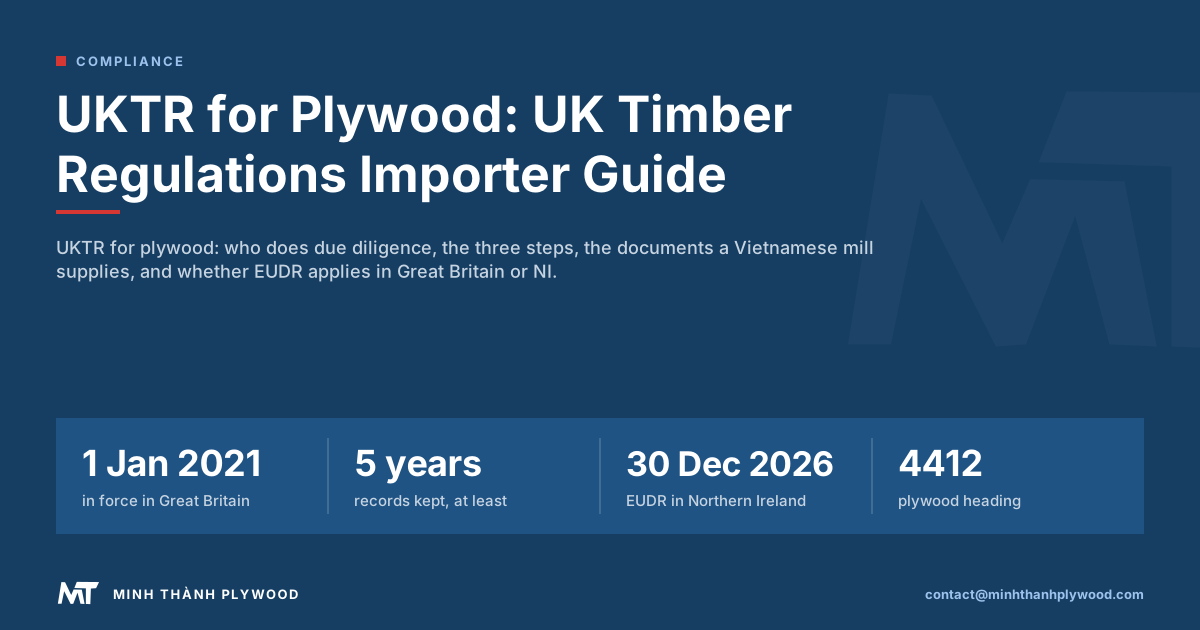
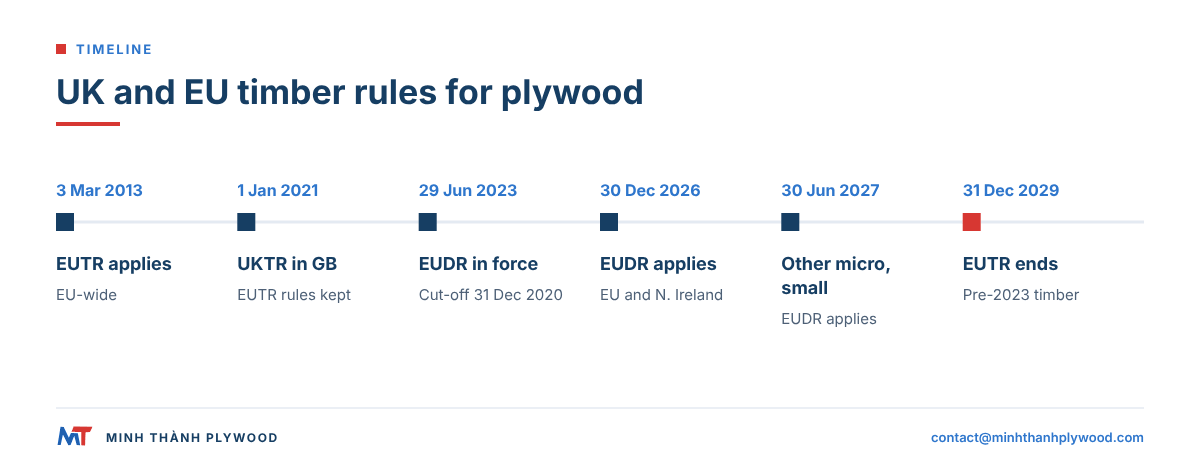
The UKTR, or UK Timber Regulations, is the Great Britain law that bans placing illegally harvested timber and timber products on the market and makes the first seller run due diligence. It has applied in Great Britain since 1 January 2021, when the UK left the EU Timber Regulation (EUTR); the rules are essentially those of the EUTR.
The UKTR is made of two instruments:
- Regulation 995/2010 as retained in UK law: the prohibition, the due diligence duty and the product schedule.
- The Timber and Timber Products (Placing on the Market) Regulations 2013, as amended in 2018 and 2020: offences, penalties and enforcement.
The GOV.UK guidance on timber and FLEGT licences, last updated 20 August 2025 and checked 20 October 2026, is the official starting point. It names the Office for Product Safety and Standards (OPSS) as the enforcer, on behalf of Defra.
What UKTR due diligence is needed for plywood from Vietnam?
An importer first placing Vietnamese plywood on the Great Britain market must gather supply-chain information, assess legality risk and reduce any identified risk to negligible before placing it on the market. Plywood falls under heading 4412 in the UKTR schedule; its Vietnamese origin does not remove that duty.
Three exclusions are worth knowing:
- Packaging. Packing material used only to support, protect or carry another product is outside the schedule; pallets and pack covers on a plywood load are not products in their own right.
- FLEGT and CITES. Timber with a valid FLEGT licence or CITES permit is treated as legally harvested.
- Recycled material. Only the virgin portion of mixed virgin and recycled timber needs to be assessed.
None of these removes plywood itself from scope. A Vietnamese panel with a Styrax core and imported birch faces is assessed for every species in it, core and faces alike.
Operators and traders: who must do what
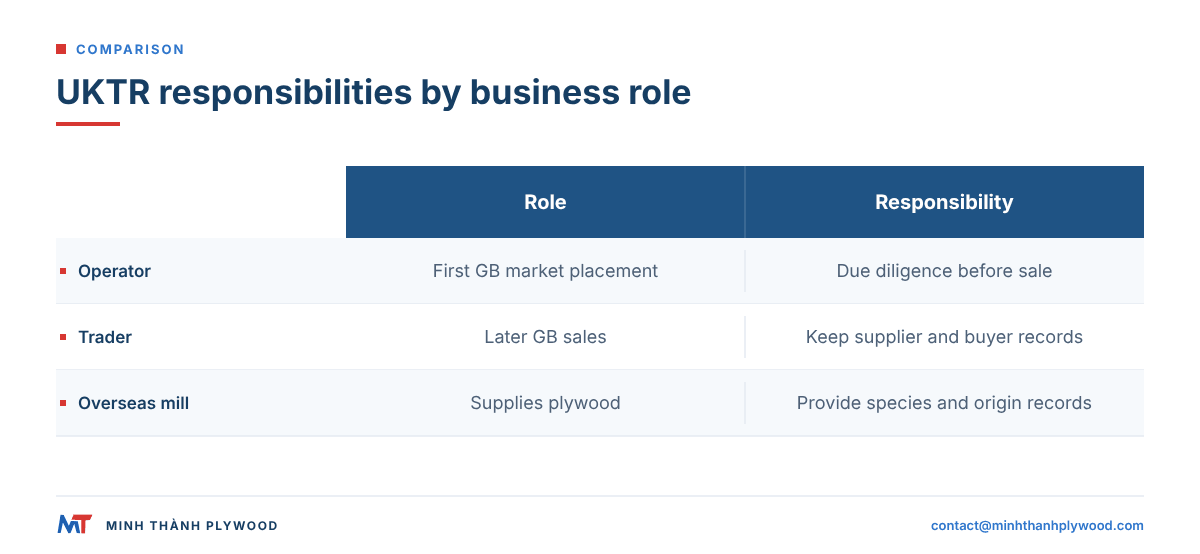
Under the UKTR, the operator is the business that first places timber on the Great Britain market, and a trader is any business that buys or sells it after that. For imported plywood the operator is usually the importer of record.
| Role | Who it usually is | Duty |
|---|---|---|
| Operator | Importer of record, a UK furniture maker importing direct | Run a due diligence system before placing the plywood on the market |
| Trader | Timber merchant, distributor, retailer | Keep records of who supplied the timber and who bought it |
| Supplier outside the UK | The Vietnamese mill | No UKTR duty; supplies the information the operator needs |
Traders must be able to identify their suppliers and, where applicable, their customers, and keep that information “for at least five years” (Article 5 as retained). The mill has no filing role, but its documents are what make the operator’s system work.
UKTR due diligence for plywood in three steps
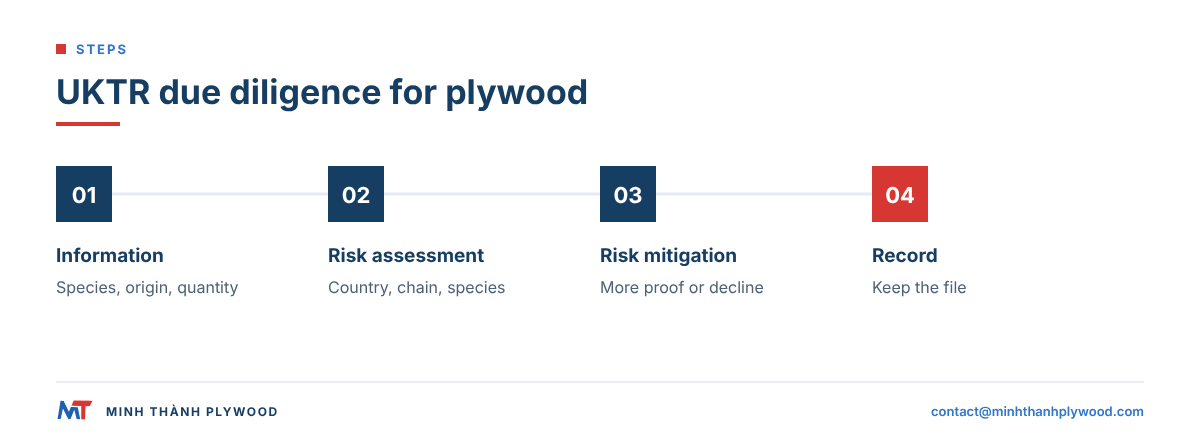
UKTR due diligence is three steps the operator runs and records for each supply: information, risk assessment and risk mitigation. The aim is to bring the risk that the timber was illegally harvested down to negligible before the plywood is sold.
- Information. Collect the product description, the species (common and scientific name), the quantity, the supplier and the country of harvest, with documents showing the timber complied with the laws of that country.
- Risk assessment. Weigh that information against criteria such as the prevalence of illegal harvesting in the country and region, the complexity of the supply chain, the species, and third-party certification or verification.
- Risk mitigation. If the risk is not negligible, gather more information or verification, such as more documents, a supplier audit or third-party checks, or decline the supply.
Operators can build their own system or use one from an approved monitoring organisation. Either way, the record of each step is the evidence OPSS asks to see.
The information a plywood operator needs, line by line
For plywood, the information step means one line per species and country of harvest, because a panel combines a core and faces that may come from different places. This table shows the line set for a typical Vietnamese furniture panel.
| Information | Example: 18 mm birch face, Styrax core | Who supplies it |
|---|---|---|
| Product description | Plywood, 18 mm, 1220 × 2440 mm, heading 4412 | Mill (invoice, packing list) |
| Face and back species | Birch (Betula), from the veneer records | Mill (species statement) |
| Core species | Styrax (Styrax tonkinensis) | Mill (species statement) |
| Country of harvest | Faces: the veneer’s country; core: Vietnam | Mill (harvest origin) |
| Quantity | Sheets and m³ per item | Mill (packing list) |
| Supplier | Mill name and address | Mill (invoice) |
| Legality documents | Origin records and geolocation files | Mill (EUDR compliance dossier) |
Writing one species and one country for a whole panel is the most common gap in plywood due diligence. Each line should come from documents tied to the order, not from a general statement.
Risk assessment for Vietnamese plywood
The risk assessment for Vietnamese plywood rests on the species, the harvest origin and the supply chain, and a short, documented chain makes the risk easiest to bring to negligible. Vietnamese cores are mostly plantation timber, such as Styrax, Eucalyptus and Acacia, grown and peeled close to the mill.
For a Minh Thanh panel, the facts the operator records are:
- Cores: white Styrax or Eucalyptus as standard, Acacia and Pine on order; Vietnamese plantation timber grown locally around Ha Hoa, Phu Tho.
- Faces: chosen for the look the buyer orders, including imported birch and okoume; each face species is assessed with its own country of harvest.
- Supply chain: the mill presses the panel itself, so there is one producer between the forest records and the importer.
- Third-party information: FSC is available*, and the EUDR compliance dossier gives origin records and geolocation files.
*Supplied directly or through qualified partner mills.
Imported faces deserve the closest look. If a face species comes from a country or region with a high risk of illegal logging, ask for its veneer records first; that line decides the risk more than the core.
Does EUDR apply to UK imports?
The EUDR does not apply to imports into Great Britain, which stay under the UKTR. It does apply in Northern Ireland, because EU timber rules apply there under the Windsor Framework; the EUDR replaces the EUTR in Northern Ireland from 30 December 2026.
| Destination | Timber law for plywood imports | From |
|---|---|---|
| England, Scotland, Wales | UKTR (due diligence on legality) | 1 January 2021 |
| Northern Ireland | EUTR, then EUDR | EUDR from 30 December 2026 |
| EU member states | EUTR, then EUDR | EUDR from 30 December 2026 |
Under the European Commission’s EUDR timetable, the regulation applies from 30 December 2026 to large and medium operators, and to micro and small operators already covered by the EUTR, which includes plywood importers; other micro and small operators follow on 30 June 2027 (checked on 3 November 2026). It asks for more than the UKTR: plot geolocation, a deforestation-free check against 31 December 2020, and a due diligence statement before customs entry.
A Great Britain importer that resells plywood into Northern Ireland or the EU moves into the EUDR for that business. The same order data serves both, if the geolocation files come with the shipment.
UKTR vs EUTR vs EUDR
The UKTR, EUTR and EUDR share the idea of due diligence but differ in what must be proved. The UKTR and EUTR ask whether the timber was legally harvested; the EUDR adds whether the land was deforested or degraded after 31 December 2020, and asks for geolocation.
| Point | UKTR (Great Britain) | EUTR (EU, until replaced) | EUDR (EU and Northern Ireland) |
|---|---|---|---|
| Question | Legally harvested? | Legally harvested? | Legal and deforestation-free? |
| Geolocation of plots | Not required | Not required | Required |
| Statement filed before entry | No | No | Due diligence statement |
| Plywood in scope | Yes, 4412 | Yes, 4412 | Yes, ex 4412 |
| Enforcer | OPSS | Member state authorities | Member state authorities |
| Applies from | 1 January 2021 | 3 March 2013 | 30 December 2026 |
The EUTR keeps applying until 31 December 2029 to timber produced before 29 June 2023 and placed on the EU market from 30 December 2026. For a plywood buyer, a supplier who can meet the EUDR dossier also meets what the UKTR information step asks for. EUTR vs EUDR covers the EU side in depth.
UK forest risk commodities: what comes next
The UK has powers for a deforestation law of its own, in Schedule 17 of the Environment Act 2021, but the secondary legislation to bring it into force had not been made by 20 October 2026. The first commodities the government named for it are cattle products, cocoa, palm oil and soy; timber is not among them.
For plywood importers the practical position is simple. In Great Britain the UKTR remains the timber rule; anything sold into Northern Ireland or the EU follows the EUDR. Buying plywood with geolocation records now keeps both doors open, whichever way UK law moves.
FLEGT licences and Vietnam
FLEGT licences are currently issued only by Indonesia for timber entering the UK market, so plywood from Vietnam has no licence route and is covered by the operator’s full due diligence. A FLEGT-licensed shipment is treated as legal and skips the due diligence steps; that shortcut does not exist for Vietnam.
Vietnam runs its own timber legality system, the Vietnam Timber Legality Assurance System, set up under Decree 102/2020/ND-CP. Its export documents are useful information in the operator’s file, but they are not a FLEGT licence and do not replace the operator’s risk assessment.
UKCA and other UK requirements for plywood
UKTR is about where the wood came from; other UK rules cover what the panel does. Three are often confused with it in buyer questions:
| Rule | What it covers | When it applies to plywood |
|---|---|---|
| UKTR | Legality of the timber | Every commercial plywood import into Great Britain |
| UKCA marking (BS EN 13986) | Performance of construction products | Plywood placed on the market for use in construction works |
| Formaldehyde class | Emission of the panel | E1 under BS EN 13986 for construction panels; buyer specification for furniture |
| Class 2 / class 3 (BS EN 636) | Bond durability for humid or exterior use | When the buyer specifies the use class |
Furniture and interior plywood bought for furniture making is outside UKCA marking, but it is never outside the UKTR. Class 2 vs class 3 plywood explains the bond classes, and formaldehyde-free plywood the emission ladder.
What Minh Thanh supplies for UKTR and EUDR due diligence
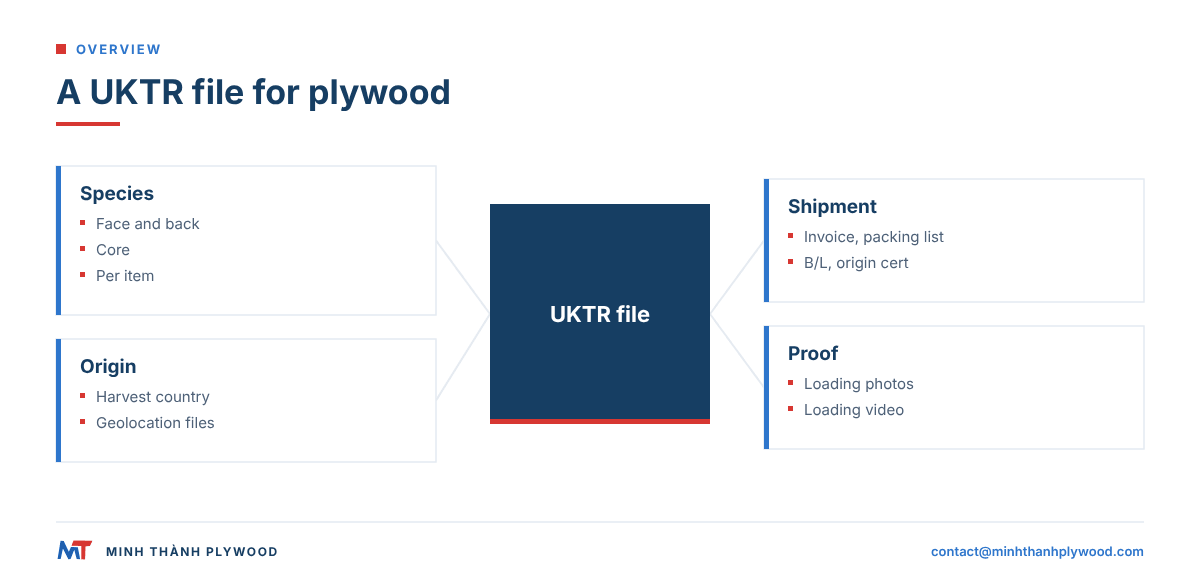
Minh Thanh Plywood supplies the information a UK operator needs for its due diligence file with every order, and the same file covers EUDR buyers in Northern Ireland and the EU.
| Document | What it gives the UK operator |
|---|---|
| Species statement | Face, back and core species for each item |
| Harvest origin | Vietnamese harvest origin for the cores; veneer records for imported faces |
| EUDR compliance dossier | Origin records and geolocation files for the timber |
| Certificate of origin | Vietnam as origin of the finished panel |
| Commercial invoice, packing list, B/L | Product description, quantity per item, supplier |
| Photos and video before loading | What went into the container |
| ISO 9001:2015 certificate (KAC25/0185) | The quality system the panels are made under |
Every shipment is photographed and filmed before loading, and the buyer receives the photos and the video. Mixed loads are usually 1–2 specifications per container, 3–6 by agreement; each item gets its own species lines. The EUDR traceability page shows how the dossier is built.
When the due diligence data is produced on an order
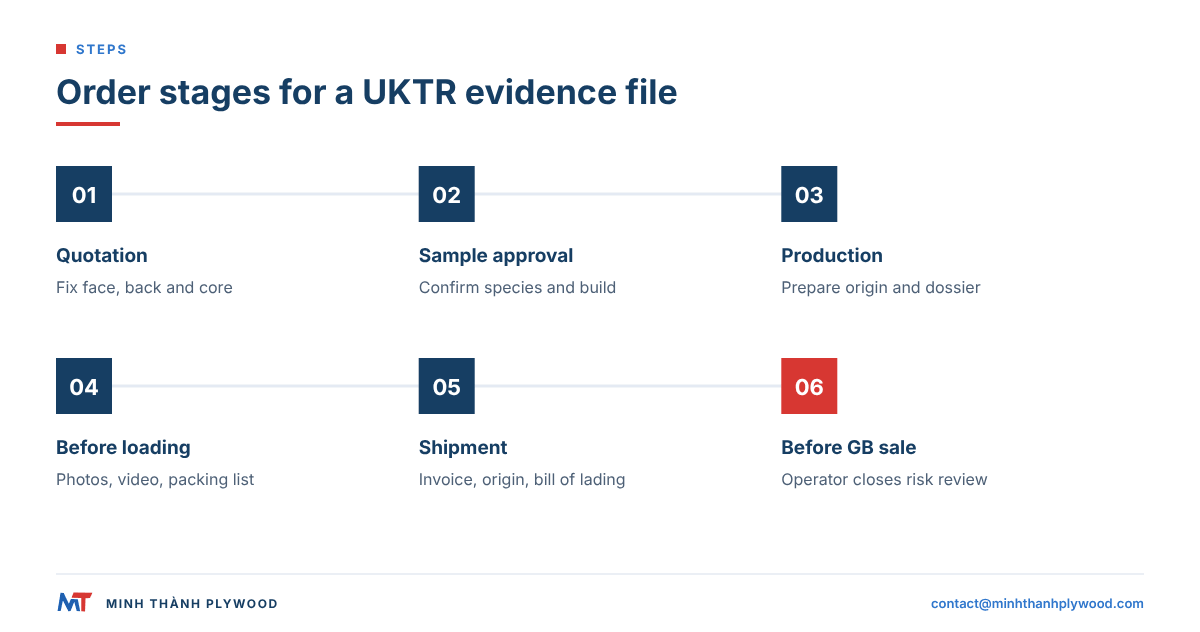
The due diligence data builds up through the order, and the operator has a complete file before the vessel arrives if species are fixed at the quotation. A typical sequence for a Minh Thanh order:
- Quotation and order: face, back and core species written on each item.
- Sample approval: free samples confirm face and core.
- Production: 15–45 days after the 30 % deposit; species statement, harvest origin and dossier prepared.
- Before loading: photos and video of the load; packing list by item.
- Shipment: FOB Hai Phong, CFR or CIF; certificate of origin, invoice and B/L.
- Before sale in Great Britain: the operator completes its risk assessment and files the record.
Sea transit from Hai Phong to Northern Europe usually takes 30–40 days, by carrier and route, which leaves time to close any gap in the file before the plywood lands.
What to write in your RFQ
Put the species and the due diligence documents into the RFQ, so they are part of the contract and not a request after shipment. A complete line reads:
18 mm × 1220 × 2440 mm; face/back: birch D+/D; core: Styrax, stitched; UF glue at E0 emission; 1×40HC CIF Felixstowe; with the shipping documents: species statement per item, harvest origin, EUDR compliance dossier with geolocation files, certificate of origin, photos and video of loading.
Minh Thanh replies within hours and sends free samples. Send your specification to [email protected] or WhatsApp +84 988 586 601, and see plywood import documents for the full shipping set.
Buyer questions, answered
What is UKTR?
UKTR is the UK Timber Regulations, the Great Britain version of the EU Timber Regulation, in force in Great Britain since 1 January 2021. It bans placing illegally harvested timber on the market and requires operators to run due diligence.
Does UKTR apply to plywood from Vietnam?
Yes. Plywood under heading 4412 is listed in the UKTR schedule, so the business that first places Vietnamese plywood on the Great Britain market must exercise due diligence before selling it.
Does EUDR apply to UK imports?
Not in Great Britain: imports into England, Scotland and Wales stay under the UKTR. In Northern Ireland, EU timber rules apply under the Windsor Framework, and the EUDR applies there from 30 December 2026.
Who is an operator under the UK Timber Regulations?
The operator is the business that first places the timber on the Great Britain market, usually the importer of record. Merchants who buy and sell it afterwards are traders.
What records must a timber trader keep in the UK?
A trader must be able to name who supplied the timber and, where applicable, who it was sold to, and keep that information for at least five years.
Do I need a FLEGT licence for plywood from Vietnam?
No. FLEGT licences are currently issued only by Indonesia for the UK market. Plywood from Vietnam enters with full due diligence by the operator instead.
Who enforces UKTR?
The Office for Product Safety and Standards (OPSS) enforces the UKTR for Defra: it checks operator due diligence systems and trader records and verifies FLEGT licences.
Is packaging wood covered by UKTR?
No. Packing material used only to support, protect or carry another product is outside the schedule, so pallets and pack covers on a plywood shipment are not declared as products in their own right.
Is UKCA marking part of UKTR?
No. UKCA marking covers construction products, such as structural plywood under BS EN 13986; the UKTR covers the legality of the timber. A construction panel can need both.
Will the UK adopt a deforestation law like EUDR?
The Environment Act 2021 gives powers for a forest risk commodities law, but the secondary legislation to bring it into force had not been made by 20 October 2026. Timber stays under the UKTR.
What documents does Minh Thanh supply for UKTR due diligence?
The face and core species of each item, the harvest origin, the EUDR compliance dossier with origin records and geolocation files, the certificate of origin, shipping documents, and photos and video of the load.
Does FSC certification replace UKTR due diligence?
No. FSC chain-of-custody certification is useful information in the risk assessment, but the operator still runs and records its own due diligence for each supply.