
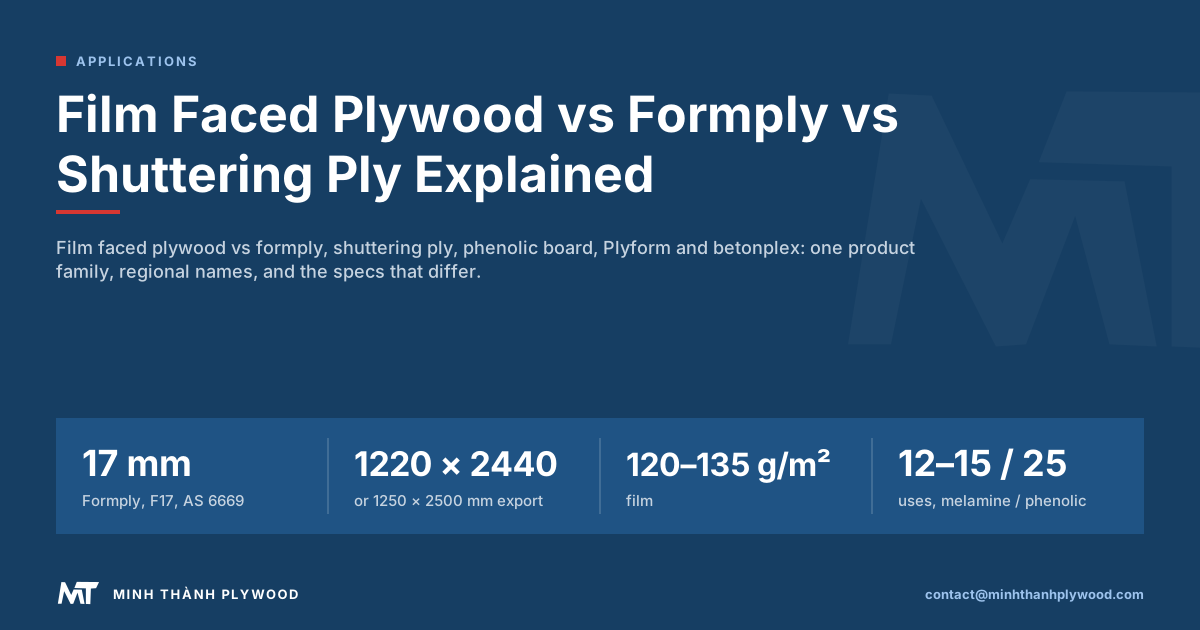
Film faced plywood vs formply is mostly a question of names: formply is the Australian and New Zealand word for film-faced formwork plywood, often graded F17 to AS 6669, while shuttering ply, phenolic board, betonplex and Plyform are other regions' names. What differs is the film, glue, core and grade. Minh Thanh Plywood makes film-faced plywood and maps every name here.
What are the key differences between film faced plywood and formply?
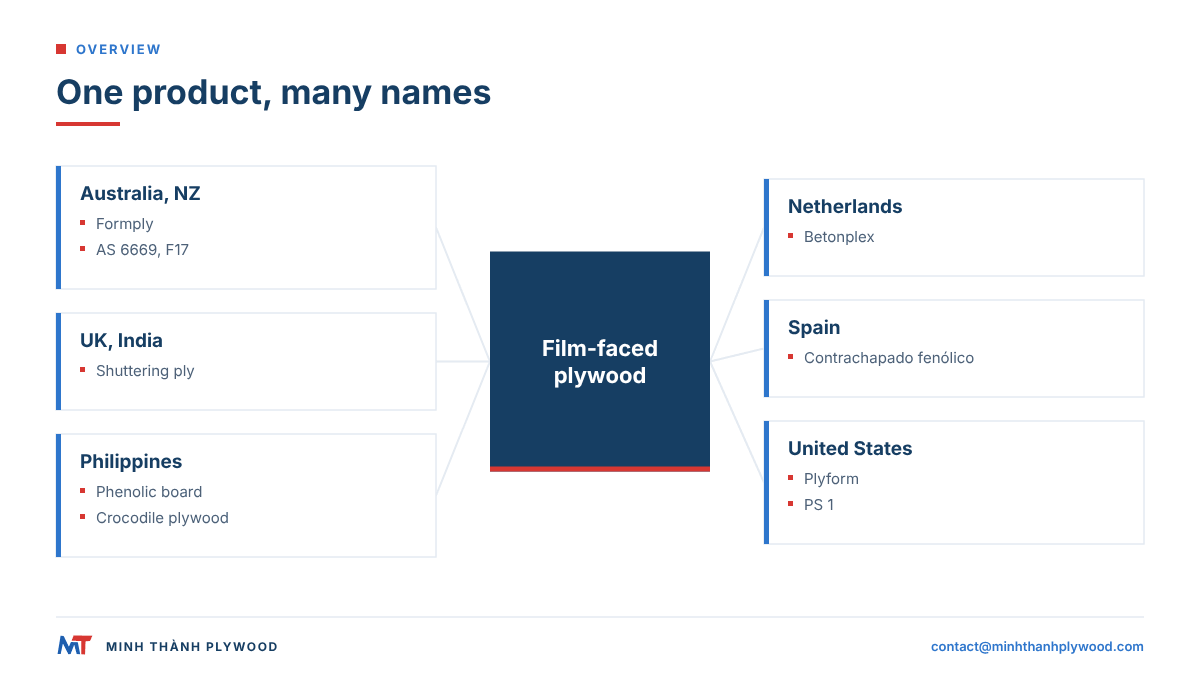
Film faced plywood and formply are the same product family: plywood with a resin film on both faces for concrete formwork. Formply is the name in Australia and New Zealand, where structural formply is also stress-graded, usually F17 to AS 6669; film-faced plywood is the general export name, specified by core, glue, film and tolerance.
- Same build: cross-laminated veneers, resin film on both faces, painted edges.
- Different names: formply, shuttering ply, shutterply, phenolic board, betonplex, Plyform.
- What really differs: stress grade and certification, film mass, glue, core, sheet size.
- What to compare: the specification and the documents, not the name.
The crosswalk table below maps each regional name to the spec that changes.
What is film-faced plywood?
Film-faced plywood is plywood with a resin-impregnated paper film pressed on both faces and paint on all four edges, used as the concrete-contact skin of formwork. The film gives a smooth face and easy release; the core and glue carry the load and decide how many pours the panel survives.
- Film: phenolic resin film, about 120–135 g/m² standard, from about 135 g/m² premium; anti-slip film about 220 g/m².
- Glue: melamine-fortified (MR) or phenolic (WBP).
- Core: Eucalyptus or Acacia hardwood veneers on our panels.
- Sizes: 1220 × 2440 mm and 1250 × 2500 mm; 12–21 mm.
Film-faced plywood is the export name, used in Europe, the Middle East, Africa and Asia. Our film-faced plywood page gives the full specification.
What is formply in Australia and New Zealand?
Formply is Australian and New Zealand film-faced plywood made for formwork, and structural formply is graded to AS 6669 (Plywood — Formwork), most often as F17. The common sheet is 17 mm thick in 1800 × 1200 mm or 2400 × 1200 mm, sized for local formwork systems.
| Line | Typical structural formply |
|---|---|
| Standard | AS 6669 (Plywood — Formwork) |
| Stress grade | F17 is the most common |
| Thickness | 17 mm |
| Sheet sizes | 1800 × 1200 mm and 2400 × 1200 mm |
| Face | Phenolic film overlay |
| Edges | Painted |
| Proof | Grade mark and third-party certification |
F11, F14, F17, F22 and F27: formply stress grades
AS 6669 formply is made from structural plywood graded under AS/NZS 2269, and the F number is the stress grade: the higher it is, the longer the span between supports and the higher the concrete pressure the sheet takes. Big River Group lists its formwork range in 12, 17, 19 and 25 mm.
| Grade | Typical use in formwork | Typical thickness | Typical build |
|---|---|---|---|
| F11 | Light-duty forming and lining; appearance-grade F11 is sold as not for formwork | 12 mm | Softwood or mixed veneers |
| F14 | Light to medium wall and slab forms | 17 and 25 mm | Mixed veneers |
| F17 | The standard formply: walls, slabs and columns on timber or system supports | 17 mm | Mixed pine and hardwood veneers with hardwood faces |
| F22 | Closer-spaced or higher-pressure forms | 17 mm and thicker | Mixed veneers, more hardwood |
| F27 | Heavy-duty forms | 17 mm and thicker | Hardwood veneers throughout |
Sheets are 2400 × 1200 mm or 1800 × 1200 mm. Vietnamese mills export F-grade formply to Australia in the same sizes, some listed with Eucalyptus cores on plywood-price.com, so certification is the line to check on every offer (Vietnam Plywood Group, checked 21 October 2026).
Sizes and grades as listed by Australian suppliers, for example a formply data sheet (read 20 October 2026). Non-structural formply is also sold; it has the film but not the grade.
What is the difference between film faced and phenolic plywood?
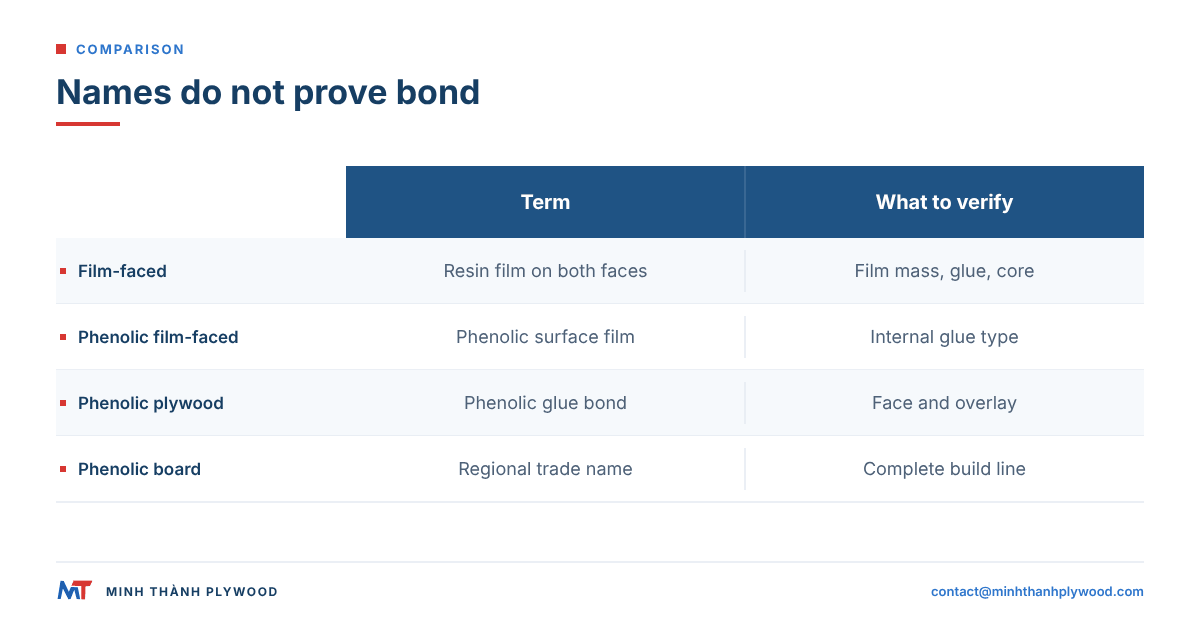
The difference between film faced and phenolic plywood is mostly in the words: phenolic plywood can mean a panel bonded with phenolic glue, or a panel faced with phenolic film. Most film-faced plywood carries a phenolic film, and its glue line may be phenolic (WBP) or melamine-fortified.
| Term | What it describes | Check on the order |
|---|---|---|
| Film-faced plywood | Plywood with resin film on both faces | Film mass, glue, core |
| Phenolic film-faced plywood | Film made with phenolic resin | Glue type inside |
| Phenolic plywood (glue) | Plywood bonded with phenolic WBP glue | Face: film, sanded or overlaid |
| Phenolic board | Philippine and Asian trade name for film-faced plywood | Full specification |
Ask for the glue type in writing: film colour does not show it. Our guide to crocodile plywood and phenolic board in the Philippines covers the Philippine names and sizes.
Shuttering formwork: is shuttering the same as formwork?
Formwork is the whole temporary structure that moulds concrete; shuttering is the facing that touches it, though in the UK and India the two words are used for the same thing.
- Formwork: panels, joists, bearers, props, walers, ties and fixings.
- Shuttering: the panels that face the concrete; in UK and Indian use, often the whole form.
- Shuttering plywood meaning: plywood for that face, usually film-faced with a water-resistant bond.
- Formwork shutters: assembled panels that are lifted into place and reused.
Our guide to shutter ply board covers UK, Irish and South African sizes and grades.
What is plywood shuttering?
Plywood shuttering is the plywood skin of a concrete formwork structure, the panel that touches the wet concrete, and shuttering plywood is the panel sold for that job. It is usually film-faced with a water-resistant bond, so the panel releases cleanly and can be reused on the next pour.
In the US, OSHA standard 1926.703 sets the requirements for formwork in cast-in-place concrete; see OSHA 1926.703.
Every regional name, mapped to the spec that differs
The same film-faced panel travels under at least eight names, and each market adds one or two specification lines. The crosswalk shows the name, where it is used and what to check.
| Name | Where | Spec that differs |
|---|---|---|
| Film-faced plywood | Export, Europe, Middle East, Asia | Film mass, glue, core |
| Formply | Australia, New Zealand | AS 6669 stress grade (F17), 17 mm, 1800 × 1200 mm |
| Shuttering ply | UK, India | Water-resistant bond; often film-faced |
| Shutterply | South Africa | Local sizes and grades |
| Phenolic board, crocodile plywood | Philippines | 1/2 and 3/4 in, 4 × 8 ft |
| Betonplex | Netherlands, Belgium | 1250 × 2500 mm, brown film |
| Contrachapado fenólico, placas fenólicas | Spain, Latin America | 1250 × 2500 mm or 1220 × 2440 mm |
| Plyform | United States | PS 1 Class I or II, APA mark |
Whatever the name, the order should state core, glue, film mass, thickness, tolerance and size. Those lines make two offers comparable across countries. A contractor in Sydney asking for formply and a contractor in Rotterdam asking for betonplex may receive the same panel build; only the grade mark, the sheet size and the documents change with the market, so translate the name before you compare prices.
Film faced plywood vs formply: comparison table
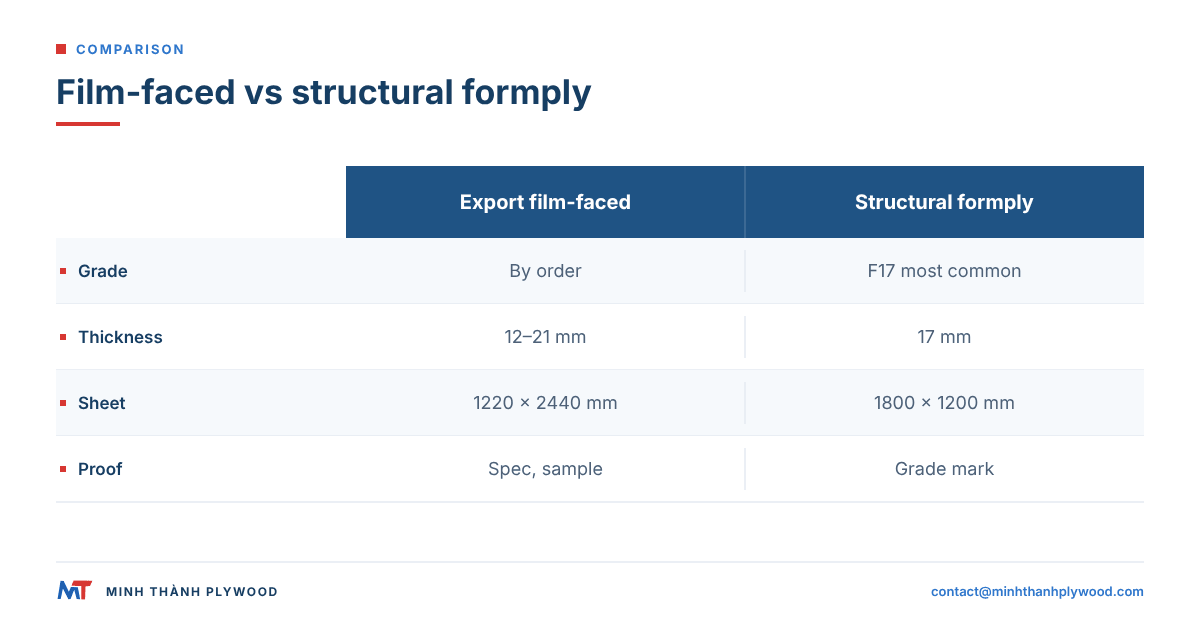
Film-faced plywood and graded formply differ on grade, size and documents; the build can be the same. Formply carries a stress grade such as F17 under AS 6669, while export film-faced plywood is sold by specification. The table compares a typical export film-faced panel with typical structural formply, one property per row.
| Property | Export film-faced plywood | Structural formply (AU/NZ) |
|---|---|---|
| Face | Phenolic film, both faces | Phenolic film, both faces |
| Film mass | About 120–135 g/m², premium from 135 | By grade and maker |
| Glue | Melamine-fortified or phenolic (WBP) | Phenolic bond for wet use |
| Stress grade | Not graded unless ordered | F17 most common |
| Standard | Order specification | AS 6669 |
| Thickness | 12–21 mm, ±0.5 mm | 17 mm |
| Sheet size | 1220 × 2440 or 1250 × 2500 mm | 1800 × 1200 or 2400 × 1200 mm |
| Proof | Spec sheet, sample, shipment photos | Grade mark and certification |
| Indicative price per 17 mm sheet (A$) | Non-structural film faced: 60.00 to 84 | F17: 81.50 to 90.00 |
| Non-structural film faced (AU shops) | 9, 12 and 17 mm in 2400 × 1200 mm; lighter shuttering at lower cost | Not applicable |
Australian shop prices come from Just Plywood, Bunnings, ausf and Blacktown Building Supplies (checked on 21 October 2026), and the gap between a non-structural and an F17 17 mm sheet runs from a few dollars to about A$30, so the grade the design names, not the price, should decide the order.
Where a design names F17, the order must buy the grade and its certification. Where the design names only a finish and a thickness, specified film-faced plywood does the job.
Shuttering plywood vs plywood: what changes?
Shuttering plywood differs from ordinary plywood in three lines: a water-resistant bond, a sealed or overlaid face, and painted edges. Ordinary interior plywood bonded with UF glue is made for furniture and dry interiors and is not built for wet concrete.
| Line | Shuttering plywood | Ordinary interior plywood |
|---|---|---|
| Glue | Melamine-fortified or phenolic (WBP) | UF for dry use |
| Face | Resin film or overlay | Sanded veneer |
| Edges | Painted at the factory | Bare |
| Reuse | About 12–15 uses on melamine, up to about 25 on phenolic | Not made for pours |
The reuse figures are industry guides with proper handling, release agent and edge sealing.
Types of shuttering plywood
The types of shuttering plywood are set by the face: smooth film for exposed concrete, anti-slip film for decks, overlays for fine finishes and uncoated WBP panels for rough work. The table gives the main types and where each fits.
| Type | Face | Fits |
|---|---|---|
| Smooth film-faced | Phenolic film about 120–135 g/m² | Walls, slabs, columns |
| Premium film-faced | Film from about 135 g/m², phenolic glue | Many pours, fair-faced concrete |
| Anti-slip film-faced | Textured film about 220 g/m² | Decks, platforms, walkways |
| HDO or MDO overlaid | Resin-impregnated overlay | US forms and fine finishes |
| Uncoated WBP | Sanded veneer | Footings and hidden concrete |
Our comparison of HDO plywood vs MDO plywood explains the two overlay grades used in US Plyform.
Betonplex and contrachapado fenólico: sizes in the Netherlands and Spain
Betonplex in the Netherlands and Belgium and contrachapado fenólico (placas fenólicas) in Spain are the local names for film-faced plywood, sold mainly in 1250 × 2500 mm sheets, with 1220 × 2440 mm also common. Thicknesses run across the usual formwork range, with 18 mm the most used.
| Market | Local name | Common size | Common thickness |
|---|---|---|---|
| Netherlands, Belgium | Betonplex | 1250 × 2500 mm | 18 mm and others |
| Spain | Contrachapado fenólico, placas fenólicas | 1250 × 2500 mm; 1220 × 2440 mm | 18 mm and others |
| UK, Ireland | Shuttering ply | 1220 × 2440 mm | 18 mm |
We make both 1220 × 2440 mm and 1250 × 2500 mm sheets. European construction products marketed in the EU fall under the Construction Products Regulation (EU) No 305/2011 (read 20 October 2026). A project that names EN 13986 should put it on the order. The service classes for dry, humid and exterior use come from BS EN 636, with bonding quality to EN 314-2.
Standards behind the names
Each regional name points to a different standard or none at all, which is why the order matters more than the name. Name the standard only if the project needs it, and then ask for the matching mark and certificate.
- AS 6669 (Australia, New Zealand): plywood for formwork, with stress grades such as F17.
- PS 1 (United States): APA Plyform Class I and Class II, sanded or overlaid.
- EN 636 and EN 13986 (Europe): plywood service classes and the harmonised standard for wood panels in construction.
- No standard: film-faced plywood sold by specification alone, common in Asia, the Middle East and Africa.
For US forming panels, our guide to Plyform plywood covers APA classes and grades in detail.
Which one should you choose?
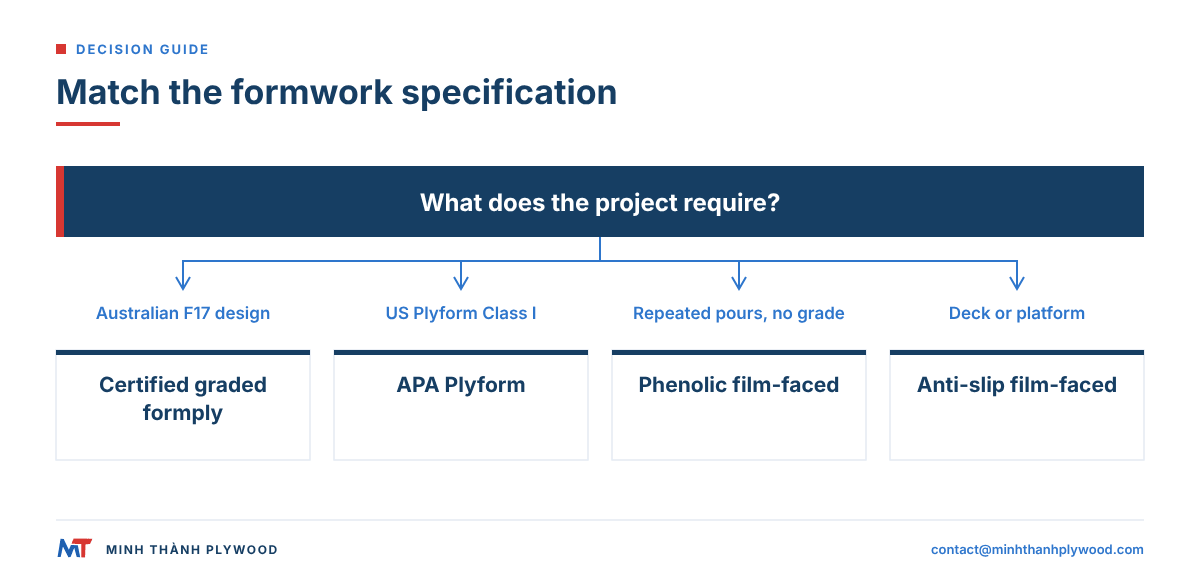
Choose by the design and the market, not by the name: graded formply where an Australian design names a stress grade, Plyform where a US design names it, and specified film-faced plywood everywhere else. The table gives the verdict by use.
| Situation | Choose | Why |
|---|---|---|
| Australian design names F17 | Graded formply with certification | Design values and compliance |
| US design names Plyform Class I | APA Plyform | Grade mark required |
| Repeated wall and slab pours, no grade named | Phenolic (WBP) film-faced plywood | Most pours per sheet |
| Short projects, few pours | Melamine-fortified film-faced plywood | Lower cost per job |
| Decks and platforms | Anti-slip film-faced plywood | Grip underfoot |
| Footings and hidden concrete | Uncoated WBP or budget film-faced | Finish not seen |
What this means for your film-faced order
A film-faced order that works in any market translates the local name into specification lines. Send these with your request:
- Application: walls, slabs, columns, decks or fair-faced concrete; planned pours.
- Local name and standard: formply F17, Plyform, betonplex or none.
- Core and glue: Eucalyptus or Acacia; melamine-fortified or phenolic (WBP).
- Face: film mass, colour, smooth or anti-slip.
- Size and thickness: 1220 × 2440 mm or 1250 × 2500 mm; 12–21 mm; ±0.5 mm.
- Packing and quantity: from one 40HC, mixed specifications by agreement; destination port.
Production is 15–45 days after the deposit, FOB Hai Phong, CFR or CIF, with free samples. See the concrete form plywood buying guide for the full buying sequence.
Buyer questions, answered
Is formply the same as film faced plywood?
Formply is film-faced plywood made for concrete formwork, under the name used in Australia and New Zealand. Structural formply is also graded, usually F17 to AS 6669, so every formply is film-faced but not every film-faced sheet is graded formply.
What is the difference between film faced and phenolic plywood?
Phenolic plywood can mean plywood bonded with phenolic glue, or plywood faced with phenolic film. Most film-faced plywood carries a phenolic resin film; the glue inside may be phenolic (WBP) or melamine-fortified.
What is plywood shuttering?
Plywood shuttering is the plywood skin of a concrete form, the part that touches the concrete. In the UK and India the panels are called shuttering ply, usually film-faced plywood with a water-resistant bond.
What is the difference between shuttering and formwork?
Formwork is the whole temporary structure that moulds concrete, including props, beams and ties. Shuttering is often used for the facing panels alone, though in the UK and India the two words are used interchangeably.
What does F17 mean on formply?
F17 is an Australian stress grade: it sets the design strength and stiffness of structural plywood. Formply sold as F17 must carry the grade mark and certification for it.
What sizes is formply?
Australian formply is commonly 17 mm thick in 1800 × 1200 mm and 2400 × 1200 mm sheets. Export film-faced plywood is usually 1220 × 2440 mm or 1250 × 2500 mm in 12–21 mm.
What is betonplex?
Betonplex is the Dutch and Belgian name for film-faced formwork plywood, typically 1250 × 2500 mm in 18 mm and other thicknesses, with brown phenolic film.
What is Plyform?
Plyform is APA's name for plywood made for concrete forming in the United States, graded to PS 1 as Class I or Class II, sanded or with HDO or MDO overlays.
Is shuttering plywood waterproof?
The film resists water and a phenolic (WBP) bond survives wet use, but cut edges and holes take in water until they are sealed. Water resistance comes from the bond, the film and the edge paint together.
What are the types of shuttering plywood?
The main types are smooth film-faced plywood, anti-slip film-faced plywood, HDO and MDO overlaid plywood, and uncoated WBP plywood for rough or hidden concrete.
Which is better, film faced plywood or formply?
Where the design calls for a stress grade such as F17, choose graded formply with its certification. Where it does not, film-faced plywood specified by core, glue, film and tolerance does the same job.