
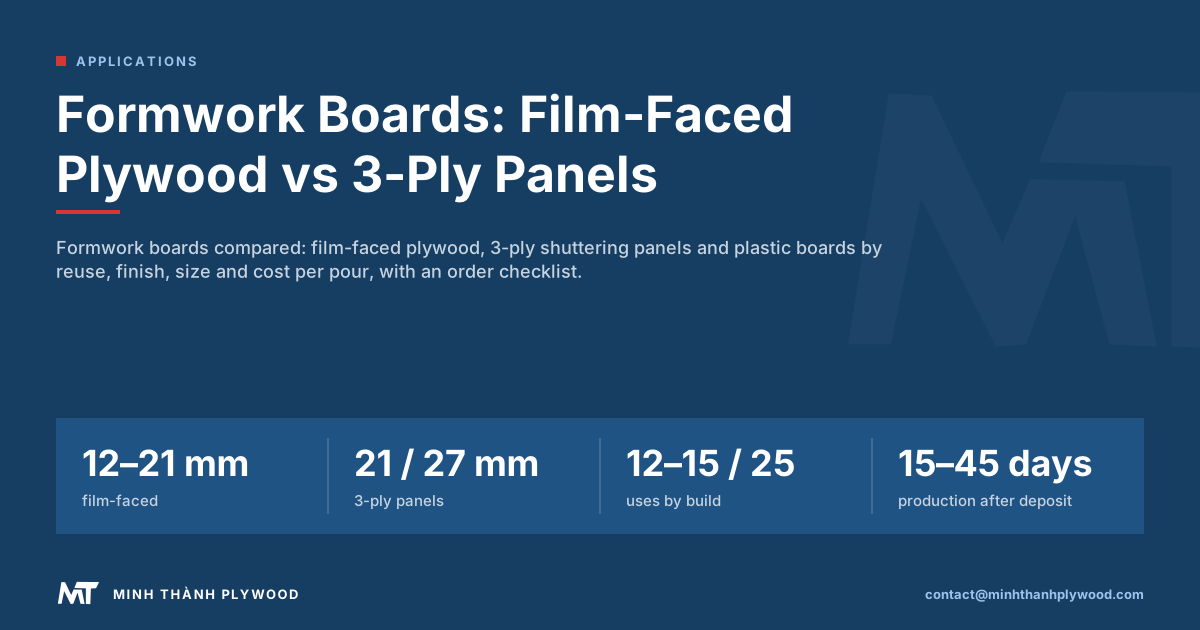
Formwork boards come in three main families: film-faced plywood, the general-purpose sheet for walls, slabs and columns; 3-ply shuttering panels, the yellow spruce boards made for system formwork; and plastic or composite boards for very high reuse. Film-faced plywood gives the lowest cost per pour on most sites. Minh Thanh Plywood makes it in 12–21 mm, 1220 × 2440 and 1250 × 2500 mm, by the 40HC.
What are formwork boards, also called form boards?
Formwork boards are the panels that form the surface of a concrete wall, slab, beam or column while it sets: the contact face of the formwork. Most are film-faced plywood, 3-ply softwood shuttering panels or plastic and composite boards, held in shape by joists, frames and ties.
The board takes the pressure of the fresh concrete and passes it to the supports behind. It also decides how the concrete looks and how many pours the formwork gives before the face is replaced. That is why the same site often buys two types: a general board for walls and slabs, and a system board that fits its frame formwork.
Form boards is the shorter trade name for the same panels. The words vary by market. A US drawing says form panels or Plyform, a UK one shuttering plywood, an Australian one formply, and a Gulf one shuttering plywood or film-faced board. The products underneath are the same three families.
What types of formwork boards are there?
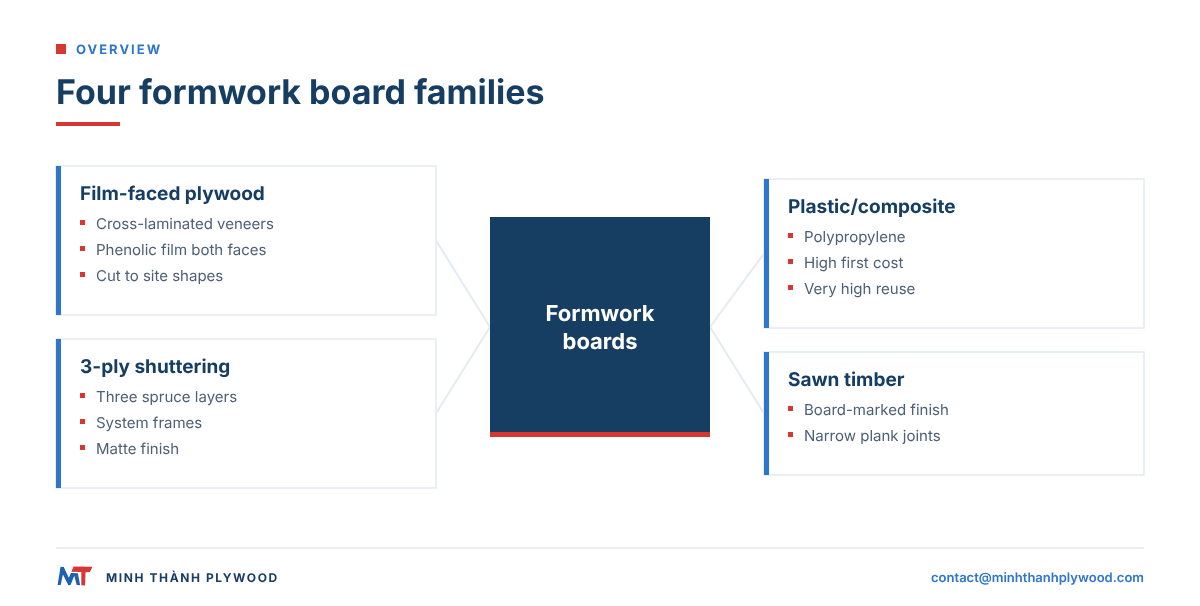
There are three main types of formwork boards: film-faced plywood, a hardwood or mixed-core plywood with resin film on both faces; 3-ply shuttering panels, three layers of spruce with a yellow resin coating; and plastic or composite boards made from polypropylene, alone or over a core. Solid timber boards survive for board-marked finishes.
- Film-faced plywood. Cross-laminated veneers, a phenolic film on both faces and sealed edges. Cut on site to any shape; the most widely used board.
- 3-ply shuttering panels. Wider spruce lamellae in three layers, coated, usually with protected edges. Made for frame and girder systems.
- Plastic and composite boards. Polypropylene faces or solid plastic. Do not absorb water; high first cost, very high reuse.
- Timber boards. Sawn or planed boards for a deliberate grain-printed finish.
Plyform is the North American grade name for plywood forms; the guide to Plyform classes and sizes explains its classes and the metric equivalents.
Film-faced plywood vs 3-ply shuttering panel: which is better?
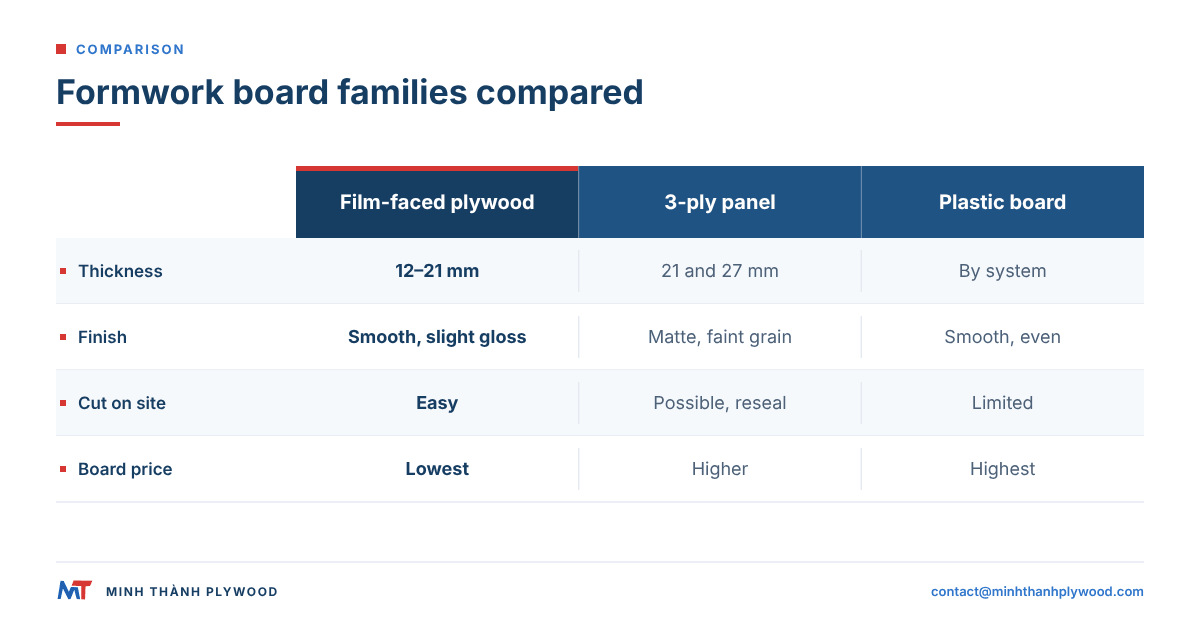
Film-faced plywood is better for general formwork that is cut, drilled and fitted on site, and the 3-ply shuttering panel is better inside a system formwork frame designed around it. The plywood gives more pours per sheet price; the 3-ply panel gives a softer, matte finish and fits the system’s module.
| Factor | Film-faced plywood | 3-ply shuttering panel | Plastic or composite board |
|---|---|---|---|
| Build | Hardwood veneers, phenolic film both faces | Three spruce layers, resin coating | Polypropylene skin or solid plastic |
| Common thickness | 12–21 mm | 21 mm and 27 mm | By system |
| Common sizes | 1220 × 2440, 1250 × 2500 mm | Long strips, often 500 mm wide | By system |
| Concrete finish | Smooth, slight gloss | Matte, faint grain | Smooth, even |
| Pours | About 12–25 by build, with care | Many, inside a system | Very many |
| Cut and fit on site | Easy | Possible, then reseal | Limited by material |
| Price per board | Lowest | Higher | Highest |
The pour figures for film-faced plywood are Minh Thanh’s panels with proper handling, release agent and edge sealing. The other columns describe the board families in general terms.
Sizes, packs and support spacing by board type
| Board | Thickness | Width | Length | Pack or weight | Support spacing |
|---|---|---|---|---|---|
| Film-faced plywood | 18 mm | 1,220 or 1,250 mm | 2,440 or 2,500 mm | Packs by the 40HC | Joists at about 300 mm |
| Film-faced plywood | 21 mm | 1,220 or 1,250 mm | 2,440 or 2,500 mm | Packs by the 40HC | Joists at about 350 mm |
| 3-ply system panel | 21 mm | 500 mm (200-450 mm optional) | 1,000 to 3,000 mm | 100 pieces per pack, about 10 kg/m² | Per the system maker’s load table |
| 3-ply system panel | 27 mm | 500 mm (200-450 mm optional) | 1,000 to 3,000 mm | 80 pieces per pack, about 12.3 kg/m² | Per the system maker’s load table |
| Sawn timber formwork board | 25 mm | 100, 120 or 150 mm | 4,000 mm | Packs of equal boards | Closely spaced studs |
The 3-ply figures are one European maker’s published range (GBM, formwork panels); its permissible uniform load by span sits in a datasheet, because it depends on the span and the load case. For film-faced plywood the span follows the thickness: 12 mm boards need joists at about 200 mm, 15 mm at 250 mm, 18 mm at 300 mm and 21 mm at 350 mm, worked through with the concrete pressure in the guide to plywood formwork design.
Sawn timber formwork boards
In Europe “formwork boards” also means sawn timber boards: rough-sawn softwood planks, wet or dry, sold in packs for foundation forms, concrete forms, stair moulds, culverts, decorative concrete and temporary support. One Polish sawmill lists 25 mm boards in 100, 120 and 150 mm widths and 4,000 mm lengths and grades them in four classes by the defects allowed (Kronobuild).
Sawn boards leave the board-marked grain of decorative concrete, and a single board is cheap, but each board gives few clean pours and the joints between narrow boards print into the wall. For sheet-formed walls, slabs and columns, film-faced plywood replaces them at 1,220 x 2,440 mm per sheet, with fewer joints and more pours.
Formwork boards in the UAE
In Dubai and Abu Dhabi, 18 mm film-faced plywood in 1,220 x 2,440 mm is the default formwork board, with 15 or 21 mm for slab soffits and heavier work. The 3-ply panel appears inside PERI- or Doka-type system formwork, where the frame sets the board. Heat and sand are the site conditions: store packs shaded and covered, and reseal cut edges the day they are cut. Shipments from Hai Phong reach Jebel Ali CFR in about 15 to 25 days at sea. The guide to film-faced plywood in the Middle East covers glue, film weight and storage for Gulf heat.
Concrete shuttering panels: where does each type win?
Concrete shuttering panels win where their strengths match the job: film-faced plywood on custom walls, slabs, columns, beams and bridges; 3-ply panels in rented or owned frame systems on repeated walls and slabs; and plastic boards on very repetitive precast or modular work where the high first cost spreads over hundreds of pours.
A contractor building one-off shapes, stair cores and transfer slabs needs a board that cuts cleanly and takes screws and nails anywhere. That is film-faced plywood. A contractor running the same wall system floor after floor buys boards that fit the frames, and the system supplier usually sets the type.
Many formwork rental yards stock both. They fit 3-ply or film-faced panels into frames and sell film-faced plywood by the sheet for the custom parts. For a distributor, film-faced plywood is the volume line and the import container is where the price is made.
Forming board thickness: which do you need?
Choose a forming board thickness from the job and the support spacing: 12 mm for supported light forms and liners, 15 mm for closely supported slab soffits, 18 mm for walls and columns, and 21 mm for heavier components or wider support spacing. 3-ply system panels come in 21 mm and 27 mm.
The formwork drawing sets the final thickness, because the board spans between joists and its stiffness rises with the cube of its thickness. The guide to plywood formwork design shows the calculation, from concrete pressure to joist spacing for each thickness.
In the US, the requirements for cast-in-place concrete formwork are set by OSHA standard 1926.703.
Thickness tolerance matters as much as nominal thickness: boards that differ by a millimetre leave steps at the joints. Minh Thanh’s film-faced boards hold ±0.5 mm on thickness and ±2 mm on length and width. Australian formply is a separate case, made in 17 mm to its own standard and stress grades such as F17.
How many times can formwork boards be reused?
Reuse depends on the board type, the glue bond and how the site treats it: Minh Thanh’s standard film-faced plywood with melamine-fortified glue gives about 12–15 uses and premium boards with phenolic WBP glue up to about 25, with proper handling, release agent and edge sealing. Plastic boards give the most pours of all.
What shortens a board’s life on site:
- Dropping boards on corners during stripping.
- Scraping the film with metal tools.
- Leaving cut edges and drilled holes unsealed.
- Stacking boards on rough or wet ground.
- Skipping release agent or applying it unevenly.
Count reuse as cost per pour: the delivered price of the board divided by the pours your site gets, plus cleaning and replacement. A board with twice the pours at a higher price per sheet often wins on that number.
Are formwork boards waterproof?
Film-faced formwork boards are made to work wet: the phenolic film seals the faces and a water-resistant glue bond holds the veneers through repeated wetting. The weak points are cut edges and drilled holes, which let water into the core unless they are sealed before the board goes back into service.
Two parts of the board do different jobs. The film protects the face and gives the concrete finish; the glue bond holds the plies together. Minh Thanh offers melamine-fortified glue for standard formwork and phenolic WBP for repeated wet service, and names both on the quotation, separately from the film mass.
Store boards flat on aligned bearers, off the ground and under cover. Keep the wrapping on until the boards are used. A board left standing in water or cut without resealing swells at the edges, and the swelling prints a ridge at every joint.
What film weight and glue should film-faced boards have?
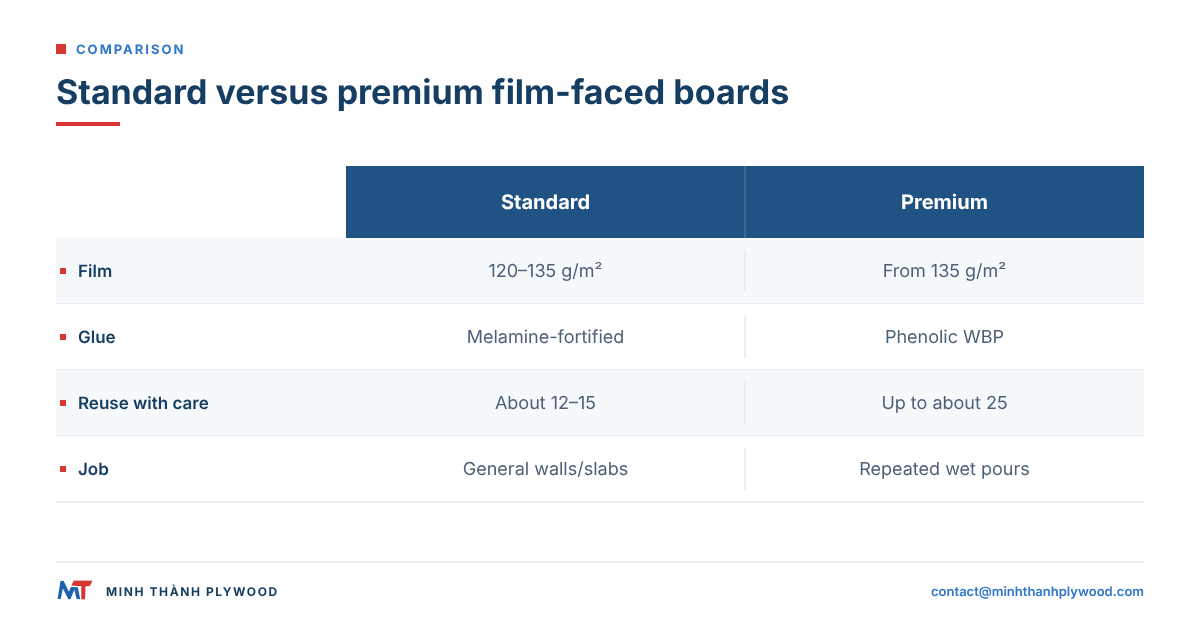
For general formwork, specify a standard film of 120–135 g/m² with melamine-fortified glue; for repeated wet pours, specify premium film from 135 g/m² with phenolic WBP glue. Name the film mass, film colour and glue bond as separate lines on the order, because each changes the board’s life.
| Build | Film | Glue bond | Uses with proper care | Best for |
|---|---|---|---|---|
| Standard | 120–135 g/m², black or brown | Melamine-fortified | About 12–15 | General walls and slabs, fewer pours |
| Premium | From 135 g/m², black or brown | Phenolic WBP | Up to about 25 | Repeated wet pours, visible concrete |
The core is the third line. Eucalyptus cores at 650–750 kg/m³ give stiffness for heavier work; Acacia at about 580 kg/m³ is lighter to carry. An 18 mm board of 1220 × 2440 mm weighs about 34.8–40.2 kg on Eucalyptus and about 31.1 kg on Acacia.
Vietnamese and Chinese film-faced boards: how do they compare?
Compare Vietnamese and Chinese film-faced boards by their written construction, not by origin: Vietnamese orders commonly use Eucalyptus or Acacia hardwood cores, while Chinese export ranges also include lighter Poplar and Poplar/hardwood cores. Both offer several film masses and glue bonds, so the quotation lines decide the comparison.
Put each offer side by side on the same fields:
- core species and density;
- film mass in g/m², colour and brand;
- glue bond, melamine-fortified or phenolic WBP;
- thickness tolerance and sheet size;
- edge sealing and packing;
- sample, test evidence and delivered weight.
A board with a hardwood core is heavier than one with a Poplar core at the same thickness, which changes both handling and the number of boards per container. The guide to choosing a film faced plywood manufacturer lists the checks for a new supplier.
How do you choose a formwork board supplier?
Choose a formwork board supplier who makes the board, writes every construction line on the quotation, sends a free sample of exactly that build, and shows inspection and loading records before shipment. Those four points separate a manufacturer from a seller who cannot control the build.
A supplier checklist for a first order:
- The quotation names core, film mass, colour, glue bond, thickness tolerance, size and edge sealing.
- The sample matches the quotation line for line, and you can cast a trial pour with it.
- The supplier shows real production and packing photos of its own boards.
- Certificates carry numbers you can check.
- Inspection photos and measurements arrive before loading, with pack references matching the packing list.
- Payment terms tie the balance to shipping documents.
Minh Thanh Plywood is a manufacturer in Ha Hoa, Phu Tho, Vietnam, with 50,000+ m³ of yearly capacity; every shipment is photographed and filmed before loading and the buyer receives the photos and video.
What documents come with an imported container of formwork boards?
An imported container of formwork boards travels with a commercial invoice, packing list, bill of lading and certificate of origin, plus phytosanitary and fumigation certificates where the destination asks for them, and an insurance certificate under CIF. Test reports and the EUDR dossier come on order.
Plywood is processed wood, so it is not subject to ISPM 15, the international standard for wood packaging.
The packing list matters most at the yard: each pack carries the thickness, film and item reference used on the list, so mixed thicknesses stay identifiable. Check pack references and sheet counts before the boards go to the cutting area.
For EU buyers, we supply the EUDR compliance dossier (origin records and geolocation files) with orders; the rules sit in Regulation (EU) 2023/1115. Minh Thanh Plywood also holds ISO 9001:2015 and TCVN 11902:2017 certificates.
How does an order for formwork boards run from enquiry to delivery?
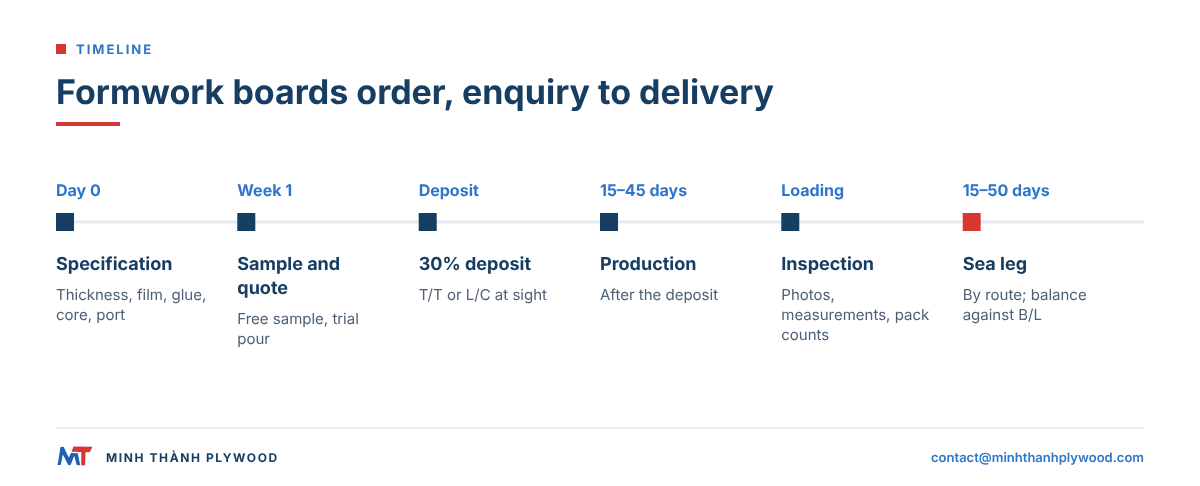
An order for formwork boards runs in seven steps: specification, sample, quotation, deposit, production in 15–45 days, inspection and loading, then the sea leg. Sea time from Hai Phong runs about 15–25 days to the Middle East, 30–40 to Northern Europe and 35–50 to West Africa, by carrier and route.
- Send the specification: thickness, size, film, glue, core, edge sealing, quantity and port.
- Approve a free sample of the quoted build, ideally with a trial pour.
- Confirm the quotation with each line repeated in writing.
- Pay the 30% deposit by T/T, or open an irrevocable L/C at sight.
- Production takes 15–45 days after the deposit.
- Inspection and loading: photos, measurements and pack counts before the container closes.
- Balance of 70% against the scanned bill of lading, then the sea leg.
Concrete forming boards: how many fit in a 40HC container?
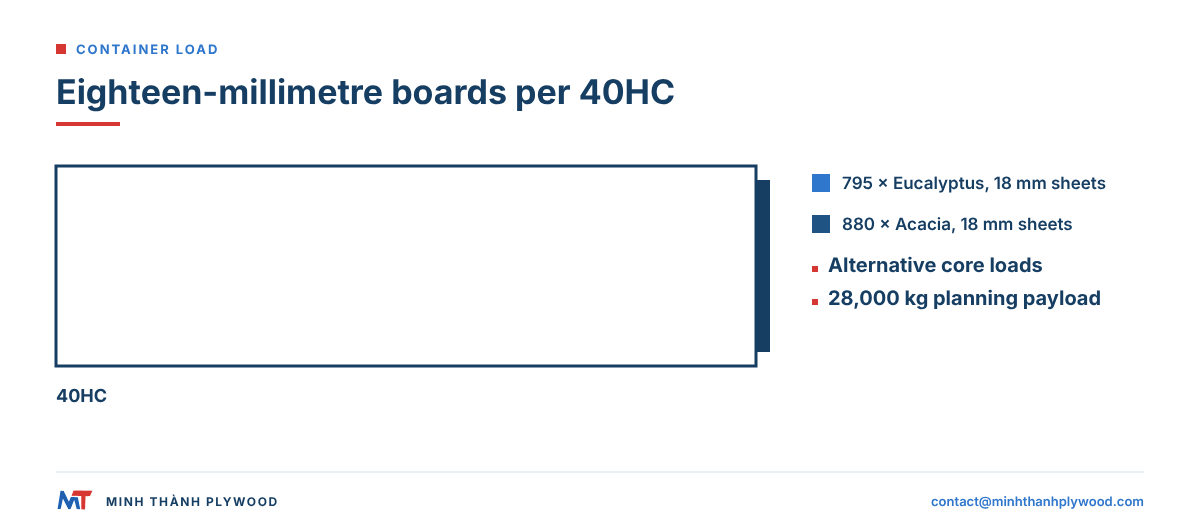
At 18 mm, a 40HC container carries 795 film-faced boards of 1220 × 2440 mm on Eucalyptus core or 880 on Acacia core, capped by the 28,000 kg planning payload. At 12 mm the Eucalyptus count rises to 1,200 boards, in 15 packs of 80.
The heavier the core, the fewer boards fit before the weight limit is reached; the container fills by weight before it fills by volume. Packs are wrapped, corner-protected and strapped on bearers, and each pack carries its reference.
Mixed thicknesses can share a container by agreement, usually one or two specifications and more by agreement, each with its own packs and packing-list line. A distributor stocking 12, 15 and 18 mm concrete forming boards can fill one container with all three.
What should you send for a formwork boards quotation?
Send the board type, thickness, sheet size, film mass and colour, glue bond, core, edge sealing, packing, quantity and destination port in one message. Minh Thanh replies within hours with a quotation that repeats each line, at FOB Hai Phong, CFR or CIF.
The minimum order is one 40HC with mixed specifications by agreement. Samples are free. Payment is 30% deposit and 70% against the scanned bill of lading, or an irrevocable L/C at sight.
Read the whole cluster in the concrete form plywood buying guide, see the standard wall board in 18 mm film faced plywood, or open the film faced plywood product page.
Specification line to send: “Formwork boards: film-faced plywood 18 mm, 1220 × 2440 mm, Acacia core, phenolic WBP glue, film from 135 g/m², black, sealed edges, export packs, 1 × 40HC to [port], mixed with 12 mm by agreement.” Send it through the contact form or WhatsApp +84 988 586 601; we reply within hours.
Buyer questions, answered
What is the best type of plywood for formwork?
Film-faced plywood with phenolic WBP glue and a dense hardwood core is the best general formwork plywood for repeated wet pours. For fewer pours, standard film with melamine-fortified glue costs less per sheet.
Is formwork plywood waterproof?
The film face and a water-resistant glue bond let film-faced plywood work wet, pour after pour, but cut edges and drilled holes must be sealed. Kept sealed and stored flat, the panel resists the water of normal formwork use.
What is the thickness of formwork plywood?
Formwork plywood runs from 12 mm to 21 mm: 12 mm for supported liners, 15 mm for slab soffits, 18 mm for walls and columns, and 21 mm for heavier components. Australia uses 17 mm formply.
How many times can film-faced plywood be reused in formwork?
Minh Thanh's standard panels with melamine-fortified glue give about 12–15 uses and premium panels with phenolic WBP glue up to about 25, with proper handling, release agent and edge sealing.
What film weight and glue should film-faced plywood from Vietnam have?
Standard film is 120–135 g/m² with melamine-fortified glue; premium film starts from 135 g/m² with phenolic WBP glue. Choose phenolic WBP for repeated wet formwork and many pours.
What is a 3 ply shuttering panel?
A 3-ply shuttering panel is a board of three cross-laid layers of softwood, usually spruce, with a yellow resin coating. It is made for system formwork frames, commonly in 21 mm and 27 mm.
Is Vietnamese film-faced plywood different from Chinese film-faced plywood?
Vietnamese film-faced orders commonly use Eucalyptus or Acacia hardwood cores; Chinese export ranges also include lighter Poplar and Poplar/hardwood cores. Compare the named core, film mass and glue on each quotation.
Do hardware stores sell formwork ply?
Yes. Builders' merchants and hardware chains stock formwork plywood by the sheet for small jobs. Contractors and distributors buying several hundred sheets usually import by the container.
What are concrete forming boards made of?
Most concrete forming boards are plywood with a resin film or overlay, 3-ply softwood panels with a resin coating, or plastic and composite boards. Solid timber boards are still used for board-marked finishes.
What is the minimum order for imported formwork boards?
Minh Thanh's minimum order is one 40HC, with mixed thicknesses by agreement. At 18 mm a container holds 795 sheets on Eucalyptus core or 880 on Acacia.