
Choose a film faced plywood manufacturer that writes film mass, core species, glue bond, thickness tolerance and reuse expectation on the quotation, and that ships the sample construction in every pack. Minh Thanh Plywood makes 12–21 mm film-faced panels on Eucalyptus or Acacia cores with 120–135 g/m² or premium film, ±0.5 mm tolerance, free samples and loads from one 40HC.
What makes a film faced plywood manufacturer worth shortlisting?
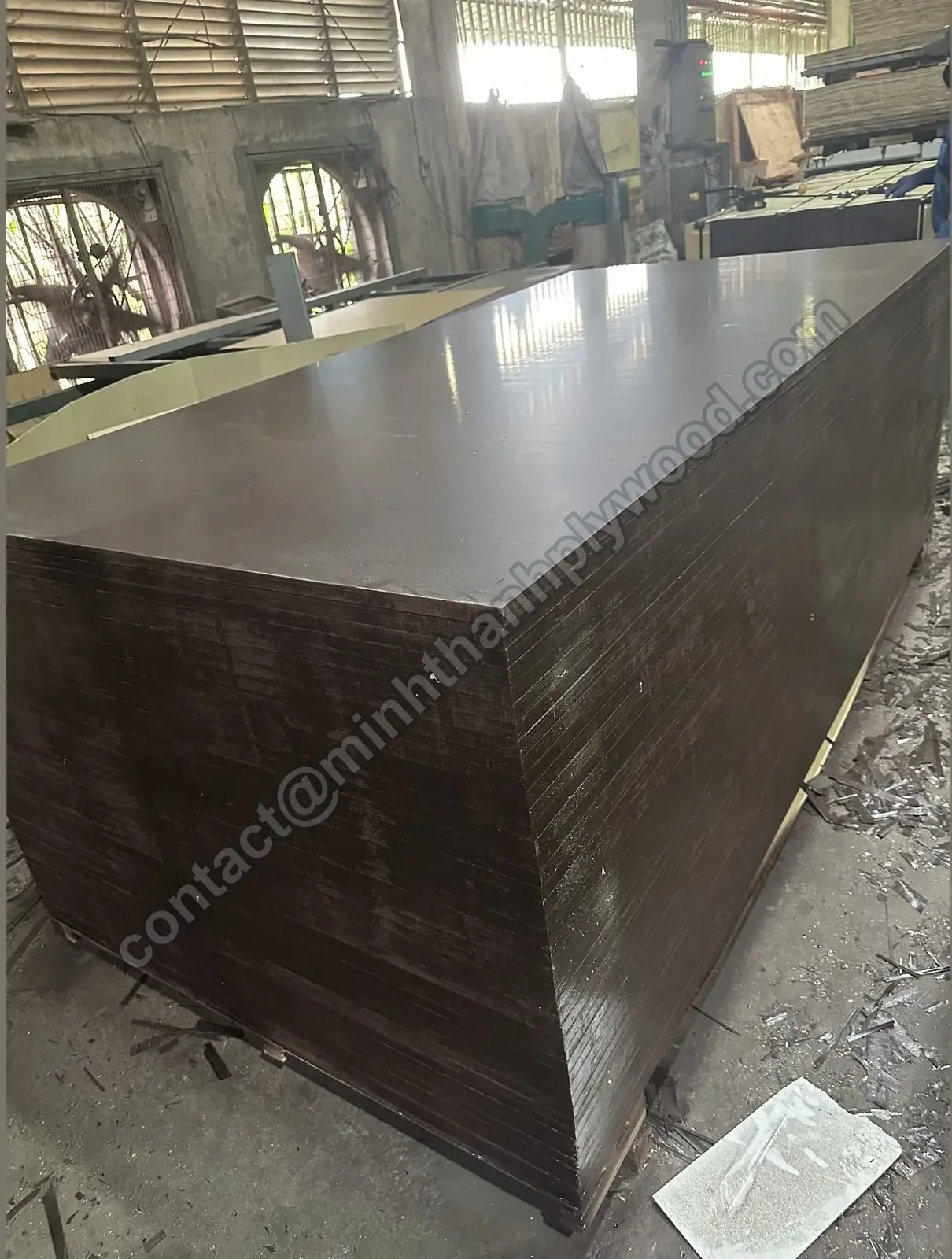
A film faced plywood manufacturer is worth shortlisting when it quotes a defined panel: film mass in g/m², core species, glue bond, thickness tolerance and reuse expectation, plus photos of the finished stack and an inspection record for every container. Those five fields decide how many pours you get; film colour and a price per sheet do not.
Most offers arrive as “black film-faced plywood, 18 mm”. That line hides the three choices that change site performance. A 120 g/m² film over an Eucalyptus core with melamine-fortified glue and a 135 g/m² film over the same core with phenolic WBP glue look identical in a photograph. On site, the second panel survives more strippings and keeps its face longer.
Ask every shortlisted supplier the same questions in writing. Which film mass is quoted? Which core? Which bond? What tolerance? How many uses does that build give with proper handling? A real manufacturer answers from its own press settings and its own recipe. A seller without production often answers with a brochure.
Minh Thanh makes film faced plywood in Ha Hoa, Phu Tho, beside its main furniture and interior range. The film-faced line runs on Eucalyptus or Acacia plantation cores, so the quotation states exactly which core and which bond goes into your packs.
Should you buy from a film faced plywood supplier or the manufacturer?
Buy planned container volumes from the manufacturer and keep a local film faced plywood supplier for urgent packs. The factory route gives you control of film, core and bond; the local route gives you sheets this week. Most contractors and distributors use both, each for a defined job.
| Channel | Best use | What you control | Typical limit |
|---|---|---|---|
| Manufacturer, factory-direct | Container programmes, own-brand stock, repeat formwork sets | Film mass, core, bond, tolerance, edge sealing, pack marks | One 40HC minimum; production 15–45 days plus sea transit |
| Export supplier consolidating several mills | Several small specifications in one load | Product codes per line, if the supplier names each mill's build | Construction can change between lines and between orders |
| Local distributor stock | Urgent pours, repairs, a few packs | Stock code and visible condition | Only the builds the distributor already holds |
A distributor’s sheet price is higher, but it keeps a pour on schedule while the next container is at sea. A container programme pays when the forecast is stable and you have covered yard space for the packs. Plan both channels together: the container sets your standard build, and the distributor covers the gap.
When you ask a film faced plywood supplier for stock, ask for the build behind the stock code. “Black film, 18 mm” without film mass and bond gives you nothing to compare with your last order.
What does a manufacturer’s film-faced build look like on paper?
A complete build sheet lists film, core, bond, thickness, tolerance, size and edge treatment, and it ties each grade to a reuse expectation. This is Minh Thanh’s standard film-faced build, as it appears on our quotations.
| Field | Standard grade | Premium grade |
|---|---|---|
| Face film | Smooth film 120–135 g/m², black or brown | Smooth film from 135 g/m², black or brown |
| Core | Eucalyptus or Acacia plantation hardwood | Eucalyptus or Acacia plantation hardwood |
| Glue bond | Melamine-fortified | Phenolic WBP |
| Reuse expectation | About 12–15 uses | Up to about 25 uses |
| Thickness | 12–21 mm, tolerance ±0.5 mm | 12–21 mm, tolerance ±0.5 mm |
| Sheet size | 1220 × 2440 or 1250 × 2500 mm, ±2 mm | 1220 × 2440 or 1250 × 2500 mm, ±2 mm |
| Edges | Sealed perimeter | Sealed perimeter |
Reuse figures assume proper handling, release agent and edge sealing. Choose the standard grade for single-project shuttering and short programmes, and the premium grade for wall and column sets that cycle many times.
The core changes handling. Eucalyptus runs at 650–750 kg/m³ and Acacia at about 580 kg/m³, so an 18 mm Eucalyptus sheet of 1220 × 2440 mm weighs about 34.8–40.2 kg and an Acacia sheet about 31.1 kg. Crews lifting by hand feel that difference on every panel.
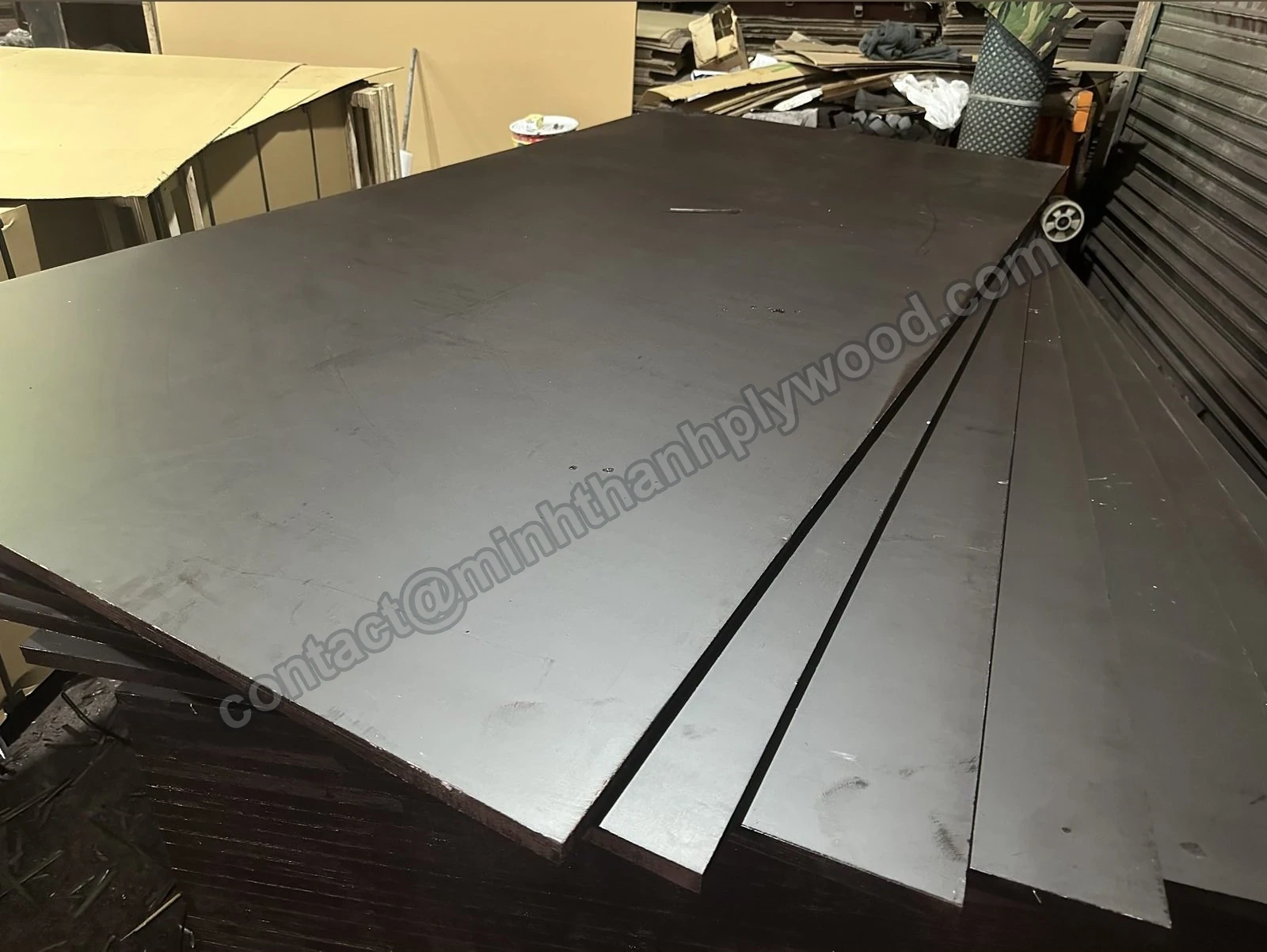
Finished contact faces spread across a stack, the view our team photographs before packing.
Why does the glue bond matter more than the film colour?
The glue bond holds the veneers together through wet pours and strippings, so it decides when a panel delaminates. Film colour only decides how the panel looks. Put the bond on its own quotation line: melamine-fortified for standard use, phenolic WBP for heavy repeated use.
A phenolic face film does not mean a phenolic core bond. Many offers describe the film as “phenolic” and leave the glue between veneers unstated. Ask for both lines in writing. For European projects, plywood classes are set by EN 636 and bond quality by EN 314-2; when the drawing names a class, put that class on the RFQ and ask for the matching test report.
WBP means weather and boil proof in trade use. It becomes a useful order instruction once it names the adhesive family and the test it must pass. Minh Thanh writes the adhesive family on every film-faced quotation and keeps the emission class as a separate line, because formaldehyde emission and wet-service bond strength are two different specifications.
Check the sample yourself. Boil a small offcut for a few hours and look for open glue lines after drying. It is a quick yard test, not a laboratory classification, but it shows you within a day whether the bond on the sample matches the bond on the quote.
Which overlay details change the concrete finish?
Film mass and face smoothness change the concrete finish. A heavier film resists scratches during stripping and keeps a smooth off-form surface for more pours. Specify mass in g/m² and inspect the face under side lighting for wrinkles, pinholes and ridges before approving the sample.
Choose black or brown to match your purchasing standard; both carry the same film options. If the job needs a different texture, such as an anti-slip mesh for walkways, buy it as a separate product. A comparison of HDO and MDO plywood is useful when your project weighs overlay families for architectural concrete.
For exposed concrete, cast a trial panel with your release agent, mix and cleaning routine. Keep the trial photo with the order. A manufacturer can match a panel to an agreed trial surface far better than to the words “high-quality finish”.
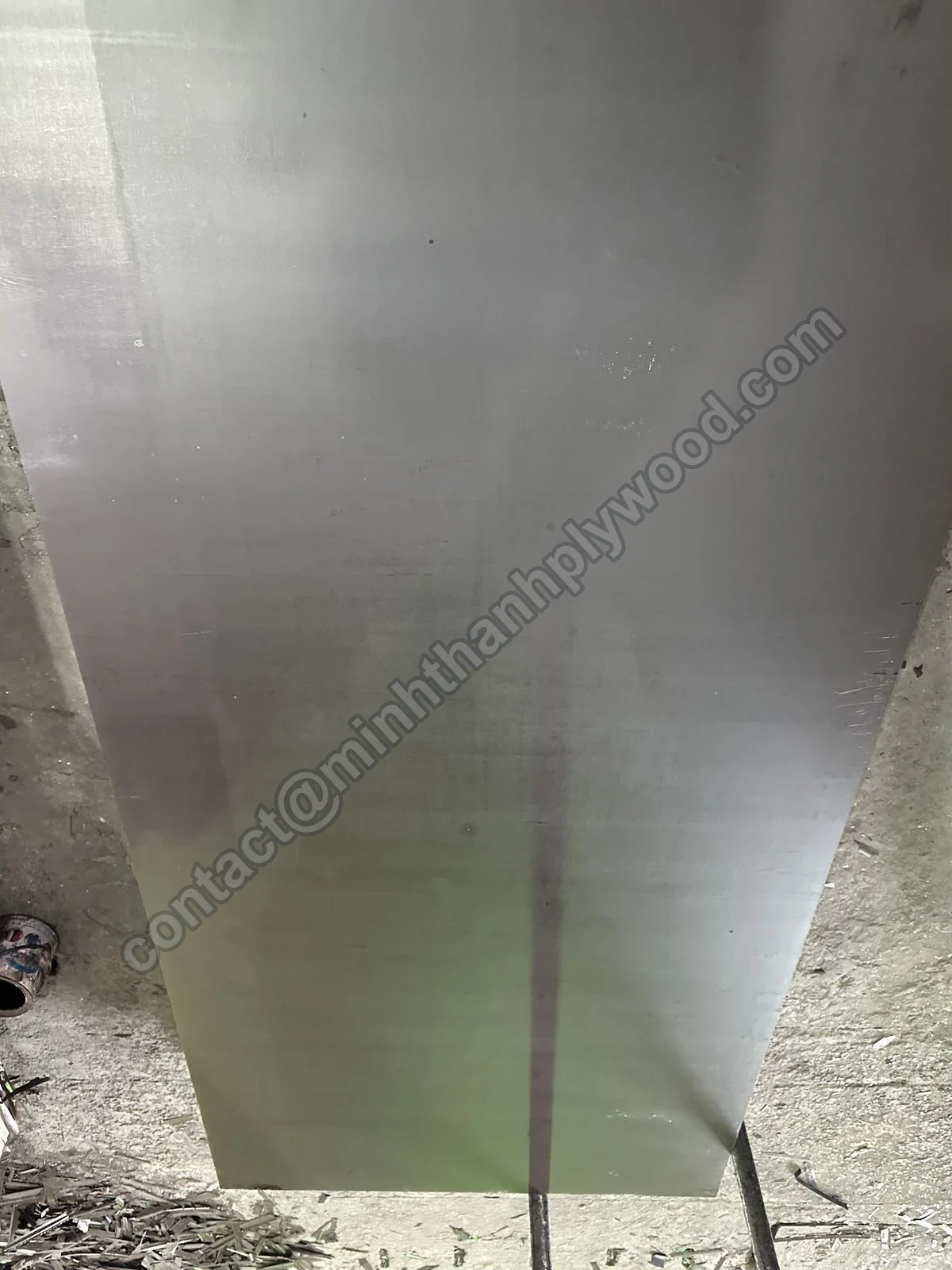
Side light shows the smoothness of the contact face; inspect every sample this way.
How do you identify the best film faced plywood supplier?
The best film faced plywood supplier gives you the same panel in every container. Judge that by four checks: a written build sheet, a free full-size sample, a pre-loading inspection record with photos, and a quotation that matches the sample line for line. Price comes after these checks, not before.
- Send the same written specification to every shortlisted supplier, with your drawing if you have one.
- Ask each for a full sheet sample of the quoted build and record the film mass, core and bond on the label.
- Cut, drill and seal the sample with your own tools; boil an offcut; check the face after one trial pour.
- Compare quotations only for builds that passed the trial, at the same delivery term and destination.
- Approve one build, keep labelled offcuts and photographs, and quote that reference on every repeat order.
Compare complete offers, not sheet prices. A cheaper sheet that gives eight pours instead of fifteen costs more per pour. Add cutting waste, edge sealing and the panels you reject at receiving before you compare suppliers. Our film faced plywood price guide shows how to turn a sheet price into a cost per pour.
Minh Thanh provides free samples. Tell us which build you want to trial, and we send the sample with its film, core and bond written on the label.
How should reuse expectations be written into the order?
Write the reuse expectation next to the grade: about 12–15 uses for melamine-fortified panels and up to about 25 for phenolic WBP panels, with proper handling, release agent and edge sealing. Then record your actual pours on the first container so the next order uses your own number.
Retire a panel when its face no longer gives the accepted concrete finish or when edge or core damage affects the form. Track three things after each pour: face scratches, edge swelling and damage around fixing holes. Damage that repeats at the same cut-out usually points to unsealed edges, not to the panel build.
Good site practice adds pours to every grade. Seal every new cut and hole on the day it is made. Apply release agent evenly before each pour. Strip with wedges, not hammers on the face. Clean with a plastic scraper and store the sheets flat on bearers, off the ground and under cover. Panel manufacturers’ site guidance, such as the WISA formwork site guidance consulted on 8 October 2026, links these same steps to panel life.
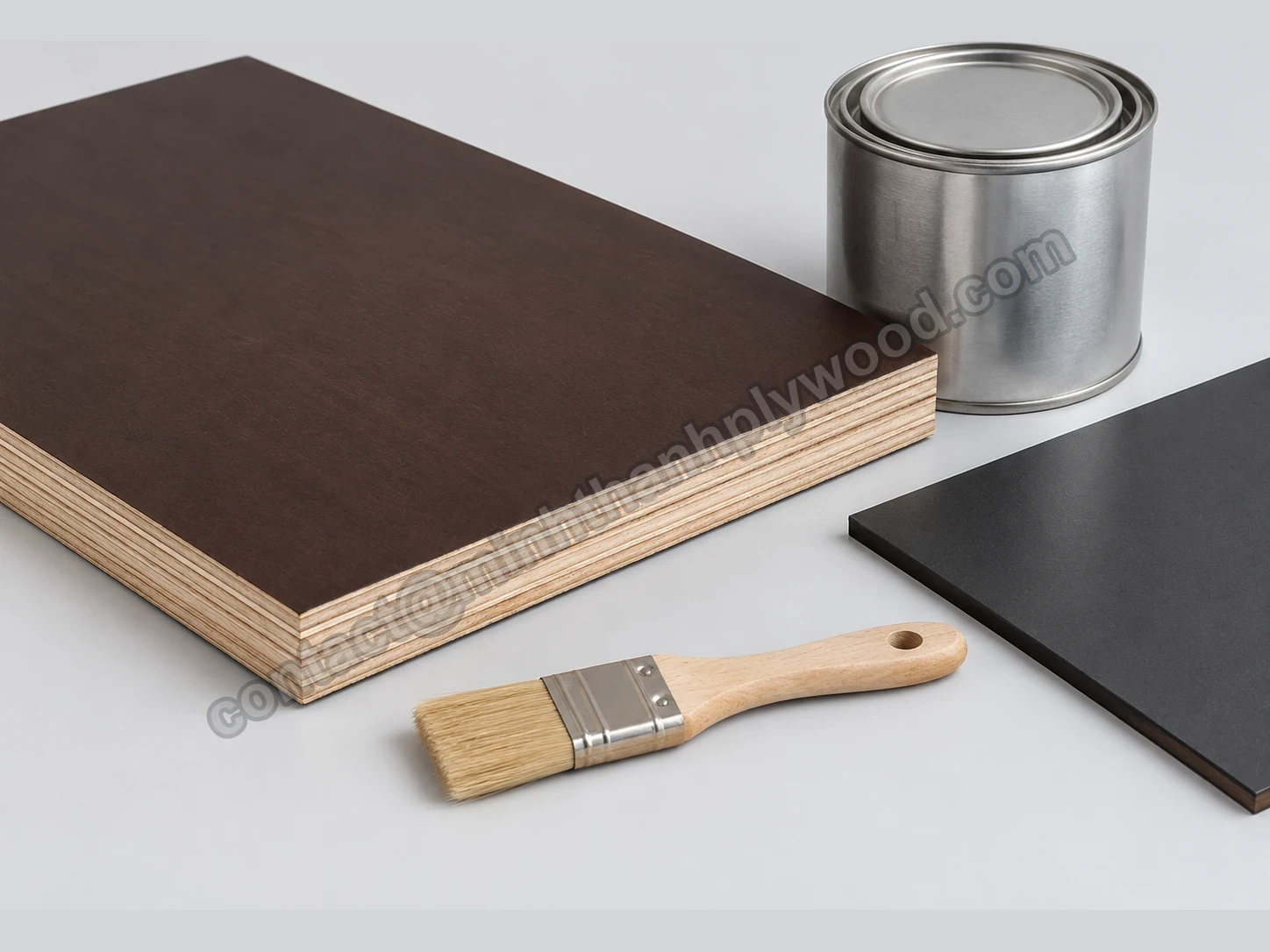
Sealing a fresh cut edge is the cheapest way to add pours to any film-faced panel.
What does a pre-shipment inspection record contain?
A useful inspection record shows measured thickness at several points per sheet, length and width, face condition, edge sealing and pack counts, each tied to a pack number. Minh Thanh photographs and films every shipment before loading and sends those records to the buyer.
Thickness is measured on individual sheets with a calliper, not averaged across a stack. On an 18 mm order, every reading must sit between 17.5 and 18.5 mm. Faces are checked under side light for film damage; corners and edges for chips and missing sealant. Pack labels are checked against the packing list.
Agree in advance what happens if a reading falls outside the order. The affected pack is set aside, the deviation is photographed and you decide before loading. Problems solved at the factory cost a phone call; problems found in your yard cost a claim.
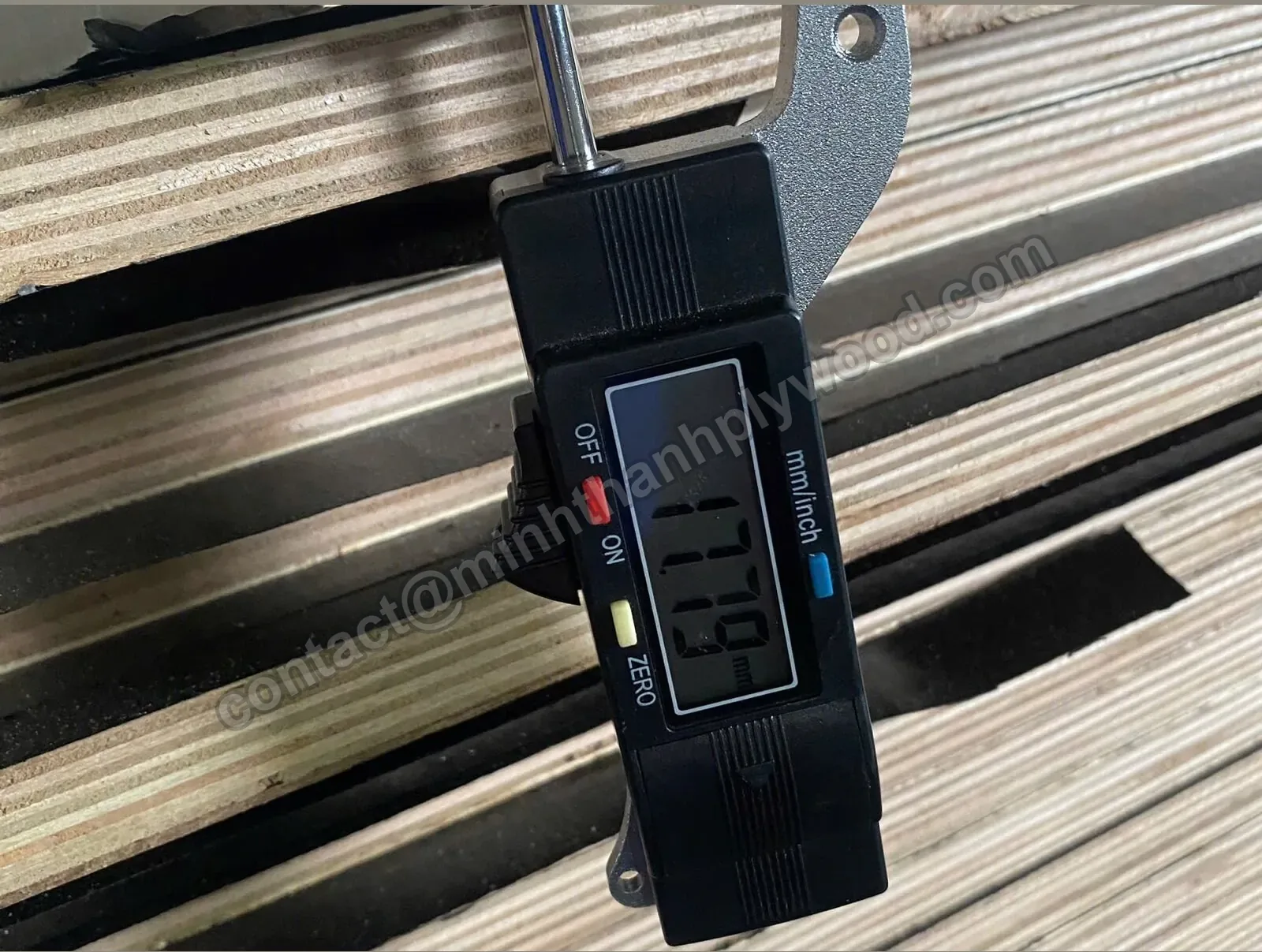
A calliper reading of 17.79 mm on an 18 mm film-faced sheet, inside the ±0.5 mm tolerance.
Which documents and checks change by destination?
Documents follow the destination. Every Minh Thanh shipment carries the commercial invoice, packing list, bill of lading, certificate of origin and phytosanitary and fumigation certificates, with insurance under CIF. Each market then adds its own items, listed below so your broker can confirm them before shipment.
| Destination | Typical days at sea from Hai Phong | Add to the RFQ |
|---|---|---|
| European Union | Northern Europe 30–40; Mediterranean 25–35 | EN 636 class if the project names one; EUR.1 origin certificate; EUDR compliance dossier |
| Middle East and Gulf | 15–25 | Thickness and film grade per project phase; heat-resistant storage plan at destination |
| United States | West Coast 20–30; East Coast 35–45 | Broker review of trade-measure scope for the exact film-faced construction |
| South-East Asia | 5–12 | Mixed thicknesses per container and short reorder cycles |
| West Africa | 35–50 | Packing for multiple handlings and open-yard storage |
For the EU, plywood falls inside the deforestation regulation. The Commission’s EUDR overview, checked on 8 October 2026, gives 30 December 2026 as the application date for large and medium operators. Minh Thanh supplies the EUDR compliance dossier, with origin records and geolocation files, with orders.
For the United States, the Commerce Department’s July 2026 final determination on hardwood and decorative plywood from Vietnam lists a conditional exclusion for phenolic film-faced plyform. The conditions cover bond class, film weight on both faces and coated edges. Ask your broker to confirm scope against the exact build before you book the container.
How do packing and loading protect the contact faces?
Packing protects the film from scratches and the edges from knocks between the press and your yard. Minh Thanh packs film-faced sheets on a pallet base with cover boards, corner protection and steel straps, then films the loading of each container.
The planning load for one 40HC of 18 mm 1220 × 2440 mm sheets is 795 sheets on Eucalyptus core (15 packs of 53) or 880 sheets on Acacia core (16 packs of 55), on a 28,000 kg payload. At 12 mm, the Eucalyptus plan is 1,200 sheets. Mixed thicknesses are planned line by line so each pack stays one specification.
Tell us how you unload. Forklift packs, crane slings and hand unloading need different pack sizes and base heights. Store packs flat on level bearers, under cover, and keep the straps on until the pack reaches the inspection area.
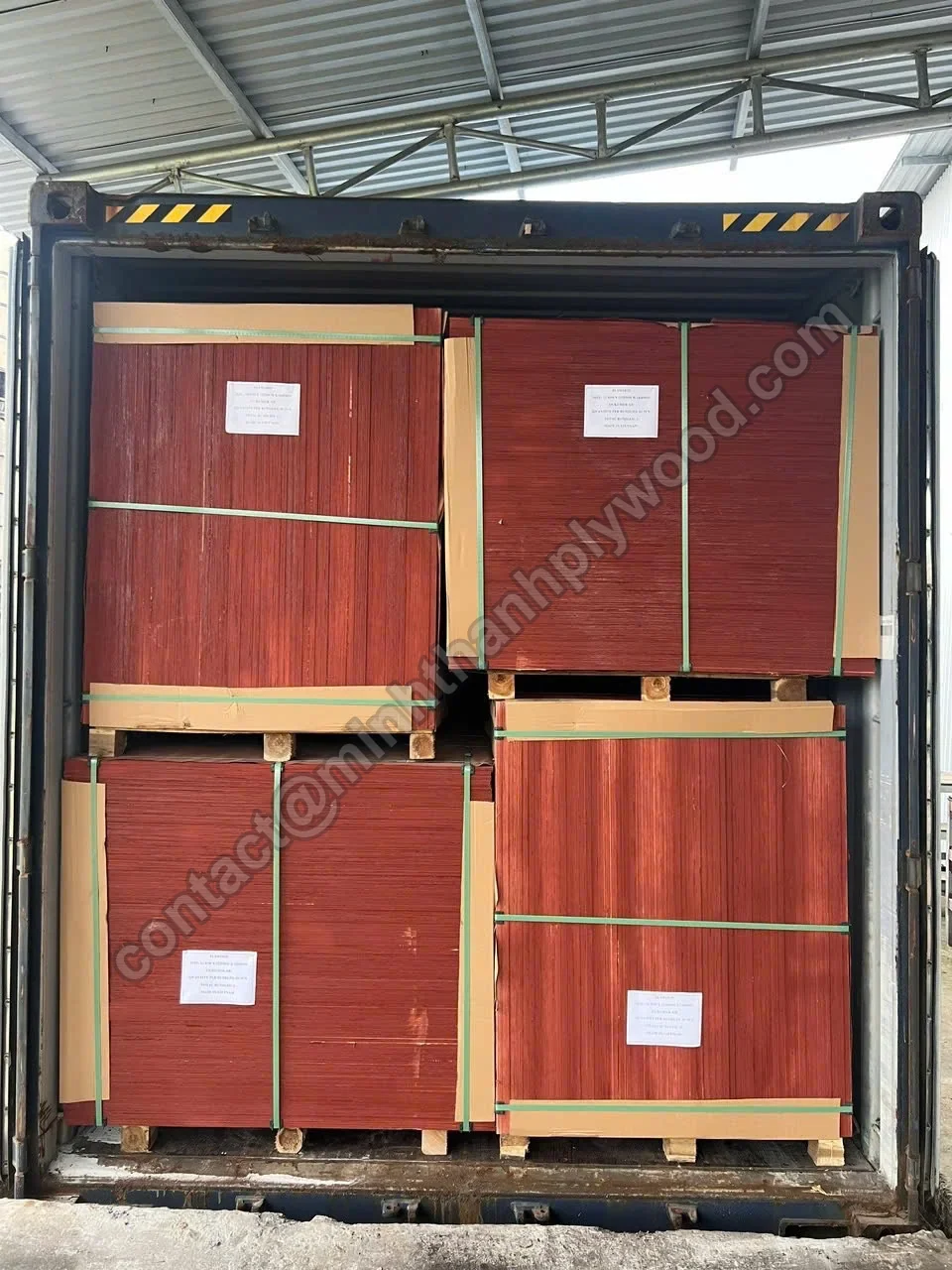
Film-faced packs with cover boards and pallet bases, loaded toward the container door.
How do you schedule production and local replenishment?
Plan backwards from the date sheets must reach your cutting station: production takes 15–45 days after deposit, then add sea transit from the table above and your clearance time. Keep a local distributor for the pours that fall before the container lands.
Map each thickness to its pour stage. Slabs often run on 15 mm or 18 mm, walls and columns on 18 mm, and heavier components on 21 mm, while 12 mm serves supported liners and light forms. A container split by stage arrives with the right sheets on top of the right packs.
Set the reorder point from your own reuse record. If a wall set gives 20 pours and the programme needs 60, you need three sets or a replacement container part-way through. Count only usable panels in stock: damaged sheets and offcuts do not serve the next pour.
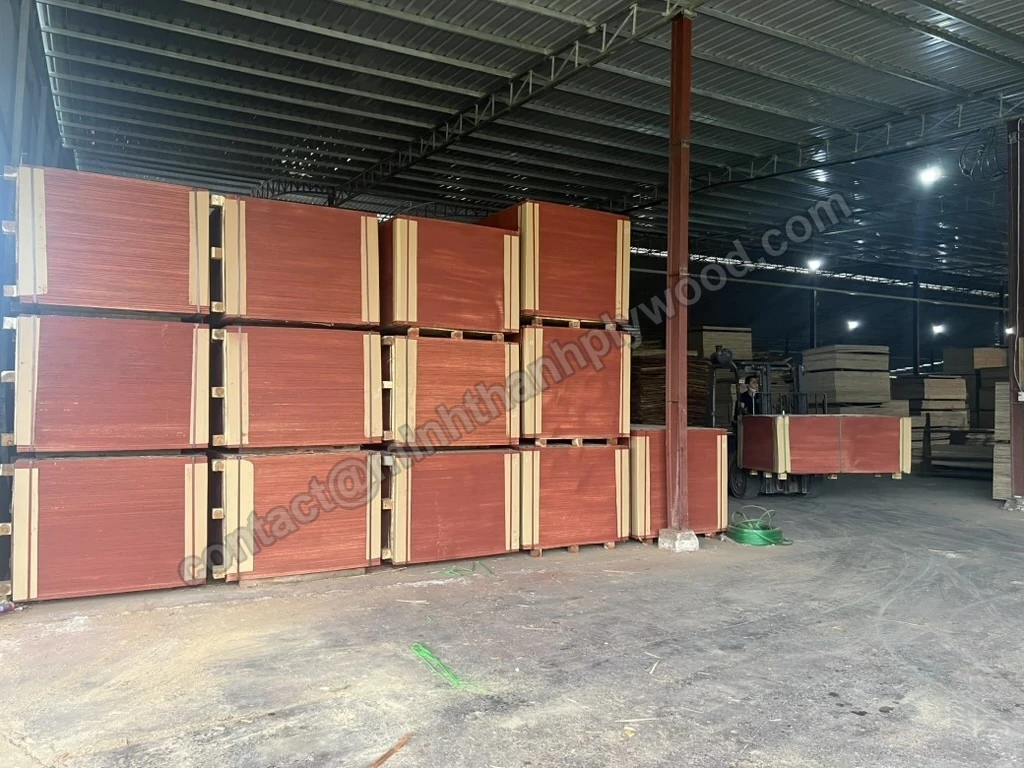
Finished film-faced packs held in the warehouse until the container booking.
What should you send for a film-faced quotation?
Send the specification in one message and you get a comparable quotation back within hours. List film colour and mass, core, bond, thickness, sheet size, edge sealing, quantity per line, packing, documents and destination port, plus the formwork drawing if you have one.
Minh Thanh quotes FOB Hai Phong, CFR or CIF. Standard payment is a 30% deposit and 70% against the scanned bill of lading, by T/T or irrevocable L/C at sight. The minimum order is one 40HC, with mixed specifications by agreement.
If you are replacing a current panel, add photographs of its face and edge, its film mass if known and the number of pours your crew gets from it. We match the build or propose a better grade, and we send a free sample before you commit.
Send your film-faced specification through the contact form, which takes up to three drawing files, or email [email protected]. For birch furniture ranges, the same checklist approach appears in our guides to birch plywood suppliers and the Baltic birch plywood supplier route.
Buyer questions, answered
What should I ask a film faced plywood manufacturer first?
Ask for the film mass in g/m², the core species, the glue bond (melamine-fortified or phenolic WBP), the thickness tolerance and the reuse expectation for that build. A manufacturer that answers all five on the quotation is quoting a defined panel, not a colour.
Where can I buy film faced plywood in bulk?
Buy container quantities directly from a manufacturer and keep a local distributor for urgent top-up packs. Minh Thanh's minimum order is one 40HC, with mixed thicknesses by agreement and production 15–45 days after deposit.
How do I identify the best film faced plywood supplier?
The best film faced plywood supplier for your yard is the one whose approved sample, written construction and shipment records match every delivery. Compare film mass, core, bond, tolerance, pack marking and inspection photos before comparing price.
Does black film mean better plywood than brown film?
No. Black and brown are colour choices. Film mass, core species and glue bond decide durability and reuse. Minh Thanh supplies either colour with standard 120–135 g/m² film or premium film from 135 g/m².
Does phenolic face film mean the core uses phenolic glue?
No. The face film and the glue between veneers are separate specifications. Write the core bond on its own line: melamine-fortified for standard panels or phenolic WBP for heavy repeated use.
How many times can film-faced plywood be reused?
Minh Thanh's melamine-fortified panels give about 12–15 uses and phenolic WBP panels up to about 25, with proper handling, release agent and edge sealing. Record your own pours on the first container to set the reorder point.
What thickness tolerance should I put on a film-faced order?
Minh Thanh's film-faced thickness tolerance is ±0.5 mm, with length and width at ±2 mm. An 18 mm order is accepted between 17.5 and 18.5 mm, measured on individual sheets at several points.
Do all film-faced sheets suit structural formwork?
Formwork engineers select panels by documented properties and the support layout. Send the drawing, the required standard and the support spacing with the enquiry so the quoted thickness and bond match the design.
Can I order mixed film-faced specifications in a container?
Yes. Minh Thanh accepts mixed specifications by agreement within one 40HC, usually 1–2 lines and up to 3–6 by agreement. Each thickness and film grade gets its own pack marks and packing-list line.
What information does Minh Thanh need for a quotation?
Send thickness, sheet size, film colour and mass, core, bond, quantity per line, edge sealing, packing, required documents and destination port. Attach the formwork drawing if you have one; samples are free.