
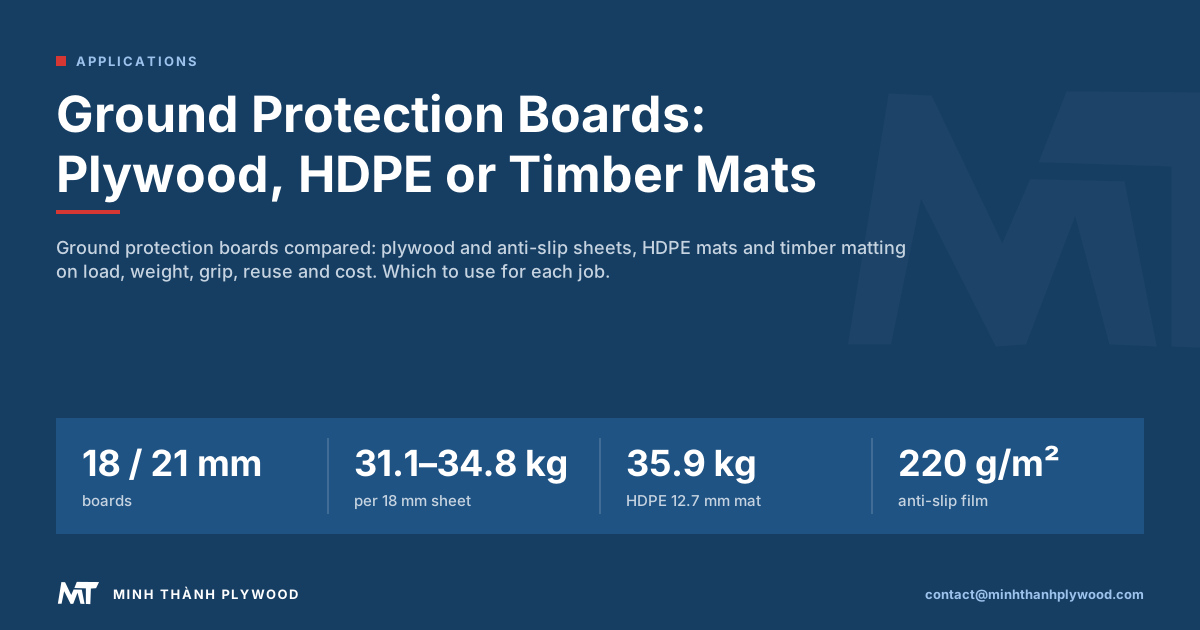
Ground protection boards spread foot, wheel or plant loads over soft ground so it does not rut. Plywood boards are the low-cost choice for walkways and light plant, HDPE mats for repeated hire and mud, and timber matting for cranes and heavy plant. Minh Thanh Plywood makes 12–21 mm film-faced and anti-slip plywood that boards are cut from.
What are ground protection boards?
Ground protection boards are rigid sheets or mats laid over grass, soil or soft ground to spread the load of people, vehicles or plant over a larger area. They stop rutting, mud and soil compaction, and they give crews a firm surface to walk, wheel or drive on.
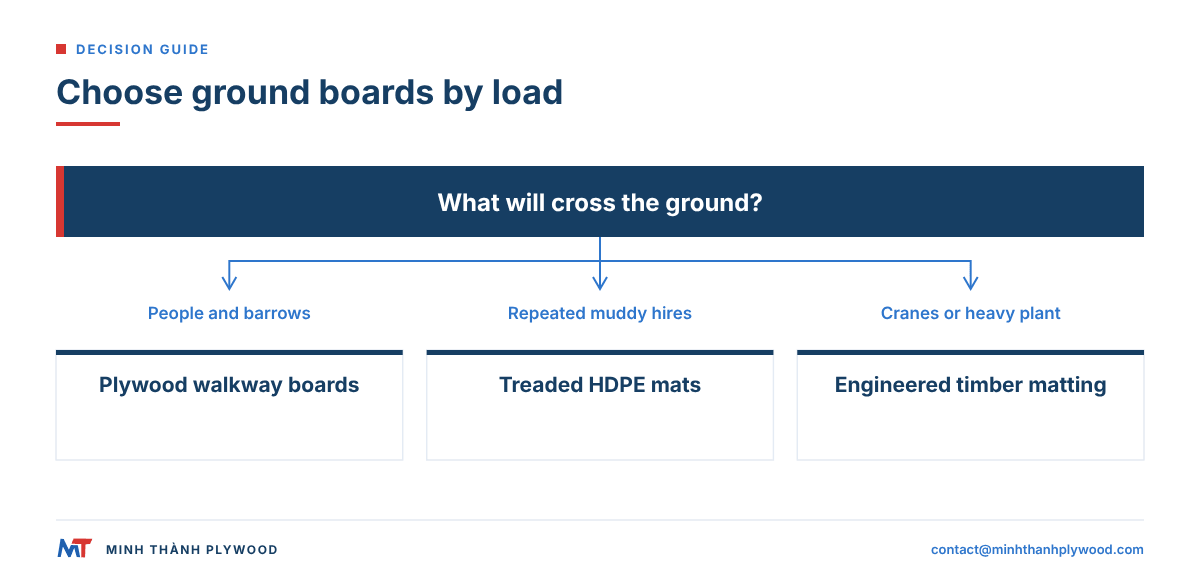
Three families cover almost every job. Plywood boards, cut from film-faced or anti-slip panels, serve walkways, event routes and light plant. HDPE mats, moulded high-density polyethylene sheets with tread patterns, serve hire fleets, utility work and repeated muddy sites. Timber matting, heavy hardwood timbers bolted into mats, serves cranes, piling rigs and pipeline routes.
The right board depends on the load, the ground, how often it is laid and lifted, and whether the surface must be grippy when wet. This comparison sets out each option, then explains what to order when the board is plywood.
Ground protection boards: load rating and UK price
UK retail prices run from about £55 for a 10 mm recycled LDPE mat rated to 10 tonnes on solid ground to about £908 for a 3000 × 2500 mm mat rated to 160 tonnes; an 18 mm anti-slip plywood sheet costs about £60 to £149 including VAT and is rated for foot traffic, barrows and light plant. Pick the rating from the heaviest axle load and the weakest ground, not from the price.
| Board (2440 × 1220 mm unless stated) | Load rating | UK retail price (ex VAT) |
|---|---|---|
| 18 mm anti-slip plywood, eucalyptus core | Pedestrians, barrows, light plant on firm ground | about £50–56 per sheet |
| 18 mm anti-slip plywood, birch core | Same use, stiffer core | about £100–124 per sheet |
| 10 mm recycled LDPE mat (Proguard) | Up to 10 t on solid ground | £55 |
| Light-duty access mat, 2400 × 1100 mm | 5 t | £77 |
| Medium-duty access mat | 20 t | £64 |
| Narrow mat, 2400 × 600 mm | 20 t | £50 |
| Heavy-duty access mat | 80 t | £109 |
| Mega track mat, 3000 × 2500 mm | 160 t | £908 |
| Composite or aluminium trackway | 150 t class | price on request |
Prices are from Hermeq, Sitepro Direct and Sheet Materials Wholesale, read 21 October 2026, and move with stock and order size. Plywood has no tonnage plate: its rating depends on thickness, the span between supports and the ground, so state the heaviest wheel load and the soil to the supplier. Treat 18 mm as the pedestrian and barrow board and 21 mm as the small-plant board; neither is a bridge.
Buyers of mats add three costs the sheet price leaves out. Add 10% for cuts and wastage. Add connectors: a U-pin is about £4, a 2-way connector about £11 and a 4-way connector about £22. Add carriage, about £75 plus VAT on external matting from Sitepro Direct. A 2-person lift is the limit for a 10 mm mat.
For a trade buyer the conversion is simple: a hire company importing 18 mm anti-slip sheets by the 40HC pays a raw FOB container price per sheet, then cuts, seals and links locally, against the retail sheet price in the table. Ask for the FOB quote per sheet and set it beside the row above.
Plywood, HDPE or timber matting: the comparison table
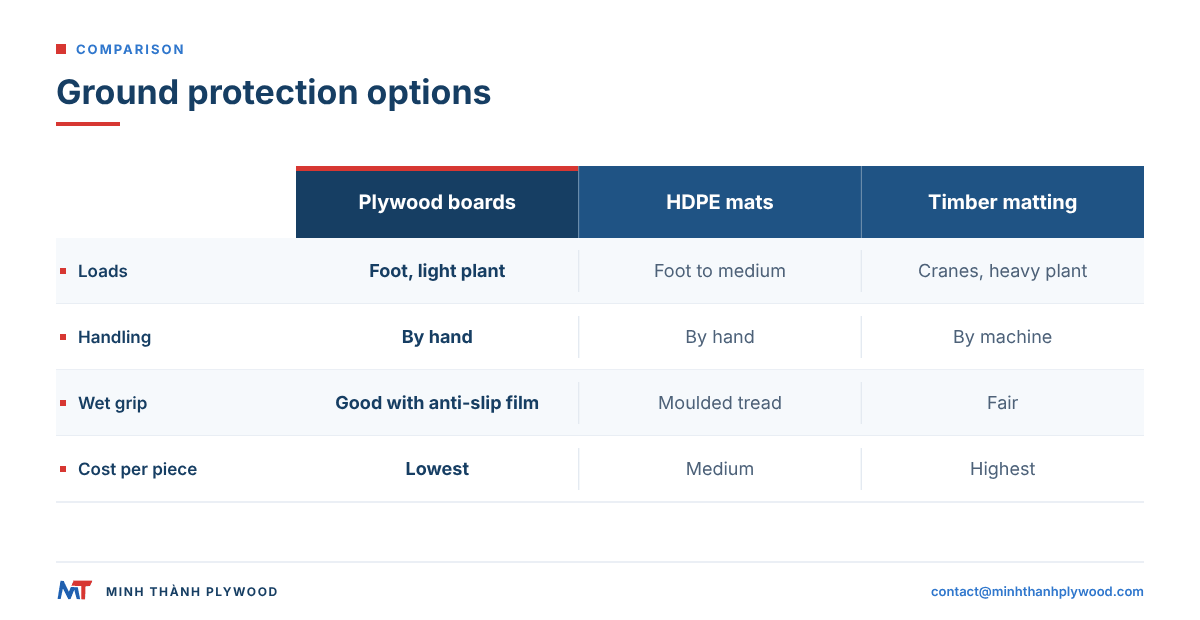
Plywood boards have the lowest cost per sheet and suit foot traffic and light plant; HDPE mats last longest in mud and wet for light and medium loads; timber matting is the only one of the three built for cranes and heavy plant. Each row compares one metric.
| Metric | Plywood boards (film-faced or anti-slip) | HDPE ground protection mats | Timber matting (crane mats) |
|---|---|---|---|
| Typical loads | Pedestrians, barrows, light plant | Pedestrians to light and medium vehicles | Cranes, piling rigs, heavy plant |
| Sheet or mat size | 1220 × 2440 or 1250 × 2500 mm | Often 2440 × 1220 mm | Long, heavy mats lifted by machine |
| Weight to handle | 18 mm sheet about 31.1–34.8 kg | 12.7 mm mat about 35.9 kg | Lifted by machine only |
| Grip when wet | Good with anti-slip film; poor with smooth film | Good on moulded tread | Fair; mud builds up between timbers |
| Water and mud | Sealed edges needed; dry between jobs | Does not absorb water | Absorbs water, gets heavier |
| Cleaning | Brush and water | Pressure wash | Hard to clean between timbers |
| Linking | Battens or clips added by the user | Moulded connectors | Bolted or chained |
| Cost per piece | Lowest | Medium | Highest |
| Best fit | Walkways, events, garden and site access | Hire fleets, utility and repeated muddy sites | Heavy access roads and crane pads |
Plywood and HDPE overlap on light work. The choice there is cost against life: plywood costs less per sheet and is simple to cut; HDPE survives more mud and pressure washing.
Plywood for ground protection: when it is the right board
Plywood for ground protection is the right board for pedestrian routes, event walkways, garden and lawn access, temporary site paths and light plant on firm-to-soft ground. It is cheap per sheet, flat, stiff and easy to cut around obstacles.
The panel has to be built for wet use. Phenolic WBP glue keeps the plies bonded when the board lies on damp ground; a phenolic film on the face sheds water and mud; painted edges stop water entering the core. Ordinary interior plywood swells and delaminates within days on wet ground.
Film-faced and anti-slip plywood do the job best. Smooth film suits board floors under covered event structures and floor protection inside buildings. Anti-slip film, with a pressed hexagon or rice/mesh pattern, suits outdoor walkways where rain and mud make a smooth face slippery. Our anti-slip plywood page sets out both patterns.
HDPE ground protection mats: strengths and limits
HDPE ground protection mats are moulded polyethylene sheets with a tread pattern on one or both faces, used for pedestrian and light-to-medium vehicle access on soft ground. They do not absorb water, they pressure-wash clean and they survive many hires.
A common light mat is 2440 × 1220 mm and 12.7 mm (half an inch) thick. At an HDPE density of about 950 kg/m³ it weighs about 35.9 kg (2.44 × 1.22 × 0.0127 m × 950 kg/m³), close to an 18 mm Eucalyptus-core plywood sheet at 34.8 kg.
The limits are stiffness and price. Polyethylene is far less stiff than plywood of the same thickness, so a thin mat follows the ruts under heavy wheels; heavy-duty mats are thicker and heavier. Mats cost more per piece than a plywood board of the same size, which pays off only when the mat is hired out many times.
Wooden matting and timber mats for heavy plant
A timber mat is a heavy platform of hardwood timbers bolted or chained together, laid to carry cranes, piling rigs and heavy plant over soft ground. Timber matting, also called wooden matting or crane mats, builds temporary roads and working platforms on pipeline routes, wetlands and wind farm sites.
Timber matting handles loads that no sheet board can: the mats are thick, long and heavy, and they are laid and lifted by machine. Their weakness is weight, water uptake and cleaning: they get heavier as they absorb water, and mud packs between the timbers.
Plywood plays a supporting part here. Crews lay plywood sheets over timber mats to give a flat walking surface, and laminated veneer lumber (LVL) can replace sawn timbers in some engineered mats. Our LVL page covers that material.
Wood matting vs HDPE: which costs less over its life?
For the same load rating, wood matting usually costs less to buy, and HDPE costs less per use when the mats go out on many wet, muddy hires. For a single project or occasional use, plywood boards or wooden matting are the cheaper route.
Work it out per use. Cost per use = (purchase price + repairs + cleaning) ÷ times laid. A plywood board that lasts a season of events and an HDPE mat that lasts many seasons can end up close per use; a plywood board left in standing water with open cut edges ends up far more expensive.
- Count the lays. How many times will each board go down and come up?
- Rate the ground. Firm grass, soft soil or standing water and mud?
- Rate the load. Pedestrians, barrows, vans, light plant or heavy plant?
- Count the handling. Who lifts the boards, by hand or by machine?
- Divide. Price plus repairs and cleaning, divided by lays.
For occasional jobs on firm-to-soft ground under light loads, the plywood board wins. For a hire fleet out every week in mud, HDPE wins.
Which plywood thickness for ground protection boards?
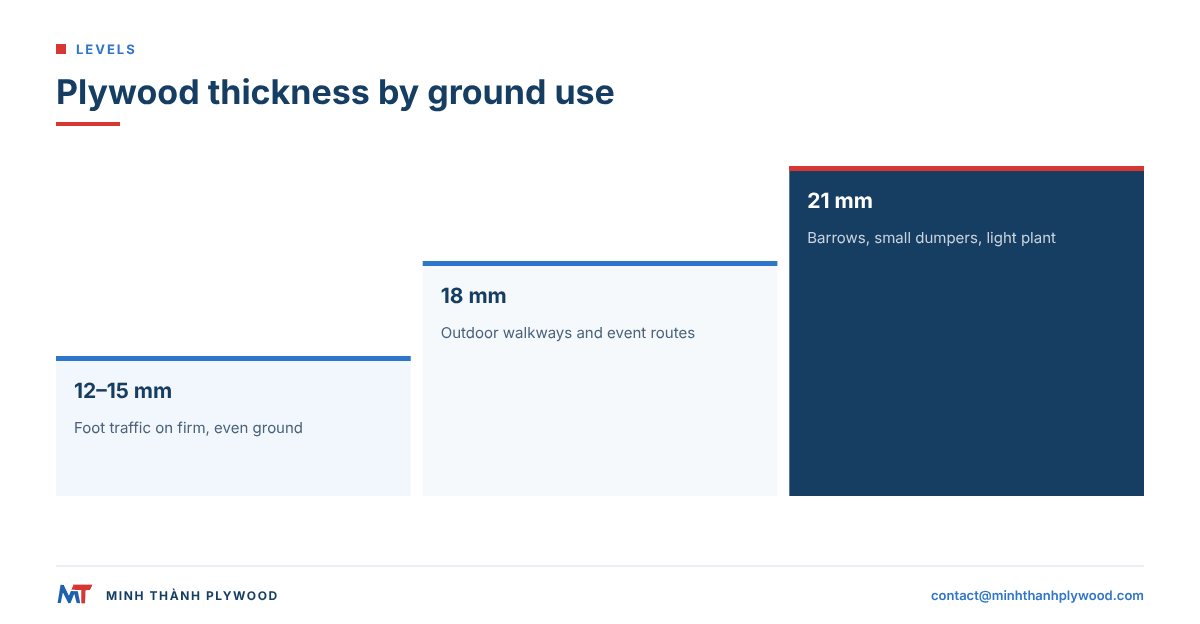
Use 18 mm plywood for walkways and pedestrian routes and 21 mm for barrows, small dumpers and light plant. Use 12–15 mm only for floor and lawn protection under foot traffic, laid on firm, even ground.
| Use | Thickness | Face | Glue |
|---|---|---|---|
| Floor and lawn protection, foot traffic | 12–15 mm | Smooth or anti-slip film | Melamine-fortified or phenolic WBP |
| Outdoor walkways and event routes | 18 mm | Anti-slip film, hexagon pattern | Phenolic WBP |
| Barrows, small dumpers, light plant | 21 mm | Anti-slip film, rice/mesh pattern | Phenolic WBP |
| Walking surface over timber mats | 18 mm | Anti-slip film | Phenolic WBP |
Our film-faced and anti-slip panels run 12–21 mm with a thickness tolerance of ±0.5 mm, in 1220 × 2440 mm and 1250 × 2500 mm sheets. An 18 mm sheet weighs about 31.1 kg on an Acacia core and about 34.8 kg on a Eucalyptus core, so two people can lay it.
Grip: smooth film or anti-slip film?
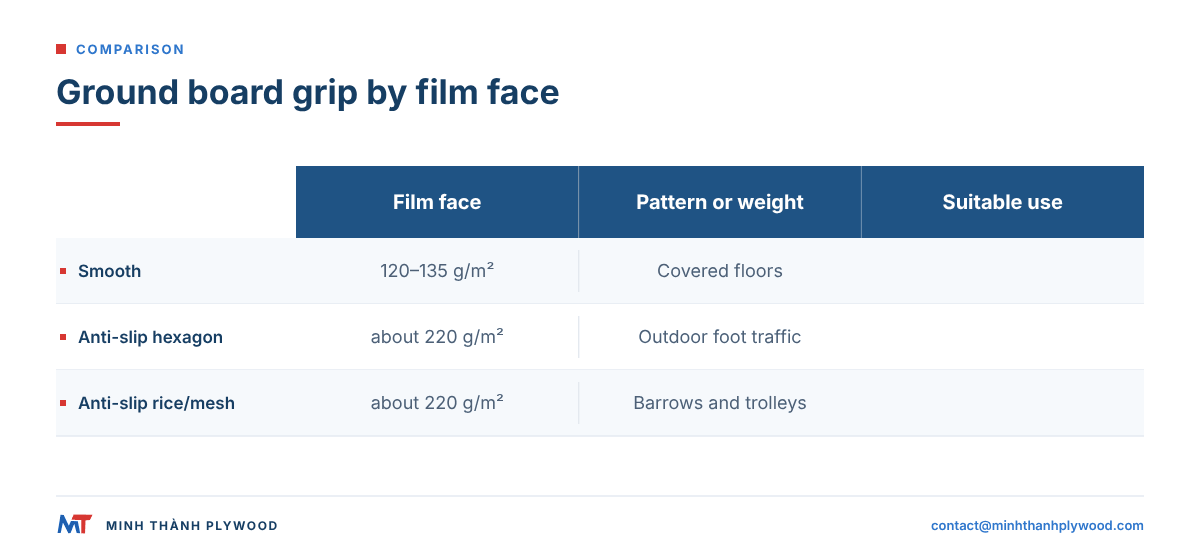
Choose anti-slip film for any board people walk on outdoors, and smooth film for covered floors and indoor protection. The textured phenolic film, around 220 g/m², gives grip when the board is wet and muddy; smooth film of 120–135 g/m² is made for concrete contact, not footing.
The two patterns suit different traffic. The hexagon pattern suits foot traffic in many directions and cleans out with water and a brush. The rice or mesh pattern suits wheeled traffic, barrows and trolleys. For a mixed route, hexagon is the usual choice.
If a site specification names a slip test, put the method on the order. Floor specifications name either a pendulum test (EN 13036-4 / BS 7976) or the ramp test behind the German R-rating (DIN 51130); we quote the face to the method you name.
Uneven and wet surfaces are both listed as key aspects of slips and trips on construction sites, and the HSE slips and trips guidance lists a temporary covering among the ways to treat slippery ground.
Tree root protection with ground protection boards
Near protected trees in the UK, ground protection boards go on a compressible layer to keep plant and feet from compacting the root zone. BS 5837:2012 gives the examples most method statements follow, and an arboriculturist reviews the final specification.
The standard’s examples are graded by load:
- Pedestrians only: a single thickness of scaffold boards on a compression-resistant layer such as about 100 mm of woodchip over a geotextile membrane.
- Pedestrian-operated plant up to 2 t: proprietary interlinked ground protection boards on about 150 mm of woodchip over a geotextile.
- Heavier wheeled or tracked plant: an engineered system to an appropriate specification.
Plywood boards fit the first two cases when they are linked so they do not shift and are thick enough not to flex into the woodchip. The UK government’s tree and development guidance explains how protected trees are handled in planning.
How to lay and link plywood boards
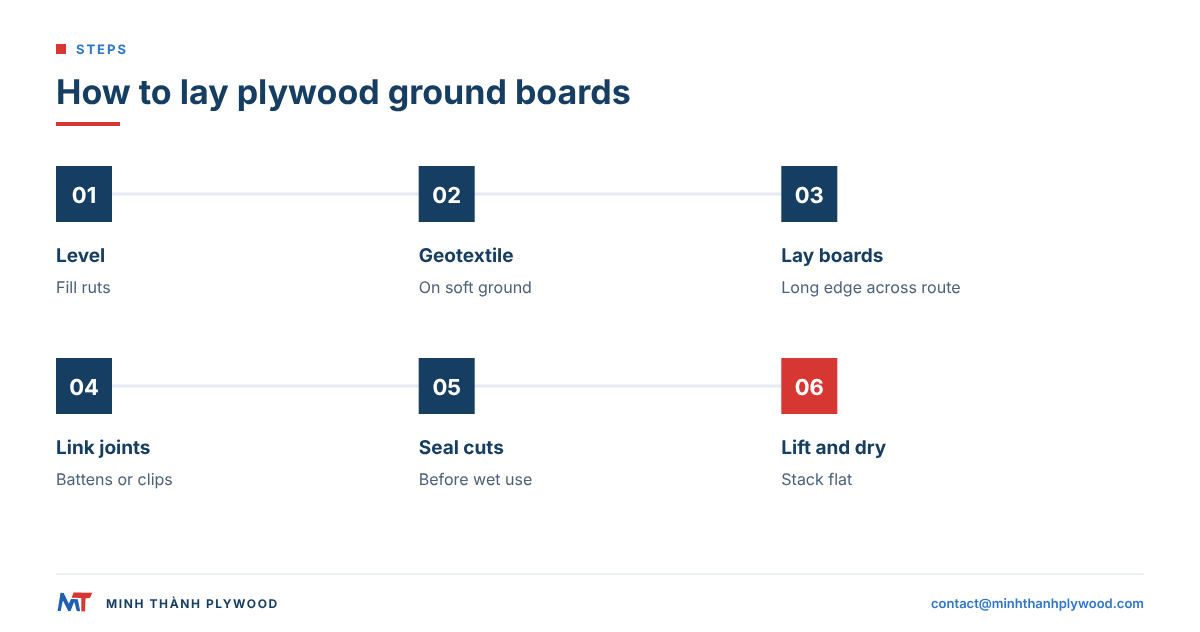
Lay plywood boards on levelled ground with the long edge across the direction of travel, link them so they cannot separate, and keep the anti-slip face up. Linking matters more than thickness: loose boards rock, tip and trip.
- Level the route. Remove stones and fill ruts so each board bears evenly.
- Lay a geotextile over very soft or protected ground.
- Place boards edge to edge, long edge across the route.
- Link the joints with screwed battens on the underside or proprietary clips.
- Seal any cut edge before the board goes on wet ground.
- Lift, brush and stack boards flat and dry after the job.
Boards stored on bearers under cover dry out between jobs and stay flat. Boards left stacked wet in the sun cup and their edges open.
How long do plywood ground protection boards last?
Plywood ground protection boards with phenolic WBP glue and sealed edges last many lays when they are lifted, cleaned and stored dry between jobs; boards left in standing water with open cut edges fail much sooner. Edge care decides the life more than thickness does.
Watch three signs. Swollen or soft edges show water has entered the core: trim and reseal, or retire the board. A worn face in the wheel path shows the film is gone: turn the board over if both faces are filmed. Splits around screw holes show the board has flexed too much: move it to a lighter route.
Our panels are pressed with a phenolic WBP glue line on order and edges are painted at the mill. Every pack is checked against the order and the approved sample, and every shipment is photographed and filmed before loading.
Ground protection boards for sale: buying in bulk
Hire companies and contractors buy plywood for ground protection boards by the container and finish them locally. They cut the sheets, seal every edge and add battens or clips. Buying full sheets by the 40HC keeps the cost per board low.
Our minimum order is one 40HC, with mixed thicknesses and faces by agreement, so one load can carry 18 mm hexagon boards for walkways and 21 mm mesh boards for plant routes. Production is 15–45 days after the 30% deposit, with the 70% balance against the scanned B/L or an irrevocable L/C at sight, on FOB Hai Phong, CFR or CIF terms.
Free samples go out before a first order, so you can test grip and edge sealing on your own ground. Our film-faced plywood page covers the smooth-face option for covered floors.
What to send for a ground protection plywood quotation
Send the use, the load, the face pattern, thickness, sheet size, quantity and destination, and we reply within hours with a quotation. A complete line looks like this:
Anti-slip plywood for ground protection boards, hexagon film about 220 g/m² on one face, smooth film back, Eucalyptus core, phenolic WBP glue, 18 mm ±0.5 mm, 1220 × 2440 mm, edges sealed, one 40HC mixed 18 mm and 21 mm, CIF UK port.
Email contact@minhthanhplywood.com or WhatsApp +84 988 586 601 (Lisa). For site walkways that need guard rails or toe boards, our planned guide to scaffold boards compares timber, plywood and steel decks, and our planned article on plywood hoarding covers site fencing panels.
Buyer questions, answered
What are ground protection boards?
Ground protection boards are rigid sheets or mats laid on grass, soil or soft ground to spread the load of people, vehicles or plant. They stop rutting and compaction and give a firm, grippy surface to work on.
Can plywood be used for ground protection?
Yes. Film-faced or anti-slip plywood of 18–21 mm with phenolic WBP glue and sealed edges makes good walkways and light-plant boards. It is cheaper per sheet than HDPE but shorter-lived in constant mud and wet.
What is the difference between timber matting and HDPE mats?
Timber matting is heavy hardwood timbers bolted into mats for cranes and heavy plant. HDPE mats are light plastic sheets with tread patterns for pedestrians, vans and light plant. Timber takes much higher loads; HDPE is easier to handle and clean.
How thick should plywood ground protection boards be?
Use 18 mm for walkways and pedestrian routes and 21 mm for barrows, small dumpers and light plant. Thinner 12–15 mm sheets suit only floor and lawn protection under foot traffic.
Are plywood boards slippery when wet?
Smooth film-faced plywood can be slippery when wet. For walkways, order anti-slip plywood with a hexagon or rice/mesh film of about 220 g/m², which gives grip on the working face.
How much does a ground protection board weigh?
An 18 mm plywood board of 1220 × 2440 mm weighs about 31.1 kg on an Acacia core and about 34.8 kg on a Eucalyptus core. A 12.7 mm HDPE mat of the same size weighs about 35.9 kg.
What ground protection does BS 5837 suggest near trees?
BS 5837:2012 gives examples: scaffold boards on about 100 mm of woodchip over a geotextile for pedestrians, and interlinked ground protection boards on about 150 mm of woodchip for pedestrian-operated plant up to 2 t.
What is wooden matting used for?
Wooden matting, also called timber mats or crane mats, builds temporary roads and working platforms for cranes, piling rigs and heavy plant on soft ground, pipeline routes and wetlands.
How long do plywood ground protection boards last?
With phenolic WBP glue, sealed edges and boards lifted and stacked dry after each job, plywood boards last many hires. Boards left in standing water with open cut edges swell at the edges and fail sooner.
Can I buy plywood ground protection boards in bulk?
Yes. Hire companies and contractors import plywood by the 40HC container and cut or finish boards locally. Minh Thanh supplies film-faced and anti-slip sheets from one 40HC, with mixed thicknesses by agreement.