
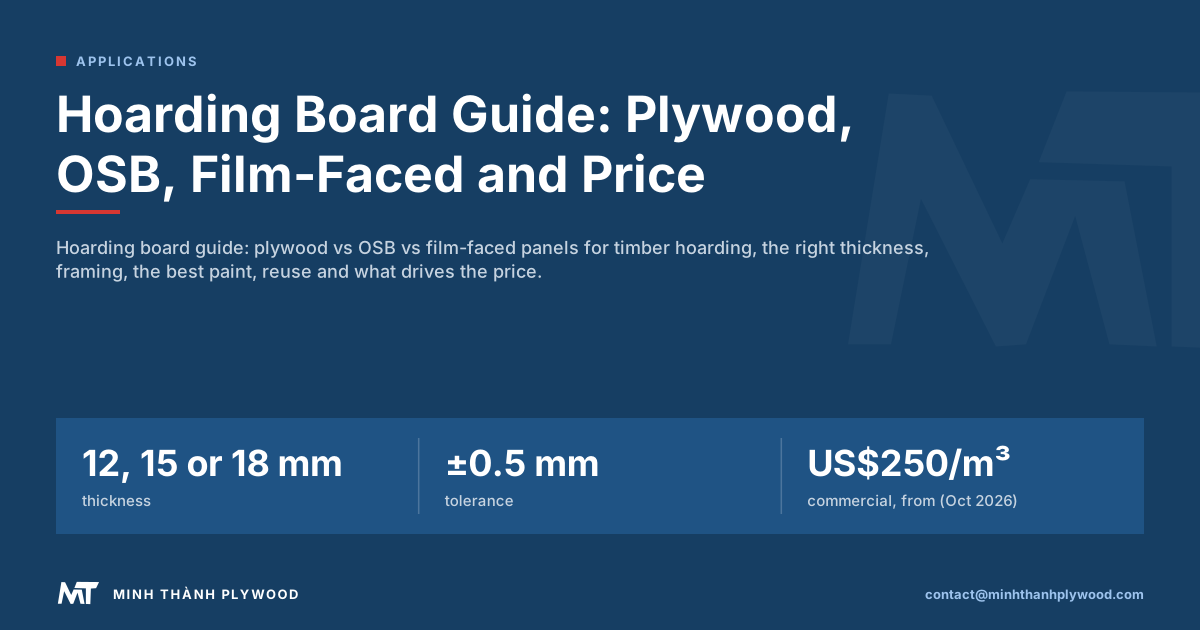
A hoarding board is a sheet panel, usually plywood or OSB, fixed to a frame to close a construction site off from the street. For a hoarding that stays straight, takes paint and survives more than one site, use exterior plywood with a water-resistant glue at 12–18 mm, or film-faced plywood for reuse. Minh Thanh Plywood makes both in Phu Tho, Vietnam.
What is a hoarding board?
A hoarding board is a sheet panel fixed to posts and rails to form a solid temporary fence around a construction site. It does three jobs: it keeps the public out, it hides the work, and it gives the developer a large surface for signs, safety notices and printed graphics.
Hoarding boards are almost always wood-based sheets. The common choices are:
- Plywood: exterior-glued sheets, painted or printed.
- OSB (oriented strand board): the low-cost option for short jobs.
- Film-faced plywood: the formwork sheet, used where the hoarding must be moved and reused.
- Overlaid or prefinished plywood: sheets with a paintable overlay or factory primer.
Metal and plastic hoarding systems exist too, mostly for hire. This guide covers the timber hoarding most contractors build themselves; the next section compares all the board materials, including the printed boards that UK sign suppliers sell.
Hoarding board materials: plywood, OSB, aluminium composite and foamex
The materials sold as hoarding board are exterior plywood, OSB, aluminium composite panel (ACM) and PVC foam board (foamex); plywood is the structural substrate for most of them, and printed vinyl or a printed face goes on top. UK sign suppliers sell the finished printed board, so a site gets a price per board, not per square metre of plywood.
| Material | Typical thickness and size | Reuse | Print quality | Cost band |
|---|---|---|---|---|
| Exterior plywood, painted or vinyl-faced | 12–18 mm, 1220 × 2440 mm | Several sites | Good after priming | Low to medium |
| Film-faced plywood | 12–18 mm, 1220 × 2440 mm | Most | Needs a special primer or vinyl | Medium |
| OSB | Similar thicknesses, 1220 × 2440 mm | Rarely beyond one site | Strand texture shows | Lowest |
| Aluminium composite panel (ACM) | Single panel about 2440 × 1220 mm, tiled for longer runs | Many | Smooth, high | High |
| PVC foam board (foamex) | 3, 5 and 10 mm | Mid-term outdoor signs | Smooth, high | Medium; thin, so it needs a frame or backing |
Sources for the ACM and foamex rows are the sign supplier Display Wizard (checked on 21 October 2026). Printed site hoarding boards start at £139.15 per board at Sign Supplier, printed at 1440 dpi in 8 × 4 ft (2440 × 1220 mm) and 10 × 5 ft (3030 × 1500 mm) sizes, with custom sizes on request (checked on 21 October 2026). JPrint quotes the same two sizes.
Where the plywood sits in that price: one 18 mm sheet of 1220 × 2440 mm is about 0.0536 m³ (sheet area times thickness), so at US$250/m³ FOB the raw board is about US$13 to US$14 before freight, duty, framing, paint and print. This is a raw FOB example for commercial plywood, not a delivered sheet price.
A contractor who buys plywood by the container and has it painted or vinyl-wrapped locally pays far less per board than for a printed board, and gets a rigid substrate that takes screws and survives a second site. Choose printed ACM or foamex where the artwork is the product and plywood where the board is the fence.
Which panel works best for timber hoarding: OSB, plywood or film-faced?
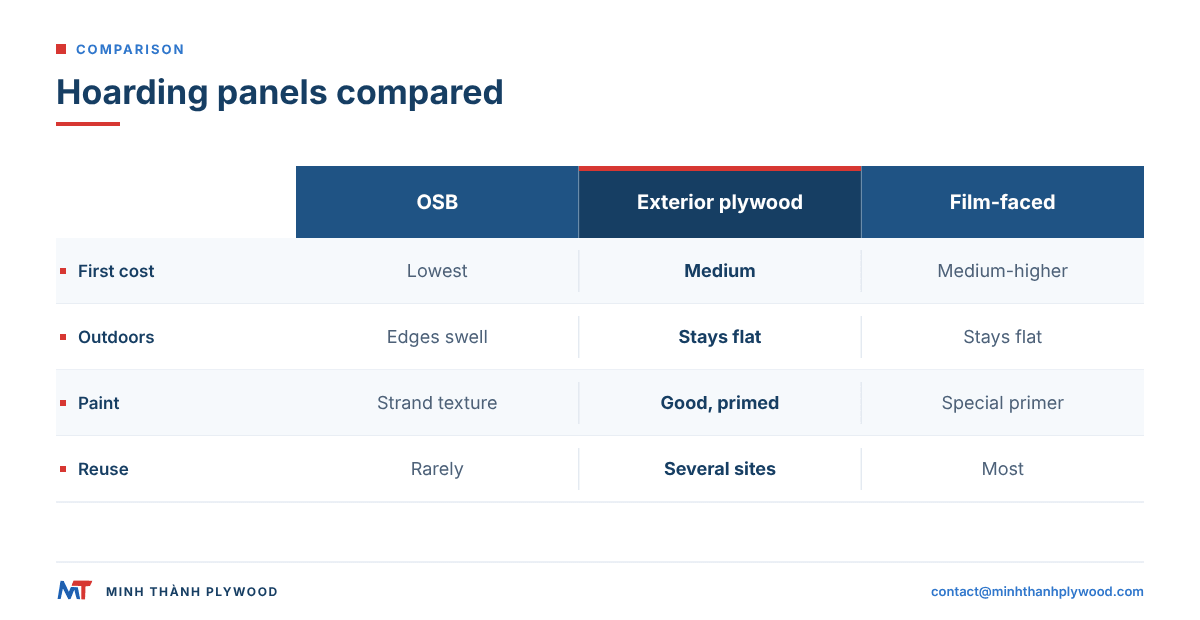
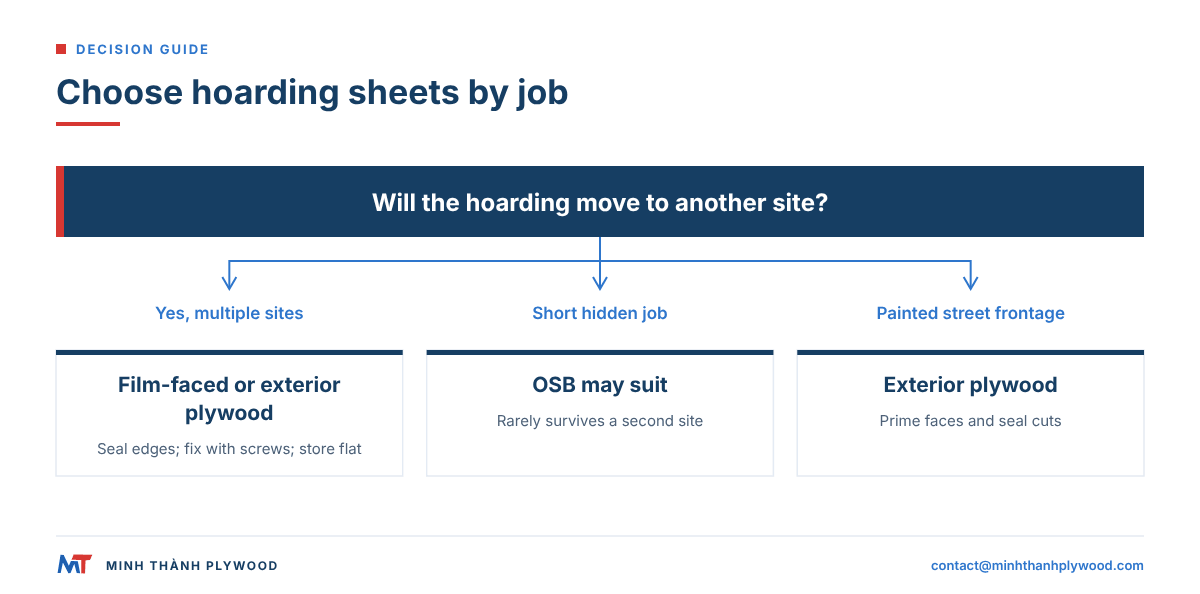
Exterior plywood is the best all-round panel for timber hoarding; OSB is cheapest for a short, hidden job; film-faced plywood lasts longest when panels move between sites.
| Panel | First cost | Flatness outdoors | Edge and screw holding | Paint and print | Reuse |
|---|---|---|---|---|---|
| OSB | Lowest | Edges swell when wet | Fair | Shows strand texture | Rarely survives a second site |
| Interior plywood (UF glue) | Low | Plies can open in rain | Good | Good | Poor outdoors |
| Exterior plywood (WBP or melamine-fortified glue) | Medium | Stays flat | Good | Good after priming | Several sites if stored well |
| Film-faced plywood | Medium to higher | Stays flat | Good | Needs a special primer or vinyl | The most reuse |
| Overlaid or prefinished plywood | Higher | Stays flat | Good | Best paint surface | Several sites |
The glue matters more than the face. A hoarding stands in rain for months, and a sheet bonded with an interior UF glue can delaminate where water gets into the edges. Specify a water-resistant bond: melamine-fortified (MR/WBP melamine) or phenolic (WBP). Our guide on plywood vs OSB compares the two panels in more detail.
Hoarding wood: what thickness do you need?
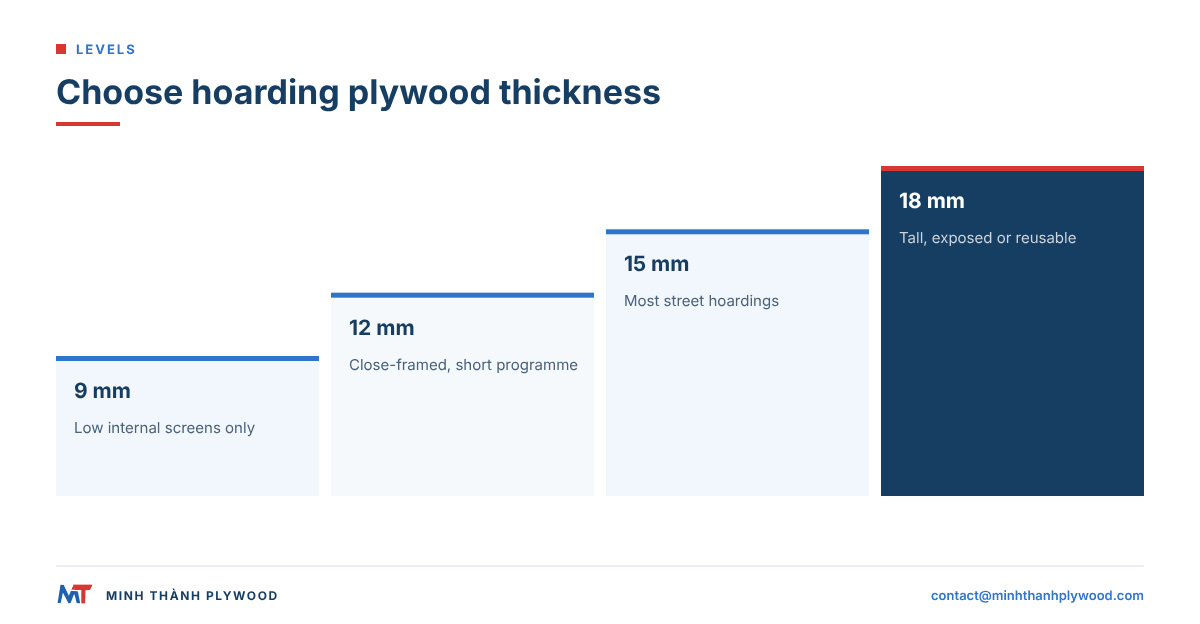
For hoarding wood, 12 mm is the minimum on a close-framed hoarding, 15 mm is the common middle choice and 18 mm is the choice for high, windy or long-life hoardings.
| Thickness | When to use it |
|---|---|
| 9 mm | Low internal screens only, not street hoarding |
| 12 mm | Standard height, close posts, short programme |
| 15 mm | Most street hoardings; good balance of stiffness and weight |
| 18 mm | Exposed sites, tall hoardings, heavy graphics, reuse across sites |
Thicker sheets resist kicks and impact, span further between rails and hold screws better near the edges. They also weigh more, which matters when one or two people fix each sheet. Our exterior and film-faced sheets are made to ±0.5 mm on thickness, so neighbouring sheets sit flush and printed graphics run across joints without steps. The plywood thickness guide lists the full thickness range.
How are wooden hoarding panels framed and fixed?
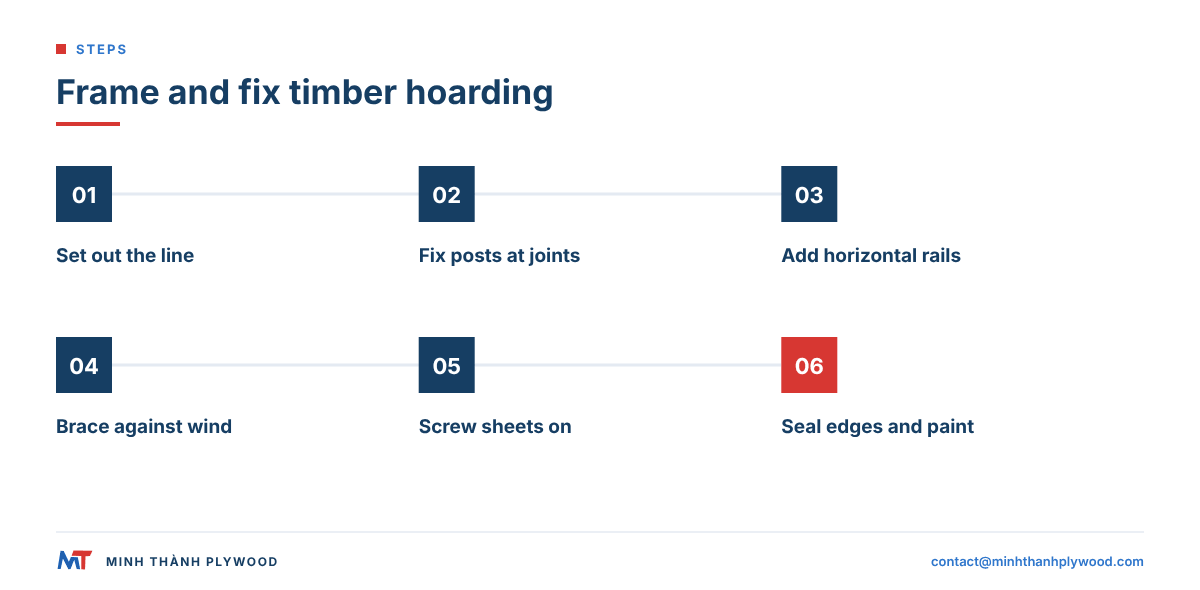
Wooden hoarding panels are fixed to timber or steel posts with two or three horizontal rails, with a post at every sheet joint. A typical build runs in six steps:
- Set out the line and agree it with the site manager and, where needed, the highway authority.
- Fix the posts in concrete, in ground spikes or on weighted feet, at each sheet joint and at mid-sheet where the hoarding is tall or exposed.
- Add rails at the top, the bottom and the middle of the sheet.
- Brace the back with raking struts, sized for the wind on that site.
- Fix the sheets with exterior screws, keeping a small gap above the ground so the bottom edge stays dry.
- Seal and paint the cut edges and faces, then fit the gates and signs.
Screws instead of nails make the sheets easier to strip and reuse. Keep the bottom edge off wet ground: most hoarding damage starts there.
What does a site hoarding have to meet?
A site hoarding has to be stable in wind, safe for passers-by and, where it stands on or beside a road or footpath, approved by the local authority. Rules differ by country and city, so check them before ordering.
In England and Wales, for example, the Highways Act 1980, section 172 requires a close-boarded hoarding or fence where a building is erected or demolished in a street, and a hoarding on the highway needs a licence from the highway authority. Licences often set the height, lighting at night and how long the hoarding may stand.
The panel itself rarely has a product standard of its own. What authorities and site managers look for is a solid, maintained hoarding with no gaps, no sharp edges and no loose sheets.
What is the best paint for plywood hoarding?
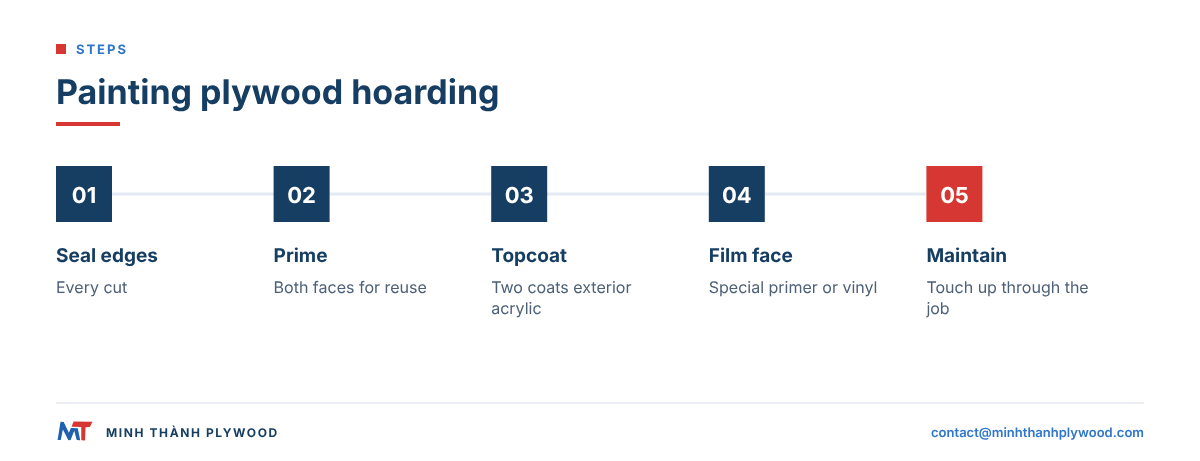
The best paint for plywood hoarding is an exterior water-based acrylic system over a primer, with the edges sealed first. Paint fails on hoardings mostly at the edges and on unprimed faces, not in the topcoat.
- Seal all edges, including every cut, with an edge sealer or the primer itself.
- Prime both faces if the sheet will be reused or stands for more than a season; the back takes the rain too.
- Apply two topcoats of exterior acrylic or masonry-type paint in the client’s colour.
- For film-faced plywood, use a primer made for smooth, non-porous surfaces, or apply vinyl graphics straight onto the film.
- Repaint and touch up damaged areas through the programme; a scuffed hoarding reflects on the project.
Sheets with a smooth, sanded face and few repairs take paint evenly. Rough faces and open defects show through the topcoat, which is why utility C/D faces are fine for the back but a better face pays on the street side.
Printed and branded hoarding: what face takes graphics best?
Printed hoarding graphics go onto a smooth, flat, primed face: overlaid plywood, primed exterior plywood or film-faced plywood. The graphics are either printed vinyl applied to the boards or printed panels fixed over them.
Two things make the graphics look right. First, flat sheets with consistent thickness, so the print has no steps at the joints. Second, a primed surface that the vinyl adhesive grips. Our guide on HDO vs MDO plywood explains the paintable overlay used for signs.
Plywood hoarding price: what drives the cost?
Plywood hoarding price is driven by the panel type, thickness, glue, face grade and the quantity you buy; framing, paint, graphics and labour come on top. As a guide, commercial plywood from Minh Thanh Plywood starts from US$250/m³, FOB, in October 2026.
| Price driver | Lower cost | Higher cost |
|---|---|---|
| Panel type | OSB, commercial plywood | Film-faced or overlaid plywood |
| Thickness | 12 mm | 18 mm |
| Glue | Melamine-fortified (MR) | Phenolic (WBP) |
| Face | Utility C/D faces | Smooth, sanded faces for paint |
| Finish | Raw sheets, painted on site | Primed or prefinished at the mill |
| Quantity | Full containers | Small lots from stock |
| Reuse | One site | Several sites, cost spread |
Cost per site matters more than cost per sheet. A film-faced sheet that stands on three sites costs less per site than an OSB sheet bought three times. Our plywood price guide explains how mills build a plywood quotation.
Can hoarding boards be reused across sites?
Hoarding boards can be reused across sites if the sheets have a water-resistant glue, sealed edges and were fixed with screws. Plan reuse from the first site:
- Choose film-faced or exterior plywood, not OSB or interior plywood.
- Fix with screws through the same holes each time.
- Strip carefully and stack the sheets flat on bearers, covered and off the ground.
- Repaint or overprint for the next client.
Contractors who reuse hoardings usually keep a stock of film-faced sheets for that purpose. Film-faced plywood from our mill gives about 12–15 uses as formwork with melamine glue, and a hoarding works the sheet far less hard than concrete does.
Prefinished hoarding plywood
Prefinished hoarding plywood arrives ready to fix: primed, painted, overlaid or film-faced. It cuts site painting time and gives a cleaner finish, which matters on city-centre sites and where the client expects a branded hoarding on day one.
The options are:
- Primed exterior plywood, ready for site topcoats.
- Overlaid plywood with a paper overlay that takes paint and vinyl well.
- Film-faced plywood in a standard colour, used as is or covered with vinyl.
In markets such as Australia, the Gulf and the UK, contractors buy prefinished sheets from local builders’ merchants and sign suppliers, who import full containers from mills. Importers order the base sheet to a written specification and finish locally, or order film-faced sheets that need no finish.
Buying hoarding plywood for import
Importers and distributors of hoarding plywood order full containers of exterior or film-faced plywood to a written specification. For hot, humid or sunny markets such as the Gulf, the glue and edge sealing matter most; for wet northern markets, the bond and the storage.
A clear specification covers:
- Use: hoarding, painted or printed.
- Panel: exterior plywood or film-faced plywood.
- Glue: melamine-fortified (MR/WBP melamine) or phenolic (WBP).
- Faces: utility C/D, or a smoother face for paint.
- Thickness and size: for example 15 mm, 1220 × 2440 mm.
- Edges: sealed or painted.
- Packing and quantity: export packs, sheets per pack, containers.
For the glue line, BS EN 314-2:1993 sets the bonding-quality requirements for plywood. Importers into the UK find the customs steps in the GOV.UK guidance, Import wood, wood products or bark.
Our exterior plywood page shows the glue and face options.
What size are hoarding boards, and how do you lay out a run?
Most hoarding boards are standard 8 × 4 ft sheets, 1220 × 2440 mm, fixed upright so the hoarding stands about eight feet high. In markets with metric framing, 1250 × 2500 mm sheets are used the same way. UK print suppliers also sell 10 × 5 ft boards, 3030 × 1500 mm, for taller or wider graphic panels; plywood is cut to those sizes on request.
Plan the run around the sheet so that cutting is kept to the ends and the gates:
- Sheet joints on posts. Every vertical joint lands on a post, so each sheet edge is screwed down.
- Gates at sheet widths. Size vehicle and pedestrian gates in whole sheets where possible.
- Corners and returns. Use a post at each corner and brace both directions.
- Ground clearance. Keep the bottom edge just clear of the ground, then fit a kick board if the licence asks for a closed base.
- Sight lines at junctions. Where a hoarding meets a road junction or a driveway, the authority may ask for a lower or see-through section.
Taller hoardings use two sheets stacked, with a horizontal rail behind the joint. Stacked hoardings need closer posts and stronger bracing, because the wind load grows with height.
How long does a plywood hoarding last?
A plywood hoarding built from exterior or film-faced plywood, with sealed edges and a maintained paint system, lasts for the whole of a typical building programme and can then move to the next site. OSB and interior plywood hoardings often need sheets replaced within a season, starting at the bottom edge.
What shortens a hoarding’s life:
- Water at the bottom edge, from sheets standing in mud or puddles.
- Unsealed cuts at gates, signs and service openings.
- Nail fixings that pull through when the wind works the sheet.
- Interior glue that lets the plies open after rain.
What lengthens it: a water-resistant bond, edges sealed on every cut, screws, a raised bottom edge and a quick repaint when the surface is damaged.
What this means for your hoarding plywood order
A hoarding order from Minh Thanh Plywood is built from our exterior and film-faced plywood lines:
| Item | Exterior plywood | Film-faced plywood |
|---|---|---|
| Glue | Melamine-fortified or phenolic (WBP) | Melamine or phenolic (WBP) |
| Faces | Utility C/D, matched to the order sample | Phenolic film both faces |
| Core | Eucalyptus or acacia | Eucalyptus or acacia |
| Thickness | 12–18 mm for hoarding (9 mm for low internal screens) | 12–18 mm for hoarding |
| Size | 1220 × 2440 mm, 1250 × 2500 mm | 1220 × 2440 mm, 1250 × 2500 mm |
| Tolerance | ±0.5 mm thickness, ±2 mm length and width | ±0.5 mm thickness, ±2 mm length and width |
| Edges | Sealed on request | Sealed |
Orders start at one 40HC, with production 15–45 days after the 30% deposit, FOB Hai Phong, CFR or CIF. Every shipment is photographed and filmed before loading, and buyers get the photos and video. Free samples are available so you can test paint and fixings first.
Specify your hoarding boards
Send us the hoarding line you would write for your merchant, and we will quote it within hours:
Hoarding plywood, 15 mm, 1220 × 2440 mm, phenolic glue (WBP), eucalyptus core, faces C/D for painting, edges sealed, ±0.5 mm, export packing, one 40HC, CIF your port.
For a reusable hoarding, ask for film-faced plywood instead. Site hoarding often sits next to formwork and scaffolding; the planned guides on formwork materials compared and on what formwork is cover those uses.
Buyer questions, answered
What is a hoarding board?
A hoarding board is a sheet panel, usually plywood or OSB, fixed to posts and rails to form a solid temporary fence around a construction site. It keeps the public out, hides the work and carries signs or printed graphics.
What thickness should hoarding plywood be?
12 mm is the minimum for a framed hoarding with close posts, 15 mm is the common middle choice, and 18 mm is used for high, exposed or long-life hoardings and for panels that will be reused.
Is OSB or plywood better for hoarding?
OSB is cheaper for a short, painted hoarding. Plywood stays flatter, holds screws better at the edges, takes paint and print more evenly and survives reuse, so it is the better choice for street-facing and long-life hoardings.
What is the best paint for plywood hoarding?
An exterior water-based acrylic system works best: seal the cut edges, apply an exterior primer, then two coats of exterior acrylic or masonry-type paint. Film-faced plywood needs a primer made for smooth surfaces, or vinyl graphics instead of paint.
How much does plywood hoarding cost?
The price depends on panel type, thickness, glue, face and quantity. As a guide, commercial plywood from Minh Thanh Plywood starts from US$250/m³ FOB (October 2026); framing, paint, graphics and labour are added on site.
Can hoarding boards be reused?
Yes, if they are plywood with a water-resistant glue, fixed with screws rather than nails and stored flat between jobs. Film-faced plywood gives the most reuse; OSB and interior plywood rarely survive a second site.
Do you need permission to put up site hoarding?
In many countries, yes. In England and Wales, for example, a hoarding on or beside a public highway needs a licence from the highway authority under the Highways Act 1980. Check the local authority's rules before ordering.
What size are hoarding boards?
Most hoarding boards are standard 8 × 4 ft sheets, 1220 × 2440 mm, fixed vertically so a hoarding is about eight feet high. 1250 × 2500 mm sheets are used in markets with metric framing.
What is prefinished hoarding plywood?
Prefinished hoarding plywood arrives already primed or painted, or with a film or overlay face, so the hoarding goes up ready for graphics. It saves site painting time, which matters on busy city sites.