
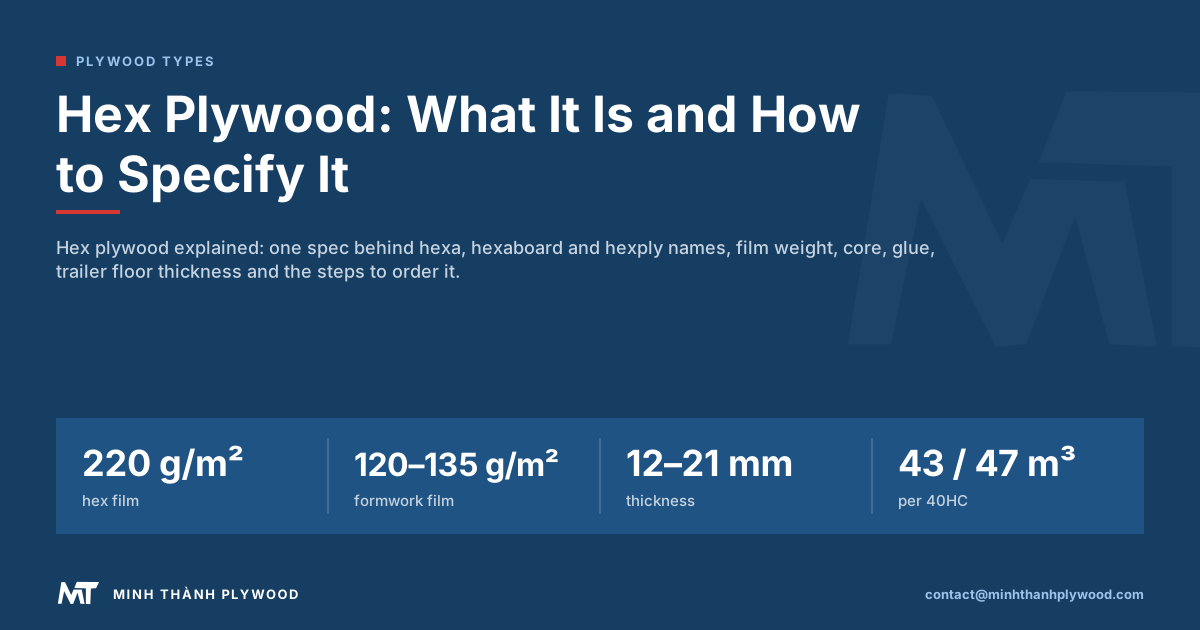
Hex plywood is film-faced plywood with a hexagon pattern pressed into a heavy phenolic film on its working face, used for trailer floors, stages, walkways and platforms. Hexa plywood, hexaboard and hexagrip are trade names for the same build. Minh Thanh Plywood makes it to order on Eucalyptus or Acacia cores, 12–21 mm, with film around 220 g/m².
What is hex plywood?
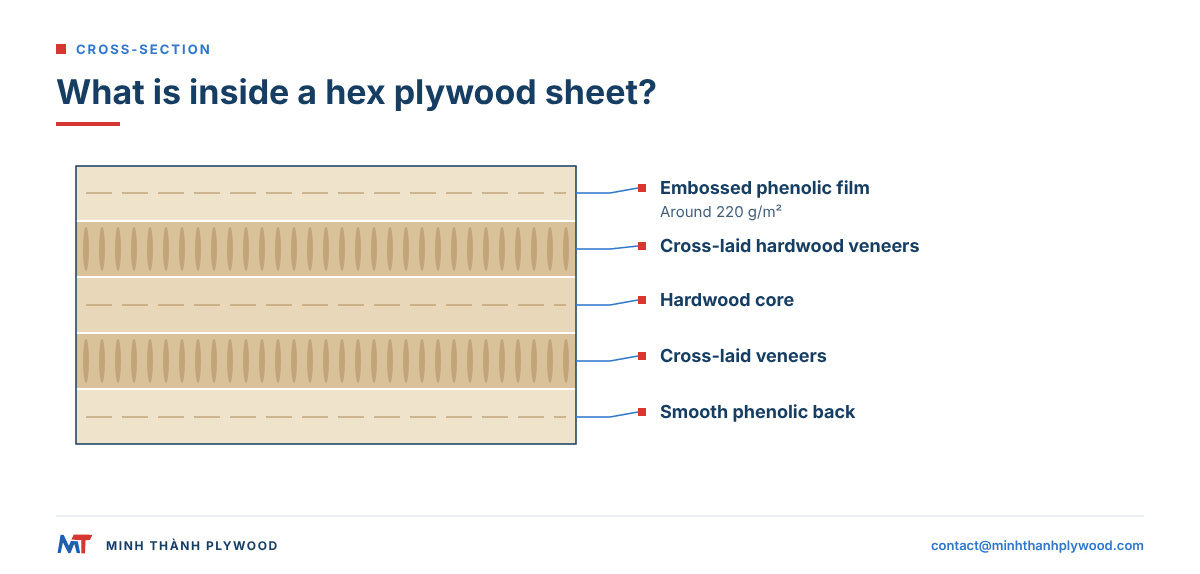
Hex plywood is a veneer-core plywood panel faced with a phenolic resin film that is embossed with a raised hexagon pattern during hot pressing. The pattern gives grip in every direction, and the film protects the wood from water, oil and wear.
A standard hex panel has three parts:
- Working face: phenolic film, usually around 220 g/m², embossed with hexagons.
- Back: a smooth phenolic film that balances the panel and is easy to clean.
- Core: hardwood or birch veneers bonded with a water-resistant glue, edges sealed with paint.
Hex plywood is one type of anti-slip plywood. The others are wire-mesh and rice-grain faces, compared in hexagonal vs wire-mesh anti-slip plywood.
How much does hex plywood cost?
UK merchants sell hex plywood by the 2440 × 1220 mm sheet, at roughly £55 to £70 for the common thicknesses. Chiltern Timber lists its 220 g/m² black hex sheet at £55.00 for 9 mm and £70.00 for 12 mm for one sheet, falling to £44.00 and £56.00 at 20 or more sheets (read October 2026, VAT status not stated).
Timberly lists a Class 3 eucalyptus-core hex sheet at £69.99, with a film of 240 g/m². The Good Sheet sells an 18 mm black hex sheet with a 2% discount over £300 and 5% over £1,000, delivered in 3 to 5 working days, with cutting tolerance of ±1-2 mm.
Three things move the price: film weight (220 g/m² or 240 g/m²), thickness, and quantity. A trailer or stage builder buying a few sheets pays the merchant’s price per sheet. A merchant, trailer maker or floor contractor buying by the container pays per cubic metre from the factory instead, with the core, film and thickness chosen on the order, and a freight cost that the 40HC plan fixes.
Eucalyptus cores weigh about 34.8 kg per 18 mm sheet in our plan, close to the 35.88 kg that UK merchants quote; the exact weight changes with film and glue. Ask for the container quote on your specification through the contact below, or see the film-faced plywood price guide for how the smooth-film panel is priced.
Hexa plywood, hexaboard, hexply: one panel, many names
Buyers search for the same panel under a dozen names, and listings mix generic words with mill trade marks. They all point to one specification: film-faced plywood with a hexagonal embossed face.
| Name you see | What it means | Same spec? |
|---|---|---|
| Hex plywood, hexa plywood | Short for hexagonal anti-slip plywood | Yes |
| Hexagon plywood, hexagonal plywood | Plain description of the pattern | Yes |
| Hexaboard, hexa board, hex board | Trade-style name used by merchants | Yes |
| Black hex plywood, black hexa plywood | Hex plywood with a black film | Yes, colour named |
| Hexply, hexaply | Search spellings of hex plywood | Yes, but HexPly is also a composite prepreg name |
| Hexa grip, hexagrip | Trade marks of individual mills | Same type; the mark belongs to one mill |
| Heksa | Trade mark of an individual mill | Same type; the mark belongs to one mill |
| “UltraHex phenolic anti-slip water resistant film-faced plywood” | Long listing title | Yes |
Trade-marked names describe one mill’s own product. We do not sell under them; we quote the specification behind them. When two quotes use different names, compare the core, glue, film weight, thickness and tolerance line by line.
How is hex plywood made, step by step?
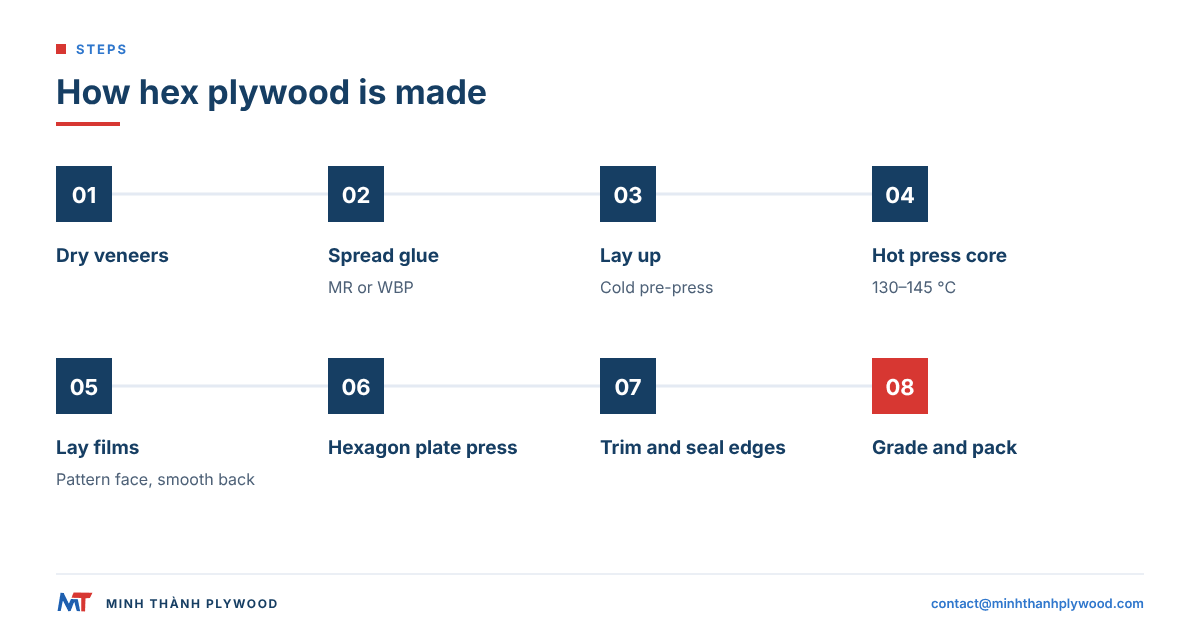
Hex plywood is made like smooth film-faced plywood, with one change: a patterned plate presses the hexagons into the film during the final hot press.
- Peel and dry the core veneers to the moisture content the glue needs.
- Spread the glue on the core veneers: melamine-fortified (MR) or phenolic (WBP), set by the end use.
- Lay up the veneers crosswise and pre-press the stack cold so it holds its shape.
- Hot press the core: phenolic bonds cure at about 130–145 °C.
- Lay the films: a patterned-face film on the working side, a smooth film on the back.
- Press with a hexagon plate: the plate embosses the pattern while the film resin cures into the surface.
- Trim and seal: saw to size, then paint all four edges with water-resistant paint.
- Grade and pack: check the pattern depth, film coverage and thickness, then strap into export packs.
Because the pattern is pressed into the cured film rather than glued on, it does not peel. Its grip lasts until wheels or boots wear the film down.
Film weight and colour: brown or black hex plywood?
Hex plywood film should be around 220 g/m² on the patterned face. Smooth formwork plywood uses 120–135 g/m², which is too thin to hold a deep pattern under traffic.
Colour is an order line, not a quality grade:
- Dark brown is the most common hex film and hides dirt well.
- Black is popular for stages, event decks and vehicle floors; black hex plywood is the same build in a different film.
- Other colours are made to order when the film supplier offers them, for example for safety zones.
Name the film weight and colour for both faces on the order. The back is usually a smooth film in the same colour; a textured back is a separate line (see the two-sided step below).
Birch core or hardwood core: which hex plywood?
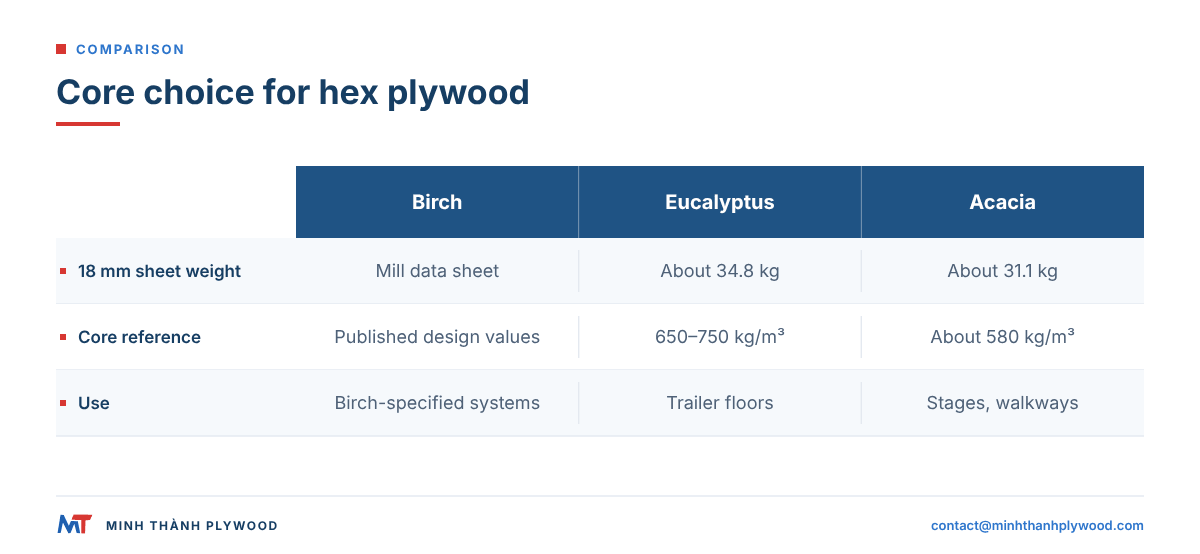
Hex plywood is made on two families of core: birch, from Nordic and Baltic mills, and hardwood plantation species such as Eucalyptus and Acacia, from mills like ours in Vietnam. Both carry the same film and pattern; the core decides weight, stiffness and price.
| Point | Birch core | Eucalyptus core | Acacia core |
|---|---|---|---|
| Where it is made | Nordic and Baltic mills | Vietnam and other Asian mills | Vietnam and other Asian mills |
| Reference density | Mill data sheet | 650–750 kg/m³ | about 580 kg/m³ |
| 18 mm sheet, 1220 × 2440 mm | Mill data sheet | about 34.8 kg | about 31.1 kg |
| Strength | Published design values | Dense, firm screw holding | Lighter, good stiffness |
| Best fit | Specified systems that name birch | Trailer floors, heavy wheel loads | Stages, walkways, lighter decks |
If your drawing names a birch-core product, it was designed with that product’s values. If it names a thickness, pattern and bond, a hardwood core is a direct match at a lower price, and you can test a free sample before you order.
Minh Thanh makes anti-slip panels on Eucalyptus or Acacia cores only, the cores we use for all film-faced plywood.
How thick should hex plywood be for trailer floors?
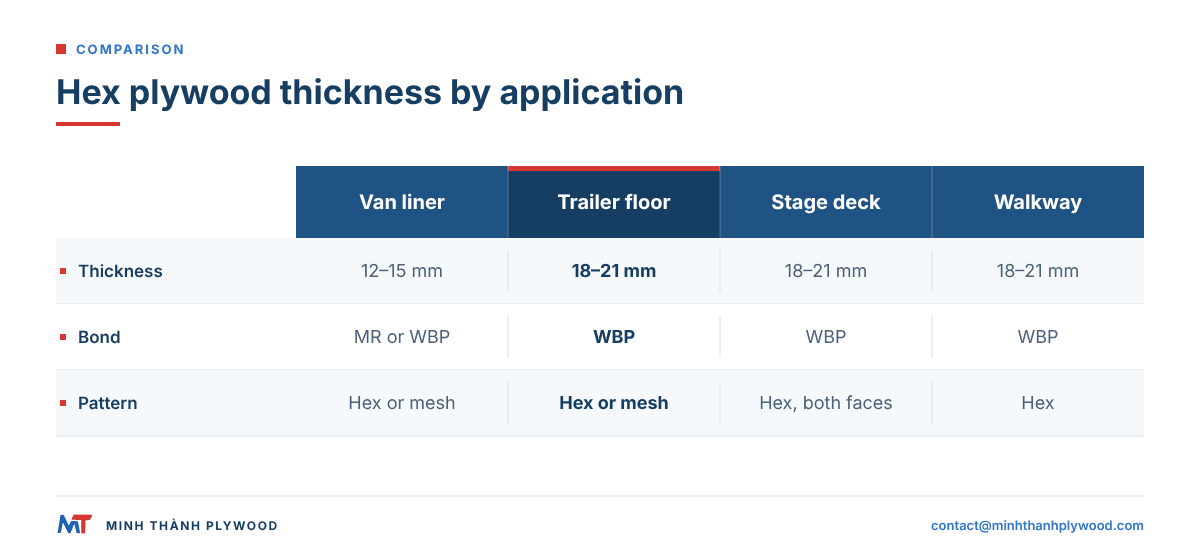
Trailer floors are usually 18 mm or 21 mm hex plywood; van floor liners on close supports are 12–15 mm. Thickness follows the support spacing and the heaviest wheel load, so the vehicle drawing decides.
| Application | Usual thickness | Pattern | Bond |
|---|---|---|---|
| Van floor liner, supported every few hundred mm | 12–15 mm | Hexagon or wire-mesh | MR or WBP |
| Trailer and truck floor | 18–21 mm | Hexagon or wire-mesh | Phenolic WBP |
| Stage and event deck | 18–21 mm | Hexagon, often both faces | Phenolic WBP |
| Walkway, ramp, scaffold platform | 18–21 mm | Hexagon | Phenolic WBP |
| Horse box, livestock trailer | 18–21 mm | Hexagon | Phenolic WBP |
For forklift traffic or point loads from equipment, give the wheel load and contact area with the drawing. The thickness and core then come from the span calculation, not from a table.
Glue: melamine-fortified or phenolic WBP?
Choose phenolic (WBP) glue for any hex plywood that will get wet: trailer floors, outdoor decks, ramps and walkways. Melamine-fortified (MR) glue suits covered, dry floors such as indoor stages and van liners.
Bond quality classes come from EN 314-2. Timberly describes Class 3 as exterior conditions with sustained weather exposure, and Class 2 as humid conditions for protected exterior and damp interior use. Write the class on your order next to the glue, and ask for the EN 13986 declaration if the panel goes into a building rather than a vehicle or stage. Chiltern Timber lists FSC chain of custody on its eucalyptus core, so raise any certificate you need at enquiry. For an FSC order, check the seller’s certificate code and the product claim on the sales documents or approved linked documents, as required by the FSC chain of custody standard.
The glue and the emission class are two separate lines on the order. A WBP bond answers the water question; formaldehyde emission is specified by its own class and test method, and third-party testing to the buyer’s method is arranged through SGS on request.
Edges are where water gets in. Every panel leaves the factory with painted edges, and any edge or hole cut on site needs the same sealing before installation.
One side or both sides textured?
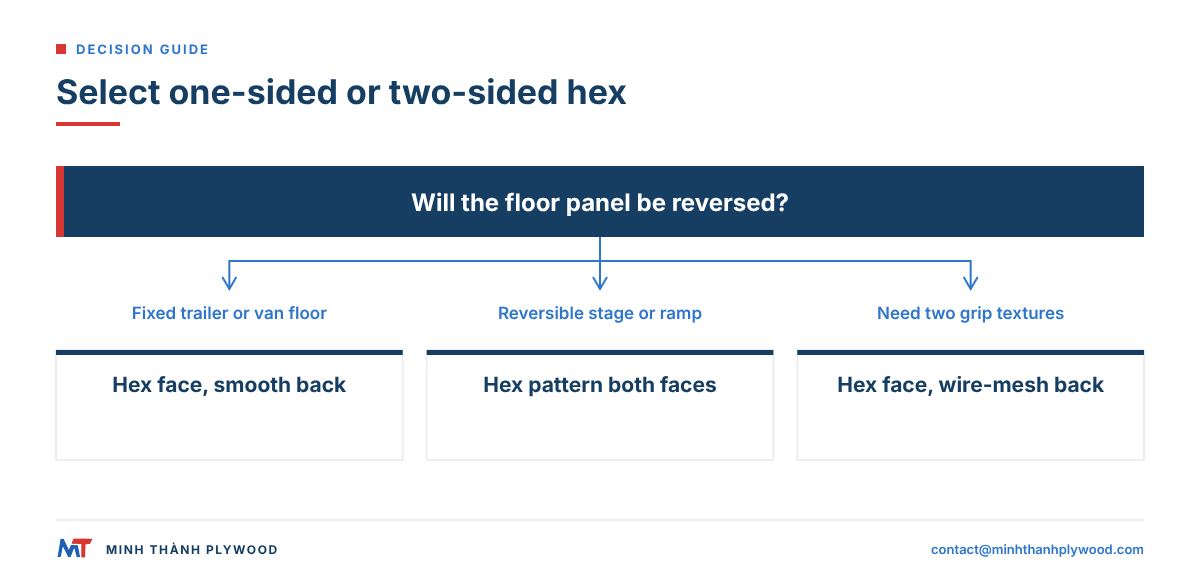
Most hex plywood has the hexagon pattern on one face and a smooth film on the back. Order the pattern on both faces when the panel can be flipped, when both faces get traffic or when you want to turn worn trailer boards over.
| Build | When to choose it |
|---|---|
| Hexagon face, smooth back | Fixed floors: trailers, vans, walkways |
| Hexagon both faces | Reversible stage decks, ramps, platforms used both ways up |
| Hexagon face, wire-mesh back | Two grip types in one stock panel |
Two-sided builds are quoted as their own line. Specify the colour and film weight for each face.
How to specify hex plywood: the order, step by step
A complete hex plywood order fits in ten lines and leaves nothing for the factory to guess. Work through them in this order:
- Application and exposure: trailer floor, stage, walkway; indoor, covered or outdoor.
- Pattern: hexagon, or hexagon with a different back.
- Film: weight (around 220 g/m² on the pattern face) and colour, for each face.
- Core: Eucalyptus for heavier loads, Acacia for lighter panels.
- Glue: phenolic WBP for wet service, melamine-fortified for dry floors.
- Thickness and tolerance: for example 18 mm, ±0.5 mm.
- Sheet size: 1220 × 2440 or 1250 × 2500 mm, or a cutting list.
- Edges: sealed with paint as standard; name a colour if it matters.
- Test evidence: the slip test your specification names, for example pendulum (EN 13036-4) or ramp (DIN 51130), arranged through SGS.
- Quantity, packing and port: sheets per thickness, export pallets, destination port.
Send this list with the drawing, and the quote comes back for the same panel you had in mind.
Which slip tests apply to hex plywood?
Floor specifications name either a pendulum test or a ramp test for anti-slip surfaces. The pendulum test (EN 13036-4, also BS 7976) swings a rubber slider over the surface and gives a slip resistance value; the ramp test behind the German R-rating (DIN 51130) tilts a board under a walker in safety shoes. The UK Health and Safety Executive explains both methods in its guide Assessing the slip resistance of flooring.
Hex film is the grip face buyers order for trailer and stage floors. If your project names a method and a pass value, put both on the order: we arrange SGS testing on the construction we ship, and the report goes with the documents.
How is hex plywood packed and shipped?
Hex plywood ships in strapped export packs on pallets, film faces protected, in 40HC containers. A container of film-faced plywood carries about 43 m³ on Eucalyptus core or about 47 m³ on Acacia core, because the denser core reaches the weight limit sooner.
At 18 mm and 1220 × 2440 mm, that is about 795 sheets of Eucalyptus core at 34.8 kg each, or about 880 sheets of Acacia core at 31.1 kg each. Mixed thicknesses and patterns can share one container by agreement.
Every shipment is photographed and filmed before loading, and you receive the photos and video. From Hai Phong, transit is about 25–35 days to Mediterranean ports, Malta included, and 30–40 days to Northern Europe, depending on carrier and route.
Where can I buy hex plywood?
You can buy hex plywood by the sheet from timber merchants and builders’ merchants, or by the container from a manufacturer. Sheet buyers pay for stock and delivery; container buyers choose the core, film, thickness and size, and a mill order starts at one 40HC.
Minh Thanh Plywood makes hex plywood to order from our factory in Ha Hoa, Phu Tho, Vietnam:
- MOQ: one 40HC, mixed specifications by agreement.
- Production: 15–45 days after the 30 % deposit; balance against the scanned B/L, or L/C at sight.
- Terms: FOB Hai Phong, CFR or CIF.
- Samples: free samples.
Send the ten lines above, or the drawing, to contact@minhthanhplywood.com or WhatsApp +84 988 586 601 (Lisa). We reply within hours. For prices of smooth film-faced panels, see the film-faced plywood price guide; the full anti-slip range is on our anti-slip plywood page.
Caring for hex plywood floors
Hex plywood lasts years on a floor when water stays out of the core and grit stays out of the pattern. Four habits keep it that way:
- Store flat before installation, off the ground, under cover, on aligned supports.
- Seal every cut edge and drilled hole with paint before fixing.
- Clean with water and a stiff brush; scrape grit out of the cells and keep solvents off the film.
- Turn or replace single boards where a wheel path wears smooth, rather than the whole floor; reversible panels turn over.
Buyer questions, answered
What is hex plywood used for?
Hex plywood is used where people or wheels need grip on a wood floor: trailer and truck beds, van floor liners, stages and event decks, walkways, ramps, scaffold boards and machine platforms.
What is black hex plywood?
Black hex plywood is hex plywood with a black phenolic film on its patterned face. Black and dark brown are the most common film colours; the colour does not change grip or strength, only the look.
Is hexa plywood the same as hex plywood?
Yes. Hexa, hex, hexaboard, hexagon plywood and hexagrip all describe film-faced plywood with a hexagonal embossed face. Compare the core, glue, film weight and thickness, not the name.
Where can I buy hex plywood?
Timber merchants stock hex plywood by the sheet in most countries. For container volumes, buy from a manufacturer: Minh Thanh Plywood makes it to order from one 40HC, FOB Hai Phong, CFR or CIF.
Is hex plywood waterproof?
Hex plywood with phenolic WBP glue is made for wet outdoor service: the phenolic film sheds water and sealed edges keep it out of the core. Seal every edge you cut or drill on site.
What thickness of hex plywood do I need for a trailer floor?
Trailer floors are usually 18 mm or 21 mm, van floor liners 12–15 mm on close supports. The vehicle drawing, support spacing and wheel loads set the final choice.
Can hex plywood have a pattern on both sides?
Yes. Order the hexagon film on both faces for reversible decks and platforms. The standard build has a hexagon face and a smooth film back.
What is the film weight on hex plywood?
The patterned film on hex plywood is around 220 g/m², much heavier than the 120–135 g/m² film used on smooth formwork plywood. The heavier film carries the embossed pattern and the wear.
Is hexply a plywood brand?
Hexply and hexaply are search spellings for hex plywood. HexPly is also the name of a composite prepreg range, which has nothing to do with plywood, so check the product before you buy.
How heavy is an 18 mm hex plywood sheet?
An 18 mm sheet of 1220 × 2440 mm weighs about 34.8 kg on a Eucalyptus core and about 31.1 kg on an Acacia core, using reference densities of 650 and 580 kg/m³.