
Choose hexagonal anti-slip plywood for foot traffic, stages and washdown floors, and wire mesh plywood for wheeled traffic, trailer and van floors and gritty loads. Both patterns are pressed into a phenolic film of about 220 g/m² over a hardwood core, so the core, glue and edges decide service life as much as the pattern. Minh Thanh Plywood makes both on order.
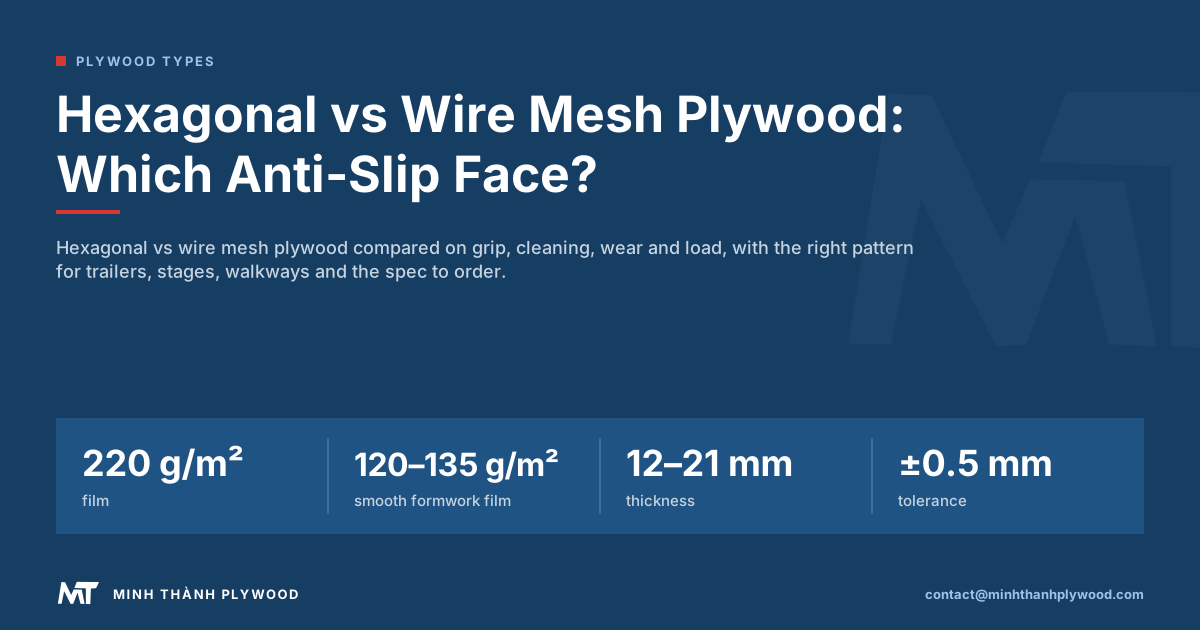
Hexagonal vs wire mesh plywood: which pattern should you choose?
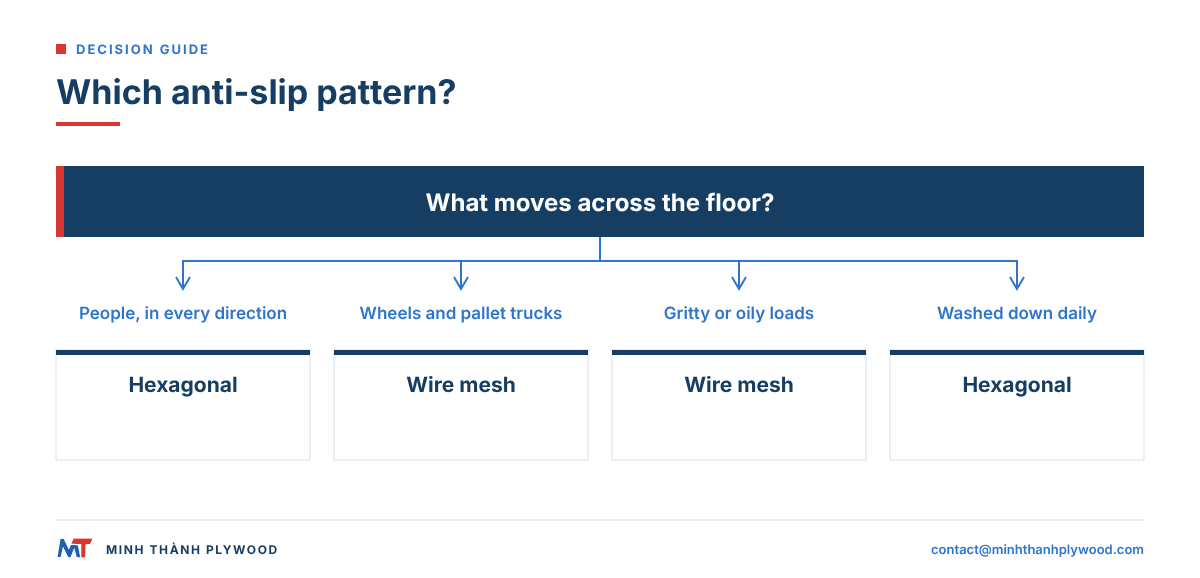
Choose hexagonal plywood where people walk and floors are washed, and wire mesh plywood where wheels roll and loads are gritty or oily. That is the whole decision for most buyers, because the two panels share everything except the pattern pressed into the film.
| If your floor is… | Choose | Why |
|---|---|---|
| A stage, walkway or platform walked in every direction | Hexagonal | Even grip in all directions, cells clean out |
| Washed down often, or wet | Hexagonal | Open cells drain and rinse clean |
| A trailer or van floor with pallet trucks and wheels | Wire mesh | Dense texture bites under tyres and wheels |
| Carrying gritty, dusty or oily goods | Wire mesh | Rough texture keeps grip when the surface is dirty |
| A ramp or reversible deck | Either, textured both sides | Turn the panel over when one face wears |
The pattern is one line of the specification. Core, glue, film weight, thickness and edge sealing decide how long the floor lasts, and they are the same choices for both patterns. The rest of this guide explains each one, so the order you send matches the floor you have.
Mesh plywood price and sizes in the UK
UK merchants price mesh plywood per sheet, ex VAT, and the sheet is cheap only in thin gauges. One UK merchant listed a 6.5 mm eucalyptus-core hexagon panel at £33.19 ex VAT, a 9 mm eucalyptus-core mesh panel at £33.42 per sheet in a pack of 100, and a 9 mm birch-core Buffalo mesh panel at £85.94 ex VAT, with all prices on 2440 × 1220 mm sheets and phenolic-board prices starting from £27.91.
These are the merchant’s phenolic plywood listings (Sheet Materials Wholesale, checked on 21 October 2026).
A Midlands timber merchant listed mesh plywood in a band from £16.07 to £24.15 a sheet. This is the merchant’s mesh plywood listing (Park Timber, checked on 21 October 2026). The band depends on thickness, core and film, and 12 or 18 mm panels cost more than the thin gauges quoted.
| UK shelf anchor (ex VAT, per sheet) | Price | Note |
|---|---|---|
| Mesh or hexagon, eucalyptus core, 6.5 mm | £33.19 | Merchant listing, 2440 × 1220 mm |
| Mesh, eucalyptus core, 9 mm, pack of 100 | £33.42 | Per sheet in the pack |
| Mesh Buffalo, birch core, 9 mm | £85.94 | Birch-core premium |
| Mesh, various, Midlands merchant | £16.07–£24.15 | Range across the thicknesses listed |
Sizes: the common UK sheet is 2440 × 1220 mm (8 × 4 ft), and merchants also list 3050 × 1525 mm (10 × 5 ft) Buffalo sheets for trailer and van floors. Minh Thanh’s standard sheets are 1220 × 2440 mm and 1250 × 2500 mm; ask for a larger or custom size with your drawing.
Birch core or eucalyptus core. The UK premium Buffalo board has a birch core; Minh Thanh builds anti-slip panels on dense Eucalyptus or Acacia cores, the more cost-effective choice per sheet for floors, and quotes the core in writing.
Standards. Phenolic WBP glue is the EN 314-2 Class 3 bond and the EN 636-3 exterior class, the labels a UK merchant prints on its product page. For construction use in the UK the panel follows EN 13986 with a declaration of performance and UKCA or CE marking, and FSC is available on request through qualified partner mills.
The BSI records for BS EN 314-2:1993 and BS EN 636:2012+A1:2015 identify the bonding-quality and the plywood requirements standards.
Container buyers. A UK trade buyer who orders a 40HC pays per m³, FOB or CIF, not per sheet, and the sheet price is a landed figure after freight, duty and handling. See our guides to anti-slip plywood price and plywood price in the UK for the per-m³ side.
What is mesh plywood?
Mesh plywood is anti-slip film-faced plywood whose working face carries a pressed wire-mesh texture for grip. The trade also calls it wire mesh plywood, mesh faced plywood or wiremesh plywood; all four names mean the same panel.
It is built like other film-faced plywood. Hardwood veneers are cross-laid and glued into a core, then a resin-impregnated paper film is pressed onto each face under heat. On a mesh panel, the press plate on the working side carries the mesh pattern, so the film cures with the texture moulded into it. The back is usually a smooth film, which keeps the underside flat on the floor frame and easy to clean.
The film is phenolic, the same family of resin used for the dark brown film on formwork panels. On anti-slip plywood the film is heavier, about 220 g/m² against 120–135 g/m² on smooth formwork film, because a floor face has to keep its texture under feet, wheels and cleaning for years. Our sibling guide on anti-slip plywood lists the full product range.
What is hexagonal anti-slip plywood?
Hexagonal anti-slip plywood is the same film-faced panel with a pattern of six-sided cells pressed into the phenolic film. Buyers also call it hexa plywood, hex plywood or hexa anti-slip plywood.
The raised ridges between the cells give the grip, and the open cells give water, dust and dirt somewhere to go. Because a hexagon has no long straight channel, grip is even in every walking direction. That makes the hexagonal face the usual choice for stage decks, event floors, walkways, access platforms and floors that are hosed down.
Hexagonal and mesh panels come off the same press with a different plate, so a mill that makes one can usually make the other. At Minh Thanh both are made on order on the same Eucalyptus or Acacia cores, with the same ±0.5 mm thickness tolerance. Our planned guide to hex plywood covers the hexagonal pattern alone in more depth.
Hexagonal vs wire mesh: how do they compare on grip, cleaning, wear and load?
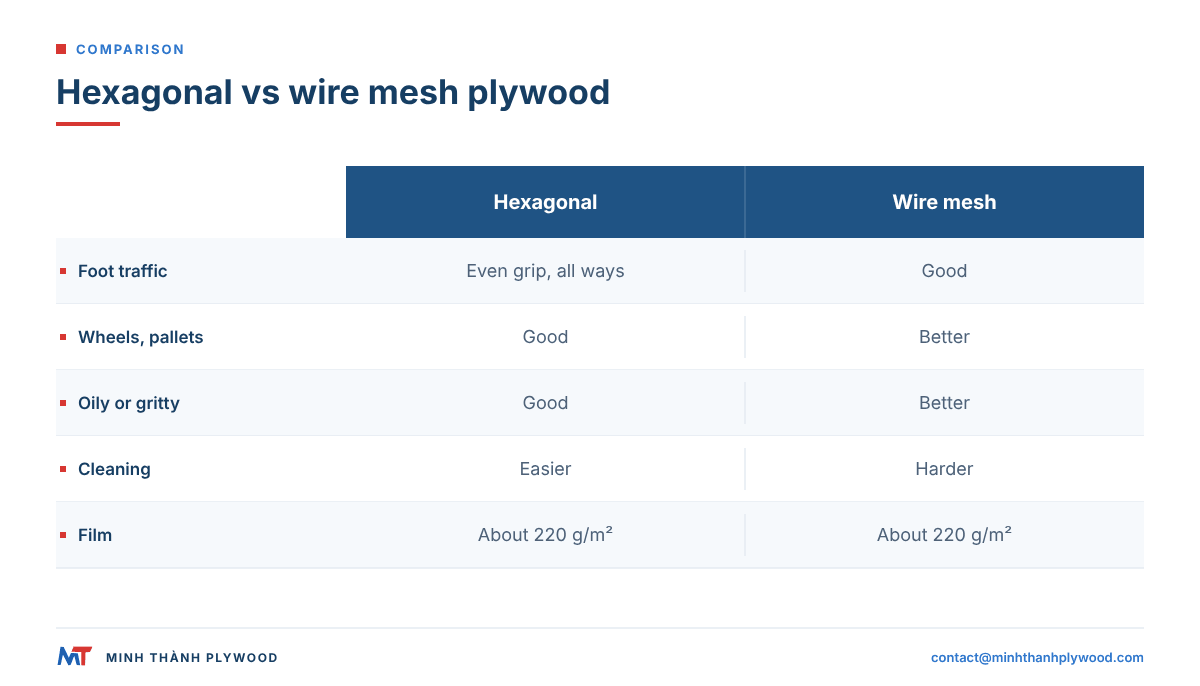
Hexagonal and wire mesh plywood perform the same on load and moisture and differ on grip direction, cleaning and how the texture wears. The table compares one property per row on the same core, glue and film.
| Property | Hexagonal pattern | Wire mesh pattern |
|---|---|---|
| Grip under foot | Even in every direction | Good, slightly directional along the mesh |
| Grip under wheels and pallet trucks | Good | Better: dense, rough texture |
| Grip when wet | Good: cells drain | Good: texture breaks the water film |
| Grip when oily or gritty | Good | Better: more edges per square centimetre to bite |
| Cleaning | Easier: brush and hose clear the open cells | Harder: fine texture holds dirt longer |
| Wear pattern | Ridges round off slowly in walk paths | Texture smooths in wheel paths |
| Film | Phenolic, about 220 g/m² | Phenolic, about 220 g/m² |
| Core options | Eucalyptus or Acacia | Eucalyptus or Acacia |
| Load capacity | Set by core, thickness and support spacing | Same |
| Thickness range at Minh Thanh | 12–21 mm | 12–21 mm |
| Typical floors | Stages, walkways, platforms, washdown floors | Trailers, vans, loading areas, ramps |
Load capacity is the row buyers most often misread. The pattern carries no load; a 21 mm Eucalyptus-core panel carries the same load with either face. Stiffness and strength come from the core species, the number of plies, the glue and the support spacing on your drawing.
Phenolic mesh plywood: how is the anti-slip pattern made?
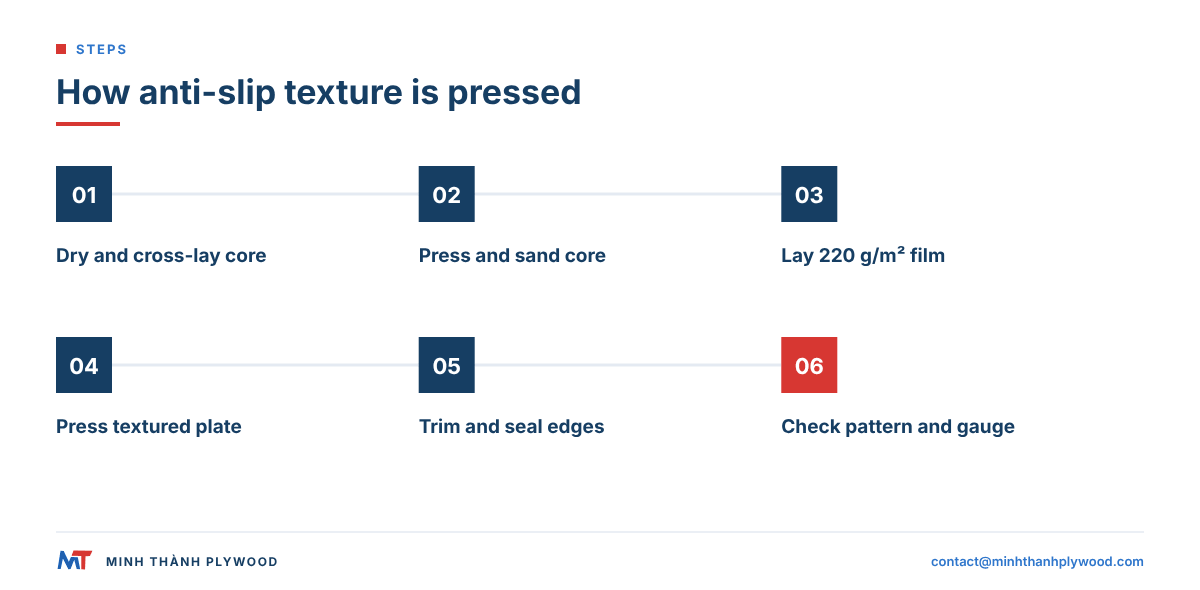
Phenolic mesh plywood gets its pattern in the final hot press: a textured plate presses the phenolic film into the face while the resin cures. The pattern is part of the film, not a coating added later, so it does not peel.
The order of work at the mill runs like this:
- Core veneers of Eucalyptus or Acacia are dried, graded and cross-laid with glue.
- The core is pressed into a board and sanded flat, so the film lies on an even surface.
- Phenolic film of about 220 g/m² is laid on the working face, with a smooth film on the back.
- The textured plate presses the hexagon or mesh pattern into the film; a WBP phenolic bond presses at 130–145 °C.
- The panel is trimmed to 1220 × 2440 mm or 1250 × 2500 mm and the edges are painted to seal them.
- Each panel is checked for film coverage, pattern depth and thickness against the ±0.5 mm tolerance.
How to cut mesh plywood. Use a fine-tooth circular or track saw, keep the phenolic film face up, feed steadily and support the sheet on both sides of the cut to avoid chipping. Seal every cut edge and drilled hole with paint or sealant before the panel goes outside.
Two failures start here. A thin or uneven film leaves bald patches after a few months of traffic. An uneven core telegraphs through the film as a wavy floor. Pressing on a sanded, flat core with a heavy film prevents both.
Which anti-slip pattern fits each application?
Match the pattern to what moves across the floor: feet favour hexagonal, wheels and dirty loads favour wire mesh. The table gives the usual choice and build for common floors.
| Application | Pattern | Usual thickness | Glue | Notes |
|---|---|---|---|---|
| Trailer floor, open or curtain-sided | Wire mesh | 18–21 mm | Phenolic WBP | Sealed edges, wheel loads on the drawing |
| Van floor liner on a supported base | Wire mesh or hexagonal | 12–15 mm | Melamine-fortified or phenolic WBP | Smooth back sits flat on the base |
| Stage and event deck | Hexagonal | 18–21 mm | Phenolic WBP for outdoor use | Reversible decks textured both sides |
| Walkway and access platform | Hexagonal | 15–21 mm | Phenolic WBP | Hose-down cleaning |
| Loading area and dock board | Wire mesh | 18–21 mm | Phenolic WBP | Pallet trucks and grit |
| Ramp | Either, textured both sides | 18–21 mm | Phenolic WBP | Turn over when one face wears |
| Replacement panel in a flooring system | Match the existing face | As specified | As specified | Send a sample of the old panel |
When two patterns fit, choose by cleaning. A floor that is hosed every day stays cleaner with hexagonal cells; a floor that is rarely cleaned and carries grit keeps its grip longer with mesh.
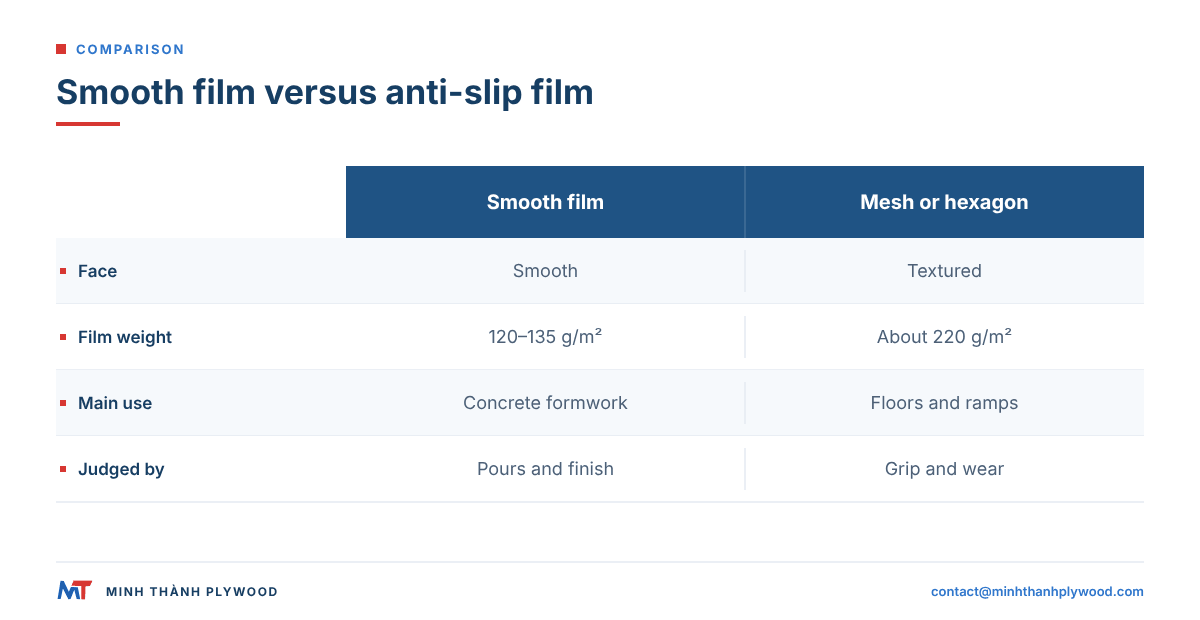
Is wire mesh plywood different from regular film faced plywood?
Yes: wire mesh plywood has a heavier, textured film for grip on floors, while regular film faced plywood has a smooth film for casting concrete. The core and glue choices overlap; the face is built for a different job.
| Point | Regular film-faced plywood | Wire mesh or hexagonal plywood |
|---|---|---|
| Face | Smooth film | Textured film, mesh or hexagon |
| Film weight | About 120–135 g/m², premium from 135 g/m² | About 220 g/m² |
| Main use | Concrete formwork and shuttering | Floors, decks, ramps, walkways |
| Back | Smooth film | Smooth film, or textured on order |
| Judged by | Pours per panel and concrete finish | Grip, wear and service life on the floor |
Do not use smooth film-faced plywood as a floor where people or wheels need grip; the smooth face becomes slippery when wet or dusty. Do not use anti-slip plywood as formwork either: the texture prints into the concrete.
What core, glue and thickness sit behind the pattern?
Behind either pattern, specify a dense hardwood core, a water-resistant glue and a thickness taken from your support spacing. These three lines decide load and service life far more than the pattern does.
Core. Film-faced and anti-slip panels in Vietnam use Eucalyptus or Acacia cores. Eucalyptus is the denser option at 650–750 kg/m³ and gives the stiffer floor; Acacia is about 580 kg/m³ and gives a lighter panel. An 18 mm 1220 × 2440 mm sheet calculates to about 34.8 kg on Eucalyptus at 650 kg/m³ and 31.1 kg on Acacia.
Glue. Phenolic WBP glue is the choice for trailers, outdoor stages and any floor that gets wet; melamine-fortified glue suits covered floors such as van liners. Glue and formaldehyde emission class are two separate lines on the quotation.
Thickness. Minh Thanh makes anti-slip plywood in 12–21 mm. Thinner panels need closer supports; your floor drawing sets the spacing, the wheel loads and the fixing positions.
Is mesh plywood waterproof, and how long does it last?
Mesh and hexagonal plywood with phenolic WBP glue are made for wet outdoor service: the phenolic film sheds water and the glue line holds when the panel gets wet. Water still enters through unsealed edges and holes, so sealing decides the life of the floor.
What keeps a textured floor in service for years:
- Phenolic WBP glue for any floor that sees rain, washing or condensation.
- The full 220 g/m² film, which keeps its texture longer than a light film.
- Painted edges from the mill, and sealant on every cut edge and drilled hole made on site.
- Drainage: no standing water on the panel, and gaps or falls where the floor design allows.
Wear shows first in the busiest paths. On a mesh floor the wheel paths smooth out; on a hexagonal floor the ridges round off in walk paths. A reversible panel, textured both sides, can then be turned over, or one worn panel replaced without lifting the floor.
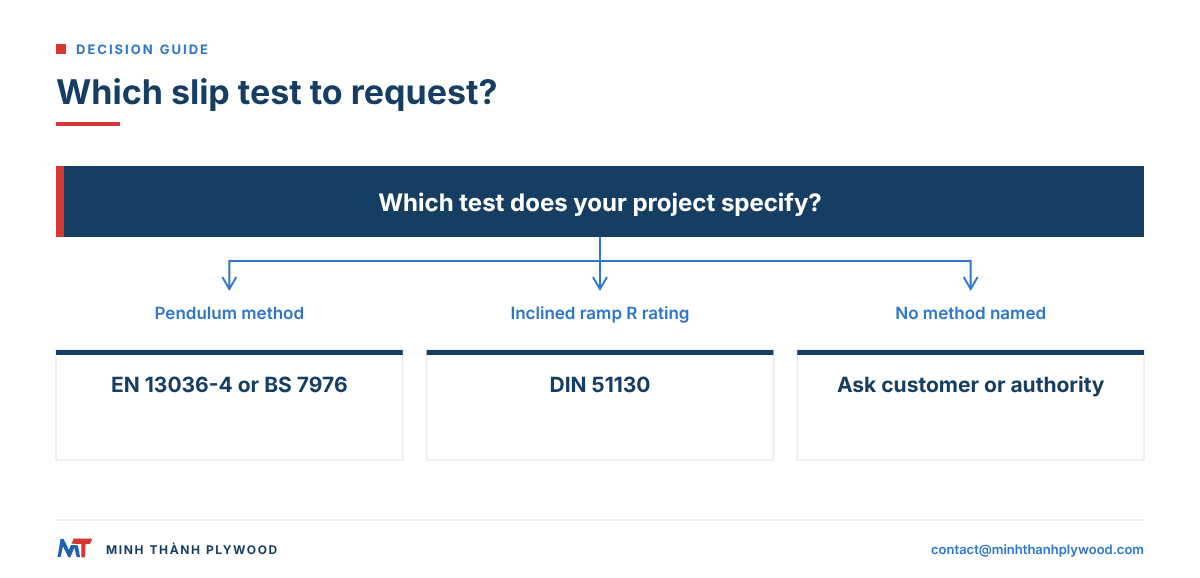
Which slip test should your specification name?
Your floor specification decides the slip test: either a pendulum test (EN 13036-4 or BS 7976, common in the UK) or the inclined-ramp test behind the German R rating (DIN 51130). The two methods measure grip differently, so results cannot be swapped.
Tell the mill which method your customer or authority names before production, and ask for the test on the construction you will receive: same film, same pattern, same core. Minh Thanh arranges SGS testing to the method you name on the construction we ship. A test on another mill’s panel, or on a smooth sample, says nothing about your floor.
Two more tests appear in tenders for vehicle and industrial floors: surface wear, often a Taber abrasion count, and bending strength and stiffness to EN 310. Name every test in the enquiry so the samples and reports can be planned with the order.
When do rice pattern or double-sided anti-slip panels make sense?
Rice pattern and double-sided panels solve two edge cases: a finer texture that is easier on bare feet and cleaning, and a reversible panel that doubles the wearing life of a deck.
Rice pattern is a finer, grain-shaped texture pressed the same way as mesh and hexagonal. Buyers often group it with mesh, and it suits floors with light wheeled traffic and frequent cleaning.
Double-sided panels carry the pattern and film on both faces. They suit ramps, stage decks and modular platforms that are turned over between events. Specify the colour and film for each face and the edge profile on the drawing; a two-sided panel is quoted separately from the standard textured face with a smooth back.
What to check when anti-slip plywood arrives
Check pattern, film, edges and thickness on arrival, against the approved sample and the order. Five checks take an hour per container:
- Count packs and sheets against the packing list, and note any damaged wrapping.
- Look along a sheet at low light: the pattern should be even, with no bald or shiny patches.
- Check the edges: painted, with no open gaps between plies.
- Caliper several sheets from different packs at the corners and centre; the tolerance is ±0.5 mm.
- Compare the face, colour and back with the approved sample.
Minh Thanh photographs and films every container before loading and sends the photos and video to the buyer, so the first check happens before the ship sails. Production and these checks run under the mill’s ISO 9001:2015 quality management system, certificate KAC25/0185. Store panels flat, off the ground and under cover until they go on the floor.
Wire mesh film faced plywood from Vietnam: what to send for a quotation
To order wire mesh or hexagonal film faced plywood from Vietnam, send the application, the pattern and the panel build in one message. A complete enquiry gets an exact quotation in one reply.
- Application: trailer, van, stage, walkway, ramp, replacement panel.
- Pattern: hexagonal, wire mesh or rice; one side or both.
- Film: about 220 g/m², colour.
- Core: Eucalyptus or Acacia.
- Glue: phenolic WBP or melamine-fortified.
- Size and thickness: 1220 × 2440 mm or 1250 × 2500 mm, 12–21 mm.
- Tests: slip test method, wear or bending tests if named.
- Quantity and port: sheets per thickness, destination port.
The minimum order is one 40HC, with mixed specifications by agreement. A 40HC of film-faced panels carries about 43 m³ on Eucalyptus cores or 47 m³ on Acacia, because the heavier core reaches the weight limit first. Production runs 15–45 days after the deposit, with sea transit added.
What this means for your order
For your order, pick the pattern by traffic and cleaning, then spend your attention on the core, glue, film weight and edges. The pattern takes one line; the build behind it takes the rest of the specification.
A spec line that works for a trailer floor reads: Anti-slip plywood, wire mesh face, phenolic film about 220 g/m², smooth film back, Eucalyptus core, phenolic WBP glue, 18 mm, 1250 × 2500 mm, painted edges. Change the pattern to hexagonal for a stage or walkway, and add “textured both sides” for a reversible deck.
Minh Thanh Plywood makes anti-slip plywood on order next to its furniture and commercial range in Ha Hoa, Phu Tho. Free samples of both patterns go out with the quotation. Send your floor drawing and spec line to contact@minhthanhplywood.com, or see the anti-slip plywood product page for sizes and options.
Buyer questions, answered
What is the difference between hexa anti-slip plywood and wire mesh anti-slip plywood?
Only the pattern pressed into the film differs. Hexagonal cells give even grip in every direction and clean out easily; the wire mesh pattern gives a dense, rough texture suited to wheels and gritty loads. Core, glue and film weight can be the same.
Is mesh plywood the same as anti-slip plywood?
Yes. Mesh plywood, wire mesh plywood and mesh faced plywood are trade names for anti-slip film-faced plywood with a mesh pattern pressed into the film. Hexagonal plywood is the same product with a hexagon pattern.
Is wire mesh film faced plywood waterproof?
The phenolic film sheds water. Order phenolic WBP glue for outdoor wet service and seal every cut edge and drilled hole; melamine-fortified glue suits covered floors.
How long does anti-slip film faced plywood last?
Years of floor service with phenolic WBP glue, the 220 g/m² film and sealed edges. When a wheel path wears smooth, a reversible panel can be turned over or one panel replaced.
How does wire mesh film faced plywood differ from regular film faced plywood?
Regular film-faced plywood has a smooth film of about 120–135 g/m² for concrete formwork. Wire mesh plywood has a heavier film of about 220 g/m² pressed with a texture for grip on floors.
Which anti-slip pattern is best for a trailer floor?
Wire mesh for trailers that carry wheeled loads, pallets or gritty goods; hexagonal when the floor is mostly walked on and washed down. Use 18–21 mm with phenolic WBP glue and sealed edges.
Can I get the anti-slip pattern on both sides?
Yes. Order the pattern and film on both faces for a reversible deck or ramp. The standard build has one textured working face and a smooth film back.
What thickness of mesh plywood should I order?
Minh Thanh makes anti-slip plywood in 12–21 mm. 12–15 mm suits supported van-floor liners; 18–21 mm suits trailer floors and stage decks, with support spacing taken from your drawing.
Which slip test applies to hexagonal or mesh plywood?
Floor specifications name either a pendulum test (EN 13036-4 or BS 7976) or the ramp test behind the German R rating (DIN 51130). Tell the mill which one, and test the construction you will receive.
Where can I buy wire mesh film faced plywood from Vietnam?
Order it from a Vietnamese mill that presses anti-slip film on its own hardwood cores. Minh Thanh Plywood makes hexagonal and mesh panels on order, with one 40HC as the minimum and free samples.