
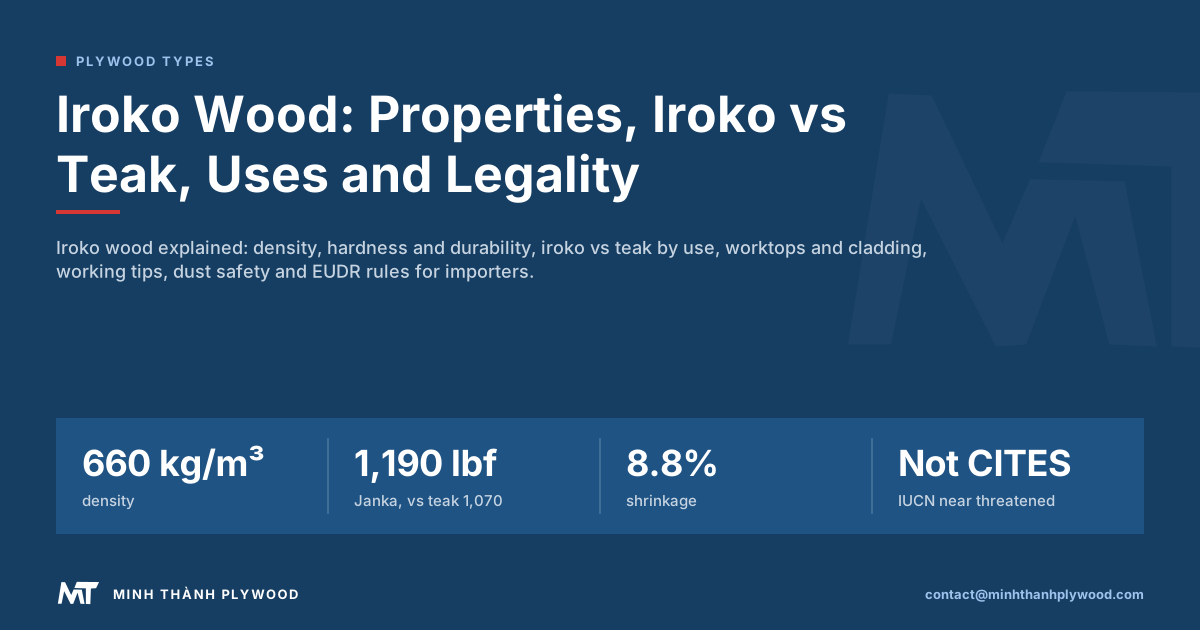
Iroko wood is a tropical African hardwood from Milicia excelsa and Milicia regia, with golden-brown heartwood that darkens towards a teak colour, a dried density of about 660 kg/m³ and very durable heartwood. Builders use it for worktops, cladding, boats and garden furniture. This guide from Minh Thanh Plywood sets iroko against teak by use and says what to order when you need panels instead of boards.
What is iroko wood?
Iroko wood is the timber of two tropical African trees, Milicia excelsa and Milicia regia, sold together under one trade name. The heartwood is yellow to golden or medium brown and darkens with age; the pale yellow sapwood is clearly marked off from it.
Both species belong to the mulberry family (Moraceae). For decades botanists placed iroko in the genus Chlorophora, and older references still use that name. The genus Milicia was reinstated in 1982 with the two species recognised today.
Iroko is known by several trade names:
- Iroko, the standard European trade name.
- African teak, a marketing name it shares with afrormosia; neither is related to true teak.
- Mvule, odum and kambala, names used in different producing countries.
Use the botanical name on contracts and import papers. Trade names overlap between species, while the Latin name fixes what you are buying and what your due diligence must cover.
Where does iroko timber come from?
Iroko timber comes from the tropical forests of Africa. Milicia excelsa grows across the continent’s forest belt, from West Africa to East Africa, and supplies most of the trade. Milicia regia is limited to a narrower band of West African forest.
The trees are large: 30-40 m tall, with clean trunks 1-1.5 m across. That size yields long, wide boards with few knots, which is one reason joiners like iroko for worktops and cladding.
Most iroko reaches Europe as sawn boards and square-edged planks, kiln-dried or air-dried, and as sliced veneer. Some comes as finished products such as worktop staves, decking and window sections.
What are the properties of iroko hardwood?
Iroko hardwood is medium-heavy, hard and stable, with low shrinkage for its density. The figures below are average values at 12% moisture content from The Wood Database, read 20 October 2026.
| Property | Iroko | What it means in use |
|---|---|---|
| Average dried weight | 660 kg/m³ | About as heavy as teak; a 40 mm worktop is a two-person lift |
| Specific gravity (basic, 12% moisture) | 0.56, 0.66 | Medium-heavy hardwood |
| Janka hardness | 1,190 lbf (5,310 N) | Harder than teak; resists dents on worktops and floors |
| Modulus of rupture | 97.1 MPa | Bending strength equal to teak |
| Elastic modulus | 10.90 GPa | Slightly less stiff than teak |
| Crushing strength | 53.5 MPa | Good for posts, sills and joinery sections |
| Radial shrinkage | 3.3% | Low |
| Tangential shrinkage | 4.8% | Low; boards stay flat |
| Volumetric shrinkage | 8.8% | Low for a hardwood of this density |
| T/R ratio | 1.5 | Low ratio; little cupping as humidity changes |
The grain is interlocked and sometimes irregular, with a medium to coarse texture and good natural lustre. Unfinished surfaces feel slightly greasy, which is the wood’s natural oil, not a coating.
The low T/R ratio is the property worktop makers value most. When tangential and radial shrinkage are close, a board moves evenly across its width, so glued staves and wide panels stay flat through dry winters and humid summers.
Iroko vs teak: which is better?
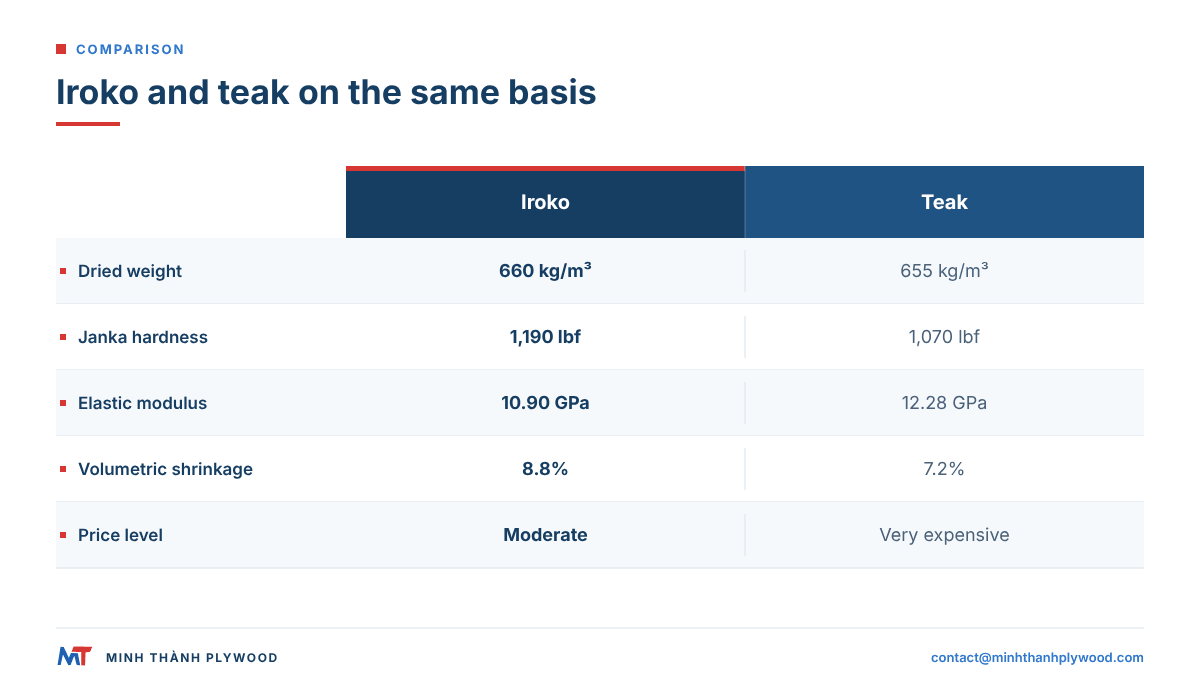
Teak is better for boat decks and the most exposed joinery; iroko is better value for worktops, cladding and garden furniture, where it performs close to teak at a moderate price. The table compares the two on the same basis, average values at 12% moisture content.
| Metric | Iroko | Teak (Tectona grandis) |
|---|---|---|
| Origin | Natural forests of tropical Africa | Native to southern Asia; widely grown on plantations |
| Average dried weight | 660 kg/m³ | 655 kg/m³ |
| Janka hardness | 1,190 lbf (5,310 N) | 1,070 lbf (4,740 N) |
| Modulus of rupture | 97.1 MPa | 97.1 MPa |
| Elastic modulus | 10.90 GPa | 12.28 GPa |
| Crushing strength | 53.5 MPa | 54.8 MPa |
| Volumetric shrinkage | 8.8% | 7.2% |
| T/R ratio | 1.5 | 2.0 |
| Heartwood durability | Very durable; resists rot and insects | Very durable; only moderately resistant to marine borers |
| Grain | Interlocked, sometimes irregular | Mostly straight |
| What dulls tools | Calcium carbonate deposits | Silica, up to 1.4% |
| Price level | Moderate | Very expensive |
Verdict by use:
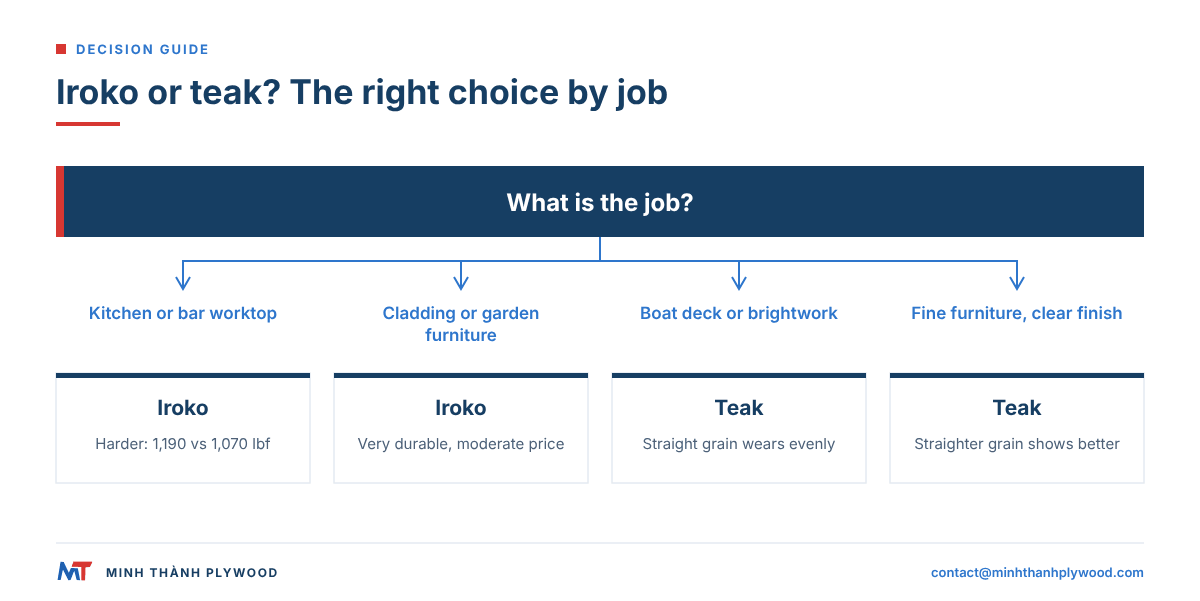
- Kitchen and bar worktops: iroko. It is harder than teak, moves little and costs much less.
- Exterior cladding and garden furniture: iroko, unless the design calls for teak by name.
- Boat decks and brightwork: teak. Its straight grain wears evenly underfoot and its oils make the classic deck surface.
- Windows, doors and sills: either. Iroko is the more common choice in European joinery for price reasons.
- Fine furniture with a clear finish: teak, where the straighter grain shows better.
How durable is iroko outdoors?
Iroko heartwood is very durable outdoors: it resists both rot and insect attack without preservative treatment. That rating applies to the heartwood only; the pale sapwood has no natural durability and should be cut out of exterior work.
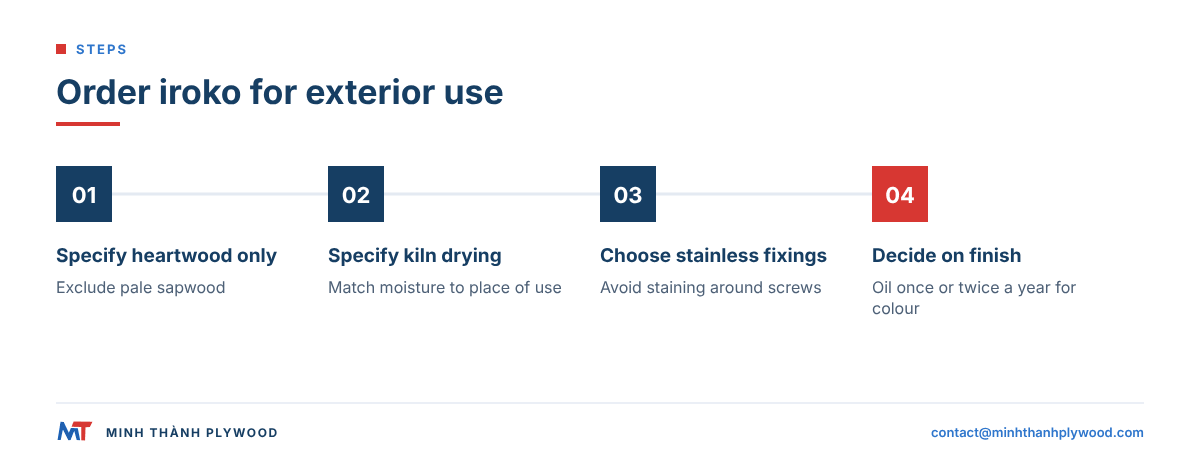
Left unfinished, iroko weathers to a silver grey within a season or two of sun and rain. The colour change is on the surface and does not weaken the wood. Owners who want to keep the golden-brown colour oil the surface once or twice a year.
For a durable outdoor job, specify three things on the order:
- Heartwood only, free of sapwood.
- Kiln-dried to the moisture content of the place of use, so joints stay tight.
- Stainless steel fixings, because plain steel stains wet hardwood around the screw heads.
Is iroko good for worktops?
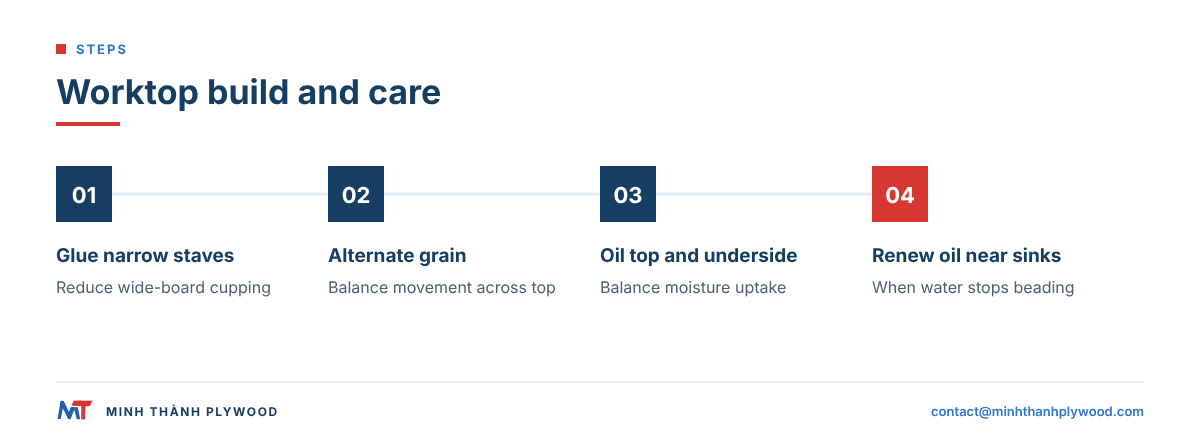
Iroko is one of the best-value timbers for worktops: hard enough to resist dents, stable enough to stay flat, and naturally resistant to water around sinks. Most iroko worktops are made of narrow staves glued edge to edge, often finger-jointed in length.
Staves are used rather than single wide boards because narrow pieces cut the risk of a wide board cupping over time. Interlocked grain also behaves better in narrow strips.
A worktop maker sets three things for iroko:
- Grain direction: staves alternated, so any movement cancels out across the top.
- Finish: a penetrating oil, renewed when water stops beading on the surface, especially beside the sink.
- Seal underneath: the underside oiled as well as the top, so both faces take up moisture at the same rate.
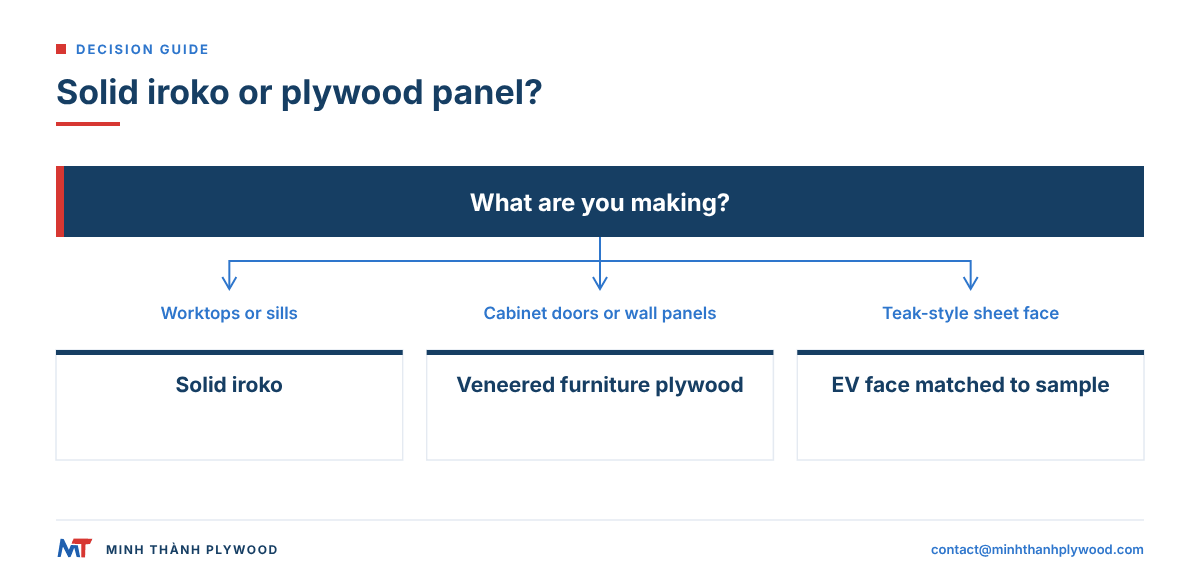
For cabinet carcasses, doors and side panels under an iroko top, solid boards are rarely used. Most kitchens pair the solid top with veneered furniture plywood, which stays flat in large panels and takes the same colour of finish.
How is iroko used for cladding and joinery?
Iroko is a standard cladding and joinery hardwood in Europe because it lasts outdoors without treatment and machines to clean profiles. Typical products are shiplap and tongue-and-groove cladding boards, open rainscreen battens, window and door frames, sills and thresholds.
For cladding, boards are usually fixed with a ventilated cavity behind them, so they dry from both faces. Iroko on a façade turns silver grey unless it is coated; architects who want an even grey often leave it bare from the start.
Joinery makers use iroko for sills and bottom rails, the parts of a window or door that stay wet longest. A crushing strength of 53.5 MPa gives a sill enough capacity under fixings and hinges.
Is iroko used for boats?
Yes. Iroko is used in boatbuilding for frames, keels, rubbing strakes, deck fittings and interior joinery, wherever a durable, stable hardwood is needed. It is less common than teak for laid decks, where teak’s straighter grain and oil content give the familiar surface.
For hulls and decks built from sheets, boatbuilders use marine plywood rather than solid iroko. A boat interior can combine iroko trim with plywood panels; the guide to marine plywood explains the sheet side of that choice.
How do you work iroko?
Iroko is generally easy to work, with two exceptions: interlocked grain that can tear out when planed, and calcium carbonate deposits that blunt cutters quickly. It glues and finishes well.
Workshops that cut iroko regularly follow a short routine:
- Use carbide tooling on saws, planers and spindle moulders; plain steel loses its edge on the deposits.
- Plane at a low cutting angle or with a back-bevel, and take light passes to limit tear-out on the interlocked grain.
- Sand rather than plane the final surface of wide panels with reversing grain.
- Wipe the surface with a solvent before gluing when the boards feel oily, so the glue wets the wood.
- Fit dust extraction at every machine, because iroko dust is a reported sensitiser.
Iroko takes oil, lacquer and varnish evenly. Under a clear finish the colour deepens over the first months, so match new and old pieces after they have aged, not on the day of fitting.
Is iroko wood toxic?
Iroko is not poisonous to touch, but its dust is a reported sensitiser. The common reactions are eye, skin and respiratory irritation. In sensitive people iroko dust has also been linked to asthma-like symptoms, boils and hypersensitivity pneumonitis.
Severe reactions are uncommon, and finished, sealed iroko in a kitchen or on a façade poses no dust risk. The precautions belong in the workshop: extraction at the source, a fitted dust mask when sanding, and gloves for anyone with sensitive skin.
Is iroko legal to import, and is it threatened?
Iroko is legal to trade: neither species is listed in the CITES Appendices, so no CITES permit is needed. In the EU, CITES is applied through Council Regulation (EC) No 338/97. Both are on the IUCN Red List, with Milicia excelsa listed as near threatened and Milicia regia as vulnerable after a population fall of more than 20% over three generations.
That status makes origin papers part of every iroko purchase. Each main market has its own rule:
| Market | Rule | What the importer needs |
|---|---|---|
| European Union | Regulation (EU) 2023/1115 on deforestation-free products (EUDR) | Due diligence with the geolocation of the harvest plots and a due diligence statement before placing on the market |
| United Kingdom | UK Timber Regulation, set out in GOV.UK timber guidance | Due diligence showing legal harvest |
| United States | Lacey Act | Declaration of species and country of harvest |
The EUDR covers wood across Chapter 44 of the customs nomenclature, which includes sawn iroko, iroko veneer and plywood. A supplier who cannot give the harvest plots cannot supply an EU importer.
How is iroko sold, and what drives its price?
Iroko is sold mostly as sawn timber, priced per cubic metre, and as sliced veneer priced per square metre. Common forms are square-edged boards, kiln-dried or air-dried planks, worktop staves and machined profiles such as cladding and decking.
The price of iroko is moderate for a durable tropical hardwood, well below teak. Five things move it:
- Grade: clear, wide boards cost more than boards with defects.
- Dimensions: long lengths and thick sections carry a premium.
- Drying: kiln-dried stock costs more than air-dried.
- Origin papers: stock with full due-diligence files for EUDR costs more to supply.
- Freight: iroko is heavy at 660 kg/m³, so transport takes a large share of a delivered price.
Check the moisture content on arrival with a pin meter before machining. Boards that are wetter than the place of use will shrink after fitting.
What should you order when you need iroko-look panels?
Order veneered furniture plywood when the job needs large flat panels in an iroko or teak colour: cabinet carcasses, wardrobe doors, wall panelling, shop fittings. Solid iroko is the right material for worktops, sills and cladding; for sheets wider than a few staves, plywood stays flat where glued solid wood would move.
Minh Thanh Plywood makes furniture plywood for this kind of work:
- Faces: EV (engineered veneer) matched to a golden-brown, teak-style sample you approve; sapele on request for a real African hardwood face.
- Core: white Styrax or Eucalyptus, stitched both ways, so no gaps show at a cut edge.
- Build: pressed twice, the core calibrated before face and back go on, for a flat face under lacquer.
- Tolerance: thickness down to ±0.2 mm on sanded panels.
- Glue: UF glue at E0 emission for interiors, with CARB P2 / TSCA Title VI certification as proof.
- Sizes: 1220 × 2440 mm and 1250 × 2500 mm, 3–40 mm thick, or cut to size.
The EV plywood page shows the face options, and the furniture plywood range covers cores and grades.
What to send for a quote
Send one line per panel type, and the quote comes back the same day in most cases. For iroko-look furniture panels, a typical request reads:
Furniture plywood, EV face teak-style colour to our sample, Styrax core, UF glue at E0 emission, 18 mm, 1220 × 2440 mm, sanded, 1×40HC, CIF Rotterdam.
Add the application (kitchen doors, wall panels, shop fittings), the face and back you need, and any test your customer asks for. Free samples are available, so you can match the face to your iroko tops before ordering. Write to contact@minhthanhplywood.com or use the quote form.
Buyer questions, answered
What is iroko wood used for?
Iroko is used for kitchen and bar worktops, exterior cladding, window and door joinery, boat decks and fittings, outdoor furniture, flooring and veneer. Its heartwood is very durable, so it suits wet and outdoor work where most hardwoods need treatment.
Is iroko as good as teak?
For worktops, cladding and garden furniture iroko does the same job at a moderate price. Teak keeps the edge for boat decks and the most demanding outdoor joinery thanks to its straighter grain and slightly higher stiffness.
Is iroko a hardwood?
Yes. Iroko comes from a broadleaf tree of the mulberry family, so it is a hardwood botanically, and it is also hard in use: its Janka hardness of 1,190 lbf is higher than teak's 1,070 lbf.
Does iroko need oiling outdoors?
It does not need oil to resist rot, because the heartwood is very durable on its own. Oil keeps the golden-brown colour; left bare, iroko weathers to a silver grey without losing strength.
Is iroko wood toxic?
Iroko is not poisonous to handle, but its dust is a reported sensitiser. Machining it can cause eye, skin and respiratory irritation and, in sensitive people, asthma-like symptoms, so use dust extraction and a fitted mask.
Why does iroko blunt saw blades?
Some iroko logs carry deposits of calcium carbonate, sometimes called stones, inside the wood. They dull cutters quickly, so carbide tooling is the normal choice for iroko.
Is iroko endangered?
Iroko is not listed in the CITES Appendices. The IUCN Red List lists Milicia excelsa as near threatened and Milicia regia as vulnerable, so legal origin papers matter when you buy.
Can I import iroko into the EU?
Yes, as long as the operator placing it on the market completes due diligence under Regulation (EU) 2023/1115, including the geolocation of the harvest plots, and files the due diligence statement.
What is African teak?
African teak is a trade name used for iroko and, more often, for afrormosia. Neither is botanically related to true teak, Tectona grandis, though both share some of its durability.
Can I get iroko-look plywood?
Yes. For cabinet sides, doors and wall panels, furniture plywood with an EV (engineered veneer) face can be made to a golden-brown, teak-style sample, on a stable double-pressed core at a fraction of the cost of solid iroko.