
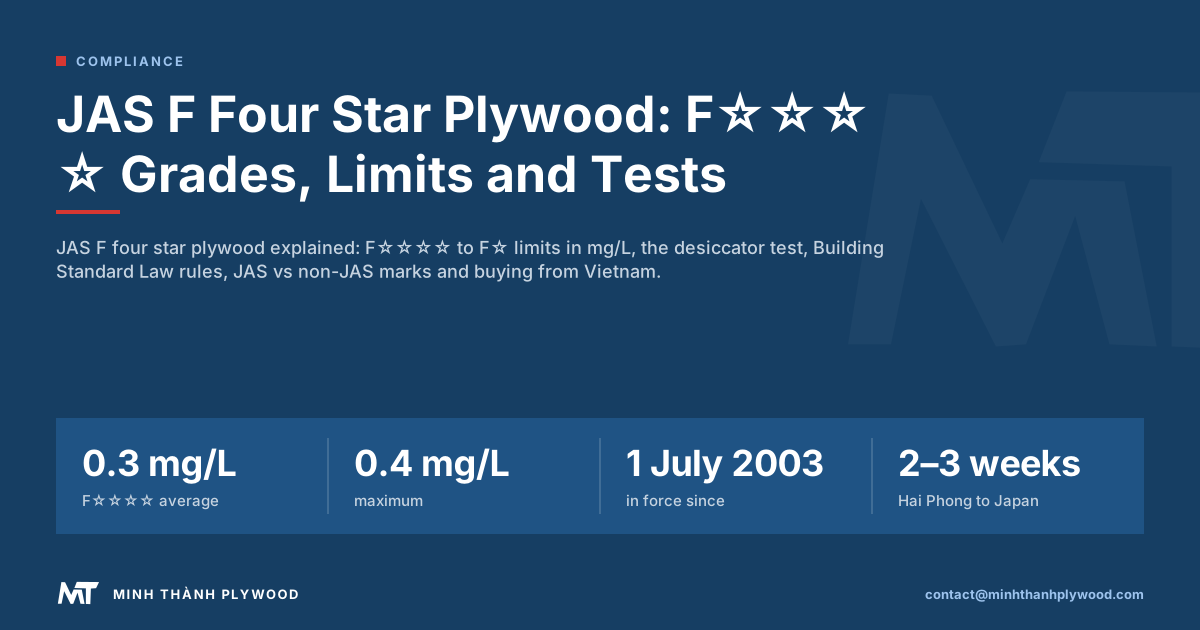
JAS F four star plywood is plywood graded F☆☆☆☆ under the Japanese Agricultural Standard: the lowest formaldehyde class in Japan, with a desiccator result averaging no more than 0.3 mg/L and no single result above 0.4 mg/L. Only F☆☆☆☆ panels can be used without area limits for interior finishing under the Building Standard Law. Minh Thanh Plywood explains the grades, the test and the marks a Japanese importer checks.
What is JAS F four star plywood from Vietnamese factories?
JAS F four star plywood is plywood graded F☆☆☆☆ under the Japanese Agricultural Standard (JAS), Japan’s lowest formaldehyde class: no more than 0.3 mg/L on average and 0.4 mg/L individually in the desiccator test. Vietnamese factories can supply JAS-marked panels when certified for that product; a test report alone does not establish that certification.
Two systems meet in the mark. JAS, run by the Ministry of Agriculture, Forestry and Fisheries (MAFF), sets the quality standards for plywood, LVL and other wood products, including the formaldehyde grade. The Building Standard Law, run by the Ministry of Land, Infrastructure, Transport and Tourism (MLIT), decides where each grade may be used inside buildings.
The grade is written many ways in quotes and emails: F☆☆☆☆, F****, F4star, F-four-star, F4S. They all mean the same top class.
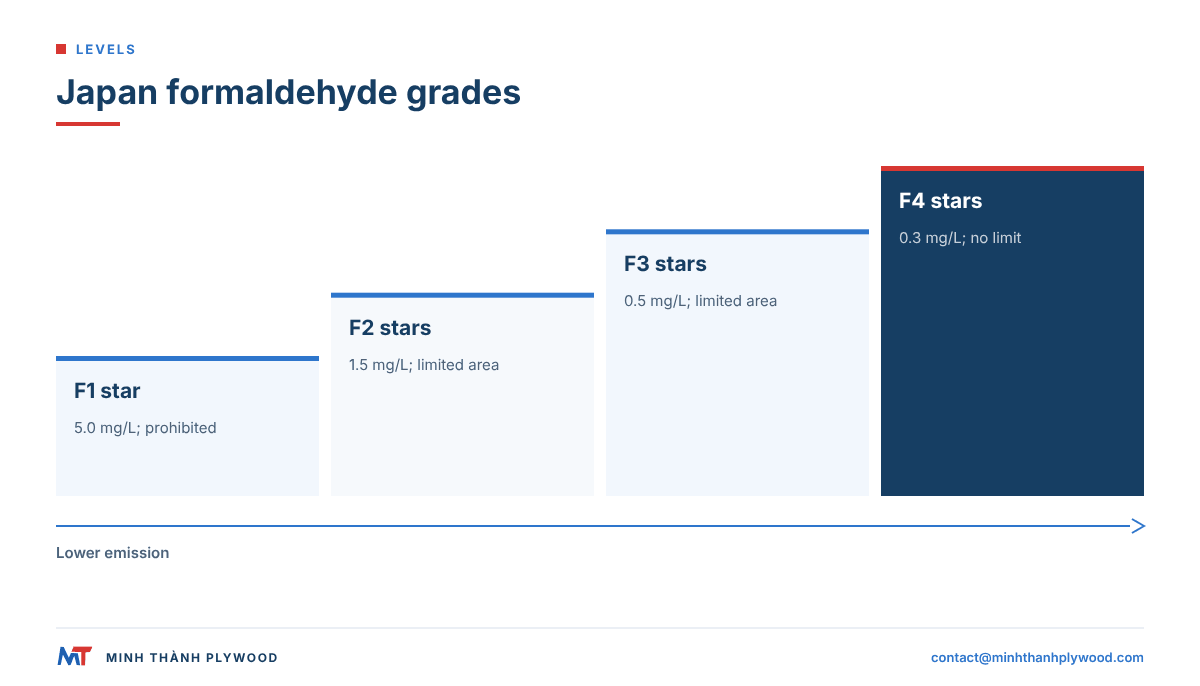
JAS formaldehyde grades: F☆☆☆☆, F☆☆☆, F☆☆ and F☆
Japan grades plywood in four formaldehyde classes, from F☆, the highest emitting, to F☆☆☆☆, the lowest. Each grade has an average and a maximum desiccator value, and the Building Standard Law ties each to an emission rate in the room.
| Grade | Desiccator average | Desiccator maximum | Emission rate, Building Standard Law | Interior finishing use |
|---|---|---|---|---|
| F☆☆☆☆ | 0.3 mg/L | 0.4 mg/L | Up to 0.005 mg/m²h | No restriction |
| F☆☆☆ | 0.5 mg/L | 0.7 mg/L | Over 0.005 up to 0.02 mg/m²h | Limited area (Type 3) |
| F☆☆ | 1.5 mg/L | 2.1 mg/L | Over 0.02 up to 0.12 mg/m²h | Limited area (Type 2) |
| F☆ or ungraded | 5.0 mg/L | 7.0 mg/L | Over 0.12 mg/m²h | Prohibited (Type 1) |
The emission rates are MLIT’s figures at 28 °C and 50 % relative humidity, the conditions behind the indoor guideline value of 0.1 mg/m³ set by the Ministry of Health, Labour and Welfare. Materials that have been part of a building for five years or more are no longer restricted.
How the Building Standard Law uses the F-star grades
Since July 1, 2003, Japan’s Building Standard Law has restricted formaldehyde-emitting materials used for interior finishing, and the F-star grade decides the restriction (MLIT guidance, checked on 3 November 2026). It is the reason Japanese builders and importers ask for F☆☆☆☆ almost by default.
The rules have three parts:
- Grade-based limits. F☆☆☆☆ materials are free to use; F☆☆☆ and F☆☆ materials are limited in area by room type and ventilation; ungraded materials are prohibited for interior finishing.
- Ventilation. Mechanical ventilation is required in principle in all buildings, so that the air in living rooms is changed regularly.
- Concealed spaces. Materials in ceiling cavities and similar spaces must be low emitting, or the cavity must be ventilated.
The law covers interior finishing and built-in furniture. Freestanding furniture is outside it, but Japanese furniture makers and retailers usually write F☆☆☆☆-level panels into their own specifications.
How the desiccator test works
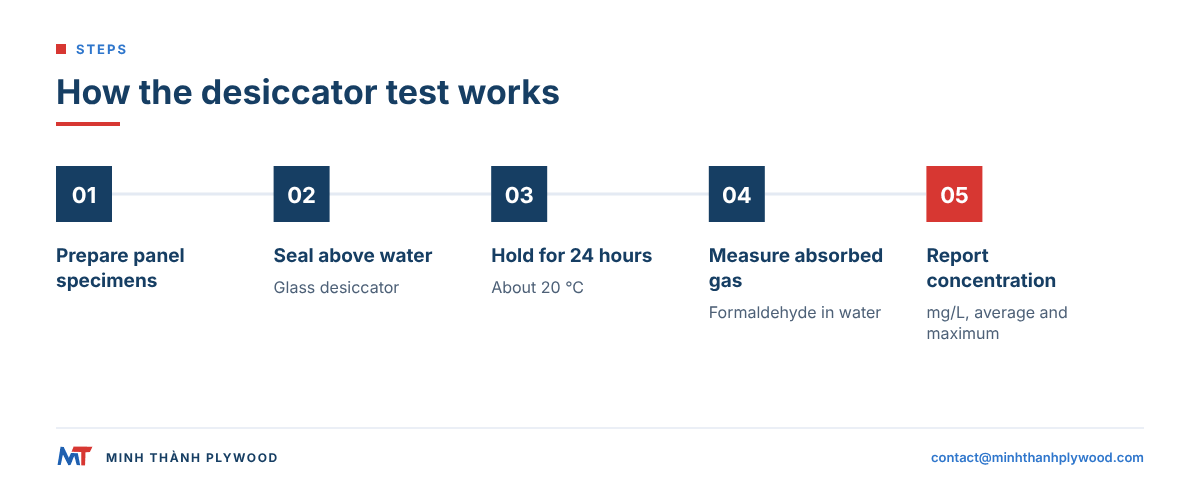
The F-star grade is measured by the desiccator method: panel specimens are sealed in a glass desiccator above a dish of water for 24 hours at about 20 °C, and the formaldehyde absorbed by the water is measured. The result is the concentration in that water, reported in mg/L.
The method is set out in JIS A 1460 for building boards and in the JAS standard for plywood. Its strengths are speed and low cost: one test takes a day and needs no large chamber. Its limit is that it is a static test, so its figures belong to its own scale.
Japanese makers also report the JIS A 1901 small chamber method, which measures an emission rate in a chamber instead of a concentration in water. Woodtec, a Japanese board maker, lists its F☆☆☆☆-compatible products with a JIS A 1901 reading taken 3 days after loading the chamber, and that rate ties to the same Building Standard Law bands as the desiccator grade (F☆☆☆☆ is up to 0.005 mg/m²h). Treat the two as separate tests: a desiccator figure in mg/L and a chamber figure in mg/m²h, each from a named laboratory.
For a buyer the rule is simple. Compare an F-star claim only with a desiccator result in mg/L, from a named laboratory, on the same product and thickness as the order.
F☆☆☆☆ vs E0, E1 and CARB P2
F☆☆☆☆, E0, E1 and CARB P2 are four low-formaldehyde labels measured by different methods, and none of them is converted into another. A panel can hold one and still need a separate test for the next market.
| Label | Market | Method | Unit | Limit for plywood |
|---|---|---|---|---|
| F☆☆☆☆ | Japan | Desiccator (JAS, JIS A 1460) | mg/L | 0.3 average, 0.4 maximum |
| E1 | Europe | EN 717-1 chamber | ppm or mg/m³ | 0.1 ppm |
| E0 | Trade class used in Asia and Europe | Stated in the report | By method | Below E1; no single threshold |
| CARB P2 / TSCA Title VI | United States | ASTM E1333 or D6007 chamber | ppm | 0.05 ppm, hardwood plywood |
A CARB P2 or TSCA Title VI claim is checked on the panel itself: the third-party certifier’s TPC number must be printed on the panel face or edge or on the bundle label, and the certifiers are listed in the public CARB and EPA registries. Ask for the number and look it up before you rely on a “low formaldehyde” label.
The US limit is set by the EPA formaldehyde standards for composite wood products (checked 20 October 2026). A low chamber result in ppm is a good sign for a desiccator test, but Japanese importers will still ask for the desiccator figure itself.
JAS mark vs non-JAS F☆☆☆☆: what the label proves
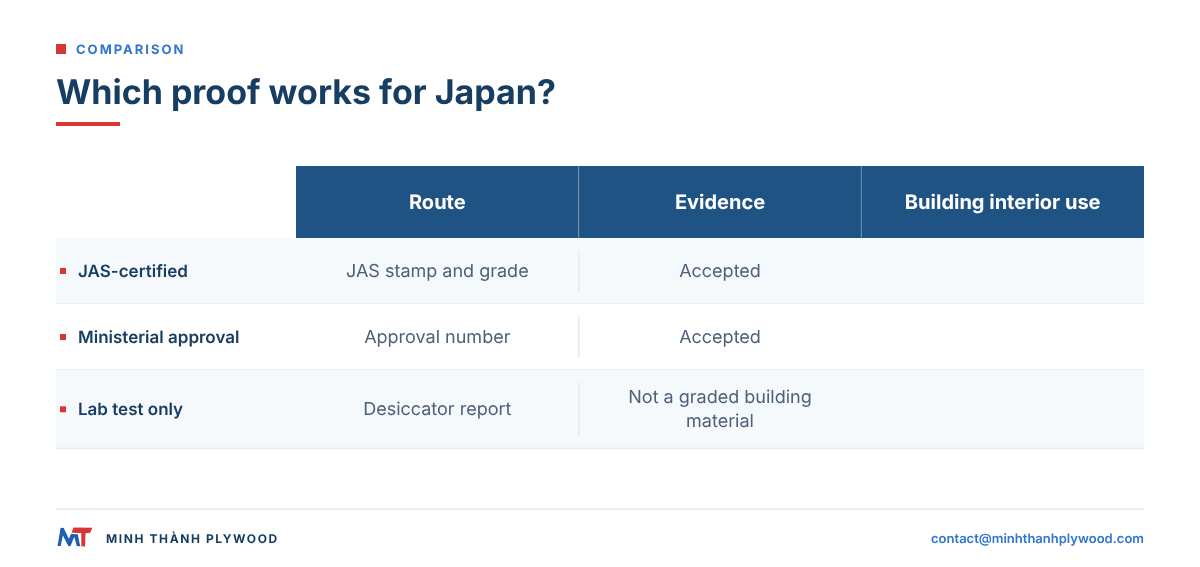
A JAS F☆☆☆☆ mark proves the mill is certified under JAS and its plywood meets the F☆☆☆☆ grade; a non-JAS “F☆☆☆☆” claim proves only what its test report shows. The difference matters most for building use.
| Route | Who grants it | What appears on the panel | Accepted for interior finishing under the Building Standard Law |
|---|---|---|---|
| JAS-certified mill | A registered certifying body, in Japan or overseas | JAS mark with the F☆☆☆☆ grade | Yes |
| Ministerial approval | MLIT, for a specific product | Approval number with the grade | Yes |
| Test report only | An accredited laboratory | Supplier’s own marking | Not as a graded building material; used for furniture and non-building uses |
A JAS certificate covers a named factory and product types. Ask which registered certifying body issued it, check that the panel you are buying is within its scope, and read the grade on the stamp of each bundle.
How Japanese importers check a Vietnamese mill
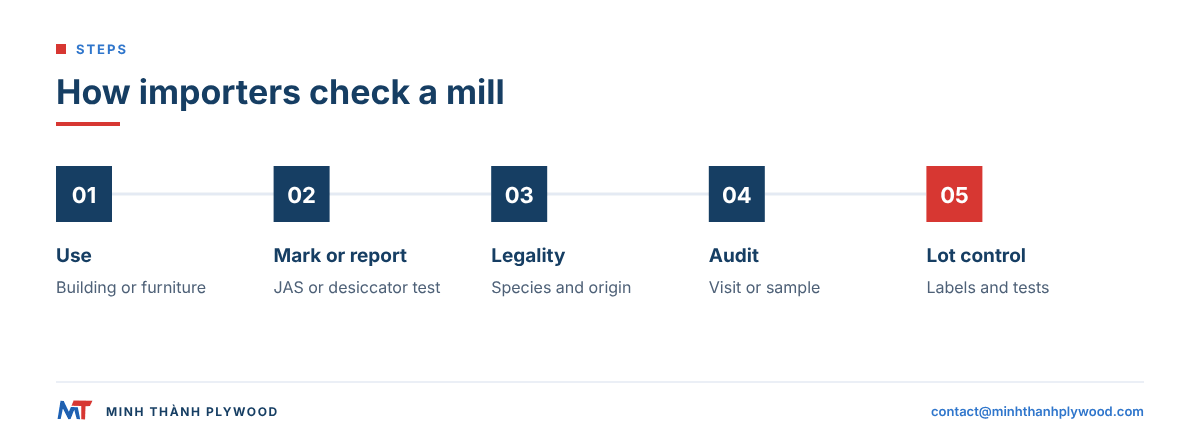
Japanese importers check a Vietnamese plywood mill in five steps, and the paperwork comes before the price. The order follows the risk: building use first, legality second, consistency third.
- Use of the panel. Interior finishing and built-in furniture need JAS F☆☆☆☆ or Ministerial approval; furniture and packaging can use a test report.
- Certificate or report. For JAS, the certificate and the registered certifying body; for a report, a recent desiccator test on the same product and thickness.
- Legality of the timber. The species and harvest origin of the core and faces, for the importer’s checks under Japan’s Clean Wood Act.
- Factory audit or sample test. A visit or video audit, then a sample tested in Japan or by a third-party lab.
- Lot control. Bundle labels with grade and lot, and a test plan for repeat orders.
Japan’s Clean Wood Act, in force since 20 May 2017, promotes the use of legally harvested wood; importers ask the mill for species and origin records to meet it.
F four star plywood from Vietnamese factories
F four star plywood is available from Vietnamese factories in two forms: JAS-marked panels from the mills that hold JAS certification through a registered overseas certifying body, and low-emission panels with desiccator test reports from mills that do not. Which one you need depends on the use in Japan.
Vietnamese furniture plywood suits the Japanese market for three reasons: light plantation cores such as Styrax and Eucalyptus, sanded faces for coating and lamination, and a short sea route, with Japan about 2–3 weeks from Hai Phong by carrier and route. The deciding question is the paperwork for the specific use.
What Minh Thanh supplies for Japanese buyers
The numbers a Japanese buyer can read straight away: six ASTM D6007 chamber tests on our panels averaged 0.014–0.032 ppm, which is 28–64 % of the 0.05 ppm CARB P2 limit, so the panels sit well inside the strictest US class before any Japanese test is added. A US chamber result in ppm does not convert into a desiccator figure in mg/L, so for an F☆☆☆☆-level reading we test the buyer’s own order product by the desiccator method (JIS A 1460) through SGS, on the thickness and face that ship.
Minh Thanh Plywood is not JAS-certified; it supplies certified low-formaldehyde furniture plywood with test evidence, and arranges third-party testing to the buyer’s method, such as the desiccator test, through SGS on request. This suits furniture, cabinet and other uses where a test report is the accepted proof.
| Evidence | Detail |
|---|---|
| Glue | UF glue at E0 emission, standard for furniture and interior panels |
| Certification | CARB P2 / TSCA Title VI, ICTT mill no. 23024 |
| Chamber results | Six ASTM D6007 tests, April 2025 to June 2026, on 9, 15 and 18 mm panels, averaging 0.014–0.032 ppm against the 0.05 ppm limit |
| Testing to the buyer’s method | Through SGS on request, for example the JIS desiccator method |
| Quality system | ISO 9001:2015 (KAC25/0185) |
| Build | Furniture panels pressed twice; stitched cores; thickness tolerance down to ±0.2 mm |
For a Japanese building project that requires a JAS F☆☆☆☆ mark or Ministerial approval on the panel, the mark itself is the requirement, and the panel must come from a mill that holds it. The E0 and E1 emission evidence page lists the reports.
F☆☆☆☆ for LVL and packing plywood
LVL used as a building material in Japan has its own JAS standard with the same F-star classes, so F☆☆☆☆ is the grade buyers ask for when LVL goes into interiors. Packing plywood is different: crates and pallets are not building materials, so the Building Standard Law does not set their grade.
| Product | Is the F-star grade required? | What buyers usually ask |
|---|---|---|
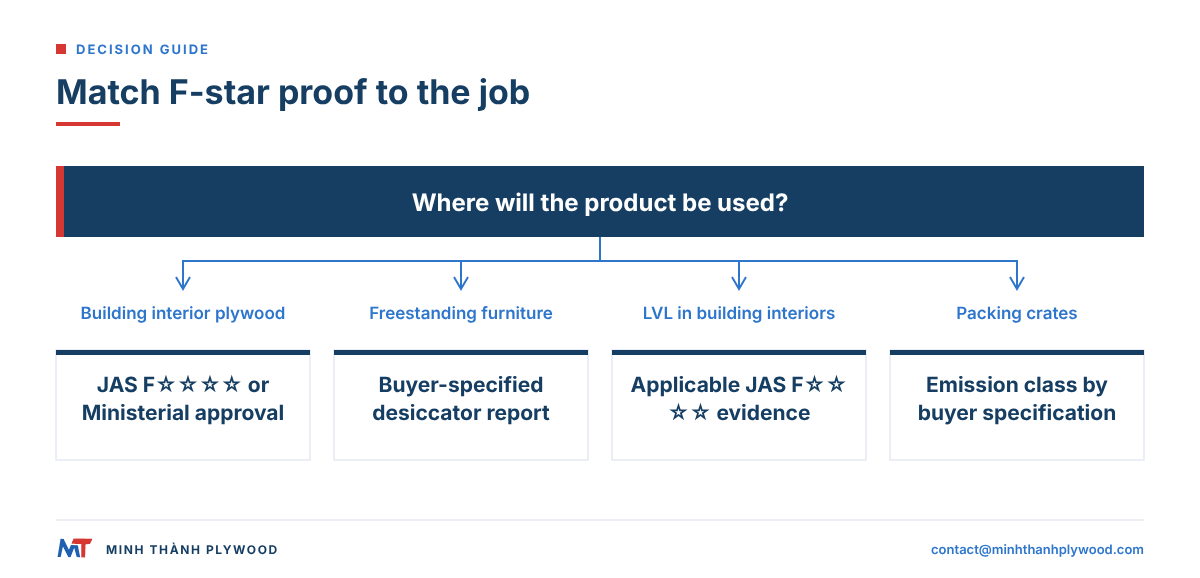
| Plywood for interior finishing, built-in furniture | Yes, by law | JAS F☆☆☆☆ or Ministerial approval |
| Furniture plywood (freestanding) | No, by law | F☆☆☆☆-level test report |
| LVL for building interiors | Yes, by law | JAS F☆☆☆☆ |
| LVL for furniture frames | No, by law | Low-emission test report |
| Packing plywood | No | Emission class by buyer’s specification |
Minh Thanh supplies LVL and packing plywood as well as furniture plywood; the emission evidence for each follows the same rule: the buyer’s method, on the product ordered.
Common mistakes when buying F☆☆☆☆ plywood
Most problems with F☆☆☆☆ orders come from four mismatches between the claim and the use. Each is avoided at the quotation stage.
- A test report where the law needs a mark. Interior finishing in a Japanese building needs JAS or Ministerial approval, not only a lab report.
- The wrong method. A ppm chamber result offered as proof of F☆☆☆☆; the grade is set by the desiccator in mg/L.
- The wrong product. A report on 9 mm panels used for an 18 mm order, or on a different glue.
- An old report. A test from before a change of resin, press or supplier.
Write the method, the product and the date into the order, and the evidence follows the panel you actually receive.
Shipping plywood from Vietnam to Japan
Plywood from northern Vietnam reaches Japanese ports in about 2–3 weeks at sea from Hai Phong, by carrier and route, one of the shortest export lanes for Vietnamese panels. That short lane makes it practical to approve a sample, test it in Japan and still meet a project date.
The order terms at Minh Thanh are the same for Japan as for other markets:
| Term | Detail |
|---|---|
| Minimum order | One 40HC, with mixed specifications by agreement |
| Production | 15–45 days after the 30 % deposit |
| Payment | Balance 70 % against the scanned B/L, or irrevocable L/C at sight |
| Delivery | FOB Hai Phong, CFR or CIF |
| Samples | Free samples |
| Sizes | 1220 × 2440 mm, 1250 × 2500 mm and custom sizes such as 1220 × 2280 mm |
Every shipment is photographed and filmed before loading, and the buyer receives the photos and video, which gives a Japanese importer a record of what left the mill before the lot is checked on arrival.
What to write on your order
Write the use, the formaldehyde grade, the method and the proof on separate lines, so the panel and the paperwork match the Japanese requirement. For furniture plywood with a test report, the line reads:
15 mm × 1220 × 2440 mm; face/back: poplar A/B; core: Styrax, stitched; UF glue at E0 emission; formaldehyde: desiccator test (JIS A 1460) through SGS on the order product, result to F☆☆☆☆ level; use: freestanding furniture; 1×40HC CIF Tokyo.
For interior finishing in a building, replace the formaldehyde line with “JAS F☆☆☆☆ mark on each panel, JAS certificate attached”. Minh Thanh sends free samples and replies within hours: [email protected] or WhatsApp +84 988 586 601. For the wider emission ladder, read formaldehyde-free plywood.
Buyer questions, answered
What is JAS F four star plywood?
It is plywood graded F☆☆☆☆ under the Japanese Agricultural Standard for plywood: the lowest formaldehyde emission class in Japan, with desiccator results of no more than 0.3 mg/L on average and 0.4 mg/L at most.
What does F☆☆☆☆ mean?
F☆☆☆☆, also written F4star or F-four-star, is Japan's top formaldehyde grade for building boards. Under the Building Standard Law, F☆☆☆☆ materials can be used for interior finishing without any limit on area.
What are the JAS formaldehyde grade limits?
In the desiccator test, F☆☆☆☆ is 0.3 mg/L average and 0.4 mg/L maximum; F☆☆☆ 0.5 and 0.7 mg/L; F☆☆ 1.5 and 2.1 mg/L; F☆ 5.0 and 7.0 mg/L.
Can F☆☆☆ plywood be used in Japanese houses?
Yes, but only in a limited area of interior finishing, set by the room type and its ventilation rate. F☆☆☆☆ is the only grade with no area restriction.
Is F☆☆☆☆ the same as E0 or CARB P2?
No. F☆☆☆☆ is measured by the desiccator method in mg/L; E0 and E1 by European chamber or other methods; CARB P2 by ASTM chamber methods in ppm. The grades are not converted into one another.
What certificates does plywood from Vietnam need for Japan?
For building use, a JAS F☆☆☆☆ mark from a mill certified by a registered certifying body, or a Ministerial approval from the Ministry of Land, Infrastructure, Transport and Tourism. Importers also check legality under the Clean Wood Act.
Can a Vietnamese factory supply F four star plywood?
Yes. Vietnamese mills that hold JAS certification from a registered overseas certifying body can mark panels JAS F☆☆☆☆. Other mills supply panels with desiccator test reports for uses outside the Building Standard Law.
Does freestanding furniture need F☆☆☆☆?
The Building Standard Law covers interior finishing and built-in furniture, not freestanding furniture. Japanese furniture brands still usually ask for F☆☆☆☆-level panels in their own specifications.
How is the desiccator test done?
Panel specimens are sealed for 24 hours in a glass desiccator above a dish of water at about 20 °C; the formaldehyde absorbed by the water is measured and reported in mg/L.
Is Minh Thanh plywood JAS certified?
No. Minh Thanh holds CARB P2 / TSCA Title VI certification, with chamber results of 0.014–0.032 ppm, and arranges third-party testing to the buyer's method, such as the JIS desiccator test, through SGS on request.
Does LVL need F☆☆☆☆ in Japan?
LVL used as a building material in Japan is graded under its own JAS standard with the same F-star formaldehyde classes; F☆☆☆☆ is the grade for unrestricted interior use.