
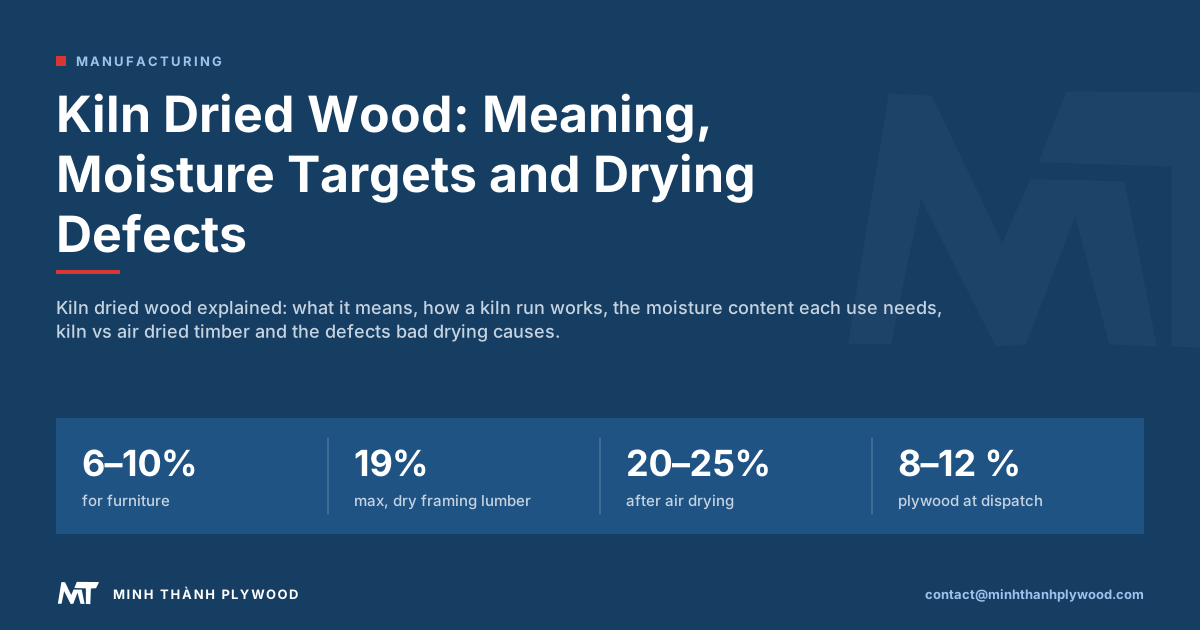
Kiln dried wood is timber dried in a closed chamber where heat, humidity and air flow are controlled until it reaches a target moisture content, usually 6–10% for furniture and interior joinery. Air drying alone rarely gets below 20–25%. This guide from Minh Thanh Plywood gives the moisture targets by use, how a kiln schedule works and the defects that bad drying leaves behind.
What is kiln dried wood?
Kiln dried wood is lumber or timber that has been dried in a closed chamber, a dry kiln, where temperature, relative humidity and air speed follow a schedule until the wood reaches a set moisture content. The kiln does in days what open-air seasoning does in months, and it gets the wood drier than outdoor air can.
Moisture content is the weight of water in the wood as a percentage of its oven-dry weight. Freshly sawn, or green, wood can hold more water than wood substance. Kiln dried lumber for furniture and interior joinery is typically brought to 6–10%; framing lumber to about 15%.
Three things make wood “kiln dried” rather than simply dry:
- Control: heat, humidity and air flow are set by a written kiln schedule, not by the weather.
- A target: the run ends at a stated moisture content, checked on sample boards or by meter.
- Conditioning: a final stage evens out moisture between the surface and the core and relieves drying stress.
The US Forest Products Laboratory’s Wood Handbook (General Technical Report FPL-GTR-190, 2010), chapter 13 is the reference most drying specifications quote, and it is the source of the targets and schedules in this article.
Kiln dried vs air dried timber: the comparison
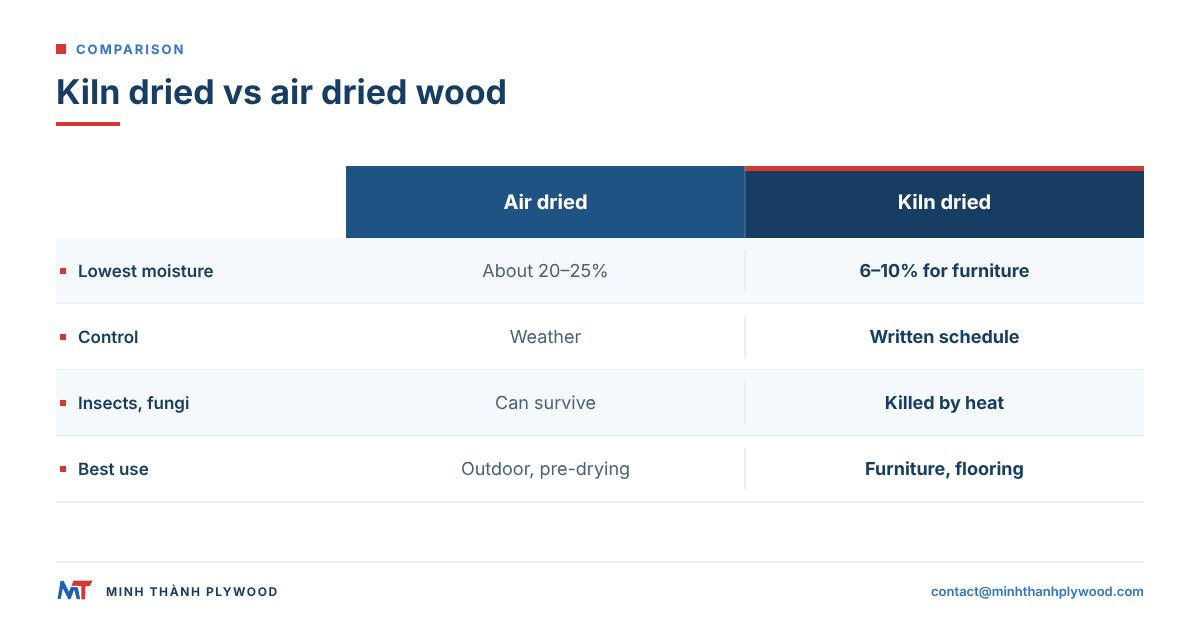
Kiln dried timber is drier, more even and ready sooner than air dried timber; air dried timber costs less energy and is the usual first stage before a kiln. The table puts the two methods side by side on the points buyers ask about.
| Metric | Air dried (seasoned) | Kiln dried |
|---|---|---|
| Lowest practical moisture content | About 20–25% | 6–10% for furniture, lower on request |
| Time for 25 mm boards | 15 to 30 days for light softwoods in good weather, 200 to 300 days for oak or birch in a northern winter | Days to a few weeks, by species and thickness |
| Control | Weather, stacking and yard layout | Written schedule of temperature and humidity |
| Insects and fungi | Can survive; stain can develop in warm, still weather | Killed by the heat of the run |
| Typical defects | Surface checks and end splits in hot wind, blue stain in humid weather | Honeycomb, collapse or case stress if the schedule is too harsh |
| Best use | Outdoor timber, firewood, pre-drying before the kiln | Furniture, flooring, cabinets, joinery, glued products |
Most mills combine the two. Lumber is air dried to 20–25% in the yard, then finished in the kiln, which saves kiln time and energy. The Wood Handbook puts it plainly: air drying evaporates as much water as possible before end use or before kiln drying.
What is seasoned wood? Timber seasoning explained
Seasoned wood is wood that has been dried after sawing so that it no longer shrinks much in use; in everyday usage the word means air dried, stacked outdoors or in an open shed for months. Timber seasoning is the trade’s older word for the whole drying process, natural or in a kiln.
Seasoned lumber is stacked on stickers, thin spacers that let air pass between layers, with a roof or cover over the stack and the ends coated to slow end splitting. How far it dries depends on the climate. In a humid tropical climate, air drying stops at the moisture level of the outdoor air, well above what a heated or air-conditioned room needs.
That is the core limit of seasoning. Wood always moves towards the equilibrium moisture content (EMC) of the air around it. Wood seasoned outdoors reaches outdoor EMC; brought indoors, it keeps drying and shrinking. Kiln drying takes it down to the indoor level before it is machined, glued or installed.
How is wood kiln dried? The steps of a kiln run
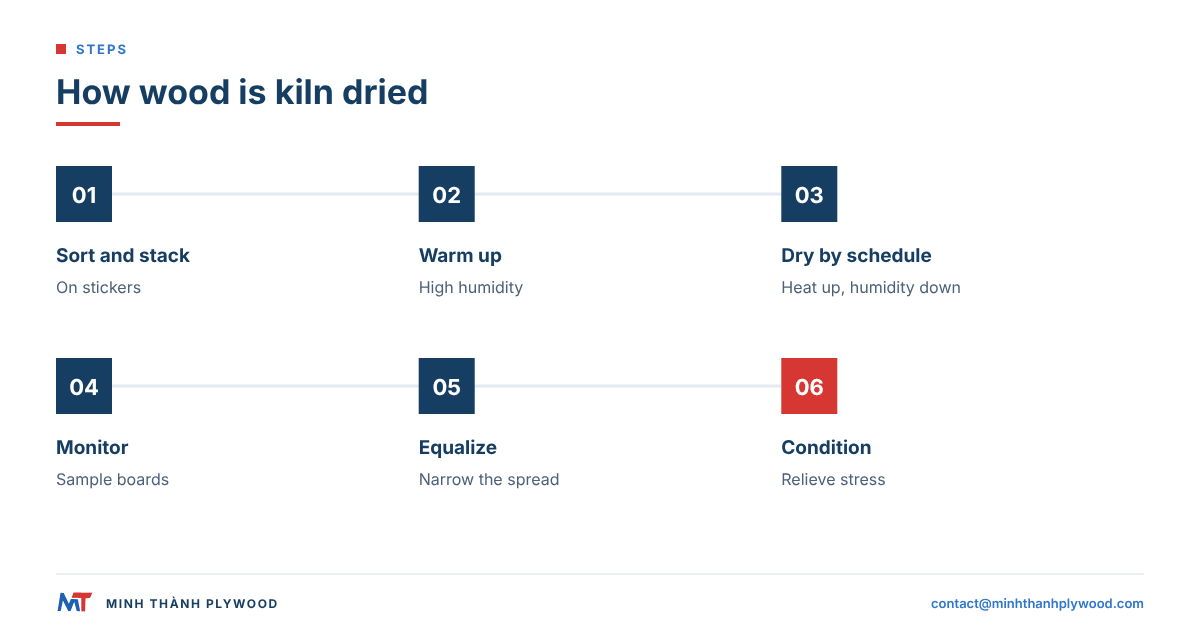
Wood is kiln dried in six steps, from stacking to conditioning. The order is the same in a small dehumidification kiln and in a large steam-heated chamber.
- Sort and stack. Boards of one species and thickness are stacked on stickers, aligned so air can pass evenly across every layer. Sample boards are cut and weighed so the operator knows their starting moisture.
- Warm up. The kiln is brought to its starting temperature at high humidity, so the surface does not dry and crack before the core starts to give up water.
- Dry by schedule. Temperature is raised and humidity lowered in steps as the wood dries, usually set by the moisture content of the sample boards, or by elapsed hours for softwood framing.
- Monitor. Sample boards are weighed through the run, or electrodes in the boards report moisture, until the target is reached.
- Equalize. The wettest boards catch up while the driest stop drying, which narrows the spread across the load.
- Condition. A short burst of high humidity relieves the surface compression left by drying, so boards do not cup or bow when resawn or machined.
The fans reverse direction at intervals so both sides of the stack dry at the same speed. The whole run ends with a check of moisture content against the order.
What is a kiln schedule?
A kiln schedule is the list of temperatures and relative humidities a load goes through, step by step, from green wood to the target moisture content. It is a compromise between drying as fast as possible and staying below the stress that would crack or collapse the wood.
Hardwoods are usually dried on moisture-content schedules. The Wood Handbook’s example for 25 mm black walnut dried to 7% shows the pattern:
| Moisture content of the wood | Dry-bulb temperature | Relative humidity |
|---|---|---|
| Above 50% | 49 °C | 80% |
| 35 to 30% | 49 °C | 40% |
| 25 to 20% | 60 °C | 15% |
| 15 to 7% | 82 °C | 27% |
| Conditioning | 82 °C | 79% |
The kiln starts mild and humid, while the wood is weak and wet, and finishes hot once the wood is dry and strong enough to take it. Softwood schedules change at set hours instead: the Handbook’s schedule for upper-grade Douglas-fir runs from 76 °C at 86% humidity to 82 °C at 36% over about 96 hours, ending at 12%.
What moisture content should kiln dried lumber have?
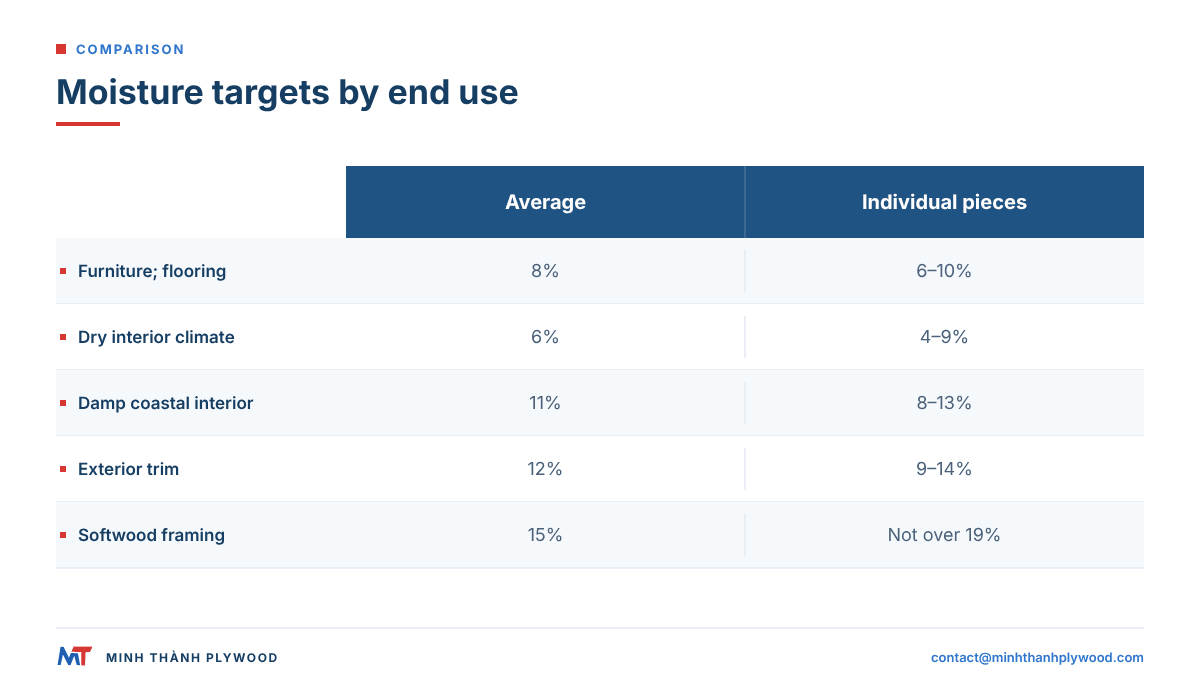
Kiln dried lumber should leave the kiln at the moisture content it will see in service, or slightly below it. For interior woodwork, flooring and furniture in most of the US, the Wood Handbook recommends an average of 8%, with individual pieces between 6% and 10%.
| Use | Average target | Range for individual pieces |
|---|---|---|
| Interior woodwork, flooring, furniture (most of the US) | 8% | 6–10% |
| Interior, dry south-western climate | 6% | 4–9% |
| Interior, damp warm coastal climate | 11% | 8–13% |
| Exterior siding, trim, sheathing | 12% | 9–14% |
| Softwood framing lumber | 15% average | not over 19% |
The figures come from Table 13–2 of the Handbook and from its notes on softwood lumber. Industry practice follows the same logic. Hardwood lumber for furniture, cabinets and millwork is usually dried to 6% to 8%; softwood for appearance uses to 10% to 12%.
Two labels matter on softwood. “Dry” lumber under the American Softwood Lumber Standard may hold up to 19% moisture. A KD 15 grade mark means no more than 15%. Neither is dry enough for furniture.
Which kilns are used to dry lumber?
Three kiln types dry most commercial lumber: track-loaded kilns, package-loaded kilns and dehumidification kilns. All of them force air across the stacks, parallel to the stickers, so every layer dries at a similar rate.
- Track-loaded kilns: lumber is stacked on kiln trucks that roll in and out on rails. Most softwood lumber in the US is dried this way.
- Package-loaded kilns: stacks are placed by forklift. They are common for hardwood lumber and are usually heated by indirect steam.
- Dehumidification kilns: instead of venting humid air, they condense the water on cold coils, which saves heat at lower temperatures.
The Handbook separates conventional schedules, below 100 °C, from high-temperature schedules above 110 °C, used mainly for softwood framing. A high-temperature run dries Southern Pine 2 by 4 to 2 by 10 inch lumber to 15% at a constant 116 °C. Furniture hardwoods are never dried that hard.
What defects does bad kiln drying cause?
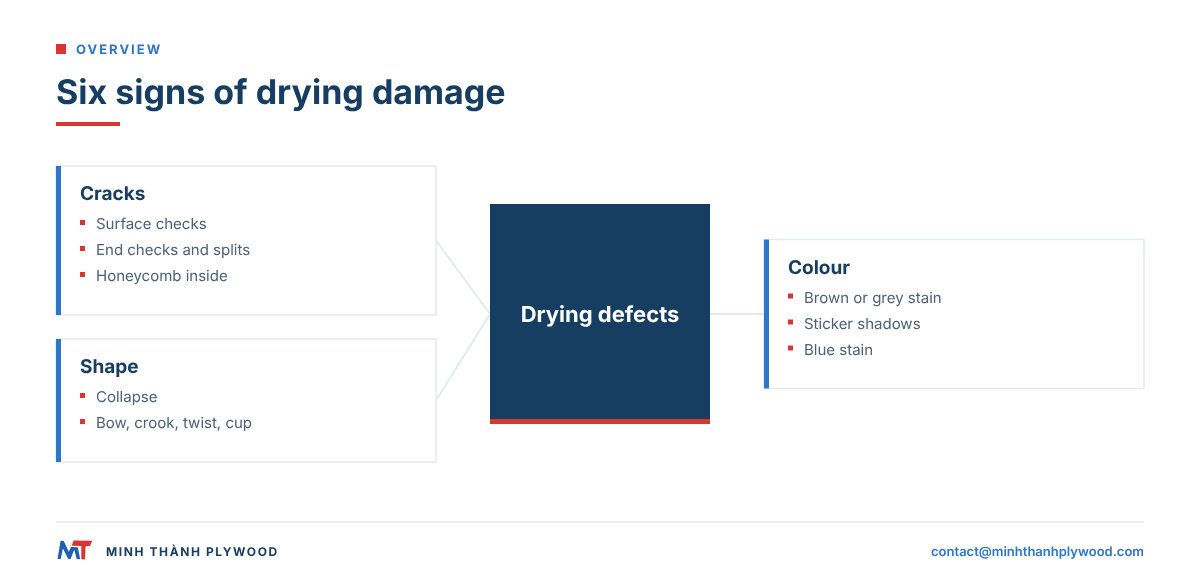
Bad drying causes six main defects: surface checks, end checks, honeycomb, collapse, warp and discoloration. Each one points to a step in the schedule that ran too fast, too hot or too slow.
| Defect | What you see | Usual cause |
|---|---|---|
| Surface checks | Fine cracks on the face of flatsawn boards | Humidity too low early in drying; the shell dries and shrinks too fast |
| End checks and splits | Cracks at board ends | Fast drying through the end grain; no end coating |
| Honeycomb | Internal cracks found only when the board is cut | Temperature too high for too long while the core is still wet |
| Collapse | Washboard grooves or excess thickness loss | Cells crushed by heat in wet wood, common in some dense species |
| Warp (bow, crook, twist, cup) | Boards out of flat or out of square | Uneven shrinkage, reaction wood, poor stacking or sticker spacing |
| Discoloration | Brown stain, grey cast, sticker shadows, blue stain | Kiln too hot, initial drying too slow, or fungi in wet sapwood |
The cause behind most of them is drying stress. Early on, the dry shell is in tension and the wet core in compression; later the stresses reverse. A schedule that respects this keeps the stress below the strength of the wood at each temperature.
How do you check kiln dried timber on delivery?
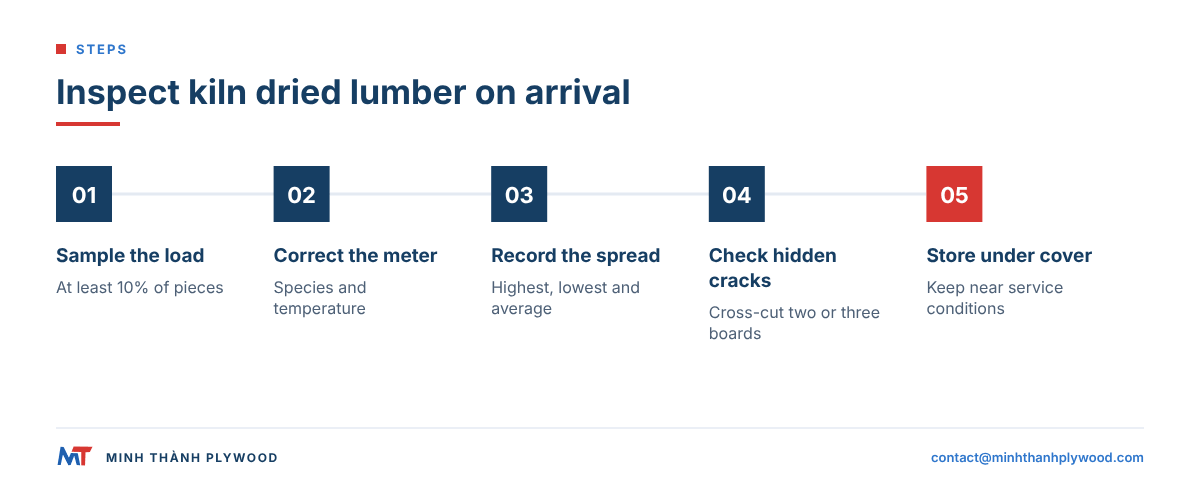
Check kiln dried timber with a moisture meter on at least 10% of the pieces, taken at random from the load. The Wood Handbook treats the lot as satisfactory when the average is within 1% of the target and every piece falls inside the individual limits.
What to note on the receiving sheet:
- Meter type. Resistance meters read reliably from about 6% to 30%; dielectric meters from about 4% to 30%. Readings above 30% show only that the wood is wet.
- Species and temperature corrections. Apply the meter’s species setting. For resistance meters, add or subtract about 0.5% for each 5.6 °C of difference from the calibration temperature.
- Spread. Record the highest and lowest piece, not only the average; a wide spread means poor equalization.
- Defects. Cut two or three boards across the middle to look for honeycomb, which never shows on the surface.
- Storage. Keep the timber covered and off the ground, in conditions close to where it will be used.
Is kiln dried wood better, and is it treated?
Kiln dried wood is the better choice for anything used indoors, glued or finished, because it arrives near its service moisture content and stays dimensionally stable. It also arrives free of live insects and fungi, which the heat of the run kills.
The benefits buyers pay for:
- Stability: less shrinkage, cupping and opening of joints after installation.
- Glue and finish: adhesives and coatings bond best to wood at a known, even moisture content.
- Lower weight: dry wood weighs less to ship and handle.
- Strength: wood gets stronger as it dries below the fibre saturation point.
The limits are cost and handling. Kiln time and energy add to the price, and a schedule that is too harsh causes the defects above. Kiln dried wood is not treated: lumber labelled KDAT, kiln dried after treatment, was pressure-treated first and dried again, because the preservative wets the wood. For outdoor timber exposed to rain, kiln drying alone adds little.
What moisture should kiln dried firewood be?
Kiln dried logs and firewood are dried in a kiln to burn cleanly; the usual target is 20% moisture content or less. Wet wood burns cooler, smokes more and tars chimneys.
In England, the Air Quality (Domestic Solid Fuels Standards) (England) Regulations 2020 require wood fuel sold in units under 2 m³ to have a moisture content of 20% or less. Kiln dried oak, ash and birch logs are sold against that limit, often with a “Ready to Burn” label.
Firewood kilns run simpler schedules than lumber kilns because appearance does not matter; checking and splitting are accepted. The moisture check is the same: a meter on a freshly split face, not on the dry outer surface.
How does a plywood mill dry its veneer?
A plywood mill dries veneer instead of boards: rotary-peeled sheets about 1.4–2.0 mm thick for the core and 0.2–0.5 mm for faces go through a veneer dryer before gluing. The physics is the same as in a lumber kiln; the scale is minutes, not days, because the sheets are thin.
The same rules apply. Veneer dried too wet steams in the hot press and causes blisters and weak bonds. Veneer dried too hard turns brittle, splits at the lay-up table and takes glue unevenly. Moisture spread across a lay-up shows up later as warp, exactly as uneven boards do in a kiln.
At Minh Thanh Plywood in Ha Hoa, Phu Tho, veneers and finished panels are dried to 8–12 % moisture content at dispatch, the normal range for furniture plywood. Furniture panels are then pressed twice as standard: the core board is pressed and calibrated, then face and back are pressed on, which keeps the sheet flat as its moisture settles. Our manufacturing process shows the steps from peeling to packing.
What does kiln drying mean for your plywood order?
For a plywood or panel order, the drying question becomes one line in the specification: the moisture content at dispatch. Put it in writing with the method of measurement, and check it on arrival as you would kiln dried lumber.
What to specify and check:
- Moisture at dispatch: 8–12 % for furniture and interior plywood, measured by meter on the sheet face.
- Glue and emission: UF glue at E0 emission for furniture panels; the bond and the emission class are separate lines.
- Flatness: a calibrated core and a balanced build; ask whether faces are pressed on a calibrated core.
- Packing: wrapped packs, so the panels do not take up water in transit.
- Storage on arrival: unwrap and acclimatize panels in the room where they will be machined.
Minh Thanh supplies furniture and interior plywood on white Styrax or Eucalyptus cores, sanded to ±0.2–0.3 mm. The US limit for veneer-core hardwood plywood is 0.05 ppm under 40 CFR 770.10. Minh Thanh holds CARB P2 / TSCA Title VI certification as ICTT mill number 23024. See furniture plywood from Vietnam for builds and sizes, and send your specification for a quote.
Buyer questions, answered
What does kiln dried mean?
Kiln dried means the wood was dried in a heated chamber with controlled humidity and air flow until it reached a target moisture content. For furniture and interior joinery that target is usually 6–10%, against 20–25% for air drying alone.
What is the difference between kiln dried and seasoned wood?
Seasoned wood is usually air dried in stacks outdoors or under a roof, which brings it down to about 20–25% moisture content. Kiln dried wood finishes the job in a controlled chamber and reaches the lower moisture content interior uses need.
How long does it take to kiln dry wood?
Days to a few weeks, depending on species, thickness and starting moisture. The Wood Handbook's time-based schedule for 25–50 mm Douglas-fir runs about 96 hours to 12% moisture content; slow hardwoods such as oak take much longer.
Is kiln dried wood better than air dried wood?
For indoor furniture, flooring and joinery, yes: only a kiln reliably reaches 6–10% moisture content, and it kills insects and fungi in the process. Air drying costs less energy and suits outdoor uses and pre-drying before the kiln.
What moisture content should kiln dried lumber be?
For interior woodwork, flooring and furniture in most of the US, the Wood Handbook recommends an average of 8% with individual pieces between 6% and 10%. Framing lumber is dried to an average of 15% and may not exceed 19% to be called dry.
Does kiln dried wood still shrink?
Kiln dried wood still moves with the air around it, but much less. It shrinks or swells only as far as the gap between its moisture content and the equilibrium moisture content of the room, which is why wood is dried to its service conditions.
Is kiln dried lumber treated?
No. Kiln drying removes water; it adds no preservative. Lumber sold as KDAT, kiln dried after treatment, was pressure-treated first and then dried again, because the treatment wets the wood.
What moisture content should kiln dried firewood have?
Firewood burns cleanly at 20% moisture content or less. In England, wood fuel sold in units under 2 m³ must meet that 20% limit under the Air Quality (Domestic Solid Fuels Standards) Regulations 2020.
How do you check whether wood is really kiln dried?
Measure it with a moisture meter on at least 10% of the pieces. If the average is within 1% of the target and every piece is inside the individual range, the Wood Handbook treats the lot as satisfactory.
Is plywood made from kiln dried wood?
Plywood is made from veneer, which is dried in a veneer dryer before gluing, the panel equivalent of a kiln. At Minh Thanh, veneers and finished panels are dried to 8–12 % moisture content at dispatch.