
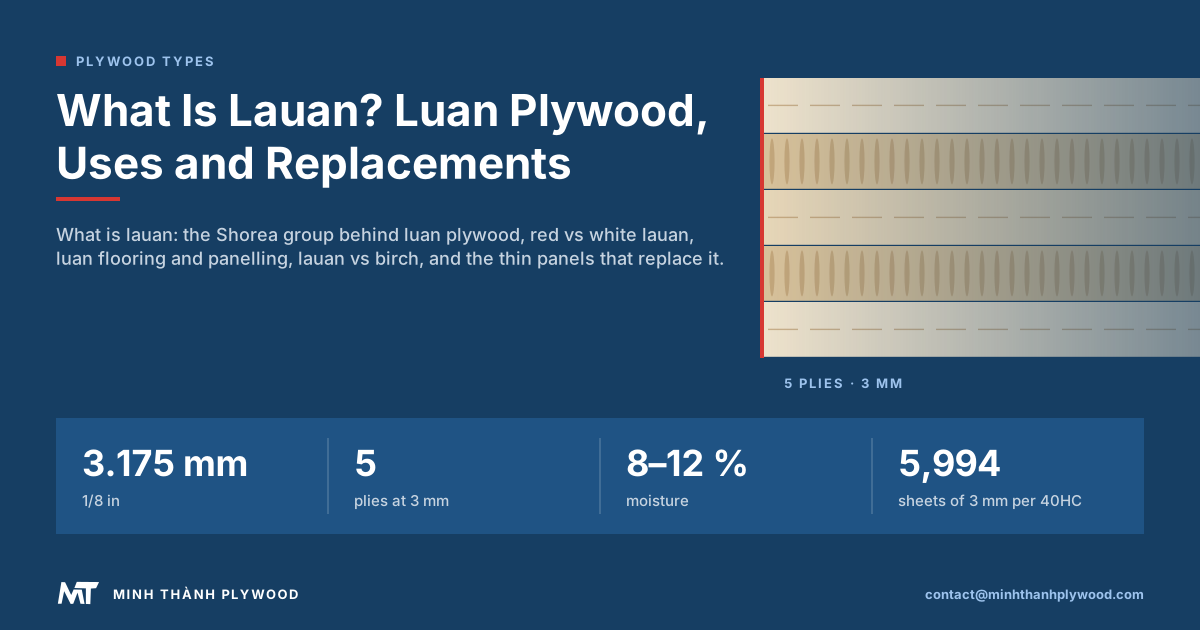
Lauan is a trade name for light tropical hardwoods of the Shorea group, also sold as meranti or Philippine mahogany. Lauan plywood, or luan, is a thin panel faced with that wood, used for underlayment, door skins, wall panelling and crafts. As lauan logs grow scarce, Minh Thanh Plywood and other mills supply 5-ply thin plywood with bintangor, okoume or poplar faces for the same jobs.
What is lauan?
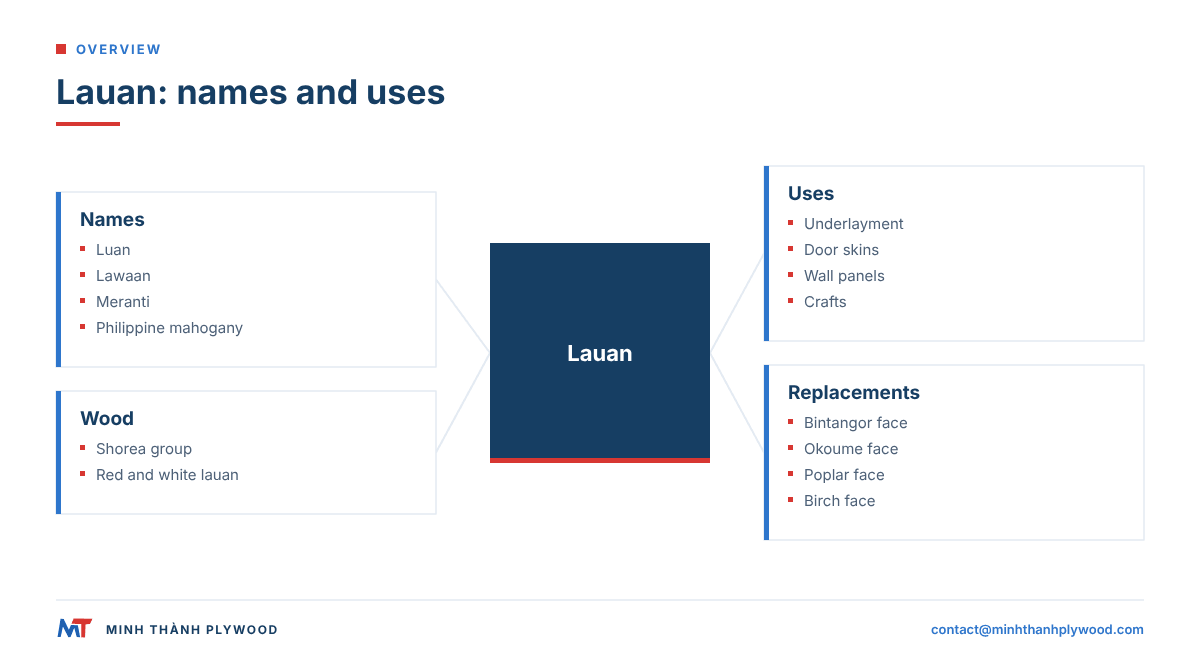
Lauan is a trade name for several light tropical hardwoods of the Shorea group, native to the Philippines, Malaysia and Indonesia. The same wood is sold as meranti, lawaan or, in older trade, Philippine mahogany. In a timber yard, “lauan” or “luan” now usually means a thin plywood sheet faced with that wood.
The names cover one family of trees (Dipterocarpaceae) and several species. Buyers meet them under these labels:
| Name | Where it is used | What it means |
|---|---|---|
| Lauan | Philippines, North America | Light hardwoods of the Shorea group; the plywood |
| Luan | North America, retail | The same thin plywood, shortened spelling |
| Lawaan | Philippines | Local name for the same wood |
| Meranti | Malaysia, Indonesia, Europe | Shorea timber graded by colour: red, light red, white, yellow |
| Philippine mahogany | Older US trade | Marketing name; not a true mahogany |
Lauan is not true mahogany, which is the genus Swietenia. The look is similar: pink to red-brown wood with a coarse, open grain. Our meranti plywood guide covers the wider meranti group and its colour grades.
What is lauan plywood?
Lauan plywood is a thin plywood with a lauan (meranti) face veneer, sold mostly in 1/8 in and 1/4 in sheets. It is light, smooth on the face and low in cost per sheet, which made it the standard thin panel in North American homes for decades.
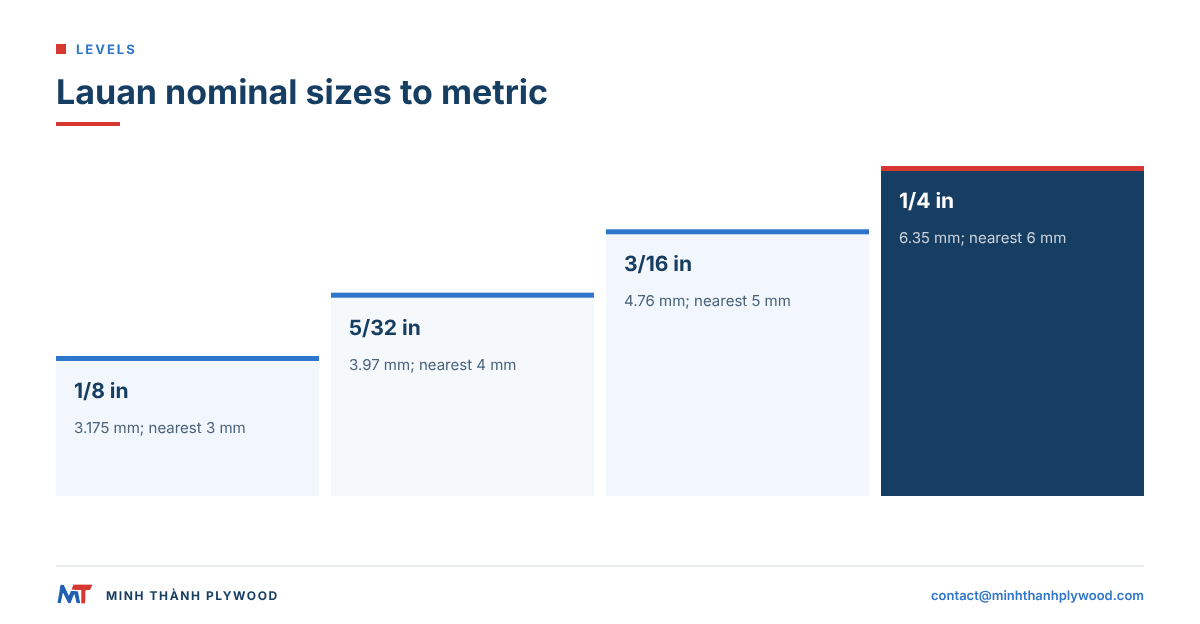
The build behind the face varies by mill and price. A lauan plywood sheet can be 3-ply or 5-ply, with a lauan core or a mixed tropical core. The exact inch sizes convert as follows:
| Nominal | Exact value | Nearest metric sheet |
|---|---|---|
| 1/8 in | 3.175 mm | 3 mm |
| 5/32 in | 3.97 mm | 4 mm |
| 3/16 in | 4.76 mm | 5 mm |
| 1/4 in | 6.35 mm | 6 mm |
A 4x8 sheet in metric is 1220 × 2440 mm. Ask any seller for the actual thickness and the ply count, because a “1/4 lauan” sheet is often thinner than 6.35 mm. See 1/8 inch plywood for how nominal and actual thickness differ.
Red lauan vs white lauan: what is the difference?
Red lauan is the darker, denser and more decorative of the two; white lauan is paler and lighter in weight. Both come from the Shorea group and related genera, and both are used for plywood faces.
- Red lauan: pink to red-brown, the classic “luan” door-skin colour, takes stain toward mahogany tones.
- White lauan: pale grey-brown to straw, mostly painted or covered.
- Grain: both have a coarse, interlocked grain; the face can show a ribbon stripe when quarter-cut.
On a thin panel the difference shows mainly in colour. For a painted or laminated part, either face works. For a stained door skin, ask for red lauan or a reddish replacement face such as okoume or bintangor.
What is lauan plywood used for?
Lauan plywood is used where a light, smooth, low-cost thin sheet is needed: underlayment, door skins, wall panelling, cabinet backs and crafts. The common uses and what each one needs are:
- Flooring underlayment: a flat, sanded sheet with a sound core under vinyl or other resilient floors.
- Hollow-core door skins: a smooth face that takes paint or stain.
- Wall panelling: a decorative face, often grooved or pre-finished.
- Cabinet backs and drawer bottoms: a sound face on one side, an economical back.
- Theatre flats and displays: light sheets that are easy to carry and paint.
- Crafts, models and laser cutting: an even core without voids.
- RV and caravan interiors: light panels that keep vehicle weight down.
Each use sets its own face, core and tolerance. The same rule applies to any thin panel that replaces lauan.
The difference between plywood and lauan is one of scope: plywood is any panel of cross-laid veneers, and lauan plywood is one kind of it, defined by its face wood. A lauan sheet and a poplar-faced sheet of the same build do the same job; the face changes the look, the weight and the way it takes paint.
Luan flooring: is lauan good as underlayment?
Lauan has been used as underlayment under vinyl and other resilient floors for decades, because it is thin, light and smooth. Its weak point is the core: voids or soft spots under a thin vinyl show through as dents and lines.
Many flooring makers now name approved underlayment panels in their installation guides, with rules on face smoothness, core voids and glue. Check that list before choosing any panel, lauan or not.
For a replacement underlayment panel, specify:
- Thickness: 1/4 in or 6 mm for most resilient floors.
- Face: sanded smooth, no open defects.
- Core: solid, cross-laid veneers with no gaps.
- Bond: a moisture-resistant glue where the subfloor can be damp.
- Flatness: a balanced 5-ply build that lies flat.
Luan panelling and luan board for walls
Luan panelling is thin lauan plywood used as a wall covering, either plain for paint or wallpaper, or pre-finished with grooves. “Luan board” is the shop name for the same thin sheets sold for walls, signs and backing.
On a wall, three points matter more than the species: the face takes paint without raised grain, the sheet stays flat on the studs, and the panel meets the fire rules of the building. Ask your supplier for the fire classification the local code needs.
A 5-ply sheet stays flatter on a wall than a 3-ply sheet of the same thickness. A sanded okoume or poplar face takes paint more evenly than a coarse lauan face.
Lauan vs birch plywood: which should you choose?
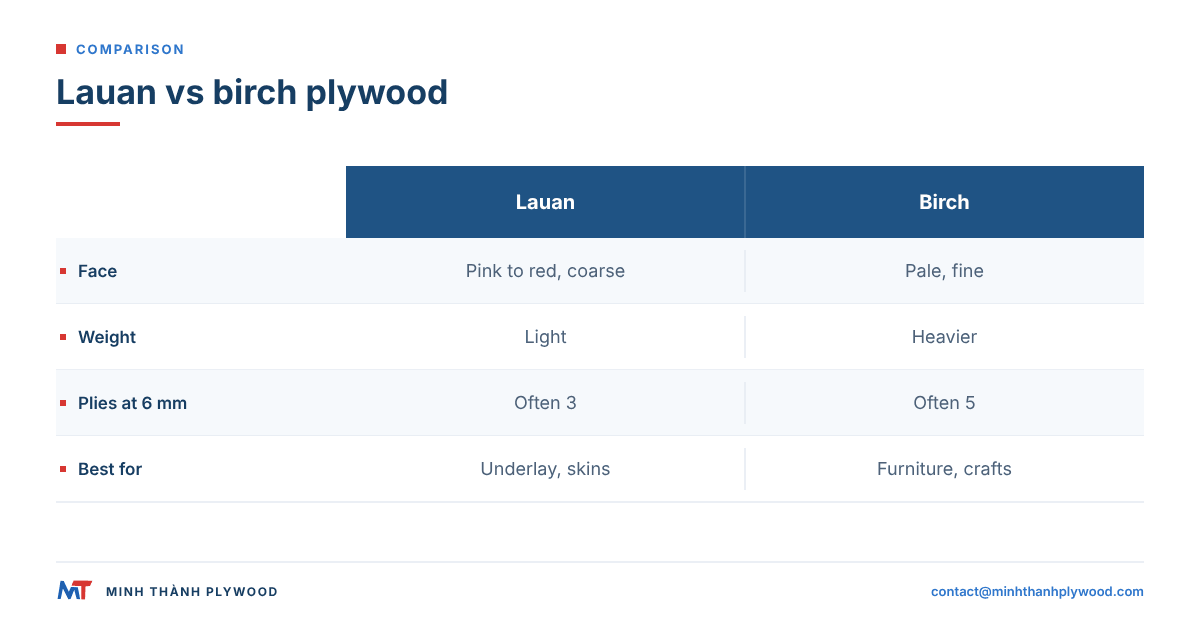
Choose lauan-type plywood for light, low-cost hidden or painted parts, and birch plywood for visible furniture parts that need fine grain and stiffness. The table compares the two on the points buyers ask about.
| Point | Lauan plywood | Birch plywood |
|---|---|---|
| Face | Pink to red-brown, coarse open grain | Pale, fine, even grain |
| Weight | Light | Heavier, denser |
| Plies at 6 mm | Often 3 | Often 5 |
| Stiffness | Lower | Higher |
| Edge look | Mixed tropical core | Clean, even layers |
| Finish | Paint, stain to mahogany tones | Clear finish, paint, stain |
| Cost per sheet | Lower | Higher |
| Best uses | Underlayment, door skins, backs | Furniture, drawers, toys, cabinets |
Our birch plywood carries birch faces over white Styrax or Eucalyptus cores, so the panel is lighter than a full birch build.
Is lauan plywood strong and waterproof?
Lauan plywood is strong enough for supported, light-duty parts but not for structural spans, and it is not waterproof. Its strength comes from the ply count and the core; its water resistance comes from the glue.
Most retail lauan sheets use an interior bond for dry rooms. The bond classes come from BS EN 314-2, which defines the bonding-quality requirements for plywood. For bathrooms, kitchens and RVs, order a moisture-resistant (MR) or phenolic (WBP) bond and seal every edge. Minh Thanh makes MR/melamine-fortified and phenolic bonds to the customer’s specification, and furniture panels use UF glue at E0 emission as standard.
A thin sheet should rest on a frame or a subfloor. For loads, step up in thickness or move to a stiffer face and core.
The disadvantages of lauan plywood follow from the same points. Its coarse face needs filler before a smooth paint finish, its 3-ply builds can show core voids, its interior bond fails in wet rooms, and supply from natural forest makes the face colour vary between deliveries. Fabricators who have switched away from lauan list the same faults. Kerfkore reports that thickness can vary by as much as 1/16 in within one sheet, that the panels warp over time, need prep work and change in appearance from panel to panel. A 5-ply sheet on a plantation core removes each of these:
| Lauan complaint | What a calibrated 5-ply sheet does |
|---|---|
| Thickness varies up to 1/16 in within a sheet | Sanded faces hold ±0.2–0.3 mm thickness |
| Warps over time | Five plies and an even core stay flatter than three plies |
| Heavy prep before paint | A sanded, polished face needs a scuff, not filler |
| Colour varies between deliveries | The face is chosen per order against an approved sample |
Bending lauan: flexible luan plywood
Bending lauan, also sold as flexible luan or bendable luan, is a 3-ply lauan sheet made so the face grain runs along the sheet and the panel bends across it. It is the product many US buyers mean when they search for “bending lauan”: a 4 × 8 ft sheet, commonly 1/4 in or 3/8 in thick, for curved counters, columns, displays and radius cabinet fronts. Cherokee Wood Products lists it as a 4 × 8 ft, 3/8 in sheet and ships stocked items in 2 to 3 business days.
- Bend direction: it bends in one direction only, along either the 4 ft or the 8 ft side depending on the sheet, so check the grain direction before cutting and test a trial piece for radius.
- Limits: it springs back, kinks on tight radii, and needs a glued substrate or laminated layers to hold the curve.
- Replacement: the same job is done by purpose-made flexible plywood or by bending poplar plywood, built with plantation cores and calibrated plies; Minh Thanh’s flexible plywood guide explains how to specify radius and direction before ordering a trial.
For flat, non-bending jobs, a 5-ply thin sheet is the better lauan replacement, as the next sections show.
Why is lauan harder to find, and what replaces it?
Lauan is harder to find because it comes from natural tropical forest, and log supply from the Philippines, Malaysia and Indonesia has narrowed. Thin plywood on plantation cores with a bintangor, okoume or poplar face now fills most lauan jobs.
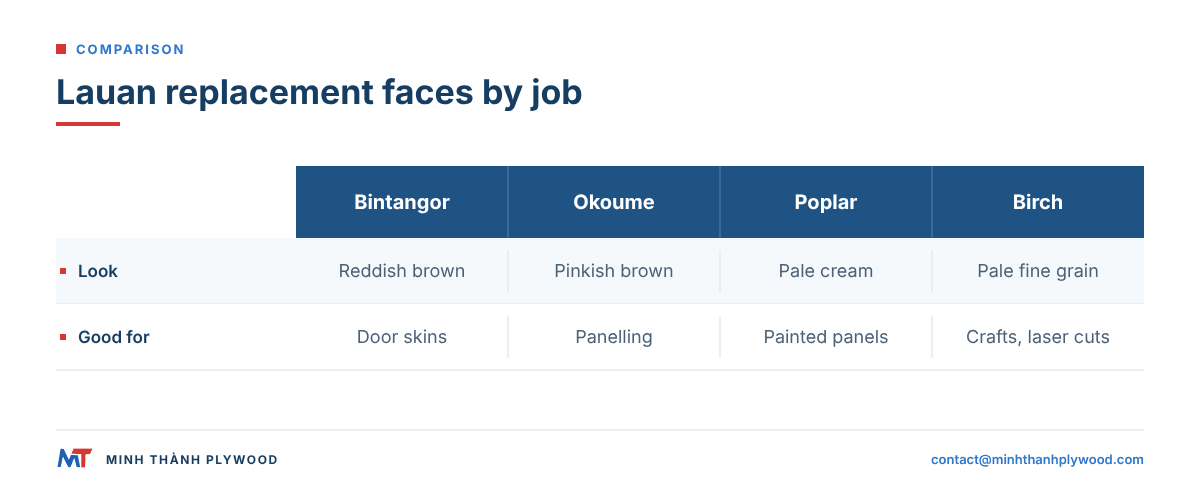
| Replacement face | Look | Fits these lauan jobs |
|---|---|---|
| Bintangor | Reddish-brown, close to red lauan | Door skins, cabinet backs, stained parts |
| Okoume | Pinkish-brown, smooth, light | Door skins, panelling, visible backs |
| Poplar | Pale cream, even | Painted panels, underlayment, laminated parts |
| Birch | Pale, fine grain | Crafts, laser cutting, visible furniture parts |
| EV (engineered veneer) | Even, repeatable grain and colour | Decorative panels, furniture backs |
Each of these faces is laid at Minh Thanh over white Styrax or Eucalyptus cores from Vietnamese plantations. The thin plywood price guide compares how each face changes the cost.
Which thin plywood sheets replace a lauan sheet?
A 3 mm sheet replaces 1/8 in lauan, and a 6 mm sheet replaces 1/4 in lauan; 4 and 5 mm fill the steps between. Minh Thanh’s thin plywood is 5-ply in every thickness from 3 to 5 mm.
- 3 mm: one core veneer, two cross-band veneers and two faces.
- 4 mm: three core veneers and two faces; a 4 mm furniture panel uses three 1.3 mm Styrax core veneers.
- 5 mm: three core veneers and two faces, with the core veneers sized to the panel. At 6 mm, the ply count is confirmed with the order.
Five plies at 3 mm give a flatter, stiffer sheet than a 3-ply lauan of the same thickness. Every sheet is dried to 8–12 % moisture before dispatch. Sanded faces hold ±0.2–0.3 mm thickness, down to ±0.2 mm, and commercial sheets ±0.5 mm.
A 40HC on Styrax core takes about 5,994 sheets of 3 mm plywood in 18 packs. Sizes are 1220 × 2440 and 1250 × 2500 mm, and panels can be cut into 4, 6 or 8 pieces for door skins and backs.
Where can you buy lauan plywood?
Buy single sheets of lauan plywood from home centres, lumber yards and timber merchants; buy container loads of thin plywood direct from a mill. In Europe, including Sweden, and in South-East Asian markets such as Cambodia and Laos, thin tropical plywood is sold through panel importers.
| Buyer | Channel | What to ask |
|---|---|---|
| Builder or workshop | Lumber yard, timber merchant | Actual thickness, ply count, glue |
| Door or furniture plant | Panel importer | Same face and core every delivery |
| Importer or distributor | Mill direct, one 40HC or more | Written build, sample, documents |
Importers into the EU also need the due-diligence data that Regulation (EU) 2023/1115, the EU Deforestation Regulation (EUDR), asks for the wood in the panel. Lauan from natural forest needs geolocation of the harvest plots, which is harder to trace than plantation wood. Minh Thanh supplies the EUDR compliance dossier (origin records and geolocation files) with orders. In the US, hardwood plywood with a veneer core is limited to 0.05 ppm formaldehyde under 40 CFR 770.10. Our thin plywood page lists the faces and sizes we make.
How do you order a lauan replacement panel?
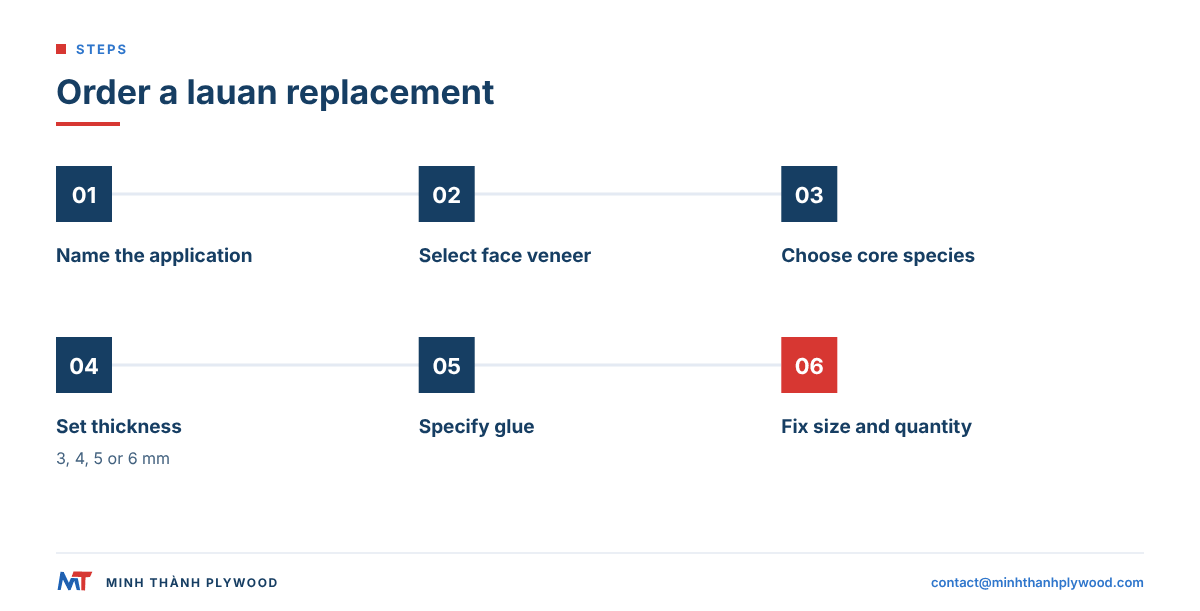
Order a lauan replacement by its job, then write the build in one line. Follow these steps:
- Name the job: underlayment, door skin, panelling, backs or crafts.
- Choose the face: bintangor or okoume for a reddish look; poplar or birch for paint and clear finishes.
- Choose the core: white Styrax for light sheets, Eucalyptus for stiffer ones.
- Set thickness and tolerance: 3, 4, 5 or 6 mm; sanded ±0.2 mm or commercial ±0.5 mm.
- Set the glue: UF glue at E0 emission for dry interiors; MR or phenolic for damp areas.
- Set size and quantity: 1220 × 2440 mm, 1250 × 2500 mm or cut-to-size; one 40HC minimum, mixed specifications by agreement.
Example: 6 mm, 1220 × 2440 mm, bintangor face, white Styrax core, ply count as agreed, UF glue at E0 emission, sanded ±0.2 mm, FOB Hai Phong. Free samples go out with the quotation; send your line to [email protected].
Buyer questions, answered
What is luan?
Luan, or lauan, is the trade name for several light tropical hardwoods of the Shorea group from South-East Asia, also called meranti or Philippine mahogany. In shops, luan usually means thin plywood faced with that wood.
What is luan plywood?
Luan plywood is a thin plywood, usually 3 to 6 mm, with a face of lauan (meranti) veneer. It is light, smooth and cheap per sheet, and is used for underlayment, door skins, wall panels and crafts.
What is lauan plywood used for?
Flooring underlayment, hollow-core door skins, wall panelling, cabinet backs, drawer bottoms, theatre flats and craft or laser-cut work.
Is lauan the same as mahogany?
No. Lauan was sold as Philippine mahogany, but it belongs to the Shorea group, not to the true mahoganies (Swietenia). It looks similar: pink to red-brown with open grain.
What are the differences between lauan and birch plywood?
Lauan plywood is lighter in weight, coarser in grain and cheaper; birch plywood is denser, finer-grained, stiffer and has more plies per thickness. Choose lauan-type panels for hidden or painted parts and birch for visible furniture parts.
Is lauan plywood waterproof?
No. Most lauan plywood is bonded with interior glue for dry use. For damp areas order a moisture-resistant or phenolic (WBP) bond and seal the edges.
Can I use luan as flooring underlayment?
Lauan has long been used under vinyl and other resilient floors, but many flooring makers now list approved underlayment panels. Check your flooring maker's list before you choose a panel.
What can I use instead of lauan plywood?
Thin 5-ply plywood with a bintangor, okoume or poplar face over a plantation core does the same jobs. It is easier to buy in steady volumes than natural meranti.
Where can I buy lauan plywood in Europe?
Timber merchants and panel importers stock thin tropical plywood in single sheets. For container loads, buy thin plywood direct from a mill on a written specification.
How thick is lauan plywood?
Lauan plywood is sold as 1/8 in and 1/4 in sheets in North America, about 3 mm and 6 mm. Export mills make 3, 4, 5 and 6 mm sheets in 1220 × 2440 mm.