
LVL sizes give a thickness (breadth), a depth and a length: Australia writes depth × breadth (240 × 45 mm) and North America writes thickness × depth (1-3/4 × 11-7/8 in). Structural LVL comes in 35, 45, 63 and 75 mm thicknesses with depths from 90 to 450 mm in Australia, and in 1-3/4 and 3-1/2 inch thicknesses in North America. Minh Thanh Plywood presses component LVL in 1220 × 2440 and 1250 × 2500 mm billets, cut to your drawing.
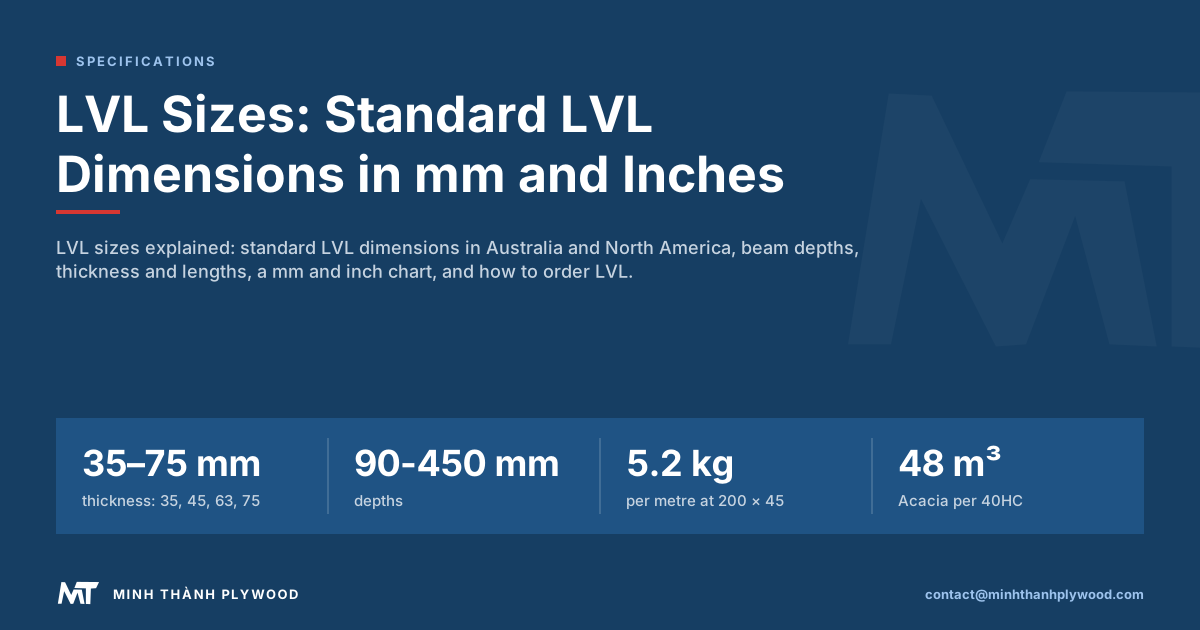
LVL sizes: the short answer
LVL sizes are described by three dimensions: thickness (called breadth in Australia), depth and length. A beam stands on its narrow edge, so its depth is the tall dimension and its thickness the narrow one. Standard structural LVL uses a short list of thicknesses and a longer list of depths; lengths are cut to order.
| Dimension | Australia (metric) | North America (inches) |
|---|---|---|
| Thickness / breadth | 35, 45, 63, 75 mm | 1-3/4 in, 3-1/2 in (billets 5-1/4 and 7 in) |
| Depth | 90 to 450 mm | 5-1/2 to 24 in |
| Length | Cut to order; stocked 2.4 to 6 m | Cut to order; stocked 12 to 40 ft |
Laminated veneer lumber is pressed as a long billet of thin veneers glued with the grain running along the length, then ripped into members. That is why the depth and length lists are long: the mill cuts the billet to the size the market uses.
Minh Thanh Plywood makes component LVL for furniture frames, door components and packaging, pressed in 1220 × 2440 and 1250 × 2500 mm billets and cut to the buyer’s drawing.
How are LVL dimensions written?
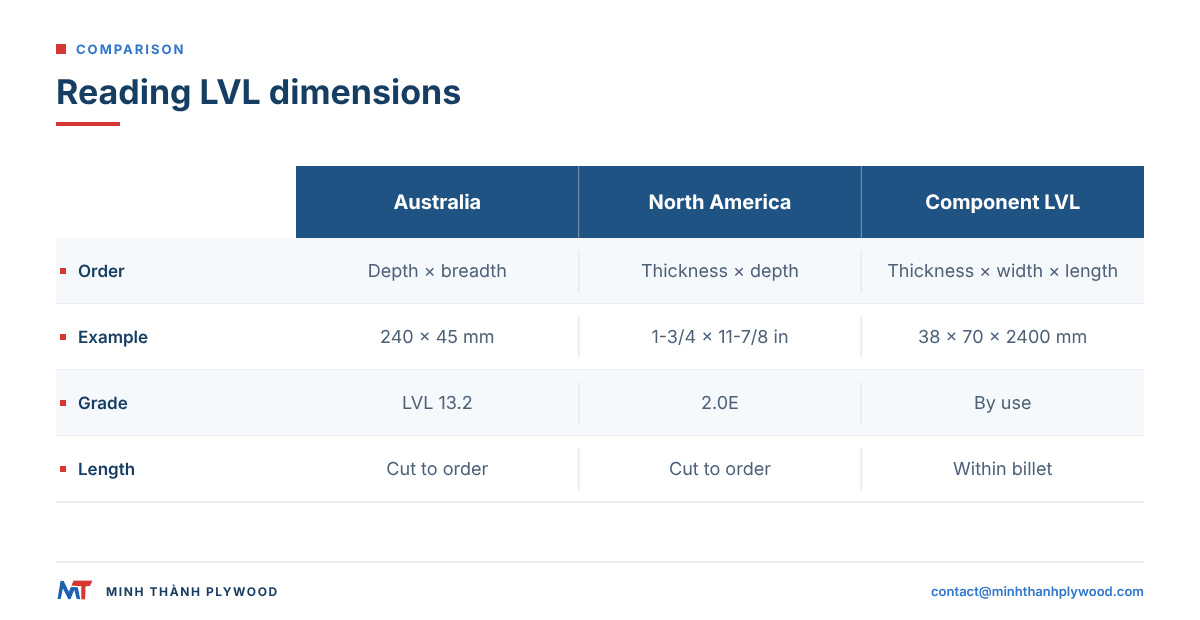
LVL dimensions are written depth × breadth × length in Australia and thickness × depth × length in North America. Read the order of the numbers before comparing two quotes.
- Australia and New Zealand: “240 × 45 LVL 13.2, 6.0 m” means 240 mm deep, 45 mm thick, grade with an MOE of 13,200 MPa, 6 m long.
- North America: “1-3/4 × 11-7/8 LVL 2.0E, 20 ft” means 1-3/4 inch thick, 11-7/8 inch deep, 2.0 million psi MOE, 20 feet long.
- Component LVL: written like timber on a cutting list: thickness × width × length in millimetres, with the grain direction along the length.
Two words cause most mix-ups. A billet is the wide pressed slab before ripping, or a factory-laminated thick beam in North America. A member is the finished piece in the size on the drawing. When a supplier quotes billets, ask what members it will cut and with what saw allowance.
Standard LVL sizes in Australia
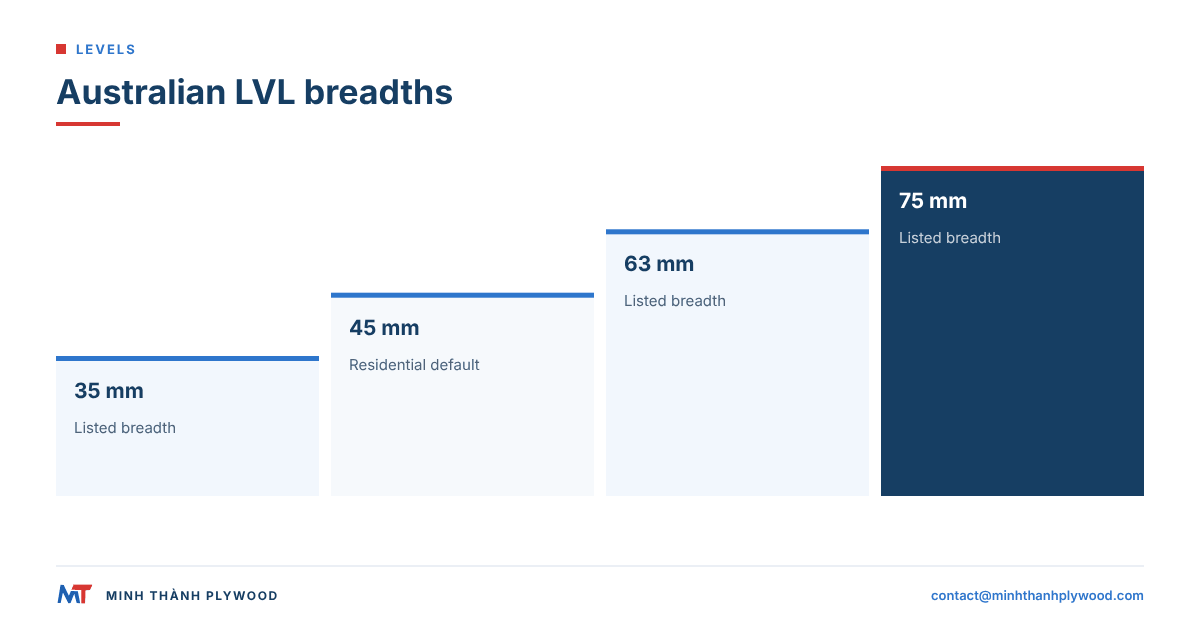
Standard LVL sizes in Australia use breadths of 35, 45, 63 and 75 mm, with 45 mm the residential default, and depths from 90 mm up to 400 or 450 mm, depending on the manufacturer. The table shows one published range for an LVL 13.2 grade.
| Depth (mm) | 35 mm breadth | 45 mm breadth | 63 mm breadth | 75 mm breadth |
|---|---|---|---|---|
| 90 | — | 90 × 45 | 90 × 63 | — |
| 130 | 130 × 35 | 130 × 45 | 130 × 63 | — |
| 150 | 150 × 35 | 150 × 45 | 150 × 63 | 150 × 75 |
| 170 | 170 × 35 | 170 × 45 | 170 × 63 | — |
| 200 | 200 × 35 | 200 × 45 | 200 × 63 | — |
| 240 | — | 240 × 45 | 240 × 63 | — |
| 300 | 300 × 35 | 300 × 45 | 300 × 63 | 300 × 75 |
| 360 | — | 360 × 45 | 360 × 63 | — |
| 400 | — | 400 × 45 | 400 × 63 | 400 × 75 |
Typical stocked grade and treatment. Australian yards name LVL by grade and treatment as well as size. Canterbury Timbers, a Sydney yard, lists 66 in-stock LVL items (October 2026), for example:
| Size | Grade and treatment as stocked | Use |
|---|---|---|
| 90 × 45 | E10 LVL H2 framing, or meyWall LVL framing | Wall framing |
| 100 × 45 joist, 100 × 63 bearer | LVL11 H2, termiSPAN | Floor joists and bearers |
| 90 to 360 × 45 and 63 | LVL E13 H2 | Beams, lintels, rafters |
| Framing for exposed use | H3 treated, LIFECORE H3V | Outdoor and weather-exposed members |
The grade labels follow the stiffness: E13 means a modulus of elasticity of about 13,000 MPa, and Wesbeam, of Western Australia, makes e-beam LVL (E 13,200 MPa, i.e. E13.2) and e-beam+ [F17] (E 14,000 MPa). e-beam+ is sold as a direct size-for-size substitute for F17 hardwood, in stock lengths of 3.6 to 7.2 m and up to 12.6 m by special order. H2 is the termite-treatment hazard class for dry framing, and H3 is for members exposed to the weather above ground. Of the thicknesses, 45 mm is the residential default; the set also includes 35, 63 and 75 mm.
Source: one Australian manufacturer’s LVL 13.2 section list as published on calcs.com (consulted 20 October 2026). A second Australian range lists depths of 90, 130, 150, 170, 200, 240, 300, 360, 400 and 450 mm in breadths of 35, 45, 63 and 75 mm; a higher-grade range lists 90 to 290 mm depths in 35 and 45 mm.
Where Minh Thanh fits is plain: our members stop at the 2,500 mm billet length, so we suit frames, rails and components, while long beams over openings come from Australian stock with the engineer’s grade.
Lengths in Australia are cut to order. Merchants stock 2.4, 3.6, 4.8 and 6.0 m; one F17 LVL range lists standard lengths from 3.6 to 7.2 m with special lengths up to 12.6 m. For a beam over a long opening, order the length from the plan, not from stock.
LVL beam sizes in North America
LVL beam sizes in North America start from one standard ply: 1-3/4 inches thick. Wider beams are built by nailing two, three or four plies together, or bought as factory-laminated billets.
| Thickness | Common depths | How it is used |
|---|---|---|
| 1-3/4 in (44.5 mm) | 5-1/2, 7-1/4, 9-1/4, 9-1/2, 11-1/4, 11-7/8, 14, 16, 18, 20, 24 in | Single ply, or 2–4 plies nailed together |
| 3-1/2 in (88.9 mm) | Same depth range | Factory 2-ply equivalent |
| 5-1/4 and 7 in | Same depth range | Factory-laminated billets, no field nailing |
The depths match the joist depths of I-joist systems (9-1/2, 11-7/8, 14 and 16 in), so LVL headers and rim boards sit flush with the floor. Dealers stock lengths from 12 to 40 ft; longer lengths are ordered from the mill.
A US “2.0E” or “1.9E” label is the grade, the stiffness in million psi, not a size. Two beams of the same size and different grades carry different loads.
Laminated veneer lumber size chart: mm and inches
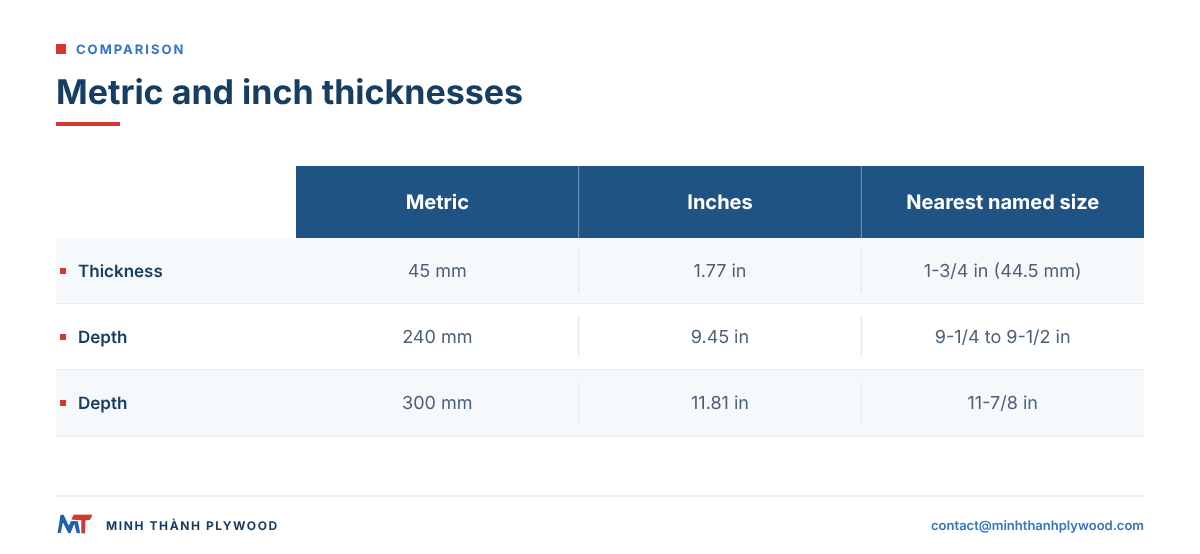
A laminated veneer lumber size chart in both units saves conversion errors when a drawing comes from one market and the supply from another. The table converts the common thicknesses and depths at the exact definition of 1 inch = 25.4 mm (NIST).
| Metric | Inches | Inch size it replaces |
|---|---|---|
| 35 mm | 1.38 in | 1-3/8 in |
| 45 mm | 1.77 in | 1-3/4 in (44.5 mm) |
| 63 mm | 2.48 in | 2-1/2 in |
| 75 mm | 2.95 in | 3 in |
| 90 mm | 3.54 in | 3-1/2 in (88.9 mm) |
| 150 mm | 5.91 in | 5-1/2 to 6 in |
| 200 mm | 7.87 in | 7-1/4 to 8 in |
| 240 mm | 9.45 in | 9-1/4 to 9-1/2 in |
| 300 mm | 11.81 in | 11-7/8 in |
| 360 mm | 14.17 in | 14 in |
| 400 mm | 15.75 in | 16 in |
A conversion is not a substitution. A 300 mm deep Australian member and an 11-7/8 inch US member are close in size, but each has its own design values. For structural use the engineer picks the member from the supplier’s own tables.
LVL timber sizes for non-structural and component work
LVL timber sizes for non-structural work are set by the part, not by a standard list. Furniture rails, door stiles, window and door frames, shelving and packaging runners are cut from billets to the drawing.
| Use | Typical member | What sets the size |
|---|---|---|
| Furniture frame rails | Thickness and width from the frame drawing | Joinery and upholstery |
| Door stiles and rails | Door thickness × stile width | Door leaf and hinge |
| Door and window frame members | Frame profile plus machining allowance | Profile drawing |
| Shelving and benches | Thickness × depth of shelf | Span and load |
| Packaging runners and skids | Runner section × pallet length | Packaging design |
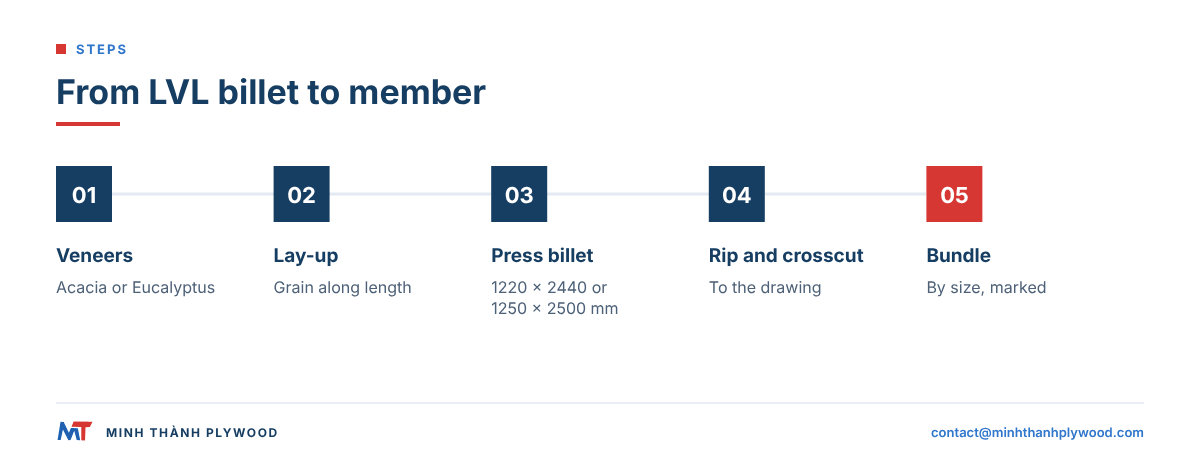
Component LVL is the work a plywood mill does well: it presses veneers along the grain, then rips and crosscuts to a cutting list. A buyer gets straight, stable members with no knots running through the section, in the exact size the line needs.
LVL sizes from a Vietnamese mill: what Minh Thanh cuts
Minh Thanh presses LVL in two billet formats, 1220 × 2440 and 1250 × 2500 mm, from Acacia or Eucalyptus plantation veneers, and cuts members to the thickness, width and length on your drawing. The grain runs along the member, which is the long direction of the billet.
| Line | Minh Thanh LVL |
|---|---|
| Billet formats | 1220 × 2440 and 1250 × 2500 mm |
| Member sizes | Thickness × width × length from the approved drawing, within the billet |
| Longest member | Up to the billet length of 2500 mm |
| Veneer species | Acacia or Eucalyptus plantation timber |
| Density | Acacia about 580 kg/m³; Eucalyptus 650–750 kg/m³ |
| Moisture content | 8–12 % |
| Glue | UF at E0 for interior use, E1 as an option; MR, melamine-fortified or phenolic (WBP) for humid or outdoor use |
| Grain direction | Along the member; cross-bands (LVB) specified separately |
| Packing | Bundles by section and length, marked to the cutting list |
| Documents | EUDR compliance dossier with origin records and geolocation files, for Regulation (EU) 2023/1115 |
Our LVL is for components: furniture rails and frames, door components and packaging members. Structural beams for buildings use an evaluated grade with published design values chosen by the project engineer; for those, write the grade and evaluation on the enquiry so the quote answers that requirement.
Tolerances on LVL dimensions
Tolerances on LVL dimensions are agreed on the drawing for component LVL and set by the product standard for structural LVL. In Europe the product standard for structural LVL is BS EN 14374. In Australia and New Zealand, AS/NZS 4357.1 gives the method for measuring the dimensions and shape of structural LVL.
For a component order, put four lines on the drawing:
- Section tolerance: the thickness and width band your joinery needs.
- Length tolerance: the band for crosscut members.
- Straightness and twist: the limit over the member length, for rails and stiles.
- Machining allowance: whether the member is supplied to finished size or with an allowance your plant removes.
Measure members the same way at both ends: caliper on the section at three points along the length, tape on the length, string line for straightness. Matching methods keeps the conversation about the timber, not the tools.
How much does LVL weigh by size?
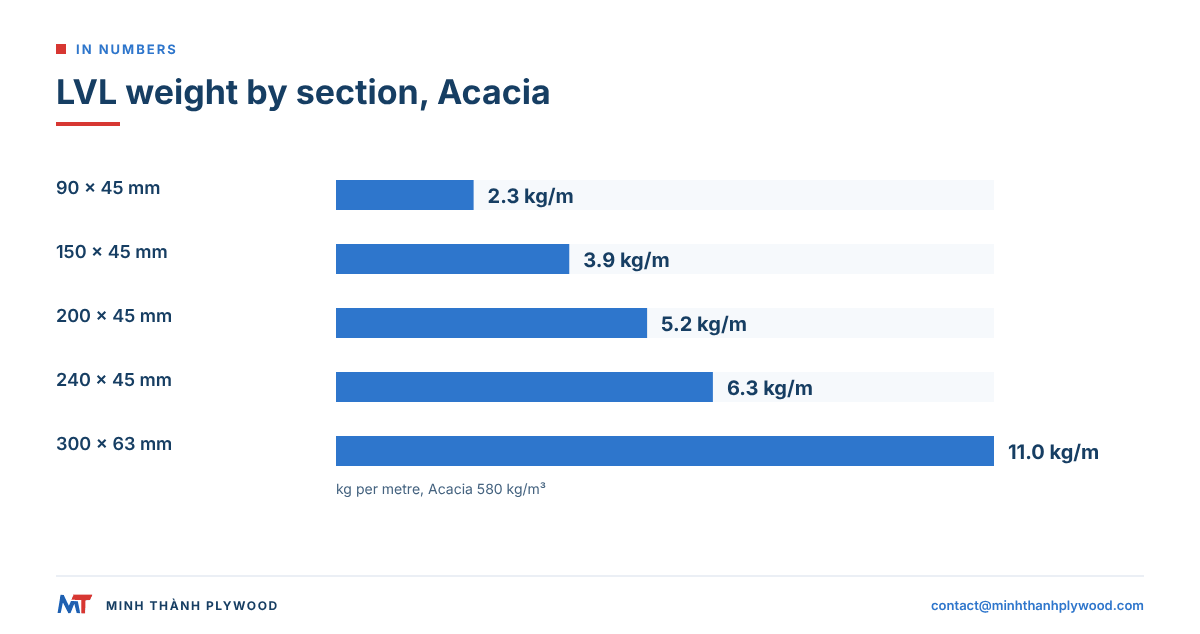
LVL weight by size is section area × length × density. At 580 kg/m³ (Acacia), a 200 × 45 mm member weighs about 5.2 kg per metre; at 650 kg/m³ (Eucalyptus), about 5.9 kg per metre.
| Section (mm) | Acacia, 580 kg/m³ | Eucalyptus, 650 kg/m³ |
|---|---|---|
| 90 × 45 | 2.3 kg/m | 2.6 kg/m |
| 150 × 45 | 3.9 kg/m | 4.4 kg/m |
| 200 × 45 | 5.2 kg/m | 5.9 kg/m |
| 240 × 45 | 6.3 kg/m | 7.0 kg/m |
| 300 × 63 | 11.0 kg/m | 12.3 kg/m |
Weight per metre is useful twice: for handling on site or on the line, and for the container plan, because a 40HC of LVL is limited by weight long before it is full by volume.
How much LVL fits in a 40HC container?
A 40HC of LVL is limited by weight: at a 28,000 kg planning payload, about 48 m³ of Acacia LVL at 580 kg/m³, or about 43 m³ of Eucalyptus LVL at 650 kg/m³, before packing weight is deducted.
If your booking carries a lower payload, the volume falls with it. A 26,000 kg booking, with 25,000 kg allowed for wood and 1,000 kg for packing, takes about 43.1 m³ of Acacia LVL. The piece count follows from your section and length schedule, and the quotation shows it bundle by bundle.
Mixed loads are normal: one 40HC is our minimum, with mixed specifications by agreement, so LVL components can share a container with plywood panels.
How to specify LVL sizes on an order
Specify LVL sizes as a cutting list with one line per member, and add the build lines once at the top. A complete order has these parts:
- Use: furniture frame, door component, packaging runner, or structural beam with its grade.
- Species and density: Acacia or Eucalyptus.
- Glue and emission: UF at E0 for interiors, or MR, melamine-fortified or phenolic (WBP) for the service environment.
- Grain: along the member; any cross-bands written separately.
- Cutting list: thickness × width × length in mm, quantity per size, tolerance, machining allowance.
- Packing: bundle size, marks per size, destination port.
A filled line: “LVL, Eucalyptus veneers, UF at E0, grain along length, 38 × 70 × 2400 mm, 2,000 pieces, section ±0.5 mm, bundled by size, CIF your port.”
Production takes 15–45 days after the 30% deposit; balance 70% against the scanned B/L, or irrevocable L/C at sight; FOB Hai Phong, CFR or CIF. Typical days at sea from Hai Phong are 5–12 to South-East Asia and 15–25 to the Middle East; Japan and Korea take about 2–3 weeks, by carrier and route.
Send the cutting list to contact@minhthanhplywood.com or WhatsApp +84 988 586 601; Lisa replies within hours and free samples go out with the quote. Certificates are on the quality page. See LVL from Minh Thanh for the build and LVL price for how sizes affect cost. Further reading as it is published: what is LVL, LVL beams and LVL strength.
Buyer questions, answered
What are the standard LVL sizes in Australia?
Structural LVL in Australia comes in breadths of 35, 45, 63 and 75 mm and depths from 90 to 450 mm, for example 150 × 45, 240 × 45 and 300 × 63 mm. Lengths are cut to order.
What LVL grades and treatments do Australian yards stock?
Common stock is E10 H2 LVL framing at 90 × 45 mm, LVL11 H2 at 100 × 45 mm joist and 100 × 63 mm bearer, E13 H2 beams from 90 to 360 mm deep in 45 and 63 mm breadths, and H3 treated LVL for exposed use. 45 mm is the residential default thickness.
What are standard LVL beam sizes in the US?
US LVL beams are 1-3/4 inches thick, or 3-1/2 inches, with depths commonly from 5-1/2 to 24 inches. Two or more 1-3/4 inch plies are nailed together for wider beams.
How are LVL dimensions written?
As depth × breadth in Australia (240 × 45 mm) and as thickness × depth in North America (1-3/4 × 11-7/8 in), followed by the length. The depth is the vertical size of a beam.
How long can LVL beams be?
LVL is pressed continuously, so lengths are cut to order. Australian merchants stock 2.4 to 6 m and longer to order; one Australian F17 LVL lists standard lengths of 3.6–7.2 m and special lengths up to 12.6 m.
What thickness is LVL?
Structural LVL is commonly 35, 45, 63 or 75 mm thick in Australia, and 1-3/4 inch (44.5 mm) or 3-1/2 inch in North America. Component LVL is cut to the thickness on the drawing.
What LVL sizes can a Vietnamese mill supply?
Minh Thanh presses LVL in 1220 × 2440 and 1250 × 2500 mm billets from Acacia or Eucalyptus veneers, then cuts members to the thickness, width and length on your drawing.
How much does an LVL beam weigh per metre?
Weight per metre is section area × density. A 200 × 45 mm Acacia LVL member at 580 kg/m³ weighs about 5.2 kg per metre; at 650 kg/m³ Eucalyptus about 5.9 kg per metre.
Is 45 mm LVL the same as 1-3/4 inch LVL?
Almost. 1-3/4 inch is 44.5 mm, so the two are interchangeable in most framing, but the design values belong to the product and grade, not the size.
Can I use any LVL size for a structural beam?
Only a size with published design values for its grade, chosen by the engineer from the manufacturer's tables. Structural LVL is sized by span, load and grade, not by dimension alone.
How much LVL fits in a 40HC container?
Weight sets the limit. At a 28,000 kg payload, about 48 m³ of Acacia LVL at 580 kg/m³, or about 43 m³ of Eucalyptus at 650 kg/m³, before packing weight.