
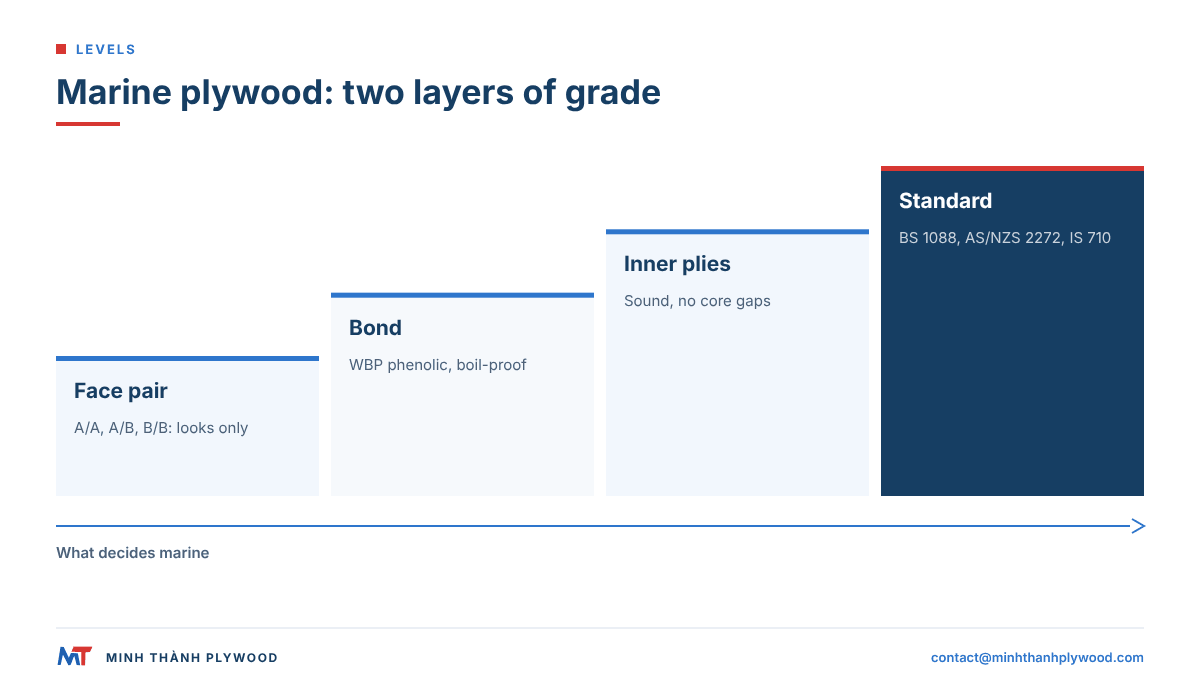
Marine plywood is graded twice: by the standard it is made to (BS 1088, AS/NZS 2272, IS 710 or the PS 1 Marine grade) and by the face/back appearance pair, such as A/A, A/B or B/BB. The standard decides the bond, the core and the defects allowed inside; the face pair only decides the look. Minh Thanh Plywood explains both and how to check a sheet.
Marine plywood grades: the short answer
The grades of marine plywood come in two layers, and a buyer needs both on the order.
- The standard grade. The panel is made to a named marine standard: BS 1088 in Europe and much of the world, AS/NZS 2272 in Australia and New Zealand, IS 710 in India, or the Marine grade of the US Voluntary Product Standard PS 1. The standard decides the bond, the inner veneers, the gaps allowed in the core and the species.
- The appearance grade. The face and back carry letter grades, written as a pair: A/A, A/B, B/B in most Asian and US catalogues, or B/BB, BB/BB in birch-based systems. The letters decide how many repairs, knots and colour changes you see.
A sheet sold as “marine plywood AA” with no standard named has only told you half of its grade. The face letters say nothing about the glue or the core.
What are the different grades of marine plywood?
There are four marine standards a buyer meets in quotations, plus one grade name that is often mistaken for a standard. This table sets them side by side.
| Standard or name | Where it is used | Bond | What it controls inside the panel | Face grades it uses |
|---|---|---|---|---|
| BS 1088 | UK, Europe, export trade | WBP, boil-proof | Durable species, no core gaps, limited repairs; standard and lightweight classes | Single marine face quality; trade adds A/A, A/B labels |
| PS 1 Marine | USA | Exterior (PS 1 section 5.7.2) | Douglas-fir or Western Larch only; inner plies B grade or better; crossband gaps 3.2 mm (1/8 in) or less | A-A, A-B, B-B, HDO, MDO |
| AS/NZS 2272 | Australia, New Zealand | Type A phenolic | Marine veneer and core rules for boat and wet use | Face/back pairs such as A/B and B/B |
| IS 710 | India | BWP phenolic | Marine plywood with boiling-water-proof bond, 72-hour boil test | Single marine quality |
| “BS 6566” | Trade label | WBP bond class | The bond only, from the older British bond standard | None |
The PS 1 row is the most specific in public text. PS 1-22, the current edition published by NIST on 2 October 2023, requires Marine panels to meet every Exterior requirement first, then adds: only Douglas-fir and Western Larch veneers, Grade A faces limited to nine wood repairs per 1220 × 2440 mm sheet, all inner plies B grade or better and full length and width, no more than four crossband gaps or edge splits per 2440 mm of crossband ply, and no filling of those gaps.
BS 1088:2018 is the current edition of the marine plywood standard. The BSI listing for BS 1088:2018 names two classes, standard and lightweight. Its scope covers resistance to biological attack and loss of bond strength; other properties a boat needs, such as stiffness for a given panel, sit with the designer.
Types of marine plywood and how to read them on a quotation
The types of marine plywood differ by standard, species and face pair, so read a marine quotation from the standard down to the face, in this order.
- Standard and edition: “BS 1088:2018, standard class” or “PS 1-22 Marine”. A quote that says only “marine quality” has no standard.
- Species: face, back and inner plies. Okoume, sapele, khaya and meranti are common marine hardwoods; Douglas-fir is the PS 1 Marine species.
- Construction: thickness, number of plies and the thickness of each ply.
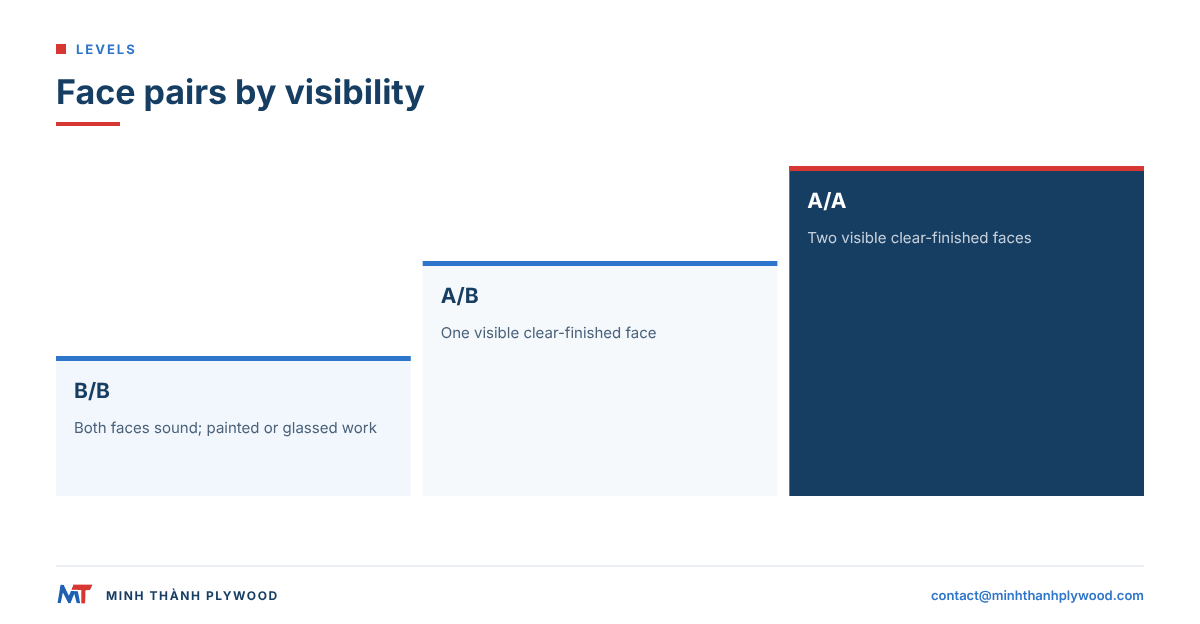
- Face/back pair: A/A for two clear-finished sides, A/B or B/B for painted or epoxy-coated work.
- Mark and papers: the stamp on the sheet, the bond test report and, where the builder needs it, a third-party mark such as Lloyd’s Register.
The face pair comes last because it is the cheapest thing to change. A B/B face on a true BS 1088 sheet is still marine plywood. An A/A face on an interior core is not.
What do the face letters AA, AB and BB mean on marine plywood?
Face letters describe the outer veneers only. On marine plywood they follow the same logic as other plywood, with stricter limits under the marine standard.
| Face grade | What you see | Typical use on a boat or wet job |
|---|---|---|
| A | Clean, smooth, few small repairs matched for colour | Clear-varnished brightwork, cabin joinery |
| B | Sound and solid, small tight knots, more repairs, colour change allowed | Painted hulls, decks under epoxy and glass |
| C (exterior only) | Knotholes and splits within limits | Not a marine face; used on exterior sheathing |
So A/A means both sides are A quality, A/B means one A face and one B back, B/B means both sides are B quality. Under PS 1-22, Grade A allows up to 18 repairs on regular panels but the Marine grade cuts that to nine wood repairs per full sheet. That cut is what “marine” adds to the same letter.
Birch-based catalogues use a different ladder (B, BB, CP, C). Our own birch faces are graded D+, D and E in Vietnam and quoted as pairs such as D+/D, comparable to B/BB in that ladder. These are appearance grades for furniture panels, not marine grades.
Marine rated plywood vs exterior plywood: what changes inside
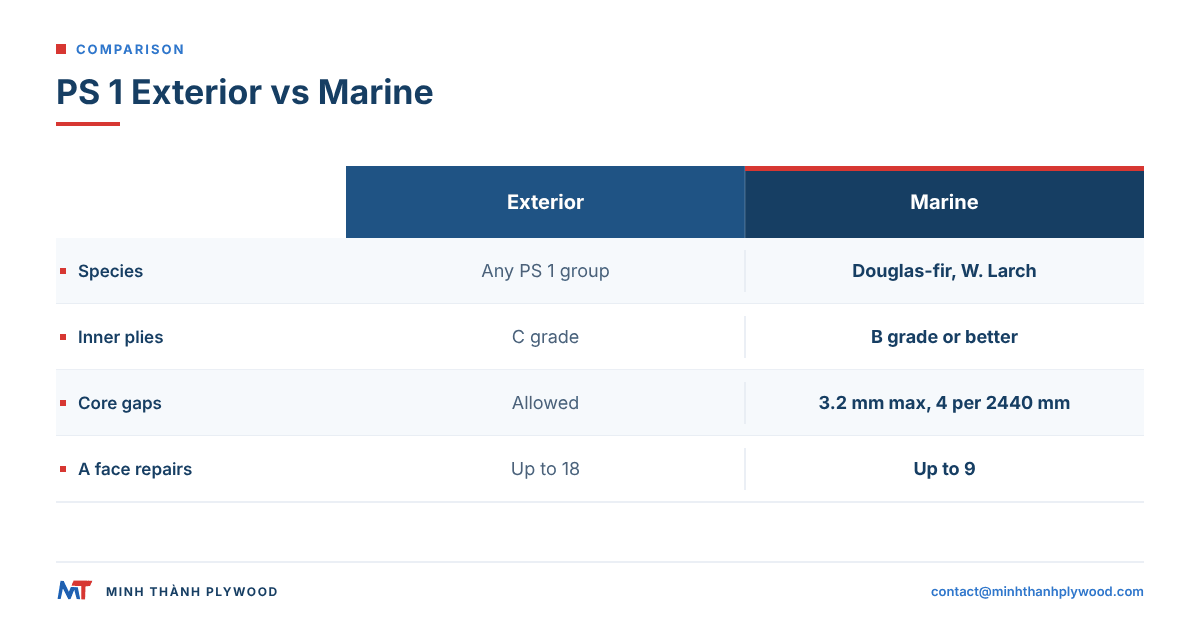
Marine and exterior plywood share a waterproof bond; the difference is inside the sheet. PS 1-22 shows the gap clearly because it grades both.
| Point | PS 1 Exterior (for example B-C) | PS 1 Marine |
|---|---|---|
| Bond | Exterior | Exterior |
| Species | Any PS 1 species group | Douglas-fir or Western Larch only |
| Inner plies | C grade minimum | B grade or better, full length and width |
| Crossband gaps | Allowed within workmanship limits, may be filled | 3.2 mm (1/8 in) maximum, four per 2440 mm, no filling |
| A face repairs | Up to 18 | Up to 9 wood repairs |
| Faces allowed | A, B, C, C plugged | A or B, or overlays (HDO, MDO) |
A gap in a core veneer is harmless in a wall. In a hull panel it becomes a pocket where water collects, the wood swells and the coating cracks. That is why marine standards spend their rules on the inner plies, which a buyer never sees.
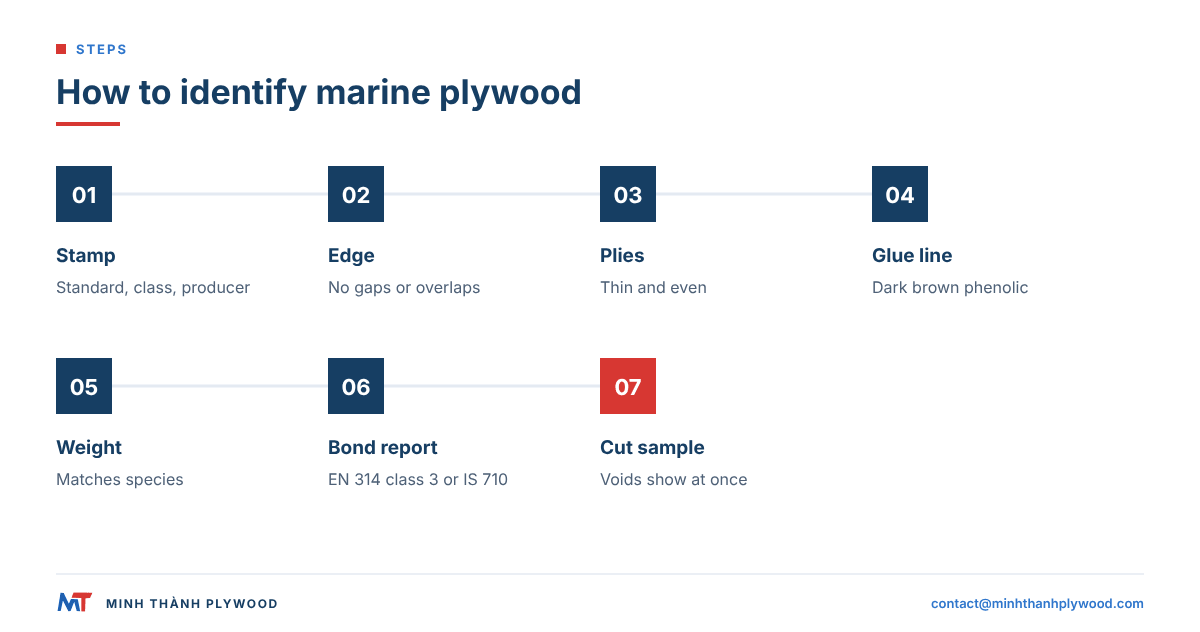
How to identify marine plywood
You identify marine plywood by its mark, its edge and its papers, in that order. Check these before you pay a marine price: a real sheet carries the standard, the class or grade and the producer, and shows continuous inner plies along all four edges.
- Find the stamp. A real marine sheet is marked with the standard, the class or grade and the producer. “Marine” written in marker pen is not a mark.
- Read the edge. Look along all four edges. Marine panels show continuous inner plies with no open gaps or overlaps; an edge with dark holes between plies is a core gap.
- Count the plies. Marine panels use more, thinner plies than commercial plywood of the same thickness, and the plies look even.
- Look at the glue line. A phenolic (WBP) glue line is dark brown to black. A pale glue line usually means urea or melamine glue.
- Weigh it against the species. Okoume marine panels are light by design and meranti panels heavy; a sheet much lighter than its stated species suggests a soft filler core.
- Ask for the bond report. A test to EN 314 bonding class 3, AS/NZS 2098 for Type A, or the IS 710 boil test should match the product and its date.
- Cut a sample. Saw an offcut through the middle. Voids, overlaps and thick filler show at once.
If the stamp, the edge and the report all agree, the sheet is what it says. If one is missing, ask before loading.
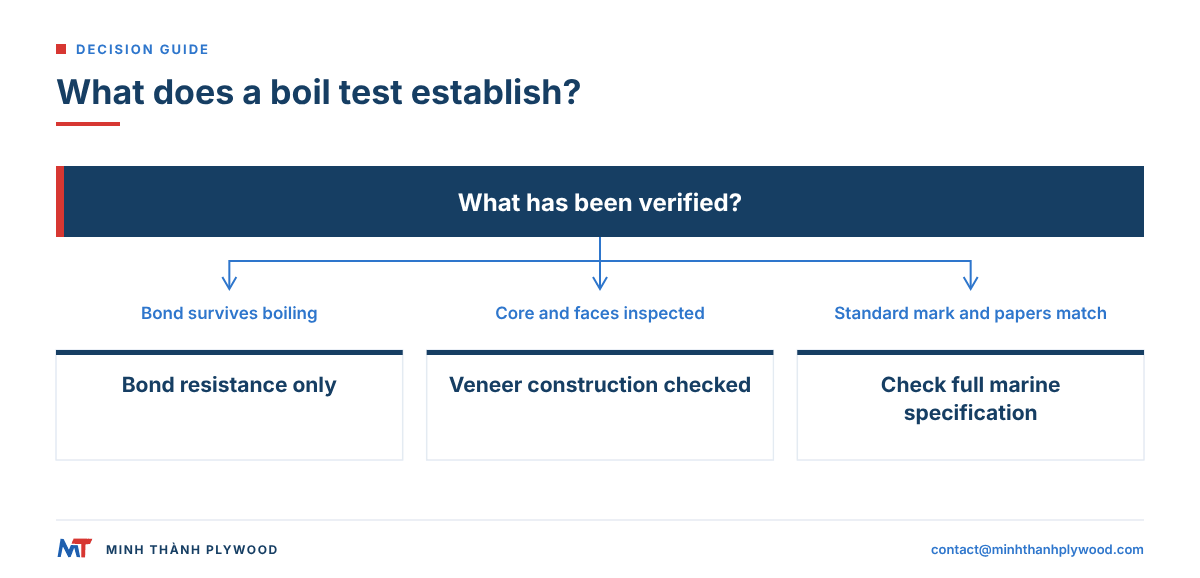
What does the boil test prove about marine plywood?
The boil test proves that the glue line survives water and heat; it says nothing about the core or the faces. It is a bond test, run on small samples cut from the panel.
- EN 314 bonding class 3, the European exterior class, is tested after cyclic boiling and drying, then the samples are pulled apart in shear. EN 314-2 sets the pass values.
- IS 710 uses a 72-hour boil for marine plywood.
- Workshop check: boiling an offcut for several hours and trying to split the plies with a chisel is a quick screen, not a certificate.
A 72-hour boil is a traditional proof of a phenolic bond. On its own it does not prove the panel is marine: a sheet with a boil-proof bond and gaps in its core passes the boil test and still fails as marine plywood. The bond is necessary; the core rules make it marine.
Marine grades by part: what to order for each job
Choose the marine grade by what the part does and how it is finished. This is how builders usually split an order.
| Part | Exposure | Grade to order | Face pair |
|---|---|---|---|
| Hull planking, transom | Immersed, structural | BS 1088 standard class, or AS/NZS 2272 | B/B under epoxy and glass; A/B if one side is varnished |
| Deck, cockpit sole | Wet, walked on | BS 1088 or PS 1 Marine | B/B with non-slip coating |
| Bulkheads | Damp, structural | BS 1088 standard class | A/B: the A face to the visible side |
| Cabin furniture | Humid, not wetted | BS 1088 lightweight class, or a good exterior panel by the designer’s choice | A/A or A/B |
| Dock and pontoon parts | Wet, outdoor | Exterior or marine by budget, always sealed | B/B or C-plugged exterior |
The designer’s panel schedule wins over any table. The table only shows where buyers overspend (A/A faces under paint) and where they underspend (exterior plywood in a hull).
Marine plywood sizes, species and price by grade
Marine plywood is sold in 4 × 8 ft sheets and, for boats, 5 × 12 ft sheets, in thicknesses from 1/4 to 1 inch (6 to 25 mm), with 1/2 inch the most common. The species changes with the standard, and so does the price.
| Standard | Typical species | Sizes and thickness | Price signal |
|---|---|---|---|
| PS 1 Marine (US) | Douglas-fir, Western larch | 4 × 8 ft, 1/4 to 1 in | Mid: sanded, void-limited |
| BS 1088 (UK, EU) | Okoume (gaboon), meranti | 4 × 8 ft, 5 × 12 ft; 6 to 25 mm | Top: 18 mm 4 × 8 ft BS 1088 listed at US$282.50 (Hydrotek) |
| AS/NZS 2272 (AU, NZ) | Hoop pine, eucalyptus, Pacific maple, gaboon | 4 × 8 ft; 1/2 in most common | Mid to top, by species |
| Exterior ACX | Pine, fir | 4 × 8 ft | Lowest, a fraction of marine |
Plyco, the Australian maker, sells four marine types by species: Pacific maple, eucalyptus, gaboon and hoop pine AA. The same grade letters sit on all of them; the species sets weight, colour and price.
When a cheaper panel is enough:
- Exterior ACX: dock parts, sheds and boat trailers, always sealed and kept above the waterline.
- MDO: an overlaid panel for signs and painted exterior surfaces, not for immersion.
- HDO: a harder overlay, sold in 1/2 and 3/4 inch, for concrete forms, trailer floors and work benches.
- Film-faced plywood: for repeated wet use as formwork, not boat building.
Is 18 mm or okoume plywood automatically marine grade?
No. Neither a thickness nor a face species makes plywood marine.
- 18 mm is a thickness. The same 18 mm can be a furniture panel with UF glue, an exterior panel with phenolic glue, or a BS 1088 marine panel. Only the standard and the mark tell them apart.
- Okoume is a species. It is the classic marine face because it is light and stable, but furniture mills also press okoume faces onto interior cores for its colour. Our own okoume-faced plywood is an interior panel and we sell it as one, never as marine plywood.
- “Marine” stamped by a seller is not a grade unless it names the standard.
If a quote for 18 mm okoume “marine” plywood is far below other marine quotes, ask which standard it meets and for the bond report.
Is marine plywood waterproof, and does it resist rot?
Marine plywood has a waterproof bond, but the wood itself still takes up water. The glue line will not fail when wet; the timber will still swell and, unprotected, decay.
- Waterproof bond: phenolic glue keeps the plies together through repeated wetting and drying.
- Water uptake: bare edges and faces absorb water. Boats are sealed with epoxy, paint or varnish, and cut edges are sealed before fitting.
- Rot: marine standards use durable species and require sound veneers, which slows decay. They do not make plywood rot-proof; sealing and ventilation do most of the work.
For a full answer on water resistance across all plywood types, see our guide on whether plywood is waterproof.
Marine plywood vs furniture plywood for indoor work
Indoors, in a dry room, marine plywood is the expensive way to buy a worse cabinet panel. Furniture plywood is made for the indoor job.
| Point | Marine plywood | Minh Thanh furniture plywood |
|---|---|---|
| Glue | Phenolic WBP, dark glue line | UF glue at E0 emission, pale glue line |
| Emission proof | Varies by mill | CARB P2 / TSCA Title VI, ICTT mill no. 23024; chamber tests averaged 0.014–0.032 ppm |
| Core | Durable hardwood plies, no gaps | White Styrax or Eucalyptus core, stitched, pressed twice |
| Thickness tolerance | Set by the marine standard | ±0.2–0.3 mm on sanded furniture panels |
| Face | Marine face species | Birch, poplar, okoume, EV and 10+ faces, sanded and UV-ready |
| Best place | Boats, wet rooms, outdoor parts | Cabinets, furniture, shopfitting, dry interiors |
The six chamber tests behind the emission figure ran from April 2025 to June 2026 on 9, 15 and 18 mm panels, against the 0.05 ppm CARB Phase 2 limit. The same 0.05 ppm applies to hardwood plywood with a veneer or composite core under 40 CFR 770.10. For the wet bathroom vanity in between, ask for an MR or phenolic bond on a furniture panel rather than full marine plywood.
What Minh Thanh Plywood makes for wet and outdoor jobs
We do not make BS 1088 marine plywood, and we do not label any panel marine. What we make for wet and outdoor use is exterior plywood, pressed to the buyer’s specification.
- Bond: phenolic (WBP) or melamine-fortified glue, pressed hot at 130–145 °C for WBP.
- Faces: utility C/D faces for sheathing and stair treads, or better faces on order.
- Core: Vietnamese plantation hardwood, stitched both ways.
- Sizes: 1220 × 2440 and 1250 × 2500 mm, 3–40 mm thick.
- Papers: third-party bond testing to the buyer’s method through SGS on request; the EUDR compliance dossier (origin records and geolocation files) with orders. EU operators need those records under Regulation (EU) 2023/1115 from 30 December 2026, as amended by Regulation (EU) 2025/2650.
If your drawing says BS 1088, buy a BS 1088 sheet. If it says exterior plywood with a WBP bond, we can quote it from Ha Hoa, Phu Tho, with free samples.
How to write marine plywood on a purchase order
Write the order so that two suppliers quoting it would ship the same panel. Copy this line and fill it in:
Marine plywood to [BS 1088:2018 standard class / AS/NZS 2272 / IS 710 / PS 1-22 Marine], face/back [A/B], face species [okoume], inner plies [species], [18] mm, [9] plies, [1220 × 2440] mm, mark on each sheet, bond test report for the lot, [quantity] sheets, [port].
For an exterior panel instead, write: exterior plywood, phenolic WBP bond, face/back C/D, [thickness] mm, [size], [quantity], bond test to [EN 314 class 3] through SGS. Send either line through the exterior plywood page and we answer within hours.
Buyer questions, answered
What are the different grades of marine plywood?
Marine plywood carries a standard grade, such as BS 1088 standard or lightweight class, AS/NZS 2272, IS 710 or the PS 1 Marine grade, plus a face/back appearance pair such as A/A, A/B or B/B. The standard sets bond and core rules; the pair sets the look.
Is A/A marine plywood stronger than B/B?
Not by the face letters alone. Under the same marine standard, A/A and B/B share the bond and core rules; the letters describe how many repairs and natural features the outer veneers may show.
Is 18 mm plywood marine grade?
Thickness does not make plywood marine. An 18 mm sheet is marine grade only when it is made and marked to a marine standard, with a waterproof bond and void-free inner plies.
Is okoume plywood marine grade?
Only when the panel is made to a marine standard such as BS 1088. Okoume is a common marine face species, but an okoume face on an interior core with interior glue is decorative plywood, not marine plywood.
Is marine grade plywood waterproof?
The glue line is waterproof; the wood is not. Marine plywood keeps its bond through repeated wetting, but the timber still absorbs water, so boats and outdoor parts are sealed with epoxy, paint or varnish.
Can marine plywood be used indoors?
Yes, for wet rooms, boat interiors and bathroom joinery, but for dry furniture it costs more than it returns. A furniture panel with UF glue at E0 emission is the better indoor choice.
Does marine plywood resist rot?
It resists delamination, not decay. Rot resistance comes from the timber species, sealing and any preservative treatment, so marine plywood used outdoors still needs sealed edges and a coating.
What is the difference between marine and exterior plywood?
Both use a waterproof bond. Marine plywood adds rules on the inside: no core gaps or overlaps, better inner veneers and limited face repairs. Exterior plywood allows gaps and lower inner grades.
Is marine plywood better than Baltic birch plywood?
For wet service, yes, when the marine sheet is made to a marine standard. For dry furniture, birch-faced furniture plywood gives a finer face and tighter thickness tolerance at a lower price.
What does BS 6566 on a marine sheet mean?
In the trade it usually points to the WBP bond class of the older British bond standard BS 6566 Part 8. It describes the glue line, not the full set of marine veneer and core rules that BS 1088 adds.