
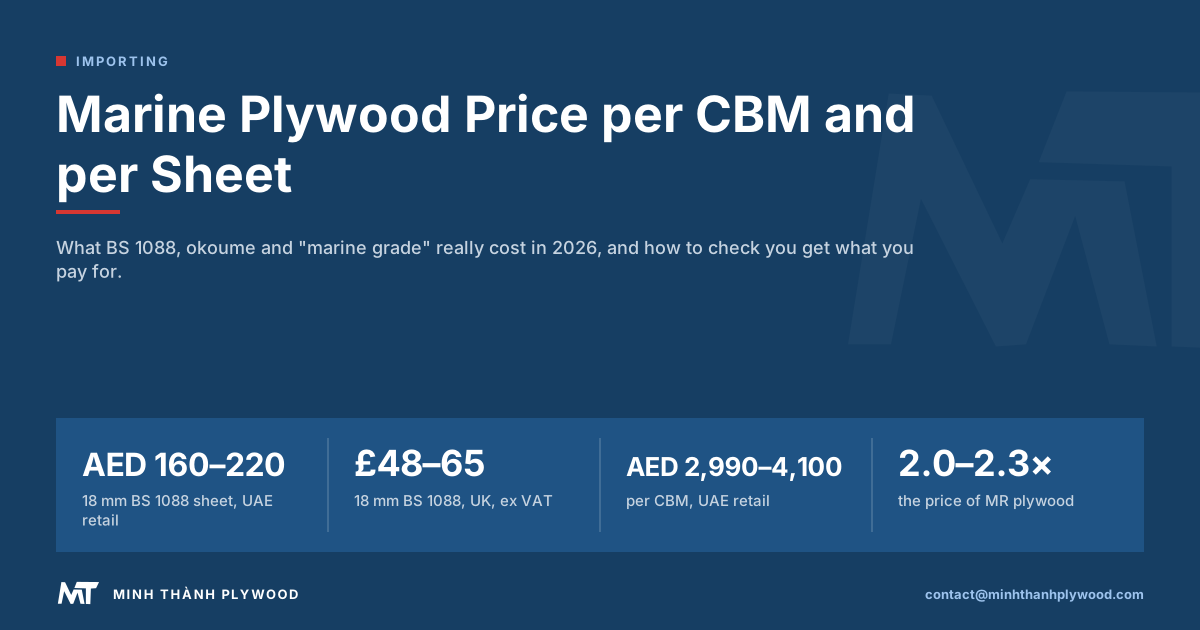
The marine plywood price is set by four things a buyer can check: durable face and core species, a core with no gaps, a boil-resistant phenolic bond, and a BS 1088 certificate. Public listings checked in October 2026 put an 18 mm BS 1088 sheet at AED 160–220 retail in the UAE and £48–65 ex VAT in the UK, about twice MR plywood. Per cubic metre (CBM), those retail sheets come to roughly AED 2,990–4,100 and £900–1,210. Minh Thanh Plywood explains each line.
How much does marine plywood cost in 2026?
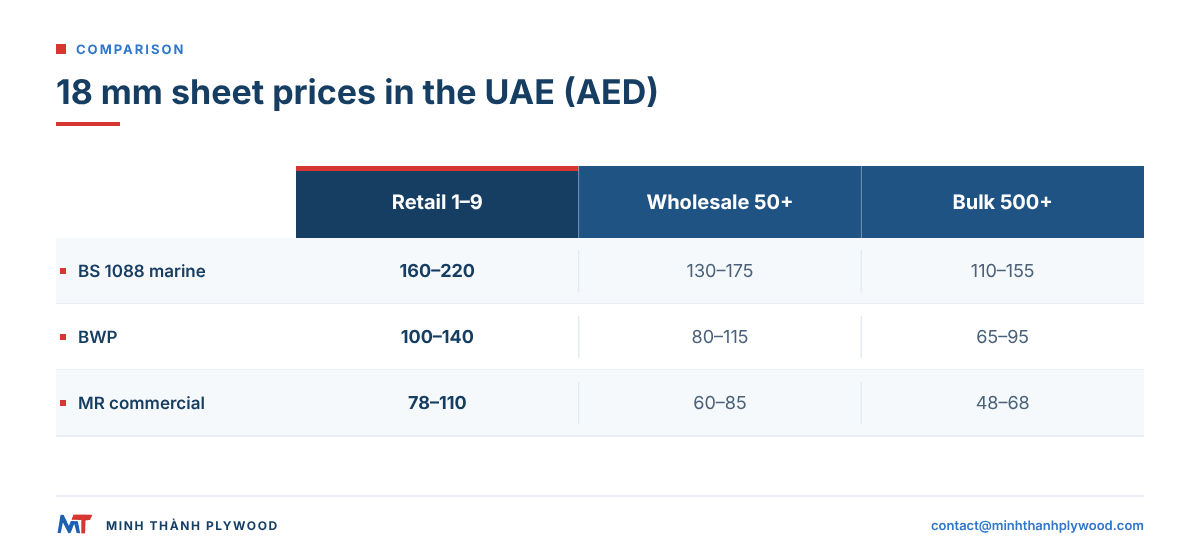
The marine plywood price for an 18 mm, 1220 × 2440 mm (8 × 4 ft) BS 1088 sheet is AED 160–220 retail in the UAE and about £48–65 ex VAT from UK merchants (listings checked 20 October 2026). Buying 50 or 500 sheets lowers the UAE range to AED 130–175 and AED 110–155 a sheet.
| 18 mm sheet, 1220 × 2440 mm | Retail, 1–9 sheets | Wholesale, 50+ | Bulk, 500+ |
|---|---|---|---|
| UAE, BS 1088 marine | AED 160–220 | AED 130–175 | AED 110–155 |
| UAE, BWP (boil-proof) | AED 100–140 | AED 80–115 | AED 65–95 |
| UAE, MR commercial | AED 78–110 | AED 60–85 | AED 48–68 |
UAE source: the price benchmark table of the Yellow Pages UAE plywood guide (guide headed 2024, retrieved 20 October 2026). UK merchants listing marine sheets include Materials Market, Sheet Materials Wholesale and SCBS. Their 18 mm BS 1088 sheets were about £48–65 ex VAT on the same date.
The table shows the shape of the market, not a quote. BWP plywood sits between MR and marine, which matches what each panel contains: a better bond than MR, but not the full BS 1088 build.
An 18 mm 8 × 4 sheet holds 0.0536 m³ of plywood (1.22 × 2.44 × 0.018 m). At £48–65 a sheet, UK BS 1088 marine works out at roughly £900–1,200 per cubic metre before VAT, freight to site and cutting.
What does marine plywood cost in the US in dollars?
In the US, a full 4 × 8 ft sheet of BS 1088 okoume marine plywood lists at about US$460 at 18 mm, a 9 mm BS 1088 meranti sheet at about US$150, and an APA “AB marine” Douglas-fir sheet at about US$120 for 3/4 in. All three were listed on 21 October 2026.
| US listing (4 × 8 ft sheet) | Panel | Price per sheet |
|---|---|---|
| Hamilton Marine | 18 mm okoume, BS 1088 | US$459.99 |
| Public Lumber | 9 mm Hydrotek meranti, BS 1088, 7-ply | US$149.95 |
| Toledo Plywood | 3/4 in. marine fir, APA grading | US$119.95 |
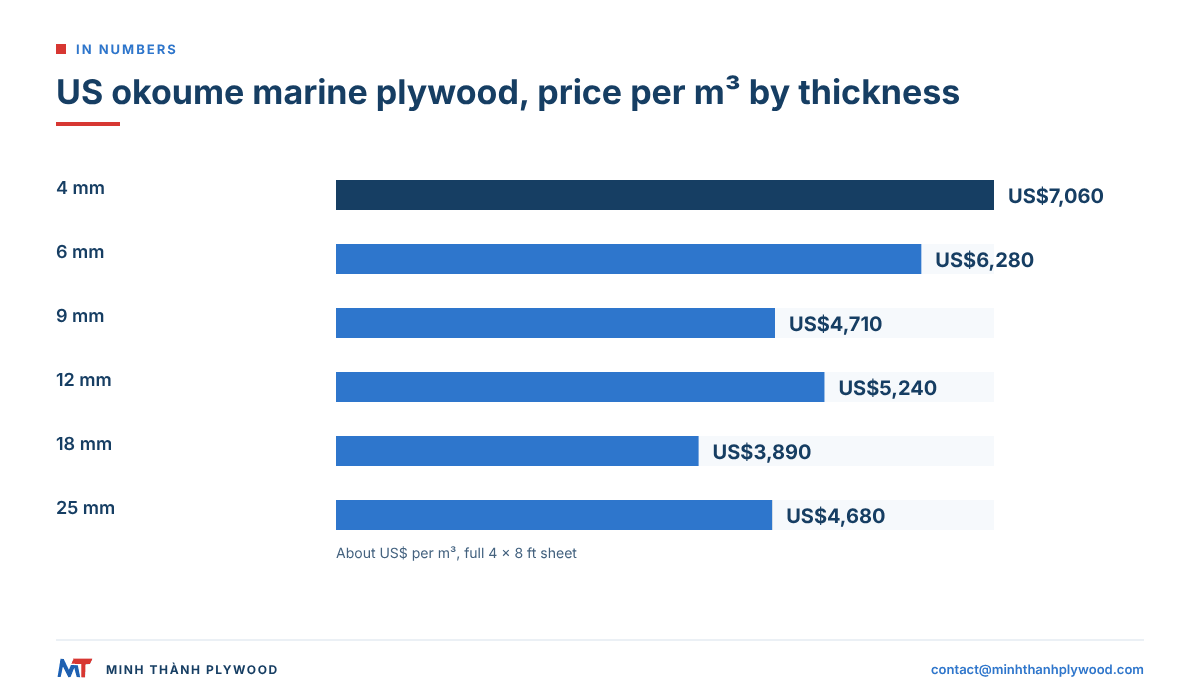
Price climbs with thickness, but not in step with the wood. The okoume marine plywood list of the boatbuilding retailer CLC Boats, read on 30 October 2026, prices a full 4 × 8 ft sheet of okoume like this:
| Thickness | Plies (seller’s table) | Price per 4 × 8 ft sheet | Price per m³ |
|---|---|---|---|
| 4 mm (5/32 in) | 3 | US$84 | about US$7,060 |
| 6 mm (1/4 in) | 5 | US$112 | about US$6,280 |
| 9 mm (3/8 in) | 5 | US$126 | about US$4,710 |
| 12 mm (1/2 in) | 7 | US$187 | about US$5,240 |
| 18 mm (3/4 in) | 11 | US$208 | about US$3,890 |
| 25 mm (1 in) | not listed | US$348 | about US$4,680 |
The seller’s table grades 4 mm and thicker as BS 1088. A 4 × 8 ft sheet covers 2.97 m², so the price per m³ is the sheet price ÷ (2.97 m² × thickness in metres).
The same 18 mm okoume sheet lists at US$208 at one boatbuilding retailer and US$459.99 at another, so compare several sellers before you price a project. Half sheets (4 × 4 ft) are sold for small boats and cost more per square metre.
Cutting and delivery come on top. The boatbuilding retailer CLC Boats quotes freight from US$175 for a full sheet and from US$120 for a half sheet. Public Lumber charges US$4 per straight cut and US$85 for local delivery on orders under US$1,000; both were retrieved on 21 October 2026. Freight on a single full sheet can cost more than a thin sheet itself.
Two different products share the word “marine” in the US. APA marine plywood, sold at big-box and lumber yards, is made entirely of Douglas-fir or larch with exterior glue and B-grade or better inner plies, graded under APA rules. BS 1088 marine plywood is a British standard for boatbuilding, normally okoume or meranti, with a boil-tested phenolic bond and gap-free core veneers. The dollar price of the fir sheet is lower per cubic metre, because the fir panel is graded by the APA rather than certified to BS 1088.
At its actual 23/32 in (18.3 mm), a 3/4 in. 4 × 8 ft sheet is 0.0543 m³, so US$119.95 is about US$2,210 per m³, against about US$8,580 per m³ for the 18 mm okoume sheet at US$459.99 (0.0536 m³).
For a hull, the standard on the stamp matters more than the word on the label. For decks, docks, sheds and signs, a WBP exterior panel bought by the container costs a fraction of either US shelf price; our commercial plywood starts from US$250/m³ FOB Hai Phong (October 2026), before freight and duty.
What is the marine plywood price per CBM?
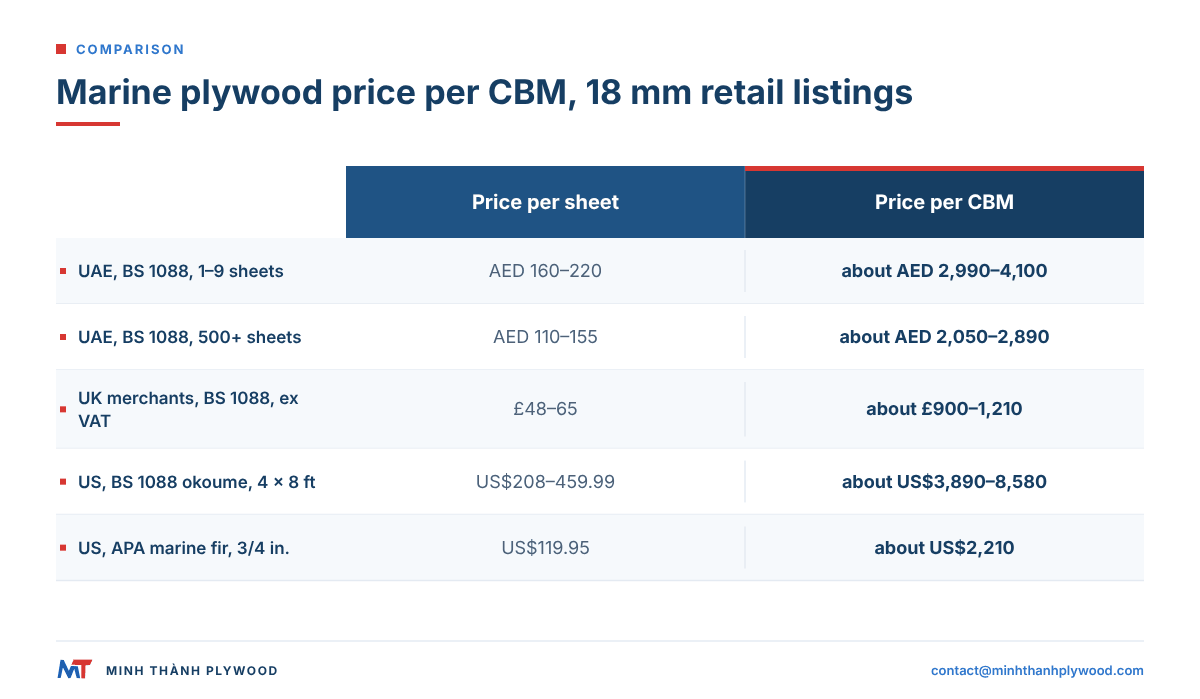
The marine plywood price per CBM (cubic metre) on retail listings checked in October 2026 is about AED 2,990–4,100 for 18 mm BS 1088 in the UAE, about £900–1,210 ex VAT in the UK and about US$3,890–8,580 for 18 mm BS 1088 okoume in the US. Importers compare offers per CBM because sheets of different thickness hold different volumes of wood.
| Listing, 18 mm sheet unless stated | Price per sheet | m³ per sheet | Price per CBM |
|---|---|---|---|
| UAE, BS 1088, retail 1–9 sheets | AED 160–220 | 0.0536 | about AED 2,990–4,100 |
| UAE, BS 1088, 500+ sheets | AED 110–155 | 0.0536 | about AED 2,050–2,890 |
| UAE, BWP (boil-proof), 500+ sheets | AED 65–95 | 0.0536 | about AED 1,210–1,770 |
| UK merchants, BS 1088, ex VAT | £48–65 | 0.0536 | about £900–1,210 |
| US, BS 1088 okoume, 4 × 8 ft | US$208–459.99 | 0.0535 | about US$3,890–8,580 |
| US, APA marine fir, 3/4 in. 4 × 8 ft | US$119.95 | 0.0543 | about US$2,210 |
Sources and dates are the ones given in the sections above (UAE and UK read 20 October 2026, US read 21 and 30 October 2026). The arithmetic is the same for every row: price per CBM = price per sheet ÷ (length × width × thickness in metres). An 18 mm, 1220 × 2440 mm sheet is 0.0536 m³, so one CBM is about 18.7 sheets.
A factory price works the other way round. Our commercial plywood starts from US$250/m³ and our furniture and interior plywood from US$350/m³ (October 2026, FOB Hai Phong), which is about US$13.40 and US$18.75 for an 18 mm, 1220 × 2440 mm sheet at the starting price. Those are starting prices for those panel types, not marine prices: the final price follows face, core, glue, thickness, size, quantity and delivery term, and thin sheets cost more per m³.
Why does marine plywood cost about twice MR plywood?
Marine plywood costs about twice MR plywood because almost every layer of the panel is upgraded. In the UAE guide, 18 mm BS 1088 sheets cost 2.0–2.3 times 18 mm MR sheets at every quantity: AED 160–220 against AED 78–110 retail, and AED 110–155 against AED 48–68 for 500+ sheets.
Four upgrades explain the gap:
- Species. Faces and cores come from species with known durability and even density, not from whatever veneer the mill has that week.
- Core quality. Every core veneer is full-width and laid without gaps or overlaps, so more veneer is rejected or patched.
- Bond. The glue is a phenolic resin that survives boiling; it costs more per kilogram and presses at a higher temperature than urea glue.
- Testing and paperwork. Bond tests, inspection and the certificate cost money on every lot.
A commercial panel can save on each of those lines. That is why it can be priced from a much lower base, and why it cannot do a marine panel’s job.
What makes a panel BS 1088 marine plywood?
A panel is BS 1088 marine plywood when it is made and certified to BS 1088, the British Standard “Marine plywood. Requirements” (BSI). BSI’s listing says BS 1088:2018 specifies two classes of marine plywood, standard and lightweight. The standard sets four groups of rules: the species allowed, the bond, the quality of face and core veneers, and the marking. For the bond, BS EN 314-2 is the BSI standard for plywood bonding-quality requirements.
- Bond: a weather and boil-proof (WBP) phenolic glue line that holds after the standard’s boil test.
- Core: veneers laid without gaps, overlaps or open defects, so water cannot sit in voids inside the panel.
- Faces: veneers free of open knots, splits and patches beyond what the standard allows.
- Species: hardwoods with the durability and density the standard lists; okoume and meranti are the most common faces on the market.
- Marking: each panel carries the standard number and the producer’s identification, and the certificate names the producing mill.
BS 1088 is a boatbuilding standard, not a structural one. A sheet stamped “marine” without the certificate behind it has not proved any of the five points.
“Marine grade” vs BS 1088: what you are paying for
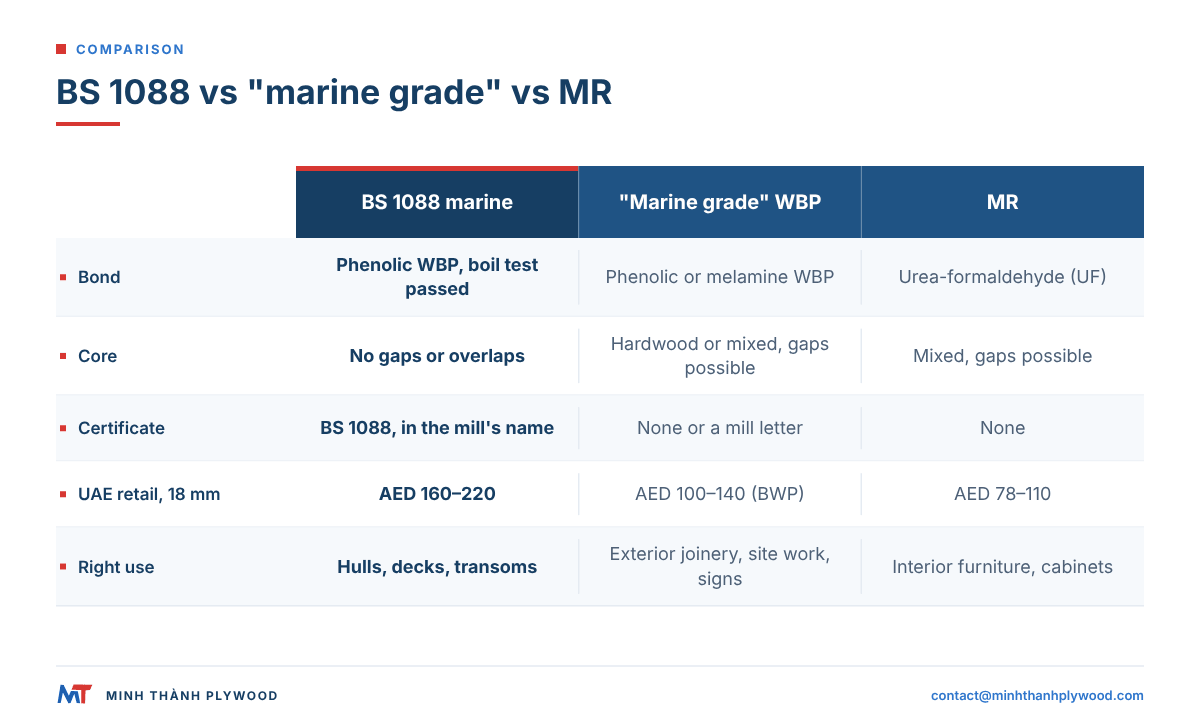
“Marine grade” on a price list is a description, not a standard. A BS 1088 panel has to meet the standard and carry a certificate; a “marine grade” panel only has to be sold under that name. The difference is usually the core and the paperwork.
| Line | BS 1088 marine | “Marine grade” WBP | MR (moisture-resistant) |
|---|---|---|---|
| Bond | Phenolic WBP, boil test passed | Phenolic or melamine WBP | Urea-formaldehyde (UF) |
| Core | No gaps or overlaps | Often hardwood or mixed, gaps possible | Mixed, gaps possible |
| Faces | Graded under the standard | Grade set by the seller | Grade set by the seller |
| Certificate | BS 1088, in the mill’s name | None or a mill letter | None |
| UAE retail, 18 mm sheet | AED 160–220 | AED 100–140 (BWP) | AED 78–110 |
| Right use | Hulls, decks, transoms, certified marine work | Exterior joinery, site work, sheds, signs | Interior furniture and cabinets |
Paying the marine price for a “marine grade” panel buys a WBP panel at a BS 1088 price. Paying the WBP price and expecting BS 1088 behaviour in a hull is the more expensive mistake.
What drives the marine plywood price, line by line?
The marine plywood price moves with seven lines of the specification. Each one should be written on the quote, because two “18 mm marine” quotes can differ on all seven.
| Price driver | What changes | Effect on price |
|---|---|---|
| Face species and grade | Okoume, meranti, other hardwoods; face grade | Rare or clear faces raise the price |
| Core species and quality | Species, density, gap-free laying, number of plies | Gap-free, full-width core veneer costs most |
| Glue | Phenolic WBP vs melamine-fortified | Phenolic costs more and presses hotter |
| Thickness | 4–25 mm and above | Thin panels cost more per m³; thick panels more per sheet |
| Size | 1220 × 2440 mm, 1250 × 2500 mm, long panels | Long or scarf-jointed panels cost more |
| Quantity | Single sheet, pack, full container | Container quantities carry the lowest unit cost |
| Delivery term | Ex-warehouse, FOB, CFR, CIF | Freight, insurance and duty move into the price |
Certification and testing sit on top of the seven. A mill that tests every lot and holds the certificate prices that work into every sheet.
Face and core species: okoume, meranti and the rest
Face and core species are the largest material cost in a marine panel. Okoume is the best-known marine face: light, even and easy to bend, which suits boat hulls and kayaks. Meranti and other tropical hardwoods give a heavier, harder panel.
Okoume plywood price depends on what is under the face. An okoume face on a certified BS 1088 build costs marine money. The same okoume face on a furniture core, bonded with UF glue at E0 emission, is an interior panel and should cost interior money. Minh Thanh Plywood offers okoume faces on furniture and interior panels; they are sold as interior panels, not as marine plywood.
Core species decide weight as well as price. At 18 mm and 1220 × 2440 mm, a sheet weighs about 26.8 kg on a Styrax core, 31.1 kg on acacia and 34.8 kg on eucalyptus (reference densities 500, 580 and 650 kg/m³). Heavier cores fill a container’s weight limit with fewer cubic metres.
How does the glue change the cost of marine ply?
The glue changes the cost of marine ply more than buyers expect. Phenolic resin costs more than urea or melamine resin, and it presses hotter: about 130–145 °C for WBP bonds against about 110–120 °C for MR bonds. That means longer cycles and more energy per cubic metre.
The bond is also where cheap “marine” panels cut corners. A melamine-fortified bond can pass a short boil and still fail a long one. Glue type and emission class are two separate lines: write the bond (phenolic WBP) on one line and the emission class on another, and ask for the bond test result with its method.
Boil tests are bond tests on samples. They say nothing about emission, and a boil test alone does not make a panel marine. A 72-hour boil is a traditional WBP test; it shows the glue line holds, and the rest of BS 1088 still has to be met.
Marine plywood price by thickness
Marine plywood price per sheet rises with thickness, and the price per cubic metre stays close across the middle thicknesses. A 12 mm sheet holds two-thirds of the wood of an 18 mm sheet, so it costs roughly two-thirds as much; 25 mm costs more per sheet again.
Thin marine panels are the exception. A 4 or 6 mm sheet needs nearly the same pressing and handling per sheet as a thicker one, with more veneers and glue lines per millimetre, so its price per cubic metre is higher. The US okoume list above shows it: about US$7,060 per m³ at 4 mm against about US$3,890 per m³ at 18 mm. Long panels and scarf-jointed lengths for boat hulls cost more again.
For thickness-by-thickness detail on regular panels, see our guide to plywood price by thickness. For the 8 × 4 imperial sizes, see 4x8 plywood price.
Retail, merchant and factory-direct marine plywood prices
The same panel has three prices on its way to a buyer. A factory price is FOB the mill’s port, per cubic metre, for a full container. A merchant or importer price adds sea freight, duty, port and warehouse costs, losses and margin. A retail price per sheet adds handling of single sheets, cutting and local delivery.
Retail listings are the prices most people see first, and they are the highest per cubic metre. A boatbuilder or a distributor who buys by the container pays closer to the factory price plus freight. A one-off DIY buyer pays the retail price, and that is still the right channel for one boat.
Delivery term matters when comparing. A CIF or CFR price includes sea freight to the buyer’s port; an FOB price does not. From Hai Phong, typical days at sea are 15–25 to the Middle East, 25–35 to the Mediterranean and 30–40 to Northern Europe, by carrier and route.
Freight and container loading: the hidden part of the price
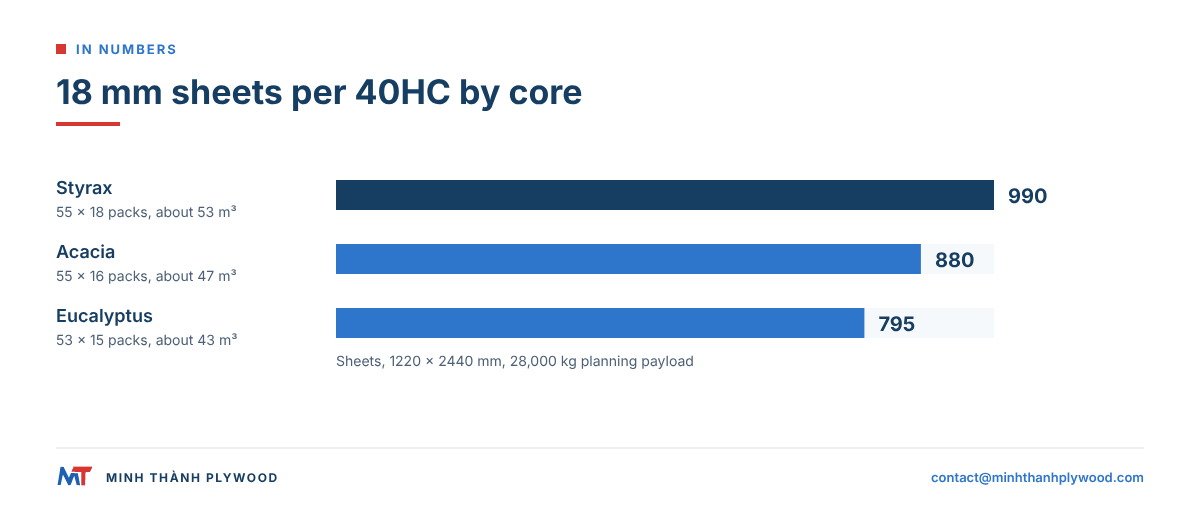
Freight per sheet depends on how many sheets fit in a container before the weight limit, and that depends on the core. In a 40HC at 18 mm and 1220 × 2440 mm, our packing plan carries 990 sheets on a Styrax core (55 sheets × 18 packs, about 53 m³), 880 on acacia (55 × 16, about 47 m³) and 795 on eucalyptus (53 × 15, about 43 m³), within a 28,000 kg planning payload.
Dense marine hardwood cores sit at the heavy end of that range. The container fills its weight limit with fewer cubic metres, so freight per cubic metre rises. When two marine quotes are CIF, compare the cubic metres per container they assume as well as the price.
Try your own mix in the packing calculator before you compare CIF quotes.
When is a WBP exterior panel the better value?
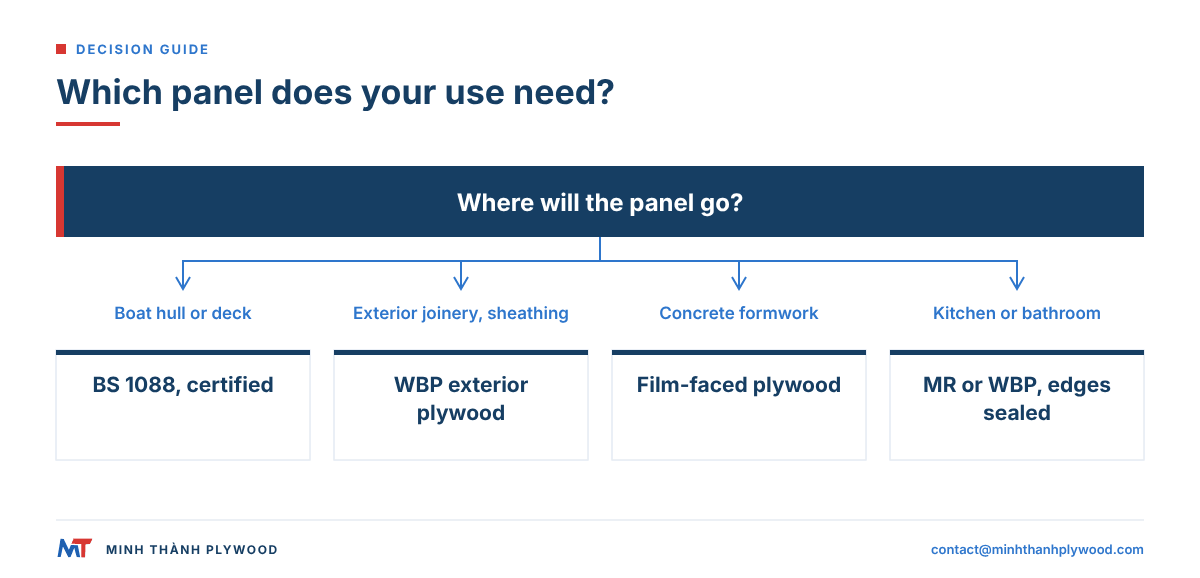
A WBP exterior panel is the better value when the panel is not going into a boat. Stair treads, wall sheathing, roof decking, site hoarding, signs and garden structures need a bond that survives rain, not a certified hull panel.
| Use | Panel that fits | Why |
|---|---|---|
| Boat hulls, decks, transoms | BS 1088 marine, certified | Long wet exposure, structural safety at sea |
| Pontoons and docks in fresh water | BS 1088 marine or a treated structural panel | Constant wet contact |
| Exterior joinery, sheathing, stair treads | WBP phenolic or melamine exterior plywood | Rain and humidity, painted or covered |
| Concrete formwork | Film-faced plywood | Film protects the face; reuse depends on glue and handling |
| Bathrooms, kitchens, wet interiors | MR or WBP furniture panel, edges sealed | Humidity, not immersion |
Minh Thanh Plywood makes exterior plywood with utility C/D faces and a water-resistant melamine-fortified or phenolic (WBP) bond to the customer’s specification, and film-faced plywood for formwork. Our indicative starting price for commercial plywood is US$250/m³ (October 2026, FOB); the final price follows face, core, glue, thickness, size, quantity and delivery term.
How to check you get what you pay for
Check a marine panel before you pay the marine price, in this order:
- Certificate. Ask for the BS 1088 certificate in the producing mill’s name, not the trader’s, and check that it covers the thickness you are buying.
- Stamp. Each panel should carry the standard number and the producer’s mark, and the invoice should match the stamp.
- Edges. Look along every edge of a sample sheet. Core gaps, overlaps and soft filler show as dark lines or voids.
- Ply count. Count the plies at the edge and compare with the quote; a thicker panel with too few plies uses thick, lower-cost core veneers.
- Thickness. Measure with a caliper at the four corners and mid-edges against the quoted tolerance.
- Bond. Send a sample to a laboratory for a boil test and keep the report with the lot.
- Species. Check that the face and core species named on the quote are the ones you see.
Our marine plywood buying guide goes deeper into grading and inspection.
How to get a better marine plywood price
Most of the saving on marine plywood comes from buying the right panel, then buying it in the right quantity.
- Specify the use first. If the panel will not go in a boat, a WBP exterior panel is the honest saving.
- Name every line. Face, core, glue, thickness and tolerance, size, quantity and delivery term on the RFQ make quotes comparable.
- Buy by the pack or container. Container buyers pay a factory price plus freight instead of a retail price per sheet.
- Mix specifications. One 40HC can carry 1–2 specifications as normal, and 3–6 by agreement, so a distributor can fill a container with several thicknesses.
- Compare per cubic metre and per sheet. Per cubic metre compares the material; per sheet is what you sell or use.
The pillar plywood price guide shows how all plywood is priced, from packing grade to furniture panels.
What to send for an exterior or WBP plywood quote
Send the use first, then the build, then the logistics. Minh Thanh Plywood replies within hours with a written quote you can set beside any marine or WBP offer.
- Use: exterior joinery, sheathing, stair treads, formwork or another use; indoor or outdoor.
- Core: eucalyptus or acacia for exterior and film-faced panels; stitched core if needed.
- Glue: phenolic (WBP) or melamine-fortified, and the boil or bond test the panel must pass.
- Face and back: C/D utility faces, or the face species and grade you need.
- Size and thickness: 1220 × 2440 or 1250 × 2500 mm, thickness and tolerance.
- Packing and quantity: pack type, number of sheets or 40HC containers, destination port, CFR or CIF.
Our terms: MOQ one 40HC with mixed specifications by agreement, production 15–45 days after the 30% deposit, 70% against the scanned B/L or an irrevocable L/C at sight, FOB Hai Phong, CFR or CIF, and free samples. Contact contact@minhthanhplywood.com or WhatsApp +84 988 586 601, or start from our exterior plywood page.
Buyer questions, answered
What is the price of marine plywood?
Public listings checked in October 2026 put an 18 mm, 1220 × 2440 mm BS 1088 sheet at AED 160–220 retail in the UAE and about £48–65 ex VAT from UK merchants. Thinner sheets cost less per sheet, but the price per cubic metre stays close to the same.
How much does a 4x8 sheet of marine plywood cost?
In the US, a 4 × 8 ft sheet of BS 1088 okoume listed at US$84 for 4 mm, US$112 for 6 mm (1/4 in), US$187 for 12 mm (1/2 in) and US$208 to US$459.99 for 18 mm (3/4 in) in October 2026, depending on the seller. An APA marine fir 3/4 in. sheet listed at US$119.95. Cutting and freight are extra.
What is the marine plywood price per CBM?
Retail listings checked in October 2026 work out at about AED 2,990–4,100 per m³ for 18 mm BS 1088 in the UAE, about £900–1,210 per m³ ex VAT in the UK and about US$3,890–8,580 per m³ for 18 mm BS 1088 okoume in the US. Factory prices FOB the mill's port are far lower and are quoted per order.
What is the difference between APA marine plywood and BS 1088?
APA marine plywood is a US Douglas-fir or larch panel graded under APA rules, with exterior glue and B-grade or better inner plies. BS 1088 is a British boatbuilding standard that sets species, a boil-tested phenolic bond, a gap-free core and a certificate. BS 1088 is the stricter test for hulls.
Why is marine plywood so expensive?
Marine plywood uses durable face and core species, a gap-free core, a phenolic bond that survives boiling and a certified test regime. Each of those costs more than the mixed core, urea glue and open grading of commercial plywood.
How much more does marine plywood cost than normal plywood?
About twice to 2.3 times MR plywood of the same thickness in the UAE. One public price guide lists 18 mm BS 1088 at AED 160–220 retail against AED 78–110 for 18 mm MR plywood, and AED 110–155 against AED 48–68 for orders of 500+ sheets.
What is the price of 18 mm marine plywood 8x4?
An 18 mm 8x4 (1220 × 2440 mm) BS 1088 sheet was listed at AED 160–220 retail in the UAE and £48–65 ex VAT in the UK when checked in October 2026. In the UAE guide, 500+ sheets drop the range to AED 110–155.
What is a cheap alternative to marine plywood?
For anything that is not a boat hull, a WBP exterior plywood with a phenolic or melamine-fortified bond is the usual cheaper alternative. In one UAE price guide, an 18 mm BWP sheet listed at AED 100–140 against AED 160–220 for BS 1088. Seal the edges and coat the faces in wet use.
What is the cheapest marine plywood?
The lowest-priced sheets sold as "marine" are usually WBP-bonded panels without BS 1088 certification. They can be the right panel for exterior joinery or site work, but they are not a BS 1088 panel, and the invoice should say so.
Is okoume plywood marine plywood?
Only when the panel is built and certified to BS 1088. Okoume is a light face veneer used on both marine panels and interior furniture panels; the face alone does not make a panel marine.
Is WBP plywood the same as marine plywood?
No. WBP names the bond: a weather and boil-proof glue line. Marine plywood to BS 1088 needs that bond plus durable species, a core without gaps and face quality rules, so every marine panel is WBP but not every WBP panel is marine.
Does marine plywood price depend on thickness?
Per sheet, yes: a thicker sheet holds more wood and more glue lines. Per cubic metre the price stays close across thicknesses, except for thin sheets, which cost more per cubic metre because they need more veneers per millimetre.
How do I check that marine plywood is genuine?
Ask for the BS 1088 certificate in the producing mill's name, look at every edge for core gaps and overlaps, have a boil test done on a sample, measure the thickness with a caliper and check that the stamp matches the invoice.
Is marine plywood waterproof?
The glue line is boil-resistant, but the wood is not waterproof. Marine plywood still needs sealed edges and a coating in wet use; the bond keeps the plies together when the wood gets wet.