
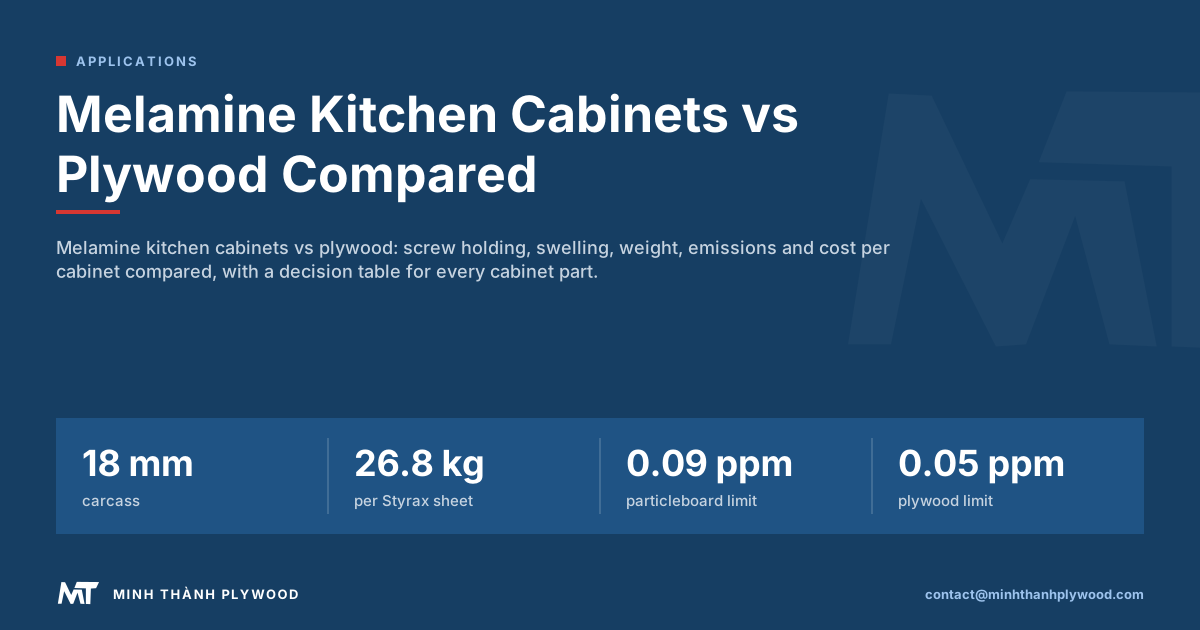
Melamine kitchen cabinets are made of particleboard faced with melamine paper: cheap, flat, easy to clean and fine in dry cupboards. Plywood cabinets cost more but hold screws better, resist swelling around the sink and weigh less for the same strength. Melamine-faced plywood sits between them. Minh Thanh Plywood, a Vietnamese furniture plywood manufacturer, compares the three carcass options part by part.
Melamine kitchen cabinets vs plywood: the short answer
Melamine kitchen cabinets are the low-cost choice for dry cupboards; plywood cabinets are the durable choice for sink bases, heavy wall units and kitchens built to last. The difference is the core. Melamine cabinets use particleboard, which swells permanently when wet and holds screws poorly at its edges. Plywood’s cross-laminated veneers hold screws well; its water resistance depends on the specified bond and exposure.
| You want | Choose |
|---|---|
| Lowest cost, dry kitchen, flat-pack | Melamine-faced chipboard (MFC) |
| Easy-clean face with a stronger, lighter core | Melamine-faced plywood |
| Wood face, exposed edges, long life | Veneered or birch plywood |
| Sink base and dishwasher housing | Plywood with a moisture-resistant bond |
| Heavy wall cabinets | Plywood |
Many cabinet makers mix them: plywood for sink bases and wall units, melamine chipboard for dry base units. The plywood for kitchen cabinets guide covers the full plywood schedule.
What are melamine kitchen cabinets?
Melamine kitchen cabinets are cabinets built from particleboard (chipboard) faced on both sides with melamine-impregnated decorative paper. The paper is pressed onto the board under heat, and the cured melamine resin forms a hard, sealed surface in white, solid colours or woodgrain prints. Cut edges are covered with plastic edge banding.
The board is called melamine-faced chipboard (MFC), melamine board or simply “melamine”. It is the standard carcass material of flat-pack and mass-market kitchens because it is flat, uniform, cheap and needs no finishing.
The core decides how melamine behaves. European particleboard is graded under EN 312:
- P2: general-purpose board for interior fittings in dry conditions.
- P3: non-load-bearing board for humid conditions, often coloured green and sold as moisture-resistant.
- P5: load-bearing board for humid conditions, also used for flooring.
Most kitchen carcasses use P2. Sink bases in better kitchens use P3. None of these grades is waterproof; they resist humidity, not standing water.
Is melamine the same as laminate? Melamine vs HPL
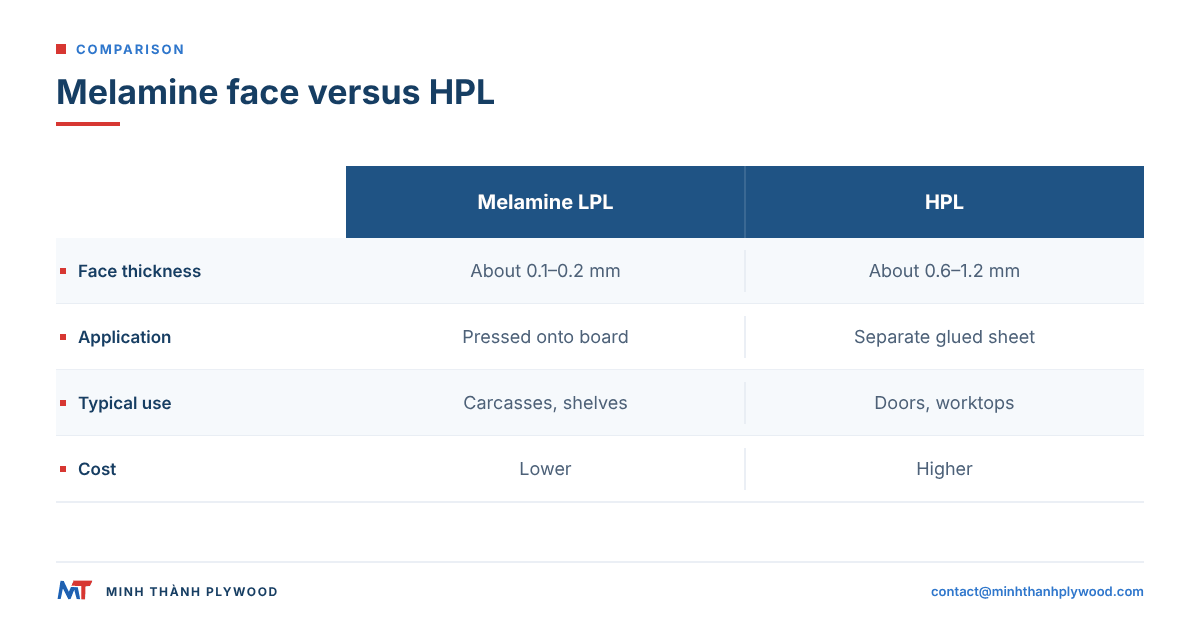
No. Melamine is low-pressure laminate (LPL): a decorative paper soaked in melamine resin and pressed straight onto the board in the factory, as a skin about 0.1 to 0.2 mm thick. High-pressure laminate (HPL) is a separate sheet of 0.6 to 1.2 mm, made from layers of resin-soaked kraft paper under much higher pressure, then glued onto the board by the cabinet maker. The two look alike on a showroom door and behave differently on a worktop (Kitchen Warehouse asks the same question in its guide to melamine kitchens).
| Melamine (LPL) | HPL | |
|---|---|---|
| Thickness | about 0.1-0.2 mm | about 0.6-1.2 mm |
| Impact and scratch | Good on vertical faces, chips at edges | Better; takes knocks and heat |
| Cost | Lowest; included in the board price | Higher; sheet plus glue and labour |
| Typical use | Carcass interiors, shelves, wardrobes | Doors, worktops, high-wear tops |
Melamine comes in four decor types. Woodgrain prints imitate oak, walnut or ash. Solid colours run from white to anthracite. Gloss and matt finishes change how the surface reflects. Textured or synchronised-pore finishes press a grain into the surface that follows the print, so the wood look can be felt. All four exist on chipboard, MDF and plywood cores, which is why the core, not the decor, decides how the cabinet lasts.
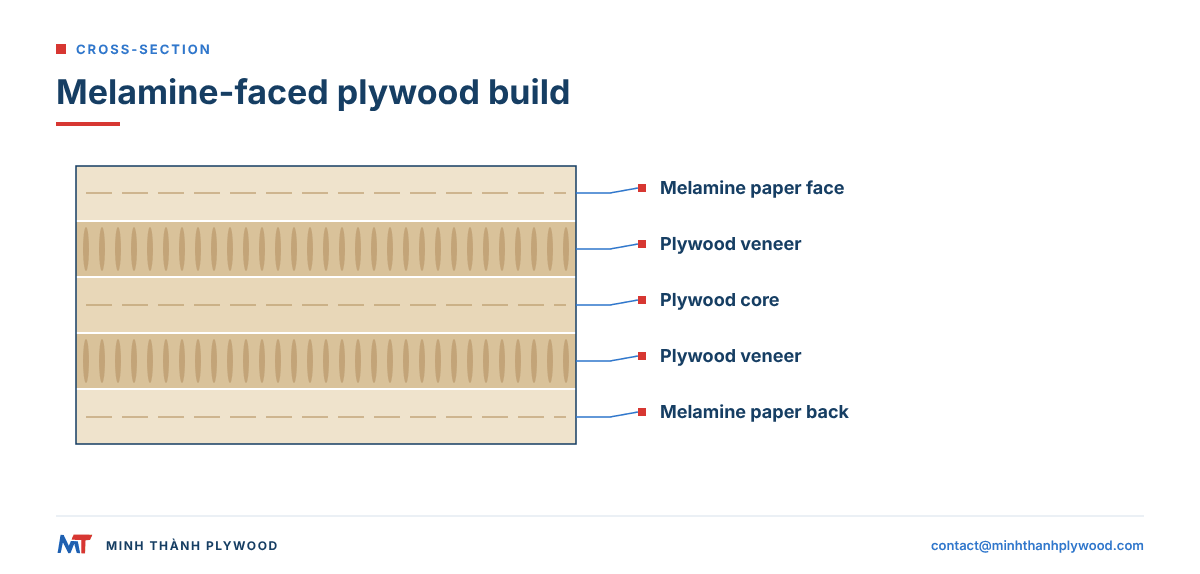
Three carcass options: melamine chipboard, melamine-faced plywood, veneered plywood
A kitchen carcass can be made from three different panels. Each pairs a face with a core.
Melamine-faced chipboard (MFC). Particleboard core, melamine paper face. Lowest cost, flat, easy to clean. Weak at edges and in water.
Melamine-faced plywood. Plywood core, melamine paper face. The same easy-clean surface, with the screw holding, stiffness and water tolerance of plywood. Lighter than MFC for the same strength, and more expensive.
Veneered or birch plywood. Plywood with a wood veneer face, sanded and then lacquered, oiled, UV-coated or laminated by the cabinet maker. Exposed edges show the plies, a look many modern kitchens use. Highest cost, longest life, and repairable.
The face decides the look and the cleaning. The core decides strength, weight and what happens when water arrives. When comparing melamine vs plywood cabinets, compare cores first.
Melamine vs plywood cabinets compared
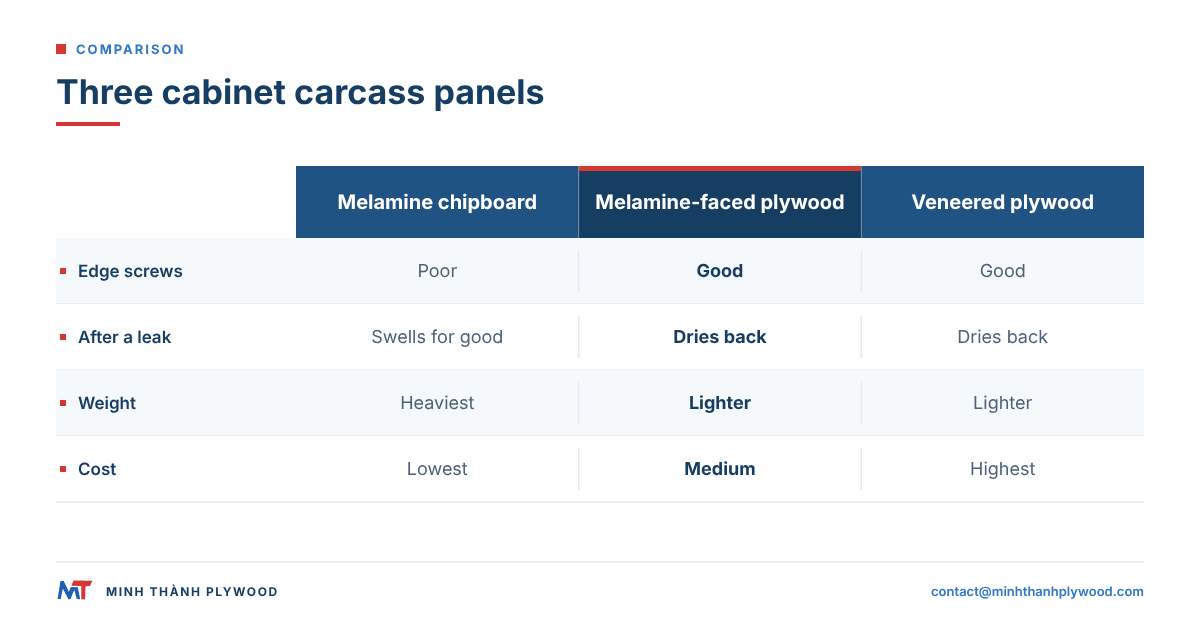
The table compares the three carcass panels at 18 mm, the usual cabinet thickness, one metric per row.
| Metric | Melamine chipboard (MFC) | Melamine-faced plywood | Veneered plywood |
|---|---|---|---|
| Core | Particleboard | Cross-laminated veneers | Cross-laminated veneers |
| Screw holding in the face | Fair | Good | Good |
| Screw holding at the edge | Poor, needs special fixings | Good | Good |
| Swelling after a leak | Swells, does not recover | Depends on bond and exposure | Depends on bond and exposure |
| Weight for the same stiffness | Heaviest | Lighter | Lighter |
| Shelf sag over 800 mm | Sags sooner | Stiffer | Stiffer |
| Impact on edges | Chips and crumbles | Face chips, core holds | Dents, repairable |
| Surface | Hard, sealed, wipe-clean | Hard, sealed, wipe-clean | Needs a finish |
| Exposed edge look | Needs banding | Needs banding or shows plies | Plies on show |
| Repair after damage | Replace panel | Patch or replace | Sand and refinish |
| Relative cost per cabinet | Lowest | Medium | Highest |
| Life where water is present | Shortest | Long | Long |
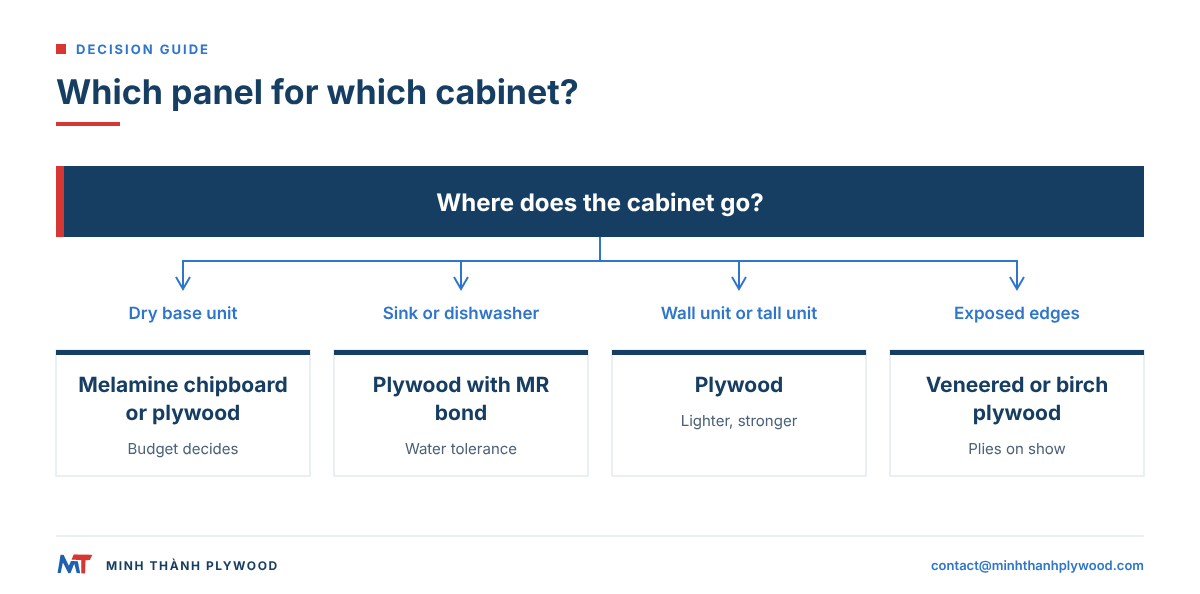
Verdict by use: use MFC for dry base units on a budget, melamine-faced plywood where you want the melamine look with a stronger carcass, and veneered plywood for exposed-edge designs, sink bases and kitchens meant to last decades.
Is melamine stronger than plywood?
No, plywood is stronger than melamine chipboard of the same thickness in every way that matters for a cabinet. Plywood is stiffer, holds screws better, and does not crumble on impact. Melamine is only the surface; the board underneath decides strength.
Three tests show the difference:
- Screw holding. A screw in the edge of chipboard grips loose particles and pulls out under load or after a second assembly. A screw in the edge of plywood crosses several veneers and holds. That is why chipboard furniture relies on cam locks, dowels and special confirmat screws.
- Shelf stiffness. An 18 mm plywood shelf carries plates and tins over a wider span before it sags. Chipboard shelves also creep, sagging slowly under a constant load.
- Impact. A knock on a chipboard corner breaks off particles that cannot be glued back. Plywood dents but stays whole.
Hinge holding follows the same pattern. Concealed hinges with 35 mm cups are screwed close to the edge of the door and carcass; in chipboard the screws loosen with use, in plywood they stay tight.
Melamine chipboard is still strong enough for most dry carcasses. With good hardware, cabinets in particleboard serve well for years. The difference shows under load, after reassembly, and when water arrives.
Water and swelling: what happens around the sink
Water can damage both melamine-faced particleboard and plywood. Particleboard soaks up water through any cut edge, screw hole or damaged banding, swells and loses strength permanently. Plywood also absorbs water; its recovery depends on the bond and the extent of exposure.
The danger zones in a kitchen are known:
- Sink base: leaks from traps, taps and seals, and splashes from cleaning.
- Dishwasher housing: steam on the underside of the worktop and the sides of adjacent units.
- Cabinet bottoms near the floor: mopping water and spills.
- Under the kettle and coffee machine: steam on wall units.
For these units, plywood with a moisture-resistant bond is the safe choice. Our sibling guide on moisture-resistant plywood for sink cabinets compares MR, WBP and marine options.
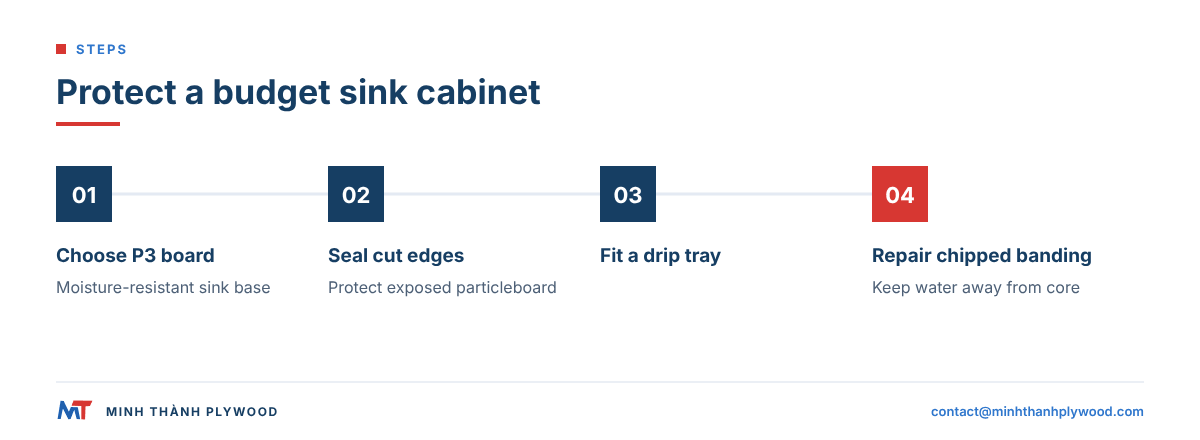
If a melamine kitchen is the budget choice, protect it: seal every cut edge, use moisture-resistant P3 board for the sink base, fit a drip tray, and repair chipped banding quickly.
Weight and installation: why lighter carcasses matter
Plywood is lighter than chipboard for the same stiffness, which makes wall cabinets easier to hang and safer on their rails. Our 18 mm furniture plywood on a white Styrax core weighs about 26.8 kg per 1220 × 2440 mm sheet, based on 500 kg/m³. A particleboard sheet of the same size is heavier, and the difference adds up in every cabinet.
The weight matters in three places:
- Wall cabinets. A lighter carcass leaves more of the fixing’s capacity for dishes.
- Transport and handling. Flat-pack and assembled kitchens ship by weight; lighter cabinets cost less to move and are easier to install.
- Tall units and drawers. Lighter drawer boxes run more smoothly and wear the runners less.
On a Eucalyptus core, the same sheet weighs about 34.8 kg at 650 kg/m³. Cabinet makers who want the lightest carcass choose Styrax; those who want a harder core for heavy hardware choose Eucalyptus.
Cost per cabinet: where the money goes
Melamine chipboard is the cheapest carcass panel; plywood costs more per sheet, but the difference per finished cabinet is smaller than the sheet price suggests. Panels are only part of a cabinet’s cost.
A standard 600 mm base unit uses roughly 1.3 m² of carcass panel: two sides, a bottom, rails and a shelf. That is under half of a 1220 × 2440 mm sheet. Hardware, doors, worktops, labour and installation usually cost far more than the carcass panel.
Where the cost difference adds up:
- Panel price: plywood carcass panels cost more per m² than MFC.
- Edge work: MFC needs banding on every visible edge; veneered plywood with exposed edges needs sanding and finishing instead.
- Finishing: melamine faces need no finish; veneered plywood needs lacquer, oil or UV coating.
- Replacements: a water-damaged MFC sink base is replaced; a plywood one must be assessed for water damage.
What a 600 mm base carcass costs in panel, UK trade prices.
A merchant lists 18 mm white melamine-faced chipboard in 2440 x 1220 mm at £35.77 ex VAT a sheet (Sheet Materials Wholesale, October 2026). The same merchant lists 18 mm B/BB birch plywood at £102.92 ex VAT (Sheet Materials Wholesale, October 2026). A sheet is 2.98 m², so 1.3 m² is 0.44 of a sheet: about £16 of panel in MFC and about £45 in birch plywood, before offcut waste.
Melamine-faced plywood and veneered plywood sit above the MFC figure and around or above the birch figure, depending on the face. The gap is about £29 per base unit in panel, against hundreds of pounds for doors, worktop and fitting.
For a buyer pricing plywood, Minh Thanh furniture and interior plywood starts from US$350/m³ (October 2026), with the final price set by face, core, glue, thickness, size and quantity.
White melamine cabinets: look and durability
White melamine cabinets are popular because the surface is bright, uniform, hard and easy to clean. White is also the most common colour for cabinet interiors, even behind wood or painted doors.
What to expect from a white melamine surface:
- Cleaning: wipes clean with a damp cloth and mild detergent; avoid abrasive pads.
- Scratches: resists everyday wear, but sharp objects leave marks that cannot be sanded out.
- Chips: edges and corners chip under knocks; dark particleboard shows through.
- Colour: stays white for years indoors; yellowing is rare on modern boards.
- Matching: white carcasses work with almost any door colour.
The same white face can be pressed onto plywood. Melamine-faced plywood gives the white interior with a stronger, lighter carcass. For painted cabinets, sanded plywood faces take paint well: B/B poplar or eucalyptus faces suit painted and laminated work.
Wood vs melamine cabinets: doors and fronts
Wood fronts, whether solid timber or veneered plywood, look warmer, age with character and can be refinished; melamine fronts are cheaper, uniform and easy to clean but cannot be repaired once chipped. Doors are what people see and touch, so the choice matters more than for carcasses.
| Front | Look | Durability | Repair | Cost |
|---|---|---|---|---|
| Melamine chipboard | Flat, uniform colour or print | Chips at edges | Replace | Lowest |
| Painted MDF | Smooth, any colour | Paint chips | Repaint | Medium |
| Veneered plywood | Real wood grain | Good, dents | Sand and refinish | Medium to high |
| Birch plywood, exposed edge | Wood with ply lines on show | Good | Sand and refinish | Medium to high |
| Solid wood | Real timber | Good, moves with humidity | Sand and refinish | Highest |
Veneered plywood stays flatter than solid timber on wide doors because the cross-laminated core resists movement. Our guide to plywood for cabinet doors covers slab, shaker and veneered fronts.
Formaldehyde emissions: melamine board and plywood
Both melamine boards and plywood used in regulated markets must meet formaldehyde emission limits, but the limits differ by product type. CARB Phase 2 and the US EPA’s TSCA Title VI rule set limits by product type. Particleboard is limited to 0.09 ppm, and hardwood plywood with a veneer core to 0.05 ppm under 40 CFR 770.10.
In the European Union, Regulation (EU) 2023/1464 restricts formaldehyde released from furniture and wood-based articles to 0.062 mg/m³ from 6 August 2026 (checked 20 October 2026).
At our mill, furniture and interior plywood uses UF glue at E0 emission as standard. Six ASTM D6007 chamber tests between April 2025 and June 2026, on 9, 15 and 18 mm panels, averaged 0.014–0.032 ppm against the 0.05 ppm limit. Our CARB P2 / TSCA Title VI certification is ICTT mill no. 23024; the reports are listed on our quality page.
For any cabinet panel, ask for the certificate of the exact board and, for the EU, a test to the buyer’s method. Third-party testing, for example to EN 717-1, is arranged through SGS on request.
Glue in cabinet plywood: UF, melamine-fortified or phenolic?
For dry kitchen carcasses, UF glue at E0 emission is the standard plywood bond; for sink bases and humid rooms, a melamine-fortified (MR) bond resists moisture better; phenolic (WBP) is for exterior and wet use. “Melamine” in plywood glue and “melamine” on a cabinet face are two different things.
- Melamine face: decorative paper impregnated with melamine resin, pressed onto a board.
- Melamine-fortified glue (MR): a urea-formaldehyde glue strengthened with melamine resin, used inside plywood to improve moisture resistance.
- Phenolic glue (WBP): a dark, boil-proof bond for exterior plywood, formwork and boats.
Glue type and emission class are two separate lines on a specification. A buyer writes the bond (UF, MR or WBP) and, separately, the emission requirement (E0, E1, CARB P2). At Minh Thanh, MR and WBP bonds are made to the customer’s specification.
Which panel for which cabinet part?
Choose the panel by the cabinet part and its exposure to water, load and wear. The table is a starting schedule for a kitchen maker.
| Cabinet part | Thickness | Best panel | Budget option |
|---|---|---|---|
| Base carcass sides | 18 mm | Plywood or melamine-faced plywood | MFC |
| Sink base | 18 mm | Plywood with MR bond | P3 moisture-resistant MFC, sealed |
| Wall cabinets | 15 to 18 mm | Plywood, Styrax core for low weight | MFC with strong rails |
| Tall units and larders | 18 mm | Plywood | MFC |
| Shelves over 800 mm | 18 mm | Plywood | MFC with centre support |
| Drawer boxes | 12 to 15 mm | Birch plywood | MFC |
| Backs | 6 to 9 mm | Plywood | Thin hardboard or MDF |
| Doors and fronts | 18 mm | Veneered or birch plywood | MFC or painted MDF |
Our guide to plywood thickness for cabinets explains each thickness by part.
Choosing plywood grades for laminated and melamine-faced cabinets
For cabinets that will be laminated, melamine-faced or painted, choose a sound, flat face that bonds well; for clear-finished cabinets, choose a higher face grade matched to an approved sample. Buyers in Sweden and other European markets often ask which grade of Vietnamese plywood fits each case.
How Minh Thanh grades map to cabinet work:
- Poplar or Eucalyptus faces, B/B: for painted, laminated or melamine-faced carcasses.
- A/B: one visible face, such as the inside of an open shelf unit.
- A/A: both faces visible, such as doors and open cabinet sides.
- Birch, D+/D or D/E: for exposed-edge birch kitchens, comparable to the European birch grades.
Thickness accuracy matters for laminating and for hinge holes. Our sanded furniture panels are made to ±0.2–0.3 mm, down to ±0.2 mm. Furniture panels are pressed twice as standard, with the core board pressed and calibrated first, which gives the flat surface a laminate or melamine paper needs. Both faces are UV-ready for the buyer’s own UV coating.
What to write on a cabinet plywood order
A cabinet plywood order should state the application, core, glue and emission, face, size, packing and quantity on separate lines.
- Application: kitchen carcass, sink base, doors, drawers, and how the face will be finished.
- Core: white Styrax for light weight, or Eucalyptus for a harder core.
- Glue and emission: UF glue at E0 emission for dry units, MR for sink bases; CARB P2 / TSCA Title VI or an EU test method if required.
- Face and back: species and grade pair, for example poplar B/B for laminating or birch D+/D for exposed edges.
- Size and thickness: 1220 × 2440 mm or 1250 × 2500 mm, or cut-to-size; 18 mm with the tolerance you need.
- Packing and quantity: pack size, marks, number of 40HC containers, destination port.
Minimum order is one 40HC with mixed specifications by agreement, and production takes 15–45 days after deposit. Minh Thanh Plywood offers free samples. Send your cabinet schedule to [email protected]; we reply within hours.
Buyer questions, answered
Is melamine stronger than plywood?
No. Plywood of the same thickness is stiffer, holds screws far better at the edges and survives impact without crumbling. Melamine chipboard is strong enough for dry carcasses with good hardware and short shelf spans.
Are melamine kitchen cabinets good quality?
They can be, in a dry kitchen with good edge banding and hardware. Their weak points are swelling where water reaches a cut edge, and screws that loosen after repeated assembly.
How long do melamine cabinets last?
In a dry kitchen with sealed edges and good hardware, melamine cabinets serve for many years. Sink bases and units beside the dishwasher fail first, when a leak reaches the chipboard core through a cut edge.
What is the difference between melamine and plywood cabinets?
Melamine cabinets use particleboard with a decorative melamine paper face; plywood cabinets use cross-laminated wood veneers with a wood, laminate or painted face. Plywood costs more and lasts longer, especially where water is present.
What is melamine-faced plywood?
It is plywood with melamine paper pressed onto both faces. It has the easy-clean surface of melamine with the screw holding, lighter weight and water tolerance of plywood.
Can melamine cabinets be repaired after water damage?
Usually not. Swollen chipboard does not shrink back and loses its strength, so the damaged panel or the whole cabinet is replaced. Plywood performance after wetting depends on the bond and the extent of moisture exposure.
Are white melamine cabinets hard to keep clean?
No. The melamine surface is hard, non-porous and wipes clean with a damp cloth. Avoid abrasive pads, which dull the gloss, and repair chipped edges quickly before water gets in.
Which is lighter, melamine or plywood?
Plywood. An 18 mm furniture plywood sheet on a Styrax core weighs about 26.8 kg at 1220 × 2440 mm; a particleboard sheet of the same size is noticeably heavier, which matters for wall cabinets.
Do melamine cabinets release formaldehyde?
Low-emission boards are the norm in regulated markets. In the US, particleboard is limited to 0.09 ppm and hardwood plywood to 0.05 ppm under CARB Phase 2 and TSCA Title VI; ask for the certification of the board you buy.
Which plywood grade is right for melamine-faced or laminated cabinets?
For panels that will be laminated or painted, B/B faces on poplar or eucalyptus are enough. For visible faces, choose A/A or A/B, or birch in D+/D, matched to an approved sample.