
Yes, birch plywood is good for cabinets: it holds screws well, machines cleanly and takes paint and clear finishes. Baltic birch plywood for cabinets is worth its price where the edge shows. Where edges are banded or painted, birch-faced plywood on a hardwood core gives the same face for less. Minh Thanh Plywood makes the birch-faced panel; this guide compares both, with maple and poplar.
Is birch plywood good for cabinets? The short answer
Birch plywood is good for cabinets, and it is the default face for plywood kitchens in Europe and North America. A birch face is hard, pale and fine-grained; it holds hinge screws, machines with clean edges, and takes paint, clear lacquer and UV coatings evenly.
The real choice is which birch panel to buy:
- Baltic birch plywood has birch in every ply. Its edge is even and void-free, so it can stay exposed as a design feature.
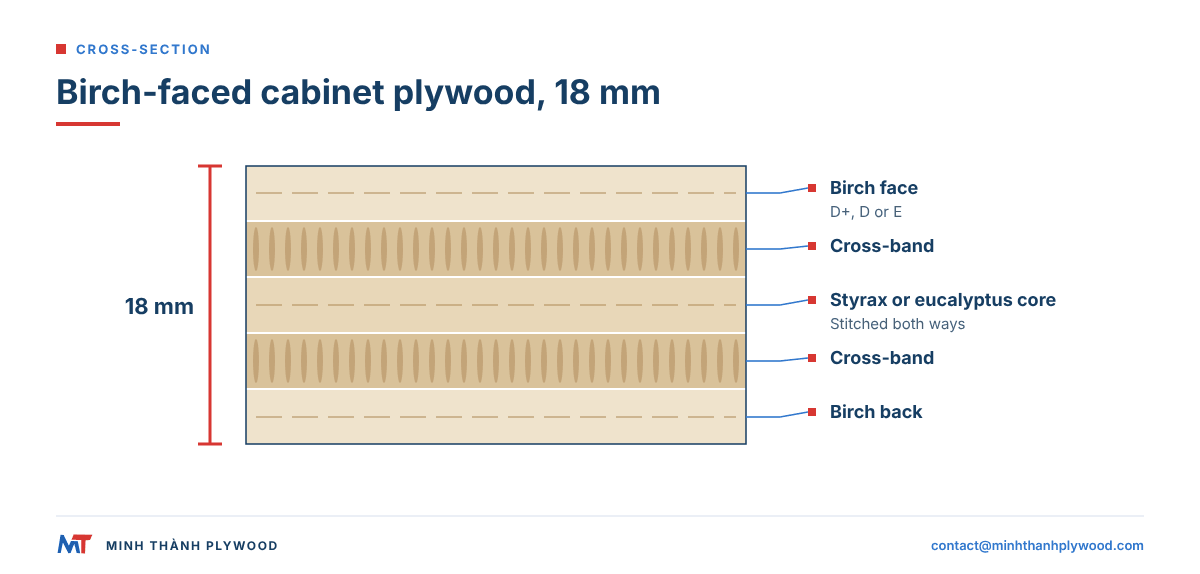
- Birch-faced plywood has birch on the face and back over a core of another hardwood. The faces look the same; the edge shows the core species.
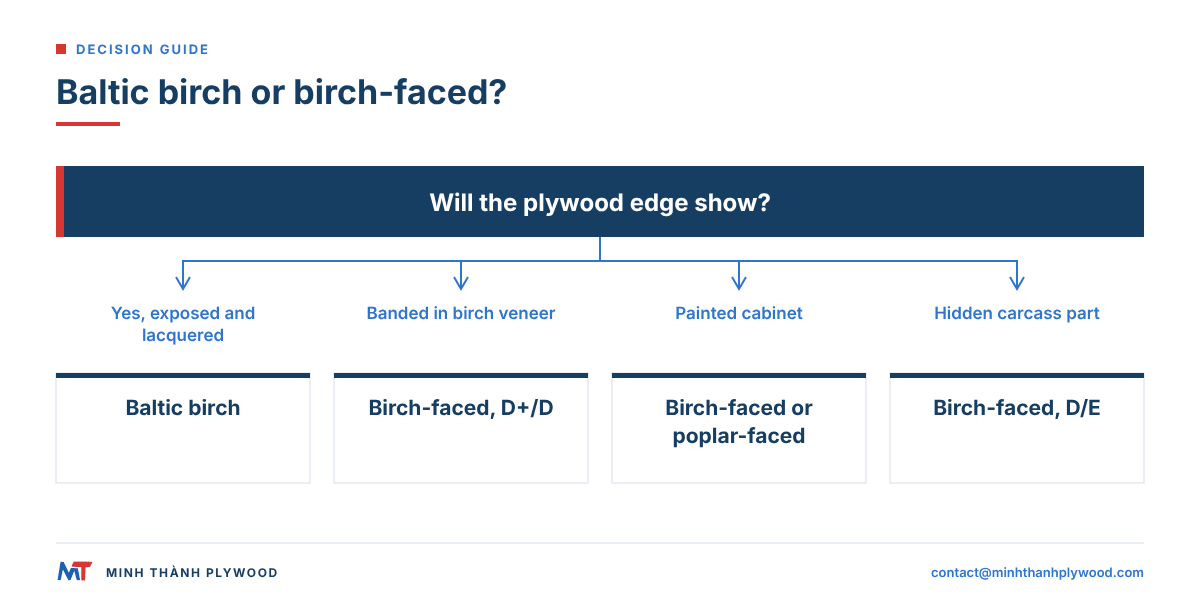
Baltic birch plywood for cabinets is worth its higher price where the edge shows: exposed-edge kitchens, open shelving and furniture with visible ply lines. For carcasses with banded edges, painted cabinets and hidden parts, birch-faced plywood gives the same face for less.
Baltic birch vs birch-faced vs maple vs poplar for cabinets
Four plywoods cover most cabinet work. The table compares them on what a cabinet maker feels in the shop and the customer sees in the kitchen.
| Metric | Baltic birch | Birch-faced, hardwood core | Maple-faced | Poplar-faced |
|---|---|---|---|---|
| Face | Birch | Birch | Maple | Poplar |
| Core | Birch in every ply | Styrax or eucalyptus (our build) | Varies by mill | Poplar or hardwood |
| Exposed edge | Even, void-free, a design feature | Shows the core; band or paint it | Band it | Band it |
| Face hardness | Hard | Hard | Harder | Soft |
| Screw and hinge holding | Very good | Very good on a dense core | Very good | Fair |
| Clear finish | Pale, even | Pale, even | Very pale, even | Greenish streaks; paint instead |
| Oil stain | Can blotch | Can blotch | Can blotch | Blotches |
| Paint | Excellent | Excellent | Excellent | Excellent |
| Relative cost | Highest | Medium | Medium to high | Lowest |
Verdict by use:
- Exposed-edge kitchens and open shelving: Baltic birch.
- Clear-finished doors and visible gable ends with banded edges: birch-faced, top grade.
- Painted cabinets: birch-faced or poplar-faced; birch holds hinges better on doors.
- Carcass interiors and drawer boxes: birch-faced in a lower grade, or poplar to save cost.
Is Baltic birch plywood worth it for cabinets?
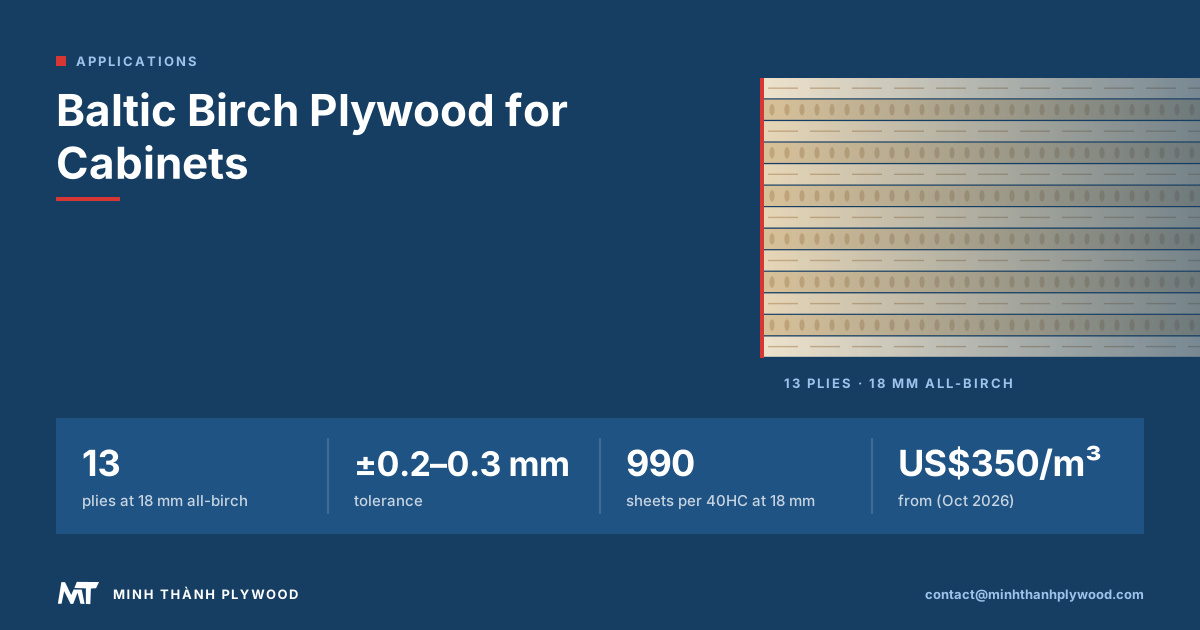
Baltic birch plywood is worth it for cabinets when the edge is part of the design. Its plies are all birch, an 18 mm sheet has 13 plies, and the edge sands to clean, even stripes that can stay visible under a clear lacquer.
It is less worth it where nobody sees the edge. In a frameless kitchen with edge-banded carcasses, the customer sees only the face and the banding, and a birch-faced panel looks the same. The price gap goes into hardware, finish or margin instead.
Two practical points also count:
- Sheet size. Baltic birch is often sold in square 5 × 5 ft sheets, which nest cabinet parts differently from 1220 × 2440 mm sheets. Check your cutting yield on both before comparing prices.
- Supply. Many buyers now compare all-birch panels from several countries with birch-faced panels; see our guide to Baltic birch plywood for what the name covers today.
When is birch-faced plywood on a hardwood core enough?
Birch-faced plywood on a hardwood core is enough for any cabinet part whose edge is banded, painted or hidden, which is most of a kitchen. The visible face is the same birch veneer; the core under it carries the screws and the stiffness.
At Minh Thanh Plywood our birch panels use a white Styrax core or a eucalyptus core:
- Styrax core is light and even, and keeps a full 18 mm sheet at about 26.8 kg, easy for one person to handle on the saw.
- Eucalyptus core is denser and holds screws and confirmat fixings very well, a good fit for hinge sides and shelves under heavy loads.
Core layers are stitched both horizontally and vertically, so gaps and overlaps stay out of the core, and furniture panels are pressed twice: the core board is pressed and calibrated, then face and back are pressed on. That second pressing keeps the birch face flat over the core, which matters under a gloss lacquer.
Choose Baltic birch only where the edge itself must look like birch. Everywhere else, the birch-faced panel is the cost-effective cabinet plywood.
Which birch plywood grade should you specify for cabinets?
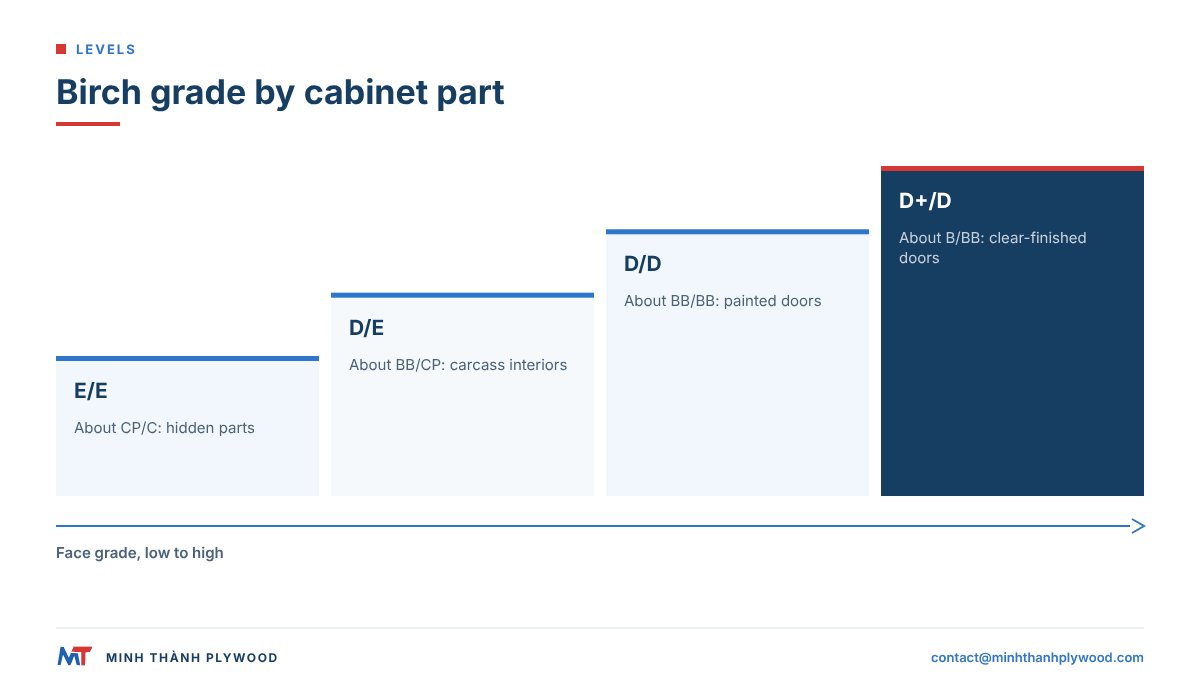
Specify the face grade by where the part sits in the kitchen. In Vietnam birch faces are graded D+, D and E (from highest to lowest) and quoted as face/back pairs; they compare with the European birch grades as follows.
| Vietnamese grade pair | European comparison | Where it goes in a cabinet |
|---|---|---|
| D+/D | About B/BB | Clear-finished doors, visible gable ends, open shelves |
| D/D | About BB/BB | Carcass sides seen inside open cabinets, painted doors |
| D/E | About BB/CP | Carcass interiors, backs of wall units, painted parts |
| E/E | About CP/C | Hidden parts, drawer bottoms under a liner |
US price lists use the birch letter grades: B/BB has a B face and a BB back; BB/BB has BB on both sides. Domestic US hardwood plywood follows ANSI/HPVA HP-1 instead, which grades the back separately with numbers 1 to 4.
Back grades run from 1, the cleanest, to 4; a “1” back suits cabinet interiors that show, while “3” and “4” backs are for concealed parts. Order appearance is fixed against an approved sample, so photograph and keep the sample you sign off. Our guide to birch plywood grades and acceptance criteria lists the defects each grade allows.
What thickness birch plywood for each cabinet part?
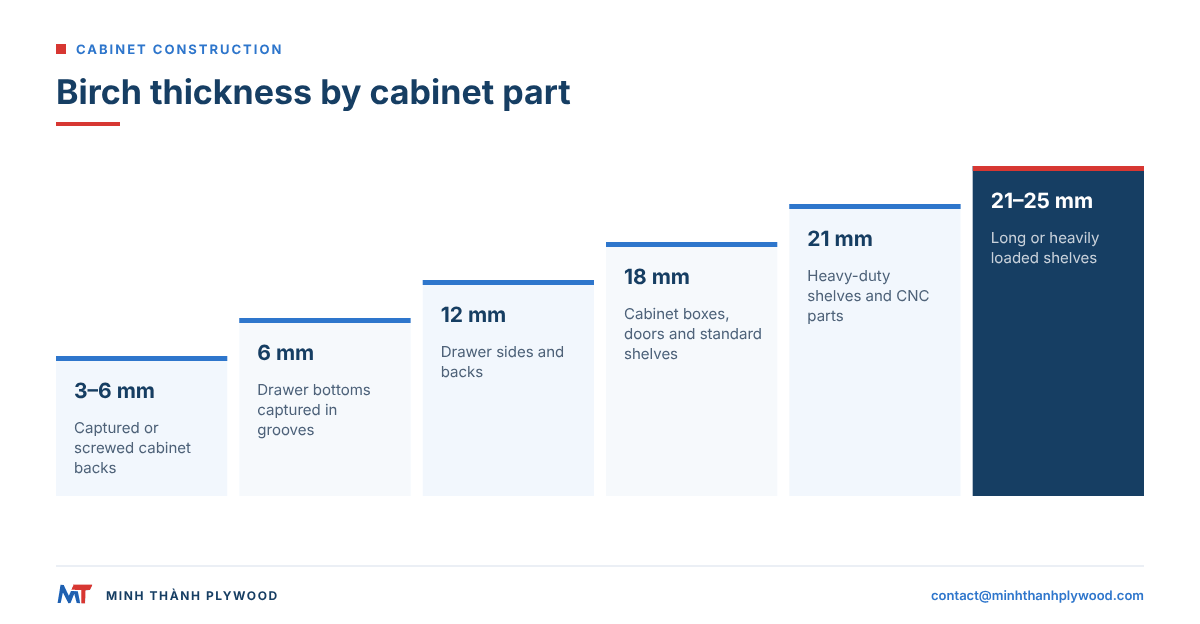
Use 18 mm (3/4 in) birch plywood for the cabinet box and doors, and thinner sheets only where the part is captured or light. These are the starting points cabinet makers order from our 3–40 mm range:
| Cabinet part | Thickness | Notes |
|---|---|---|
| Heavy-duty shelves and CNC parts | 21 mm (about 13/16 in, 15 plies in Baltic birch) | A heavy-duty Baltic birch size; order it where a design calls for 21 mm |
| Sides, tops, bottoms | 18 mm | Holds confirmat screws and hinge plates |
| Fixed and adjustable shelves | 18 mm | 21–25 mm or a support for long spans and heavy loads |
| Doors and drawer fronts | 18 mm | Balanced faces, same finish both sides |
| Drawer sides and backs | 12 mm | 15 mm for wide or heavy drawers |
| Drawer bottoms | 6 mm | Captured in a groove |
| Cabinet backs | 3–6 mm | Captured or screwed; thicker if the back hangs the cabinet |
An inch is exactly 25.4 mm (NIST). A 3/4 in label and an 18 mm panel are therefore close but not identical. Ply count is the quick test of a genuine all-birch sheet: a 3/4 in (18 mm) Baltic birch sheet has 13 plies against 5–7 plies in standard plywood, and the 21 mm size has 15. Our thin 3–5 mm plywood is always five plies, so a 4 or 5 mm back or drawer bottom stays flat in its groove. The sister guides on plywood for cabinet boxes and plywood for cabinet doors go part by part.
How well does birch plywood hold screws and hinges?
Birch plywood holds screws and hinge fixings very well, because the face is hard and the cross-grain plies grip the thread in every direction. That is why birch faces are common on hinge-side gables and doors, where a soft face would let a hinge plate pull out over years of use.
Three rules keep the holding strength where it should be:
- Drill pilot holes for face screws and use confirmat or system screws for carcass joints; driving coarse screws into the edge without a pilot can split the plies.
- Keep fixings away from the sheet edge by at least the panel thickness, and away from cut corners.
- Choose the core for the load. A denser eucalyptus core holds better under heavy drawers and tall doors; a Styrax core keeps the box light.
The thickness tolerance matters too. Our sanded furniture panels are held to ±0.2–0.3 mm, down to ±0.2 mm, so 18 mm parts fit the same in every dado, hinge cup and drawer runner.
How do birch plywood edges look, and how do you finish them?
A Baltic birch edge shows even birch stripes and can stay exposed; a birch-faced edge shows the core and is usually banded. Plan the edge before you order the panel.
- Exposed edge, all-birch look: Baltic birch, sanded and lacquered. Chamfer the edge lightly to stop chipping.
- Birch veneer edge banding: iron-on or hot-melt birch banding on a birch-faced panel matches the face colour.
- ABS or PVC banding: for painted or coloured cabinets, the band is chosen to match the paint.
- Painted edge: fill, sand and prime the edge before the face, so the ply lines do not telegraph through the topcoat.
On a birch-faced panel with a pale Styrax core, a clear-lacquered edge reads as a light, even striped edge; customers who want birch-coloured stripes still need Baltic birch.
Can you stain or paint birch plywood cabinets?
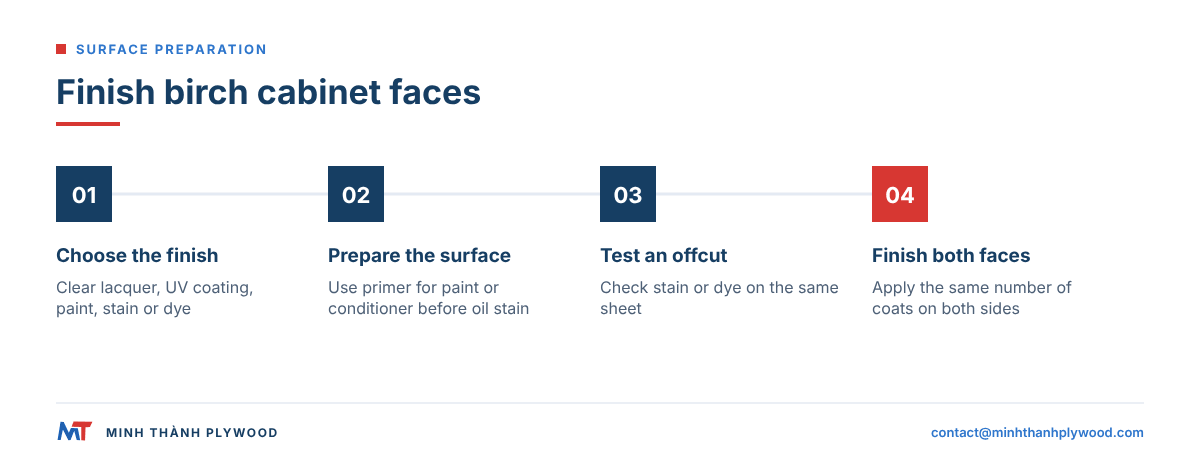
Birch plywood cabinets take paint and clear finishes very well; stain needs care. Birch is a closed-grain wood that absorbs oil-based stain unevenly and can look blotchy.
| Finish | How birch takes it | Tip |
|---|---|---|
| Clear lacquer or water-based varnish | Pale and even | The usual finish for birch kitchens |
| UV coating | Even, hard surface | Our faces are UV-ready on both sides for your own UV line |
| Paint | Smooth, no grain raising after priming | Prime with a sanding sealer or primer first |
| Oil-based stain | Can blotch | Use a wood conditioner or switch to gel stain |
| Water-based dye | More even than oil stain | Test on an offcut of the same sheet |
Finish both faces of every door and panel with the same number of coats. An unequal finish takes in moisture unequally and can bow a door, whatever the plywood.
What is the moisture and emission story for birch cabinet plywood?
Cabinet plywood for Europe and North America must meet formaldehyde limits, and the glue and the emission class are two separate lines on the order. Our furniture panels use UF glue at E0 emission; moisture-resistant (MR) and phenolic (WBP) bonds are made to the customer’s specification for sink units and bathrooms.
For the US market, composite wood products in cabinets fall under TSCA Title VI, with a limit of 0.05 ppm for hardwood plywood under 40 CFR 770.10. Our mill holds CARB P2 / TSCA Title VI certification (ICTT mill no. 23024), and six ASTM D6007 chamber tests between April 2025 and June 2026 on 9, 15 and 18 mm panels averaged 0.014–0.032 ppm, three by Shanghai Hongjun and three by ICTT Vietnam. Details are on our CARB P2 / TSCA Title VI page.
Panels are dried to 8–12 % moisture content at dispatch, the normal range for furniture plywood. Let them settle in your shop for a few days before machining.
How much does birch plywood for cabinets cost?
Birch cabinet plywood is priced by the cubic metre at the factory and by the sheet at the merchant. Factory-direct furniture plywood from Vietnam starts from US$350/m³ (October 2026); the face grade, core, thickness, size and quantity set the final price.
What does a sheet cost in the US?
US stockists sell Baltic birch by the sheet. Cherokee Wood Products lists 5 × 5 ft and 4 × 8 ft B/BB and BB/BB sheets from US$33 (1/8 in) to US$138 (3/4 in), and Berta lists a 4 × 8 ft BB/BB sheet from US$99.90 with 10 % off at ten sheets (prices read 21 October 2026). Our factory price converts like this:
| Item | Per sheet, 1220 × 2440 mm |
|---|---|
| US retail, Baltic birch BB/BB, 4 × 8 ft | US$99.90 and up (Berta); US$33–138 across thicknesses (Cherokee) |
| Factory-direct furniture plywood, 18 mm, at US$350/m³ | About US$19 raw FOB (0.0536 m³ per sheet; before freight, duty and margin) |
The FOB figure is a raw example of the cubic-metre price, not a delivered sheet price. Ocean freight, US duty, port and trucking costs sit on top, and the gap to a retail sheet is the margin an importer or cabinet shop works with. Unfnshed, a US furniture maker, also notes that solid wood often costs 3–5 times as much as Baltic birch for comparable furniture, which is why plywood is the cost-effective cabinet material.
Four things move the price most:
- All-birch vs birch-faced. Baltic birch costs more because every ply is birch.
- Face grade. D+/D (about B/BB) costs more than D/E (about BB/CP).
- Core species. Styrax and eucalyptus cores price differently and weigh differently.
- Thickness tolerance and sanding. Calibrated, sanded panels cost more than commercial panels and save time in the shop.
For current price bands on the all-birch panel, see our Baltic birch plywood price guide.
How do Vietnamese birch-faced panels compare for a cabinet shop?
For a cabinet maker looking for an alternative to Baltic birch, a Vietnamese birch-faced panel gives the same birch face with a different core and a factory-direct price. Our mill is built for top-grade furniture and interior plywood with Europe as its main market, and ships regularly to European buyers, with repeat orders into Italy, as well as across the Americas.
What a cabinet shop gets from a direct order:
- Birch faces in D+, D or E grade, matched to your approved sample.
- White Styrax or eucalyptus cores, stitched and pressed twice.
- Sizes 1220 × 2440 and 1250 × 2500 mm, plus custom sizes and cut-to-size parts.
- UV-ready faces for your own UV line, and sanded, polished surfaces.
- Origin records for the EU: the EU Deforestation Regulation, Regulation (EU) 2023/1115, requires origin data, so we supply the EUDR compliance dossier (origin records and geolocation files) with every order, and CARB P2 / TSCA Title VI labels for the US.
What this means for your cabinet plywood order
A cabinet shop buying birch plywood by the container plans by sheets and weight. At 18 mm on a Styrax core, a 40HC holds about 990 sheets, close to 53 m³, under a planning payload of 28,000 kg. A eucalyptus core is heavier, so fewer sheets fit.
Order terms are simple:
- MOQ one 40HC, with mixed thicknesses and grades by agreement, for example 18 mm carcass sheets plus 12 mm drawer stock and 6 mm backs.
- Production 15–45 days after the 30% deposit.
- FOB Hai Phong, CFR or CIF.
- Free samples of each face grade, so you can test stain, lacquer and hinges before ordering.
Our kitchen cabinet plywood buyer guide covers the full kitchen, from the sink unit to incoming inspection.
How to specify birch cabinet plywood on an RFQ
Send each line in the form a mill can price without questions back:
Birch-faced plywood for kitchen cabinets, 18 mm, 1220 × 2440 mm, birch D+/D face/back, Styrax core, UF glue at E0 emission, CARB P2 / TSCA Title VI, sanded both sides, tolerance ±0.2–0.3 mm, packed on pallets, one 40HC, CIF your port.
Add the parts the panel is for (doors, carcass, shelves), the finish you will apply, and any thinner sizes for drawers and backs. The birch plywood product page has the full range; we reply within hours.
Buyer questions, answered
Is birch plywood good for kitchen cabinets?
Yes. Birch is a hard, fine-grained face that holds screws and hinges well, machines with clean edges and takes paint and clear lacquer evenly. It is one of the most used cabinet plywoods in Europe and North America.
Is Baltic birch plywood worth it for cabinets?
It is worth it where the plywood edge stays visible, as in exposed-edge kitchens and open shelving, because every ply is birch. For carcasses with banded edges, painted cabinets or hidden parts, birch-faced plywood on a hardwood core gives the same face at lower cost.
What grade of birch plywood is best for cabinets?
For clear-finished doors and visible sides, order B/BB (Vietnamese D+/D). For carcass interiors and painted parts, BB/BB or BB/CP (D/D or D/E) is enough. Agree the grade against an approved sample.
What thickness birch plywood should I use for cabinet boxes?
Use 18 mm (3/4 in) for sides, tops, bottoms and fixed shelves, 12 mm (1/2 in) for drawer sides, and 3–6 mm for captured backs. Wider or heavily loaded shelves need 21–25 mm or extra support.
Can I stain birch plywood cabinets?
Yes, but birch can blotch under oil-based stain. Use a wood conditioner or a gel stain, test on an offcut of the same sheet, and keep doors from one sheet or one batch together. Clear lacquer and paint give the most even result.
Is birch plywood better than maple plywood for cabinets?
They perform alike. Maple is a little harder and lighter in colour; birch is usually easier to buy in volume and cheaper per sheet. Both blotch under stain, so the choice is mostly the colour and grain you want.
Is birch plywood better than poplar plywood for cabinets?
Birch is harder and holds screws better, so it suits doors, shelves and hinge sides. Poplar is lighter and lower in cost and paints well, so it suits painted carcasses and drawer boxes.
Does Baltic birch warp in cabinet doors?
Any plywood door can bow if its two faces are finished differently or it is stored unevenly. A balanced build, the same finish on both faces and 18 mm thickness keep birch plywood doors flat.
Is birch-faced plywood the same as Baltic birch?
No. Baltic birch has birch veneers in every ply. Birch-faced plywood has birch on the face and back over a core of another species, such as Styrax or eucalyptus. The faces look the same; the edges do not.
Where can a cabinet maker buy birch plywood other than Baltic birch?
Vietnamese mills make birch-faced cabinet plywood with E0 emission and CARB P2 / TSCA Title VI certification, shipped by the container to Europe and the Americas. Minh Thanh Plywood is one of them, with free samples and MOQ one 40HC.
How much does birch cabinet plywood cost?
Factory-direct furniture plywood from Vietnam starts from US$350/m³ (October 2026), with the face grade, core, thickness and quantity setting the final price. Baltic birch costs more per sheet because every ply is birch.