
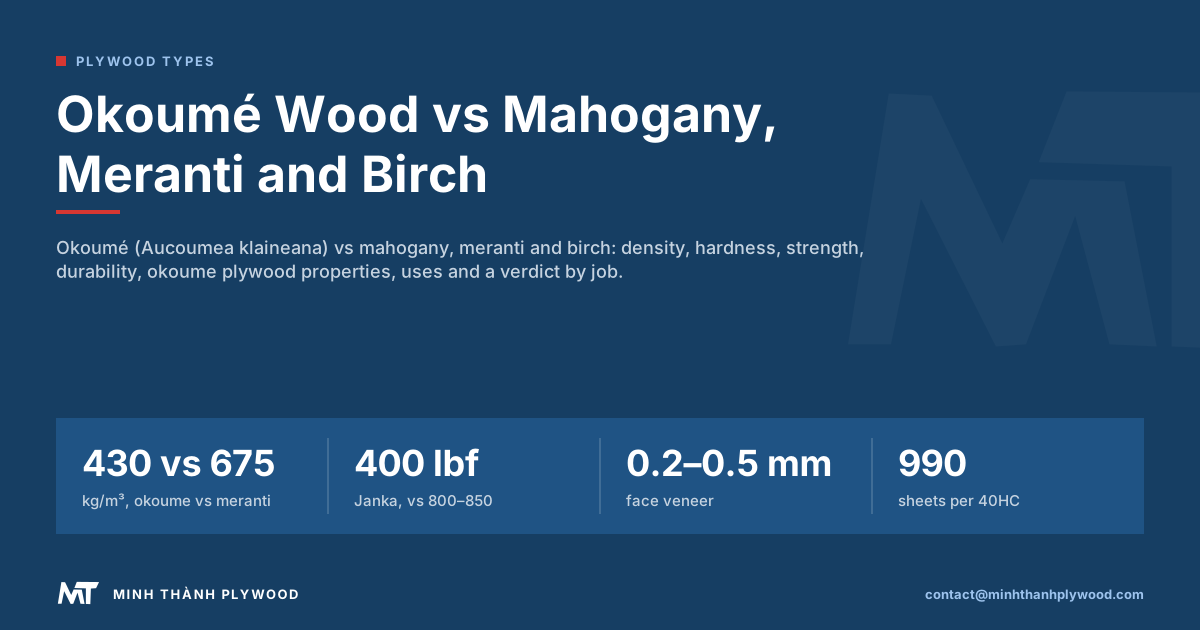
Okoumé (Aucoumea klaineana) is a light, soft, pinkish-beige hardwood from Central Africa, mainly Gabon, grown for veneer and plywood. At about 430 kg/m³ it is far lighter than meranti or birch, peels into large, even sheets and takes glue and finishes well, so okoume is chosen for light plywood with a warm face. Minh Thanh Plywood presses imported okoume faces on white Styrax or Eucalyptus cores.
What is okoumé wood?
Okoumé is the wood of Aucoumea klaineana, a tall Central African tree that grows mainly in Gabon, where it is the principal commercial timber species. The tree reaches 30–40 m with a trunk diameter of 1–1.8 m, which is why it peels into the large, clean veneer sheets plywood mills want.
The wood is light and soft, with a pale pink to light brown heartwood that darkens with age, a fine, even texture and a mild, sometimes wavy figure. In the trade it is spelled okoumé (French), okoume or okume, and is sometimes called gaboon after its home country; in French-speaking markets okoume plywood is contreplaqué okoumé.
Almost all okoume is used as veneer. Gabon’s okoume goes into marine plywood, furniture plywood, doors and wall panels in Europe and worldwide. As lumber it is rare, because the wood is soft and blunts saw teeth.
Okoumé the wood, not the Quebec band: what are you looking for?
Okoumé (also spelled okoume or okume) is a tree, a timber and a plywood face, and it is also the name of a Quebec folk-rock band that played from 1995 to 2002. This page is about the wood. If you came for the band, Wikipedia lists its members and albums; if you came to buy, this is where the wood and plywood answers start:
| You want | Short answer | Where on this page |
|---|---|---|
| The species | Aucoumea klaineana, a light Central African hardwood from Gabon | What is okoumé wood? |
| Its numbers | About 430 kg/m³, Janka 400 lbf, bending strength 75 MPa | Okoume wood properties at a glance |
| Okoume plywood | Okoume veneer face and back on a plywood core; marine only when built to BS 1088 | Okoume plywood properties |
| Marine-grade okoume sheets | 4 ft × 8 ft (1220 × 2440 mm), certified to BS 1088 | How do you order okoume plywood? |
| A supplier | Okoume-faced furniture plywood from Vietnam, by the container | Who supplies okoume plywood from Vietnam to Europe? |
Canadian shops list “okoumé panels, marine grade, 4 x 8”, which is the same 1220 × 2440 mm sheet sold in feet and inches.
Okoume wood properties at a glance
Okoume’s numbers explain its uses: light enough for boats and vans, soft enough to dent, even enough to finish well. Figures from The Wood Database (read 20 October 2026), at 12% moisture content:
| Property | Okoume (Aucoumea klaineana) |
|---|---|
| Origin | Central Africa, primarily Gabon |
| Average dried weight | 430 kg/m³ |
| Janka hardness | 400 lbf (1,790 N) |
| Bending strength (modulus of rupture) | 75 MPa |
| Stiffness (elastic modulus) | 8.47 GPa |
| Crushing strength | 36.2 MPa |
| Durability | Non-durable; poor insect resistance |
| Working | High silica blunts cutters; glues and finishes well |
| Colour | Pale pink to light brown, darkens with age |
Two numbers matter most to a plywood buyer. The low density makes okoume plywood among the lightest hardwood plywood available. The low hardness means an okoume face dents more easily than birch or meranti, so it suits panels that are seen and handled rather than floors or worktops. Source: The Wood Database, okoume.
Okoume vs mahogany, meranti and birch: comparison table
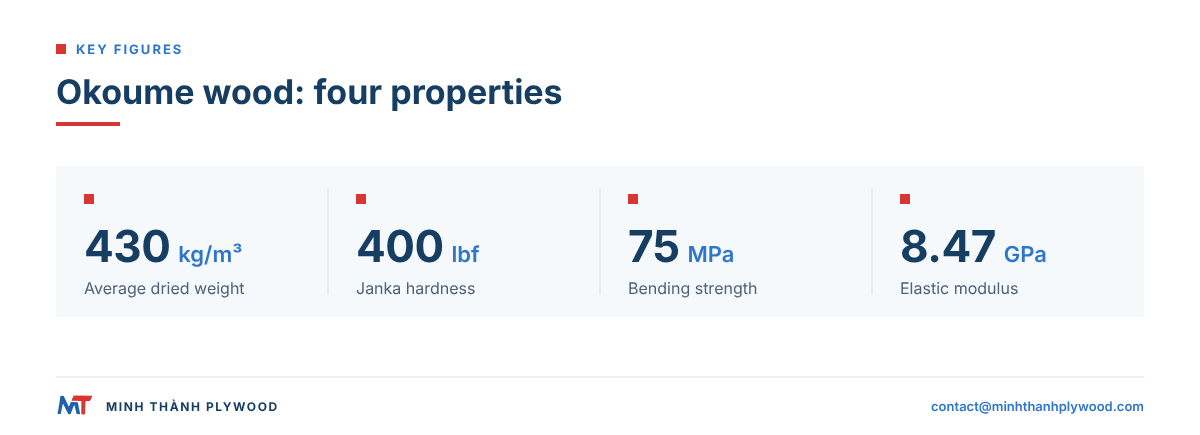
Buyers compare okoume most often with African mahogany, meranti and birch. One row per metric, figures from The Wood Database (read 20 October 2026):
| Metric | Okoume | African mahogany (Khaya) | Dark red meranti (Shorea) | Birch (North American) |
|---|---|---|---|---|
| Origin | Central Africa (Gabon) | Tropical Africa | South-East Asia | North America |
| Average dried weight | 430 kg/m³ | 545 kg/m³ | 675 kg/m³ | 610–690 kg/m³ |
| Janka hardness | 400 lbf (1,790 N) | 850 lbf (3,800 N) | 800 lbf (3,570 N) | 910–1,260 lbf (4,050–5,610 N) |
| Bending strength | 75 MPa | 80.9 MPa | 87.7 MPa | 84.8–114.5 MPa |
| Stiffness | 8.47 GPa | 9.72 GPa | 12.02 GPa | 10.97–13.86 GPa |
| Durability | Non-durable | Moderately durable | Moderately durable to non-durable | Perishable |
| Face look | Pinkish-beige, mild figure | Pale pink to reddish brown | Dark reddish brown, resin streaks | Pale cream, fine |
| Main use in plywood | Light faces, marine and furniture plywood | Faces, joinery | Marine and exterior plywood | Furniture, all-birch plywood |
Birch figures cover paper birch and yellow birch. Sources: African mahogany, dark red meranti, paper birch and yellow birch.
Read the table by use: okoume wins on weight, every other species on hardness and stiffness. That is the whole trade-off.
Okoume vs mahogany: is okoume a mahogany?
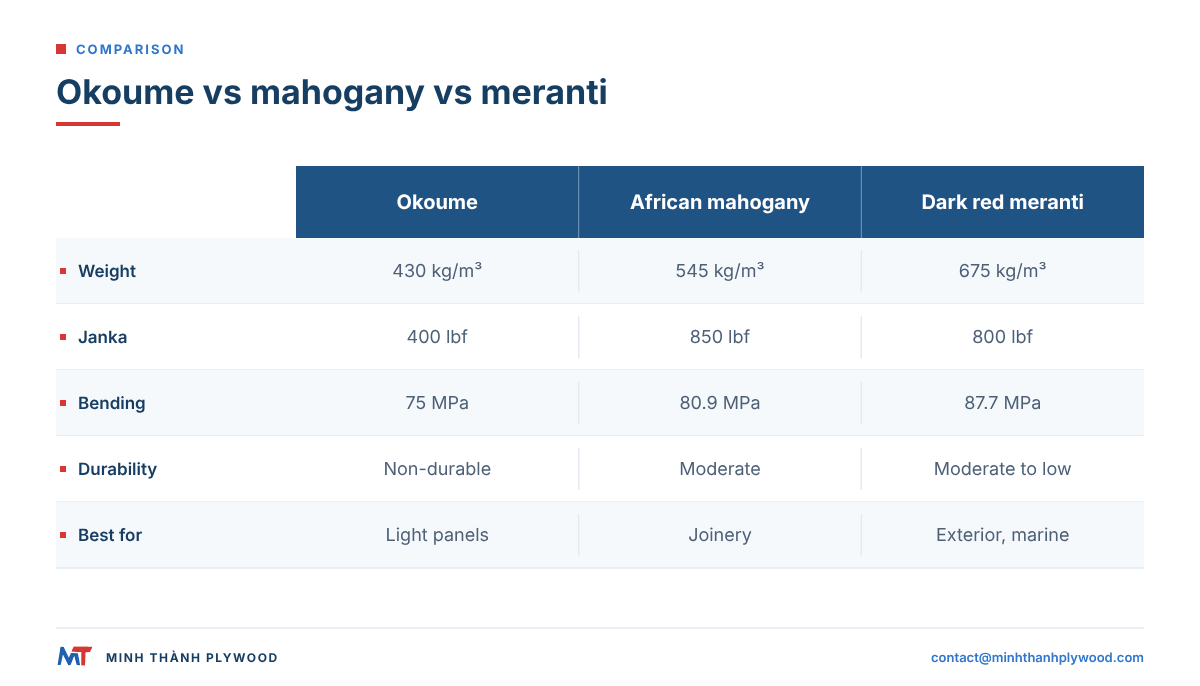
Okoume is not a mahogany. It belongs to the Burseraceae family, while African mahogany (Khaya) and genuine mahogany (Swietenia) belong to the Meliaceae. The confusion comes from colour: an okoume face has a pinkish, mahogany-like tone, and older trade names grouped many reddish tropical woods as “mahogany”.
The practical differences:
- Weight: okoume about 430 kg/m³, African mahogany about 545 kg/m³.
- Hardness: African mahogany is more than twice as hard, 850 against 400 lbf.
- Durability: African mahogany is moderately durable; okoume is non-durable.
- Form: mahogany is sold as lumber for joinery and furniture; okoume almost only as veneer and plywood.
For a panel, okoume gives a mahogany-like warm face at much lower weight. For solid joinery, doors and frames that must resist wear, mahogany is the stronger wood. Genuine mahogany, Swietenia macrophylla, is listed under CITES, which adds paperwork to every shipment; okoume is not.
Okoume vs meranti plywood: which to choose?
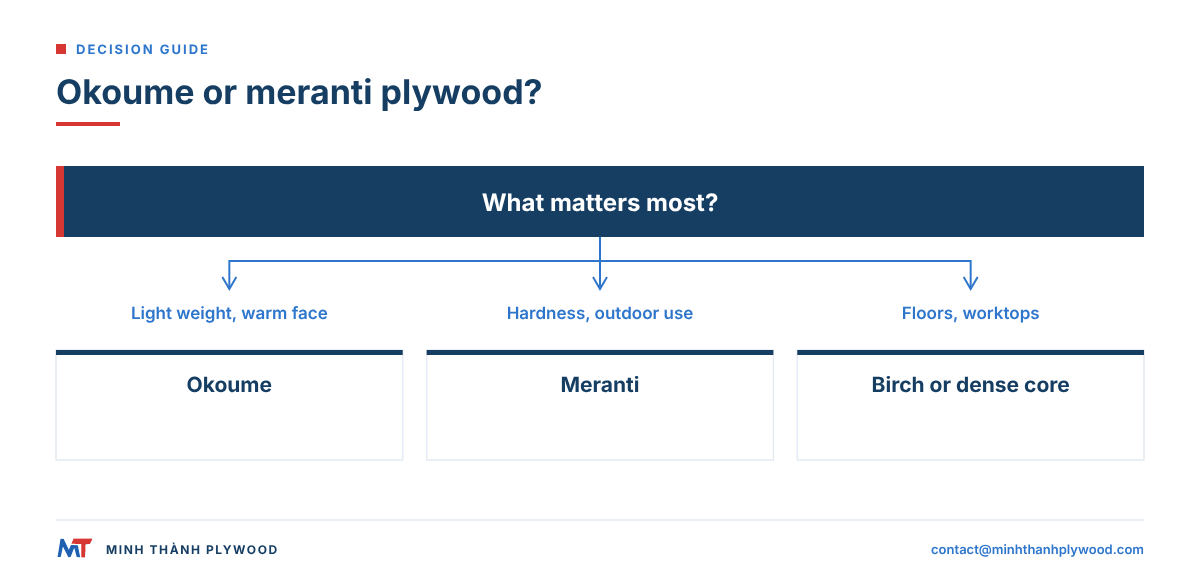
Choose okoume plywood for light weight and a pale, even face; choose meranti plywood for density, hardness and outdoor durability. Meranti, at about 675 kg/m³, is over 50% heavier than okoume at about 430 kg/m³, and about twice as hard.
| Use | Better choice | Why |
|---|---|---|
| Boat hulls and decks, light build | Okoume marine plywood | Lightest per sheet; the classic BS 1088 species |
| Boat parts that wear or stay wet | Meranti marine plywood | Harder, more durable |
| Van, caravan and camper interiors | Okoume-faced plywood on a light core | Weight saving on every sheet |
| Furniture, wall panels and doors | Okoume-faced plywood | Warm face that stains and lacquers evenly |
| Exterior joinery and cladding | Meranti plywood | Moderate durability, harder face |
| Floors and worktops | Neither: birch or a dense core | Okoume dents; meranti marks |
Both species need a phenolic WBP bond and a finish to survive outdoors. The bond and the build, not the face species, make a panel marine.
What is okoume plywood, and what are its properties?
Okoume plywood comes in two builds, and its properties depend on which one you buy:
- All-okoume plywood: okoume in every ply. The lightest build, used for marine plywood and lightweight boat building.
- Okoume-faced plywood: okoume face and back over a core of another species. The standard furniture and interior build, including all Vietnamese okoume plywood.
In okoume-faced plywood, the face veneer is only 0.2–0.5 mm thick; European furniture orders usually take 0.3 mm. The core therefore sets the weight, stiffness and screw holding:
| Minh Thanh okoume plywood, 18 mm, 1220 × 2440 mm | White Styrax core | Eucalyptus core |
|---|---|---|
| Core density | about 500 kg/m³ | 650–750 kg/m³ |
| Sheet weight | about 26.8 kg | about 34.8 kg at 650 kg/m³ |
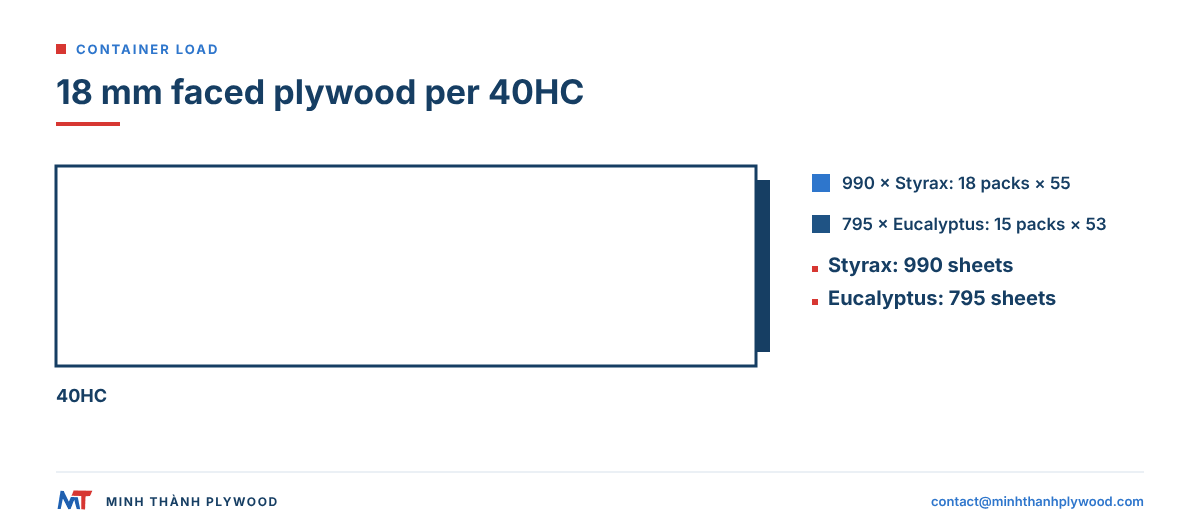
| Sheets per 40HC | 990 (18 packs of 55) | 795 (15 packs of 53) |
| Best for | Light furniture, wall panels, van interiors | Doors, hinge sides, loaded shelves |
Both are pressed twice, with core layers stitched both horizontally and vertically, and sanded and polished on both faces. Thickness runs from 3 to 40 mm, with a tolerance down to ±0.2 mm on sanded furniture panels.
How strong is okoume plywood?
Okoume plywood is strong for its weight but soft on the surface. The wood’s bending strength of 75 MPa at only 430 kg/m³ gives a good strength-to-weight ratio, which is why boat builders use all-okoume marine plywood. Its hardness of 400 lbf means the face dents under point loads that birch or meranti would shrug off.
In faced plywood, the core carries most of the load. On a Styrax core the panel is light and stiff enough for furniture, doors, wall panels and van interiors. On a Eucalyptus core, at 650–750 kg/m³, it is denser and holds screws and hinges more firmly. For shelves that span far or parts that take knocks, a denser core or a protective lacquer does more than changing the face species.
Is okoume plywood waterproof or marine grade?
Okoume plywood is not waterproof or marine grade by itself; the glue and the build decide. Okoume wood is non-durable, so outdoors or in water it needs a phenolic bond, a protective finish and sealed edges.
Marine plywood to BS 1088 is a separate build with durable plies throughout and a boil-proof bond, certified as such; all-okoume marine plywood is one version of it. Minh Thanh’s okoume plywood is a furniture and interior panel and is not sold as marine plywood. For humid interiors, such as kitchens, bathrooms and vans, it is pressed with melamine-fortified MR glue; for outdoor parts with sealed edges, with phenolic WBP glue. The difference between the two products is explained in okoume marine plywood vs okoume-faced plywood, and the marine grades in our marine plywood buying guide.
What is okoume plywood used for?
Okoume plywood is used where a light panel with a warm, even face is worth more than a hard surface. The main uses:
- Furniture: cabinets, wardrobes, shelving and tables with stained or clear-lacquered faces.
- Wall and ceiling panelling: large, light sheets that are easy to hang.
- Doors: interior doors and door skins.
- Van, camper and caravan interiors: furniture and linings, where every kilogram counts.
- Boat interiors: cabin furniture and linings on MR or WBP glue.
- Marine plywood: hulls, decks and bulkheads, in certified all-okoume builds.
- Model making and laser work: thin, light okoume sheets cut cleanly.
Okoume faces also suit painting and lamination, because the even texture takes paint without heavy grain show-through.
Is okoume plywood from Vietnam real okoume, and what is the core?
Yes: Vietnamese okoume plywood has genuine okoume face and back veneers, imported, pressed over a local plantation core. Okoume, like gurjan and bintangor, is only ever a face species in Vietnam; the core is Styrax, Eucalyptus, Acacia or a mix. Minh Thanh uses white Styrax or Eucalyptus cores as standard.
How to confirm the face is okoume and not a look-alike:
- Colour: okoume is pinkish-beige to pale salmon; bintangor is redder-brown.
- Figure: okoume has a mild, wavy figure; bintangor a straight, interlocked stripe.
- Paperwork: the face species is written on the proforma invoice and the pack marks.
- Pre-shipment proof: close photos and a clip of your own sheets before loading; every shipment is photographed and filmed.
For US orders, Minh Thanh supplies the face and core species and the harvest origin for the importer’s Lacey Act declaration. Our bintangor plywood page shows the other common red-toned face for comparison.
Which okoume veneer face grades are there?
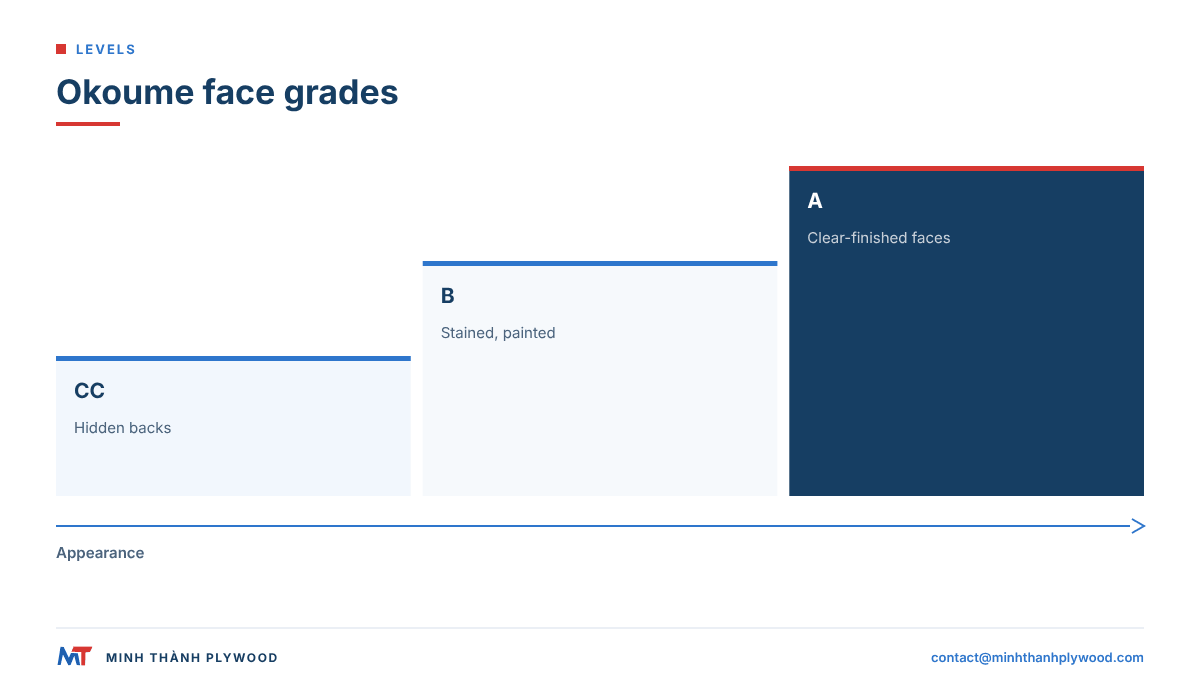
Okoume faces are graded by colour evenness and defects, and quoted as face/back pairs. On Minh Thanh’s okoume plywood, faces are graded A or B, and hidden backs are often ordered as CC:
| Grade | Look | Use |
|---|---|---|
| A | Even colour, few features | Clear-finished, seen faces |
| B | More figure and colour streaks | Stained, painted or laminated faces |
| CC | Repairs and colour variation allowed | Hidden backs |
Pairs such as A/B, B/B or B/CC are graded against the sample the buyer approves. Because okoume veneer is imported, the face grade is the first driver of price: an A/B pair costs more than B/CC.
Does okoume plywood meet European and US requirements?
Yes. Minh Thanh’s okoume panels are made for European furniture buyers and meet the emission and quality requirements they ask for, with UF glue at E0 emission as standard. The proof is the CARB P2 / TSCA Title VI certification (ICTT mill no. 23024), and six ASTM D6007 chamber tests, April 2025 to June 2026, on 9, 15 and 18 mm panels, which averaged 0.014–0.032 ppm. The US limit for veneer-core hardwood plywood is 0.05 ppm under 40 CFR 770.10.
EU orders come with the EUDR compliance dossier, with origin records and geolocation files. The application dates are set by Regulation (EU) 2025/2650. Third-party testing to the buyer’s method, for example EN 717-1, is arranged through SGS on request. E0 emission is tested every 3 months.
Who supplies okoume plywood from Vietnam to Europe?
Okoume plywood in Vietnam is made by factories that import okoume face veneer and press it on local plantation cores for furniture and interior buyers. Minh Thanh Plywood is one of them: a manufacturer in Ha Hoa, Phu Tho, with 50,000+ m³ of capacity a year and Europe as its main market, shipping regularly to European buyers with repeat orders into Italy.
Trade terms for okoume plywood:
- MOQ: one 40HC, with thicknesses, grades and faces mixed by agreement.
- Production: 15–45 days after the 30% deposit; balance 70% against the scanned B/L, or irrevocable L/C at sight.
- Delivery: FOB Hai Phong, CFR or CIF.
- Sizes: 1220 × 2440 and 1250 × 2500 mm, custom sizes such as 1220 × 2500 and 1220 × 2280 mm, and panels cut to size into 4, 6 or 8 pieces.
- Samples: free.
The builds and grades are on our okoume plywood page.
How should okoume plywood be stored and finished?
Store okoume plywood flat on bearers, indoors, off concrete and with the wrapping on until use. Keep packs out of direct sun: okoume darkens with light, and an uncovered top sheet can tan unevenly. Let the panels settle in the workshop for a few days before machining.
When working okoume:
- Use sharp, carbide tooling. The wood’s high silica content blunts cutters quickly.
- Support the face. The soft surface dents under clamps and handling; use pads.
- Sand lightly. The face veneer is thin, so sand with fine grit and little pressure.
- Seal before staining. A sealer coat evens the absorption and avoids blotches.
- Finish exposed edges. Lacquer or band the edges, and seal any panel that meets moisture.
How do you order okoume plywood?
An okoume plywood order is complete when it names the core and the glue, not just the face. Write these lines:
- Use: furniture, wall panels, doors, van interior, boat interior.
- Core: white Styrax for light weight, Eucalyptus for screw holding.
- Glue and emission: UF glue at E0 emission, MR or phenolic WBP; emission class on its own line.
- Face and back: okoume grade pair, such as A/B or B/CC, against an approved sample.
- Thickness, tolerance and size: for example 18 mm, ±0.2 mm, 1220 × 2440 mm.
- Packing and quantity: sheets per thickness, pack marks, destination port.
Canada and the US: sizes in feet and inches. Okoume panels are sold as 4 ft × 8 ft sheets, which is 1220 × 2440 mm, in thicknesses from 1/4 inch to 3/4 inch (about 6.35 to 19 mm). Marine-grade okoume is certified to BS 1088, which is the standard Canadian marine suppliers list.
Our panels are okoume-faced furniture and interior plywood, not BS 1088 marine plywood, so quote them for cabinets, wall panels, doors and vehicle interiors, and use CARB P2 / TSCA Title VI paperwork for the US. Write the thickness in millimetres on the order and let us match it to the nearest inch size you sell.
Send the list to [email protected] or on WhatsApp +84 988 586 601 (Lisa); replies come within hours, and free samples go out with the quotation. For other furniture faces, see our furniture plywood range.
Buyer questions, answered
What is okoume?
Okoume (Aucoumea klaineana) is a Central African hardwood, mainly from Gabon. It is light, about 430 kg/m³, pinkish-beige, and mostly used as veneer for plywood.
What is okoume plywood?
Plywood with okoume veneer on the face and back. It is either okoume all through, as in classic marine plywood, or okoume faces over a core of another species, as in most furniture plywood.
Is okoume a hardwood or softwood?
Okoume is a hardwood, botanically, though it is soft: its Janka hardness of 400 lbf (1,790 N) is lower than many softwoods. It dents more easily than birch or meranti.
Is okoume the same as mahogany?
No. Okoume belongs to the Burseraceae family; African mahogany (Khaya) and genuine mahogany (Swietenia) belong to the Meliaceae. Okoume is lighter and softer and is sold as veneer and plywood rather than lumber.
Is okoume plywood waterproof?
Not by itself. Water resistance comes from the glue: a phenolic WBP bond for wet use, melamine-fortified MR for humid interiors. The okoume wood is non-durable and needs a finish outdoors.
Is okoume plywood marine grade?
Only when it is built and certified as marine plywood, for example to BS 1088. Okoume-faced furniture plywood on another core is an interior panel, not marine plywood.
How strong is okoume plywood?
Strong for its weight. Okoume wood has a bending strength of 75 MPa at 430 kg/m³; in faced plywood the face is only 0.2–0.5 mm, so the core species sets most of the panel's strength and screw holding.
Okoume vs meranti plywood: which is better?
Okoume for light weight, a pale even face and easy handling; meranti for higher density, hardness and durability. Meranti plywood weighs much more for the same thickness.
Is okoume good for furniture?
Yes, as a face veneer: its warm pinkish-beige colour stains and lacquers evenly, and okoume-faced panels on a light core are easy to handle for cabinets, wall panels and doors.
What core does okoume plywood from Vietnam have?
Vietnamese okoume plywood has imported okoume face and back veneers over a local plantation core. Minh Thanh uses white Styrax or Eucalyptus cores; okoume is never the core species in Vietnam.
How do you tell okoume from bintangor?
Okoume is pinkish-beige to pale salmon with a mild, wavy figure; bintangor is redder-brown with a straight, interlocked stripe. The face species should be written on the proforma and the pack marks.
Does okoume darken over time?
Yes. Okoume darkens with light and age towards a deeper pinkish-brown, so keep packs wrapped and out of sun until use, and finish exposed panels evenly.