
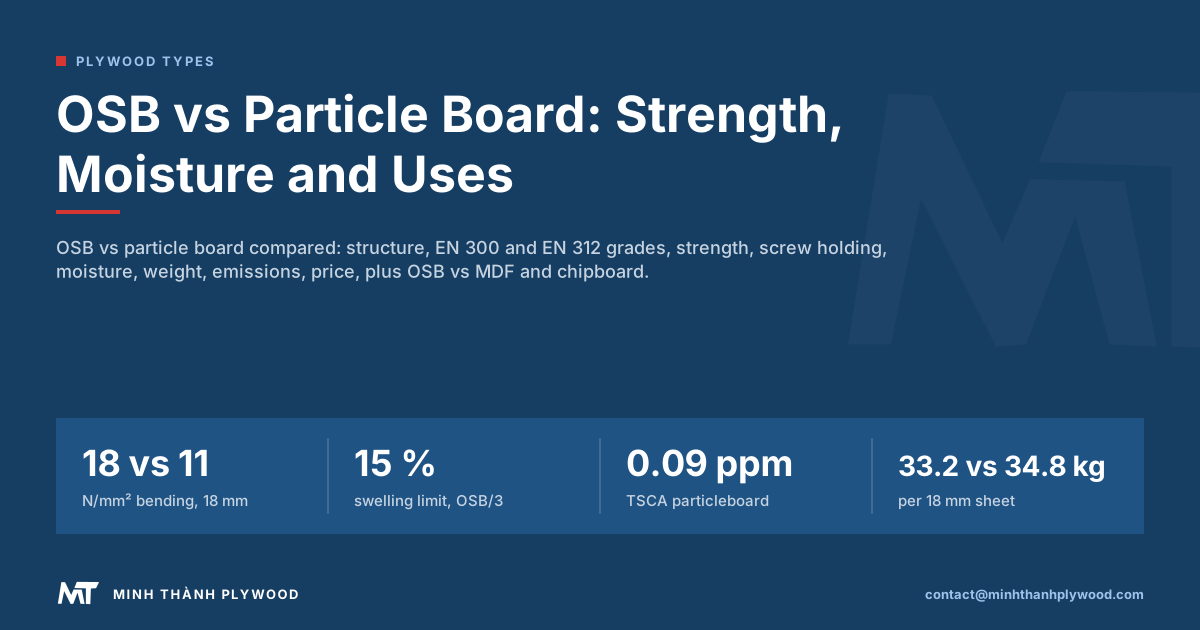
OSB vs particle board comes down to structure: OSB presses long wood strands in crossed layers, so it is stronger, stiffer and better in damp; particle board presses fine chips into a smooth, flat board that is cheaper and better for furniture and laminating. Use OSB for sheathing, subfloors and crates; particle board for dry furniture. Minh Thanh Plywood shows where plywood beats both.
OSB vs particle board: the short answer
OSB is the stronger, stiffer, more moisture-tolerant board; particle board is the smoother, flatter, cheaper board. Choose OSB for anything that carries load or meets damp during building: sheathing, subfloors, roof decks, hoarding, crates. Choose particle board for dry-room furniture, shelving and anything that will be laminated or veneered.
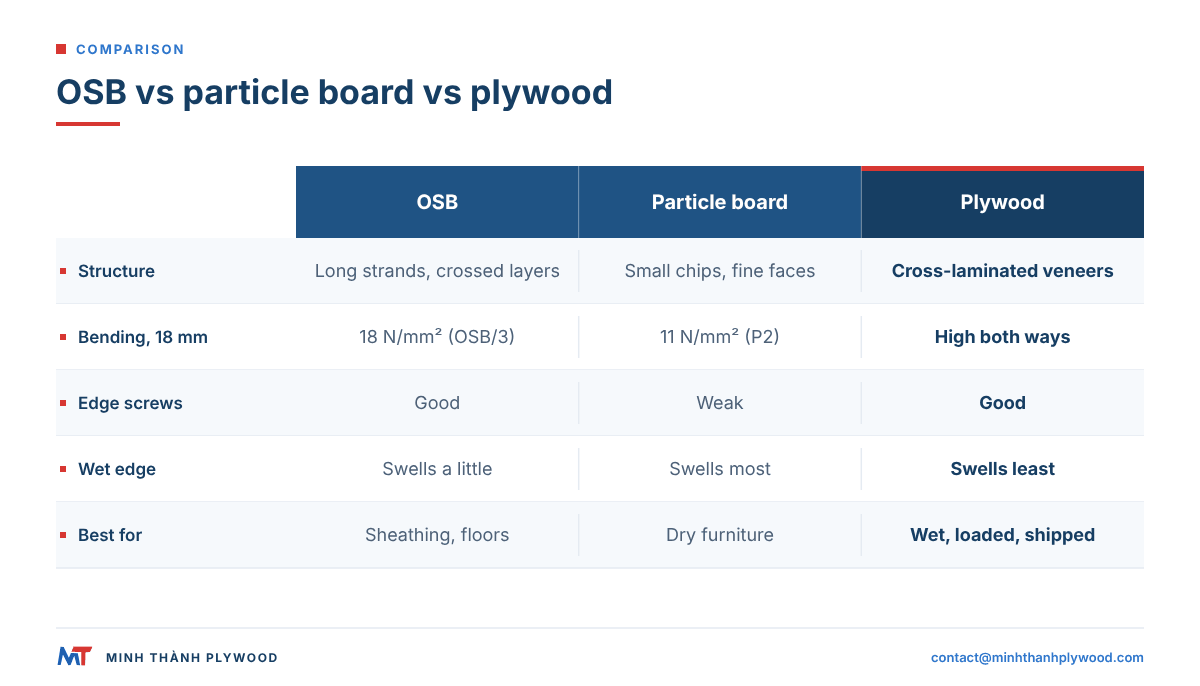
| Metric | OSB (oriented strand board) | Particle board (chipboard) |
|---|---|---|
| Wood element | Long, thin strands in crossed layers | Small chips and sawdust, fine faces |
| European standard | EN 300, grades OSB/1 to OSB/4 | EN 312, grades P1 to P7 |
| Bending strength, 18 mm | 18 N/mm² major axis (OSB/3) | 11 N/mm² (P2 furniture grade) |
| Screw holding | Good on face and edge | Fair on face, weak in edge |
| 24-hour thickness swelling | 15 % max (OSB/3) | No limit for P2; 14 % max for P3 |
| Surface | Textured, visible strands | Smooth, ready for melamine or veneer |
| Typical density | About 600–680 kg/m³ | About 600–750 kg/m³ |
| Price per sheet | Low | Lowest |
| Best for | Sheathing, subfloors, roofs, crates | Furniture carcasses, shelving, worktop cores |
Where neither fits, plywood usually does: it holds screws in every edge, swells least at a wet edge and is lighter than both for the same strength.
What is OSB (oriented strand board)?
OSB, oriented strand board, is a structural panel pressed from long, thin wood strands bonded with resin and laid in three to five layers. The strands in the outer layers run along the length of the board, and the core strands run across or at random, which gives OSB its strength along the major axis.
Strands are cut about 75–150 mm long from fast-grown softwoods and aspen, dried, coated with resin and wax, formed into a mat and pressed hot. The resin is usually PMDI (polymeric diisocyanate) or phenol-formaldehyde, which makes OSB a moisture-tolerant structural board.
Common OSB types under EN 300:
- OSB/1: general purpose and interior fitments, dry conditions.
- OSB/2: load-bearing, dry conditions.
- OSB/3: load-bearing, humid conditions; the standard for walls, roofs and floors in Europe.
- OSB/4: heavy-duty load-bearing, humid conditions.
In North America, OSB is made to PS 2 as rated sheathing and flooring, usually with an Exposure 1 bond for temporary weather exposure during building.
What is particle board (chipboard)?
Particle board, called chipboard in the UK and Australia, is a panel pressed from small wood chips, shavings and sawdust bonded with resin, usually urea-formaldehyde. Fine particles form the faces and coarser chips form the core, giving a smooth, flat surface over a lighter centre.
It is made from sawmill residues and recycled wood, which keeps it the cheapest wood panel in most markets. Most of it is sold faced with melamine paper as MFC (melamine-faced chipboard), veneered, or laminated with HPL.
Particle board types under EN 312:
| Grade | Use | Conditions |
|---|---|---|
| P1 | General purpose | Dry |
| P2 | Interior fitments, including furniture | Dry |
| P3 | Non-load-bearing | Humid |
| P4 | Load-bearing | Dry |
| P5 | Load-bearing, including T&G flooring | Humid |
| P6 | Heavy-duty load-bearing | Dry |
| P7 | Heavy-duty load-bearing | Humid |
Moisture-resistant grades (P3, P5, P7) are often dyed green so they can be told apart on site.
Oriented strand board vs particle board: how they are made
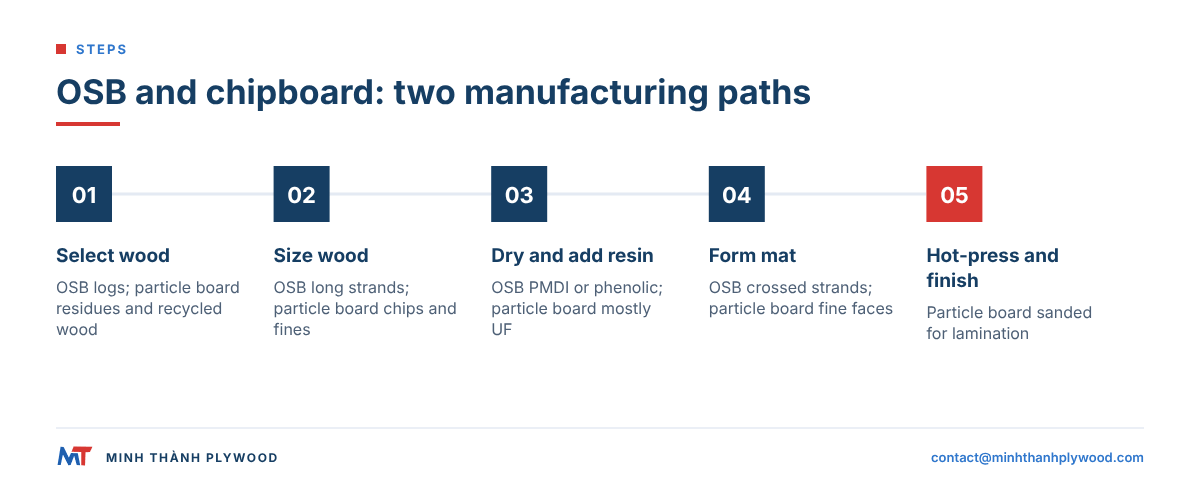
Oriented strand board vs particle board differs at the very first step: OSB cuts logs into long strands, particle board breaks wood into small chips. Everything else in the process follows from that.
- Wood: OSB uses fresh logs of aspen, pine and other fast-grown species; particle board uses sawmill residues, shavings and recycled wood.
- Cutting: OSB flakers slice strands about 75–150 mm long; particle board hammer mills and flakers produce chips and fines.
- Drying and resin: both dry the wood; OSB strands get PMDI or phenolic resin and wax; particle board chips get mostly urea-formaldehyde resin.
- Forming: OSB lays strands in oriented, crossed layers; particle board lays fine faces over a coarse core, without orientation.
- Pressing and finishing: both are hot-pressed, cooled, trimmed and graded; particle board is sanded smooth for lamination.
Orientation is why OSB is stronger along its length than across it. Particle board is equally strong, and equally weak, in every direction.
Is OSB stronger than particle board?
Yes, OSB is stronger and stiffer than particle board of the same thickness. The European product standards set these minimums for an 18 mm board:
| Property (minimum), 18 mm board | OSB/3 (EN 300) | P2 particle board (EN 312) |
|---|---|---|
| Bending strength, major axis | 18 N/mm² | 11 N/mm² |
| Bending strength, minor axis | 9 N/mm² | 11 N/mm² |
| Stiffness (modulus of elasticity), major axis | 3,500 N/mm² | 1,600 N/mm² |
| Stiffness, minor axis | 1,400 N/mm² | 1,600 N/mm² |
| Internal bond | 0.30 N/mm² | 0.35 N/mm² |
The numbers show the practical difference. Along its length, OSB has about 1.6 times the bending strength of P2 particle board and more than twice the stiffness, so it sags less than half as much under the same load. That is why it spans floor joists and rafters. Across its width, OSB is slightly weaker than particle board, so the strength axis printed on the sheet must run across the supports.
Particle board’s even internal bond is what furniture needs: it holds a flat, laminated face and machines cleanly at the edge.
Which holds screws better?
OSB holds screws better than particle board, on the face and especially in the edge. Long strands lock around a screw thread; small chips crumble and lose grip, most of all when a screw is driven twice.
- Face screws: both hold, OSB better; particle board needs coarse-thread chipboard screws.
- Edge screws: OSB holds reasonably; particle board splits and pulls out unless pre-drilled and fixed with confirmat or cam fittings.
- Re-driving: particle board loses most of its grip in a re-used hole; OSB and plywood keep more.
- Hinges and runners: furniture plants fix them with euro screws and dowels into particle board, or switch to plywood for doors and drawers that take repeated load.
Which handles moisture better?
OSB handles moisture better than standard particle board. OSB/3 is made for humid conditions and must stay within 15 % thickness swelling after 24 hours in water; OSB/4 within 12 %. Standard P2 furniture particle board has no swelling limit and swells and crumbles when water reaches an edge.
Moisture-resistant particle board narrows the gap: P3 must stay within 14 % swelling for 13–20 mm boards, and P5 flooring grade within 10 %. Neither board is waterproof. Both swell at cut edges that stay wet, and the swelling does not go back when the board dries.
Practical rules:
- Seal or tape all cut edges of either board in kitchens, bathrooms and on building sites.
- Use OSB/3, OSB/4 or P5 where boards will see damp during construction.
- Use phenolic-bonded plywood where boards will stay wet or outdoors.
How much do the sheets weigh?
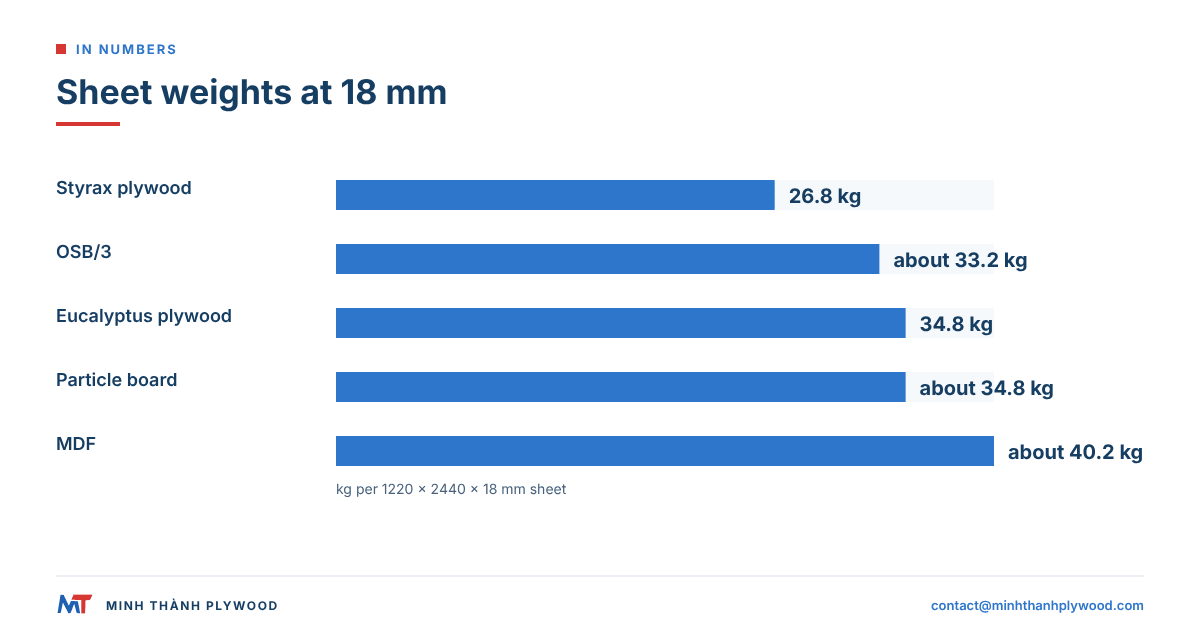
OSB, particle board and Eucalyptus-core plywood weigh about the same per sheet; plywood on a white Styrax core weighs least. A 1220 × 2440 × 18 mm sheet weighs:
| Board | Density | Sheet weight, 18 mm, 1220 × 2440 mm |
|---|---|---|
| Plywood, Styrax core | 500 kg/m³ | 26.8 kg |
| Plywood, Eucalyptus core | 650 kg/m³ | 34.8 kg |
| OSB/3 | About 620 kg/m³ | About 33.2 kg |
| Particle board | About 650 kg/m³ | About 34.8 kg |
| MDF | About 750 kg/m³ | About 40.2 kg |
Weight is density × volume: 1.22 m × 2.44 m × 0.018 m is 0.0536 m³ per sheet. A lighter sheet means easier handling on site and in the factory, and more sheets per container before the weight limit.
OSB board vs particle board for furniture, flooring and lofts
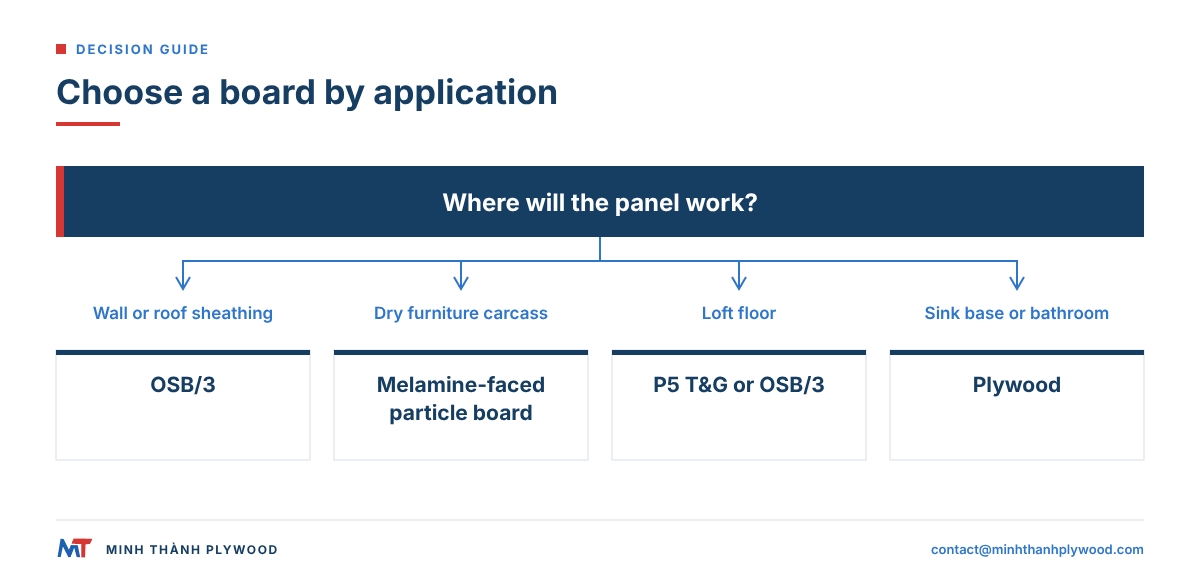
Use the board whose grade matches the job; the use map is short:
| Use | Better choice | Why |
|---|---|---|
| Wall and roof sheathing | OSB/3 | Load-bearing, humid-rated, nails and screws hold |
| Subfloor on joists | OSB/3 T&G or plywood | Stiff along the span, screw grip |
| Loft (attic) flooring | P5 T&G chipboard or OSB/3 | Load-bearing grades, low cost |
| Furniture carcasses, wardrobes | Melamine-faced particle board | Smooth, flat, cheapest finished board |
| Shelving | Particle board for short spans; OSB or plywood for long, loaded spans | Sag |
| Kitchen worktop core | High-density particle board under HPL | Flat and heavy |
| Sink bases, bathroom units | Plywood | Edge swelling |
| Crates and packing | OSB or packing plywood | Impact and screw holding |
| Hoarding and site protection | OSB/3 | Cheap, tough, humid-rated |
OSB board vs particle board for cabinets: particle board wins on cost and finish in dry rooms, but neither is the best choice where the cabinet meets water or is shipped assembled. Plywood carcasses survive both.
OSB vs chipboard: the same choice under UK names
OSB vs chipboard is the same comparison as OSB vs particle board: chipboard is the UK and Australian name for particle board. In UK building, the question usually means flooring: 18 mm or 22 mm P5 tongue-and-groove chipboard against OSB/3 tongue-and-groove boards.
- Chipboard flooring (P5): cheaper, flat, quiet underfoot; swells if leaks reach it.
- OSB/3 flooring: stiffer along the span, better screw holding, more tolerant of damp during building.
- Joist spacing: follow the board maker’s span table for each thickness.
OSB vs MDF: which is better?
OSB is better than MDF for structure, damp and weight; MDF is better for painted furniture, routed doors and mouldings. MDF (medium-density fibreboard) is pressed from fine wood fibres, about 750 kg/m³, so it machines to a crisp edge and paints smoothly, but it is heavy, weak in screw edges and swells badly when wet.
| Metric | OSB/3 | MDF |
|---|---|---|
| Wood element | Long strands | Fine fibres |
| Surface | Textured | Smooth, paint-ready |
| Strength along the span | High | Medium |
| Moisture | Humid-rated | Poor unless MR grade |
| Machining and routing | Rough edges | Clean profiles |
| Sheet weight, 18 mm | About 33.2 kg | About 40.2 kg |
| Best for | Sheathing, floors, crates | Painted doors, mouldings, furniture panels |
OSB board vs MDF for shelving: OSB sags less along its strong axis; MDF sags more under the same load and needs closer supports.
Which board emits more formaldehyde?
Many OSB boards, especially European OSB/3, use PMDI resin with no added formaldehyde, while most particle board uses urea-formaldehyde resin and must be tested for emission. Both must meet the limit of the market where they are sold.
- United States: 40 CFR 770.10 limits particleboard to 0.09 ppm and veneer-core hardwood plywood to 0.05 ppm. OSB, a structural panel, is exempt under 40 CFR 770.1(c).
- European Union: Regulation (EU) 2023/1464 sets 0.062 mg/m³ for wood-based panels and furniture from 6 August 2026.
For plywood, Minh Thanh holds CARB P2 / TSCA Title VI certification (ICTT mill no. 23024). Six ASTM D6007 chamber tests between April 2025 and June 2026 on 9, 15 and 18 mm panels averaged 0.014–0.032 ppm against the 0.05 ppm limit.
Which is cheaper, OSB or particle board?
Raw particle board is usually the cheapest wood panel per sheet, with OSB a little more and plywood more again. Prices move with resin, energy and freight, so compare a delivered price per sheet for the same thickness.
The lowest sheet price can mislead. Count three more costs before choosing:
- Finishing: OSB needs more work to paint; particle board arrives ready to laminate.
- Waste and failure: swollen particle board in a sink base or on a wet site is scrap; plywood rarely is.
- Freight: heavier boards fill a container’s weight limit before its volume.
When should you use plywood instead?
Use plywood when a part needs strength in both directions, screw holding in every edge, the least swelling at a wet edge, or the lightest sheet for its strength. Cross-laminated veneers give plywood all four, at a higher sheet price than OSB or particle board.
Minh Thanh makes plywood on white Styrax or Eucalyptus cores, stitched horizontally and vertically, with furniture-grade panels pressed twice and sanded to ±0.2–0.3 mm, down to ±0.2 mm. Interior panels use UF glue at E0 emission; melamine-fortified and phenolic (WBP) bonds are made to order for damp and exterior use.
Write your order in six lines:
- Application: carcasses, sink bases, subfloor, crates, sheathing.
- Core: white Styrax for light, flat furniture panels; Eucalyptus for harder construction panels.
- Glue and emission: UF at E0 emission, MR, or phenolic.
- Face and back: poplar, birch, pine, EV, okoume or packing grade.
- Size and thickness: 1220 × 2440 mm or 1250 × 2500 mm, 3–40 mm.
- Packing and quantity: sheets per pack, total sheets or m³, destination port.
Minh Thanh Plywood ships from Ha Hoa, Phu Tho, Vietnam: MOQ one 40HC, 15–45 days after the 30% deposit, FOB Hai Phong, CFR or CIF, free samples. Commercial plywood starts from US$250/m³ and furniture plywood from US$350/m³ (October 2026). Send your specification to contact@minhthanhplywood.com, or compare plywood vs OSB and particle board vs plywood.
Buyer questions, answered
Is OSB stronger than particle board?
Yes. Under EN 300, an 18 mm OSB/3 board must reach 18 N/mm² bending strength along the major axis; an 18 mm P2 furniture particle board under EN 312 needs 11 N/mm². OSB also holds screws better.
Is particle board cheaper than OSB?
Usually, yes. Raw particle board is the lowest-cost wood panel per sheet in most markets; OSB costs a little more, and plywood more again. Melamine-faced particle board costs more than raw OSB.
Is OSB good for furniture?
OSB suits rough or industrial-style furniture, workshop benches and storage. Its textured face does not take paint or laminate smoothly, so finished furniture uses particle board, MDF or plywood.
Is particle board good for cabinets?
Melamine-faced particle board is the standard carcass for low-cost, dry-room cabinets. Sink bases, bathrooms and cabinets shipped assembled last longer in plywood, because chipboard swells and loses screw grip.
Which is better for construction, OSB or particle board?
OSB. OSB/3 and OSB/4 are load-bearing panels for walls, roofs and floors. Only special load-bearing particle board grades (P5 to P7) are used in construction, mainly as tongue-and-groove flooring.
Is OSB waterproof?
No. OSB/3 and OSB/4 are made for humid conditions and resist short exposure during building, but edges swell if they stay wet. Permanent outdoor use needs cladding or a phenolic plywood.
Is particle board waterproof?
No. Standard particle board swells and crumbles when water reaches an edge. Moisture-resistant P3 and P5 grades, often with a green core, reduce swelling but still need sealed edges.
What is the difference between OSB and chipboard?
Chipboard is the UK name for particle board. OSB uses long strands laid in crossed layers; chipboard uses small chips in a random mat, so OSB is stronger and chipboard is smoother.
Is OSB better than MDF?
For structure and damp, yes: OSB is stronger, lighter and handles moisture better. For painted furniture, mouldings and routed doors, MDF is better, because its fine fibre surface machines and paints cleanly.
Which board is best for loft flooring?
Use 18 mm or 22 mm P5 tongue-and-groove chipboard or OSB/3 flooring boards on joists at the spacing their maker states. Both are load-bearing grades; standard furniture chipboard is not.
Does OSB or particle board emit more formaldehyde?
Many OSB boards use PMDI resin without added formaldehyde, while most particle board uses urea-formaldehyde. Both must meet the market limit, such as 0.09 ppm for particleboard under TSCA Title VI.