
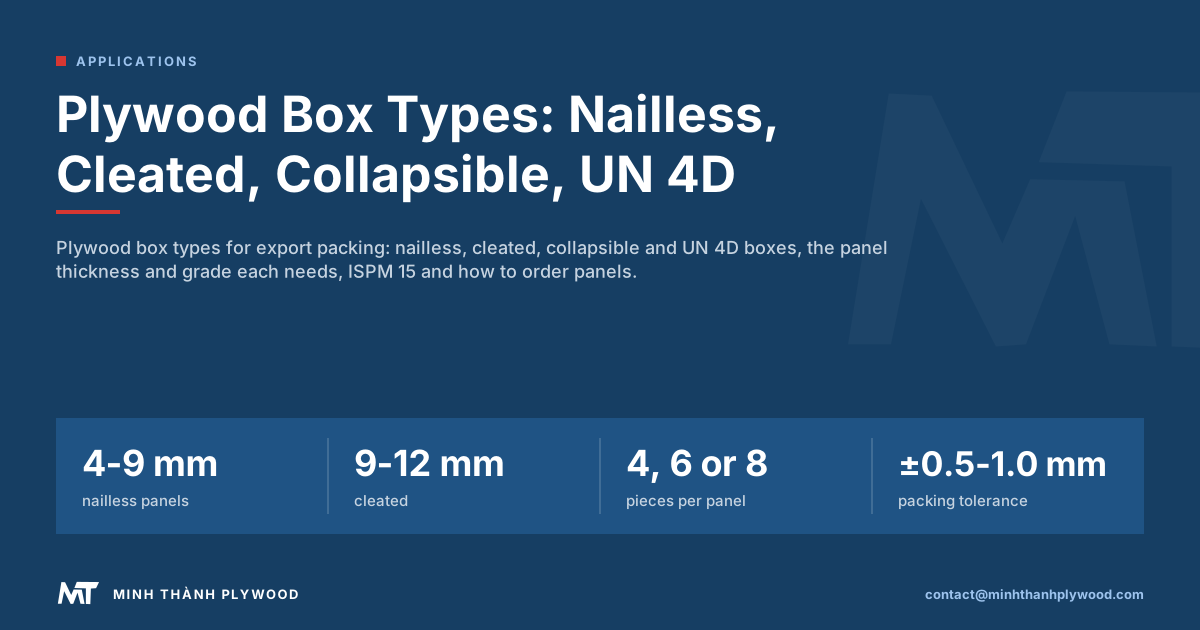
A plywood box is a shipping or storage box whose walls, base and lid are plywood panels, joined by steel clips, wooden cleats or hinges. It is lighter than a solid timber box, needs no ISPM 15 treatment for its plywood, and folds flat when it is collapsible. Minh Thanh Plywood supplies the cut-to-size and thin panels box makers build them from.
What is a plywood box?
A plywood box is a box whose walls, base and lid are made of plywood panels, joined by steel clips, wooden cleats, nails or hinges. Factories use plywood boxes to ship and store machinery parts, spares, instruments, cast components and dangerous goods, from a few kilograms to well over a tonne.
Plywood boxes replaced solid timber boxes in much export packing for three reasons. The panels are lighter for the same strength, because cross-laid veneers carry load in both directions. They do not split along the grain when nailed near an edge. And the plywood itself is exempt from ISPM 15, the treatment rule for wood packaging, which removes one step from export shipping.
Minh Thanh does not make boxes. We supply the panels: packing plywood, thin plywood and cut-to-size pieces for box makers and packaging plants.
Plywood storage and display boxes
Plywood storage boxes are made in birch or poplar plywood of 9, 12, 15 or 18 mm, cut to size and joined by rebate, finger or dovetail joints, with a lift-off, hinged or sliding lid.
UK makers sell exactly this: a made-to-measure 18 mm birch plywood storage box with a design proof in 5 working days (Madeinply, read in October 2026), and a range of boxes in 15 mm birch plywood, 16 mm black MDF, 16 mm chipboard and 16 mm oak, walnut, mahogany or ash (HM Wood Shop, read in October 2026). A box maker buys the panels for such boxes from a mill by the container.
| Example box (inside size) | Volume | Typical panel | Typical use |
|---|---|---|---|
| 300 × 200 × 150 mm | 9 litres | 9 or 12 mm | Tools, gifts, desk storage |
| 400 × 300 × 250 mm | 30 litres | 12 or 15 mm | Toys, files, kitchen storage |
| 600 × 400 × 400 mm | 96 litres | 15 or 18 mm | Blanket box, shop display, crate liner |
The volumes are length × width × height (the first box is 0.009 m³, or 9 litres). Joints and finish set the look: a rebate joint is quick, a finger joint shows the plies as a pattern, a dovetail is the most work and the strongest in tension. Finish with oil, lacquer or paint; a lacquered edge shows the layers of the plies as a design feature.
How plywood compares with the other storage-box materials:
| Material | Strength and weight | Edge and finish | Best fit |
|---|---|---|---|
| Plywood, 12–18 mm | Strong along both directions; light | Plies show; oil, lacquer or paint | Boxes that are lifted, stacked or screwed |
| MDF, 16 mm | Heavier; chips at corners; swells when wet | Smooth for paint, no grain | Painted fixed boxes |
| Chipboard, 16 mm | Heavy, crumbly edges | Needs edging or laminate | Low-cost flat-pack |
| Solid oak or walnut, 16 mm | Strong, heavy and costly | Natural grain | Premium gift and display boxes |
Plywood wins where the box is moved, loaded or screwed together repeatedly, because the crossed veneers hold fixings and do not crumble at the edge.
Which types of plywood packing box are there?
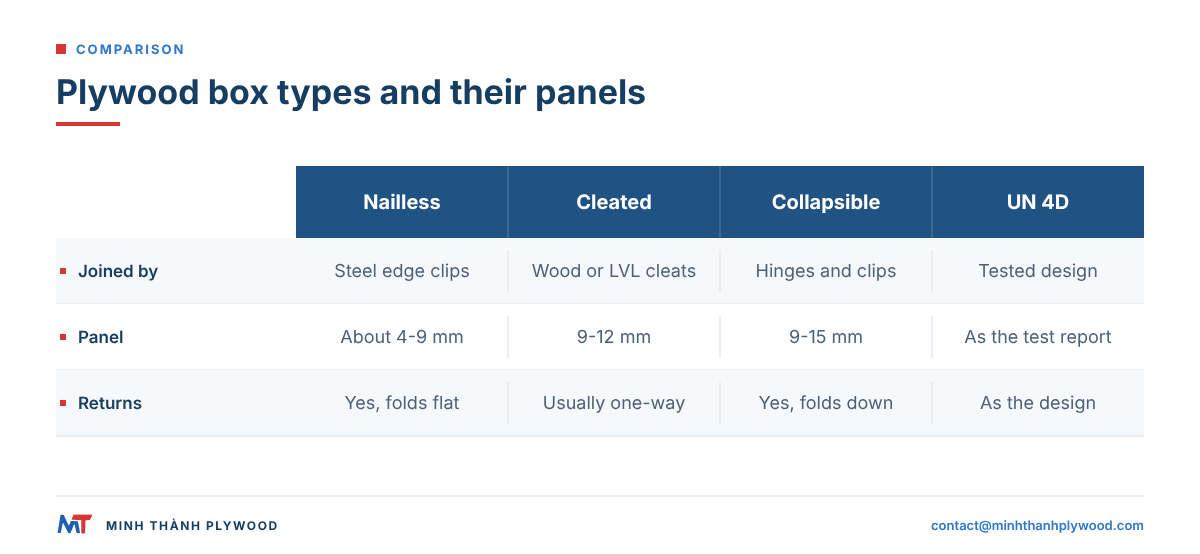
There are six main plywood box types, and each asks for a different panel. The table shows the build, the usual plywood packing box panel and the cargo it suits.
| Type | How it is built | Panel thickness | Panel grade and glue | Typical cargo |
|---|---|---|---|---|
| Nailless steel-band box | Thin panels joined by steel wire or clip strips at the edges | About 4–9 mm | Packing face, uniform thickness; melamine-fortified for sea transit | Spares, parts, returnable shipments |
| Cleated plywood box | Panels nailed or stapled to wooden or LVL cleats | 9–12 mm | Packing or commercial face | Machinery, castings, one-way export |
| Collapsible box | Hinged or clipped panels on a pallet base | 9–15 mm | Commercial face, edges sealed | Returnable automotive and industrial loops |
| UN 4D dangerous-goods box | Tested design, panels to the approved specification | As the design report states | Fixed grade and glue for every batch | Hazardous materials in inner packaging |
| Plywood case with skid base | Box on solid wood or LVL skids for forklifts | 12–18 mm | Packing or commercial face | Heavy units, crating alternatives |
| Foldable large-volume box | Six sections (base, lid, four loose sides), full access from all sides | Set by the design | Per the design | Large products |
Capacity runs from small boxes to very large ones: Nefab’s ExPak XL has a bottom, a lid and four loose sides for full access, and is suited to large products up to 20 m³ (Nefab, read in October 2026). The type is chosen by the cargo and by whether the box returns. Weight and stacking set the thickness; the transit climate sets the glue.
What is a nailless plywood box?
A nailless plywood box is a box built from thin plywood panels joined at their edges by steel wire or clip strips, with no nails. The panels and the steel bands fold against each other, so the box ships flat, sets up by hand in a minute and closes with clips or bands.
Nailless boxes suit spare parts, instruments and repeated shipments between the same sites. Their panels are usually about 4 to 9 mm thick, and they must be uniform: the steel edging is formed for one panel thickness, and a panel that is too thick will not seat in the clip, while one too thin rattles loose.
That makes thickness tolerance the main panel property for nailless box lines. Minh Thanh’s packing plywood holds ±0.5–1.0 mm, and its thin plywood of 3 to 5 mm is always 5-ply, which keeps thin panels flat and strong across both directions.
How is a cleated plywood box built?
A cleated plywood box is built from plywood panels nailed or stapled to a frame of wooden cleats along the edges and across large panels. The cleats carry the stacking load and the nails; the plywood closes the box and resists punctures.
Cleated boxes are the usual one-way export package for machinery and heavy parts. The panels are usually 9 to 12 mm, with the cleats in sawn timber or LVL. The American standard ASTM D6251 covers wood-cleated panelboard shipping boxes, including plywood, and many packaging specifications refer to it.
If the cleats are sawn timber, they need ISPM 15 treatment for export. LVL cleats, like plywood, are processed wood and exempt.
Collapsible plywood boxes and returnable packaging
A collapsible plywood box folds down onto its base after unloading and is shipped back empty at a fraction of its set-up volume. Automotive and industrial supply chains use them in closed loops between a supplier and an assembly plant.
The panels take more handling than in a one-way box, so they need:
- A commercial face that stays smooth after many cycles.
- Sealed edges, because water enters plywood through the end grain.
- A water-resistant bond, melamine-fortified for most loops and phenolic (WBP) for outdoor storage.
- Exact sizes, because hinges and clips are set for one panel thickness.
UN 4D plywood boxes for dangerous goods
UN 4D is the packaging code for a plywood box under the UN Recommendations on the Transport of Dangerous Goods (Model Regulations, checked October 2026). A UN 4D box carries hazardous materials in inner packagings, and each box design must pass drop, stacking and other tests for its packing group before it can carry the UN mark.
A UN box carries a marking such as 4D/Y/S/year/country/maker: 4D is the plywood-box code, X, Y or Z give the packing groups the design is approved for, and a number plus S is the maximum gross mass in kilograms. One supplier’s plywood box is marked 4DV/X16/S/21/GB/5021 (Air Sea Containers, read in October 2026).
For the plywood buyer, the test report is the specification. It fixes the panel thickness, the number of plies, the glue and the construction, and every later batch of boxes must match the tested design. A box maker supplying UN 4D boxes therefore needs a panel that is the same from one container to the next.
We supply to that need with a fixed specification per order line, sizes and thickness to the drawing, and loading photos and video of every container so each delivery can be checked against the previous one.
Plywood box vs solid wood box vs cardboard box
A plywood box sits between a solid timber box and a heavy-duty cardboard box: stronger and drier than cardboard, lighter and simpler to export than solid wood.
| Property | Plywood box | Solid timber box | Heavy-duty cardboard box |
|---|---|---|---|
| Strength for its weight | High, in both directions | Good along the grain only | Low for heavy or stacked loads |
| Splits when nailed near edges | No | Often | Not nailed |
| Humidity in sea transit | Keeps its strength | Moves and may split | Loses strength |
| ISPM 15 treatment | Not needed for the plywood | Needed for all solid wood | Not needed |
| Folds flat for return | Nailless and collapsible types | No | Some types |
| Reuse | Several trips for nailless and collapsible types | Mostly one-way | Mostly one-way |
Choose plywood when the cargo is heavy, valuable, stacked or travels by sea, and when the box should fold or return.
Packers also buy to test standards. ASTM D4169 sets distribution test cycles for shipping containers and ISTA publishes parcel and pallet test procedures; a box that passes the cycle the buyer names is the safe specification. Ask which cycle applies before you choose thickness, then send the panel thickness that passed.
Does a plywood box need ISPM 15?
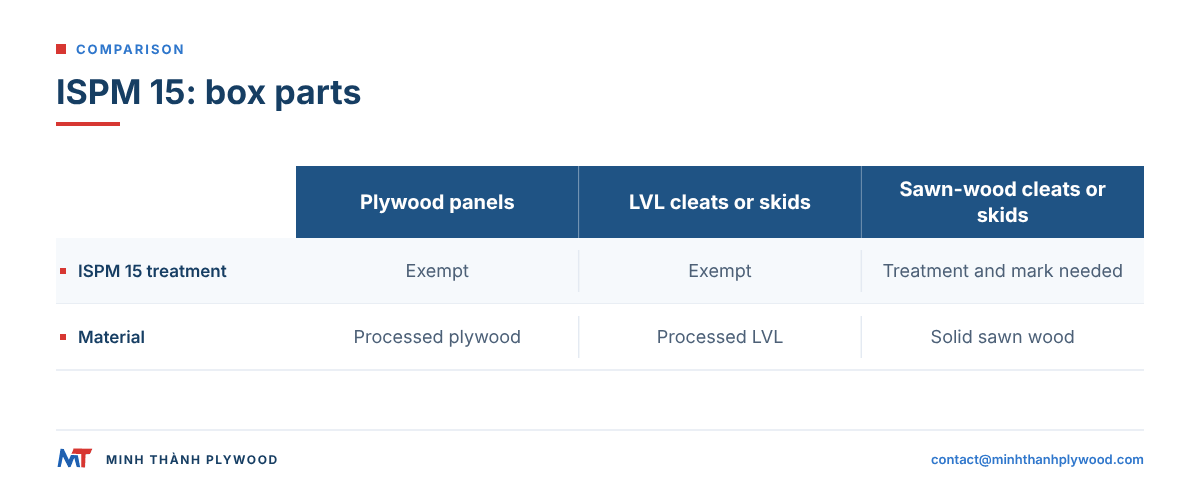
No, the plywood in a plywood box does not need ISPM 15 treatment. The IPPC’s ISPM 15 standard exempts wood packaging made wholly of processed wood, such as plywood, particle board and LVL, because heat, glue and pressure in manufacturing have already removed the pest risk (checked October 2026). The UK government guidance says the rules “do not apply to processed, non solid WPM like plywood” (GOV.UK, checked October 2026).
What does need attention is any solid sawn wood on the box:
- Solid wood cleats, skids and bearers must be heat-treated or fumigated and stamped with the ISPM 15 mark.
- LVL cleats and skids are processed wood and exempt.
- Plywood panels, lids and bases need no mark.
A box built entirely of plywood and LVL ships to any ISPM 15 country without treatment.
Which plywood thickness and grade suit each box part?
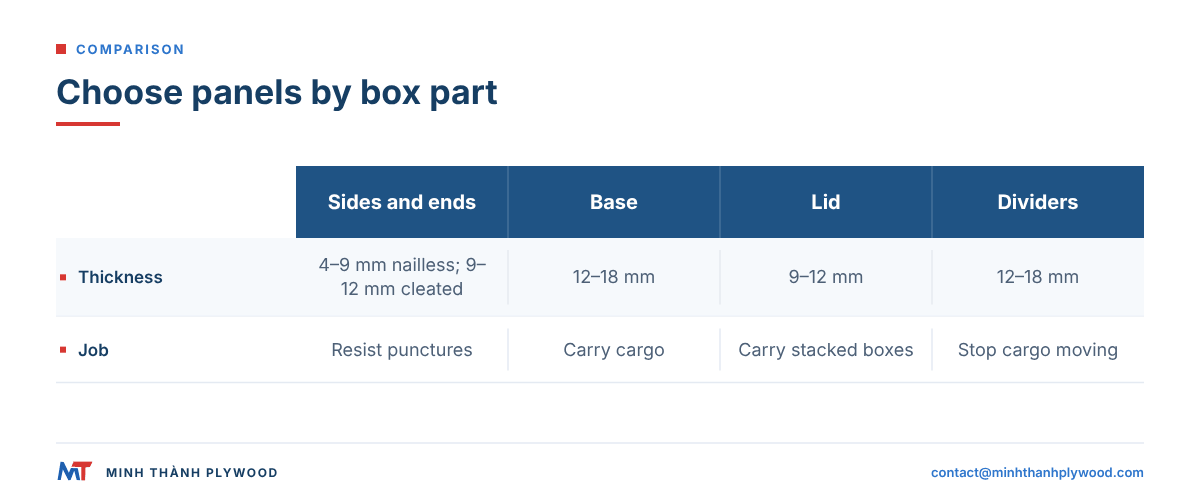
Each part of a plywood box has its own job, and the panel follows it.
| Box part | Job | Usual thickness | Face and core |
|---|---|---|---|
| Sides and ends | Close the box, resist punctures | 4–9 mm nailless, 9–12 mm cleated | Packing face, eucalyptus or acacia core |
| Base | Carry the cargo and the forklift | 12–18 mm | Packing or commercial face, dense core |
| Lid | Carry stacked boxes | 9–12 mm | Packing face |
| Internal blocking and dividers | Stop the cargo moving | 12–18 mm | Packing grade |
| Cleats and skids | Frame and lift the box | By section size | LVL or treated sawn timber |
Face appearance matters less than thickness and bond. Paying for a furniture face on a box side adds cost and nothing else; paying for a consistent thickness saves rejects on the box line.
How to make a plywood box
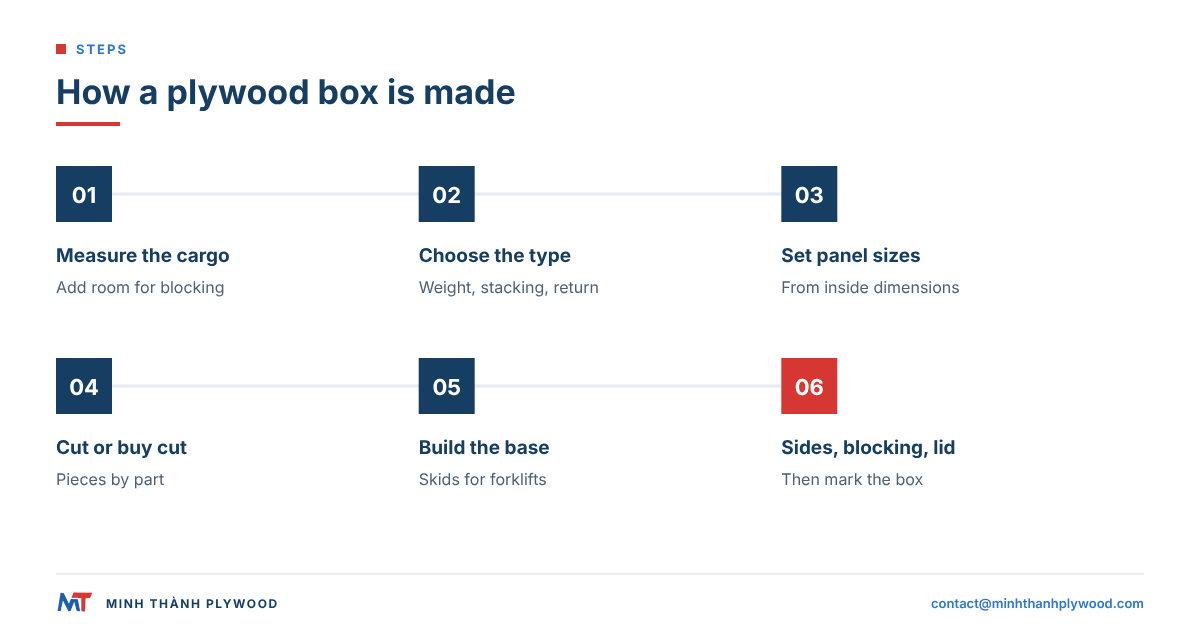
A plywood box is made in the same order whether it is a single case or a production run:
- Measure the cargo with its packing, and add clearance for cushioning and blocking.
- Choose the box type from the cargo weight, the stacking height and whether the box returns.
- Set the panel sizes from the inside dimensions, the panel thickness and the joint method.
- Cut the panels, or buy them cut to size so the box line only assembles.
- Build the base first, with skids or a pallet base if a forklift will lift it.
- Join the sides and ends to the base with cleats, clips or glued joints.
- Fit internal blocking so the cargo cannot move in any direction.
- Fit and fix the lid with screws, clips or steel bands.
- Mark the box: handling symbols, weight, centre of gravity and, for any solid wood, the ISPM 15 mark.
The same steps answer how to build a wooden box with plywood at home: a toy box or storage box is simply a small, light version, glued and screwed rather than clipped.
What should a box maker order from a plywood mill?
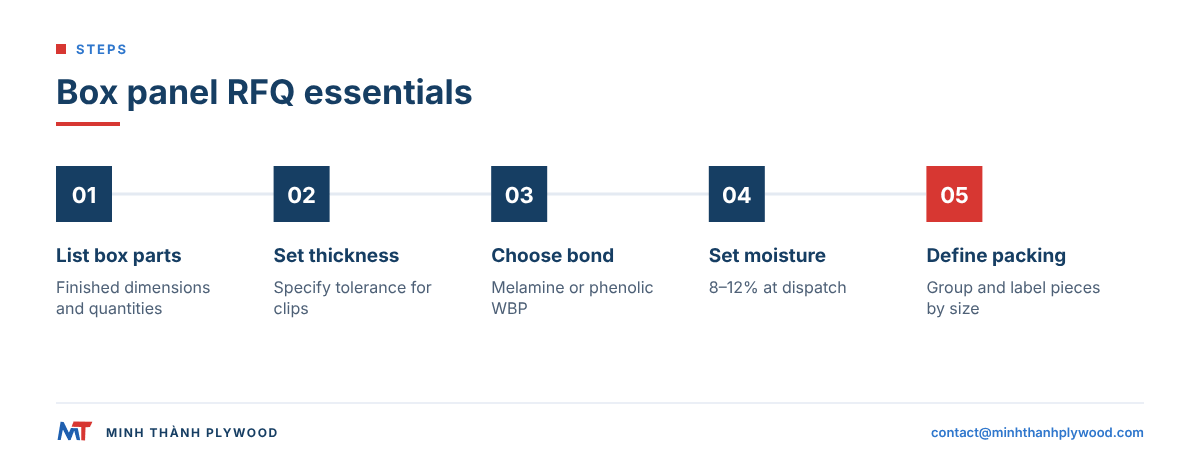
A box maker should order plywood by component, not by sheet: give the mill the finished part sizes, the thickness and tolerance, the glue, and how the parts should be packed. That turns a container of sheets into a container of ready box parts.
The order lines that matter:
- Thickness and tolerance: packing plywood at ±0.5–1.0 mm, or sanded panels at ±0.2–0.3 mm where clips need an exact fit.
- Sheet size or cut size: 1220 × 2440 mm or 1250 × 2500 mm, or pieces cut from them.
- Glue: melamine-fortified for humid sea transit, phenolic (WBP) for outdoor storage.
- Moisture: panels dried to 8–12 % before dispatch, so boxes do not shrink after assembly.
- Edge sealing for collapsible and returnable boxes.
- Packing: pieces packed by size, with labels the box line can read.
Cut-to-size plywood for box production
Cut-to-size plywood saves a box maker the sawing, the offcuts and the labour of breaking down full sheets. Minh Thanh cuts one panel into 4, 6 or 8 pieces and ships cut-to-size plywood regularly to Italy and other European markets.
For a box line, cut pieces arrive grouped by part, so sides, ends and lids go straight to assembly. Length and width hold ±2 mm, which suits clip and cleat systems. The full options are on the cut-to-size plywood page, and thin panels for nailless boxes are on the thin plywood page.
Can you use plywood for a subwoofer box or small boxes?
Yes, plywood makes a good subwoofer box: a sanded 15 or 18 mm panel with a solid core is stiff, lighter than MDF of the same thickness and holds screws through repeated assembly. The core must be free of gaps, because a hidden void buzzes at low frequencies.
For speaker cabinets and small display or gift boxes, choose sanded furniture plywood rather than packing grade. Minh Thanh’s furniture panels are pressed twice and their core layers are stitched both horizontally and vertically, so the edges show tight layers with no gaps when cut.
Where do box makers in the UAE and other markets buy plywood?
Box makers in the UAE, the wider Gulf, Europe and Africa buy plywood for boxes by the container from mills that cut to size and pack by component. The questions that separate a good supplier are the same everywhere: does it press the panels itself, does it hold thickness tolerance, and does it send loading photos.
From Hai Phong, typical days at sea are 15–25 to the Middle East, 25–35 to the Mediterranean and 30–40 to Northern Europe, by carrier and route. For Morocco, Tanger Med sits at the Mediterranean mouth, so plan on the 25–35 day Mediterranean figure; for Casablanca, ask the carrier for the routing and add the feeder or Atlantic leg to the same figure.
Minimum order is one 40HC with mixed specifications by agreement, so a box maker can take sides, bases and lids in one container. Every container is photographed and filmed before loading, and the buyer receives the photos and video.
What to send for a plywood box panel quotation
Send the box type, the part list with sizes, the thickness and tolerance, the glue, the moisture limit, the packing and the quantity. A complete line for a nailless box reads: “Nailless plywood box panels, 6 mm thin plywood, packing face, melamine-fortified glue, cut to 1220 × 610 mm, ±0.5 mm, packed 100 pieces per bundle, 1 × 40HC.”
Production takes 15–45 days after the 30% deposit, FOB Hai Phong, CFR or CIF, and free samples are available. Send your list to [email protected] or through the packing plywood page, and we reply within hours.
Buyer questions, answered
What is a plywood box?
A box whose walls, base and lid are plywood panels, joined by steel clips, wooden cleats, nails or hinges. It is used to ship and store machinery parts, spares, instruments, bulk goods and dangerous goods.
What is a nailless plywood box?
A plywood box assembled without nails: thin plywood panels are joined at the edges by steel wire or clip strips, so the box folds flat, sets up by hand and is reused.
Do plywood boxes need ISPM 15 treatment?
No, not for the plywood. ISPM 15 exempts processed wood such as plywood and LVL. Solid sawn-wood cleats, skids or bearers on the box need heat treatment and the ISPM 15 mark.
What thickness of plywood is used for a plywood box?
Nailless boxes use thin panels of about 4 to 9 mm; cleated boxes use 9 to 12 mm; heavy cases and box bases use 12 to 18 mm. The cargo weight and the stacking load decide.
What is a UN 4D box?
UN 4D is the packaging code for a plywood box under the UN Recommendations on the Transport of Dangerous Goods. Each design must pass the drop and stacking tests for its packing group before it carries the UN mark.
Is a plywood box stronger than a cardboard box?
Yes, by a wide margin for heavy or stacked loads, and it does not lose strength in humid sea transit. Heavy-duty cardboard is lighter and cheaper for light, dry goods.
Can you use plywood for a subwoofer box?
Yes. Sanded 15 or 18 mm furniture plywood with a solid, gap-free core makes a stiff, light speaker box that holds screws well; seal the inside joints airtight.
How do you make a plywood box?
Cut the panels to size, join the sides to the base with cleats, clips or glued joints, fit internal blocking for the cargo, then fit the lid. Box makers work from cut-to-size panels to save cutting time.
Where can a box maker buy plywood for boxes in full containers?
From a plywood mill that cuts to size and packs by component. Minh Thanh supplies packing, thin and cut-to-size plywood from one 40HC, with mixed specifications by agreement.
Are plywood boxes reusable?
Nailless and collapsible plywood boxes are built to be reused: they fold flat for the return trip and set up again in minutes. Nailed cleated boxes are usually one-way.